
Binance USDT-M vs COIN-M futures: which to choose? Long/short, fees, and liquidation risk

Table of contents

Binance new user rewards
20% trading fee rebate
Official Binance registration. Complete identity verification (KYC) to trade and withdraw.
Here's the conclusion up front: most people — especially beginners and short-term traders — should choose USDT-M; only those who already hold BTC/ETH long-term and whose goal is "accumulate more coins" rather than "earn more dollars" should consider COIN-M. If you're unsure, start with USDT-M.
Futures are leveraged, high-risk products. Both margin types can be liquidated and lose your entire principal. This article only helps you understand how the USDT-M and COIN-M "tracks" differ and how to choose — it is not telling you to rush into futures. If you haven't figured out leverage and liquidation yet, don't touch futures.
About 10 minutes to read. Remember this first: both USDT-M and COIN-M can be liquidated — the difference is only how hard the math is to follow. And a COIN-M short earns you a coin that is itself falling, while your margin shrinks along with it.
Who should choose USDT-M and who should choose COIN-M
Start with this selection table — matching your situation beats reading a pile of definitions.
| Your situation | Recommendation | Why |
|---|---|---|
| First time with futures | USDT-M | Profit and loss are both in USDT, where 1 USDT ≈ 1 dollar — the most intuitive, hardest to miscount |
| Mostly short-term, watching charts and entering/exiting often | USDT-M | Mainstream pairs usually have deeper liquidity and tighter spreads |
| You hold USDT, not BTC/ETH | USDT-M | Use the stablecoin as margin directly, without first converting coins into stablecoins |
| Long-term BTC/ETH holder who wants more coins | COIN-M | Profit settles in the coin, so when it rises you earn coins and can accumulate |
| Miner or long-term holder who will keep using the coin | COIN-M | Both margin and profit are in the coin, avoiding conversion friction from price moves |
This table is "the tendency in most cases", not a hard rule. The real criteria are expanded in the sections below.
The core difference: what you use as margin and what you earn
In Binance futures, "USDT-M" and "COIN-M" are really two sides of the same thing: whatever you use as margin is what your profit and loss settle in.
- USDT-M (also called linear contract): uses USDT (or USDC and other stablecoins) as margin, and profit/loss settles in USDT too. Whether the coin price rises or falls, your gain or loss converts directly to dollars — easy to picture in your head.
- COIN-M (also called inverse contract): uses the underlying coin itself as margin — for example, the BTC perpetual uses BTC as margin — and profit/loss settles in BTC too. What you earn is BTC, and what you lose is also BTC.[1]
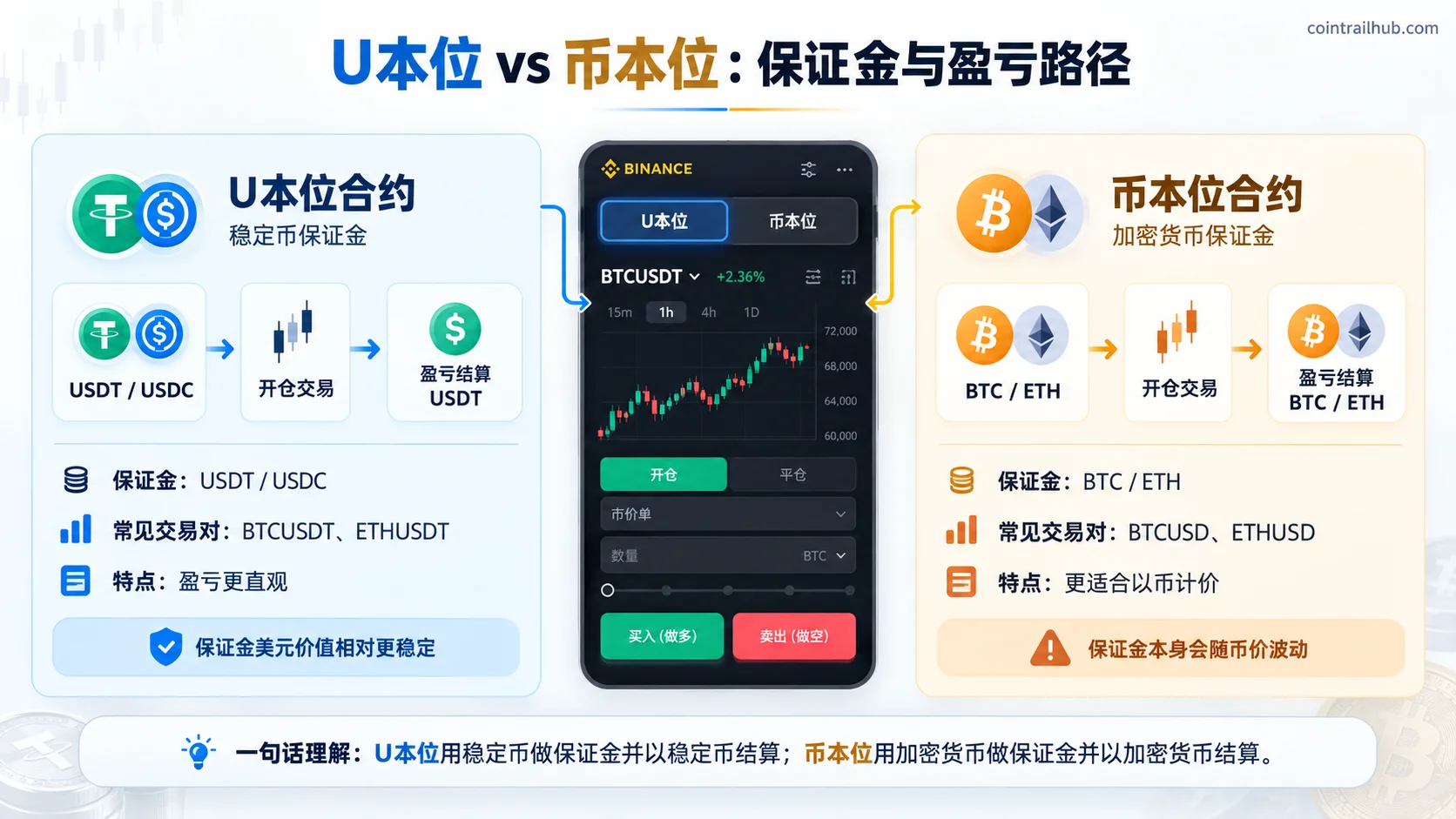
USDT-M vs COIN-M margin and P&L path: USDT-M mainly uses stablecoins like USDT/USDC as margin and settles P&L in the stablecoin; COIN-M uses crypto assets like BTC/ETH as margin and settles P&L in that crypto asset.
One key difference hides here: COIN-M margin itself also moves with the price.
When you use USDT as margin, USDT is pegged to 1 dollar, so your margin's value barely moves. When you use BTC as margin, every move in BTC's price moves your margin's value too. This leads to the most easily-overlooked COIN-M risk, explained separately below.
One table to understand the two margin types
| Dimension | USDT-M (USDT-margined) | COIN-M (coin-margined) |
|---|---|---|
| Margin currency | USDT / USDC and other stablecoins | BTC, ETH and other underlying coins |
| P&L settlement currency | USDT | The underlying coin (e.g. BTC) |
| Alias | Linear contract | Inverse contract |
| Calculation intuitiveness | High — directly in dollars | Low — profit is a coin, then you multiply by the price again |
| Mainstream pair liquidity | Usually deeper (e.g. BTCUSDT volume far exceeds COIN-M) | Relatively shallower |
| Is margin affected by price | Barely (stablecoin pegged to dollar) | Yes — margin shrinks as the coin price falls |
| Multi-asset margin mode | Supports single-asset / multi-asset margin | Primarily single-asset margin |
| Better for | Beginners, short-term traders, stablecoin-based users | Long-term holders, miners, users who want more coins |
The "deeper liquidity" above is relative to mainstream pairs. COIN-M has its own pairs; it's just that overall liquidity and fill depth are usually shallower than the corresponding USDT-M pairs.
Fees differ: COIN-M is cheaper for makers, takers are the same
Fees are split by Maker/Taker. At the regular-user (non-VIP) tier, the difference runs opposite to what many expect:
| Fee tier | USDT-M | COIN-M |
|---|---|---|
| Maker | ~0.02% | ~0.01% |
| Taker | ~0.05% | ~0.05% |
The table above is the common regular-user (VIP0) tier example shown on Binance's official page, for reference only. Actual rates vary with VIP level, BNB discount, campaigns and other factors — always go by the Binance official futures fee page and the live display in your account.
Here's the easily-missed point: the COIN-M maker fee (0.01%) is half of USDT-M (0.02%), but the taker fee is about 0.05% for both — it is not cheaper.[2] In other words, COIN-M's fee advantage only shows when you "place limit orders and wait to be filled". If you habitually use market orders that fill instantly, COIN-M and USDT-M fees are basically the same. Fees aren't the deciding factor, but frequent traders who like limit orders should know this difference.
Long and short have different P&L paths
This is what most people miss, yet it matters most for your result. Because the two types settle in different currencies, the same direction, with a different margin type, earns you different things and carries different volatility.
The conclusion first:
| Direction | Return comparison | Risk comparison |
|---|---|---|
| Long (bullish) | COIN-M usually higher | COIN-M usually bigger |
| Short (bearish) | USDT-M usually higher | COIN-M usually bigger |
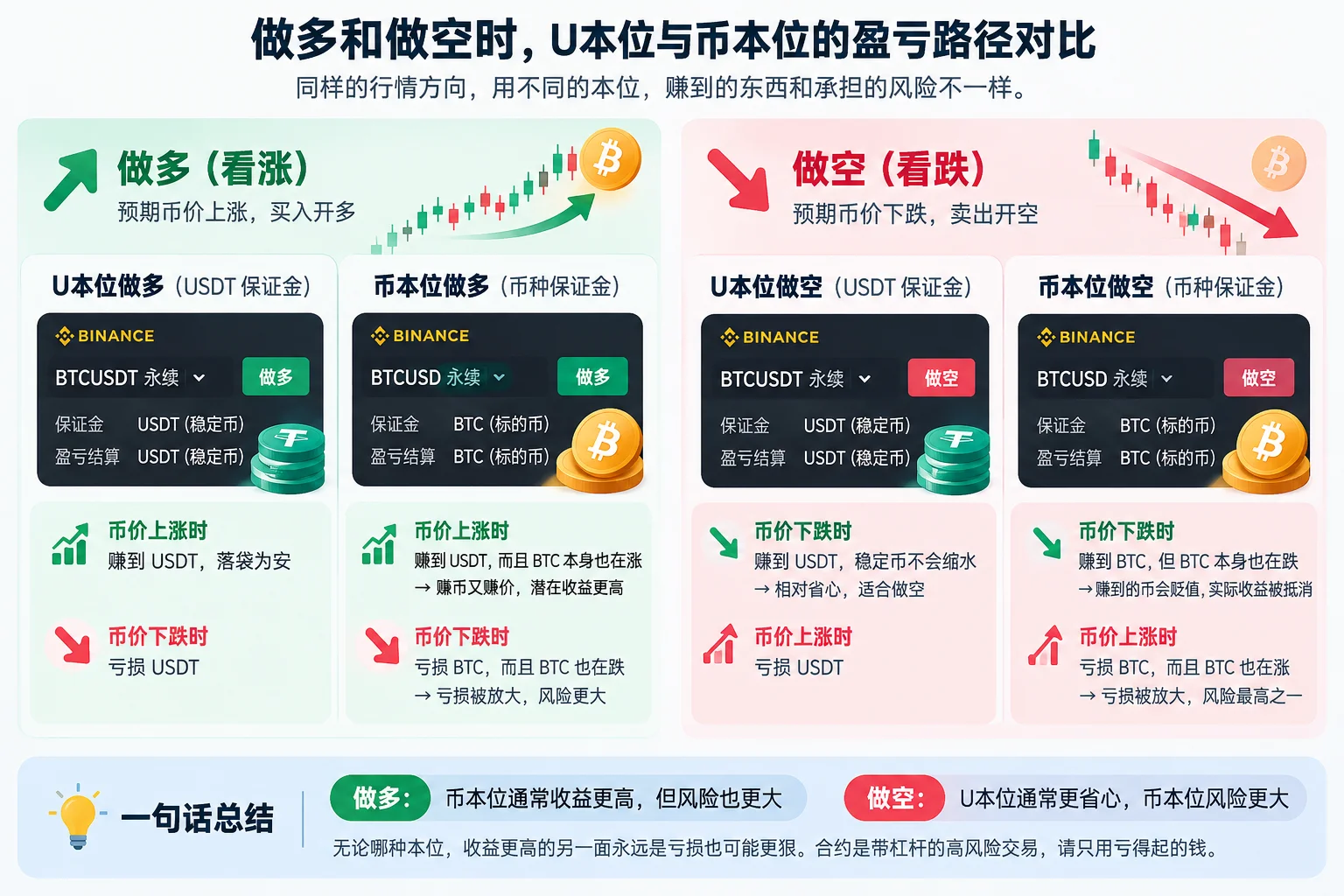
USDT-M vs COIN-M long and short P&L path: USDT-M uses stablecoins like USDT as margin and settlement asset; COIN-M uses crypto assets like BTC as margin and settlement asset, so on top of the contract direction itself, the margin asset's price change is layered in too.
Plainly:
- When long, COIN-M "earns coins and price". You're bullish on BTC and go long using BTC as margin. When the price rises, you earn BTC, and that BTC is itself appreciating — so you "earn coins that keep rising", and COIN-M long has higher potential return. The flip side: if you get the direction wrong and the price falls, you lose BTC, and that BTC is also depreciating, so the loss is amplified too.
- When short, USDT-M is simpler. You're bearish on BTC and go short with USDT. You earn USDT — a stablecoin that doesn't shrink, so you lock it in. If you short with COIN-M instead, you still earn BTC — the very coin you're bearish on — and that earned coin is also falling. That's one reason COIN-M shorting is widely regarded as the highest-risk move.
So in one sentence: if you're long and already hold the coin, COIN-M can amplify returns; if you want a simple short or don't hold the coin, USDT-M fits better. But in either case, "higher return" always has "bigger possible loss" on the other side.
COIN-M's biggest trap: the margin can "shrink twice"
This is the point I most want beginners to notice, and it's the most fundamental gap between COIN-M and USDT-M.
When you use BTC as margin, your margin is not stable. A simplified example (not a return promise):
- You use 1 BTC as margin to open a COIN-M long;
- If BTC's price falls, your margin value immediately shrinks, while your long is also losing — margin and position are falling together;
- The two stack up, so the account approaches the liquidation price faster, and liquidation may come quicker than USDT-M.[3]
Conversely, USDT-M uses USDT as margin, and USDT is pegged to the dollar, so when the coin price falls your margin value stays basically flat — liquidation depends mainly on the position's own loss. This doesn't mean USDT-M can't be liquidated; rather, COIN-M's "double hit" mechanism is more pronounced when the coin price moves against you.
This also explains why COIN-M fits people who "intended to hold the coin long-term anyway" — you can already ride the coin's price swings, so using the coin as margin earns you a bit of coin on top; but for someone who "just wants to bet on a direction short-term", the price swings plus leverage make the risk harder to control.
My judging criteria
Condense the previous sections into three questions, and ask yourself in order:
- Do you mainly hold USDT, or BTC/ETH? Mainly USDT → USDT-M; mainly the coin, and planning to hold long-term → COIN-M.
- Do you want to earn dollars, or more coins? Dollars and locked-in profit → USDT-M; accumulating coins and future coin use → COIN-M.
- Are you going long or short? For shorting, prefer USDT-M; for long and already holding the coin, COIN-M can amplify returns — but expect the liquidation risk.
Most people get stuck on question 1: if you only hold USDT, the answer is basically USDT-M, no need to agonize.
If you're still unsure after reading this, start with USDT-M. It's more intuitive, deeper in liquidity, and the math is easier to reconcile when something goes wrong. Master the basics and risks of futures first, then studying COIN-M is not too late.
In practice: how to choose USDT-M or COIN-M on Binance
Open the Binance app, enter the "Futures" section, and you'll see two entries: "USDT-M Futures" and "COIN-M Futures", each leading to its own set of trading pairs.[4] The basic steps:
- Tap "Futures" at the bottom to enter the futures section;
- You'll see "USDT-M Futures" and "COIN-M Futures" — tap the one you want;
- In the pair list, pick the coin you want to trade (under USDT-M these end in USDT, like BTCUSDT, ETHUSDT; under COIN-M they're priced in the coin, like BTC-margined or ETH-margined);
- On the trading page, check the margin mode and leverage first, then place your order.
The cost of choosing wrong is small — the two account systems are separate, with margin and positions recorded in their own accounts, and you can transfer assets from USDT-M to COIN-M and back at any time.[5]
For the full interface walkthrough, see this Binance futures video tutorial, which demonstrates step by step how to enter futures, choose the type, and place orders. The video also covers the difference between futures and spot, and the risks of leverage and liquidation — more intuitive than text alone.
If you haven't registered on Binance yet, you can sign up via the Binance registration link and enter the referral code BN522 for a trading-fee rebate. If you don't have USDT yet, see Binance buy USDT guide 2026: P2P buying, choosing a merchant, and payment — USDT-M requires USDT first.
The mistakes beginners most often make
- Reading "USDT-M is more intuitive" as "USDT-M can't be liquidated". Wrong. Both types carry leverage and can be liquidated; USDT-M is just easier to count.
- Placing an order without checking what the margin is. Many people assume entering futures means USDT settlement, then actually opened a COIN-M position, and only realize the P&L is in coins when reconciling. Confirm the margin type before ordering.
- Using market orders while choosing COIN-M. COIN-M taker fees are not cheaper — frequent taker trades will eat into your profit with fees.
- Shorting with COIN-M. As covered above, a COIN-M short earns a coin that's falling, stacking the risk — beginners should avoid it.
- Seeing only COIN-M long's "higher return" but not its faster liquidation. The margin is a coin, so when the price reverses, it shrinks twice and liquidation can come sooner.
FAQ
What is the core difference between USDT-M and COIN-M?
Whatever you use as margin is what your P&L settles in. USDT-M uses stablecoins like USDT as margin and settles P&L in USDT; COIN-M uses coins like BTC/ETH as margin and settles P&L in that coin. USDT-M is also called a linear contract, and COIN-M an inverse contract.
Should a beginner choose USDT-M or COIN-M?
In most cases USDT-M. It settles in a stablecoin, is intuitive to calculate, and mainstream pairs usually have deeper liquidity. Master USDT-M's mechanics and risks first, then consider COIN-M.
Is COIN-M more profitable than USDT-M?
Not necessarily. When you're long and already hold the coin, COIN-M has higher potential return but bigger risk; when shorting, USDT-M is usually simpler. "Higher return" always comes with the possibility of bigger loss — it's not a guarantee of "more profit".
Why is shorting COIN-M risky?
Because a short earns you the very coin you're bearish on, and that earned coin is also depreciating; meanwhile the margin is the same coin, so when the price moves against you the margin and the position shrink together, bringing you closer to liquidation.
Are USDT-M and COIN-M fees the same?
No. At the regular-user tier, the COIN-M Maker fee is usually lower, but the Taker fee is usually the same as USDT-M. Always go by the official fee page and your account's live display.
Can funds be transferred between the two margin types?
Yes. USDT-M and COIN-M are two separate account systems, and you can transfer assets between futures accounts — see the transfer page inside the Binance app.
What happens if a futures position is liquidated?
When the margin is insufficient, the system force-closes the position without your consent, and the principal may be wiped out. So only use money you can afford to lose, and learn spot before touching futures.
Related reading
- Binance futures tutorial 2026: how to trade futures? Account opening, leverage, fees, and liquidation risks
- Binance futures walkthrough video tutorial (with risk warning)
- Binance spot trading video tutorial
- Binance options video tutorial: calls, puts, and placing orders
- Binance buy USDT guide 2026: P2P buying, choosing a merchant, and payment
Data verification notes
The key facts in this article were checked against Binance's official public documentation on 2026-10-16, item by item:
- USDT-M and COIN-M margin and settlement rules: USDT-M uses stablecoins like USDT as margin and settles P&L in USDT; COIN-M uses the underlying coin as margin and settles P&L in that coin, which is why COIN-M is also called an inverse contract. Source: Binance — what are USDT-M and COIN-M futures.
- Regular-user (VIP0) futures fee tiers: USDT-M Maker ~0.02%, Taker ~0.05%; COIN-M Maker ~0.01%, Taker ~0.05% — i.e. COIN-M makers pay half, while takers are the same. Source: Binance — USDT-M and COIN-M futures fees.
- COIN-M "double shrinkage" mechanism: when the coin price moves against you, the COIN-M margin value and the position loss happen simultaneously, so the account approaches the liquidation price faster and may liquidate sooner than USDT-M. Source: Binance — beginner guide to futures trading.
- Futures section entry path: the Binance app's bottom "Futures" section splits into "USDT-M Futures" and "COIN-M Futures", each a separate set of trading pairs. Source: Binance — beginner guide to futures trading.
- Two futures account systems are separate and transferable: USDT-M and COIN-M margin and positions are recorded in their own accounts, and assets can be transferred between the two. Source: Binance — what are USDT-M and COIN-M futures.
This article is based on Binance's official public documentation. Fee tiers and account features may change with platform adjustments — always go by the pre-order page and the latest official information. Futures are leveraged, high-risk products that can liquidate and wipe out your principal; this article is not investment advice.
- 2026-10-16UpdateAdded evidence-chain superscripts and "Data verification notes"; updated the key-fact verification date.
- 2026-10-06CorrectionCorrected the USDT-M Taker fee from about 0.04% to about 0.05%, matching the COIN-M Taker fee.
See ourEditorial Policy and the correction process in ourCorrections Policy.
The CoinTrailHub editorial team focuses on crypto education for beginners, exchange security and P2P trading risk. This article is compiled from official sources and public data, reviewed by humans, and strives for accuracy but is not investment advice.
Last updated:2026-09-24 · Content reviewed by humans · Learn more
© 2026 CoinTrailHub · Original content. Reproduction or rewriting without permission is prohibited.