
Binance futures tutorial 2026: how to trade futures? Account opening, leverage, fees, and liquidation risks
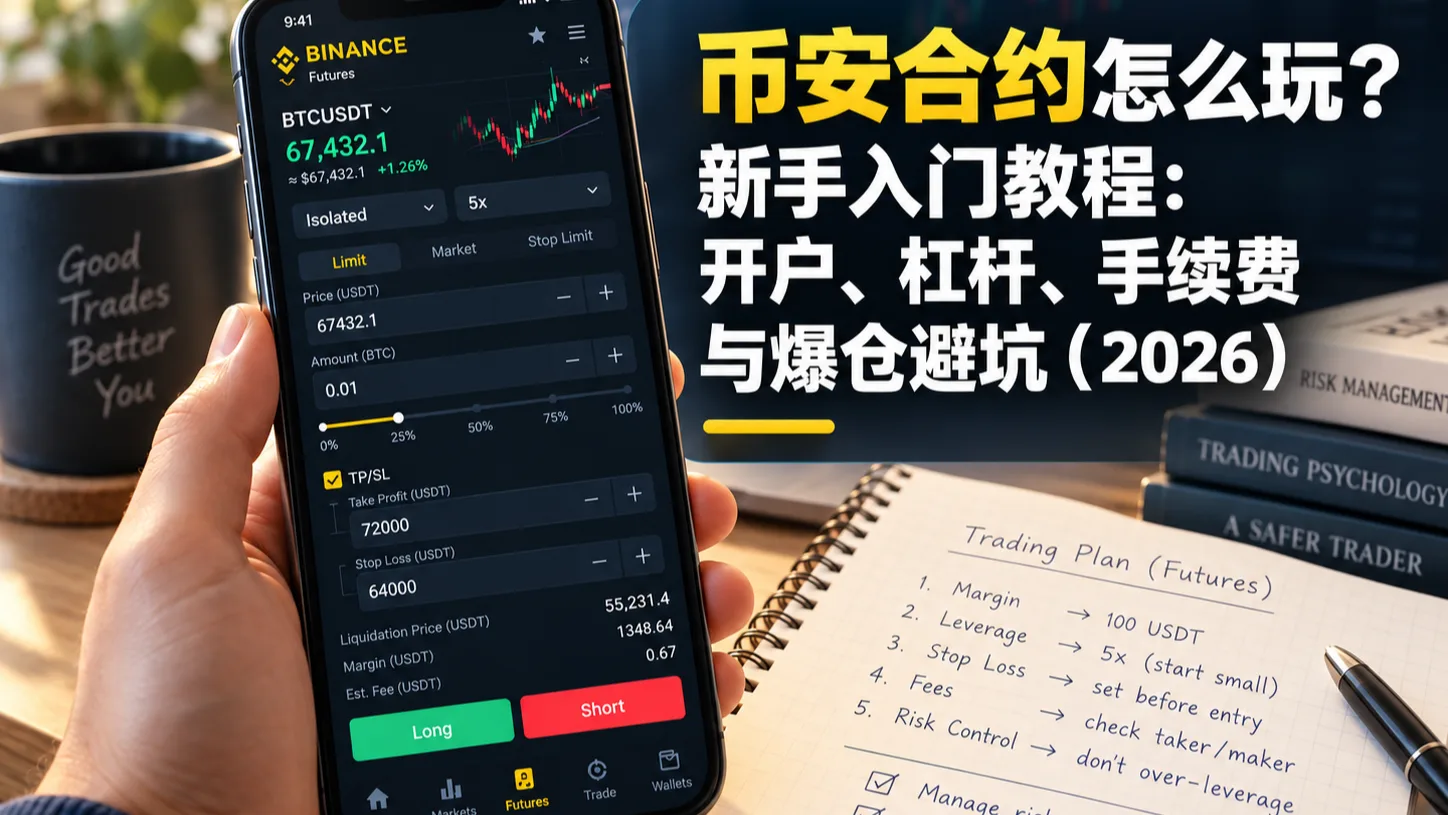
Table of contents

Binance new user rewards
20% trading fee rebate
Official Binance registration. Complete identity verification (KYC) to trade and withdraw.
How to trade Binance futures? Start with the conclusion
Binance futures is leveraged derivatives trading: you use margin to build a long or short position larger than your principal, and make or lose money from price moves up or down.
Its biggest difference from spot isn't "you can earn more", but this: spot mainly carries the risk of the coin price falling; futures add leverage, forced liquidation, funding rate, and trading-fee risk on top of price risk.
If it's your first time with Binance futures, understand it in this order:
Open a futures account → transfer USDT → choose USDT-M → choose isolated margin → set low leverage → decide position size → choose long/short → place the order → set a stop-loss → close the position.
Don't start by studying 50x or 100x leverage, and don't read "how to trade futures" as "how to make money fastest". What you really need to understand first are four numbers:
- How much you're prepared to lose in total;
- How large the actual position is;
- Where your stop-loss is;
- Where the liquidation price is.
If you don't yet understand the relationship between "position size, margin, leverage, and liquidation price", you're not ready to trade high leverage with real money.
If all goes well, you can go from account opening to your first order in 10 minutes. The two easiest places to trip up are: opening tens of times leverage right away, and looking only at the leverage multiplier while ignoring the actual position size.
One table to understand Binance spot vs futures
| Item | Spot | Futures |
|---|---|---|
| Trading approach | Buy and hold the asset | Open a long or short position |
| Leverage | Usually none | Supported |
| Shorting | Plain spot can't short directly | Yes |
| Forced liquidation | No futures liquidation mechanism | May be liquidated if margin is insufficient |
Simply put: spot is mainly "buying coins", futures is mainly "trading price direction". For example, if you buy BTC spot with 100 USDT and BTC falls 10%, your asset loses about 10%; but if you use 100 USDT of margin to open a 1,000 USDT BTC futures position, a small adverse price move can cause a floating loss far greater than 10 USDT. That's leverage.
What are you actually trading in Binance futures?
Many beginners open the Binance futures page and see BTCUSDT, long, short, 5x, mark price, margin, liquidation price, unrealized PnL. It looks complicated, but one futures trade is really only five things:
- Pick a trading pair;
- Judge whether the price will go up or down;
- Decide the position size;
- Set the risk range;
- Finally close the position.
For example, trading BTCUSDT:
Going long BTCUSDT means you judge BTC will rise against USDT — you profit if the price rises, and lose if it falls.
Going short BTCUSDT means you judge BTC will fall against USDT — you profit if the price falls, and lose if it rises.
So: long and short are just directions; what really decides your risk is position size, leverage, margin, and stop-loss.
What types of Binance futures are there?
Beginners most often encounter two types:
| Futures type | Margin / settlement | When it fits |
|---|---|---|
| USDT-M futures | USDT, USDC, etc. | P&L amounts are intuitive, easier for beginners |
| COIN-M futures | BTC, ETH, and other crypto | The margin itself also moves with the coin price |
For a first-time Binance futures learner, USDT-M perpetual futures are usually easier to understand. If you make 8 USDT, you made about 8 USDT; if you lose 5 USDT, you lost about 5 USDT. COIN-M may use assets like BTC as margin and settlement, and is itself affected by coin-price volatility, making the math more complex. So the walkthrough below mainly uses USDT-M perpetual futures.
Do futures suit beginners?
Don't rush to open an account.
| Your situation | What fits better |
|---|---|
| Buying crypto for the first time | Learn spot first |
| Can't tell a market order from a limit order | Learn spot orders first |
| Can't accept a clear loss of principal | Don't use futures |
| Want to use high leverage to win back losses | Don't open futures |
| Understand stop-loss, position size, and leverage | Practice with small amounts and low leverage |
Futures is not an "upgraded spot" — it's a leveraged product with a completely different risk structure. Above all, don't treat futures as a "win back your losses" tool just because spot lost money — raising leverage after already losing principal only speeds up how fast a single mistake causes large losses.
How to open a Binance futures account?
If you've decided to learn futures, follow this order.
Step 1: register on Binance and complete KYC
First complete Binance account registration and identity verification. If you don't have a Binance account yet, see the Binance registration tutorial 2026 first, then enter the futures area of the Binance App.
Step 2: open a futures account
In the Binance App, find "Futures → USDT-M Futures". On first entry you usually need to read the risk disclosure and complete the opening flow according to your current account and region. Note in particular: whether a futures product is available depends on your account's location, identity-verification region, and Binance's local product policy. If the page shows no futures entry, don't try to bypass restrictions by editing your region data.
Step 3: transfer USDT to the futures account
A futures account and a spot account use funds for different purposes. If your USDT is currently in the spot wallet, use the transfer feature: Spot account → USDT-M futures account. Transferring is not opening a position — the money can still sit there without trading. On your first transfer, don't move all your assets into the futures account.
How to place your first Binance futures order?
This is the part that really answers "how to trade Binance futures". Assume the futures account has 100 USDT, trading BTCUSDT, using USDT-M perpetual futures. Your first order can follow this sequence.
Step 1: choose BTCUSDT
Enter the USDT-M futures interface and choose BTCUSDT perpetual. Beginners should first use a mainstream, liquid pair they can understand to get familiar with the interface — don't jump straight into a newly listed small coin just to chase volatility.
Step 2: choose isolated or cross margin
You'll see something like "isolated / cross". The core difference is how risk is allocated.
| Mode | Risk scope | Beginner take |
|---|---|---|
| Isolated | Mainly limited to the margin allocated to that position | Easier to isolate a single position's risk |
| Cross | Available futures-account balance shares the risk | May affect other positions and the balance |
Beginners in the learning stage usually do better to understand isolated margin first. Note that this doesn't mean isolated margin can't lose — an isolated position can still be liquidated, only the risk isolation differs from cross.
Step 3: set leverage
Next you'll see 2x, 3x, 5x, 10x, 20x... Leverage means: position notional value ÷ required initial margin.[1] For example, with 100 USDT of margin:
| Leverage | Theoretical notional position |
|---|---|
| 2x | 200 USDT |
| 5x | 500 USDT |
| 10x | 1,000 USDT |
| 20x | 2,000 USDT |
The most common misconception here: leverage itself isn't a return button — what really decides how much a price move makes or loses you is the actual position size. For example, 100 USDT margin × 10x = 1,000 USDT position; if BTC moves 1% against you, the position's price loss is about 1,000 × 1% = 10 USDT, which — ignoring fees and other factors — is about 10% of your 100 USDT margin.
How much leverage should a beginner use?
There's no fixed multiplier that suits everyone. But if your goal is only to learn placing, closing, stop-loss, and liquidation mechanics, 2–5x is far easier to understand risk with than tens of times.
| Leverage | Risk profile |
|---|---|
| 2–3x | Relatively larger distance to liquidation |
| 3–5x | Still needs strict position control |
| 10x+ | Price tolerance clearly shrinks |
| High leverage | Small moves can cause large margin losses |
Binance allows different maximum leverage for different pairs and position tiers, and the platform adjusts leverage and margin tiers based on risk. So don't memorize "what's Binance's maximum". What you should actually look at is the current maximum leverage shown for that pair on the order page, and your own actual position.
Step 4: decide how large a position you're really opening
This is the step most futures tutorials skip, yet it matters more than "how many times leverage". Suppose your account has 1,000 USDT — you don't have to put all of it into a position. If you only open a 200 USDT notional position, a 5% adverse move means a theoretical price loss of about 200 × 5% = 10 USDT; but a 2,000 USDT notional position with the same 5% adverse move is 2,000 × 5% = 100 USDT. So: the direct variable deciding your speed of gain or loss is position size, not just the leverage multiplier.
Step 5: choose a limit or market order
The two most common order types for a first trade.
| Order | How it fills | Feature |
|---|---|---|
| Market order | Fills immediately at the current market price | Fast fill, usually a Taker |
| Limit order | Specifies the price you want to fill at | Not guaranteed to fill immediately |
For example, if BTC is at 100,000 USDT and you want to open immediately, use a market order; if you only want to buy long at 99,000 USDT, set a limit order and wait for it to fill.
Step 6: long or short
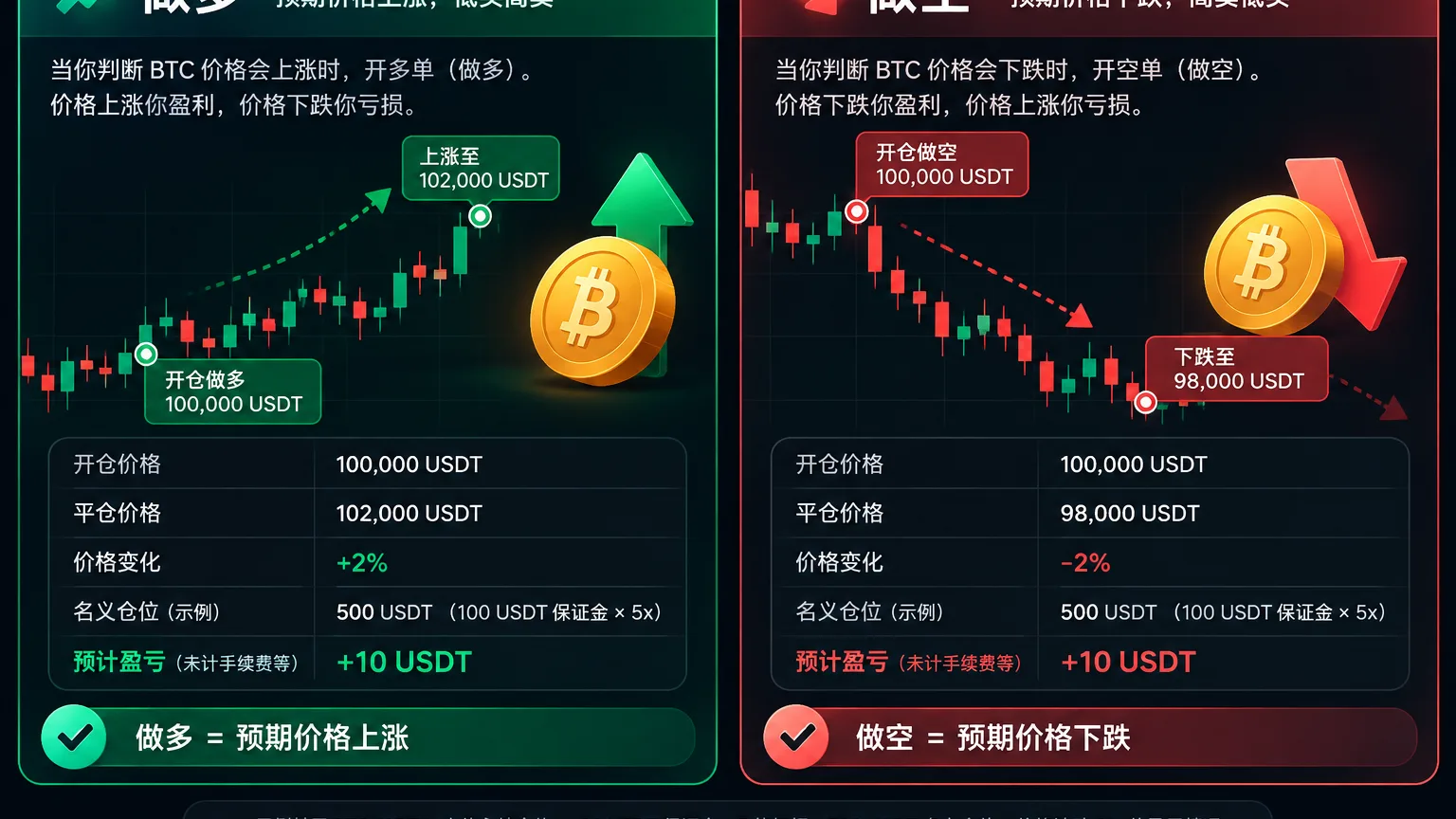
The order button generally maps to two directions.
Buy / long: you judge the price will rise. For example, go long BTC at 100,000 USDT, and if BTC rises to 102,000, the long makes a profit.
Sell / short: you judge the price will fall. For example, go short BTC at 100,000 USDT, and if BTC falls to 98,000, the short makes a profit.
Movement in the opposite direction produces a loss.
Step 7: check the liquidation price before placing
Don't look for the liquidation price after clicking "open". Before confirming the order, check at least: position size, leverage, margin mode, estimated liquidation price, and stop-loss price. The liquidation price is the important price at which the system may force-close a position when the margin is no longer enough to maintain it — it is not your "normal stop-loss". In normal circumstances you should proactively set a risk-exit, rather than using the system liquidation price as a stop-loss.[2]
Step 8: set a stop-loss
Suppose the BTC entry price is 100,000 USDT, and you judge that the trade logic fails if BTC breaks below 98,000. Then you should consider setting a stop-loss around that logic-invalidating zone, rather than holding on because "the liquidation price is still far". A stop-loss answers "when do I exit if I'm wrong", while liquidation answers "your margin is already insufficient" — they are not the same thing.
A complete 100 USDT Binance futures example
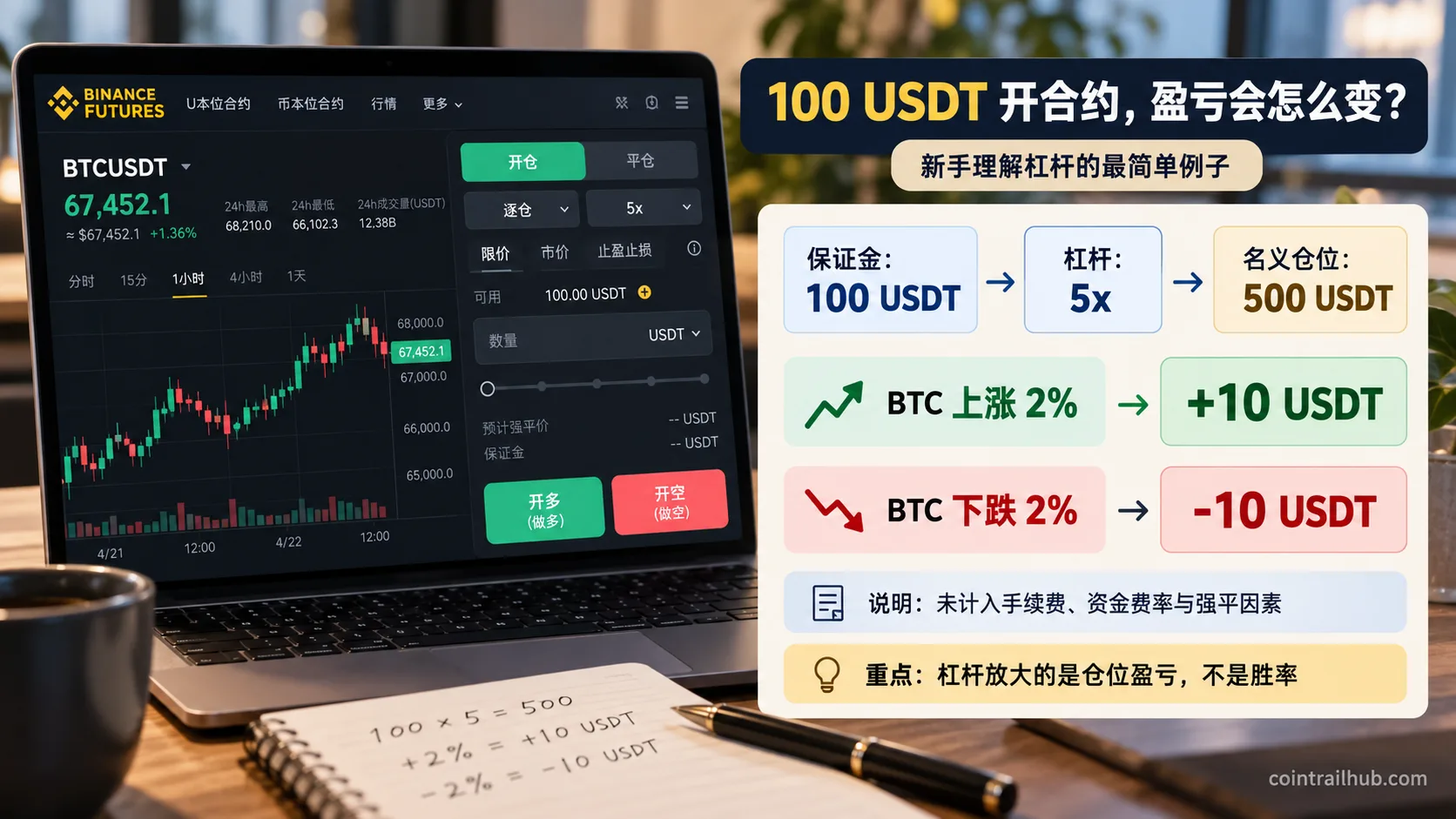
Below is an example with the easiest numbers. Assume: margin 100 USDT, leverage 5x, direction long, notional position 500 USDT, BTC entry 100,000 USDT. Then what you actually control is a 500 USDT BTCUSDT position, not just trading 100 USDT.
If BTC rises 2%
Ignoring trading fees and funding fees: 500 × 2% = 10 USDT, about 10 USDT profit, roughly 10% against your 100 USDT margin.
If BTC falls 2%
500 × 2% = 10 USDT, about 10 USDT loss. That is, leverage amplifies both profit and loss against the margin.
Why can't you simply say "5x leverage liquidates at a 20% drop"?
Because the real liquidation price isn't simply "100% ÷ leverage". Binance also considers maintenance margin, position tier, mark price, account margin, fees, and other risk parameters, so "5x ≈ 20%, 10x ≈ 10%" is at most a way to understand the concept of leverage. The real liquidation price must be based on the data shown on the order page.
What is the mark price? Why isn't liquidation based on the last traded price?
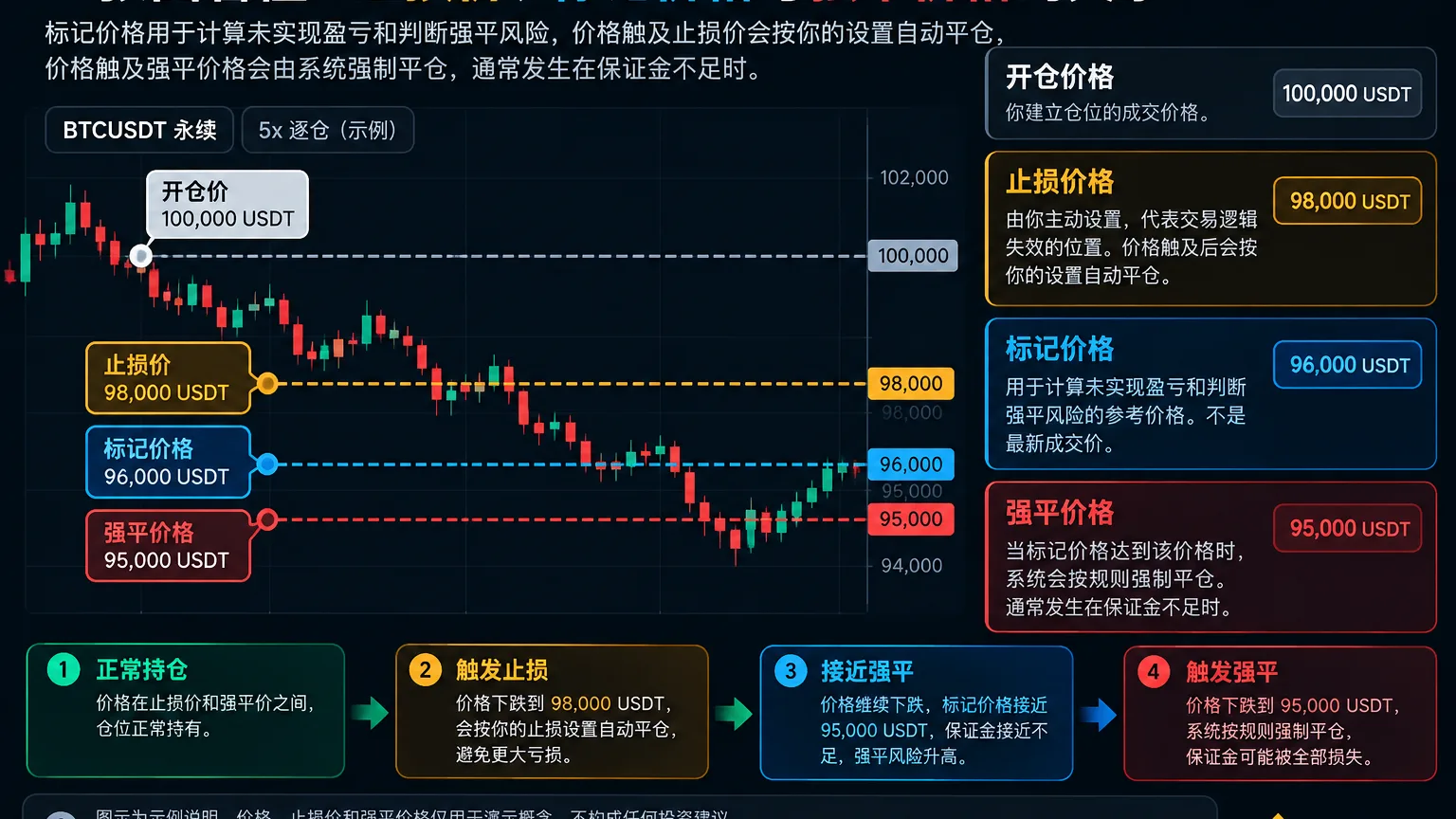
Binance futures has two prices beginners easily confuse:
| Price | Main purpose |
|---|---|
| Last price | The most recent trade price |
| Mark price | An important reference price used for unrealized PnL and liquidation risk |
When judging liquidation risk, don't only stare at the last K-line trade price — the mark price and liquidation price on the futures page matter more. One purpose of Binance's mark-price mechanism is to reduce the risk that a brief abnormal trade price triggers an unnecessary liquidation.
How are Binance futures fees calculated?
Futures trading isn't only about the opening fee. A perpetual futures trade can involve three main types of fees:
| Fee | When it arises |
|---|---|
| Trading fee | When the order actually fills |
| Funding fee | When you still hold a perpetual position at funding settlement |
| Liquidation-related fee | May arise when a position is force-closed |
This is why looking only at Maker/Taker fees can't compute the full cost of a futures trade.
What do Maker and Taker fees mean?
Simply: Maker — the order doesn't fill immediately, but sits in the order book providing liquidity; Taker — the order fills immediately against existing orders, consuming order-book liquidity; market orders are usually Takers.[3]
Binance's exact rates for regular users can differ by USDT-M or COIN-M, VIP level, BNB fee discount, campaign rules, and product changes. So this article doesn't recommend treating any single fee number as a permanent fixed rate — rely on the live display on the trading page and Binance's official fee table.
Why aren't fees calculated on margin?
This is very important: trading fees are usually charged on filled notional value, not just on how much margin you put in.[4] For example, margin 100 USDT, leverage 10x, notional position 1,000 USDT; assume a fee rate of 0.05% for a fill, then 1,000 × 0.05% = 0.5 USDT, about 0.5 USDT for one open. If the close fills at the same notional value and rate, another trading fee arises. So when trading frequently with high leverage, don't only look at margin — the basis for the trading fee you actually pay is the filled position.
How much can BN522 reduce fees?
If your Binance account qualifies for the current referral-rebate rules, establishing a valid referral relationship with the code BN522 lets you receive an eligible fee rebate at the ratio confirmed on the page. The rebate ratio CoinTrailHub currently uses for verification is 20%.
Note: the rebate applies to eligible trading fees, not a return of principal, and not "20% profit on every trade". Whether it actually applies should be based on the Binance registration page, the referral relationship, and your account dashboard.
What is the funding rate?
A perpetual futures contract has no fixed expiry like a normal delivery contract. To keep the perpetual price close to the spot price, the platform uses a funding-rate mechanism. Funding fees are paid between longs and shorts, and are not an ordinary trading fee Binance collects separately.
Generally: when the funding rate is positive, longs pay shorts; when negative, shorts pay longs. The calculation can be simplified to: funding fee = position notional value × funding rate.[5] For example, a 10,000 USDT position with a 0.01% funding rate is 10,000 × 0.01% = 1 USDT.
Is the funding rate always settled every 8 hours?
Not every contract should be simply understood as a fixed 8 hours. Binance perpetual futures don't have a uniform funding settlement interval — common intervals include 8 hours and 4 hours, and some contracts may use other frequencies under special market conditions. So the most reliable method isn't memorizing a schedule, but directly checking the "next funding settlement time" shown on the current trading page — and only if you still hold the position at settlement does that funding fee apply.
What is liquidation?
Liquidation, i.e. forced liquidation, is when a position's margin is no longer enough to meet the maintenance-margin requirement and the system force-processes the position per the rules.[6] Beginners often misunderstand: "my principal isn't all gone, so why did I get liquidated?" The reason is that the platform can't wait until margin is fully zero before starting risk handling — a position must keep some maintenance margin, so liquidation usually happens before the theoretical point where your "principal is fully gone".
Why does higher leverage liquidate more easily?
Ignoring maintenance margin and other complex factors, just to understand the direction:
| Leverage | Adverse price tolerance |
|---|---|
| 2x | Relatively large |
| 5x | Clearly smaller |
| 10x | Even smaller |
| High leverage | Small moves can cause large margin losses |
So high leverage doesn't change "whether the market is easier for you to predict" — it makes the space for adverse price movement smaller.
Which suits beginners better, isolated or cross margin?
If you're just learning futures operation, it's usually more intuitive to understand isolated margin first.
Isolated: a position uses its allocated margin to bear risk; the advantage is that one position's risk is easier to separate from others.
Cross: available margin in the futures account may jointly support positions; the benefit is more balance to support a short-term floating loss, but the problem is that an extreme move can make one position affect more account funds.
So don't read cross as "harder to liquidate = safer". That's wrong — it's just a different way of allocating risk.
Why is "isolated + high leverage" still dangerous?
Isolated only isolates risk — it doesn't reduce position size, market volatility, leverage, fees, or liquidation probability. For example, if you put 100 USDT into isolated margin and then open extremely high leverage, that 100 USDT can still quickly suffer a large loss. So the correct understanding is: isolated controls the risk boundary, while position size and leverage decide the risk speed.
What settings should a beginner use for their first Binance futures trade?
If your goal is only to learn the full flow rather than chase high returns, you can simplify the approach to:
| Setting | Learning-stage approach |
|---|---|
| Contract | USDT-M perpetual |
| Margin | Isolated, easier to understand risk isolation |
| Leverage | Start with low leverage to understand the mechanics |
| Position | Only small funds whose loss won't affect your life |
| Exit | Be clear on the stop-loss before opening |
This isn't a return strategy — it's a way to lower the cost of learning.
The 7 mistakes Binance futures beginners most often make
1. Opening tens of times leverage right away
High leverage doesn't raise your accuracy — it only shrinks your price-tolerance space.
2. Moving all your funds into the futures account
Keep futures risk capital separate from long-term assets, to avoid one trading mistake affecting everything.
3. Looking only at leverage, not position size
"5x leverage, so the risk is small" isn't necessarily true — a 5x position of 50,000 USDT has a completely different price risk from a 10x position of 500 USDT.
4. No stop-loss, waiting for liquidation
Liquidation isn't a stop-loss tool. By the time you reach liquidation, the position's risk has already entered the platform's risk-control scope.
5. Raising leverage after a loss to win it back
This is one of the most dangerous behaviors. Loss → raise leverage → lose again → add more, which easily turns normal trading into emotional gambling.
6. Ignoring fees
Leverage amplifies notional position, and the larger the notional position, the higher the absolute amount of fees from frequent trading.
7. Ignoring the funding rate
Especially when holding perpetual futures continuously, a correct direction judgment doesn't mean your final net result equals the price move — you must include trading fees + funding fees.
Which 6 numbers must you check before placing an order?
Before your first real position, check:
- Entry price
- Position notional value
- Actual margin
- Leverage multiplier
- Stop-loss price
- Estimated liquidation price
If you don't know what any of these 6 numbers means, don't tap "buy/long" or "sell/short" yet. This is a more important rule than memorizing any "futures technique".
How do you close a Binance futures position after a profit?
After opening a position, you haven't yet realized a profit or loss. What the page shows is usually unrealized PnL — only after the position is closed does the corresponding P&L settle. You can close with a market order, a limit order, or via take-profit/stop-loss triggers. For example, if you open a BTC long and BTC rises, tapping close settles the P&L into the futures account.
How do you withdraw futures profits?
The order is: close the futures position → USDT stays in the futures account → transfer to the spot account → then withdraw per the withdrawal flow. A transfer between the futures and spot wallets isn't an on-chain withdrawal; only when you need to send to an external wallet or another platform do you enter the normal withdrawal flow. See Binance withdrawal: how to sell USDT to your bank account, fees, arrival, and freeze risk (2026).
How to understand Binance futures fees, funding rate, and liquidation together?
Beginners can remember this table:
| Item | What it affects |
|---|---|
| Leverage | Margin requirement and distance to liquidation |
| Position size | The actual P&L amount from price moves |
| Trading fee | The cost of each fill |
| Funding rate | The holding cost or income of a perpetual position |
| Liquidation price | Where the position enters forced-liquidation risk |
If you can only read "how many times leverage" but can't yet calculate position size, fees, and stop-loss, then the right move isn't raising leverage — it's not increasing your position for now.
FAQ
How do I trade Binance futures?
The basic flow is: open a futures account → transfer in margin → choose a pair → set isolated/cross → set leverage → enter the position → long or short → set a stop-loss → close. For your first trade, understand USDT-M, position size, liquidation price, and stop-loss first, rather than jumping into high leverage.
What does Binance futures mean?
Binance futures is a type of derivatives product that lets users use margin and leverage to open long or short positions. Users mainly trade the change in asset price, rather than simply buying and holding the coin like spot.
What does going long in Binance futures mean?
Going long means you judge the price will rise; after opening, a price rise usually produces profit, and a price fall produces a loss.
What does going short in Binance futures mean?
Going short means you judge the price will fall; after opening, a price fall usually produces profit, and a price rise produces a loss.
What leverage should a Binance futures beginner use?
There's no guaranteed-safe leverage. If you're just learning the mechanics, 2–5x is easier than tens of times for observing the relationship between position, stop-loss, and liquidation — but even with low leverage, an oversized position can still cause large losses.
Does 10x leverage always liquidate at a 10% drop?
You can't compute the real liquidation price that way. "10x ≈ 10%" only helps understand the concept of leverage; the real liquidation is also affected by maintenance margin, position tier, mark price, fees, and account margin state. The actual liquidation price should be based on the order interface display.
Can isolated margin be liquidated?
Yes. Isolated only limits the margin risk mainly to the specified position; it doesn't mean no liquidation. High leverage, large positions, and violent moves can still liquidate an isolated position.
Is cross margin safer than isolated?
You can't judge it that way. Cross can use more account balance to support a position, so in some cases the distance to liquidation may be farther, but the cost is that the position may affect more futures-account funds. The difference is mainly how risk is allocated, not which one is absolutely safe.
How much are Binance futures fees?
Binance futures fees are affected by contract type, Maker/Taker, VIP level, BNB discount, and campaign rules — rely on Binance's official futures fee table and the current order-page display. Also, perpetual futures may have funding fees and liquidation-related fees beyond the trading fee.
How often is the Binance futures funding rate?
Binance perpetual funding settlement intervals aren't uniform — common intervals include 8 hours and 4 hours, and some contracts may use other frequencies under special conditions. The most accurate way is to check the funding rate + next-settlement countdown on the current contract page.
Can liquidation make you owe Binance money?
Don't treat futures as ordinary borrowing. Binance uses maintenance margin, forced liquidation, insurance fund, and auto-deleveraging to handle extreme-market risk. What regular users should focus on is: liquidation itself can cause the loss of most or all of the related margin. The specific handling of extreme markets should be based on Binance's futures rules in effect at the time, not on assuming "liquidation loses at most a fixed amount".
What's the minimum to trade Binance futures?
There's no universal "minimum principal" for all pairs — each pair has its own minimum order size, notional value, and trading rules. What you should really ask is: if this money is entirely lost, will it affect your normal life? If the answer is yes, it shouldn't be used as futures margin.
Which suits beginners, USDT-M or COIN-M?
Usually USDT-M is easier to understand, because it mainly uses assets like USDT as margin and settlement unit, making P&L amounts intuitive; COIN-M uses BTC, ETH, etc. as margin, and the margin itself is also affected by coin-price volatility. See Binance USDT-M vs COIN-M: which to choose?.
Which is better, Binance futures or OKX futures?
Both Binance and OKX offer perpetual futures, leverage, isolated/cross margin, and funding rates. For beginners, what matters more than "which one is easier to make money" is: whether the product is available in your region, whether you can understand the fees, whether you can read the liquidation price, whether you can set a stop-loss, and whether you can control your position. The risk of futures comes from leverage and position, not from switching platforms.
Can I withdraw directly after a futures profit?
Usually you first close the position to settle, then transfer the futures-account assets back to the spot account, and then withdraw via Binance's normal withdrawal flow.
Final summary: just remember 5 things about Binance futures
1. Futures isn't buying coins — it's opening a price-direction position — you can go long or short.
2. Leverage isn't a return button — it mainly changes the margin requirement and distance to liquidation.
3. Position size matters more than the leverage number — with the same leverage, different positions can produce P&L amounts that differ by tens of times.
4. A stop-loss and liquidation are not the same — a stop-loss is you proactively controlling the loss; liquidation is the platform starting risk handling.
5. Check position, fees, funding rate, and liquidation price before placing — if you can't read these, don't open a position yet.
Futures can amplify gains and losses. It amplifies the effect of price moves on your principal, not the accuracy of your judgment.
Related reading
- Binance USDT-M vs COIN-M: long/short, fees, and liquidation risk compared
- Binance futures walkthrough video tutorial (with risk warning)
- Binance spot trading: market orders, limit orders, and trade records (2026 test)
- Binance registration tutorial 2026: the full account-opening flow
- Binance withdrawal: how to sell USDT to your bank account, fees, arrival, and freeze risk (2026)
Data verification notes
The key facts in this article were checked against Binance's official futures documentation on 2026-10-16, item by item:
- Definition of leverage: the leverage multiplier represents the ratio between position notional value and required initial margin. Source: Binance USDT-M futures leverage and margin.
- Liquidation price: the liquidation price is the price at which the system may force-close a position when the margin is no longer enough to maintain it, and is different from an actively set stop-loss. Source: Binance USDT-M futures leverage and margin.
- Maker and Taker: a Maker order sits in the order book providing liquidity; a Taker order fills immediately against existing orders and consumes liquidity; market orders are usually Takers. Source: Binance futures trading fees.
- Fee calculation basis: futures trading fees are calculated on filled notional value, not on the margin you put in. Source: Binance futures trading fees FAQ.
- Funding fee calculation: funding fee = position notional value × funding rate, paid between longs and shorts. Source: Binance futures trading fees.
- Liquidation (forced liquidation): when a position's margin no longer meets the maintenance-margin requirement, the system force-processes the position per the rules, so liquidation usually happens before the theoretical point where the principal is fully gone. Source: Binance beginner guide to futures trading.
- Binance: beginner guide to futures tradingFutures basics, margin, and liquidation mechanics
- Binance: futures trading feesFutures fee structure, Maker/Taker, and funding fees
- Binance: futures trading fees FAQHow futures trading fees are calculated on notional value
- Binance: USDT-M futures leverage and marginLeverage, margin mode, and liquidation price explanation
- 2026-10-16UpdateAdded evidence-chain superscripts and "Data verification notes"; updated the key-fact verification date.
- 2026-10-06UpdateNewly published — the Binance futures beginner entry page covering account opening, isolated/cross margin, leverage, position size, long/short, fees, funding rate, mark price, liquidation, and stop-loss.
See ourEditorial Policy and the correction process in ourCorrections Policy.
The CoinTrailHub editorial team focuses on crypto education for beginners, exchange security and P2P trading risk. This article is compiled from official sources and public data, reviewed by humans, and strives for accuracy but is not investment advice.
Last updated:2026-10-06 · Content reviewed by humans · Learn more
© 2026 CoinTrailHub · Original content. Reproduction or rewriting without permission is prohibited.