
Didn't fill in a Binance referral code? Rebind rules + real old-account test, code BN522 20% rebate
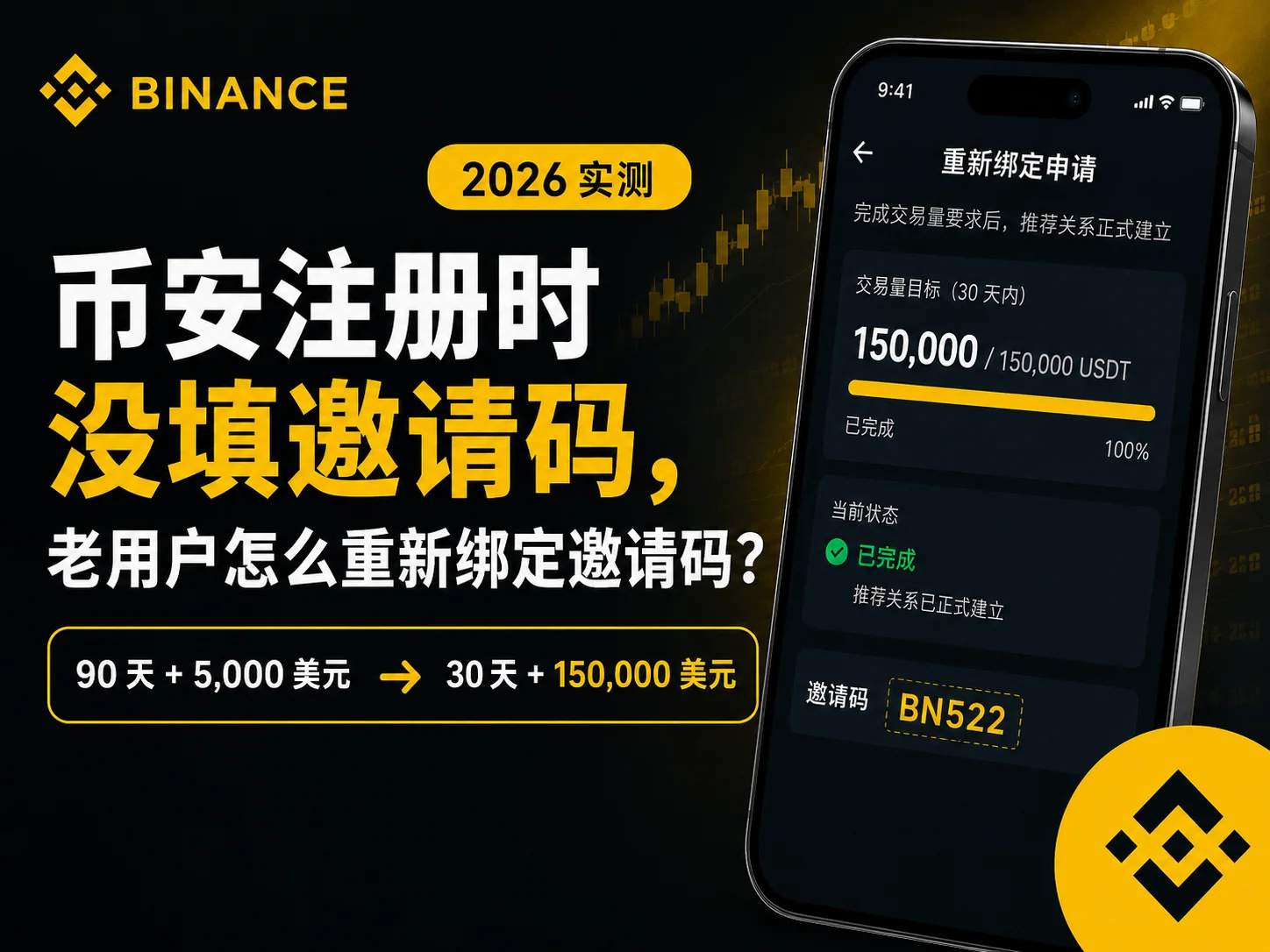
Table of contents

Binance new user rewards
20% trading fee rebate
Official Binance registration. Complete identity verification (KYC) to trade and withdraw.
Not filling in a referral code when you register on Binance doesn't necessarily mean you can never establish a referral relationship later.
In August 2026, CoinTrailHub used a Binance old account that registered without a referral code and had already passed KYC to actually walk through the re-binding process, and confirmed the current conditions with Binance support.
The tested conclusion is: some old users with no current referrer can indeed apply to re-bind, but it isn't as simple as going back into the account and "filling in a referral code" — you must meet the account eligibility before applying, and complete a trading-volume assessment after applying, before the referral relationship is formally established.
Remember two numbers first — everything hangs on them:
- 90 days + 5,000 USD = whether you can apply. Having traded no more than 5,000 USD equivalent in the last 90 days before applying is the eligibility threshold.[1]
- 30 days + 150,000 USD = whether you can finish binding after applying. Within 30 days of submitting the application, you must accumulate 150,000 USD equivalent in spot trading volume before the referral relationship is formally established.[2]
The two numbers are unpacked in detail in the body.
About 8 minutes to read. Remember two numbers and one misconception first: 90 days plus 5,000 USD is the application threshold, and 30 days plus 150k USD is the post-application assessment; being able to see your own referral code does not mean you filled in someone else's code when you registered.
What this test actually did
The test account's basic situation was:
- Did not fill in a referral code at registration;
- Already passed KYC;
- Has no current referrer;
- An old account that has been registered and in normal use for a while.
The first thing I did was confirm "where the referral code was actually filled in at registration," then confirm "whether it can still be added now."
Where was the referral code originally filled in at registration?
I walked through the Binance registration flow again.
In the current tested flow, after setting the password you get:
Do you have a referrer? (optional)
After choosing "Yes," the page shows the referral code input box. In this registration page, BN522 was filled in.
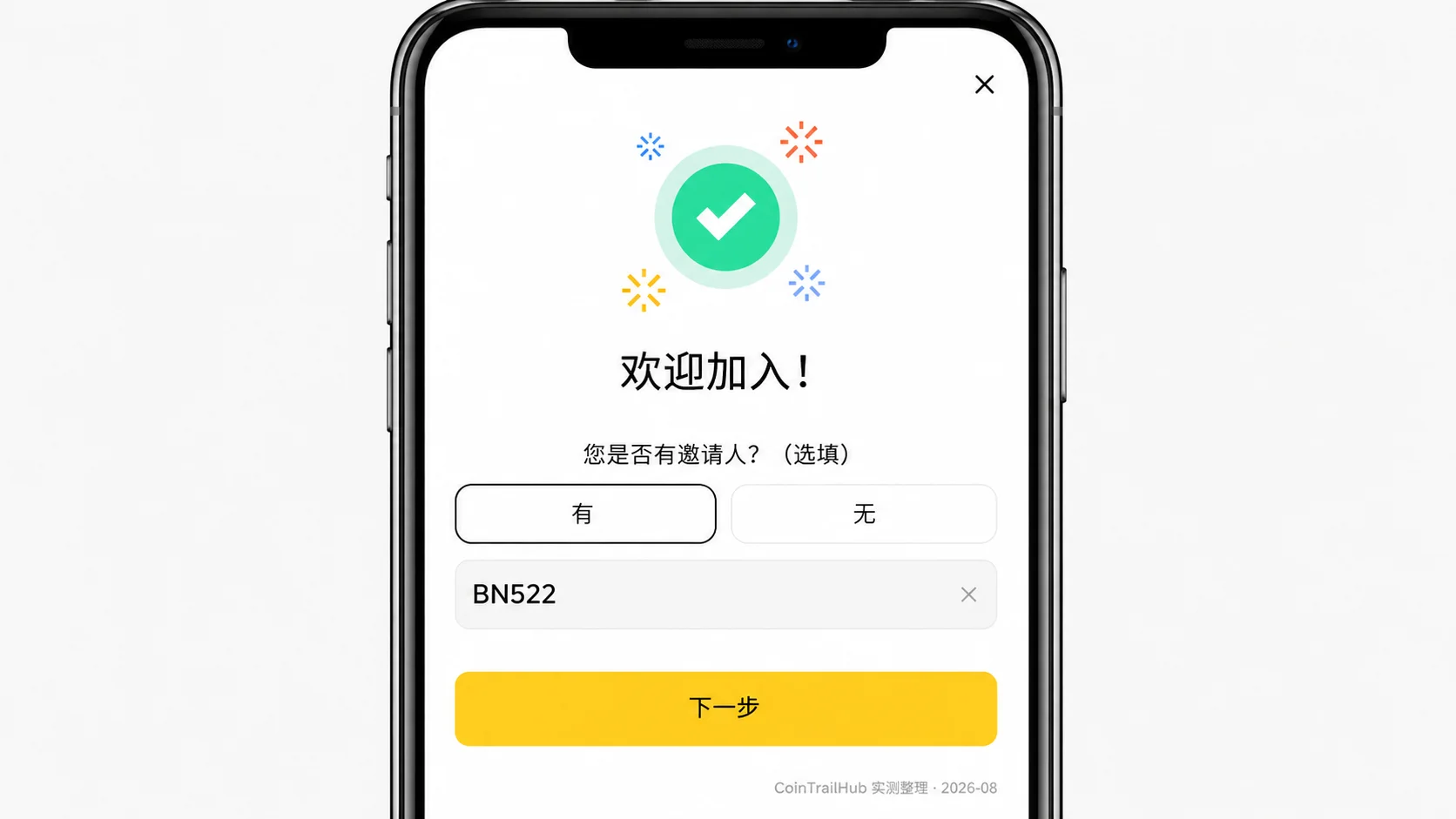
If you fill in the referral code during registration and meet the campaign and account conditions in effect at the time, the referral relationship is handled according to Binance's rules at that time.
If you didn't fill it in at registration, there is no ordinary settings entry after registration that lets every old user go back and fill it in whenever they want. That's why "adding a referral code" has to go through a dedicated process.
If you haven't created an account yet, you can first look at CoinTrailHub's Binance registration tutorial (2026) to confirm the order of registration, referral code, and KYC.
I skipped the referral code on an old account — can I still add it now?
The more accurate answer is:
Some eligible old users with no current referrer can apply to re-establish a referral relationship.
This test account is exactly that premise: registered without a referral code, already verified, currently no referrer.
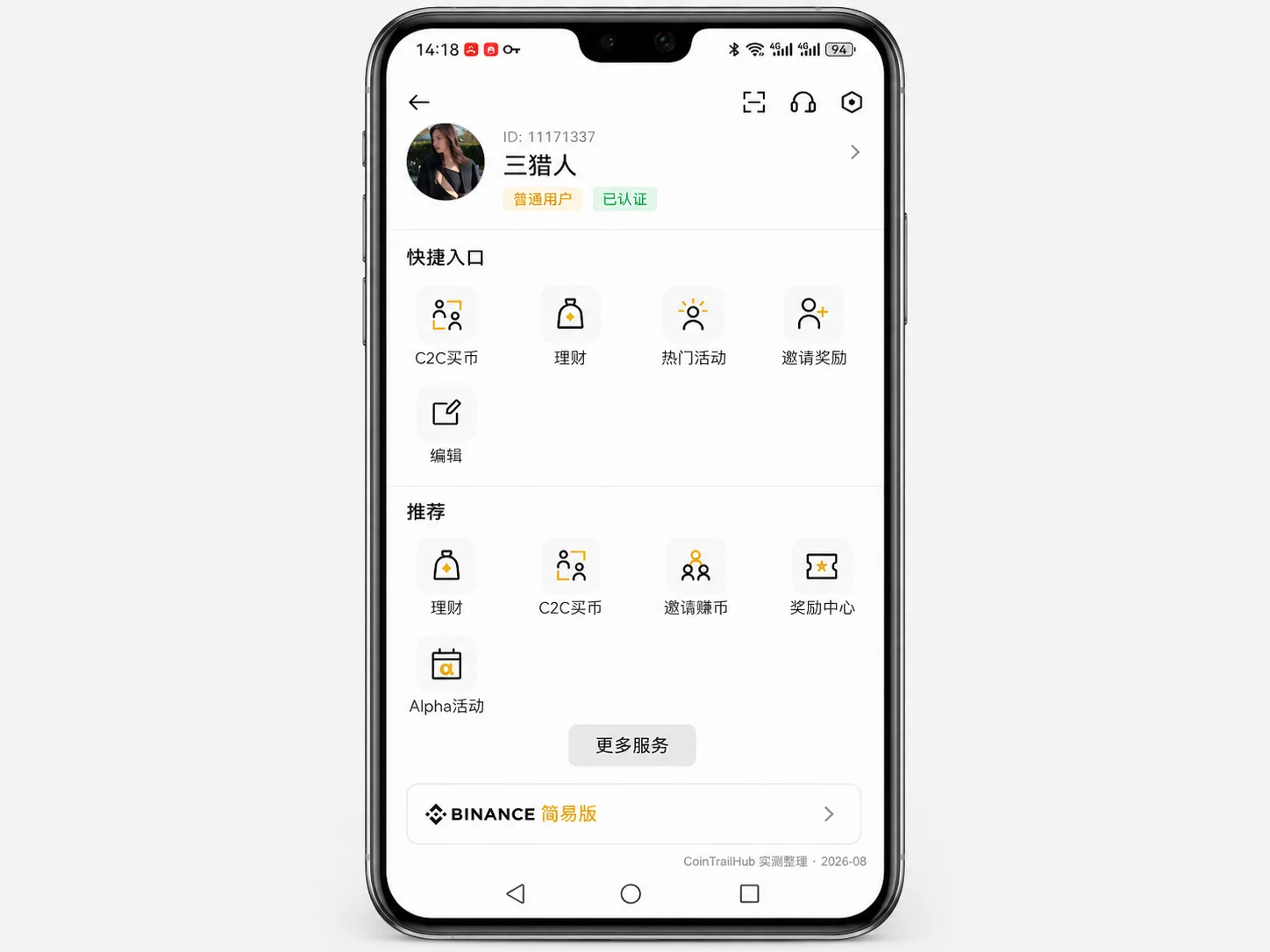
If the account hasn't completed identity verification yet, you can first look at CoinTrailHub's Binance KYC identity verification tutorial, or the official Binance identity verification documentation.
Being able to see your own referral code doesn't mean you filled one in at registration
There's one concept that's easiest to mix up here.
After this old account entered the "Refer & Earn" page, it could also see its own referral code, referral link, spot referral rebate, and futures referral rebate.
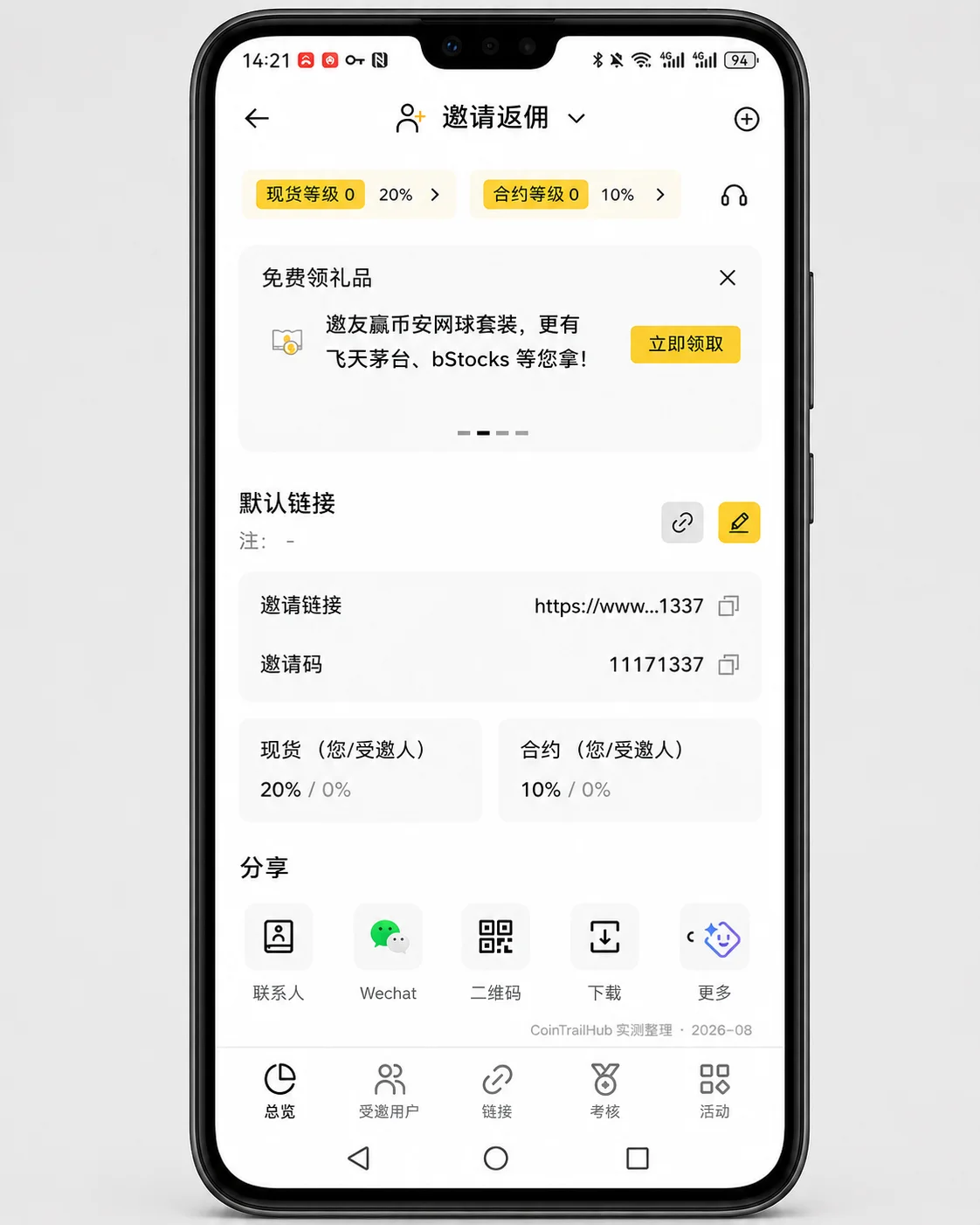
But what's shown here is:
What referral code this account can use, as an inviter, to invite other people.
It does not prove whether this account itself filled in someone else's referral code when it registered.
"I have my own referral code" and "I bound a referrer at registration" are two completely different things.
If you want to confirm whether your account actually has a referral relationship, see How to check if Binance referral code BN522 is bound? Where to see the referral relationship.
What exactly did Binance support reply?
To confirm whether this old account had any room to act, I asked Binance support directly:
My Binance account didn't fill in any referral code at registration, and has now completed registration and identity verification. Can I still add someone else's referral code, or re-bind a referrer?
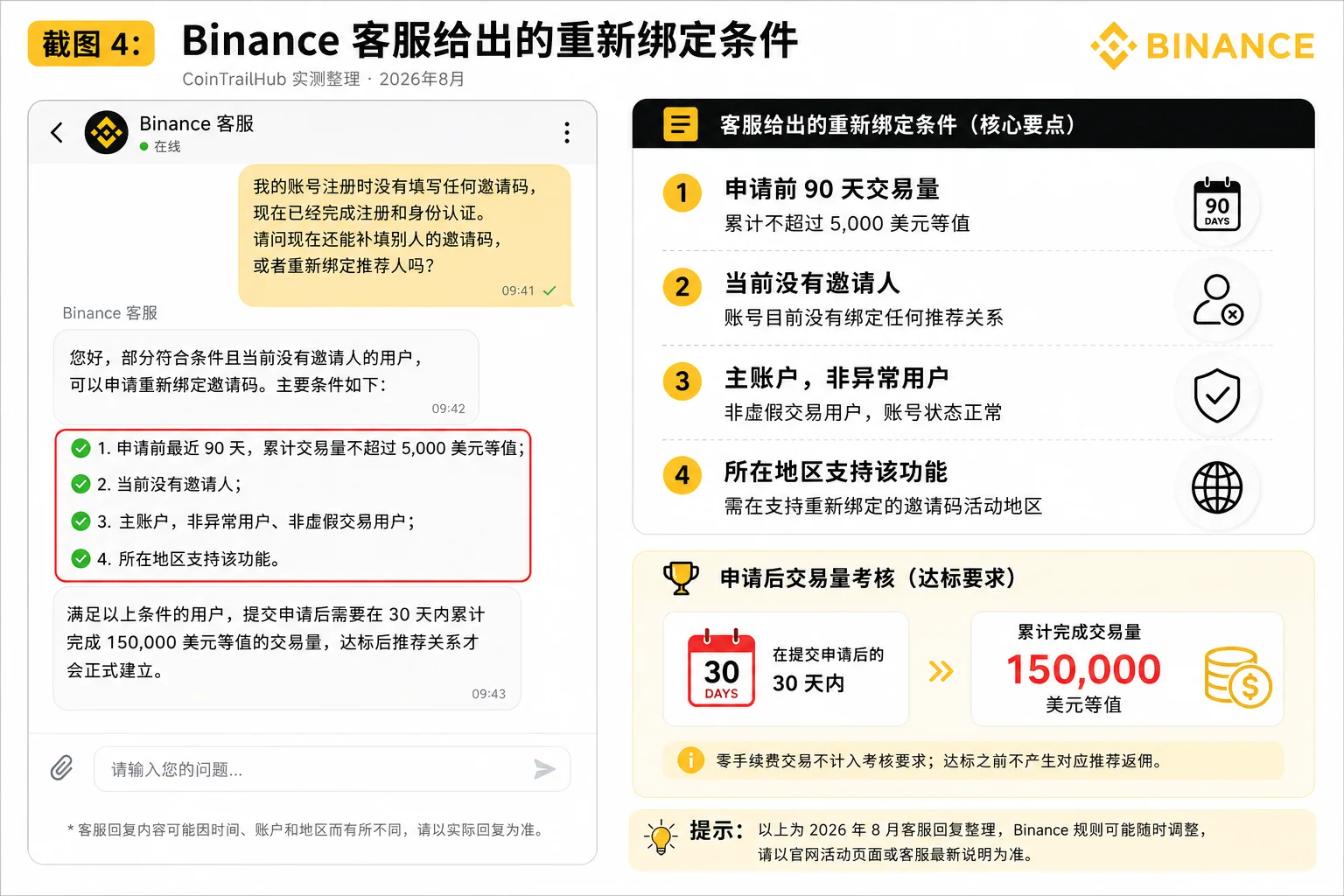
Support didn't simply reply "yes" or "no" — they first gave the re-binding eligibility conditions. The item most likely to be misread is:
No more than 5,000 USD equivalent in cumulative trading volume in the 90 days before applying.
CoinTrailHub tested compilation · 2026-08
The point of this rule isn't "the account has been registered for 90 days" but "before applying to re-bind, Binance looks at the last 90 days of trading." So the online summary "after 90 days you can re-bind a referral code" is not accurate.
The main conditions support confirmed, I've organized into this table:
| Condition | Confirmed in this test |
|---|---|
| KYC | Completed |
| Current referral relationship | No referrer |
| Account type | Main account |
| Trading volume in the 90 days before applying | No more than 5,000 USD equivalent |
| Account state | Not an abnormal user, not a wash-trading user |
| Region | Must support this feature |
| Post-application requirement | 150,000 USD equivalent cumulative over 30 days |
| Zero-fee trades | Not counted toward the requirement |
| Before reaching the target | No corresponding referral rebate accrues |
| After reaching the target | Referral relationship formally established |
Even if these conditions are met, it doesn't mean every Binance old user can re-bind at any time. If the account already has a referrer, recent trading volume exceeds the requirement, or the region doesn't support it, you may not have re-binding eligibility.
What do 90 days and 30 days each mean?
After this test, the two time conditions can be understood separately:
90 days + 5,000 USD = whether you can apply. This is the eligibility check before applying. The condition support gave is "no more than 5,000 USD equivalent in total trading volume over the last 90 days before applying." This is a recent-volume observation window, not simply how long the account has been registered.
30 days + 150,000 USD = whether you can ultimately finish binding after applying. Once the account meets eligibility and submits the application, it needs to accumulate 150,000 USD equivalent in trading volume within 30 days.
What happens after submitting the re-bind application?
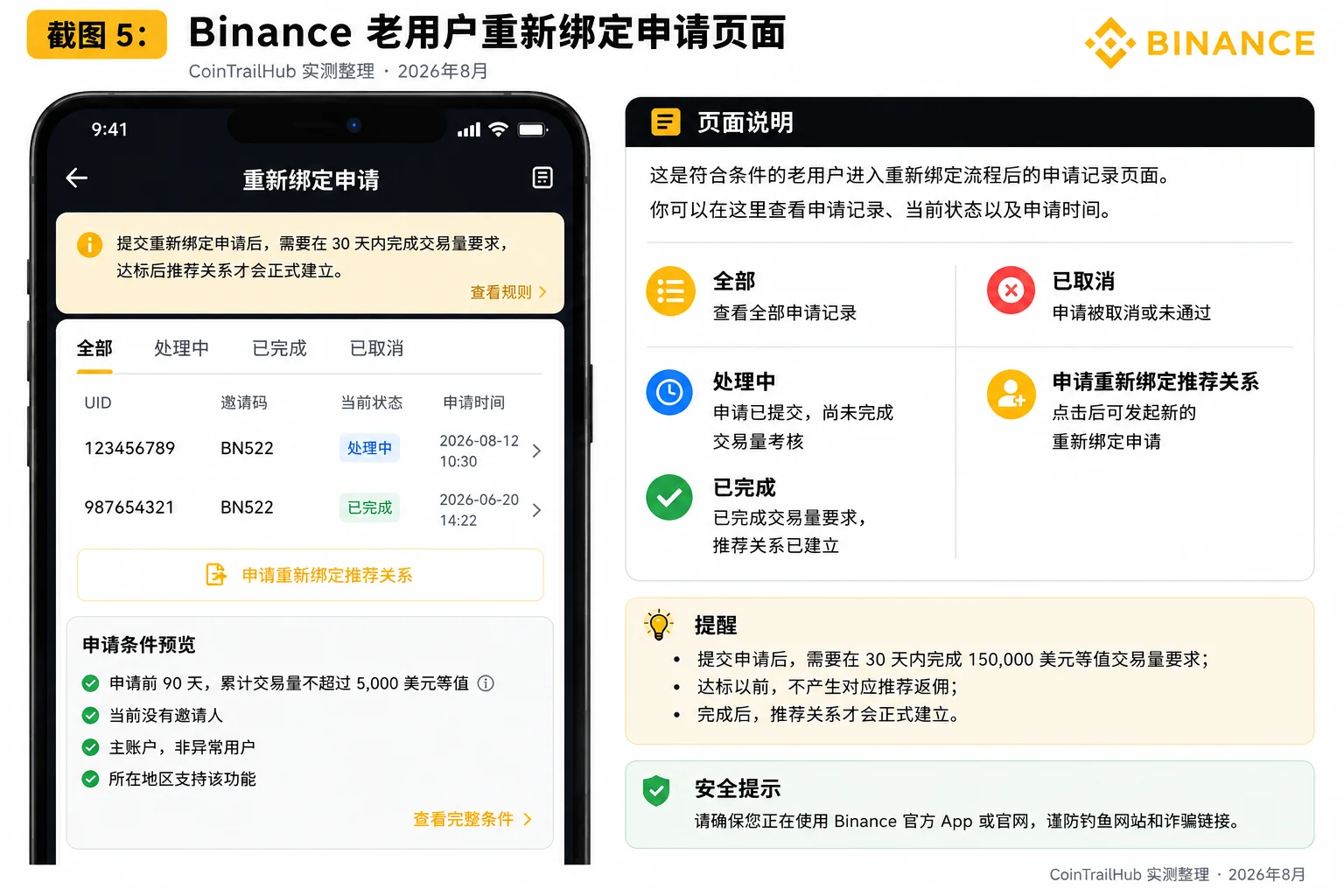
Once eligible, this account could enter a dedicated re-bind application page, where you can see "All / In progress / Completed" along with fields like UID, referral code, and current status.
CoinTrailHub tested compilation · 2026-08
This is the re-bind application entry point used by the CoinTrailHub test account. Whether a different account has application eligibility, go by what the Binance backend actually shows and the support confirmation.
Binance old-user re-bind application entry
Open it, log into your Binance main account, manually enter the referral code BN522 on the application page, and confirm to submit.
The whole flow is closer to:
Submit application → enter assessment → complete trading volume → formally establish the referral relationship
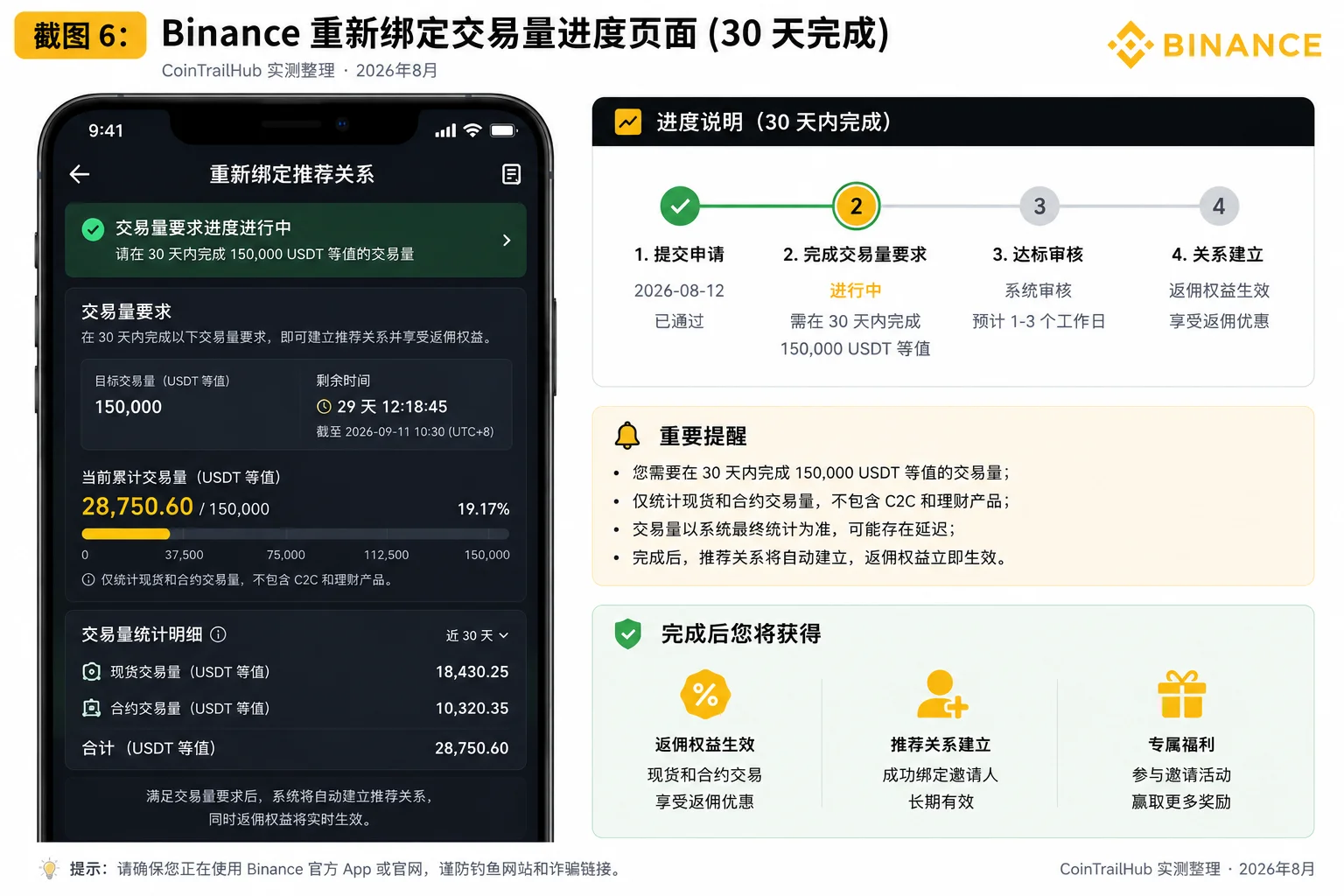
The trading target seen this time was 150,000 USDT. Before completion, the page shows the current cumulative progress.
CoinTrailHub tested compilation · 2026-08
Do you get a rebate immediately after submitting the application?
No.
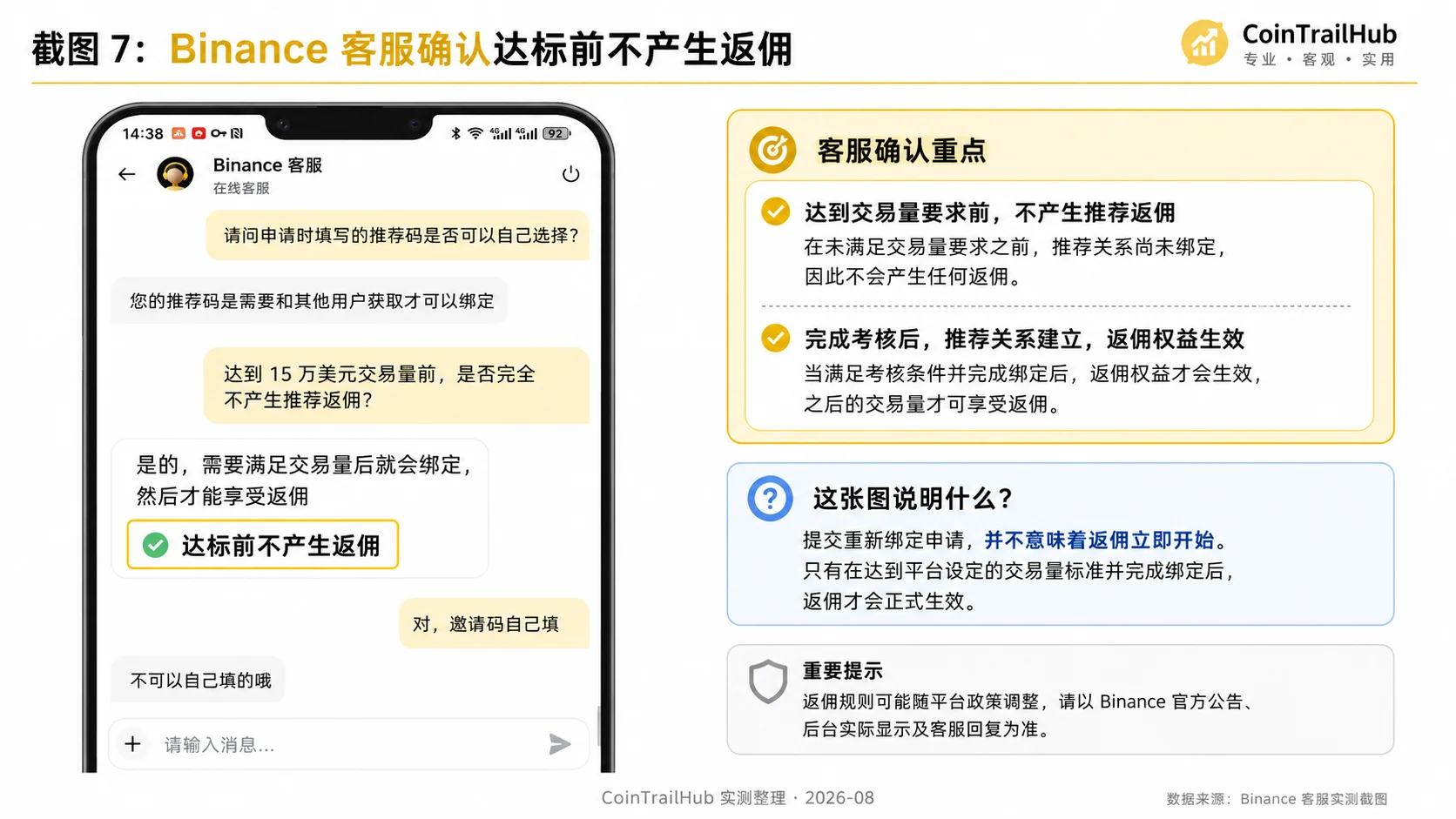
I further confirmed with support: "Before reaching 150,000 USD in trading volume, is there no referral rebate at all?" Support confirmed that you must first reach the volume requirement and formally establish the referral relationship before you can enjoy the corresponding rebate.[3]
CoinTrailHub tested compilation · 2026-08
So there are two things to remember:
Submitting the application ≠ the rebate has started.
Filling in the referral code ≠ the referral relationship has formally taken effect.
Also, support confirmed this time: zero-fee trades are not counted toward this volume requirement.[4] If you care more about how Binance fees are calculated and how referral-code rebates differ from BNB discounts, continue with How to save on Binance fees? BNB discount + referral code BN522 rebate stacking, how much you can save in 2026.
What's the state after reaching 150,000 USD?
After the cumulative trading volume reaches the requirement, the page shows "150,000 / 150,000 USDT" and enters the completed state.
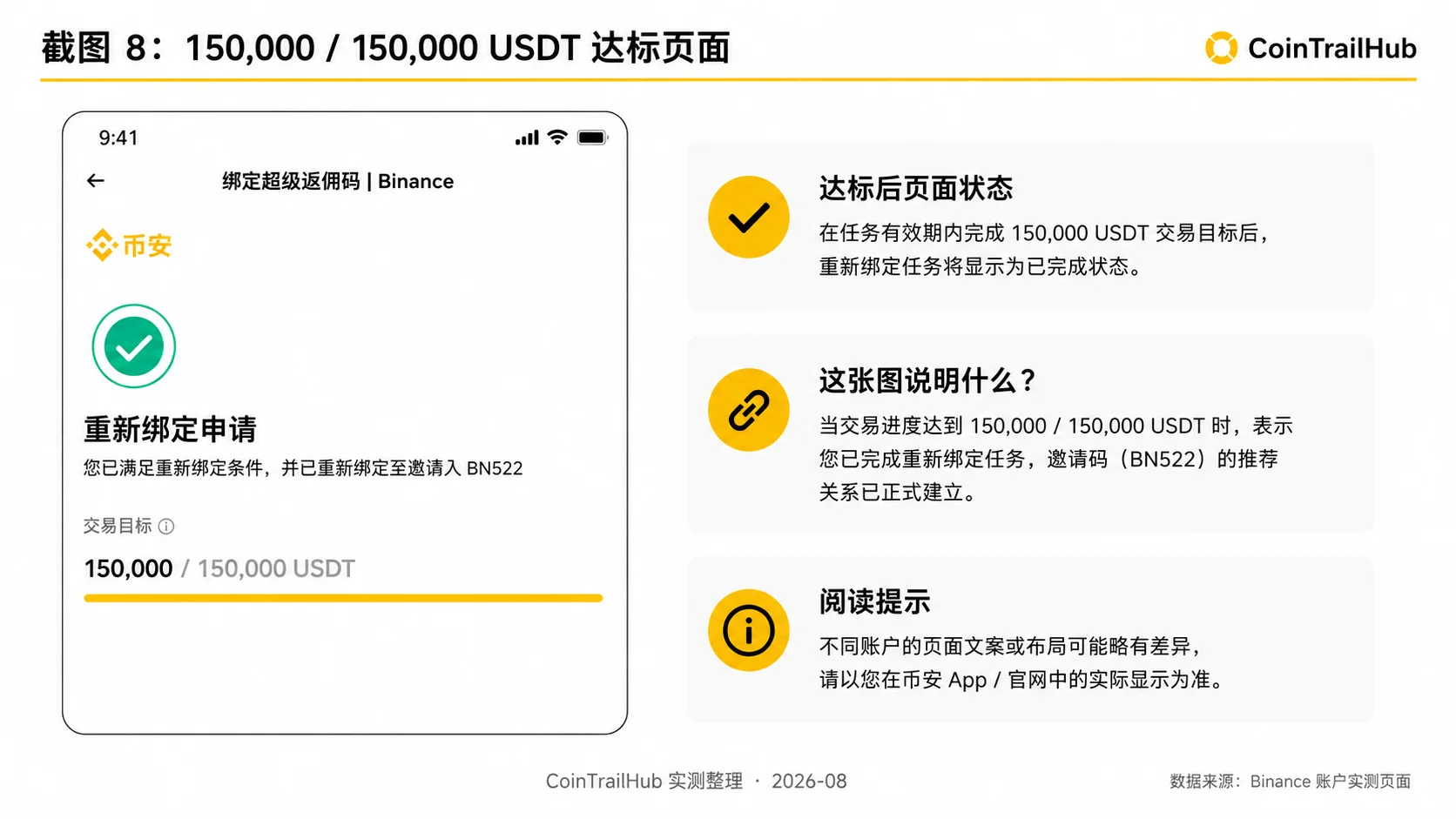
CoinTrailHub tested compilation · 2026-08
At this point the referral relationship is formally established. To show BN522, this article's completion screenshot has had the original referral code processed — it is not the account's real binding result.
Already bound another referral code — can you still switch?
This test has one important premise: there is currently no referrer.
So this article mainly applies to accounts that "didn't fill in a referral code at registration and also have no existing referral relationship right now." If you've already bound another referrer, you can't directly apply this flow — "re-bind" does not mean every old user can swap referrers at any time. In that case, it's best to have Binance support directly check the current referral relationship and account eligibility.
Is it worth deliberately trading 150,000 USD just for a referral code?
That depends on your original trading needs.
If you already have large normal trading volume each month, 150,000 USD cumulative volume may just be part of everyday use; but if you normally only trade a few hundred or a few thousand dollars, it's not recommended to deliberately push volume to 150,000 USD just to re-bind a referral code.
The point of a rebate is to lower trading costs you would incur anyway — not to add trades you wouldn't otherwise make just to earn a rebate. Extra trading also brings fees, spreads, slippage, and market-volatility risk. For how this 150,000 USD assessment is actually calculated and which trades don't count, see Binance old-user referral code rebind BN522 conditions: is the 150k trading volume assessment worth it (2026).
Is it worth re-registering a new Binance account just for the referral code?
If you already have a KYC-passed, normally-used Binance old account, I don't recommend immediately closing or re-registering just because you see "no referral code filled in."
A more sensible order is:
Confirm whether you have a referrer → check re-bind eligibility → confirm with support → then decide the next step
This avoids adding unnecessary trouble to your original account just for a fee discount. Whether you can re-register after closing, and whether one identity can use multiple accounts, are separate topics this article doesn't cover.
Which old users are worth checking?
If you match any of the following, you can check your account first:
- Did not fill in a referral code when registering on Binance;
- Already passed KYC;
- No current referrer;
- Low trading volume over the last 90 days;
- Want to confirm whether you have re-bind eligibility.
But even if you meet the application conditions, note the 150,000 USD equivalent volume requirement within 30 days. For ordinary users with small volume, there's no need to deliberately add trades just to complete this task.
FAQ
I forgot to fill in a referral code when registering on Binance — can I still add it after?
Some old users with no current referrer may have re-bind eligibility, but it's not an ordinary "add a referral code" feature — it requires a dedicated application process and meeting both account eligibility and the follow-up assessment.
Can a Binance old user re-bind a referral code once the account is 90 days old?
No. The 90 days here is the trading-volume observation window before applying. The condition this time is no more than 5,000 USD equivalent in total trading volume over the last 90 days.
Is there a rebate immediately after submitting the re-bind application?
No. Support confirmed this time that you must complete the follow-up volume requirement and formally establish the referral relationship before you can enjoy the corresponding rebate.
How much volume does re-binding need? Do zero-fee trades count?
The actual application page this time showed that you need to accumulate 150,000 USD equivalent in trading volume within 30 days of submitting the application. Per support's reply, zero-fee trades are not counted toward this requirement.
I already bound someone else's referral code — can I switch?
This article tested an account with no current referrer. An account that already has a referral relationship is a different situation; it's best to have Binance support check directly.
Is it worth deliberately trading 150,000 USD to re-bind a referral code?
If you didn't have that much trading need in the first place, I don't recommend it. A rebate should lower fees you'd already incur, not become the reason to actively increase volume.
What did this test finally confirm?
After this verification, two common claims are both inaccurate:
"After registering on Binance, you absolutely cannot add a referral code."
and:
"Binance old users can just wait 90 days and re-bind directly."
Closer to what this test actually found:
Some Binance old users who registered without a referral code and currently have no referrer do have a chance to re-apply for a referral relationship, but they must first meet account eligibility, and complete a trading-volume assessment after applying.
There are only two sentences really worth remembering: 90 days + 5,000 USD is the application eligibility; 30 days + 150,000 USD is the post-application assessment. Only after completing the assessment is the referral relationship formally established.
Rules may change
This article records CoinTrailHub's August 2026 real Binance old-account test, the application page, and the support reply. Binance's referral campaigns, regional restrictions, account eligibility, and volume requirements may all be adjusted.
So the 90 days, 5,000 USD, 30 days, and 150,000 USD in this article should not be read as permanent rules that apply to all Binance users forever. If your account page differs from this article, prioritize Binance's actual check of your account, the support reply, and the current campaign page.
CoinTrailHub tested compilation · last updated: September 2026
Data verification notes
The key facts in this article were all checked on 2026-10-16 against CoinTrailHub's August 2026 old-account test and Binance support confirmations, item by item:
- Application eligibility threshold: no more than 5,000 USD equivalent in total trading volume over the last 90 days before applying to re-bind. Source: CoinTrailHub test · Binance support confirmation (2026-08).
- Post-application assessment: within 30 days of submitting the application, accumulate 150,000 USD equivalent in spot trading volume before the referral relationship is formally established. Source: CoinTrailHub test · Binance re-bind application page and support confirmation (2026-08).
- When the rebate takes effect: no corresponding rebate accrues before the volume requirement is met and the referral relationship is formally established. Source: CoinTrailHub test · Binance support confirmation (2026-08).
- Zero-fee trades: not counted toward this volume assessment. Source: CoinTrailHub test · Binance support confirmation (2026-08).
Reprint notice: this article is an original CoinTrailHub compilation. When quoting this article's test data, images, or original content, please credit the source and link the original.
- Binance referral program supplementary notesAccount eligibility, regional restrictions, and KYC requirements for the referral program
- Binance old-user recall program official documentationTiming and participation conditions of the old-user recall program
- 2026-10-16UpdateAdded evidence-chain superscripts and "Data verification notes"; updated the key-fact verification date.
See ourEditorial Policy and the correction process in ourCorrections Policy.
The CoinTrailHub editorial team focuses on crypto education for beginners, exchange security and P2P trading risk. This article is compiled from official sources and public data, reviewed by humans, and strives for accuracy but is not investment advice.
Last updated:2026-09-17 · Content reviewed by humans · Learn more
© 2026 CoinTrailHub · Original content. Reproduction or rewriting without permission is prohibited.