
How to check if Binance referral code BN522 is bound? Where to see the referral relationship

Table of contents

Binance new user rewards
20% trading fee rebate
Official Binance registration. Complete identity verification (KYC) to trade and withdraw.
I recently hit a very practical question while checking a Binance account I'd been using for a while: did this account originally register through someone else's referral code?
At first I also assumed that as long as I went into Binance's referral page and saw my own referral code, I could tell.
Only after actually going in did I realize it wasn't that simple.
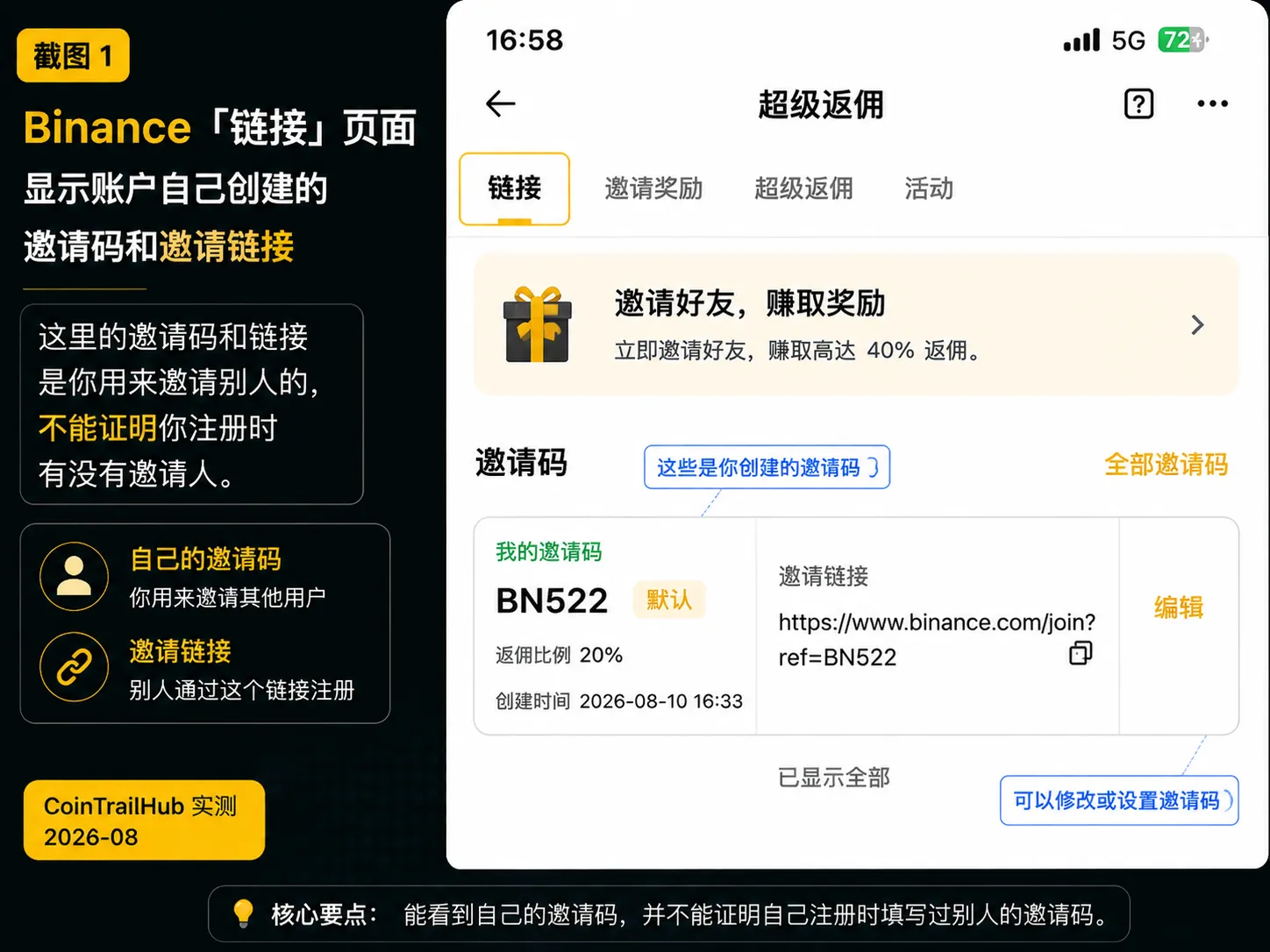
The referral code and referral link on the "Link" page are what I use to invite others. They can't tell you whether this account had a referrer when it registered.
After checking further, I found the "Referral relationship" that actually relates to my own registration status on Binance's "Referrals" page.
This test account shows:
You registered via the
<Co-Inviter referral code>
And also shows:
- Referred-user spot rebate rate: 20%
- Referred-user futures rebate rate: 20%
To confirm what this result actually means, and whether I could further find out whose referral code was actually used, I also queried Binance official support once.
Support ultimately confirmed that this account has been registered via the referral rebate program.
However, this doesn't mean you can see who specifically invited you, nor that you can retrieve the specific referral code used at the time.
This time support said that, based on the privacy policy, they would not provide the referrer's detailed information or the referral code used.
If you just want to confirm whether your Binance account has a referral relationship, the query path from this test is:
Search "Refer & Earn" in the Binance App → go into "Co-Inviter" → open "Referrals" → check "Referral relationship"[1]
If all goes well, you can get the result within 2 minutes. The two easiest places to trip up are: treating the referral code you use to invite others as your own referrer, and handing your account to a stranger to "check on your behalf".
Your own referral code is not your own referrer
This is the first place that was easy to get wrong in my check this time.
After entering Binance's referral-related page, I could see several referral codes on the "Link" page, along with the corresponding referral links, creation dates, and other info.
CoinTrailHub tested · 2026-08
Seeing this, it's easy to form a misunderstanding: I have referral codes in my account, so does that mean I also bound someone when I registered?
No.
The referral codes here are used by this account as the referrer — that is, the codes you give to others to register with.
But what this article wants to check is: when this account itself registered on Binance, did it establish a referral relationship as the "referred user" through someone else's referral code?
It's best to keep these concepts separate:
| Info on the Binance page | What it actually represents |
|---|---|
| Your own referral code | What you use to invite other users |
| Your own referral link | Others can register through this link |
| Referrals | Check your status as a referred user |
| Referral relationship | Check your own referral registration relationship |
| Referred-user rebate rate | The referred rebate benefit currently shown on the page |
So being able to see your own Binance referral code doesn't prove that you filled in someone else's referral code when you registered.
If you haven't created a Binance account yet, you can first look at the Binance registration tutorial (2026) on this site — the registration stage and an old user checking their referral relationship are two different questions.
The place to actually look is "Referrals"
After checking further, the key location I found is Referrals.
This test used the Binance App; the actual path is:
Search "Refer & Earn" → Co-Inviter → Referrals
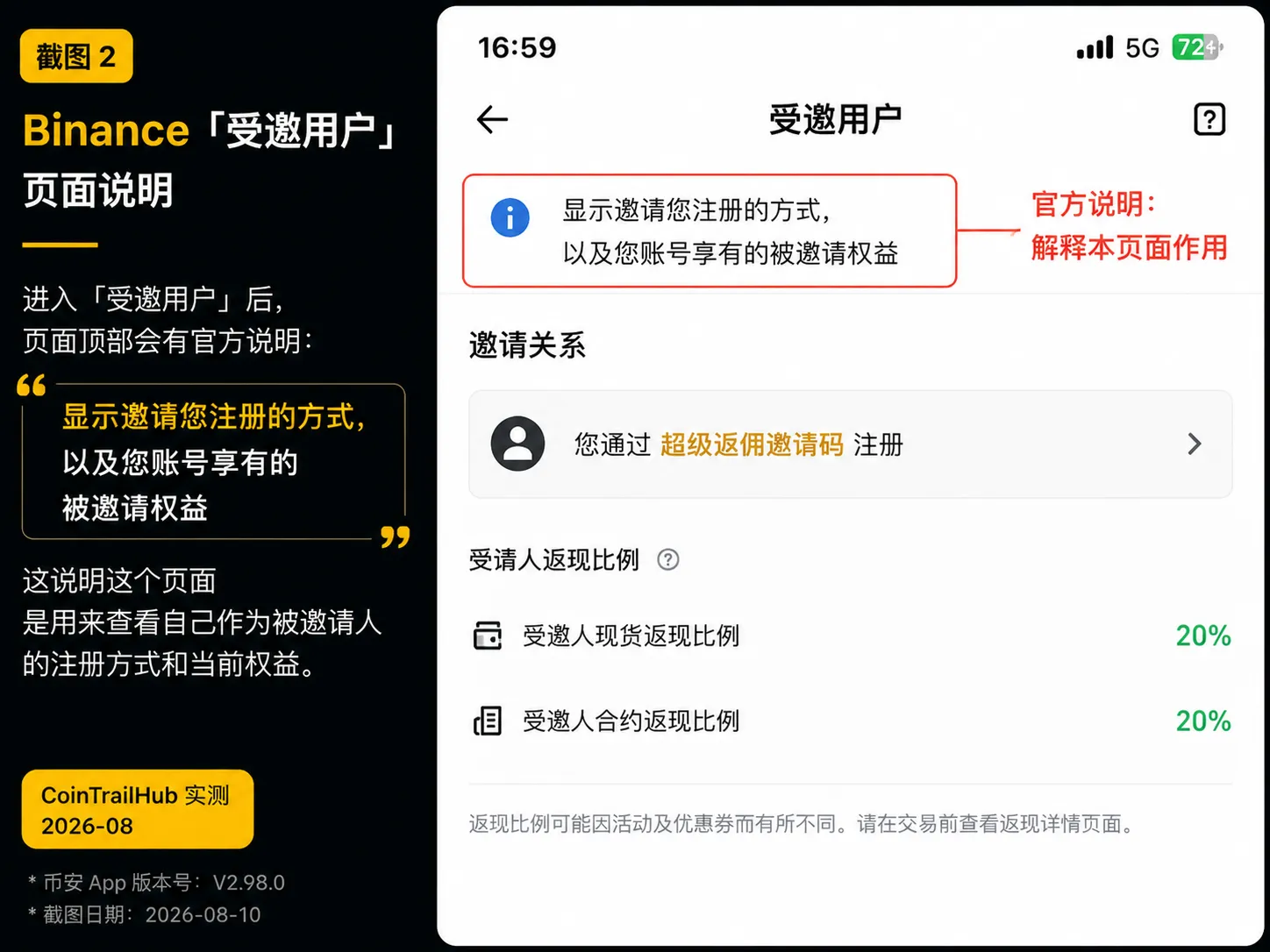
The first time you enter this location, the Binance page itself gives an explanation:
Shows how you were invited to register, and the referred benefits your account enjoys
CoinTrailHub tested · 2026-08
This sentence already makes the difference between "Link" and "Referrals" clear.
The "Link" page shows: how I invite others.
The "Referrals" page shows: how I myself was invited to register, and what referred benefits I currently have.
So if what you really want to check is "did I actually bind a referral code when I registered on Binance", don't keep looking in your own referral code list.
The location more worth looking at is:
Referrals → Referral relationship
Binance's referral campaigns, rebate rates and applicable conditions may change with region and account status; for the current rules you can refer to the Binance official referral program.
What did my account actually find?
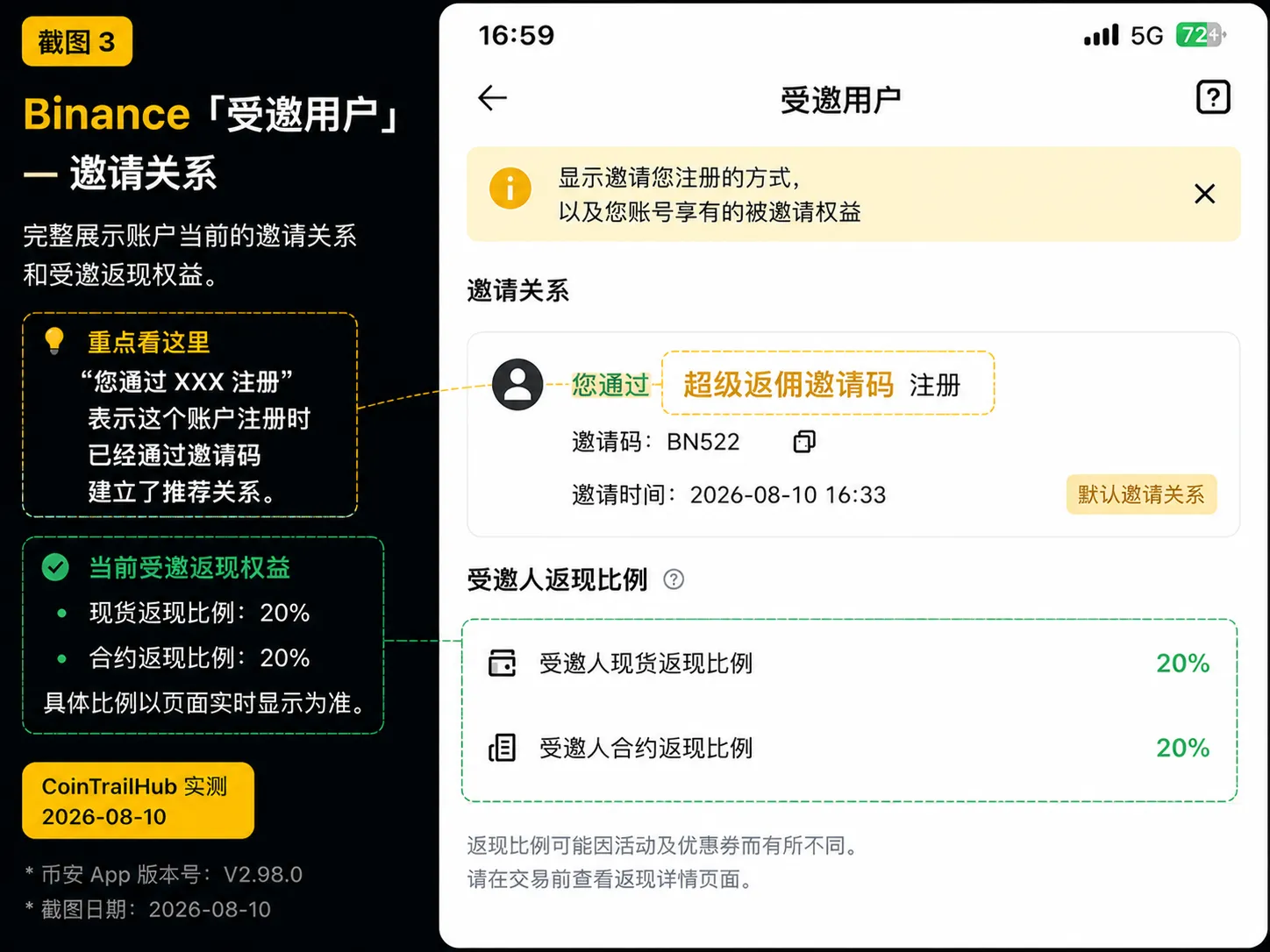
After closing the page prompt and scrolling down, you can see a separate "Referral relationship" section.
This test account shows here:
You registered via the
<Co-Inviter referral code>
Below it also shows:
Referred-user spot rebate rate: 20%
and:
Referred-user futures rebate rate: 20%
CoinTrailHub tested · 2026-08
At this point, at least one thing can already be confirmed: this test account is not in a "no referral relationship at all" state.
Because the Binance page clearly shows that this account was registered via the Co-Inviter referral code.
Referral relationship, rebate rate, and the specific referral code are not the same thing
After checking this far, there are several concepts that are often mixed together and need to be separated.
Your own referral code is what you use to invite other users.
Referral relationship is your own registration relationship as a referred user.
Referred-user rebate rate is the rebate benefit shown on the current page.
But the page didn't directly tell me two other questions: who specifically invited me? And which referral code was actually used at registration?
Although this account has already been confirmed as registered via the Co-Inviter referral code, the page didn't show the specific referrer's identity, nor the complete referral code actually used at the time.
So I queried Binance official support once more.
I had Binance support check again
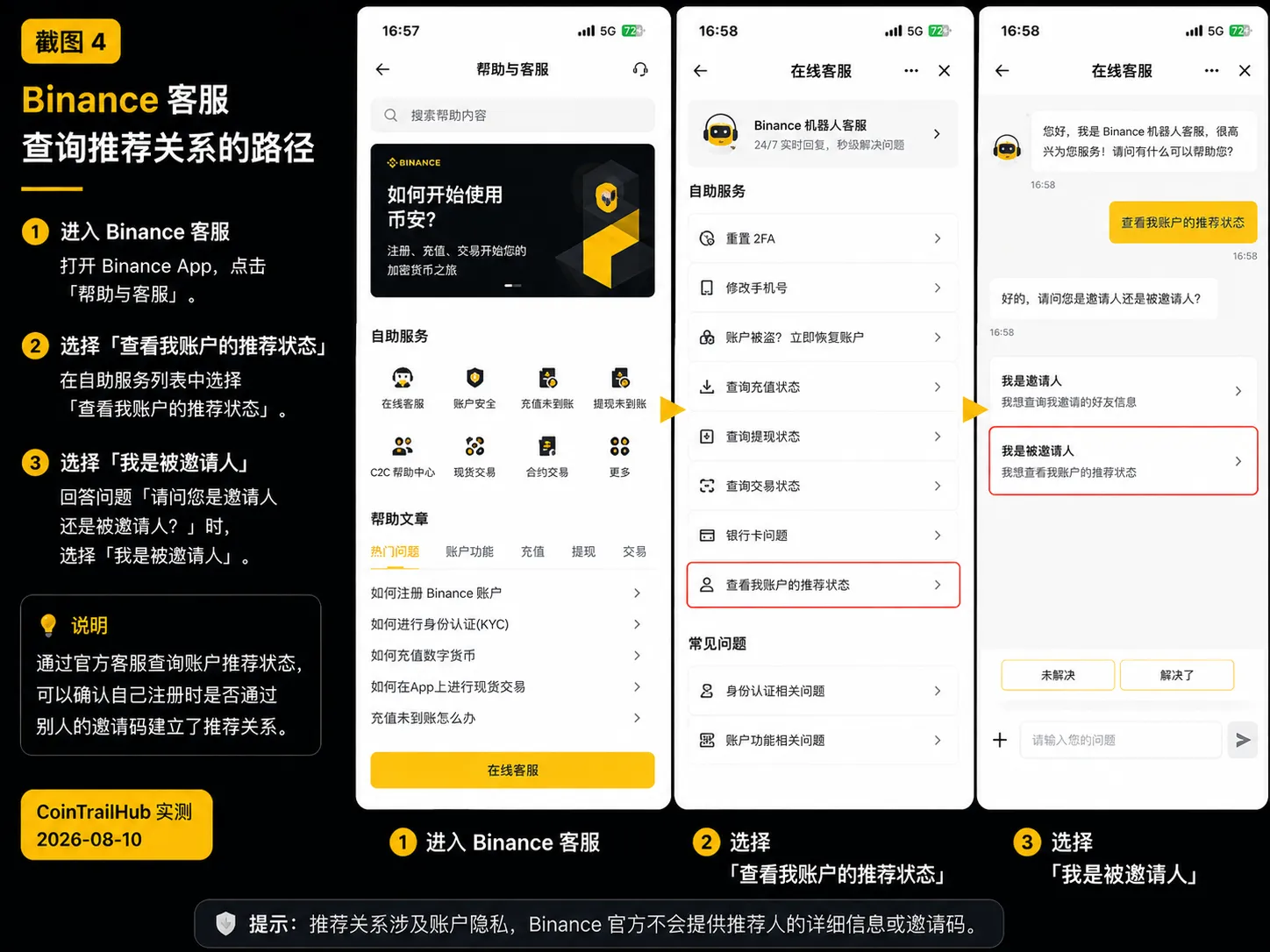
To avoid judging only from the page text myself, I went into Binance official support and queried the account's referral status.
The support system itself provides the option:
Check my account's referral status
CoinTrailHub tested · 2026-08
After entering, the system also asks:
Are you the referrer or the referred user?
What this article wants to check is whether you registered through someone else's invitation, so here you choose:
I am the referred user
This step again shows why "your own referral code" and "your own referrer" can't be conflated.
If your account page differs from this article, you can also query directly through the Binance official support center, without needing a third party to "check on your behalf".
Support confirmed: this account has been registered via the referral rebate program
After choosing "I am the referred user", Binance support gave a clear result:
Your account has been registered via the referral rebate program.
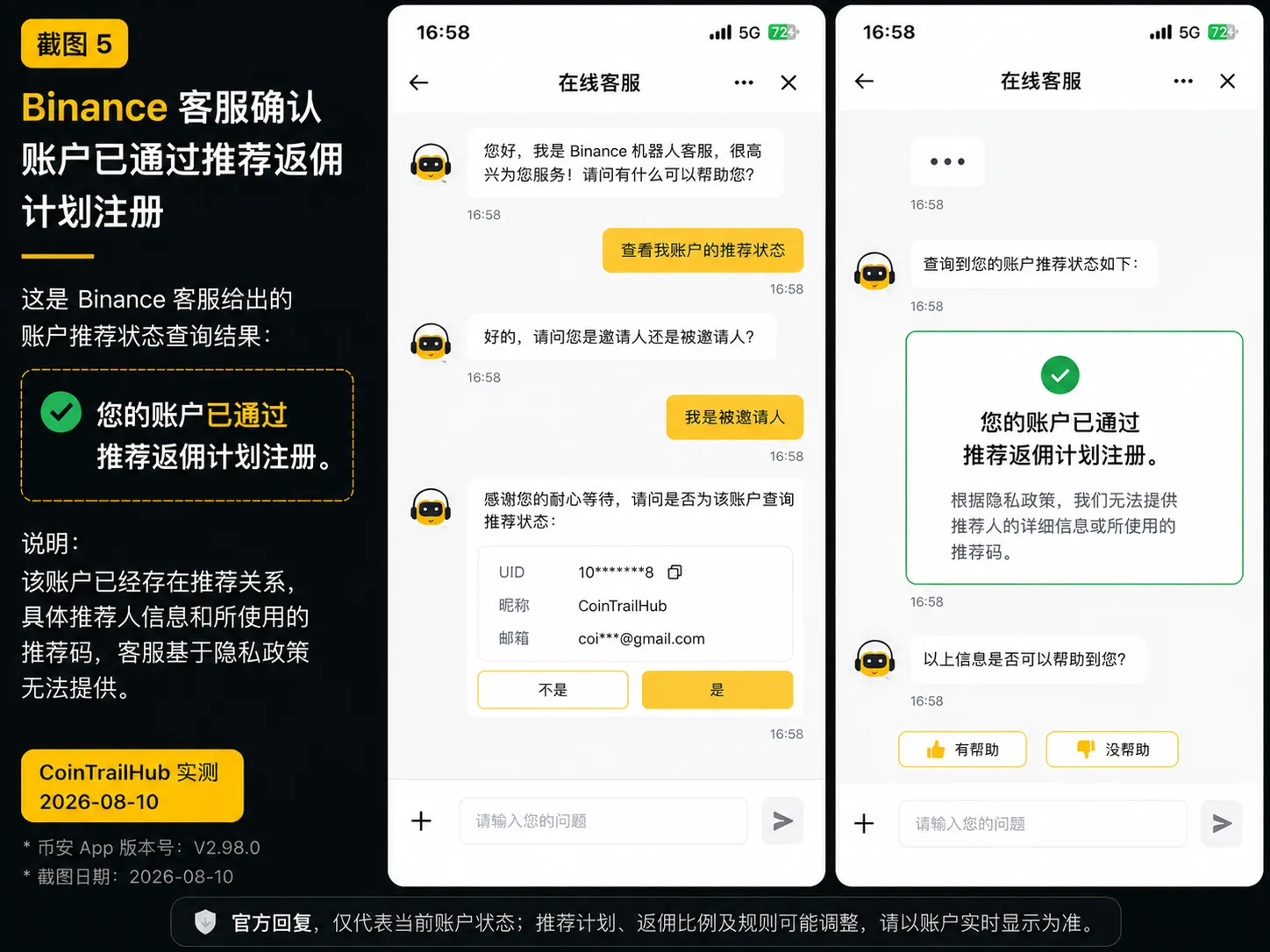
CoinTrailHub tested · 2026-08
This is consistent with what the account page showed earlier:
You registered via the
<Co-Inviter referral code>
That is, this test didn't guess whether the account has a referral relationship from the 20% rebate rate, but went through:
- Binance's account front-end page;
- Binance official support;
and got mutually corroborating results from both.
This test account has a referral relationship.
Can you find out who specifically invited you?
This is another more valuable result from this test.
After confirming the referral relationship exists, I continued wanting to know: who specifically invited this account? And which referral code was used at registration?
Binance support didn't provide this information this time.
Support said that, based on the privacy policy, they can't provide the referrer's detailed information or the specific referral code used.[3]
So this actual query can be understood in three levels.
Is there a referral relationship?
Can be confirmed.
Both the account page and Binance support could confirm it this time.
What referred rebate benefits are there currently?
Can be seen on this account's page.
Both spot and futures show 20%.
Who specifically invited, and which referral code was used at the time?
This query didn't get this information.
So "being able to check the referral relationship" doesn't mean Binance will show you the original referrer and the specific referral code in full.
Does a 20% rebate shown on the page mean you have a referrer?
This test account did show both "registered via the Co-Inviter referral code" and "spot 20% / futures 20%" at the same time.[2]
But it's not recommended to reverse it and simply understand it as "as long as there's no 20%, it means there's no referrer".
This time support also explained that if no rebate rate is shown, it may be because the referrer hasn't enabled commission sharing.
So a more reliable way to judge is: first look at what the "Referral relationship" itself shows.
"Referral relationship" answers: whether the account registered through a referral program.
Rebate rate answers: what referred rebate benefits the current page shows.
Don't mix the two.
If you want to further understand what 20%, 10% and other rates actually mean, you can check the Binance referral code 2026 latest test: which code actually gets the 20% rebate? BN522 test record on this site.
What does "You registered via the Co-Inviter referral code" mean?
Combined with this real account page and the Binance support query result, this status is already quite clear.
The page shows:
You registered via the
<Co-Inviter referral code>
Support simultaneously confirmed:
Your account has been registered via the referral rebate program.
Therefore, for this test account, a referral relationship already exists.
This account can't be handled as a "no referrer at all at registration" case.
So before researching whether an old user can re-bind a referral code, it's more reasonable to first confirm whether your account has an existing referral relationship.
Already have a referral relationship — can you switch to another referral code?
During the query, Binance support also mentioned:
Referral relationships are permanent and cannot be modified.[4]
Therefore, if your account already clearly has a referral relationship like this test account, don't assume "I'll just find a new referral code and re-bind it".
The Binance old-user re-binding mechanism that CoinTrailHub tested earlier has a very important precondition: the account currently has no referrer.
If the account already has a referral relationship, go by the result Binance gives for the current account.
What if the check shows you have no referrer?
If your "Referrals" page doesn't show the same status as this article, and you further confirm through Binance official support:
Currently no referrer
then you need to continue judging: can this Binance old account still establish a referral relationship now?
This article only solves the "does the account have a referrer" question.
If you ultimately confirm there's currently no referrer, you can continue to:
That article specifically discusses whether, after having no existing referral relationship, the account meets the re-binding eligibility and what conditions need to be met afterward; if you ultimately want to re-bind, the referral code BN522 can be used.
One more reminder: after an old user's re-binding application is approved, you also have to complete a 150,000 USD spot trading volume assessment within 30 days before it's truly bound. Whether that threshold is worth grinding for, see What conditions are needed to re-bind Binance referral code BN522 as an old user? Is the 150k volume assessment worth it (2026).
Why do I have my own referral code but possibly no referrer?
Binance's referral system has two directions.
You invite others
You are the referrer.
Binance can give you a referral code and referral link.
Others invite you
You are the referred user.
Only this involves whether you established a referral relationship when you registered.
So having your own referral code and having your own referrer are not necessarily related.
If you want to check your registration-time referral status, what's really worth looking at is still:
Referrals → Referral relationship
Don't ask a stranger to "check the referral relationship for you"
After actually going through this, one more thing can be confirmed: checking whether you have a referrer doesn't require handing your account to a third party.
Binance's own account page can already show the referral relationship, and official support also provides an account referral status query.
So there's no need to seek out so-called:
- rebate agents;
- Binance private support;
- referral code checkers;
- referrer checkers;
- referral code binders.
In particular, never provide strangers with:
- Binance login password;
- email verification code;
- SMS verification code;
- Google Authenticator code;
- Passkey;
- API Secret;
- identity documents;
- wallet private keys;
- seed phrase.
And don't transfer funds to a strange address for the so-called "verifying the referral relationship".
If your account page differs from this article, just confirm directly through the Binance official support center.
FAQ
How do I check whether I bound a referral code on Binance?
CoinTrailHub's August 2026 test: in the Binance App, search "Refer & Earn", go into "Co-Inviter", then open "Referrals" and check "Referral relationship".
This test account shows:
You registered via the
<Co-Inviter referral code>
Afterward Binance support also confirmed that the account has been registered via the referral rebate program.
Can Binance show who my referrer is?
You can confirm whether the account has a referral relationship, but this test didn't see the specific referrer's identity.
Binance support also said that, based on the privacy policy, they can't provide the referrer's detailed information or the specific referral code used.
How do I check which referral code I filled in when registering on Binance?
This test could confirm that the account has been registered via the referral rebate program, but couldn't retrieve the specific referral code used at the time.
So "confirming whether there's a referral relationship" and "retrieving the specific referral code from back then" are two different questions.
Why does my Binance account have its own referral code?
Because your own referral code is for inviting other users.
It can't prove whether you yourself registered on Binance through someone else's referral link or code.
To check your own registration referral relationship, go into:
Referrals → Referral relationship
What does "You registered via the Co-Inviter referral code" mean?
Combined with this real account page and the Binance support query result, it means this test account has been registered via the corresponding referral program and has a referral relationship.
If no 20% rebate is shown, does it mean there's no referrer?
You can't judge it that way.
Binance support explained this time that if no rebate rate is shown, it may be because the referrer hasn't enabled commission sharing.
To judge whether there's a referral relationship, you should first look at what the "Referral relationship" itself shows, rather than only looking at whether there's 20%.
If I already have a referrer, can I switch referral codes?
Binance support explained this time that referral relationships are permanent and cannot be modified.
If the account already has a referral relationship, you shouldn't directly apply the re-binding flow meant for "currently no referrer" accounts.
If I have no referrer, can I still fill in a referral code?
Some eligible Binance old accounts may have a mechanism to re-establish a referral relationship, but that's a different question.
If you've already confirmed there's currently no referrer, you can continue to:
What did this test finally confirm?
I originally just wanted to confirm: did this Binance old account fill in a referral code when it registered?
After actually checking, the key turned out not to be looking for "your own referral code".
Because your own referral code is what you use to invite others.
The location that actually relates to your own registration status is:
Refer & Earn → Co-Inviter → Referrals → Referral relationship
This test account shows here:
You registered via the
<Co-Inviter referral code>
And also shows:
Referred-user spot rebate rate: 20% Referred-user futures rebate rate: 20%
To avoid judging only from the page myself, I then queried the account referral status through Binance support.
Support confirmed:
This account has been registered via the referral rebate program.
So at least for this test account, whether there's a referral relationship can be confirmed.
But after further follow-up, support didn't provide the specific referrer's detailed information, nor the specific referral code used at the time, citing the privacy policy.
Therefore, if you also forget whether you filled in a referral code when registering on Binance, you can first go to:
Referrals → Referral relationship
and check the actual status.
If you still can't judge here, query the account referral status through Binance official support.
If you ultimately confirm there's currently no referrer, further judge whether you meet the old-user re-binding conditions.
Related reading
For users who have confirmed there's currently no referrer and want to continue judging re-binding eligibility.
Binance referral code 2026 latest test: which code actually gets the 20% rebate? BN522 test record
For users who want to understand the 20% rebate, referral codes, and fee discount rules.
Binance registration tutorial (2026)
For new users who haven't created a Binance account yet.
For Binance's current referral campaign, you can also check the Binance official referral program.
Data verification notes
Key facts in this article were checked on 2026-10-16 against CoinTrailHub's August 2026 tested account and Binance official support confirmation, item by item:
- Query path: in the App, "Refer & Earn → Co-Inviter → Referrals → Referral relationship". Source: CoinTrailHub tested (2026-08).
- Referred rebate rate: this test account's page shows both spot and futures at 20%. Source: CoinTrailHub tested account page (2026-08).
- Referrer information: based on the privacy policy, Binance support does not provide the referrer's detailed information or the specific referral code. Source: Binance official support confirmation (2026-08).
- Permanence of referral relationship: referral relationships are permanent and cannot be modified. Source: Binance official support confirmation (2026-08).
CoinTrailHub tested and compiled · August 2026
Test note: this article is based on CoinTrailHub's actual Binance account page and Binance official support query results in August 2026. The Binance App page, referral program, rebate benefits and query path may change with version, region and account status — go by your own account's current page and Binance's official replies.
Reprint note: the test process, original screenshots and tested conclusions in this article were compiled by CoinTrailHub. When quoting or reprinting this article's tested screenshots, test results, or original content, please credit CoinTrailHub and the original source.
CoinTrailHub 实测记录
Binance 实测数据库
| 项目 | 实测结果 | 日期 |
|---|---|---|
| 邀请关系查询 | 可查邀请关系 | 2026-08 |
本次测试仅反映上述账户、时间和条件下的结果,不代表所有地区、账户等级或未来规则一致,也不证明平台不存在托管或偿付风险。
- Binance official referral programReferral campaign rebate rate and applicable conditions
- Binance official support centerAccount referral status query and support confirmation
- 2026-10-16UpdateAdded evidence-chain superscripts and the "Data verification notes"; updated the key-fact verification date.
See ourEditorial Policy and the correction process in ourCorrections Policy.
The CoinTrailHub editorial team focuses on crypto education for beginners, exchange security and P2P trading risk. This article is compiled from official sources and public data, reviewed by humans, and strives for accuracy but is not investment advice.
Last updated:2026-09-17 · Content reviewed by humans · Learn more
© 2026 CoinTrailHub · Original content. Reproduction or rewriting without permission is prohibited.