
Binance Referral Code 2026: Which Code Really Gets 20% Rebate? BN522 Verified
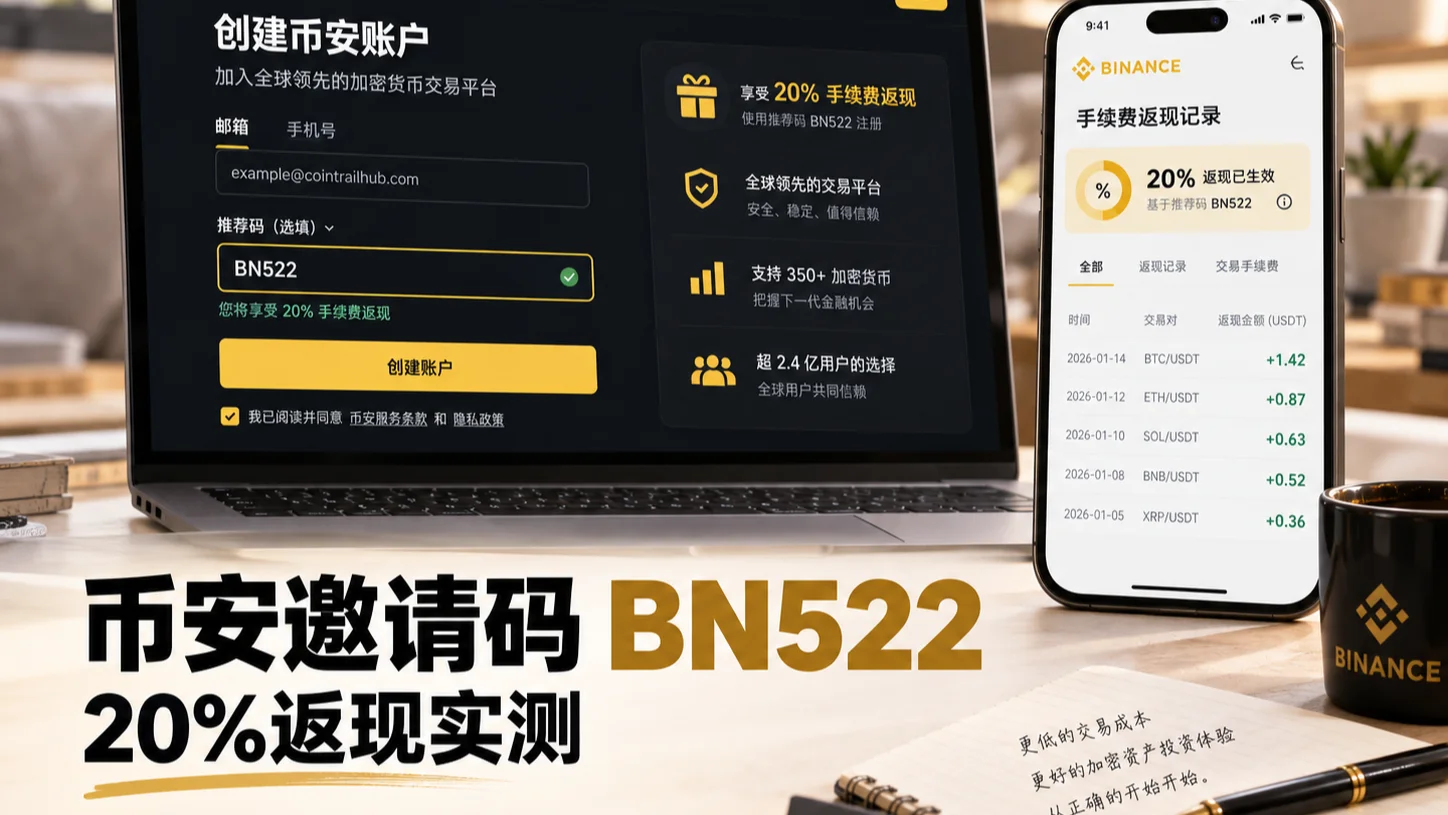
Table of contents

Binance new user rewards
20% trading fee rebate
Official Binance registration. Complete identity verification (KYC) to trade and withdraw.
In 2026, the Binance referral code BN522 gives a 20% fee rebate on spot and a 20% fee rebate on futures.[1] CoinTrailHub has verified the BN522 sign-up page, the invitee rebate rates and actual rebate records. Based on the invite account we track, the futures rebate has already met the long-term eligibility condition and is not subject to the ordinary one-year limit.
The fee rebate Binance gives back to you, the person registering, is capped at 20% — any higher number you see online is marketing spin. Those "30%, 40%, 50% rebates" all swap the commission the referrer earns for the fee you save. Binance officially allows invitees to receive at most 20% in futures rebate; anything above that is non-compliant and can be revoked if detected, so skip those pages. BN522 is verified at 20% (both spot and futures) — on 100,000 USDT of monthly spot volume, that is about 240 USDT more in a year than using no code.
What is a Binance referral code? It is the code used when registering for Binance to establish a referral relationship. Eligible users who register with BN522 can, under the applicable rules, receive 20% of their trading fees back — not 20% of their trading principal.
How do I use it? Enter BN522 at sign-up, confirm the referral code and rebate rate shown on the page, then finish registering. After trades generate eligible fees, check "My rebates" to confirm what was actually paid out.
The sections below cover the sign-up steps, how to verify your account, real rebate records, and the old-user rebinding conditions.
Binance Referral Code BN522: 2026 Verified Facts
| Item checked | BN522 verified result |
|---|---|
| Binance referral code | BN522 |
| Spot fee rebate | 20% |
| Futures fee rebate | 20% |
| Rebate plan | Long-term 20% rebate entitlement |
| Futures invite eligibility | Meets the relevant long-term review conditions |
| Sign-up page recognition | Verified in testing |
| Actual rebate records | Has real invitee cashback records |
| Rebate calculation base | Eligible trading fees |
About 7 minutes to read. Remember two things people get wrong: the fee rebate Binance gives an invitee is at most 20% — "30%, 40%, 50%" is the referrer's commission dressed up as your rebate; and 20% is calculated on the net fee, not on trading volume.
Before you fill in a Binance referral code, ask yourself four questions
Whether it's BN522 or any other code, don't rush to enter it. Run it through these four questions first — they don't depend on any brand and apply to any Binance referral code:
- Who is this percentage for? Is it a fee rebate for you (the invitee), or a commission for the referrer? "40%, 50%" usually means the referrer's commission, which is not the same as the rebate that lands in your account.
- What are the spot and futures rates separately? The two markets follow two different rebate rules. Don't assume "20%" covers both — check what the sign-up page shows for each.
- Is it long-term or time-limited? Does this code's rebate carry a one-year or assessment condition? "Permanent" has to be checked against the plan rules and your account eligibility.
- Is there real payout evidence? The sign-up page recognizing the code is one thing; whether rebates actually arrive is another. You need at least two layers — "sign-up page recognition + real rebate records" — before it passes.
Run these four questions and you can filter out most of the exaggerated claims online. BN522 was verified against exactly these four layers; the results are below.
1. How to enter the Binance referral code BN522 (2026 sign-up)
The referral code should ideally be confirmed at sign-up.
The most direct way is to enter Binance through a registration link that carries the code; you can also type BN522 into the "Referral ID / Referral Code" field on the official sign-up page.
Step 1: Open the official Binance sign-up page
Go to the official Binance sign-up page and check the domain and page details.
If you enter through the BN522 registration card on this site, first confirm that you land on the official Binance sign-up page and that the code was passed through correctly.
Step 2: Choose email or phone sign-up
Register with an email address or phone number, as currently supported by Binance.
Complete the verification steps the page requires.
Account registration methods and service eligibility may differ by region — follow what the official page shows.
Step 3: Enter and check the referral code BN522
If the sign-up page shows a "Referral ID", "Referral Code" or similar field, confirm it shows:
BN522
If the code is filled in automatically through the registration link, still check that it was recognized correctly before submitting.
If the page can display the invitee fee rebate rate, also confirm the spot and futures entitlements.
Do not trust what a third-party site claims the rebate is — go by what the actual Binance sign-up page shows.
Step 4: Finish registration and complete identity verification if needed
After confirming the code, complete account creation as the Binance sign-up page requires.
When identity verification is needed, complete KYC.
Passing identity verification does not automatically grant trading access in every country or region — go by the services your account can actually use.
Step 5: Check that the referral code is bound
After registration, go to the page in your account related to referral relationships or fee rebates and check the referral info currently shown.
If your account has already generated eligible trading fees, you can also check the actual rebate records.
It is worth checking "sign-up page recognition" and "actual rebate credited" separately, because they prove different things.
2. What is a Binance referral code? Can I register without one?
A Binance referral code is a referral identifier in the Binance referral program, used to establish a referral relationship between the referrer and a newly registered user when the conditions are met.
A referral code is not required to open an account.
You can register for Binance normally without entering a referral code. But without an eligible referral relationship, you cannot get the fee rebate tied to a referral code.
What is the difference between entering BN522 and not entering any code?
| Registration situation | Fee rebate situation |
|---|---|
| Entered BN522 at sign-up | Eligible for the corresponding 20% rebate entitlement |
| Did not enter any code | Usually no referral fee rebate |
| Entered a different code | Depends on that code's actual rebate settings |
| Apply to bind after registration | Must meet Binance's subsequent binding rules |
Whether you get a 20% rebate ultimately depends on the relationship established at sign-up, the relevant plan, your account eligibility and platform rules.
So new users should confirm the code before submitting registration, rather than assuming they can always add it later.
3. BN522 evidence: does the sign-up page really show 20%?
This site does not judge a referral code by what its promoter claims — it checks three things:
Sign-up page recognition → rebate rate setting → actual rebate records.
These three layers answer different questions.
| Evidence | What it proves |
|---|---|
| Binance sign-up page | The code is correctly recognized by the system |
| Invite account settings | The rebate rates for spot and futures |
| Rebate fund records | The account actually received rebate payouts |
The rebate fund records are a very important layer of evidence, but without matching them to the original fees, a single credit line alone cannot prove that every rebate equals exactly 20%.
Evidence 1: The Binance sign-up page recognizes BN522
This site has used BN522 to check the Binance sign-up entry.
The sign-up page recognizes the code:
BN522
At the same time, the invitee's fee rebate info can be checked in the relevant sign-up or referral settings.

Caption: BN522 sign-up page verification (checked 2026-09-26), focused on the referrer ID and the fee rebate info shown on the page.
If the sign-up page currently shows different info from this screenshot, go by the official Binance page you actually open.
Evidence 2: Both spot and futures checked at 20%
The claim "Binance referral code 20% rebate" needs to be broken down by product.
Because spot rebate, futures rebate, referrer commission and invitee rebate are not the same concepts.
BN522's current invitee rebate results are:
| Product | BN522 invitee rebate |
|---|---|
| Spot trading | 20% |
| Futures trading | 20% |
These two 20% figures are this site's verification of BN522's entitlements and cannot be applied to other codes.
If you only trade spot, check the spot rebate; if you also use futures, check the futures rebate rate and term separately.
Evidence 3: Real fund records show "invitee cashback"
The sign-up page showing a rate proves the code has that setting in that step.
But to know whether the rebate is actually paid, you need to check the account's fund records.
This site has checked several entries in a real Binance account:
Invitee cashback

Caption: Actual fee rebate records in a Binance account (checked 2026-09-26), showing record name, payout asset and time, with personal info hidden.
This proves the rebate is not just a number in marketing copy.
To be clear, however: the screenshot proves actual rebates occurred, but it cannot replace a line-by-line reconciliation of every fee and rebate amount.
As a more concrete reference, CoinTrailHub recorded two real spot rebates (2026-09-02) in another verified article:
| Item | Actual record |
|---|---|
| BNB/USDT | Fee 0.00001050 BNB; final rebate 0.00126774 USDC |
| XRP/USDT | Fee 0.00740000 XRP; final rebate 0.00183836 USDC |
| Account shows rebate | Spot 20% |
| Payout status | Both shown as paid |
This set of records is quoted from CoinTrailHub's published test case "Binance referral code BN522: no rebate received? Why and where to check rebate records", not a new test for this article. It also cannot be used to back-calculate the payout by multiplying the original fee by 20% — rebates follow Binance's actual settlement.
4. Is BN522's "permanent 20% rebate" real?
Based on the invite account this site continuously tracks, BN522 carries 20% rebate entitlements on spot and futures, and the futures invite account has met the long-term rebate eligibility, so it is not subject to the ordinary one-year limit.[2]
Here we need to distinguish "the code has long-term eligibility" from "Binance guarantees the rate will never change no matter what".
BN522's long-term entitlement comes from the fact that its invite account has met the platform's relevant review conditions, not because the characters "BN522" inherently have a permanent property.
Why do other codes have a term, while BN522 is long-term?
Binance's different referral plans, products and account qualifications can be subject to different terms and review rules.
The BN522 invite account this site has verified meets the relevant long-term futures rebate review conditions.
Therefore, BN522 is not limited to the ordinary one-year futures rebate setting.
What does "permanent rebate" mean?
In this article, "permanent rebate" means:
Under the current plan and invite-account eligibility, BN522 carries a long-term fee rebate entitlement, rather than one that automatically expires after a short promotional period.
But long-term rebates still follow official platform rules, including applicable accounts, products and possible plan changes.
For users, the most important check remains:
Confirm the entitlement at sign-up, check the referral relationship after sign-up, and check the rebate records after trading.
Do I need to check both spot 20% and futures 20%?
Yes.
Spot and futures are different products. Even if both pages show 20%, you cannot assume their calculation rules, term conditions and payout records are identical.
5. How is the 20% fee rebate calculated? How much can I save?
A Binance referral-code rebate of 20% means 20% of the eligible trading fee is returned — it is not a cashback on trading principal.
For example, if an eligible trade produces 10 USDT as the rebate calculation base:
| Fee item | Amount |
|---|---|
| Eligible fee | 10 USDT |
| Rebate rate | 20% |
| Estimated rebate | 2 USDT |
| Net fee after rebate | 8 USDT |
This is a simplified example assuming the full 10 USDT is eligible and no other factor affects the calculation base.
The BN522 20% rebate formula
Rebate amount = eligible fee base × 20%
For example:
- 1 USDT of eligible fee → about 0.2 USDT back.
- 10 USDT of eligible fee → about 2 USDT back.
- 100 USDT of eligible fee → about 20 USDT back.
The actual payout asset may differ from the asset the fee was charged in, and may involve Binance's current net-fee calculation and conversion rules.
If I trade 10,000 USDT a month, how much is the 20% rebate?
Using the ordinary spot fee rate of 0.10% as a simplified example:
| Item | Example amount |
|---|---|
| Monthly volume | 10,000 USDT |
| Assumed fee rate | 0.10% |
| Estimated fee | 10 USDT |
| Rebate at 20% | 2 USDT |
| Net fee after rebate | 8 USDT |
No code vs a 10% code vs 20% BN522 — the one-year difference
Again using the ordinary spot fee rate of 0.10%, assuming 100,000 USDT of monthly spot volume (about 100 USDT in monthly fees):
| Registration | Monthly rebate | Yearly rebate | More than no code |
|---|---|---|---|
| No code | 0 USDT | 0 USDT | — |
| 10% ordinary code | 10 USDT | 120 USDT | +120 USDT |
| 20% BN522 | 20 USDT | 240 USDT | +240 USDT |
On the same 100,000 USDT of monthly spot volume, 20% BN522 returns about 240 USDT more per year than no code, and about 120 USDT more than a 10% code.[3] For high-frequency futures traders the gap widens further.
This is a simplified estimate at a 0.10% spot fee rate with all monthly fees eligible; the actual figure follows Binance's net-fee calculation and rebate settlement.
Can the 20% rebate stack with the BNB discount?
Yes, but not by simple addition.
For spot: paying fees with BNB gives a 25% discount; the 20% rebate is then calculated on the discounted fee. Combined, the spot fee cost drops by about 40%, not 20% + 25% = 45%.[4]
For futures, the BNB discount rate differs from spot, and the combined reduction is about 28%.[5]
The exact number depends on your account fee tier, whether you pay with BNB and the rebate calculation base — go by your actual Binance statement.
Actual fees are affected by maker/taker, VIP tier, the BNB fee discount, zero-fee pairs and Binance referral program rules.
So this is not a guarantee of any future monthly rebate amount.
Do not deliberately increase your trading volume just to get a 20% fee rebate. A rebate only lowers part of the eligible fees; it cannot offset the market risk of trading itself.
6. After registering, how do I check whether BN522 is bound?
After sign-up, check three layers in order:
Layer 1: Check the code at sign-up
Before submitting, confirm BN522 is recognized correctly; if the page shows the invitee rebate rate, it should match expectations.
Layer 2: Check the referral relationship after sign-up
Go to the page in your Binance account related to referrals, referral relationships or rebates, and check whether the relationship is established. The entry point may differ by account and app version; check the official help if you cannot find it.
Layer 3: Check the rebate records after trading
After trades that meet the plan conditions occur, check whether rebate records exist, and check the payout asset, time and amount. Only when an actual payout record appears can you confirm you received the rebate.
For detailed troubleshooting, read "How to check whether Binance referral code BN522 is bound? Where to see the referral relationship".
7. I entered BN522 but got no rebate — what happened?
Entering a code at sign-up does not automatically mean a rebate — you first need to generate eligible trading fees. If you traded but still see no rebate, check against this table:
| Possible cause | How to check |
|---|---|
| No eligible fee generated | Check the fee records for the relevant product |
| Code did not establish the relationship | Check the account's referral relationship |
| Rebate not yet settled | Check the rebate records and settlement notes |
| Trade outside the applicable scope | Check the plan's products and account eligibility |
| Rebate recorded under another account | Check the corresponding product assets and fund records |
The rebate amount may also differ from "nominal fee × 20%" because of net-fee calculation or other discounts already applied. For detailed causes and real rebate records, see "Binance referral code BN522: no rebate received? Why and where to check".
8. What is the difference between 20%, 30%, 40% and 50% Binance referral codes?
In the Binance referral program, the referrer's commission and the invitee's fee rebate are two different concepts.
"Binance referral commission up to 50%" online does not mean you, a new user, will personally get a 50% fee rebate.
What is the gap between the "40%, 50%" ads and the 20% for new users?
Searching "Binance referral code", you will often see titles like "up to 50% rebate" or "40% fee discount". Most are not a fee rebate you can personally receive — they stack or mix different concepts such as the referrer's commission and the BNB fee discount.
| Common claim | What it usually means | BN522 verified |
|---|---|---|
| "Binance 50% rebate" | Usually the referrer's commission cap after meeting review tiers | Invitee rebate 20% |
| "Binance 40% rebate / discount" | Often stacks the referral-code rebate with the BNB fee discount | Invitee rebate 20%, BNB discount separate |
| "50% back on sign-up" | Presents the referrer's commission tier as the invitee rebate | Not valid; go by the sign-up page |
The louder the "40%, 50%" claims, the more you should go back to the sign-up page to see the real rate. In Binance referral rebates, the invitee's fee rebate can be set to a maximum of 20% in futures; anything above the officially allowed rate is non-compliant and can be revoked.[6] BN522 corresponds to the invitee's own fee rebate — spot 20%, futures 20% — with real rebate records as evidence (see below).
So when you see "40%" or "50%", first ask one question: is this rate for the referrer, or for you, the registering user?
Referrer commission vs invitee rebate
| Type | Meaning |
|---|---|
| Invitee fee rebate | Eligible new users get part of their fees back |
| Referrer base commission | The commission rate the referrer earns under the plan |
| Referrer high-tier commission | A higher rate the referrer earns after meeting review conditions |
| BN522 invitee rebate | Spot and futures each 20%, as verified by this site |
Binance's referrer commission mechanism may include tiers like 20%, 30%, 41% and 50%, where higher tiers usually involve additional qualifications or review requirements.
But these rates cannot be treated as the invitee's fee rebate rate.
What should I check when I see "Binance 50% rebate"?
Confirm three things:
- Is the 50% a commission the referrer earns, or a rebate the invitee receives?
- Does the rate apply to spot, futures, or another referral plan?
- Does the sign-up page actually show the corresponding invitee entitlement?
If an article packages the referrer's commission tier as "all registering users get a 50% fee rebate", it is confusing different entitlements.
For an ordinary user, what matters most is how much of your own fee you actually get back, not how high the referrer's commission tier is.
9. I already registered — can I still add BN522?
Some eligible accounts can bind a code afterwards, but not every registered user can. Different account situations are handled differently:
| Account situation | Suggested action |
|---|---|
| Not yet registered | Enter BN522 at sign-up and confirm the rebate rate |
| Just registered, no referral relationship | Check whether you meet the later binding conditions |
| Already bound to another referrer | Usually cannot change the referral relationship |
| Long-inactive account | Check whether you meet the old-user recall eligibility |
| Already actively trading | Check the official rules for your account status |
Key conclusion: an account that just registered with no referral relationship must meet Binance's later binding conditions (such as registration time, account status, KYC); an account already bound to another referrer usually cannot switch; a long-inactive account can check whether it meets the old-user recall eligibility.
For detailed rules, see "Binance old-user referral code rebinding: what conditions apply? Is the 150k volume requirement worth it (2026)".
Do not trust "internal forced rebinding" or "paid referrer change" services; if you do not meet the official binding eligibility, do not close your account, re-open it or bypass identity verification just for a referral code.
10. What is the difference between BN522 and other 20% Binance referral codes?
If two codes can both provide the same invitee entitlements — spot 20% and futures 20% — with the same applicable rules, rebate term and account eligibility, then in terms of the fee rebate rate alone, they may not differ materially.
BN522's main feature is that CoinTrailHub keeps the sign-up recognition, rebate settings and real payout records associated with this code.
It does not rely on claims like "the only code", "internal exclusive" or "highest rebate" that lack a basis.
When comparing referral codes, check:
| Item | What to confirm |
|---|---|
| Invitee spot rebate | The officially displayed rate |
| Invitee futures rebate | The officially displayed rate and eligibility |
| Rebate term | The applicable long-term or limited-time rule |
| Real payout evidence | Whether there are checkable rebate records |
| Sign-up entry | Whether it leads to the official Binance page |
If two codes have the same actual entitlements, there is no reason to think one is better just because its marketing text is more exaggerated.
FAQ
1. What is the Binance referral code in 2026?
The Binance referral code this site continuously verifies is BN522, with a 20% spot fee rebate and 20% futures fee rebate. Confirm the code and invitee entitlements on the official Binance page before registering.
2. Is BN522 a permanent 20% rebate?
Based on the invite account this site verifies, BN522 carries a long-term 20% rebate entitlement, and the futures invite account has met the relevant review conditions with no ordinary one-year expiry. Long-term entitlements still follow Binance's official plan rules.
3. How do I enter the Binance referral code BN522?
Enter BN522 in the "Referral ID / Referral Code" field on the Binance sign-up page, or use a registration link that correctly passes BN522. Confirm the info shown before submitting.
4. Can I register for Binance without a referral code?
Yes. A referral code is not required to register, but without an applicable referral relationship you usually cannot get the fee rebate tied to a referral code.
5. Is BN522's 20% for spot or futures?
This site has verified both separately: BN522 corresponds to a 20% spot invitee fee rebate and a 20% futures invitee fee rebate.
6. Is the 20% referral rebate a rebate on trading principal?
No. The 20% rebate is calculated on eligible trading fees, not on buy-in principal or deposit amount.
7. How long after registering before I see the rebate?
You first need to generate eligible trading fees, then the rebate is paid according to Binance's settlement rules. Registering successfully does not by itself mean an immediate fixed rebate.
8. How do I check whether BN522 is active after registering?
First check the account's referral relationship, then check the rebate records for the relevant product. An actual rebate record appearing is the key confirmation that you received the rebate.
9. I forgot to enter BN522 at sign-up — can I add it later?
Some accounts with no referral relationship that meet Binance's later binding conditions may be able to add it, but not every user is eligible.
10. I already bound another referral code — can I switch to BN522?
You usually cannot directly change an established referral relationship. Go by Binance's official rules and do not trust paid forced-rebinding services.
11. Why do others advertise a 40% or 50% Binance rebate?
Some numbers describe the referrer's commission tier, not the fee rebate you personally receive. Check who the actual beneficiary is and which plan applies.
12. What is BN522's advantage over other 20% codes?
BN522's main difference is that this site keeps actual sign-up recognition, rebate rate and payout records. If another code provides exactly the same invitee entitlements, its fee-saving effect may not differ materially.
Risks and boundaries: don't do these things just for the rebate
A rebate lowers part of your eligible fees, but it has clear boundaries — it's not "fill in the code and you automatically save".
The rebate applies to fees, not to principal. 20% is returned on eligible trading fees, not on your deposit or the amount of coins you buy. Buying 1000 USDT of coins won't directly "return 200 USDT".
Don't deliberately increase your trading volume to chase the rebate. A rebate only offsets a small amount of fees and can't offset the price risk of trading itself; trading more just to rebate a bit more can actually lose you more.
20% is the cap on the invitee's fee rebate. Online claims of an "invitee rebate" above 20% don't match the range Binance officially allows, and being caught may also void the benefit.
Long-term rebate ≠ the rules never change. BN522's account has met the long-term assessment and isn't bound by the ordinary one-year period, but the platform may still adjust plan rules; "long-term" doesn't guarantee the rate under all circumstances.
Don't believe "forced rebinding" or "paid referrer changes". An established referral relationship usually can't be changed directly; and it's not recommended to close your account, open a duplicate account or bypass identity verification just to enter a code — these actions carry their own account risk.
11. Summary: what should you check when choosing a Binance referral code?
In 2026, choosing a Binance referral code is not just about the rebate a page claims — it is about whether the code is real, whether the rate applies to the invitee, how the term is defined, and whether actual payout has evidence.
The Binance referral code CoinTrailHub continuously verifies is BN522: spot 20%, futures 20%, with a long-term fee rebate entitlement.
The verification info this site can provide includes:
- The Binance sign-up page recognizes BN522;
- Spot invitee rebate rate 20%;
- Futures invitee rebate rate 20%;
- Explanation of the futures long-term rebate eligibility;
- Real "invitee cashback" records.
If you have not registered for Binance, confirm BN522 and the rebate rate before creating your account.
If you have already registered, first check whether a referral relationship exists, then judge whether you meet the rebinding or recall rules.
If you have already generated eligible fees, check the rebate records to confirm actual payout.
BN522's value is not advertising a bigger percentage — it is providing a verifiable 20% fee rebate entitlement and actual payout records.
Recommended reading
- How to check whether Binance referral code BN522 is bound? Where to see the referral relationship — check whether the code correctly established a relationship
- Binance referral code BN522: no rebate received? Why and where to check rebate records — troubleshoot why no fee rebate appears after registering
- Binance referral code rebinding tutorial BN522: can you add it after registering? 30-day binding + 90-day recall + 150k rules (2026) — binding eligibility, account conditions and steps
- Binance sign-up tutorial 2026: full account-opening flow (with screenshots) — registration and identity verification
- How much are Binance fees? Spot/futures/withdrawal rates, BNB discount + BN522 rebate saving up to 40% — common fees, fee calculation and how different discounts apply
Official references
1. Binance Referral Pro Mode — Frequently Asked Questions
https://www.binance.com/id/support/faq/detail/6233094e540b4ea4ac50387d1518911b
Covers spot and futures referral commission tiers, account review and commission calculation rules.
2. Binance — 2026 referral commission calculation update
https://www.binance.com/en/square/post/316986220443009
Covers the 2026 updates to the spot and futures referral commission calculation base.
3. Binance — referral program and spot/futures rebate announcement
https://www.binance.com/en/support/announcement/detail/360043011652
Historical referral program notes, useful for understanding the difference between referrer commission and invitee rebate; specific entitlements follow current plan rules.
Author's note
The CoinTrailHub editorial team has long focused on crypto trading platforms, fees, referral codes, stablecoins and beginner account security.
The BN522 sign-up recognition, invitee rebate rates and actual records in this article are compiled from this site's kept sign-up page and related account verification records.
The rebate figures in this article do not mean all referral codes have the same entitlements, nor do they guarantee platform rules will never change. Parts that cannot be independently proven from current public records are not presented as new line-by-line test results.
Data verification notes
The key facts in this article were checked against Binance's official notes and this site's verification records on 2026-10-16, item by item:
- BN522 rebate rate: BN522 corresponds to a 20% spot invitee fee rebate and a 20% futures invitee fee rebate. Source: Binance Referral Pro Mode — Frequently Asked Questions.
- Futures long-term eligibility: BN522's futures invite account has met the relevant long-term review conditions and is not subject to the ordinary one-year limit. Source: Binance — referral program and spot/futures rebate announcement.
- One-year rebate difference example: on 100,000 USDT monthly spot volume at a 0.10% fee rate, 20% BN522 returns about 240 USDT more per year than no code. Source: Binance Referral Pro Mode — Frequently Asked Questions.
- Spot BNB discount stacking: paying spot fees with BNB gives a 25% discount, which with the 20% rebate reduces the total by about 40%, not the simply-added 45%. Source: Binance — 2026 referral commission calculation update.
- Futures BNB discount stacking: the futures BNB discount rate differs from spot, and the combined reduction is about 28%. Source: Binance — 2026 referral commission calculation update.
- Invitee rebate cap: the invitee's fee rebate can be set to a maximum of 20% in futures; amounts above the officially allowed rate are non-compliant and can be revoked. Source: Binance Referral Pro Mode — Frequently Asked Questions.
The figures above are simplified examples for clarity; the actual figures follow Binance's net-fee calculation, account fee tier and rebate settlement results.
Disclaimer: This article is educational content about exchange referral codes and fee mechanisms, and does not constitute investment, legal, tax or other professional advice. Fee rebates may be affected by platform rules, account eligibility, actual products traded and settlement mechanisms. Trading digital assets carries the risk of capital loss; do not increase unnecessary trading just to obtain a fee rebate.
- 2026-10-20UpdateAdded the "four questions before choosing" decision framework and a "risks and boundaries" section; rewrote the meta description as a truth-telling line. Additions only, no original text removed.
- 2026-10-16UpdateAdded evidence-chain citations and "Data verification notes", updated the key-fact verification date.
- 2026-07-15UpdatePublished BN522 referral-code verification content.
- 2026-09-26CorrectionCorrected the claim that "30%/40%/50% are all fake codes" — these are referrer commission tiers, distinct from invitee rebates; added futures long-term eligibility notes.
- 2026-10-08UpdateReorganized search intent while keeping the H1, sign-up card and verified evidence; added the first-screen fact table, sign-up steps, rebate lookup, fee calculation and old-user scenario table.
See ourEditorial Policy and the correction process in ourCorrections Policy.
The CoinTrailHub editorial team focuses on crypto education for beginners, exchange security and P2P trading risk. This article is compiled from official sources and public data, reviewed by humans, and strives for accuracy but is not investment advice.
Last updated:2026-10-20 · Content reviewed by humans · Learn more
© 2026 CoinTrailHub · Original content. Reproduction or rewriting without permission is prohibited.