
Binance referral code back-fill tutorial BN522: can you still add it after registering? 30-day back-fill + 90-day recall + the $150k rule (2026)
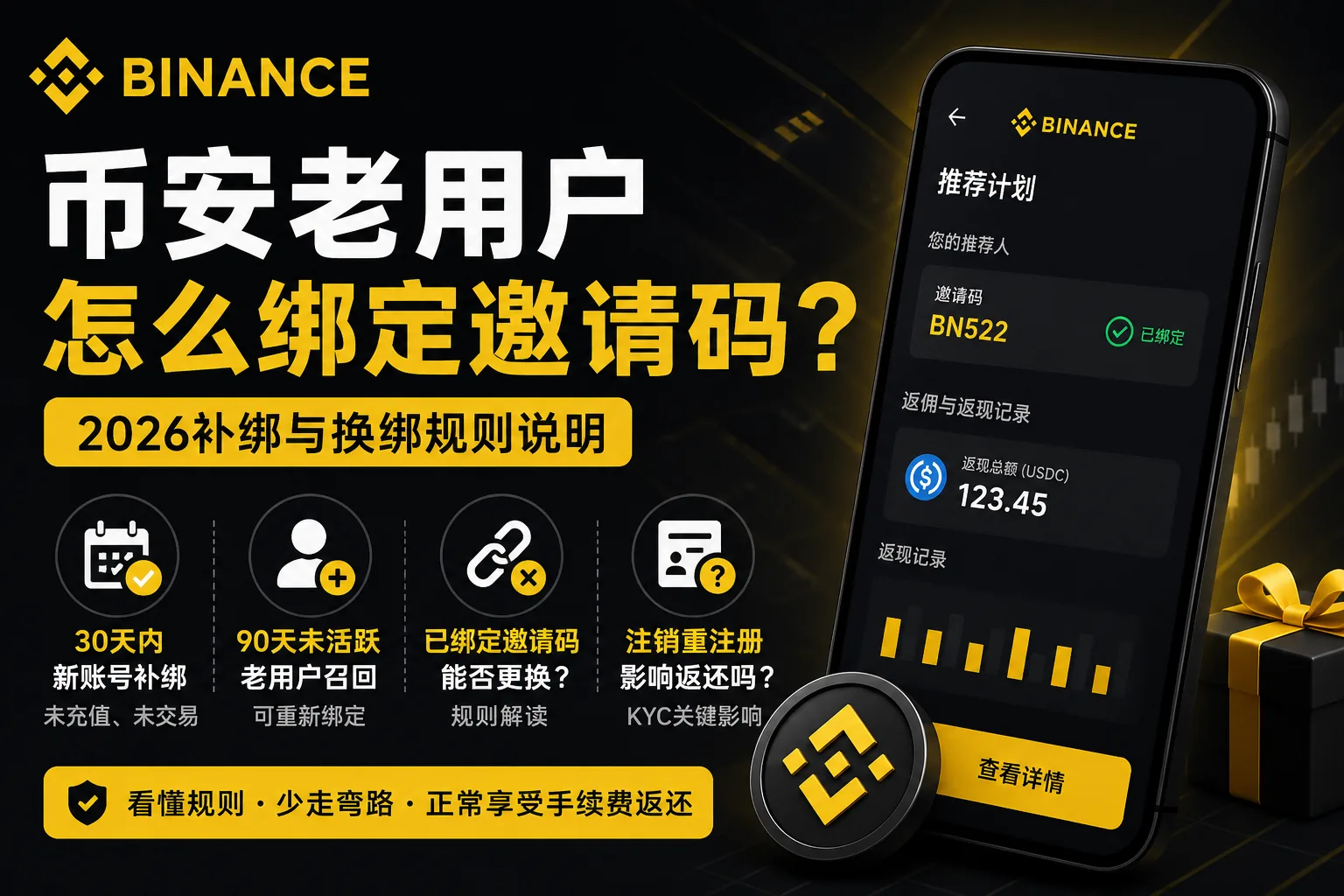
Table of contents

Binance new user rewards
20% trading fee rebate
Official Binance registration. Complete identity verification (KYC) to trade and withdraw.
Can you back-fill a Binance referral code after registering? The conclusion first
Yes, but not for every account.
Back-filling a Binance referral code means your account didn't establish a referral relationship at signup, and you add a referral code later based on the account's state. It's not the same as "switching to a different code after one is already bound".
As of October 2026, there are 3 situations where you may still back-fill or re-establish a referral relationship after forgetting the code at signup:
- Registered no more than 30 days ago, with no deposit or trading history: you can go through new-account back-fill;
- Under $5,000 in cumulative trading volume over the last 90 days: some accounts can submit a rebind application, but you usually need to complete $150,000 in valid trading volume within 30 days of applying;
- Registered over 90 days ago and completely unused for the last 90 days: you can try the old-user recall.
If the account has already bound another referrer, none of the three usually applies, because an existing referral relationship generally can't be changed or unbound.
Use this table to figure out which situation you're in.
| Account situation | Can you still back-fill? | Which path to take | Is there a $150k task? |
|---|---|---|---|
| Registered within 30 days, no deposits, no trades, no referrer bound | Yes | New-account back-fill | Usually no |
| Under $5,000 in last-90-day volume, some usage history | Possibly | Rebind application | Usually needs $150,000 valid volume within 30 days |
| Registered over 90 days ago, completely unused for the last 90 days | Possibly | Old-user recall | The recall path doesn't center on a $150k assessment |
| Already bound another referral code | Usually no | Can't normally switch | Not applicable |
| Close the old account and re-register | Not recommended as a switch plan | Carries duplicate-KYC risk | Cashback not guaranteed to work |
First check whether you have a referrer, then look at the last 90 days of trading and usage. An account already bound to a referrer usually doesn't need to study back-fill; only if nothing is bound do you continue figuring out which tier you fall into.
If all goes well, you can submit a back-fill within 5 minutes. The two places people trip up most: depositing or trading before back-filling, and mixing up "back-fill" with "switching an already-bound code".
Back-filling a code and switching a code are different
Many people search "how to switch a Binance referral code" or "how to re-enter the code after registering", but they're actually mixing two different things together.
What is back-filling a referral code?
Back-filling means the account currently has no referral relationship, and you establish a new one afterward.
For example: you registered on Binance directly from the official site without entering referral code BN522 and without registering through anyone else's referral link. This is called "no referral relationship". As long as the account state meets Binance's current back-fill, rebind or recall rules, you may still be able to establish a referral relationship.
What is switching a referral code?
Switching means the account already has referrer A, and you now want to change to referrer B.
This is completely different. Binance's current referral rules state clearly: once a referral relationship is established, it usually can't be changed or unbound.[1]
So: never bound — you can keep checking back-fill eligibility; already bound — you usually can't switch just because another code gives a higher cashback.
Case 1: registered within 30 days — can you directly back-fill the referral code?
Yes, but several conditions must all be met.
Binance currently keeps an entry for new users who forgot to enter the code at signup to re-establish a referral relationship. Per Binance's official referral and rebate rules, the account usually needs to meet all of the following:
- Registered no more than 30 days ago;
- Currently has no referral relationship;
- Uses the main account, not a sub-account;
- No deposit history;
- No trading history;
- KYC identity documents were not used for another Binance account in the past 180 days;
- Not flagged by the system as a wash trader or abnormal user.
The easiest mistake here is "buy USDT first, then back-fill the code"
Many people see "30 days" and only remember the registration age, but miss that no deposits and no trades are equally core conditions.
For example, an account registered only 3 days ago but that already bought USDT via P2P, deposited USDT, or made a spot trade may already fail the simplest new-account back-fill conditions, even though it's still within 30 days of registration.
So the correct order for a new account is: confirm the referral relationship → complete the back-fill → then deposit and trade.
How to back-fill BN522 within 30 days?
If you've confirmed you registered less than 30 days ago, have no deposits, no trades and no other referrer bound, you can enter Binance's official "Bind Super Referral code / referral relationship binding" page.
After logging into your Binance account:
- Check whether the page allows your current account to bind;
- Enter referral code BN522;
- Check the referral code and cashback rate shown on the page;
- Confirm and submit;
- After submitting successfully, then start depositing or trading.
If the page shows the account already has a referral relationship, doesn't meet the conditions, or can't submit, don't repeatedly create new accounts — first check the account state.
BN522 currently provides a 20% fee cashback rate.[2] The actual page result and account eligibility are subject to what Binance shows after login.
If you haven't finished registering yet, see the Binance registration tutorial (2026) first.
Case 2: can an old Binance account still back-fill? Under $5,000 in last-90-day volume can apply for a rebind
This is the rule most worth updating in this article as of October 2026.
"Registered over 30 days ago" no longer means you've completely lost the back-fill opportunity.
Binance has added a "Rebind Application" path. Per Binance's official rules updated in September 2026, eligible existing users can submit a rebind application. The user usually needs to meet all of:
- KYC completed;
- Currently no referrer;
- Using the main account;
- Under $5,000 (or equivalent) in cumulative trading volume over the last 90 days;
- Not identified as abnormal-trading or wash-trading user;
- Your region supports the Binance referral program.
As long as you have no referrer, even if you already have some trading history, it doesn't necessarily mean you can't back-fill. The key is to keep checking: has your cumulative trading volume over the last 90 days reached $5,000? If it has, you generally don't meet this rebind-application eligibility.
Why does the rebind come with "30 days and $150,000"?
The "30 days" here isn't the same concept as a new account's "within 30 days of registration" — they're very easy to confuse.
- A new account's 30 days: no more than 30 days since the account registration date.
- The rebind's 30 days: a 30-day assessment period starting from when you submit the Rebind Application.
Meeting rebind eligibility only means you can submit an application. After submitting, you still need to accumulate $150,000 (or equivalent) in valid trading volume within 30 days of applying.[3] Once the volume is reached, you don't need to wait until day 30 — Binance officially states that once the target is reached, the rebind relationship can complete the same day.
Which trades count toward the $150,000?
| Trade type | Counts toward $150,000? |
|---|---|
| Spot trading | Counts |
| Futures trading | Counts |
| Convert | Counts |
| Margin trading | Counts |
| Copy trading | Eligible main-account volume counts |
| Sub-account trading | Does not count |
| Zero-fee trading pairs | Does not count |
Note this carefully: $150,000 means cumulative trading volume, not preparing $150,000 in principal. For example, one amount of funds that goes through multiple eligible buys and sells keeps adding to cumulative turnover. But trading itself incurs fees, and there is also price volatility and trading risk. So don't deliberately manufacture a lot of unnecessary trading just to get the 20% fee cashback.
Is the $150,000 volume worth doing for the cashback?
If you already have normal trading needs, you can do the math; if you're deliberately washing $150,000 in volume just for cashback, it's usually not worth it.
Cashback is essentially returning a portion of fees you've already paid. For example, at a 0.10% spot fee rate: 150,000 × 0.10% = 150 USDT in fees; the corresponding 20% cashback is 150 × 20% = 30 USDT. This is just a static example for understanding. Real costs are also affected by maker/taker, BNB discount, spot vs. futures, VIP tier, actual fills, buy/sell spread, market volatility and more.
Don't actively manufacture trading volume far above your normal needs just for tens of dollars of cashback. If you would generate that volume anyway, it's more reasonable to consider completing the assessment.
For how to calculate the cost of the $150k assessment, see What conditions apply to switching a Binance referral code to BN522 as an old user? Is the $150k volume assessment worth it (2026); for fees and BNB discount, see How much are Binance fees.
Case 3: registered over 90 days ago, unused for the last 90 days — the old-user recall
This isn't the same as the "under $5,000 in 90-day volume" above either. Binance has a separate "old-user recall program".
Binance adjusted the original 180-day threshold to 90 days on March 24, 2026.[4] An account eligible for the old-user recall usually needs to:
- Have a registered Binance account;
- Never have bound any referrer;
- Be registered more than 90 days ago;
- Have not used any Binance product line in the last 90 days;
- Be in a region that supports the feature.
How does the old-user recall work?
This tier of users doesn't simply fill in a code in account settings. The normal flow is:
- Open the latest referral link that supports old-user recall;
- Log into the original Binance account;
- The system checks whether the account meets recall eligibility;
- A binding confirmation appears on the page;
- The user actively clicks to confirm binding.
If you plan to use BN522, you should enter through the latest BN522 referral link that supports recall — don't just look for a "referral code input box". Binance currently distinguishes this explicitly: a new referral link can handle eligible new and old users, while an old referral link may not support old-user recall.
What's the difference between the 90-day recall and the 90-day low-volume back-fill?
This is the easiest thing to confuse when searching "Binance referral code back-fill" now.
| Item | 90-day old-user recall | 90-day low-volume rebind |
|---|---|---|
| Core audience | Long-term completely inactive users | Existing users with little recent usage |
| Has a referrer? | Must not | Must not |
| Main condition | Registered over 90 days ago and unused for the last 90 days | Under $5,000 in cumulative last-90-day volume |
| Main entry | Latest referral link supporting recall | Rebind application page |
| $150k assessment | The recall rule doesn't center on this assessment | $150,000 valid volume within 30 days of applying |
Simply put: completely unused for 90 days → check recall first; used but very low last-90-day volume → check the rebind application.
Case 4: already bound another code — can you switch to BN522?
Usually no.
If the account has already established a referral relationship, you generally can't remove the existing referrer, switch to another code, change codes because another code gives higher cashback, or ask support to change referrer A to referrer B.
Binance's current official rule is clear: once a referral relationship is established, it can't be normally changed or unbound. So don't understand "rebinding an account with no referrer" as "changing an account bound to A into B". These are two completely different things.
How do you check whether your Binance account has a referral code bound?
If you don't know whether your account currently has a referrer, don't first guess whether you're in the 30-day or 90-day bucket. The first step is confirming whether the account currently has a referral relationship.
After logging into Binance, you can check: the invite-rewards related page, whether an existing referral relationship is shown, whether there is any fee-cashback record, whether the binding page prompts that a referrer exists, and whether it allows submitting a rebind.
If you still can't tell, directly ask Binance's official support: "Please help me check whether this account currently has a referrer or referral relationship." You don't need to tell support which code you plan to switch to. First confirm "is there a referral relationship" — this one answer directly rules out a lot of useless actions.
For how to view the referral relationship, see How to check whether Binance referral code BN522 is bound? Where to view the referral relationship.
I already deposited or traded — can I still back-fill the referral code?
The answer can no longer be simply "no"; it depends on the case.
- Within 30 days of registration, but already deposited or traded: usually no longer meets the simplest new-account back-fill conditions.
- Already has trading history, but under $5,000 in last-90-day volume: may be able to use the new rebind-application path, but still needs to meet KYC, no referrer, main account, normal risk control, region support and more — and after submitting successfully, usually needs to complete the $150,000 valid-volume assessment within 30 days.
- Completely unused for the last 90 days: if also registered over 90 days ago, you can separately check old-user recall eligibility.
So "traded once means never able to back-fill" is no longer an accurate conclusion.
Can you close the account and re-register to switch the referral code?
Closing and re-registering isn't recommended as a normal code-switching plan.
Binance's official referral rules already warn: if the system finds a user closed an existing account to create a new one with a new referral code to obtain referral rewards, Binance can terminate the new account's referral rebate. In addition, KYC identity documents carry identification continuity — a new email may register successfully, KYC may complete, and the referral code may appear to be entered successfully, but the system later finds the same identity documents corresponded to another account, and the result is the referral rebate and user cashback being voided.
So "you can register a second account" doesn't equal "the new referral cashback will definitely work". If the original account has been in long-term use, closing it just to switch a code is usually unnecessary.
Don't register with someone else's ID documents
Also, don't long-term use a family member's or friend's identity documents to register a trading account just to get referral cashback. Down the road it can involve facial recognition, withdrawal review, risk-control re-review, identity re-verification, account appeals and source-of-funds explanation. When the actual user doesn't match the KYC identity holder, account problems become far more troublesome than the referral code.
After BN522 binds successfully, how is the 20% fee cashback calculated?
BN522 currently sets a 20% fee cashback rate. The "20%" here doesn't mean depositing 1,000 USDT returns 200 USDT, nor 20% of trading principal; it means: after eligible trading fees are generated, cashback is paid at the corresponding rate.[5]
For example, a trade that ends up generating 10 USDT in eligible fees gets 20% cashback of 10 × 20% = 2 USDT. The actual rate is also affected by trade type, BNB fee discount, VIP tier and more. For how fees are calculated, see How much are Binance fees.
Why don't I see cashback immediately after binding?
A referral code successfully establishing a referral relationship doesn't mean the account will show cashback right away. Eligible trades must happen first and generate fees.
If you don't see cashback, check in this order:
- Was the referral relationship actually established;
- Did the referral code set a user cashback rate;
- Did trades actually generate fees;
- Do the trade type and VIP tier meet the requirements;
- Is it still in settlement.
Binance's current referral and rebate rules show that referral rebates and invitee cashback are paid in USDC by default, calculated hourly and converted to USDC, and after conversion usually credited to the spot account within 6 hours.[6]
So: first confirm "did it bind successfully", then judge "why hasn't the cashback arrived". If the relationship was never established, waiting longer won't produce any cashback.
Binance referral code back-fill: a one-minute way to decide what to do
The judgment order for back-filling a Binance referral code is: first check whether you have a referrer, then registration age, then whether you used Binance in the last 90 days, and finally whether last-90-day volume is under $5,000.
If you just want the next step now, follow this order.
Step 1: Have you bound another referrer?
Yes → usually can't switch, done; No → continue to step 2.
Step 2: Registered within 30 days and never deposited or traded?
Yes → new-account direct back-fill; No → continue to step 3.
Step 3: Registered over 90 days ago and completely unused for the last 90 days?
Yes → check the old-user recall first; No → continue to step 4.
Step 4: Is your cumulative last-90-day volume under $5,000?
Yes → check rebind-application eligibility (if eligible, usually need to reach $150,000 in valid volume within 30 days of applying); No → the normal back-fill opportunity is usually very low right now.
This order is more accurate than just memorizing "30 days" and "90 days".
FAQ
Can I still enter a referral code after registering on Binance?
Yes, but it depends on the account state. Users registered within 30 days with no deposit or trading history and never bound to a referrer can check new-account back-fill eligibility. Some users beyond the new-account window may apply for a rebind if their last-90-day volume is under $5,000. Long-term inactive users can check 90-day recall eligibility.
Can I back-fill a Binance referral code if I registered over 30 days ago?
Possibly. After 30 days you're no longer on the simplest new-account back-fill path, but if you currently have no referrer, have completed KYC and have under $5,000 in last-90-day volume, you may still meet Binance's rebind-application conditions. Also, accounts registered over 90 days ago and unused for the last 90 days can check the old-user recall.
I already bought USDT — can I still back-fill the code?
Not necessarily. If you already bought USDT via P2P or made trades, you usually don't meet the "no deposits, no trades within 30 days" new-account direct back-fill conditions. But if the account has no referrer and its last-90-day volume is under $5,000, you can keep checking rebind-application eligibility.
Does back-filling a Binance referral code always require $150,000 in trading?
No. The $150,000 task doesn't apply to all back-fill users. A new account within 30 days with no deposit or trading history does direct back-fill, while a low-volume old user's rebind application is a different path. The $150,000 assessment mainly applies to the latter.
Does $150,000 mean I have to deposit $150,000?
No. $150,000 refers to eligible cumulative trading volume, not that the account must deposit $150,000 in principal. However, trading incurs fees and trading risk, so it's not recommended to do unnecessary large-volume trading just for cashback.
Which trades count toward the $150,000?
Per Binance's current rules, spot, futures, Convert, margin and eligible main-account copy trading count. Sub-account trading and zero-fee trading pairs do not count.
Is the old-user recall now 90 days or 180 days?
It's now 90 days. Binance adjusted the original account-registration and inactivity requirement from 180 days to 90 days on March 24, 2026.
Is "no trading for 90 days" the same as "under $5,000 in 90-day volume"?
No. Completely unused for the last 90 days mainly maps to the old-user recall; having usage records in the last 90 days but under $5,000 in cumulative volume may map to the rebind application. The two paths have different entries and follow-up conditions.
I already bound another code — can I switch to BN522?
Usually no. Once a referral relationship is established, Binance's normal rules don't allow changing or unbinding it.
Can contacting Binance support switch the referral code?
Support can help confirm whether the account has a referral relationship, why an application can't be submitted, or why cashback hasn't arrived, but support can't serve as a normal forced code-switch method.
After closing and re-registering, can I enter BN522?
It's not recommended to treat this as a switch plan. The system may identify the same KYC identity documents, and Binance explicitly reserves the right to terminate such accounts' referral rebate and cashback.
What does BN522's 20% rebate mean?
It means eligible trading fees get 20% cashback, not 20% of the deposit amount or trading principal. For example, 10 USDT in eligible fees corresponds to 2 USDT at 20%.
My advice
If you forgot to enter the referral code when registering on Binance, don't close the account first, and don't go study some so-called "forced switch". Just follow these four steps:
- Within 30 days + no deposits/trades → new-account back-fill
- Over 90 days + completely unused for the last 90 days → old-user recall
- Under $5,000 in last-90-day volume + no referrer → check the rebind application, noting the 30-day $150,000 assessment
- Already bound another referrer → usually can't switch
What actually decides whether you can back-fill isn't a single "30 days" or "90 days", but: whether you have a referrer + how long since registration + whether you used it in the last 90 days + your last-90-day volume.
If you've confirmed the account meets direct back-fill or rebind eligibility, you can check referral code BN522 (current fee cashback rate 20%). If you haven't registered, go straight to the BN522 signup entry and confirm the 20% cashback on the signup page before continuing.
Before submitting, first confirm the referral code, cashback rate, trading target and assessment period shown on the Binance page, then decide whether to continue. If the system requires $150,000 in trading volume, don't start trading just because of the words "20% cashback" — first calculate how many fees completing the assessment would generate, then judge whether it matches your normal trading needs.
Rules may change
Binance may adjust these features based on region, account state and referral-program policy. The 30-day back-fill conditions, $5,000 threshold, $150,000 assessment and 90-day recall rule recorded here — the final eligibility, trading target, assessment period and cashback rate are subject to what the account actually shows after logging into the official Binance page.
Related articles
- What conditions apply to switching a Binance referral code to BN522 as an old user? Is the $150k volume assessment worth it (2026) — specifically calculates the $5,000 threshold, the 30-day $150k assessment and fee cost
- Didn't enter the Binance referral code? Back-fill rules + old-account test, code BN522 with 20% back — demonstrates the back-fill process with a real account
- How to check whether Binance referral code BN522 is bound? Where to view the referral relationship — read this first if you're unsure whether you have a referrer
- Binance referral code 2026 latest test: which code actually gives 20% back? BN522 test record — check the code's rate and cashback record
- How much are Binance fees? Spot/futures/withdrawal rates, BNB discount + BN522 rebate saving up to 40% — after binding, keep calculating your actual trading fees
Data verification notes
The key facts in this article were verified against Binance's official documentation on 2026-10-16, item by item:
- Referral relationship can't be changed or unbound: once a referral relationship is established, it usually can't be changed or unbound. Source: Binance "Referral and rebate program FAQ".
- BN522 cashback rate: BN522's current fee cashback rate is 20%, subject to what the page shows after login. Source: Binance "Referral and rebate program FAQ".
- Rebind assessment: after submitting a rebind application, you need to accumulate $150,000 (or equivalent) in valid trading volume within 30 days. Source: Binance "Super Referral rebind feature FAQ".
- Recall threshold adjusted: Binance adjusted the old-user recall threshold from 180 days to 90 days on March 24, 2026. Source: Binance "Old-user recall program".
- What the 20% is calculated on: 20% cashback is calculated on eligible fees, not on the deposit amount or trading principal. Source: Binance "Referral and rebate program FAQ".
- How rebates are paid: referral rebates and invitee cashback are paid in USDC by default, calculated hourly and converted, usually credited to the spot account within 6 hours. Source: Binance "Referral and rebate program FAQ".
The 30-day back-fill conditions, $5,000 threshold, $150,000 assessment and 90-day recall rule recorded here are subject to what the account actually shows after logging into the official Binance page.
- 2026-10-16UpdateAdded evidence-chain superscripts and "Data verification notes"; updated key-fact verification date.
- 2026-10-06UpdatePer Binance's Super Referral rebind feature, added the "under $5,000 in last-90-day volume + $150,000 valid volume within 30 days of applying" path; restructured into three paths — 30-day back-fill / 90-day recall / low-volume rebind.
- 2026-09-15UpdateAdded Binance official sources, HowTo structured data and verification date.
See ourEditorial Policy and the correction process in ourCorrections Policy.
The CoinTrailHub editorial team focuses on crypto education for beginners, exchange security and P2P trading risk. This article is compiled from official sources and public data, reviewed by humans, and strives for accuracy but is not investment advice.
Last updated:2026-10-06 · Content reviewed by humans · Learn more
© 2026 CoinTrailHub · Original content. Reproduction or rewriting without permission is prohibited.