
Why can't anyone control Bitcoin? 17 years of consensus mechanisms explained

Table of contents

Binance new user rewards
20% trading fee rebate
Official Binance registration. Complete identity verification (KYC) to trade and withdraw.
If someone proposed today:
"Change Bitcoin's total supply from 21 million to 50 million."
Who could stop it?
Not the US government. Not the miners. Not even the Bitcoin Core developers.
But it's also not true that "nobody can change anything" — Bitcoin can be upgraded; SegWit and Taproot are proof. The key point is: any upgrade must win the acceptance of a broad range of participants. Nobody can decide unilaterally.
This is exactly what makes Bitcoin special: it has no boss, yet it has a consensus system that makes every participant follow the rules.
After long-term research and use of BTC, my biggest takeaway is this: understanding how this system works matters a hundred times more than staring at price charts. Because it answers a fundamental question — is this thing going to disappear one day?
Reminder: this article shares personal holding experience and explains technical principles. It does not constitute investment advice. Crypto assets are volatile; make decisions carefully according to your own risk tolerance.
Core information
- BTC has no "controller" — no CEO, no central server, no single point of control. The node network distributed across the globe verifies independently; no single party can change the rules unilaterally.
- The 21 million cap is almost impossible to change — it is not just a code rule, but a social consensus formed by 17 years of market participants. Anyone who publicly pushes for inflation faces enormous community and economic resistance.
- A 51% attack exists in theory but is economically infeasible — the cost of attacking for one day is in the tens of millions of dollars. Once launched, BTC's price collapses, and the attacker's mining machines and holdings go to zero first.
- Extremely slow upgrades are actually a moat — for a store of value, stability > features. Bitcoin's "conservatism" is a deep understanding of its "digital gold" positioning.
- What you should really worry about is not the Bitcoin network, but your own private key management — the Bitcoin main chain has remained highly consistent for 17 years with no persistent consensus splits. Most coin-loss incidents come from users losing, leaking, or mismanaging their private keys.
Who should read / who shouldn't
| Your situation | Recommendation |
|---|---|
| Planning to hold BTC long-term (3+ years) | Must read — understand why BTC can't be wrecked by anyone, so you can hold through it |
| Hesitating on allocation between BTC and other chains | Must read — differences in governance models directly determine long-term value certainty |
| Worried that "Bitcoin has nobody in charge, will something go wrong someday" | This is the article for you |
| Holding a large amount ($100,000+), want more peace of mind | Should read — you'll learn why you should run your own full node |
| Only doing short-term trading, selling within days | Not really needed — knowing to wait for 6 confirmations is enough |
| Only want to know "will it reach $1 million" | Not needed — this article is not about price, but about "will it go to zero" |
Who decides which chain is real? — Technical consensus
Many people think PoW is Bitcoin's consensus, but actually PoW only solves one problem: without a central authority, how does the entire network choose one single history?
In a decentralized P2P network, there is no central server telling you "which version is correct". Different nodes may receive different blocks at the same time — the network has latency. How do nodes decide which version is "real"?
The answer is Nakamoto consensus, which mainly consists of two core mechanisms: PoW (Proof of Work) makes block production costly, and the longest-chain rule lets the whole network automatically pick the same chain when a fork happens. Economic incentives then act as a deeper driving force that keeps participants willing to maintain the system long-term — that is the economic consensus covered in the next section.
A simplified understanding: miners spend real hash power to compete for the right to produce blocks (PoW) → after a block is produced, all nodes across the network verify it independently → if a fork occurs, everyone automatically follows the chain with the most accumulated work → the whole process is driven economically by block rewards and fees.
What this means for you: once your transaction is confirmed by 6 or more blocks, the cost of rewriting that part of history becomes unrealistically high — the more hash power the network has, the higher the cost an attacker must bear. This is not "theoretically safe"; it is economically infeasible.
A key boundary: miners cannot make the rules
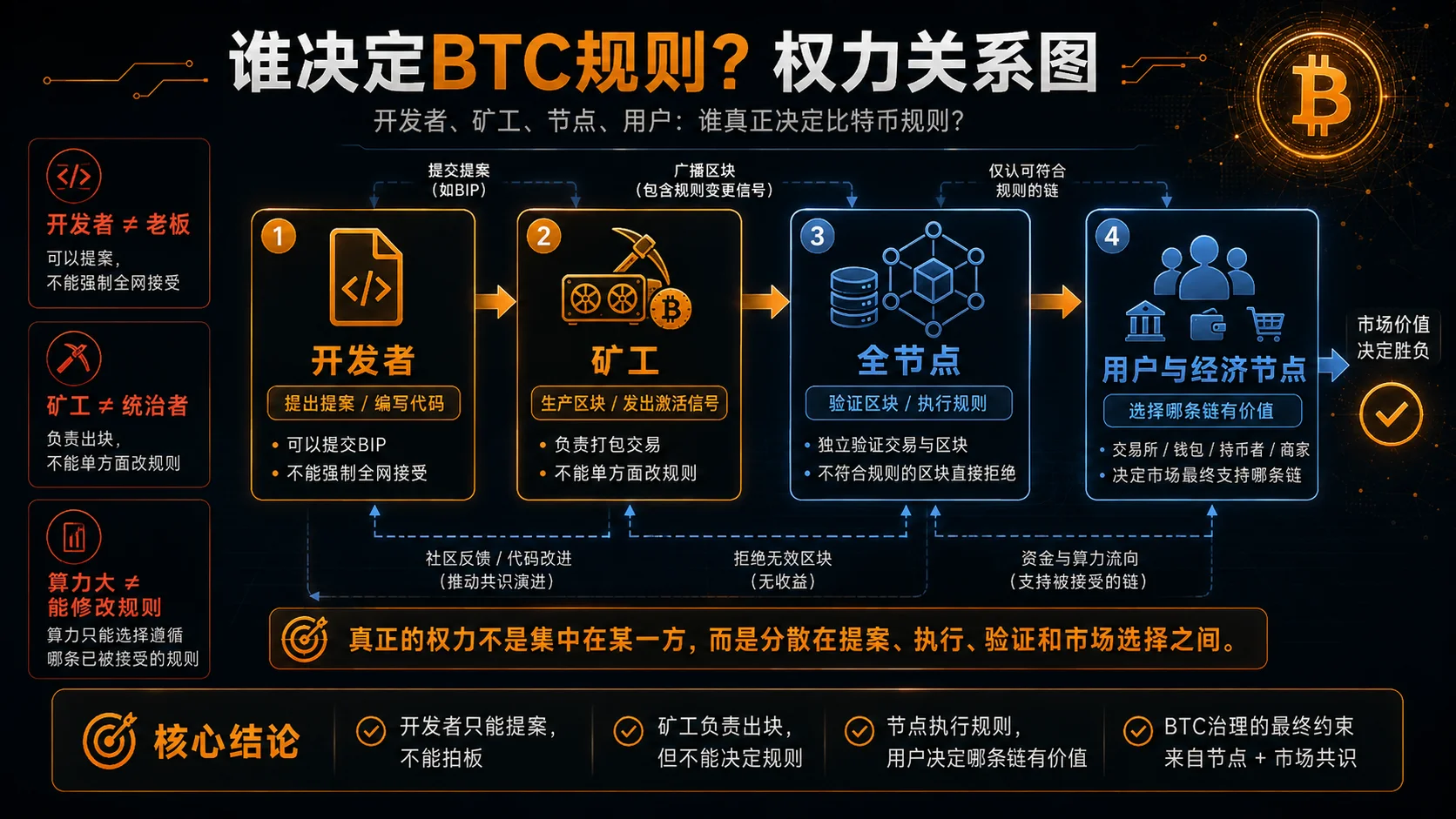
Many people mistakenly think "whoever has the most hash power controls Bitcoin" — that is wrong. Miners can only produce blocks within the protocol rules. If a miner produced more than 21 million BTC, users running Bitcoin nodes would simply reject it — no matter how much hash power was stacked on it. Miners packing blocks ≠ miners making the rules.
Case: the 2010 value overflow bug
In August 2010, someone found a bug and used it to generate a transaction of 184 billion BTC — far exceeding the 21 million cap.
How did the Bitcoin network respond? Developers quickly released a fix. After most nodes and miners upgraded to the new version, the blockchain containing the abnormal transaction was repaired, and the network rolled back to the state before the bug. Within hours, the chain was back to normal.
This case illustrates two things: first, this was not Bitcoin being hacked, but an early code bug being found and fixed — any long-running software system can go through an early-bug phase; the key is the repair mechanism after discovery. Second, the fix had to win broad acceptance from network participants — nobody can unilaterally rewrite Bitcoin's history.
For technical details, see How does the blockchain record transactions? Blocks, hashes, and Proof of Work (2026).
Why don't miners cheat casually? — Economic consensus
Technical consensus answers "how to choose"; economic consensus answers "why follow the rules".
The Bitcoin network has four core groups of participants. Each has its own interests, but under the economic incentive design, honest behavior is more profitable for every party in the long run.
| Participant | Benefit of following rules | Cost of cheating | Why they choose honesty |
|---|---|---|---|
| Miners | Block reward (3.125 BTC) + fees | Block rejected → electricity loss + machine depreciation | Cheating profit < long-term mining profit |
| Full node operators | Independent verification, no need to trust anyone | Running a dishonest client isolates you from the network | Verify rules to protect their own assets |
| Holders | Secure asset storage | Cheating is meaningless | Support the network they recognize through economic value |
| Developers | Community reputation + code used by millions | Submitting malicious code gets them permanently banned | Gain influence through reputation |
Satoshi wrote the core logic clearly in the Bitcoin whitepaper:
"If a greedy attacker is able to assemble more CPU power than all the honest nodes, he would have to choose between using it to defraud people by stealing back his payments, or using it to generate new coins. He ought to find it more profitable to play by the rules."
In 2014, the Ghash.io mining pool briefly exceeded 50% of hash power, causing community panic — but the miners voluntarily pulled out hash power themselves. Not out of kindness, but because a BTC price collapse would turn their mining machines into scrap. The people capable of wrecking the system are exactly the ones who lose the most if they do. This design is brilliantly subtle.
For more on Bitcoin's value logic and decentralized operation, see Why does Bitcoin not need banks? UTXO, nodes, and PoW.
Why does nobody dare change the 21 million cap? — Social consensus
The first two layers are supported by algorithms and game theory; the third layer is purely about "people" — but its binding force is no weaker than any law.
Social consensus is the set of core values not written into code, but shared by all participants. It is like a "constitutional spirit" — specific clauses can be discussed and amended, but core principles cannot be touched.
Three untouchable principles
- Decentralization: any proposal that makes the network more centralized is almost impossible to pass. The community instinctively resists it.
- Censorship resistance: anyone, anywhere, can send and receive Bitcoin without permission. This is the most fundamental difference between BTC and fiat currency.
- Permissionless: no account application, no KYC (at the protocol level) needed to run a node, mine, or transact.
Why can't the 21 million cap be changed?
Bitcoin's 21 million cap is just a few lines of constants in the code. But over the past 17 years, there has never been a single serious BIP proposal to increase the supply. Because "21 million fixed supply" has become a core belief of social consensus — any developer who proposes inflation immediately loses all community credibility; their GitHub account, mailing list posts, and forum threads would all become worthless.
The reason SegWit2x (the New York Agreement) failed in 2017 was, on the surface, technical disputes — but at root, the community believed it violated the social consensus that "miners should not unilaterally decide protocol rules" (Bitcoin Magazine ran a series of in-depth reports on this). A large number of users and economic nodes chose not to upgrade, and the entire proposal was abandoned. The opposition split off to create BCH — ultimately forming another independent chain, but without replacing BTC as the mainstream Bitcoin network.
The power of social consensus: those who comply gain reputation; those who violate get excluded. Bitcoin has no power to "fire" anyone, but it has the power to make anyone "lose all influence". Bitcoin's 17-year history proves: code can be copied, but consensus cannot. Fork coins like BCH and BSV share the same code but failed to replicate BTC's community consensus and network effect. For the economics of the 21 million cap, see Bitcoin's 21 million supply cap: why a fixed supply is more valuable.
How do Bitcoin's rules actually upgrade? — Governance consensus
The first three layers answer "what are the rules" and "why follow them", but rules also need to evolve. That involves the fourth layer — how rules change.
BIP: Bitcoin's "legislative process"
Every upgrade is advanced through BIP (Bitcoin Improvement Proposal), modeled on the IETF's RFC mechanism. The process is: draft → community discussion → code implementation → miner signaling → node activation. Every step is public and transparent.
The Bitcoin community strongly prefers soft forks (backward compatible, old nodes can still verify) over hard forks (must upgrade or be kicked off the network). This is not a technical reason but a governance philosophy: upgrades are optional, forcing no one. Even if you don't upgrade, you still see the same chain.
Case ①: SegWit (2015–2017) — why aren't miners the final decision-makers?
This is the most controversial, and most instructive, governance event in Bitcoin's history.
Background: in 2015, blocks approached the 1MB limit, and transaction confirmations started to slow. The community split — the big-block faction (supported by some miners and community members) vs the SegWit faction (supported by core developers, fixing transaction malleability + effectively scaling to ~2MB).
The key game:
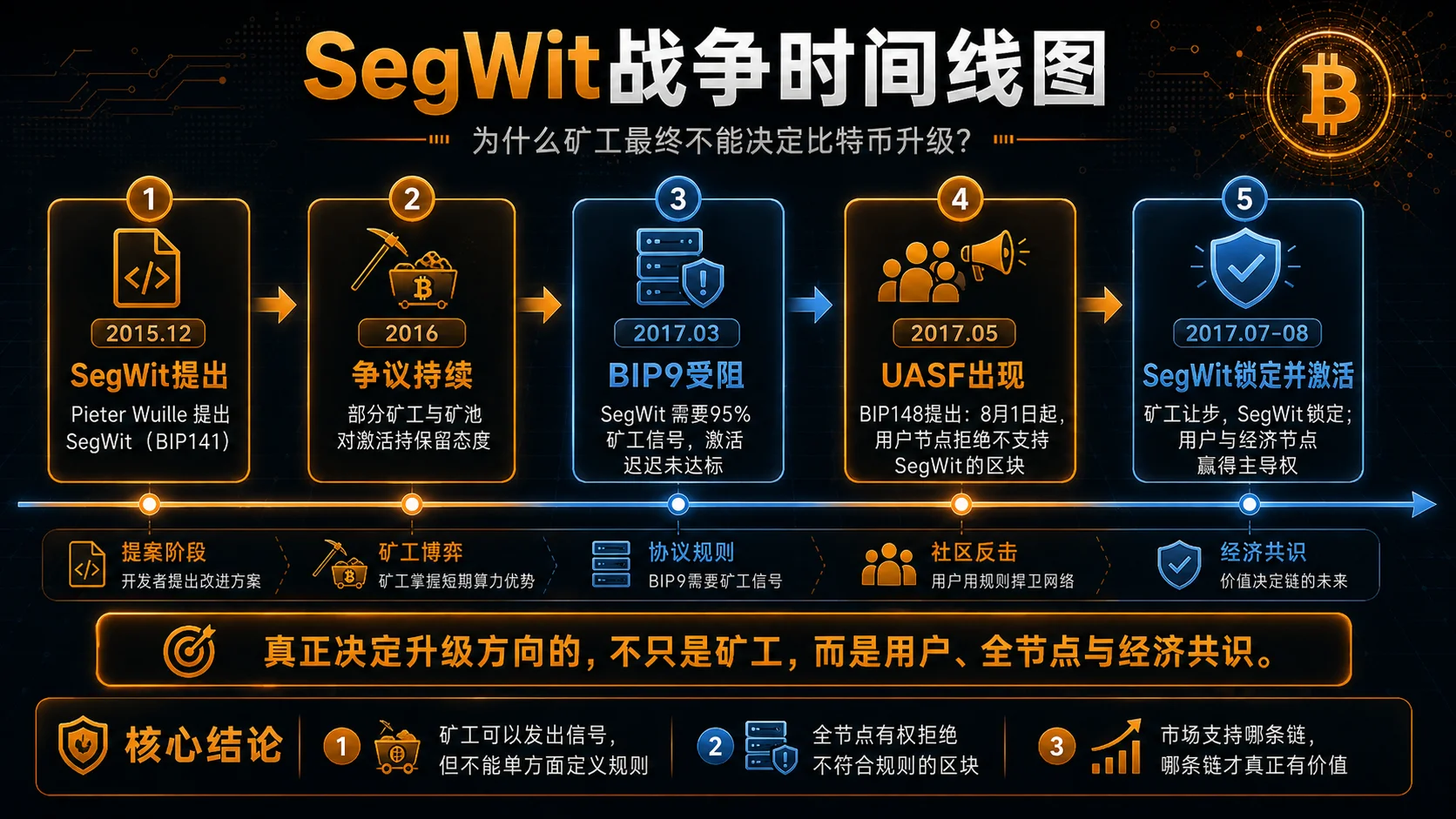
- December 2015: Pieter Wuille proposed SegWit (BIP141)
- Throughout 2016: some miners and pools, out of interests and roadmap disagreements, held back on SegWit activation
- March 2017: activation required 95% miner signaling (BIP9), and miners deliberately failed to meet it
- May 2017: the community proposed UASF (BIP148) — regardless of whether miners signaled, blocks that did not implement SegWit after August 1 would be rejected. This was a counter-move by users and economic nodes against the miner signaling mechanism.
- July 2017: miners relented, and SegWit was locked in and activated
What holders should learn from this: when miners don't cooperate, users and economic nodes can force miners into line by "refusing to recognize your blocks". Governance power ultimately rests with users — because if miners mine on a chain nobody wants, their rewards are worthless.
Case ②: Taproot (2018–2021) — why are some upgrades completely uncontroversial?
Taproot is the biggest upgrade since SegWit (Schnorr signatures + MAST + Tapscript), but the process was almost "quiet" — no controversy, no split; when it activated in November 2021, most holders didn't even know what happened (Bitcoin Optech has detailed technical records of the entire activation process).
Why was it so smooth?
- It didn't touch sensitive issues (no block size or inflation involved)
- The community absorbed the lessons of SegWit (full discussion, long-term review)
- It used Speedy Trial rather than BIP9 (harder for miners to stall)
- All participants net-benefited; nobody lost
In the week Taproot activated in 2021, I felt absolutely no change — that is the best governance experience.
The two cases illustrate the same thing: when there is controversy, the game is fierce but users ultimately win. When there is no controversy, upgrades happen quietly and seamlessly. Both paths work well.
My selection logic: what different holding strategies need to care about
Not every holder needs to study the BIP process. Your strategy determines which layer you need to care about.
| Your holding strategy | Consensus layer to care about most | Actual risk | What you need to do |
|---|---|---|---|
| Long-term HODL (3+ years) | Social consensus | Very low | Understand why the 21M cap won't change → just hold |
| Monthly DCA | Economic + social consensus | Very low | Just watch major upgrade events (only once every few years) |
| Large holdings ($100,000+) | Technical + social consensus | Low | Run your own full node, verify every transaction independently |
| Using Lightning Network | Technical consensus | Low | Understand channel security and confirmation mechanisms |
| Developer / entrepreneur | Governance consensus | Low | Participate in BIP discussions, follow the bitcoin-dev mailing list |
| Short-term high-frequency trading | Technical consensus | Very low | Just wait for enough confirmations; no need to care about governance |
My personal choice: as a long-term holder, I put 90% of my energy into private key security (seed backup, hardware wallet), and 10% into watching major governance events. As for the Bitcoin network itself, 17 years of history have already proven — it is more stable than you think.
For concrete private key security operations, see Bitcoin private key security: 6 decisions that determine whether your BTC gets lost (2026).
Extension: how does governance differ across blockchains?
If you are allocating across different crypto assets, governance differences are a useful reference dimension:
| Dimension | Bitcoin | Ethereum | Solana |
|---|---|---|---|
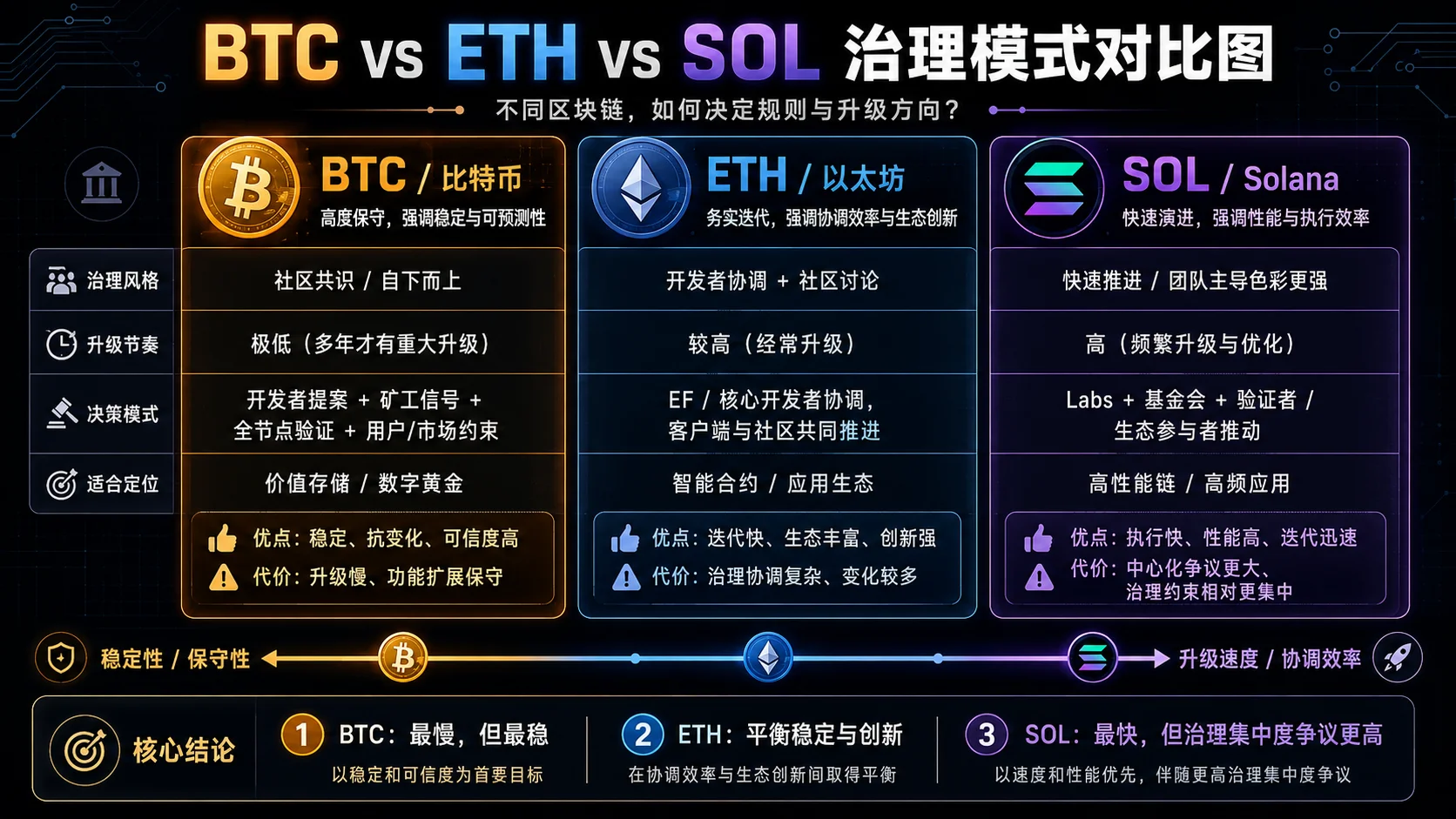
| Governance style | Highly conservative, highly predictable | Pragmatic iteration, efficient coordination | Fast evolution, varying centralization |
| Upgrade pace | Extremely low (a few times in 17 years) | High (multiple times a year) | High (frequent upgrades) |
| Decision model | Community bottom-up | EF + core developer coordination | Labs + foundation led |
Bitcoin's "slowness" is not a flaw — for a store of value, stability > features. Ethereum's rapid iteration suits application ecosystems. It is not about which is better, but different choices under different positionings.
The pitfalls I fell into: 3 lessons from over-worrying about governance
Pitfall 1: when FTX collapsed in 2022, I almost sold my BTC too
Scenario: in November 2022, FTX collapsed and the whole market panicked. Many people, myself included, had this thought: "Is the whole crypto space going to be done? Will BTC also go to zero?"
Reason: I conflated "fraud risk of centralized exchanges" with "security risk of the Bitcoin network". FTX was a people problem; BTC is a code problem — the two are completely unrelated.
Lesson: during the FTX collapse, the Bitcoin network kept producing blocks, one every 10 minutes, none missing. Distinguish "platform risk" from "protocol risk". Exchanges can run away; Bitcoin won't.
Pitfall 2: when I first heard about 51% attacks, I spent a week researching in fear
Scenario: when I first entered the space, I saw on forums that "a 51% attack can roll back transactions", and thought my coins could be stolen at any moment. I spent a week reading various technical articles.
Reason: I only understood "what a 51% attack can technically do", not "why an attacker would do it". Attacking for one day costs tens of millions of dollars, and after a successful attack BTC's price collapses — the attacker's mining machines and holdings go to zero first.
Lesson: technical "possibility" does not equal economic "feasibility". Bitcoin's security is not built on "it can't be done", but on "it's not worth doing". This is also why more hash power means a more secure Bitcoin — the attack cost rises with it.
Pitfall 3: over-focusing on BIP discussions and wasting a lot of time
Scenario: for a while I was obsessed with following the bitcoin-dev mailing list and every BIP discussion, always thinking "what if there's a major upgrade I miss and it's over".
Reason: I turned "staying informed" into an obsession. In reality, Bitcoin's major upgrades happen on a scale of years, and community discussion is thorough enough that — by the time you hear about it, it has already been discussed for months.
Lesson: as an ordinary holder, you don't need to be a "governance participant". Bitcoin's upgrade mechanism is designed to be slow enough that you have ample time to learn, digest, and decide. Checking once every few months is enough.
Decision framework: when to worry, and when not to worry at all
The thing you're worried about ──→ Should you worry?
│
├── "Bitcoin will be controlled / shut down"
│   └── No. No CEO, no server, no single point. There is no switch that can turn it off.
│
├── "Developers will maliciously change the code"
│   └── No. Developers are only "proposers", not "decision-makers". Nodes and users choose whether to upgrade.
│      Your full node is your way of independently executing rules — you don't need to accept anyone's explanation.
│
├── "Miners with too much hash power can tamper with transactions"
│   └── Almost no. The cost of rewriting a 6+ confirmation transaction record far exceeds the gain, and machines depreciate after an attack.
│      Short-term double-spend risk exists (< 2 confirmations); for large transactions, just wait a few more confirmations.
│
├── "The 21M cap gets changed and BTC becomes worthless"
│   └── No. This is Bitcoin's hardest social consensus; a proposer would be thoroughly excluded by the community.
│
├── "Governments jointly ban it"
│   └── Note: affects price and usability, but not network operation.
│      The Bitcoin network has no "headquarters"; miners and nodes span the globe.
│
├── "My coins got stolen"
│   └── This is what you should worry about. Most coin-loss incidents are private key management problems.
│      Use a hardware wallet, back up your seed phrase, don't store private keys on internet-connected devices.
│
└── "The exchange I use runs away"
    └── This is what you should worry about. Not your keys, not your coins.
        Large long-term holdings → withdraw to a hardware wallet. Trading funds → keep only on top-tier exchanges.
Security risk reminder
- Private key management is your biggest risk — the Bitcoin network has remained highly consistent for 17 years; the vast majority of coin-loss incidents come from users losing/leaking/having their private keys stolen. Use a hardware wallet, store your seed phrase offline, don't screenshot it on your phone.
- Exchange ≠ Bitcoin network — when FTX and Mt.Gox collapsed, the Bitcoin network kept producing blocks. Don't dismiss BTC itself because an exchange blew up. But large assets should be moved to a wallet you control.
- Newly confirmed transactions still carry rewrite risk — 0-confirmation transactions can theoretically be replaced, and 1–2 confirmations carry short-term double-spend risk. For large incoming payments, wait at least 6 confirmations.
- The barrier to governance participation is lower than you think — running a full node means you independently execute the rules, needing to trust no one. Big enough disk and fast enough network is all it takes.
FAQ
Q1: Could Bitcoin be maliciously modified by developers? No. Developers are only "proposers", not "decision-makers". After code is submitted, miners choose whether to signal support and nodes choose whether to upgrade. There has never been a long-term mainnet consensus breakdown caused by malicious code. The separation of powers — developers propose, miners execute, nodes verify — means no single party can change the rules unilaterally.
Q2: If a miner has 51% hash power, can they control BTC? They can't control the rules, but in the short term they can roll back the transactions of the last few blocks (a double-spend attack). However, this attack is extremely costly (tens of millions of dollars per day), and once launched, BTC's price inevitably collapses — the attacker's mining machines and holdings go to zero first. Moreover, the community can counter by changing the PoW algorithm through a hard fork — this is the nuclear option, but it does exist. So a 51% attack has never truly threatened Bitcoin in history.
Q3: Will Bitcoin's 21 million supply be changed in the future? Almost certainly not. This is not a code-level limitation but a social-level consensus. Over the past 17 years there has never been a single serious BIP proposal to increase supply. Anyone who proposes inflation instantly loses all credibility in the community. Even if someone force-forks an "inflated Bitcoin", exchanges, wallets, and the vast majority of users would not follow, and that chain's token would be worthless.
Q4: Can Bitcoin be shut down by governments? Governments can affect trading channels, regulate exchange entry points, and restrict fiat on/off ramps, but they cannot "shut down" the Bitcoin network like shutting down a company. Bitcoin has no headquarters, no server cluster, no operating entity — miners and nodes are distributed across dozens of countries and regions, and there is no switch that can turn it off. Of course, extreme regulation can affect BTC's usability and short-term price.
Q5: Why is Bitcoin's upgrade so slow? It's not a bug; it's a feature. Bitcoin's positioning is "digital gold" — a global store of value. For a store of value, stability has far higher priority than feature updates. Imagine the Fed announcing "we're upgrading the dollar protocol to support smart contracts" — the market would panic. Bitcoin's conservatism is a deep understanding of its own positioning.
Q6: Which has better governance, Bitcoin or Ethereum? Depends on your purpose. Bitcoin's governance suits a store of value — an extremely slow upgrade pace means extremely high predictability. Ethereum's governance suits application ecosystems — the EF coordinates more efficiently and upgrades faster. It's not "which is better", but "which better suits your needs". Use BTC for long-term storage, ETH for DeFi/NFT.
Q7: Satoshi disappeared, so who "manages" Bitcoin? Nobody "manages" it — and nobody needs to. Satoshi's role was "inventor", not "manager". Rules are executed by full nodes, the code is maintained by hundreds of volunteers in Bitcoin Core (fully open source on GitHub), and upgrades are decided bottom-up by the community. Even if Satoshi appeared today and proposed inflation, nobody would listen to him. The founder has become irrelevant — this is the strongest proof of decentralization.
What does this mean for ordinary holders?
Three sentences to sum up: BTC's reliability does not depend on price swings; it is built on game theory and cryptography — nobody needs your trust, you only need to verify. Once you understand the governance process, you won't be scared by "Bitcoin is about to fork, sell fast". Exchanges can fail, miners can lose money, developers can leave — but the Bitcoin network is not controlled by any single entity. This understanding is the confidence to hold BTC through a bear market.
Summary
Back to the opening question: if someone proposed today "change 21 million to 50 million", who could stop it?
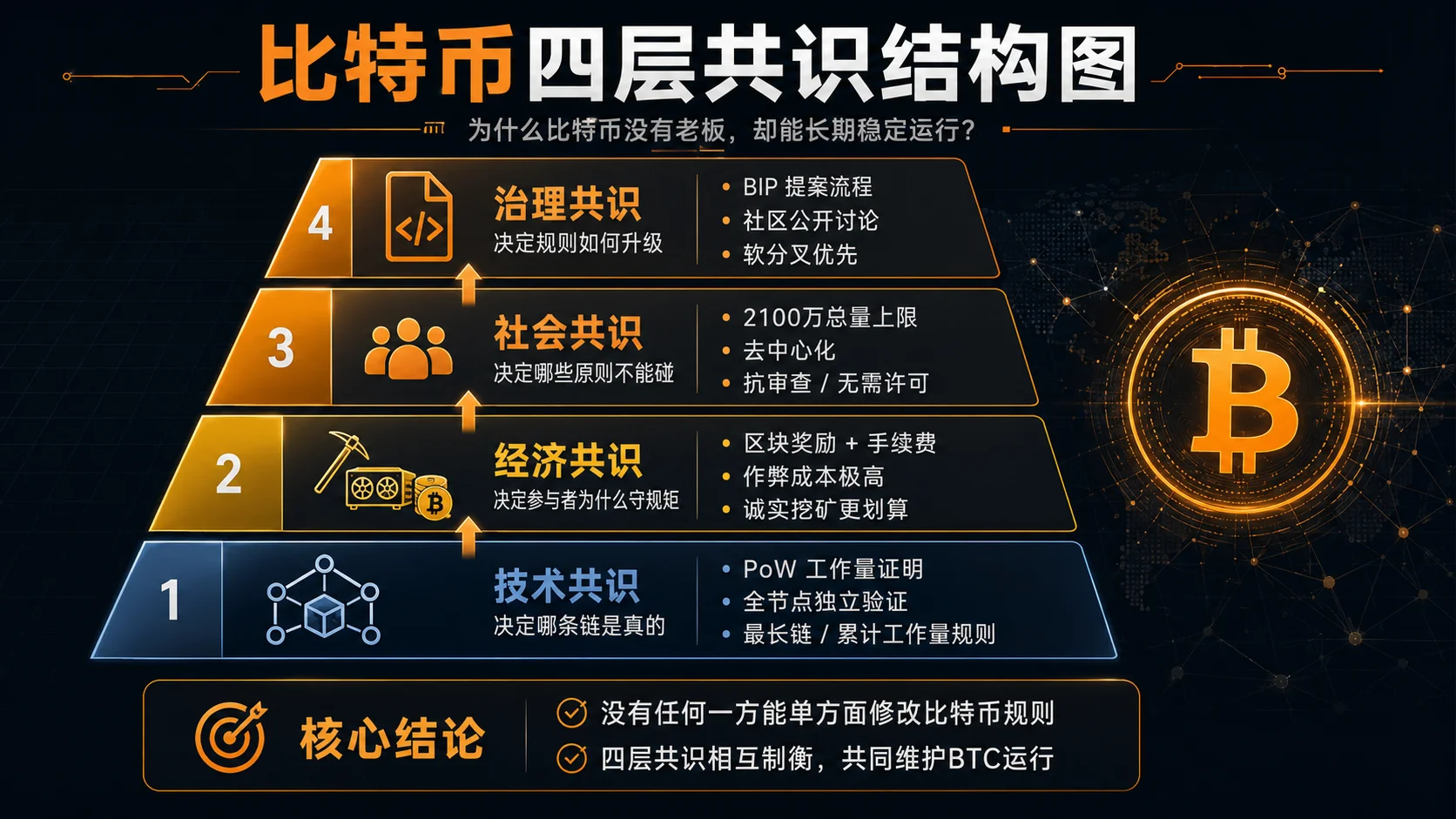
The answer: everyone. Because Bitcoin's consensus is not one person's decision, but the result of four layers precisely interlocking.
- Technical consensus decides which chain is real — miners produce blocks with hash power, nodes verify independently.
- Economic consensus decides why participants follow the rules — honesty is more profitable for every party.
- Social consensus decides which rules can never be touched — the 21M cap, decentralization, censorship resistance.
- Governance consensus decides how rules evolve — the BIP process, community discussion, users having the final say.
The lower the layer, the more automated (code); the higher, the more human coordination is needed (community). The four layers operate simultaneously and check each other — miners are constrained by full nodes, full nodes by social consensus, social consensus by public discussion. There is no absolute authority, only a precisely interlocking system of checks and balances.
If you remember only one thing: Bitcoin needs no CEO, because it breaks "who gets to decide" into four layers and distributes them to every participant. Your node decides which rules you accept; your private key decides which assets you control.
Related reading
- Why does Bitcoin not need banks? UTXO, nodes, and PoW — the first in this series, UTXO + PoW + four-layer power structure
- How does the blockchain record transactions? Blocks, hashes, and Proof of Work (2026) — a hardcore breakdown of the technical consensus layer
- Can Bitcoin's 21 million supply cap be changed? Source code and fork analysis — the core principle of social consensus
- Bitcoin private key security: 6 decisions that determine whether your BTC gets lost (2026) — what you should really worry about: private key management
- Is Bitcoin a scam? 10 doubts broken down one by one (2026) — clearing up N misunderstandings including "Bitcoin has nobody in charge, so it'll go to zero"
- BTC vs gold: value, risk, and liquidity compared (2026) — why BTC suits long-term value storage
Disclaimer
This article is for explaining the technical principles of Bitcoin's consensus mechanism and sharing holding experience, and does not constitute any investment, financial, or trading advice.
Crypto asset prices are volatile, and related services may involve platform risk, market risk, network security risk, and operational risk. Users should judge carefully according to their own risk tolerance and comply with local laws and regulations.
- Bitcoin whitepaperOriginal wording on economic incentives and the attacker's choice
- BIP documentation repositoryOriginal text of upgrade proposals such as BIP141/BIP148
- Bitcoin Optech technical documentationTechnical record of the Taproot activation process
- Bitcoin Magazine historical reportingSeries of reports on SegWit2x and social consensus
See ourEditorial Policy and the correction process in ourCorrections Policy.
The CoinTrailHub editorial team focuses on crypto education for beginners, exchange security and P2P trading risk. This article is compiled from official sources and public data, reviewed by humans, and strives for accuracy but is not investment advice.
Last updated:2026-08-10 · Content reviewed by humans · Learn more
© 2026 CoinTrailHub · Original content. Reproduction or rewriting without permission is prohibited.