
BTC vs gold: value, risk, and liquidity compared (2026)

Table of contents

Binance new user rewards
20% trading fee rebate
Official Binance registration. Complete identity verification (KYC) to trade and withdraw.
Gold and Bitcoin are not simple substitutes — they solve problems on different dimensions.
The real question is not "gold or BTC", but which kind of protection your assets need more.
Gold represents a store-of-value asset validated by 5,000 years within the traditional financial system; its core advantages are physical presence and survivability in extreme environments. Bitcoin represents the native asset network of the digital age; its core advantages are decentralization, verifiability, and the ability to transfer value digitally across the globe.
I started holding both in early 2024, and after 2 years my biggest takeaway is: each solves exactly the other's weakest point. Gold has limits in cross-border transport, storage, and trading convenience; Bitcoin depends on the internet and power infrastructure, carrying systemic technical risk. Holding both means your store-of-value assets don't have to choose between the "physical world" and the "digital world".
Reminder: this article is a comparative analysis of asset attributes and does not constitute investment advice. Crypto assets are extremely volatile, and gold also carries price risk. Please judge independently based on your own situation.
I recommend understanding Bitcoin's basic concepts before reading this: What is Bitcoin (BTC)? Principles, value, and risks (2026).
Core information: how to choose in different situations
| Your situation | Reference choice | Reason |
|---|---|---|
| Total assets < $50,000 | Skip both gold and BTC for now, prioritize saving 6 months of living expenses | Liquidity matters 100× more than growth |
| Total assets $50,000–$500,000, don't want hassle | Gold 5%–10%, can skip BTC for now | Gold needs no private key or seed phrase learning; zero barrier |
| Total assets $50,000–$500,000, willing to research | Gold 5% + BTC 2%–5%, start with ETFs | BTC has higher growth potential but also higher volatility risk |
| Total assets $500,000+, have investing experience | Gold 5%–10% + BTC 3%–8%, partly self-custodied | Strongest complementarity; can gradually raise BTC ratio |
| Need cross-border asset transfer | BTC has a natural edge in transfer efficiency, paired with a small amount of physical gold | BTC offers a global transfer method outside the traditional financial system |
| Purely want "doomsday insurance" | Only physical gold, not BTC | In a doomsday there's no power, no internet, no blockchain |
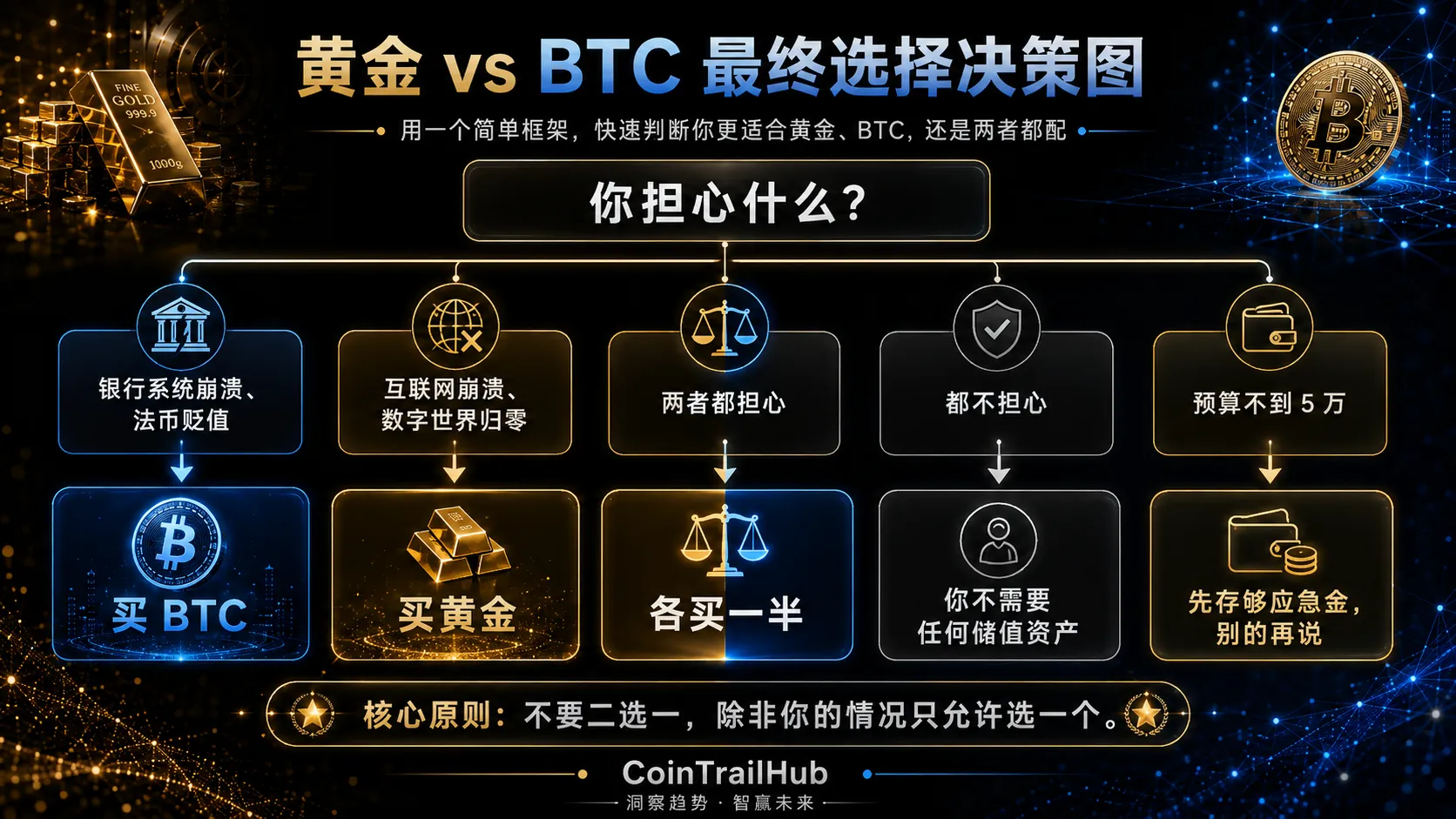
Core principle: don't choose one over the other, unless your situation only allows one.
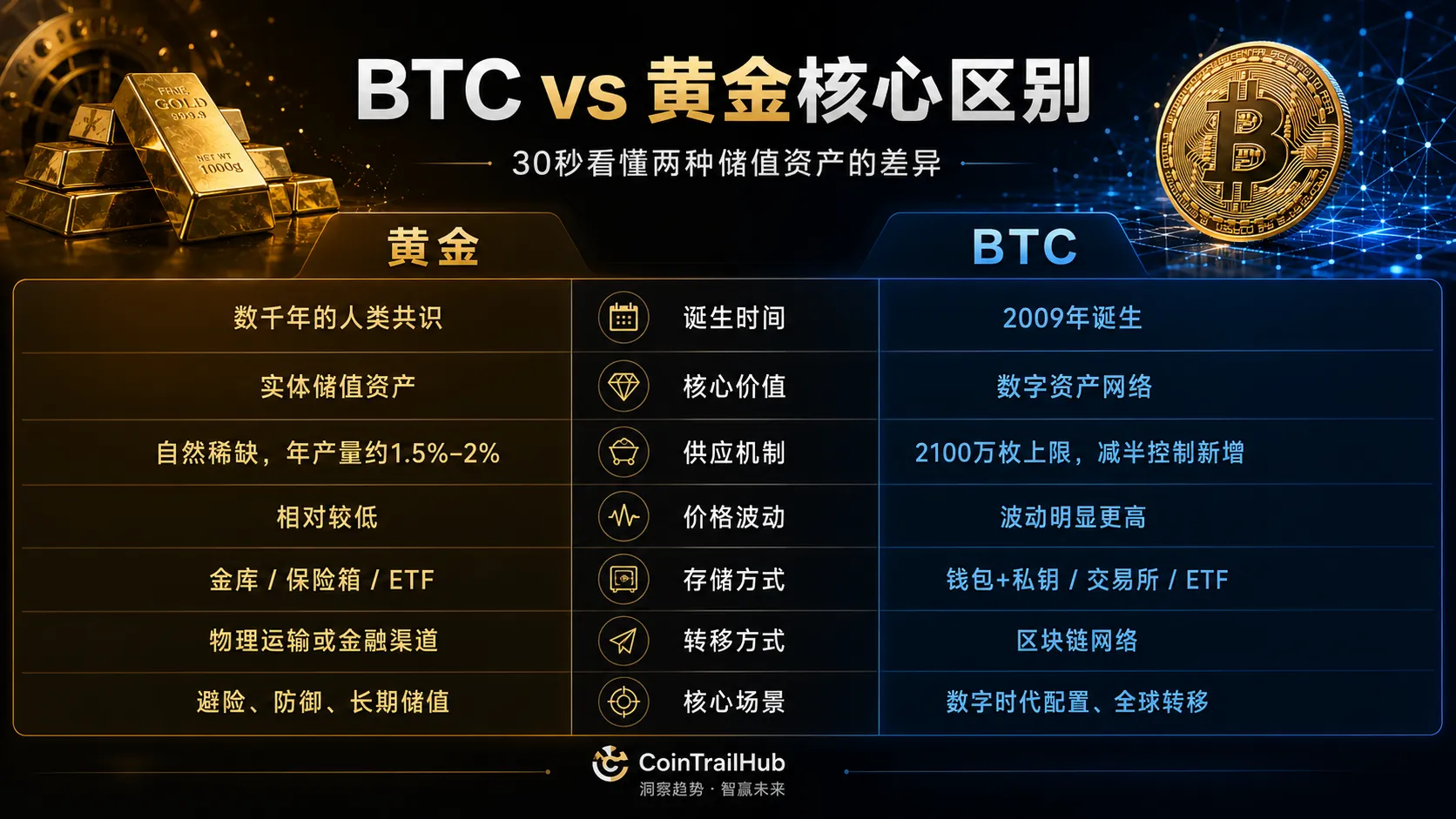
Gold vs Bitcoin core differences (30 seconds to understand)
| Gold | Bitcoin | |
|---|---|---|
| Age | Thousands of years of human consensus | 2009 |
| Core value | Physical store-of-value asset | Digital asset network |
| Supply mechanism | Naturally scarce, ~1.5%–2% annual production | 21 million hard cap, halving controls new supply |
| Price volatility | Relatively low | Historically far higher than gold |
| Storage | Vault / safe / ETF | Wallet + private key / exchange / ETF |
| Transfer | Physical transport or financial channels | Blockchain network |
| Core use case | Safe haven, defense, long-term storage | Digital-age asset allocation, global transfer |
Who should read / who shouldn't
| Your situation | Recommendation |
|---|---|
| First time considering asset allocation, unsure what to buy | Must read — this helps you build a basic framework |
| Already bought BTC, wondering whether to add gold | Must read — the risk comparison and selection framework will answer |
| Already bought gold, wondering whether to add BTC | Must read — the five-dimension comparison will help |
| Already have a clear allocation plan running for 2+ years | Not needed — your framework is already validated |
| Tight on cash, can't save each month | Not needed — solve the savings problem first, then allocation |
My judgment framework: how I use the five dimensions
I measure whether a store-of-value asset works well across five dimensions. This framework comes from my own usage experience, not a textbook — it's the actual criteria I use every time I decide "add gold or add BTC".
Dimension 1: Scarcity — will this thing get printed more and more?
| Item | Gold | Bitcoin | My judgment |
|---|---|---|---|
| Supply cap | Physically finite (Earth's reserves) | Mathematically fixed (21 million) | Tie |
| New supply speed | ~1.5%–2% annual (source: World Gold Council) | After the 4th halving, dropped to under ~1% and still decreasing | BTC wins |
| Supply predictability | Roughly predictable | Fully predictable | BTC wins |
| Supply shock risk | Deep-sea/asteroid mining could break scarcity | Code rules are immutable | BTC wins |
My take: after BTC's fourth halving in April 2024, its annual new-supply rate dropped to under ~1%, and will keep falling with later halvings — while gold's annual production growth has stayed stable at 1.5%–2% long-term. From a Stock-to-Flow perspective, BTC shows "hard asset"-like characteristics in supply predictability — new output is smaller relative to existing stock, so existing holders get diluted more slowly.
But gold's scarcity is validated by 5,000 years. BTC has only ~16 years. Mathematical perfection does not equal historical trust. That's also why you can't judge BTC's value on scarcity alone — recommended reading: Why does Bitcoin have value? Scarcity, decentralization, network effects for a more complete analysis framework.
Dimension 2: Durability — will this thing still exist in ten years?
Gold has an irreplaceable advantage in this dimension. It needs no electricity, no internet, no cryptography, no node network. For thousands of years, gold has persisted as a store-of-value tool recognized across cultures and economies — a historical record no other asset has.
BTC has one soft spot gold will never have: it needs the internet to exist. In extreme scenarios like a global EMP attack, prolonged network outage, or SHA-256 being broken by quantum computing, the BTC network could be paralyzed — but gold bars can still be exchanged.
Reality has already proven that short regional network outages are enough to make digital assets temporarily unusable. Undersea cable cuts, power outages from natural disasters, or large-scale cyberattacks — these are not sci-fi scenarios but real events happening every year. In those moments, physical gold can still be exchanged, while digital assets depend entirely on infrastructure running normally.
Dimension 3: Divisibility — use as much as you want
BTC has a clear advantage in digital scenarios.
- Gold: the smallest tradable unit is physically limited. A 1-gram gold pellet is already the retail limit; smaller units either can't be weighed or have absurd transaction costs.
- Bitcoin: 1 BTC = 100 million satoshis (sat). With Layer 2 solutions like the Lightning Network, even smaller and faster payment scenarios become possible.
What does this mean? Gold suits large-scale reserves; BTC covers a wide range from daily micro-payments to large on-chain transfers. This advantage has already been validated in payment and transfer scenarios worldwide. The same asset covering both extremes — gold can't do that.
Dimension 4: Transferability — can you take it with you when things go wrong?
This is BTC's most fundamental structural advantage.
From a technical standpoint, when transferring equivalent value across borders, the efficiency gap between the two is orders of magnitude:
| Gold | Bitcoin | |
|---|---|---|
| Transfer method | Financial channels (high fees) or physical transport (high security cost) | On-chain transfer |
| Time required | 2–5 business days | ~10–60 minutes |
| Total cost | Fees + FX spread + insurance, ~3%–5% | Miner fee usually under $5 |
| Depends on third party | Bank + customs + SWIFT + security company | Only the Bitcoin network itself |
Of course, someone might say gold can be "transferred on paper" through ETFs or futures. Correct — but that introduces counterparty risk: you're not holding gold, but a third party's IOU. On-chain BTC transfer has no such problem: on-chain BTC is BTC itself. However, it must be emphasized that any cross-border asset transfer should comply with local laws and regulations; BTC's technical capability is not the same as compliance advice.
Dimension 5: Verifiability — how do you know this thing is real?
BTC has a significant advantage in verifiability.
- Verifying gold: needs XRF spectrometers, density tests, professional equipment — ordinary people simply can't verify independently.
- Verifying BTC: any ordinary computer, running a full node, can independently verify every transaction and every balance on the blockchain.
Fort Knox holds roughly 147 million ounces of the US Treasury's gold, and according to USGS data, the last full audit was in 1953 — over 70 years ago. Meanwhile I can check the balance of any BTC address anytime, trusting no one.
But verifiability is a double-edged sword. All BTC transactions are permanently recorded on a public ledger — no privacy. Gold is different; if you buy a gold bar with cash, the bar can completely "disappear".
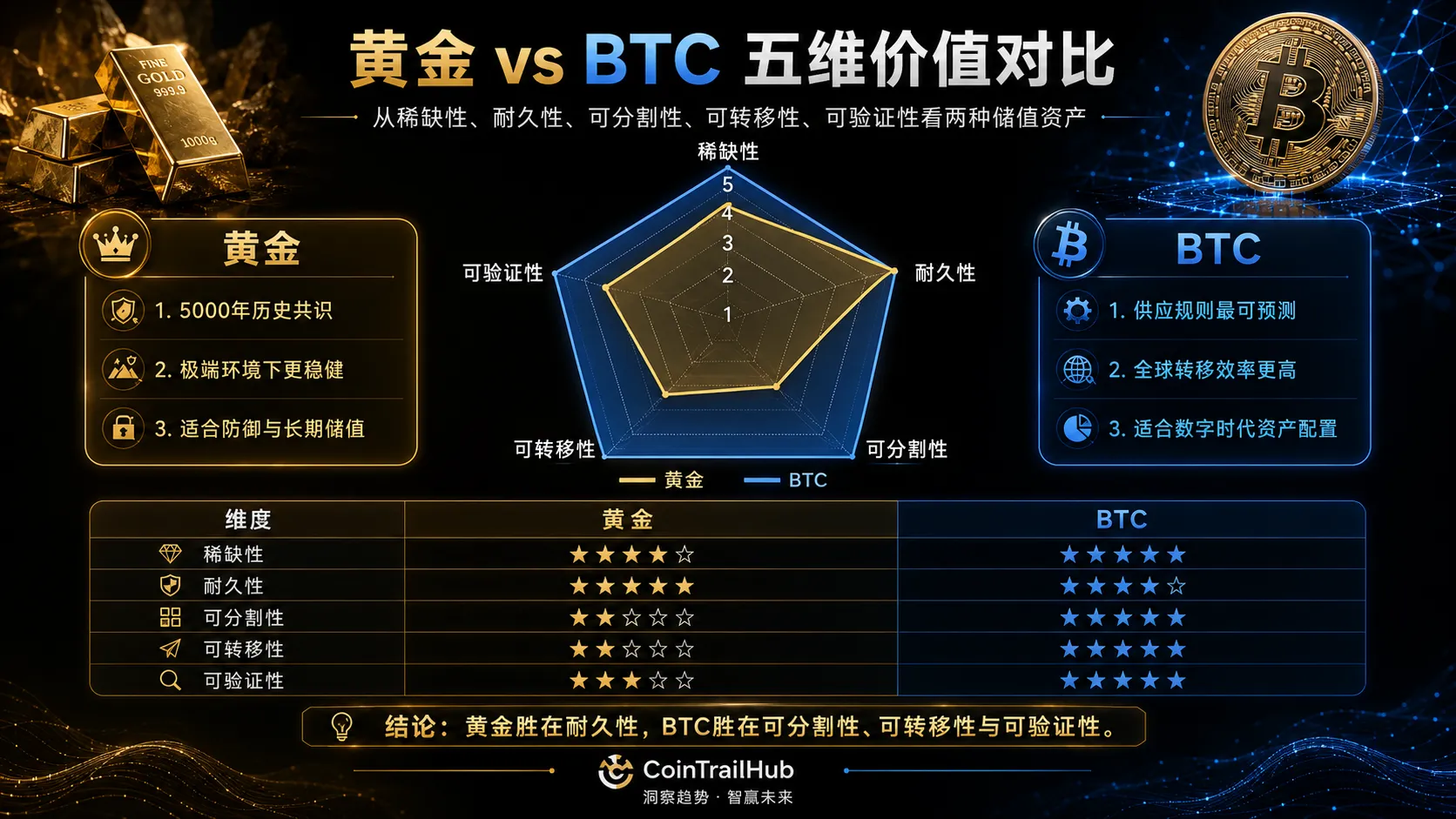
Five-dimension summary
| Dimension | Gold | Bitcoin | Result | Key difference | Suitable scenario |
|---|---|---|---|---|---|
| Scarcity | 4/5 | 5/5 | BTC edge | BTC supply rules are highly transparent; gold supply is affected by mining tech, cost, and market changes | Pursuing supply predictability |
| Durability | 5/5 | 4/5 | Gold edge | Gold depends on no infrastructure; BTC needs internet and power | Extreme-risk protection |
| Divisibility | 2/5 | 5/5 | BTC edge | BTC's smallest unit reaches 1 sat, suitable for digital payments and on-chain trading | Daily payments and micro-transactions |
| Transferability | 2/5 | 5/5 | BTC edge | BTC offers a global transfer method outside the traditional financial system | Cross-border and large transfers |
| Verifiability | 3/5 | 5/5 | BTC edge | BTC's public ledger lets anyone verify independently, no need to trust third parties | Scenarios needing transparent audits |
But the biggest blind spot of the table is: gold's 5,000 years of human consensus can't be quantified. This is also an important reason I personally choose to watch both asset classes — even if gold is less efficient than BTC on several dimensions, the trust accumulated over time is the one thing that can't be compressed.
The biggest difference between gold and BTC: different sources of risk
To understand the two assets, advantages alone aren't enough — their sources of risk are completely different, and that's what you most need to understand when choosing.
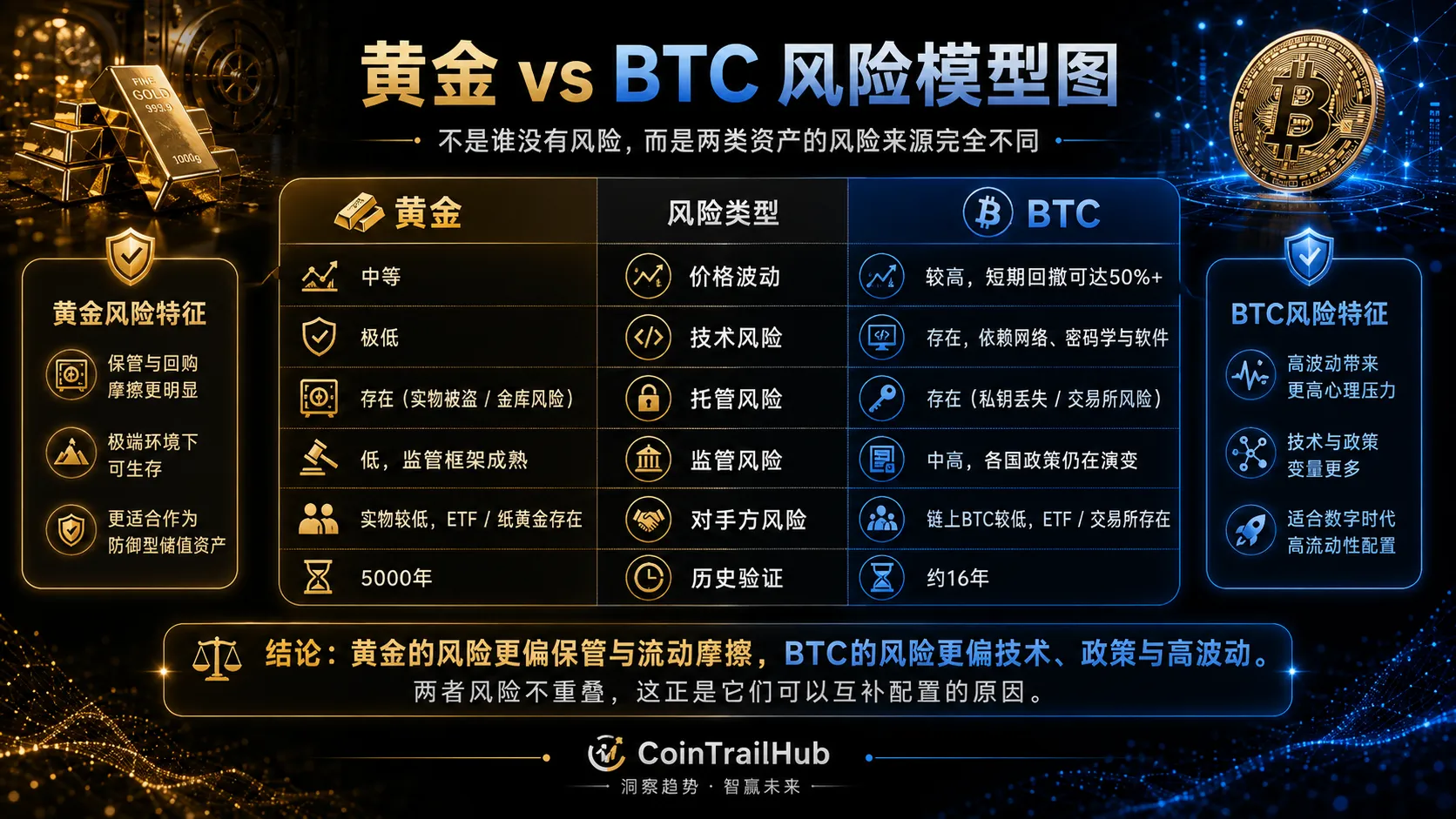
| Risk type | Gold | Bitcoin | Note |
|---|---|---|---|
| Price volatility | Medium | Higher | BTC's annualized volatility far exceeds gold; short-term drawdowns can exceed 50% |
| Technical risk | Extremely low | Exists | BTC depends on cryptography, network, and software — a problem in any layer can affect asset safety |
| Custody risk | Exists (physical theft/vault risk) | Exists (lost private keys/exchange collapse) | Both need proper custody, but in completely different ways |
| Regulatory risk | Low (mature framework) | Medium-high (policies still evolving) | BTC's regulatory environment is improving but uncertainty is far higher than gold |
| Counterparty risk | ETF/paper gold has it, physical bars don't | On-chain BTC doesn't, ETF/exchange does | Both face the "real holding vs certificate holding" choice |
| Historical validation | 5,000 years | ~16 years | Gold has a far longer span of human use; BTC is still in an early stage |
Core conclusion: gold's risk concentrates on the "people" and "system" levels (custody security, trading friction), while BTC's risk concentrates on the "technology" and "policy" levels (code security, regulatory change). Their risks don't fully overlap — that's exactly why they can complement each other.
How to think about gold and BTC allocation at different asset scales
This framework comes from my own usage experience, not investment advice — it's my thinking logic on the question "should I buy gold or BTC". The specific ratios and choices ultimately need to be judged based on your own situation.
Tier 1: total assets < $50,000
Suggestion: skip gold and BTC for now.
At this stage the most important thing is not "growing assets" but "having enough cash to survive surprises" — job loss, illness, unexpected expenses. Save 6 months of living expenses first, in a bank checking account or money market fund.
Once you've saved an emergency fund, come back to allocation.
Tier 2: total assets $50,000–$500,000
| Your style | Example portfolio (for reference only) | Action path |
|---|---|---|
| Conservative | Gold 5%–10%, no BTC yet | Buy a gold ETF via your broker/bank app, done in 1 minute |
| Balanced | Gold ~5% + a small research allocation to BTC | Gold via ETF; BTC via exchange, then withdraw to a wallet |
| Aggressive | Gold 3%–5% + BTC 5%–8% | Part of BTC self-custodied, part in ETF |
I've been at this tier. In early 2024 I was roughly at this asset scale, with a portfolio of 5% gold ETF + 3% BTC. My biggest takeaway: don't go all-in on BTC just because the amount is small. In the March 2024 dip, BTC fell 25% in three days; without gold offsetting the psychological pressure, I likely would have panic-sold at the very bottom.
Tier 3: total assets $500,000+
| Your style | Example portfolio (for reference only) |
|---|---|
| Conservative | Gold 10% + BTC 3%–5%, BTC preferably via ETF |
| Balanced | Gold 5%–10% + BTC 5%–8%, partly self-custodied |
| Aggressive | Gold 5% + BTC 8%–15%, mostly self-custodied |
At this stage the key is not "whether to buy" but "how to store". Once your BTC position grows to a certain size, learning self-custody and private key security becomes increasingly important — BTC left on an exchange is not your BTC.
Recommended reading on private key custody: Bitcoin private key security: 6 decisions that determine whether your BTC gets lost (2026).
Practical steps: how to buy gold and BTC
Buying gold (done in 5 minutes)
- Open your broker or bank app → search for "gold"
- Choose a physically-backed gold ETF (e.g., GLD or IAU) or a bank's gold savings plan
- Buy the amount you want
Why I recommend a gold ETF over physical bars:
- Smaller buy/sell spread (ETF ~0.1%, while physical bars can see a 3%–5% spread between buy and sell price)
- No custody needed (physical bars either sit at home risking theft, or cost an annual fee for a bank safe deposit box)
- Better liquidity (T+0 or T+1 settlement, while selling physical gold requires going to a dealer or bank with cumbersome procedures)
But if you're buying gold precisely as "doomsday insurance" — then buy physical bars, kept somewhere only you know. Don't buy gold jewelry — the workmanship premium is as high as 20%–30%, very inefficient for value preservation.
Buying BTC (two paths)
If it's your first time with BTC, read Buying BTC for the first time in 2026: don't rush the order, think about what to do after buying first, then choose a path below.
Path A: ETF — for people who don't want to manage private keys (10 minutes)
- Open a US brokerage account (Interactive Brokers, Fidelity, Charles Schwab, etc.)
- Search for IBIT (BlackRock iShares Bitcoin Trust) or FBTC (Fidelity Wise Origin Bitcoin Fund)
- Buy the amount you want
Pros: no private key learning, no theft worry, operates like buying a stock. Cons: you're not holding real BTC but the custodian's IOU. Counterparty risk exists. There's an annual management fee (IBIT currently 0.25%).
Path B: exchange + self-custody — for people who want to truly "own" BTC (30 minutes)
- Register on an exchange (recommend Binance; use a referral code to save on fees)
- Complete KYC, deposit fiat, buy BTC
- Key step: withdraw BTC to a hardware wallet, don't leave it on the exchange
- Safely store your seed phrase (write it on paper, keep multiple copies in different locations)
The two paths don't conflict — right now I keep half my BTC in an ETF for convenience and half self-custodied for peace of mind.
Why is Bitcoin called digital gold?
The "digital gold" framing is not crypto marketing jargon — it comes from Bitcoin's design deliberately imitating gold's core attributes.
Bitcoin's design borrows some core characteristics of gold as a store-of-value asset:
The "mining" mechanism — Bitcoin is obtained through Proof of Work (PoW), requiring real electricity and equipment investment, just like gold mining has no "free lunch". This ensures no one can create Bitcoin at zero cost.
Total supply cap — the mathematical promise of 21 million coins imitates gold's finite crust reserves. The difference: gold's scarcity is a physical constraint, Bitcoin's is a code constraint. On why the 21M cap can't be changed, see Can Bitcoin's 21 million supply cap be changed? Source code and fork analysis.
The halving mechanism — every 210,000 blocks (about 4 years), the block reward halves, artificially creating a "declining production" effect. This corresponds to the natural law of gold's gradually declining annual production — but Bitcoin does it more aggressively and more predictably.
Stock-to-Flow (S2F) — this is one reference indicator for measuring an asset's scarcity. According to market data platforms like CoinGecko, Bitcoin's new-supply ratio dropped further after the halving, and its scarcity indicator is approaching traditional highly-scarce assets (like gold). However, it should be noted that the S2F model has differing views in academia and the market; it's better suited as a framework for understanding scarcity than as a price-prediction tool.
But the "digital gold" metaphor has one key limitation: gold has value by simply existing in the physical world, while Bitcoin needs an entire tech stack (internet, power, nodes, cryptography) running continuously. That's why "digital gold" describes BTC's direction, not its current state — BTC's volatility, regulatory uncertainty, and technical dependency all mean it still has a long way to go before reaching gold-level "store-of-value asset" status.
Gold ETF vs Bitcoin ETF: both ETFs, but different logic
After introducing how to buy gold and BTC separately, it's worth putting the two ETFs side by side — because although both are called "ETF", they represent two completely different asset logics.
| Gold ETF (GLD) | Bitcoin ETF (IBIT) | |
|---|---|---|
| Underlying asset | Physical gold (London vault custody) | Bitcoin (Coinbase custody) |
| Launch | 2004 | 2024 |
| AUM | ~$120 billion | ~$50 billion (just over 1 year) |
| Annual fee | 0.40% | 0.25% |
| Core value | Tracks gold price, replaces physical holding | Provides BTC price exposure, lowers entry barrier |
| Do you control the asset | No (you hold fund shares) | No (you hold fund shares) |
| Suitable for | People who want gold without managing physical metal | People who want BTC exposure without managing private keys |
Key difference: the gold ETF connects to a traditional asset class with a mature regulatory framework, while the BTC ETF connects to a new asset with only ~16 years of history and a still-evolving regulatory environment. Both are "paper assets" — you hold not gold or BTC itself, but the custodian's certificate. Choosing an ETF means trading counterparty risk for convenience.
BTC ETF: how people who don't want the private key hassle participate
In January 2024, the US SEC approved spot Bitcoin ETFs. Looking back from 2026, this was Bitcoin's watershed.
Its meaning for ordinary people in one sentence: buying BTC became as simple as buying a gold ETF.
For a complete introduction to BTC ETFs, see How to buy a Bitcoin ETF? IBIT/FBTC comparison and fees (2026).
| Gold ETF (GLD) | Bitcoin ETF (IBIT) | |
|---|---|---|
| Launch | 2004 | 2024 |
| AUM | ~$120 billion | ~$50 billion (source: The Block, SEC filings) |
| Annual fee | 0.40% | 0.25% |
| Purchase channel | Any US brokerage account | Any US brokerage account |
| Physical custody of underlying | Yes (London vault) | Yes (Coinbase custody) |
BlackRock CEO Larry Fink — who once criticized BTC as an "index of money laundering" — now publicly calls BTC "digital gold". This isn't because his values changed, but because institutional clients are demanding BTC exposure, and the ETF is the best compliant path.
But the ETF has an irony: it makes BTC more like gold — both have become "paper assets". ETF holders don't truly hold Bitcoin; they hold the custodian's certificate. From self-custody to ETF, BTC has completed a "from on-chain to off-chain" loop.
For me personally: the ETF solves convenience; self-custody solves sovereignty. Each has its use.
The pitfalls I fell into
Pitfall 1: leaving all my BTC on an exchange
Scenario: in early 2024, when I first bought BTC, I left it all in the exchange account for convenience. At the time I thought "moving it around is a hassle, and a big exchange shouldn't collapse".
Wake-up call: later I studied the FTX incident in depth — the world's second-largest exchange in 2022, reduced to ashes overnight, with client funds still not fully recovered. If my BTC had been on FTX back then, it would be zero now.
Lesson: any BTC position exceeding one month of your salary must be moved to a hardware wallet. An exchange is "where you trade", not "where you store". This principle saved me from every later exchange collapse — because most of my BTC no longer depends on any third party.
Pitfall 2: underestimating the friction cost of physical gold trading
Scenario: in early 2025, I bought a 50-gram investment gold bar at a bank. At purchase, holding a physical asset felt "very reassuring" — but when I later wanted to sell, the nightmare began.
Reality: the bank's buyback conditions were extremely strict — original packaging intact, purchase receipt required, and only a few designated buyback branches. Worse, the buyback price was several percent below the market rate, and I'd already paid a premium per gram at purchase. On a 50-gram bar, the round trip cost me roughly 5%.
Lesson: unless you want it as "doomsday insurance" or your position is large enough that an ETF's management fee exceeds the physical buy-sell spread, ordinary people are fine with just a gold ETF. The friction cost of physical gold far exceeds what you'd imagine.
Pitfall 3: changing phones almost lost my wallet
Scenario: when I changed phones in early 2025, one of my hot wallets (holding ~0.1 BTC) hadn't had its seed phrase backed up in advance. The old phone was reset, and the new one had nothing — in that moment I froze.
Result: luckily, data recovery tools on the old phone helped me retrieve the wallet file. But that 0.1 BTC came close to being locked on the blockchain forever. According to Chainalysis research, the market widely believes a significant amount of BTC is permanently unspendable due to lost private keys — while there's no unified statistic on the exact ratio, this is a real risk. I almost became part of that statistic.
Lesson: write your seed phrase on paper, at least two copies, in two different physical locations. Don't screenshot it, don't store it in cloud drives, don't message it to yourself. The flip side of "being your own bank" is: no one will reset your password for you.
Situations where BTC is not suitable
This section may be more practically valuable than the analysis above. In the following situations, consider carefully whether to allocate BTC:
- You'll need this money within 1 year. BTC's short-term swings can halve your position; within 12 months you might be forced to sell at a loss.
- You saw others making money and fear missing out (FOMO). FOMO-driven buying leads to panic selling in corrections 99% of the time — buy high, sell low, perfectly losing money.
- You plan to borrow or use leverage to buy BTC. This is the shortest path to liquidation. Not going to elaborate — just search "futures liquidation".
- You don't want to learn "hassles" like private key management and seed backup. If you don't want to learn, buy the ETF. But if you neither want to learn nor want to leave BTC on an exchange — better not to buy at all.
- You think BTC can make you "rich quick". It can't. BTC in 2026 is not BTC in 2012; the 100x-return story is over. Today's BTC is a store-of-value asset, not a lottery ticket.
Decision framework summary: a one-sentence selection guide
What are you worried about?
├── Banking system collapse, fiat devaluation → buy BTC
├── Internet collapse, digital world going to zero → buy gold
├── Worried about both → buy half of each
├── Worried about neither → you don't need any store-of-value asset
└── Budget under $50,000 → save an emergency fund first, the rest later
A personal note: if you haven't touched gold or BTC yet, you can start by learning the basic characteristics of both assets and see which better fits your needs. The gap between "understanding" and "not understanding" is more critical than any theoretical analysis. Once you've formed your own judgment about these assets, decide whether to allocate based on your actual situation.
FAQ
Q1: Can BTC really replace gold?
Whether BTC replaces gold is still hugely uncertain; the more likely scenario is the two coexisting long-term. A more reasonable framing is: BTC is becoming the "new gold" of the digital age, while gold continues to serve as the physical world's store-of-value anchor — they serve different needs and scenarios.
Q2: I have some spare money now (say $100,000) — should I go all-in on gold or all-in on BTC?
Neither. Using $100,000 as an example, one approach is to keep most of it in a money market fund as an emergency reserve and spread a small portion across gold and BTC — the specific ratio depends on your risk tolerance and investment horizon. Never go all-in just because you're bullish on something — the fastest way to lose money is believing you're 100% right.
Q3: Bitcoin ETF vs buying BTC directly — which is better?
Depends on your priority: convenience → ETF; "true ownership" → buy yourself + withdraw to a hardware wallet; both → half and half. I wrote the concrete steps in the practical-steps section.
Q4: Gold ETF vs physical bars — which to choose?
95% of people should choose the gold ETF. Only two situations call for physical bars: one, you want "doomsday insurance" (a systemic-collapse scenario); two, your position is large enough that the ETF management fee significantly exceeds the physical buy-sell spread.
Q5: With Bitcoin this volatile, how can you call it "digital gold"?
Good question. BTC's current volatility is indeed far higher than gold's — that's a fact. But the trend shows BTC's volatility has been declining over the past three cycles. With institutional money flowing in through ETFs and the rising proportion of long-term holders (Glassnode data shows HODLing behavior significantly increased in 2025–2026), this trend will likely continue. "Digital gold" is not BTC's current state, but its direction.
Q6: What if BTC drops after I buy?
First, if you bought with money you need within 1 year — sell it; you should switch to an asset with a more matching investment horizon. If you used long-term spare money (3–5+ years) — do nothing. BTC has historically made new highs after every major drawdown, but that doesn't guarantee the future — so the premise is "long-term spare money". Don't check the price every day. My personal rule: check the balance once a month, and live your life the rest of the time.
Related reading
- What is Bitcoin (BTC)? Principles, value, and risks (2026) — essential first read; understand what BTC is before deciding to buy
- Why does Bitcoin have value? Scarcity, decentralization, network effects — understand in depth why BTC is worth anything
- How to buy a Bitcoin ETF? IBIT/FBTC comparison and fees (2026) — the ETF is the most convenient path for ordinary people into BTC
- Buy a Bitcoin ETF or buy BTC directly? Choose by amount and holding period (2026) — ETF vs self-custody comparison to help you decide
- Bitcoin private key security: 6 decisions that determine whether your BTC gets lost (2026) — must-read before buying BTC; lose the key and you lose everything
- Can Bitcoin's 21 million supply cap be changed? Source code and fork analysis — scarcity is the mathematical foundation of BTC's value logic
- Buying BTC for the first time in 2026: don't rush the order, think about what to do after buying — decided to buy? Read this for step-by-step operations
Disclaimer
This article is for sharing experience on asset allocation thinking and store-of-value tool comparison, and does not constitute any investment, financial, or trading advice.
Crypto asset prices are extremely volatile and may cause partial or total loss of principal. Gold also carries price volatility risk. Past performance does not guarantee future returns. The allocation ratios in this article are personal experience only; different individuals have different financial situations, risk tolerances, and investment goals. Please judge carefully based on your own situation and consult a licensed financial professional if necessary.
- World Gold CouncilAnnual gold production growth of roughly 1.5%–2%
- CoinGeckoNew supply ratio data after the halving
- GlassnodeHODLing behavior and long-term holder data
- The BlockBTC ETF assets under management data
- U.S. Geological Survey (USGS)History of full audits of the Fort Knox gold reserves
- ChainalysisBTC permanently lost to circulation due to lost private keys
See ourEditorial Policy and the correction process in ourCorrections Policy.
The CoinTrailHub editorial team focuses on crypto education for beginners, exchange security and P2P trading risk. This article is compiled from official sources and public data, reviewed by humans, and strives for accuracy but is not investment advice.
Last updated:2026-08-10 · Content reviewed by humans · Learn more
© 2026 CoinTrailHub · Original content. Reproduction or rewriting without permission is prohibited.