
How to Buy Bitcoin? 2026 Beginner's Complete Flow + How Much to Buy, Where to Store, When to Sell
Table of contents

Binance new user rewards
20% trading fee rebate
Official Binance registration. Complete identity verification (KYC) to trade and withdraw.
How to Buy Bitcoin? 2026 Beginner's Complete Flow + How Much to Buy, Where to Store, When to Sell
For someone buying BTC for the first time, the flow can first be understood as:
Choose a platform → prepare funds → buy BTC → confirm arrival → decide whether to keep it on the exchange or in a personal wallet.
If you use Binance, a common path is:
Buy USDT via P2P → buy BTC on the BTC/USDT spot market.
If you already have USDT, you can skip P2P and go straight to the BTC/USDT spot market to buy BTC.
This article mainly uses Binance as the example; the basic logic is similar on OKX.
If all goes smoothly, it takes under 10 minutes. The two easiest places to mess up: paying outside the platform order in P2P, and withdrawing without checking the network.
| Step | What beginners should do | Corresponding Binance action | What to watch |
|---|---|---|---|
| 1 | Prepare a trading account | Register and complete identity verification | Verify the official Binance entry |
| 2 | Prepare funds to buy BTC | Buy USDT via P2P | Payment method depends on what the page actually shows |
| 3 | Buy BTC | BTC/USDT spot trading | Start small the first time |
| 4 | Confirm the asset arrived | Check BTC balance | You don't need to buy a whole BTC |
| 5 | Decide where to store it | Keep on Binance or withdraw to a personal wallet | The bigger the amount, the more security matters |
Merchants, payment methods, and available channels on Binance's P2P page may change; go by what the page actually shows when you place the order.
When using P2P, complete the trade only within the platform order — don't contact merchants privately, and don't trade outside the platform.
Besides explaining "how to buy," this article also answers the follow-up questions beginners most often ask:
How much to buy the first time? Where to store BTC after buying? When to sell? How to convert back to fiat later?
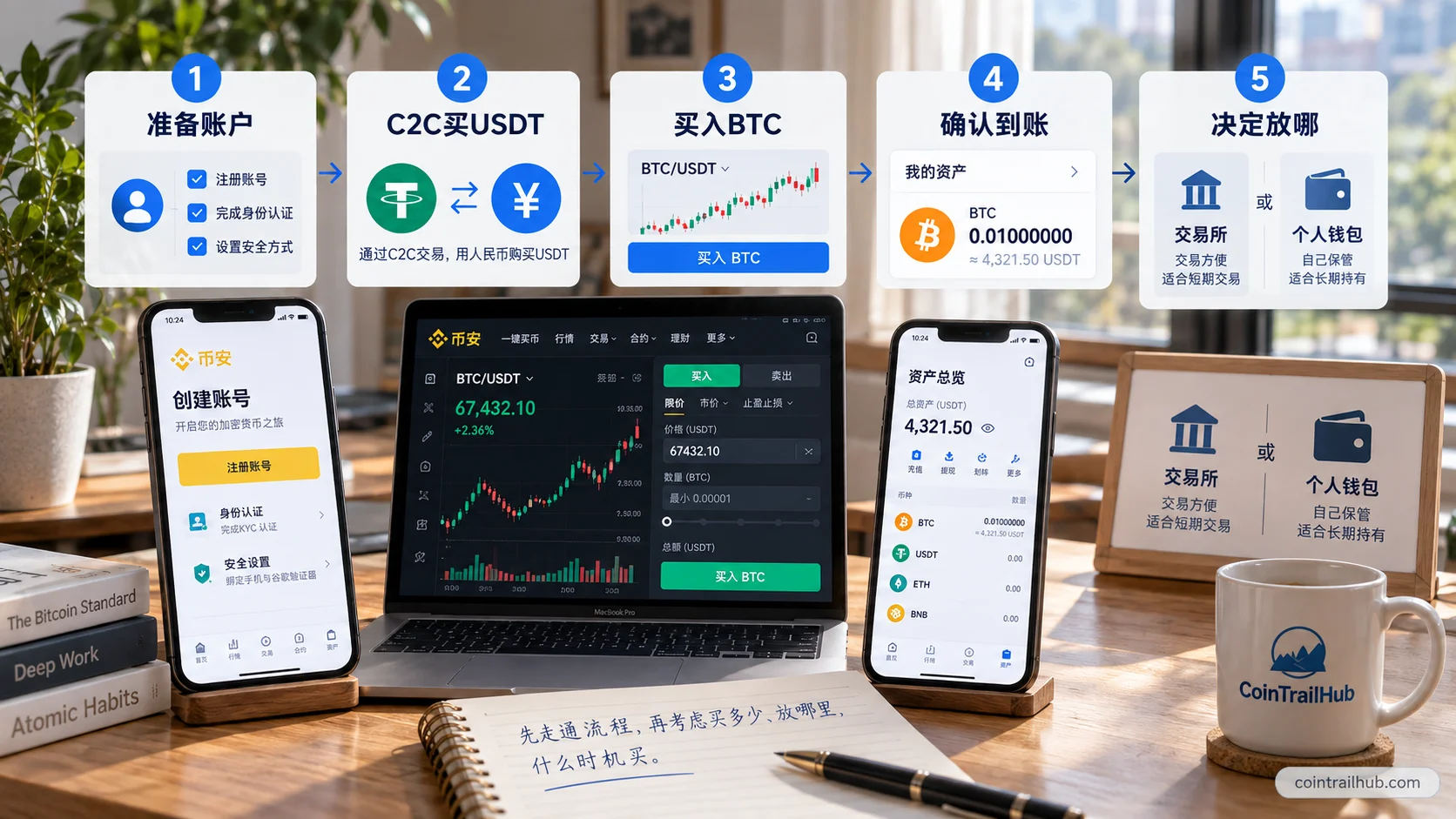
Figure 1: the 5-step flow for a beginner's first Bitcoin purchase: prepare an account → buy USDT via P2P → buy BTC → confirm arrival → decide where to store it
1. How Should a Beginner Buy Bitcoin? Complete Your First Purchase in 5 Steps
Step 1: Prepare a trading account
For your first BTC purchase, you don't need to research many platforms at once.
More importantly, pick one platform you can actually use and walk through the full flow.
This article mainly uses Binance as the example, because:
Prepare funds → buy USDT via P2P → buy BTC with BTC/USDT → check assets → sell or withdraw
can all be done within one platform.
If you already use OKX, you can follow similar logic — no need to switch platforms just for your first BTC purchase.
Step 2: Prepare the funds to buy BTC
If your account already has USDT, skip to the next step.
If you don't have USDT, Binance users can first buy USDT via P2P.[1]
A common path can be understood as:
Local fiat → Binance P2P → USDT → BTC
Why buy USDT first?
Because BTC/USDT is a very common spot trading pair.
You can think of USDT as a settlement asset used when buying BTC.
Once on Binance's P2P page, focus on:
- the merchant's trade volume
- completion rate
- per-order limits
- currently supported payment methods
- the payment info shown on the platform's order page
Different merchants may support different payment methods — go by what the order page actually shows.
After placing an order, strictly follow the info shown on the platform's order page.
After paying, return to the order page and confirm the payment.
Don't trade outside the platform order just because the other party says "better price privately" or "faster offline."
For your first time, start with a small amount to walk through the flow.
For a detailed walkthrough, read on: How to Buy USDT on Binance 2026: P2P Process, Choosing a Merchant, and Payment.
Step 3: Enter BTC/USDT to buy BTC
Once USDT arrives, you can buy BTC.
In Binance, go to:
Trade → Spot → search BTC/USDT → buy BTC
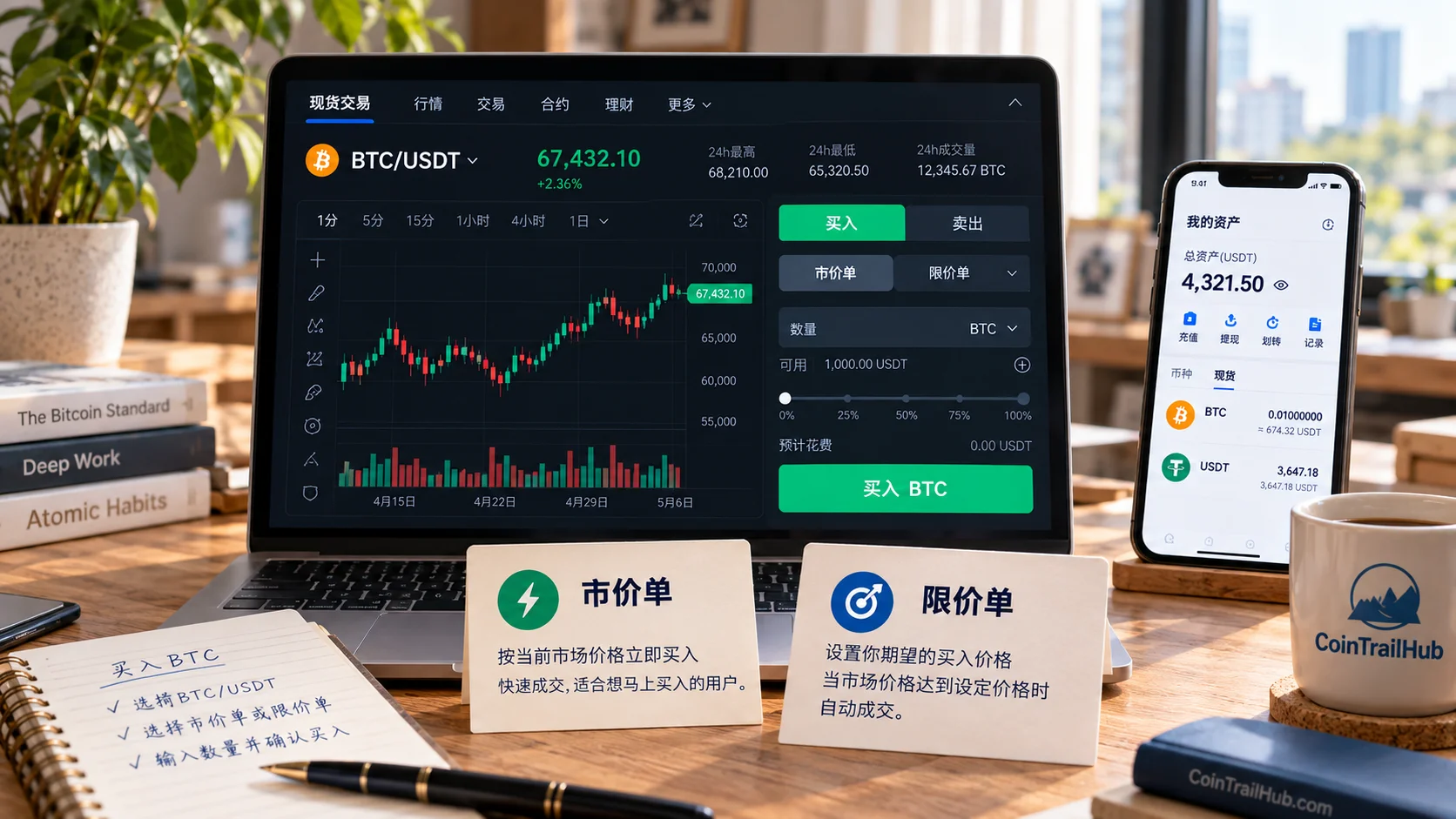
Figure 2: buying BTC on BTC/USDT spot — the difference between market and limit orders
When buying BTC for the first time, you'll mainly encounter two order types.
Market order
Buy immediately at the price the current market can fill.
The advantage is simplicity and fast execution.
If you just want to experience the purchase flow the first time, a market order is easier to understand.
Limit order
Set the price you want to fill at, and the order fills when the market reaches that price.
For example:
BTC's current price is 100,000 USDT, and you set a 98,000 USDT limit buy — the order only fills when the price reaches the corresponding range.
Don't rush to study complex order types the first time.
One sentence is enough to start:
USDT is the asset you pay with, and BTC is the asset you end up buying.
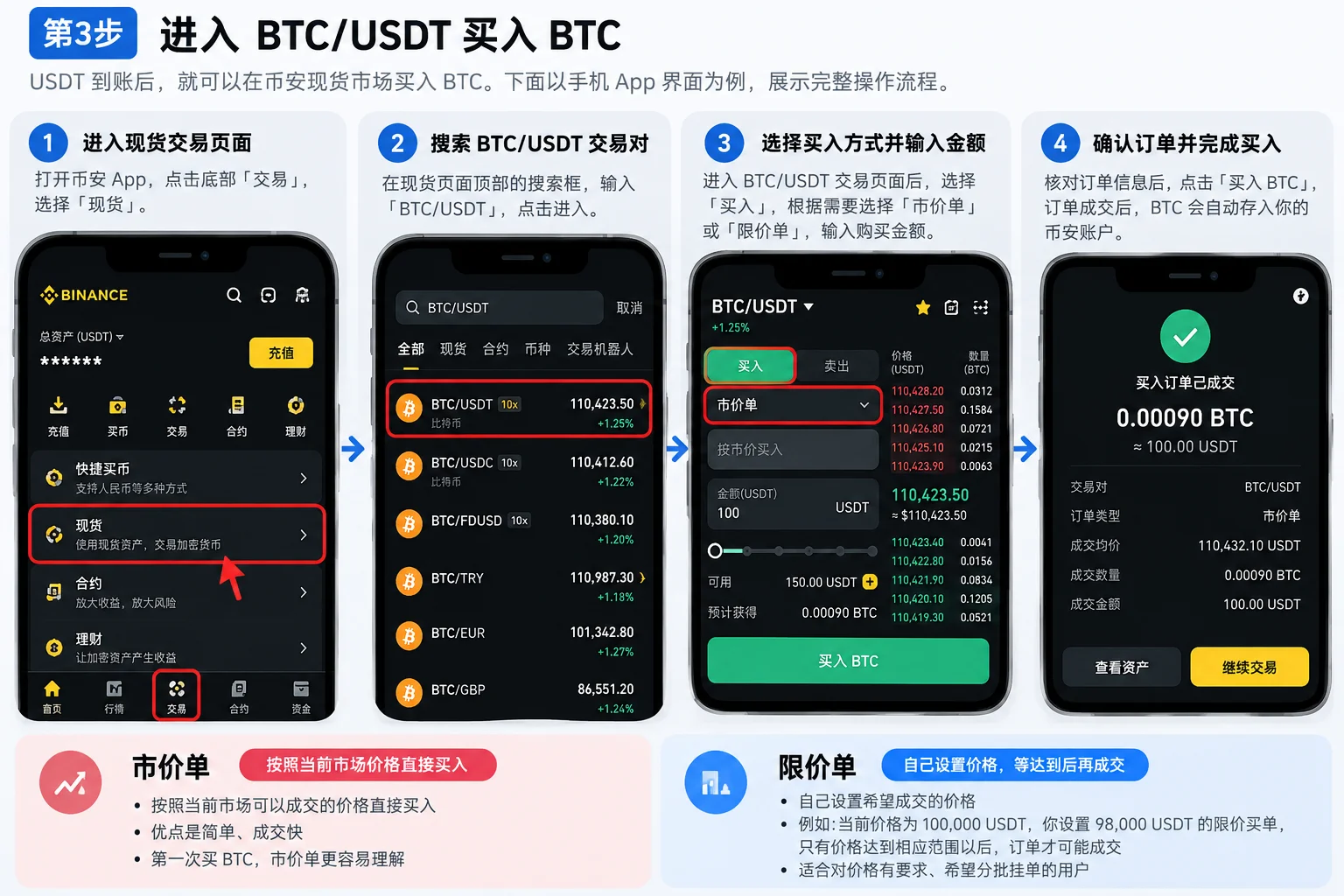
Figure 3: the complete Binance app BTC purchase flow — enter spot, search BTC/USDT, place the order and confirm the fill
Step 4: Confirm BTC has arrived
After the trade fills, open the assets page and you'll see the BTC amount.
For example:
0.001 BTC
This is normal.
You don't need to buy 1 BTC at a time.
BTC can be split into very small units to buy, as long as you reach the platform's minimum order amount.[2]
So don't worry:
"I don't have tens of thousands of dollars — does that mean I can't buy Bitcoin?"
No.
You can buy a small fraction of BTC for $100 or even less, depending on the platform's minimum order amount.
Step 5: Decide where to store BTC
After buying, you can keep it on the exchange or withdraw it to a personal wallet.
For beginners who are just starting, with a small amount and still learning, keeping it on the exchange is simpler.
If your assets grow larger later, you can further learn about:
- personal wallets
- seed phrases
- private keys
- hardware wallets
There's no need to make the process complicated right after buying a small amount of BTC.
2. Do You Have to Buy USDT First Before Buying Bitcoin?
Not necessarily.
If you already have USDT, you can go straight to the BTC/USDT spot market to buy BTC.
Common approaches are roughly:
| Method | Better for | How to understand it |
|---|---|---|
| Binance P2P → USDT → BTC | Beginners who need to prepare USDT first | This article mainly covers this path |
| USDT → buy BTC directly | People who already hold USDT | Go straight to BTC/USDT |
| OKX P2P → USDT → BTC | People who mainly use OKX | The flow logic is similar |
If you already have USDT, there's no need to go through P2P again.
3. Binance or OKX? How Should a Beginner Choose?
This article mainly uses Binance as the example.
The reason is simple:
For first-time BTC buyers, Binance lets you complete, in one account:
P2P buy USDT → buy BTC → check assets → sell → withdraw
OKX can complete a similar flow.
If you already use OKX long-term, there's no need to switch platforms just to buy BTC.
| Your situation | Better choice |
|---|---|
| First-time BTC buyer who wants a simple flow | Walk through the Binance flow first |
| Already have a Binance account | Use your existing account |
| Already use OKX long-term | Continuing with OKX is fine too |
| Later want to compare fees, wallets, Web3 | Look at a dedicated Binance vs OKX comparison |
For beginners, what really matters usually isn't a small fee difference, but:
whether you're operating from the official entry, whether P2P strictly goes through platform orders, and whether account security is set up.
For a deeper comparison, see: Binance or OKX? How Beginners Should Choose — 5 Dimensions, Real-Tested.
4. How Much Bitcoin Should You Buy the First Time?
There's no single correct amount that works for everyone on a first BTC purchase.
The more important question is:
If this money drops a lot, will it affect your normal life?
1. If you just want to learn how to buy
If your only goal is to:
- understand the exchange
- learn P2P
- learn BTC/USDT
- understand account assets
- experience a purchase once
then there's no need to invest a large amount the first time.
Use a small amount you can fully afford to lose, as long as it reaches the platform's minimum trade amount — that's enough to help you understand the flow.
The biggest meaning of a first BTC purchase usually isn't how much you earn, but:
you finally know how the whole process actually works.
2. If you plan to participate long-term, in batches
If you're not just trying it out but plan to participate long-term, you can learn about DCA or batch buying. If you don't want to buy all at once, you can also read How to DCA into Bitcoin, and the Difference Between Weekly and Monthly DCA.
The point of these methods isn't to guarantee profit, but to reduce daily second-guessing:
Is it expensive today?
Should I wait a bit more?
Should I buy on the dip?
For long-term participation, what matters more is controlling the amount you put in.
An easier principle to understand:
Only use money you don't need in the short term and won't be affected by even large fluctuations.
3. If BTC drops 50%, can you still live normally?
BTC has seen many very large drawdowns historically.
If BTC drops by half and that would:
- affect your rent
- affect your living expenses
- affect your debt repayments
- force you to sell immediately
then the amount you've put in likely already exceeds your risk tolerance.
5. Where Should You Store BTC After Buying?
After buying, there are roughly three choices.
| Your situation | Where to store | Characteristics |
|---|---|---|
| Just starting, small amount | Binance account | Convenient to operate |
| Preparing to hold long-term | Personal wallet | You control the private key |
| Large amount, not needed long-term | Hardware wallet | Reduces the risk of private keys long exposed to internet-connected devices |
There's no single answer that fits everyone.
Keep it on Binance
Advantages:
- easy to buy and sell
- no need to manage a seed phrase yourself
- low barrier to operate
The risk:
assets are custodied by the platform, and you don't directly control the on-chain private key.
For users who are just starting, with a small amount and frequent trading, keeping it on Binance is easier to manage.
Keep it in a personal wallet
The biggest difference with a personal wallet:
You are responsible for the private key and seed phrase yourself.
The advantage is more direct control over the asset.
But if you lose the seed phrase entirely, no customer support can regenerate your original private key.[3]
Consider a hardware wallet when the amount is large
If your BTC has grown to an amount you can't easily dismiss, you can look further into hardware wallets.
The main value of hardware wallets like Ledger and Trezor is reducing how often your private key is exposed to ordinary internet-connected devices.
When using a hardware wallet for the first time:
Transfer a tiny test amount first, then consider larger transfers.
6. When Should You Sell BTC?
There's no single answer.
More important than guessing the top is thinking through your sell conditions in advance.
| Situation | Worth reassessing a sell | Reason |
|---|---|---|
| You need the money in the short term | Yes | The use of funds has changed |
| The BTC position already affects your normal life | Yes | Risk exposure is too high |
| Reached a goal you set in advance | Evaluate per plan | Avoid in-the-moment emotion |
| It suddenly dropped a lot today | Don't decide on that alone | A single-day drop isn't the full picture |
| It suddenly surged a lot today | Don't decide on that alone | A single-day surge isn't a complete sell logic either |
Don't make a snap sell decision just because of one big up or down day.
Before buying BTC, think through three questions in advance:
- Under what circumstances will I need this money?
- At what share of my investable assets do I need to rebalance BTC?
- Which original buy reasons, if changed, would make me reassess?
7. How Do You Convert BTC Back to Fiat?
BTC itself can't be sent directly to your bank account or a payment app.
A common path is:
BTC → sell for USDT on Binance → exit through the P2P channel Binance supports at the time
Specific payment and receipt methods depend on what Binance's page actually shows.
The whole process still follows the same principle:
Trade only within the platform order — don't trade privately with strangers outside Binance.
8. What Else Should a Beginner Do After Buying BTC?
After buying BTC, you don't need to study every advanced feature right away.
Just get these few things clear:
- where to see BTC and USDT
- how to read spot order records
- how to read P2P order records
- what a wallet address is
- what private keys and seed phrases are
- why you must check the network when withdrawing[4]
- whether account 2FA is enabled
If you want to practice withdrawing or using a personal wallet, use only a tiny amount the first time.
Don't use your main assets for your first test.
9. The 4 Most Common Scams for Beginners Buying BTC
1. Fake Binance websites
Some clone sites look almost identical to the official one, with just one letter different in the domain.
Only log in through an official entry you've verified yourself.
2. Fake Binance support
Anyone who proactively asks you to:
- provide a verification code
- provide your password
- transfer to a "safe address"
- provide your seed phrase
— should be an immediate signal to stop.
3. Off-platform P2P trades
If a merchant asks you to:
"trade outside the platform for a better price"
don't accept it.
Complete the trade only within the platform order.
4. Fake wallets and fake airdrops
Any unknown site that asks you to enter your full seed phrase should be treated as a high-risk signal.
Never share your seed phrase with anyone, and never enter it into an unknown website.
10. For Beginners Buying BTC, Remember These in the End
If you only remember a few lines from this whole article, remember these:
First, you don't need to buy a whole BTC
You can buy a very small fraction of BTC — no need to buy 1 BTC at once; the exact minimum depends on the platform.
Second, if you use Binance, a common path is buying USDT via P2P, then buying BTC with BTC/USDT
If you already have USDT, go straight to BTC/USDT.
Third, the first-time focus isn't buying at the lowest point
It's getting this flow clear:
prepare funds → buy USDT → buy BTC → check assets
Fourth, don't use money you need in the short term to buy a highly volatile asset
BTC can surge a lot, and it can also draw down a lot.
Fifth, a small amount is more convenient on an exchange; study personal wallets once the amount grows
Don't rush into complex self-custody operations right after buying a little BTC.
Sixth, never share your seed phrase with anyone
Whoever has the seed phrase can control the wallet.
11. FAQ
How do I buy Bitcoin from my country?
For first-time buyers, understand it first as:
choose a platform → prepare funds → buy BTC → decide where to store it.
If you use Binance, a common practical approach is:
Buy USDT via Binance P2P → buy BTC on the BTC/USDT spot market.
Specific payment methods and available services depend on what the platform page shows at the time.
What's the minimum for a first Bitcoin purchase?
Bitcoin doesn't need to be bought whole — you can buy a very small fraction.
The exact minimum purchase amount is set by the platform.
If you're just learning the flow the first time, start with a small amount you can fully afford to lose.
Can I buy Bitcoin with $100?
Usually yes, as long as you reach the platform's minimum order amount.
You're buying a small fraction of 1 BTC — you don't need to afford a whole Bitcoin.
Do I have to buy USDT first to buy Bitcoin?
Not necessarily.
If you already have USDT, you can go straight to the BTC/USDT spot market to buy BTC.
If you don't have USDT, Binance users can first buy USDT via P2P.
Binance or OKX — which is better for a first BTC purchase?
Both can complete the purchase.
If you don't have an account yet and just want to walk through your first purchase, this article mainly uses Binance as the example.
If you already use OKX long-term, there's no need to switch platforms just to buy BTC.
Is it OK to keep BTC on Binance after buying?
For users just starting, with a small amount and wanting convenience, keeping it on Binance is easier to manage.
If your assets grow larger later and you plan to hold long-term, then learn about personal wallets, hardware wallets, and seed-phrase backup.
When should I sell Bitcoin?
There's no single answer.
More important than predicting the top is deciding in advance:
- when you'll need the money
- how much volatility you can tolerate
- what conditions, if triggered, would make you reassess the position
Don't decide based on a single day's move.
How do I sell BTC for fiat?
A common path is:
BTC → sell for USDT on Binance → exit through the P2P channel Binance supports.
Specific methods depend on Binance's real-time page.
Could buying Bitcoin make me lose everything?
BTC's price carries big volatility risk, plus platform, wallet, network-operation, scam, and regulatory risks.
So don't put in money you need in the short term or can't afford to lose.
Data verification notes
Key facts in this article were verified on 2026-10-17, item by item:
- P2P USDT purchase flow: Binance P2P supports users placing orders with merchants, paying within the platform order, and the merchant releasing coins; the order also serves as the basis for later appeals. Source: Binance Official Help — Fiat and P2P Trading.
- BTC divisibility: 1 BTC is divisible to 8 decimal places, i.e. 1 BTC = 100,000,000 satoshis, so you don't need to buy a whole coin. Source: Bitcoin.org — FAQ.
- Self-custody responsibility: a personal wallet's seed phrase is backed up by the user; if lost, no platform support can recover the original private key. Source: Bitcoin.org — Secure your wallet.
- Withdrawal network: when withdrawing, the sending network must match the network supported by the receiving platform or wallet, otherwise the assets may not arrive automatically. Source: Binance Official Help Center.
Continue learning
How to Buy USDT for the First Time? A Complete Tutorial from Registration to Arrival (Binance/OKX)
How to Buy USDT on Binance 2026: P2P Process, Choosing a Merchant, and Payment
Binance or OKX? How Beginners Should Choose — 5 Dimensions, Real-Tested
What Is a Cold Wallet? How to Store Your Seed Phrase Safely (2026, 5 Ways Compared)
How to Choose a Bitcoin Wallet? Cold, Hot, and Hardware Wallets Compared (2026)
Why Does Bitcoin Have Value? Scarcity, Decentralization, and Network Effects
- Binance Official Help — Fiat and P2P TradingP2P merchant screening, placing orders, payment, coin release, and order appeal process
- Binance Official Help CenterIdentity verification, withdrawal network selection, and account security
- Bitcoin.org — FAQBitcoin 21 million supply cap, 1 BTC divisible into 100 million satoshis
- Bitcoin.org — Secure your walletSeed phrase backup and private-key responsibility for self-custody wallets
- 2026-10-17UpdateAdded evidence-chain superscripts and Data verification notes, updated key fact verification date
See ourEditorial Policy and the correction process in ourCorrections Policy.
The CoinTrailHub editorial team focuses on crypto education for beginners, exchange security and P2P trading risk. This article is compiled from official sources and public data, reviewed by humans, and strives for accuracy but is not investment advice.
Last updated:2026-10-05 · Content reviewed by humans · Learn more
© 2026 CoinTrailHub · Original content. Reproduction or rewriting without permission is prohibited.