
How to DCA into Bitcoin? Frequency, Amount, and Binance Practice for Beginners (2026)

Table of contents

Binance new user rewards
20% trading fee rebate
Official Binance registration. Complete identity verification (KYC) to trade and withdraw.
How to DCA into Bitcoin: A Quick Overview
Bitcoin DCA means continuously buying BTC on a fixed schedule with a fixed amount.
The first time you try DCA, start by setting aside an amount of idle money that wouldn't affect your normal life even if BTC dropped sharply, then choose to buy on a weekly, biweekly, or monthly basis.
When you don't know which frequency to pick, once a week is an easy place to start, but it isn't the frequency that guarantees the highest returns.
On Binance in 2026, ordinary crypto DCA is done mainly through 「Convert → Recurring Buy」, not the old Auto-Invest entry. The current Convert DCA supports automatic buys every 1, 4, 8, or 12 hours, as well as daily, weekly, biweekly, or monthly.
A simple BTC DCA flow can be summarized as:
Prepare USDT → set the per-cycle amount → choose the frequency → create the BTC DCA plan → periodically check the balance and execution records.
The purpose of DCA isn't to predict BTC's bottom, but to split one purchase into many, spreading your buy price across different times.
But let me be clear up front:
DCA can reduce the impact of buying at a single stage high, but it doesn't guarantee profit, and it doesn't guarantee higher returns than lump-sum buying.
If BTC declines over the long term, DCA will lose money too.
1. What is Bitcoin DCA?
DCA stands for Dollar Cost Averaging, also known as "average cost method" or "recurring investment."
Its basic rules are just three:
Fixed asset + fixed amount + fixed time.
For example:
Every Monday, buy BTC with a fixed 100 USDT, and don't change the plan just because BTC went up or down this week.
When the price is high, the same 100 USDT buys less BTC; when the price is low, the same money buys more BTC.
Look at a simple example:
| Month | BTC price | Amount invested | BTC bought |
|---|---|---|---|
| January | $50,000 | 100 USDT | 0.002 BTC |
| February | $40,000 | 100 USDT | 0.0025 BTC |
| March | $60,000 | 100 USDT | 0.00167 BTC |
| April | $45,000 | 100 USDT | 0.00222 BTC |
Over 4 months you invested a total of 400 USDT and bought about 0.00839 BTC, for an average cost of about 400 ÷ 0.00839 ≈ $47,676.
Here's a frequently overlooked point:
An average cost that's below the simple arithmetic average of several prices doesn't mean DCA automatically created extra returns.
Fixed-amount buying itself buys more BTC when the price is low. What DCA actually solves is:
Reducing the impact of choosing the wrong entry time once.
If BTC keeps rising from the moment you start investing, putting in all your capital at once up front might actually earn higher returns.
So:
DCA is a way of deploying capital, not a magic formula for higher returns.
2. How Much Should You Invest in Each Bitcoin DCA Cycle?
There's no single fixed answer that works for everyone.
Instead of first asking "should I invest 100 USDT or 500 USDT," ask first:
If this money is temporarily locked up for a year, will it affect my life?
If the answer is yes, the amount is too high.
You can use this line of thinking:
| Situation | Better approach |
|---|---|
| Just starting with BTC | Start with a small amount to get familiar with DCA, trading, and account flows |
| Stable income, aiming for long-term accumulation | Set a fixed amount you can afford every month for the long term |
| Unstable income | Prioritize your living cash flow; don't force a high amount |
| Short-term cash needs | Lower the amount or don't start DCA yet |
| Can't accept a large BTC drawdown | Don't invest beyond your tolerance just because "DCA is low risk" |
A simple calculation
Suppose the money you can truly freely use each month is 1,000 USDT.
That doesn't mean all 1,000 USDT should go into crypto.
First subtract:
- daily living expenses;
- emergency funds;
- short-term debt you need to repay;
- money you'll definitely need in the coming year.
Then, out of the remaining money, decide how much of it you're willing to expose to BTC's price swings.
The key isn't that the amount is as large as possible, but that you can still live according to your plan even if the market drops.
3. How Often Should You DCA: Daily, Weekly, or Monthly?
This is one of the most common questions from beginners.
In reality, there's no frequency that's optimal for everyone.
Binance Convert DCA currently supports every 1, 4, 8, or 12 hours, as well as daily, weekly, biweekly, and monthly.
Think of it this way:
| Frequency | Characteristics | Better for |
|---|---|---|
| Daily | Most spread-out buy points, but many executions | People who want finer-grained buy timing |
| Weekly | Balanced spread and management difficulty | Most first-time DCA users |
| Biweekly | Fewer executions | People whose income or cash flow runs on a two-week cycle |
| Monthly | Simplest, but single buys are more concentrated | People paid monthly who want to manage the account less |
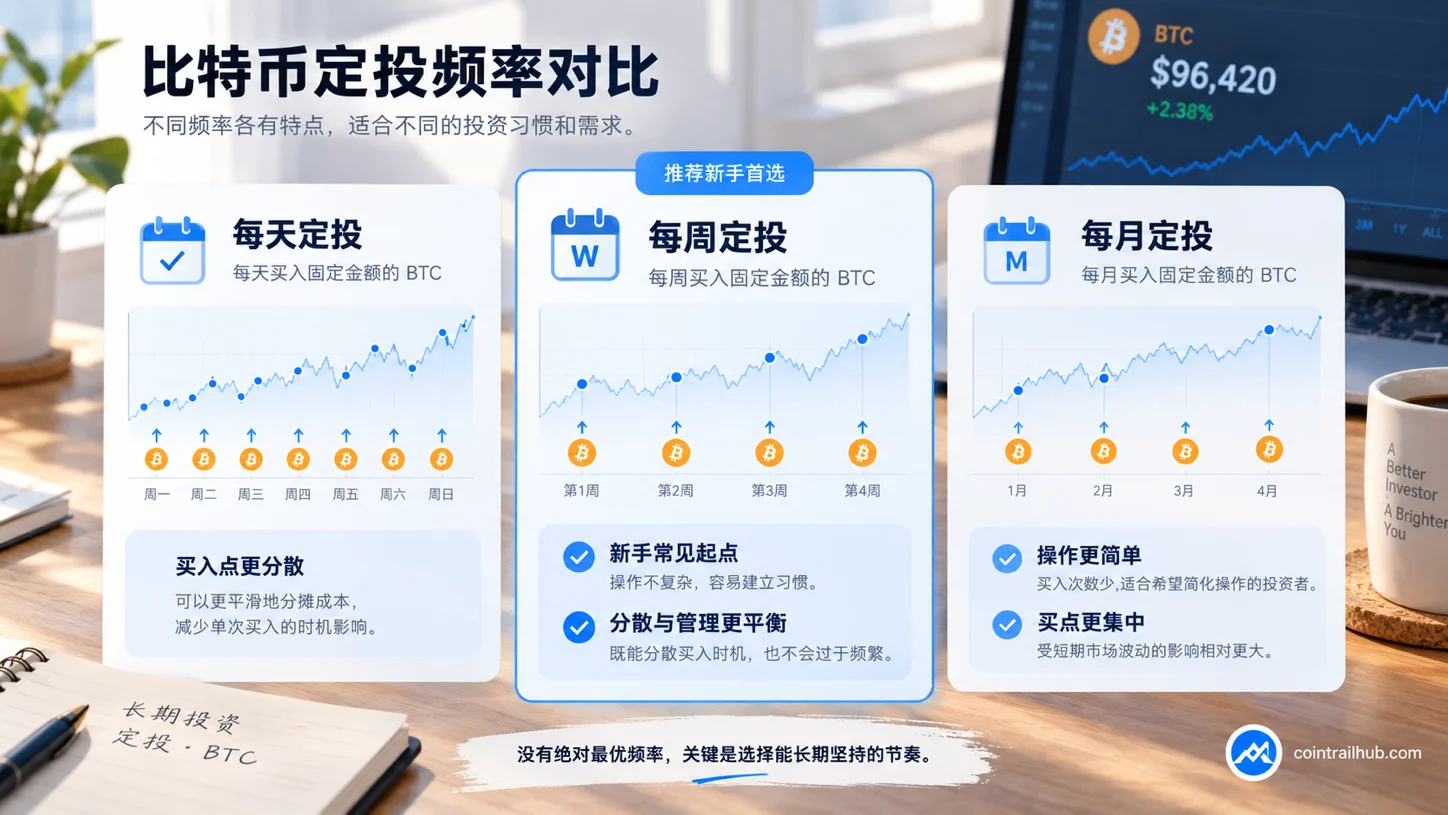
What if a beginner doesn't know how to choose?
Once a week can serve as a simple starting point.
The reason isn't "weekly earns the most," but:
- no need to manage it daily;
- buy dates are more spread out than monthly;
- easier to match with long-term cash flow;
- about 52 executions a year already covers many different market prices.
But if your salary arrives once a month, monthly DCA is perfectly reasonable too.
What truly matters is:
Once you settle on a frequency, don't keep changing it because BTC went up or down this week.
4. You Can DCA Into Both BTC and ETH — What Should a Beginner Choose?
If this article's job is "how to DCA into Bitcoin," the simplest answer is really:
DCA only into BTC.
That's the easiest to understand and the easiest way to track your average cost.
Both BTC and ETH have been through multiple crypto market cycles and still have high liquidity and market attention, but that doesn't prove their prices will keep rising in the future.
If you want to allocate to both BTC and ETH, first understand the difference between the two, then decide whether you need to hold both.
| Asset | Core characteristics | Main risks |
|---|---|---|
| BTC | Clear supply mechanism, high liquidity, held mainly as a digital asset | Price volatility, regulation, market-cycle risk |
| ETH | Base asset of the smart-contract, DeFi, and Layer 2 ecosystem | Price volatility, technical-direction and ecosystem-competition risk |
| Other major coins | Different ecosystems and application directions | Project risk usually higher than BTC |
| Meme / small-cap tokens | Very large short-term swings | Higher liquidity, project-survival, and extreme-drawdown risk |
DCA doesn't automatically turn a high-risk asset into a low-risk one.
If a token's long-term value keeps declining, continuing to DCA just means repeatedly buying the same falling asset at different prices.
5. BTC Has Already Risen a Lot — Is It Still a Good Time to Start DCA?
This question is essentially asking:
Is today a good entry point?
And the reason DCA exists is precisely to reduce the number of times you have to answer that question.
Suppose three market scenarios happen after you start DCA:
Scenario 1: BTC then falls
Later cycles will buy at lower prices, so the same amount gets more BTC, and your average cost gradually shifts.
But if BTC keeps falling over the long term, you can still end up losing money.
Scenario 2: BTC then rises
The early-invested part benefits, but each later cycle buys less and less BTC.
In this case, putting in all your capital up front might get more upside exposure than DCA.
Scenario 3: BTC moves sideways for a long time
DCA keeps building a position in batches within the sideways range.
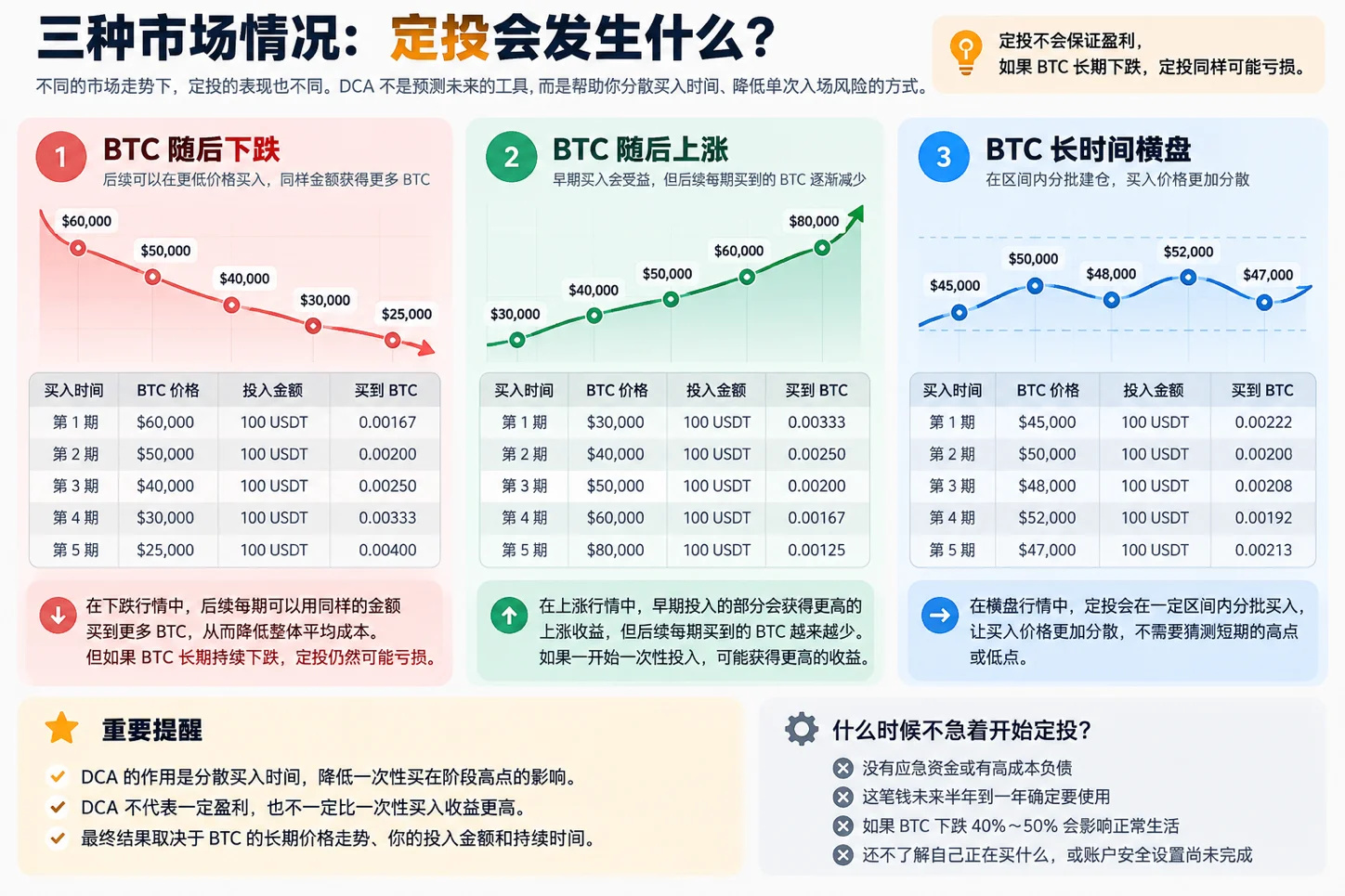
Under different market trends, DCA's results differ; DCA's core is spreading out the buy timing, not guaranteeing profit.
So DCA isn't trying to prove:
"Now is definitely a good time to buy BTC."
It's trying to solve:
"I'm not sure now is the best entry point, but I still want to invest in stages."
When should you NOT rush to start DCA?
When the following apply, dealing with cash flow first may matter more than creating a BTC DCA plan:
- no emergency fund;
- high-cost debt that should be dealt with first;
- the money will definitely be needed in the next six months to a year;
- a 40%-50% BTC drop would affect your normal life;
- you haven't secured your exchange account yet;
- you don't really understand what you're buying.
In one sentence:
DCA can handle the "when to buy" question, but it can't solve the "can you afford the loss" question.
6. How to DCA into Bitcoin on Binance: 2026 Walkthrough
This is the most important part of this article.
First, an important note:
In 2026, Binance's ordinary crypto DCA has been largely integrated into the 「Recurring Buy」 mode of Binance Convert.
Binance migrated its ordinary Auto-Invest plans to Convert DCA in 2025; by 2026, users creating an ordinary BTC DCA plan should use the Convert DCA entry in the current app.
Binance also adjusted the app's Convert entry in March 2026.
The current official app navigation logic is:
Trade → Buy & Sell → Convert → Recurring Buy.
Different regions, app versions, and account interfaces may differ slightly. If you can't find the entry, searching "Convert" or "Recurring Buy" directly inside the Binance app is usually faster.
Step 1: Enter Binance Convert DCA
Open the Binance app.
Go through, in order:
Trade → Buy & Sell → Convert
Once on the Convert page, switch to:
Recurring Buy
Don't confuse this with the "Spot DCA bot" — the difference is explained separately later.
Step 2: Choose BTC and the payment asset
Choose the target asset:
BTC
For the payment asset, you can choose based on what your account actually supports, for example:
USDT → BTC
or another payment asset the platform currently supports.
For users who already hold USDT, using USDT to periodically convert into BTC is the easiest to understand. If you don't have USDT in your account yet, first see How to Buy USDT on Binance 2026: P2P Process, Choosing a Merchant, and Payment.
Step 3: Enter the per-cycle amount
For example:
100 USDT per cycle
Minimum amounts and supported coins may change as product rules evolve, so don't treat the minimum amount you see at any one moment as a permanent standard.
Go by what the plan-creation page actually shows.
Step 4: Choose the frequency
For example, choose:
Weekly
Then set the date and time you want it to execute.
Binance currently supports every 1, 4, 8, or 12 hours, as well as daily, weekly, biweekly, and monthly.
The first time you use it, you don't need to make the plan complicated.
For example:
Invest 100 USDT into BTC every Monday.
That's already a complete DCA plan.
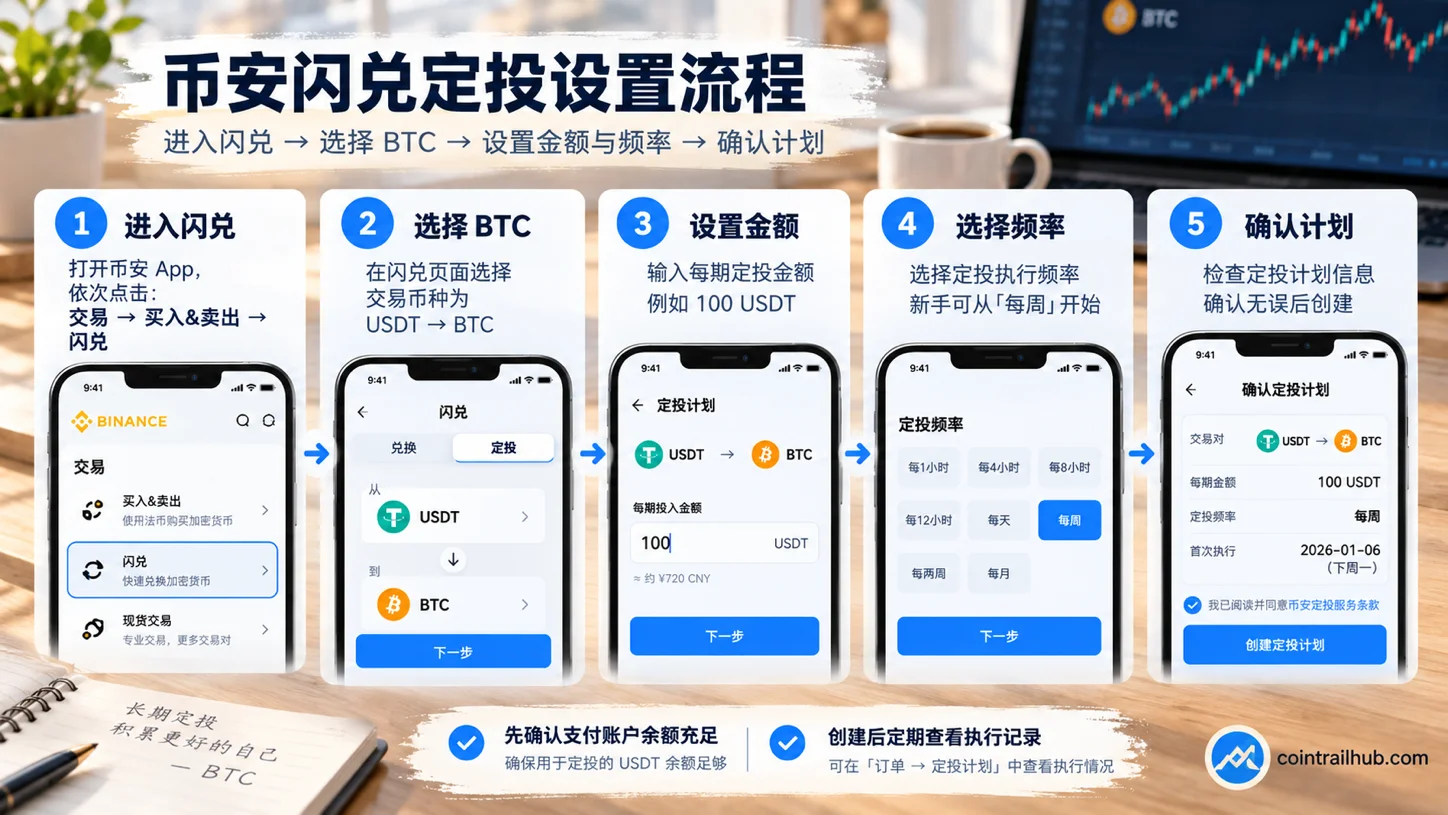
Step 5: Confirm the plan
Check:
- whether the buy asset is BTC;
- whether the payment asset is correct;
- the per-cycle amount;
- the execution frequency;
- the execution time.
Once everything is correct, create the plan.
The system will then execute automatically at the set times.
Step 6: Make sure the payment account has enough balance
This is very important.
Starting September 29, 2026, all Convert orders no longer settle through the Funding Account; DCA orders will settle to the Spot Account or Earn Account according to the plan settings, and failed orders refund to the Spot Account. Binance also recommends updating the account selection from the Funding Account to the Spot Account.
So, if you DCA into BTC with USDT:
Confirm the payment account selected by your DCA plan has enough balance before the execution day. After September 29, 2026, Binance recommends updating plans that previously used the Funding Account to the Spot Account; DCA orders will settle assets to the Spot Account or Earn Account according to the plan configuration, and failed orders refund to the Spot Account.
Don't wait until the deduction day to realize your balance is still sitting in another account.
If the balance is insufficient, that cycle's plan may not execute normally.
Step 7: Check your BTC DCA records
Once done, go to:
Orders → Convert History → Recurring Buy History
to view each:
- execution time;
- invested amount;
- amount of BTC bought;
- actual fill price.
Binance officially records Convert DCA fills in this location.
When doing long-term DCA, what matters more than watching BTC's current price every day is:
Periodically checking that the plan is executing properly.
7. Does Binance DCA Have Fees?
This deserves a separate explanation.
Binance currently describes Convert DCA as:
zero trading fees.
But:
Zero fees ≠ zero actual execution cost.
Because Binance also clearly states:
The fill price of Convert DCA may differ from Binance's spot market price.
So the correct understanding is:
Binance Convert DCA
doesn't charge an ordinary trading fee separately
but:
the final conversion uses the Convert quote.
If you care a lot about the fill price, before creating the DCA plan, check both:
- the BTC/USDT spot price;
- the Convert DCA reference quote.
Don't see "0 fees" and assume there's no spread cost at all.
8. What's the Difference Between Binance Convert DCA and Spot DCA?
This is where many beginners get confused.
Just because the word "DCA" appears in Binance doesn't mean every DCA product is the same.
| Comparison | Convert DCA | Spot DCA |
|---|---|---|
| Main purpose | Continuously buy on a fixed schedule | Automatically buy and sell in batches based on preset trading conditions |
| Core trigger | Time | Price and strategy parameters |
| Difficulty | Lower | Higher |
| For | Ordinary users accumulating BTC long-term | Users who understand trading strategies and bot parameters |
| Main goal | Spread capital across different times | Automatically run a trading strategy |
If your goal is simply:
Buy BTC with a fixed 100 USDT every week.
you usually don't need a complex Spot DCA bot.
Convert DCA is closer to the traditional sense of long-term DCA.
9. Binance Added Smart DCA in 2026 — Should You Turn It On?
On July 2, 2026, Binance added Smart DCA to Convert DCA.
Its biggest difference from ordinary DCA:
Ordinary DCA
Each cycle's amount is fixed.
For example:
Buy 100 USDT of BTC every week.
Smart DCA
It still executes on the schedule you set, but it reads CoinMarketCap's Fear & Greed Index and then raises or lowers that cycle's amount based on the rules you set in advance.
For example, you can design it so that:
when the market is in a certain sentiment zone, that cycle's amount is allowed to change by a preset ratio.
But note:
Binance won't decide which set of parameters is best for you, and it won't guarantee that Smart DCA earns more than fixed-amount DCA. Binance explicitly states that this feature only runs according to the parameters the user chooses.
Do beginners need Smart DCA?
Not necessarily.
When you first start BTC DCA, begin with:
fixed amount + fixed schedule
That actually makes it easier to understand your investment and average cost.
Smart DCA is an advanced feature to explore after you understand ordinary DCA.
10. Bitcoin DCA vs. Lump-Sum: Which Is Better?
There's no absolute answer.
The two methods solve different problems.
| Situation | Lump-sum buying | DCA |
|---|---|---|
| Market starts a sustained rally | Get full upside exposure earlier | Later buys get increasingly higher prices |
| Big drop right after buying | Short-term drawdown more concentrated | Later capital can keep buying at lower prices |
| Can't judge the current position | Psychological pressure usually higher | Buy timing more spread out |
| Execution difficulty | Done in one shot | Requires maintaining the plan long-term |
So:
DCA's advantage isn't guaranteeing higher returns — it's reducing the importance of a single entry price.
If you already have a lump of idle cash, say 5,000 USDT, you don't necessarily have to choose between:
lump-sum buying
and
fully staged DCA.
There's also this option:
Buy part of it first, and deploy the rest gradually over a few months.
But there's no standard ratio, and you certainly shouldn't treat any particular ratio as investment advice for everyone.
11. Should You Keep DCA-ing After BTC Drops?
Many people's real question isn't:
how to start.
It's:
should I keep going after it drops?
You can't mechanically answer "definitely keep going."
You should re-check three conditions:
1. Has your original investment thesis changed?
If only BTC's market price dropped but your long-term plan hasn't changed, this is a market-volatility issue.
If your basis of judgment has changed, you need to re-evaluate.
2. Has your cash flow changed?
If you suddenly lose your job, your income drops, or a large expense comes up, pausing DCA is completely fine.
A DCA plan serves your financial situation, not the other way around.
3. Is the current amount already keeping you up at night?
If every BTC drop causes you serious stress, it means:
the problem may not be the DCA strategy, but that the amount exceeds your tolerance.
At that point, prioritize capital risk over mechanically executing the plan.
So:
A price drop itself is neither a signal you must stop, nor a signal you must increase.
Whether to continue should come back to cash flow, risk tolerance, and your original plan.
12. The 4 Easiest Pitfalls to Fall Into with Bitcoin DCA
1. Stop when it drops, resume when it rises
Pausing the plan after BTC drops and only resuming after it rises again makes your buys increasingly concentrated at higher prices.
That's the opposite of DCA's purpose of spreading out entry timing.
If you pause, there should be a real reason:
like reduced income, needing cash, or a change in risk tolerance.
Not:
BTC dropped 10% today.
2. Suddenly increasing the amount whenever BTC rises
For example, originally:
100 USDT per week.
After BTC rises for a while, you suddenly change it to:
500 USDT per week.
Then when the price pulls back, you drop it back to 100 USDT.
This effectively turns back into:
chasing momentum based on short-term price action.
If you need to adjust the amount, more sensible reasons are:
- higher income;
- lower expenses;
- a change in long-term asset allocation.
Not the price moves of a few days.
3. Treating DCA as "stick with it and you'll definitely profit"
No.
If BTC's long-term value declines in the future:
DCA can still lose money.
DCA only adjusts the way capital enters the market; it doesn't eliminate:
- market risk;
- regulatory risk;
- liquidity risk;
- platform risk;
- the price risk of the asset itself.
4. Checking your DCA profit/loss every day
If your goal is a 2-3 year long-term DCA, checking every day:
- how much you gained today;
- how much you lost today;
- how many more points BTC dropped;
usually doesn't improve the strategy's results.
What's more worth checking periodically is:
whether the plan executed successfully, whether the balance is sufficient, whether the account is secure, and whether your cash flow has changed.
13. After DCA-ing into BTC, Where Should You Store It?
After buying BTC through DCA, whether to leave the asset on the exchange or move it to a self-custody wallet has no fixed dollar threshold.
You can judge by how you use it:
| Situation | What to prioritize |
|---|---|
| Small amount, frequent trading | The exchange is more convenient, but enable the necessary security settings |
| Long-term hold, infrequent trading | You can learn about self-custody wallets |
| The amount is already large enough that you couldn't easily absorb the loss | Worth seriously researching hardware wallets, backups, and asset diversification |
| Still don't know how to manage a seed phrase | Don't rush to move it into a wallet you don't know how to manage just to feel "safer" |
Self-custody solves part of the exchange-custody risk, but introduces new risks:
losing your seed phrase, wrong-address transfers, choosing the wrong network, and approval scams.
So:
Exchange risk and self-custody risk aren't about which is absolutely safer, but about who is responsible for the risk.
14. FAQ
What does Bitcoin DCA mean?
Bitcoin DCA means continuously buying BTC on a fixed schedule with a fixed amount, also called DCA (Dollar Cost Averaging).
Its main purpose is to spread your buy timing across different market prices, rather than predicting BTC's lowest point.
Is weekly or monthly Bitcoin DCA better?
There's no universal answer.
Weekly spreads the buy timing more; monthly has fewer executions and simpler management.
If it's your first time trying DCA and you don't know how to choose, you can start with once a week, but that doesn't mean weekly always earns more than daily or monthly.
How much should I DCA into BTC each time?
There's no fixed amount.
A more sensible standard is:
after investing this money, even if BTC drops significantly, it won't affect your life or short-term cash needs.
The easier the amount is to maintain long-term, the more it fits DCA's design.
Can I DCA into BTC with 100 USDT?
If the platform's current minimum allows it, 100 USDT can be a BTC DCA amount.
BTC can be bought in fractions — you don't need to buy one whole Bitcoin at a time.
The specific minimum amount is what the Binance plan-creation page shows in real time.
How do I set up automatic BTC DCA on Binance?
In 2026, go to:
Trade → Buy & Sell → Convert → Recurring Buy
then choose BTC, the payment asset, the per-cycle amount, and the frequency, and confirm to create the plan. Different regions and app versions may show slight differences.
Does Binance DCA have fees?
Binance currently labels Convert DCA as zero trading fees.
But Convert DCA uses the Convert quote, and the fill price may differ from the BTC/USDT spot market price, so you can't simply understand it as "all trading costs are zero."
What's the difference between Binance Convert DCA and Spot DCA?
Convert DCA mainly buys automatically by time — for example, buying BTC on a fixed weekly schedule.
Spot DCA is an automated trading strategy that usually requires setting more price and trading parameters.
If you just want to accumulate BTC on a fixed long-term schedule, Convert DCA is closer to traditional DCA.
Should I keep DCA-ing after BTC drops?
You can't answer based on price alone.
Check:
- whether your long-term view has changed;
- whether your cash flow is stable;
- whether the amount is still affordable.
A BTC drop itself is neither a reason you must stop, nor a reason you must increase.
Does DCA definitely make money?
No.
If BTC declines over the long term, DCA can still lose money.
DCA's main role is spreading out the timing of capital entering the market, not eliminating investment risk.
I already have a lump of idle cash — lump-sum or DCA?
If BTC keeps rising, lump-sum may earn more because the capital enters the market earlier.
If you're worried about buying at a stage high, DCA can reduce the impact of a single entry price on the overall result.
You can also use staged buying — you don't have to choose between the two extremes.
How long before I see results from DCA?
There's no fixed time.
DCA is a long-term capital-deployment method; you shouldn't preset "definitely profit in 3 months" or "definitely profitable in 2 years."
The final result depends on BTC's future price, the investment duration, the ongoing period, and the actual fill cost.
15. What Does the Simplest BTC DCA Plan Look Like?
If we compress the whole article into one example:
Asset: BTC Payment asset: USDT Amount: a fixed amount that won't affect your life long-term Frequency: once a week Tool: Binance Convert DCA Execution: automatic purchase Check: monthly confirmation of balance, plan execution, and account security
Note:
This is just an example to help you understand DCA's structure, not an investment plan suitable for everyone.
What truly matters isn't finding the "most profitable" amount and date, but:
an amount you can afford, rules you clearly understand, and execution you can sustain long-term.
Related reading
Bitcoin or Ethereum: Which Is Better? How to Choose for Your First Crypto Purchase (2026) — before DCA-ing, understand the difference between BTC and ETH
Buying BTC for the First Time in 2026: Don't Rush the Order — First Figure Out What Happens After You Buy — start with your first BTC purchase to understand the full flow
How to Buy USDT on Binance 2026: P2P Process, Choosing a Merchant, and Payment — before using USDT to DCA into BTC, prepare your account funds
What Is a Crypto Wallet? A Guide to Cold, Hot, and Hardware Wallets — after accumulating BTC long-term, learn the different storage options
What Is Bitcoin (BTC)? How It Works, Its Value, and Its Risks (2026) — before DCA-ing into BTC, understand what you're buying
Disclaimer
This article is for crypto-asset education and strategy sharing only, and does not constitute investment advice, financial advice, or trading advice.
Crypto asset prices are volatile and may carry market risk, liquidity risk, regulatory-policy risk, network-security risk, platform risk, and operational risk.
DCA does not guarantee profit and does not eliminate the risk of losing your principal.
Historical performance does not represent future results.
Readers should make independent judgments based on their own financial situation, risk tolerance, and investment goals, and comply with applicable local laws and regulations. Never invest money you cannot afford to lose.
- 2026-10-06UpdateUpdated to the Convert DCA entry, added Smart DCA, zero fees, and the difference from Spot DCA
See ourEditorial Policy and the correction process in ourCorrections Policy.
The CoinTrailHub editorial team focuses on crypto education for beginners, exchange security and P2P trading risk. This article is compiled from official sources and public data, reviewed by humans, and strives for accuracy but is not investment advice.
Last updated:2026-10-06 · Content reviewed by humans · Learn more
© 2026 CoinTrailHub · Original content. Reproduction or rewriting without permission is prohibited.