
What is Bitcoin (BTC)? How it works, its value, and risks (2026)

Table of contents

Binance new user rewards
20% trading fee rebate
Official Binance registration. Complete identity verification (KYC) to trade and withdraw.
Bitcoin, abbreviated BTC.
You can first think of it as: a crypto asset that runs on a blockchain network and is not issued by any institution.
It is not points issued by some company, nor virtual money created by some trading platform.
Bitcoin's design goal is to let people transfer value peer-to-peer over the internet without a bank or third party.
For beginners, you don't need to study code, mining hardware, or complex technology right away. Remembering three things is enough:
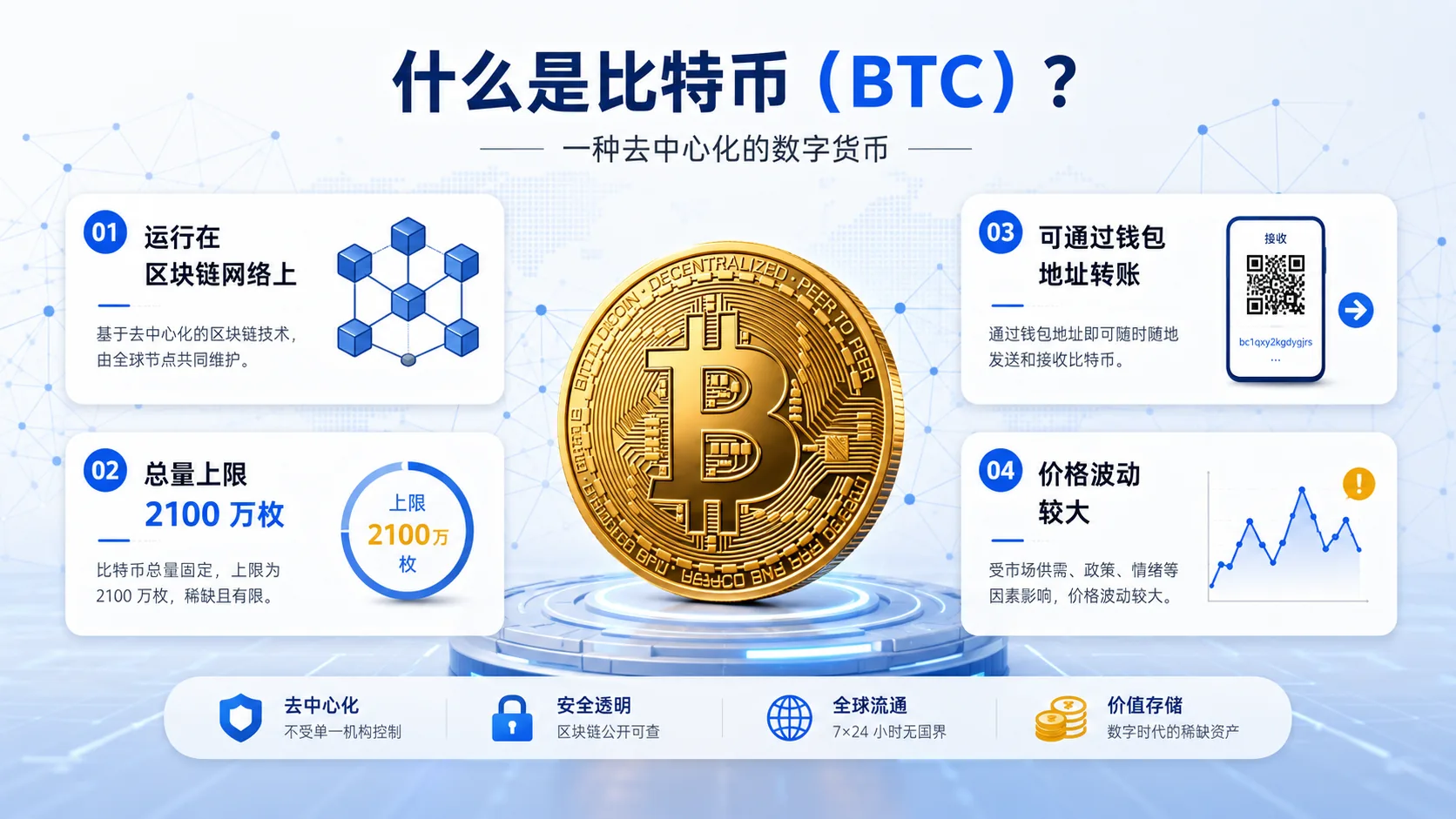
- Bitcoin runs on its own blockchain network;
- Bitcoin's supply cap is generally considered to be 21 million coins;
- Bitcoin's price is highly volatile — understanding risk matters more than chasing price.
This article is for basic education only and does not constitute investment advice or price prediction.
If you're starting to learn crypto systematically, it's recommended to first read What is crypto? Cryptocurrencies, Web3 wallets, and on-chain assets (2026) and What is blockchain? How it works, its uses, and risks (2026), then come back to this Bitcoin article — it will be easier to understand the relationship between BTC and blockchain.
Three sentences to remember first
1. Bitcoin is not platform points
Bitcoin is not exchange points, nor a digital balance in some company's backend database.
It runs on the Bitcoin network, where a blockchain records transfers and balance changes.
The BTC you see on an exchange is just what the platform account displays; real on-chain BTC is tied to wallet addresses, private keys, and seed phrases.
2. A limited supply does not mean the price will rise
Many people pay attention to Bitcoin because of its 21-million supply cap and halving mechanism.
But that does not mean the price will necessarily go up.
Bitcoin has gone through many rounds of large volatility. Beginners should not see only the words "digital gold" and ignore price risk.
3. Seeing an account balance does not mean you truly understand BTC
If your BTC is in an exchange account, the platform records your balance and handles transactions.
If you withdraw BTC to your own wallet, you need to keep the private key or seed phrase yourself.
An exchange is more convenient; a wallet gives you more control, but also more responsibility.
Early on, when our team ran a BTC withdrawal test, the first time we moved coins from an exchange to a personal wallet, we mixed up the difference between address and network — luckily we transferred a tiny amount and only continued after confirming the arrival. Since then we've always advised beginners: the first time you send BTC to a wallet, send 0.0001 BTC as a test first, confirm the address and network are correct, then consider further operations.
So for beginners, understanding the flow with a small amount matters more than rushing into large operations.
What is Bitcoin?
Bitcoin is one of the first cryptocurrencies widely known to the public.
In 2008, someone under the pseudonym Satoshi Nakamoto published the whitepaper "Bitcoin: A Peer-to-Peer Electronic Cash System." In 2009, the Bitcoin network officially went live.
The problem it wants to solve is direct:
Can two people transfer money to each other directly over the internet, without a bank, payment company, or intermediary?
Bitcoin's answer is:
Use a blockchain to keep the ledger, network nodes to verify, and rules to limit issuance.
So Bitcoin is not a company, nor an app.
It is more like a set of openly running network rules.
As long as the network keeps running, users can send and receive BTC through wallet addresses.
What is the relationship between Bitcoin and blockchain?
Bitcoin cannot be separated from blockchain.
You can understand it this way:
Bitcoin is the asset; blockchain is the ledger that records this asset's transfers and balance changes.
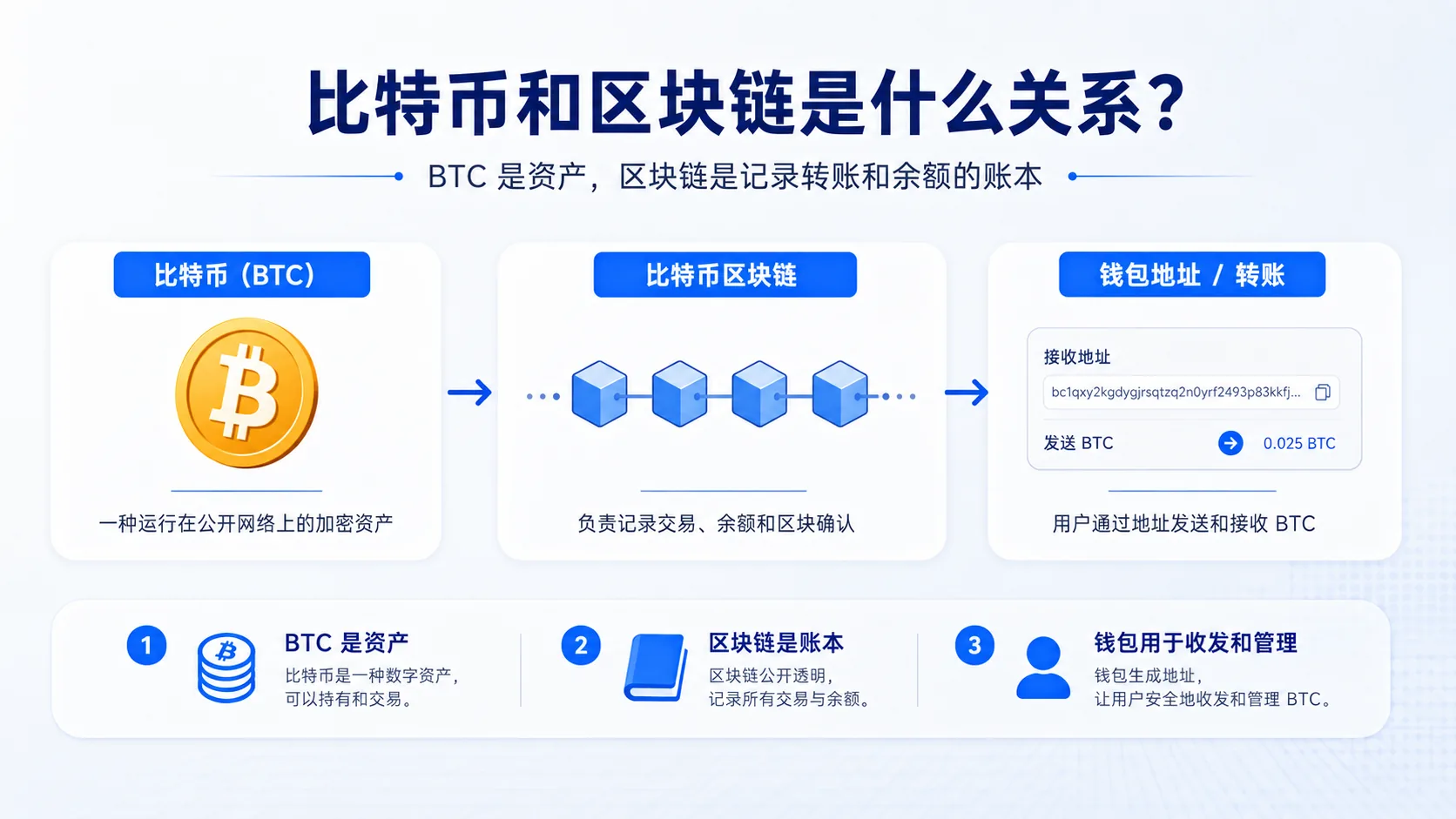
For example:
Who sent BTC to whom;
How much BTC a certain address received;
Miners mined a new block and got the block reward.
These records are all written into the Bitcoin blockchain.
So Bitcoin is not an asset "stored in some platform," but an on-chain asset recorded in the Bitcoin network.
This is also why beginners must understand blockchain first.
If you're still unclear about why blockchain can record transfers and why on-chain transactions are usually hard to reverse, read What is blockchain? How it works, its uses, and risks (2026).
Because once you start dealing with deposits, withdrawals, wallet addresses, and transaction confirmations, you'll find:
Bitcoin is not an ordinary app balance, and on-chain transfers are not platform orders.
What does "21 million" mean?
One of Bitcoin's most important features is that its supply cap is generally considered to be 21 million coins.
This is also one of the reasons many people call Bitcoin "digital gold."
Gold's scarcity comes from natural resource limits.
Bitcoin's scarcity comes from code rules and network consensus.
Simply put, Bitcoin is not an asset that can be issued at will — its issuance schedule is written into the rules in advance and executed by the whole network together.
But beginners should note:
A limited supply does not mean the price will rise.
Scarcity is only part of understanding Bitcoin's value logic; market sentiment, the macro environment, regulatory changes, and capital flows all affect the price.
So don't read "21 million" as a guaranteed-profit logic.
It only means Bitcoin's supply rules are relatively clear; it guarantees no investment outcome.
What is the Bitcoin halving?
New bitcoins are mainly produced through mining.
Miners add new blocks to the Bitcoin blockchain by computing and verifying transactions, and receive block rewards.
The so-called "halving" is when Bitcoin's block reward is cut in half roughly every 4 years.
In the earliest days, each block reward was 50 BTC.
It then gradually became 25 BTC, 12.5 BTC, 6.25 BTC, and after the 2024 halving, 3.125 BTC.
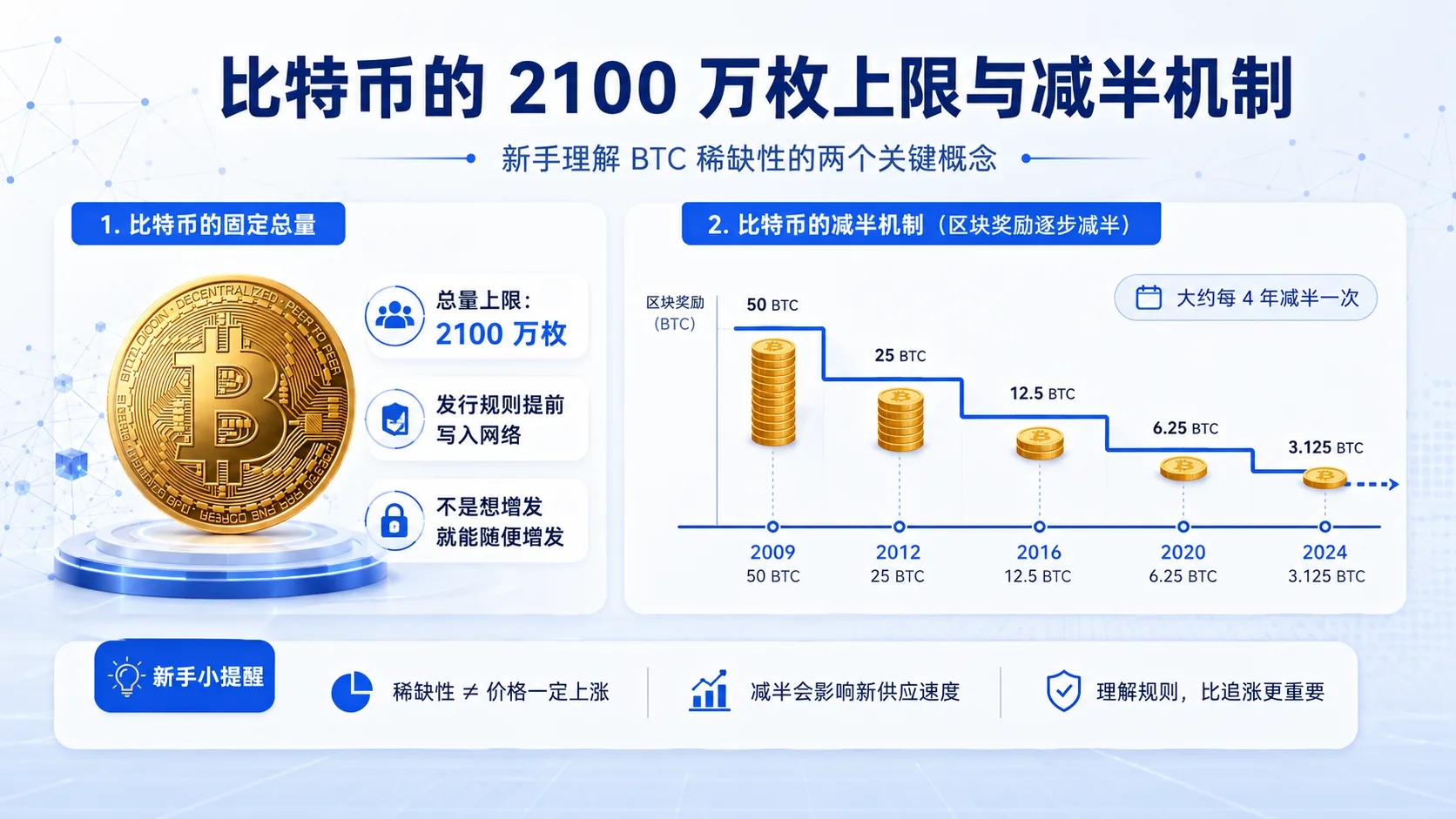
The purpose of the halving is to make new BTC issuance slower and slower, until it finally approaches the supply cap.
Many people pay attention to the halving because it affects Bitcoin's new supply.
But the halving does not mean the price will rise.
Historically, halvings are often discussed by the market and may affect expectations, but price ultimately still depends on supply and demand, capital, sentiment, and the macro environment.
Beginners can understand the halving mechanism, but should not treat it as a buy/sell signal.
Why do some people call Bitcoin "digital gold"?
Bitcoin is called "digital gold" mainly because it shares some similarities with gold.
| Dimension | Gold | Bitcoin |
|---|---|---|
| Scarcity | Limited reserves | Supply cap (generally considered 21 million) |
| Issuer | Not issued by a single company | Not issued by a single company; runs on an open network |
| Store of value | Treated by some as a store of value | Also treated by some as a store of value |
| History | Thousands of years of history | Only a little over a decade of history |
| Price volatility | Relatively lower volatility | Much higher price volatility |
| Asset form | Real-world asset | Digital network asset |
1. Both have scarcity
Gold has limited reserves, and Bitcoin has a supply cap.
This makes many people view Bitcoin as a scarce asset.
2. Neither is issued by a single company
Gold is not issued by some company.
Bitcoin is not points issued by some company either.
It runs on an open network.
3. Both are treated by some as a store of value
Some people hold gold to hedge against currency devaluation or to preserve purchasing power over the long term.
Some people hold Bitcoin with similar logic.
But the two also have clear differences.
Gold has thousands of years of history; Bitcoin has only a little over a decade.
Gold is relatively less volatile; Bitcoin's price is far more volatile.
Gold is a real-world asset; Bitcoin is a digital network asset.
So "digital gold" is only a metaphor to help beginners understand — it does not mean Bitcoin is exactly the same as gold, and it certainly does not mean Bitcoin is risk-free.
What is Bitcoin used for?
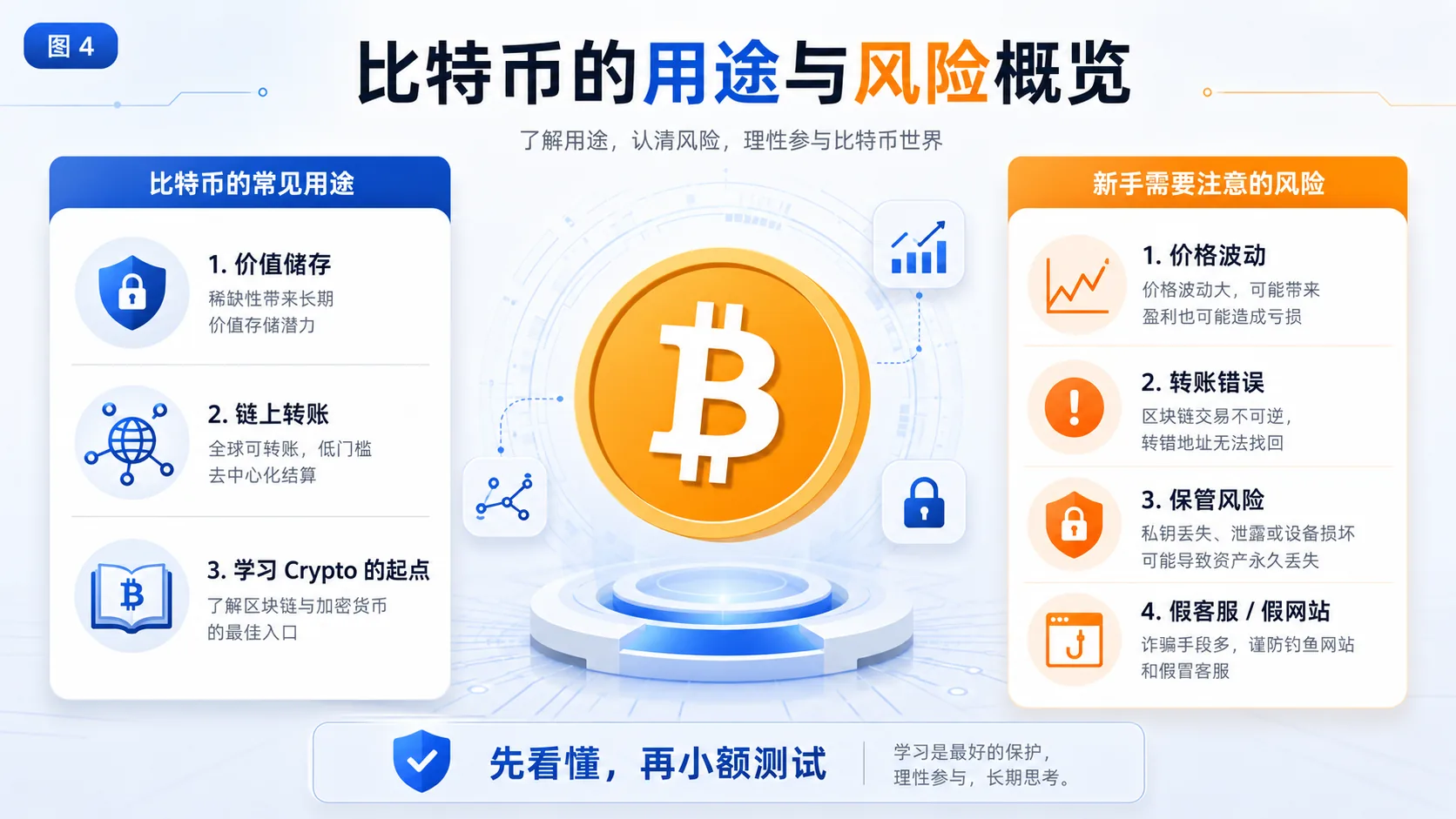
Looking at actual use today, Bitcoin mainly has the following common uses.
1. Store of value
Many people hold BTC as part of a long-term asset allocation. But this is only a viewpoint, not investment advice.
What they value is Bitcoin's scarcity, global liquidity, and decentralization.
But that does not mean everyone is suited to hold BTC.
For a highly volatile asset, you must first consider your own risk tolerance.
2. On-chain transfers
Bitcoin can be transferred worldwide through addresses.
As long as you have the other party's Bitcoin address, you can send BTC.
But before transferring, you must confirm:
The address is correct;
The network is the Bitcoin mainnet;
The fee is appropriate;
The amount is correct.
For the first operation, a small test is recommended.
3. A starting point for learning crypto
Bitcoin is the first stop for many people learning about crypto.
After understanding Bitcoin, looking at Ethereum, USDT, wallets, exchanges, and on-chain assets makes it easier to build the overall framework.
So Bitcoin is not just an asset name — it is also an important starting point for understanding the whole crypto world.
The places beginners most easily misunderstand Bitcoin
Misconception 1: Bitcoin is blockchain
No.
Bitcoin is an important application of blockchain, but blockchain is not only Bitcoin.
Ethereum, TRON, Solana, and others are also different blockchain networks.
Misconception 2: Bitcoin is definitely safe
The Bitcoin network has run for many years, but the process of holding BTC still carries risk.
Exchange account theft, seed phrase leaks, downloading fake wallets, and sending to the wrong address can all cause asset loss.
So don't read "the Bitcoin network is secure" as "however I operate, it's safe."
Misconception 3: Buying BTC means you will definitely profit
Not necessarily.
Bitcoin has gone through many large drawdowns in its history.
Many people chased in at the top and later left at a loss because they couldn't handle the volatility.
Understanding Bitcoin does not mean you must hold Bitcoin.
Even less does it mean blindly chasing price rises.
Misconception 4: You must buy a whole BTC
No.
1 BTC can be split into very small units.
Beginners don't need to worry about "not being able to afford a whole coin."
What you really need to understand first is what BTC is, where the risks are, and how to operate safely — not to worry about the quantity first.
What are the risks of Bitcoin?
1. Price-volatility risk
Bitcoin's price is very volatile.
In the short term, both rises and falls can be severe.
Beginners should not decide whether to participate based only on price trends, community sentiment, or others' recommendations — they should first understand volatility, custody, transfer, and regulatory risks.
Even more importantly, don't use living funds, borrowed money, or money you need soon to participate in highly volatile assets.
2. Custody risk
If your BTC is on an exchange, you bear risks of platform account security, platform rules, and withdrawal limits.
If your BTC is in your own wallet, you bear risks of private keys, seed phrases, device security, and transfer operations.
Neither way is absolutely safe; the key is to understand where the responsibility lies.
3. Transfer risk
Once a BTC transfer is confirmed, it is usually hard to reverse.
A wrong address, wrong network, or unreasonable fee setting can all cause trouble.
For the first operation, definitely do a small test.
When our team writes beginner tutorials, we always put "address, network, amount, fee, small test" on the pre-transfer checklist. Because many losses are not caused by the technology being too complex, but by rushing the first operation without carefully checking the basic information.
4. Scam risk
Bitcoin itself is not a scam, but there are many scams around Bitcoin.
Common scams include:
Fake exchanges;
Fake wallets;
Fake customer support;
Fake airdrops;
"Send 1 BTC, get 2 BTC back";
Guaranteed-principal high-yield investments;
Celebrity impersonation giveaways.
As long as the other party asks you to send money first, hand over your seed phrase, download unfamiliar software, or promises guaranteed profit, be highly alert.
5. Regulatory uncertainty
Different countries and regions have different rules for Bitcoin, exchanges, wallets, taxes, and crypto-asset services.
The same tool or service may face different requirements in different regions.
Beginners should follow the laws, regulations, and official pages where they live.
Before touching BTC, do these 5 things first
1. Understand blockchain first
Without understanding blockchain, it's hard to understand why Bitcoin transfers can't be casually reversed.
2. Tell exchanges and wallets apart
An exchange is a platform account.
A wallet is an on-chain address management tool.
Both can be used, but the responsibilities differ.
3. Learn to check the network
BTC withdrawals usually require choosing the Bitcoin mainnet.
Don't confuse BTC with wrapped assets on other chains.
4. Do a small test
For the first deposit, withdrawal, or transfer, don't go straight to a large amount.
Run through the process with a small amount first.
5. Stay away from anyone promising guaranteed profit
Bitcoin has no guaranteed-profit play.
The more someone promises high returns, principal protection, or inside information, the more you should stay away.
FAQ: common Bitcoin beginner questions
Is Bitcoin a scam?
Bitcoin itself is not a scam.
It is a decentralized network and crypto asset that has run publicly for many years.
But there are many scams around Bitcoin, such as fake exchanges, fake wallets, fake customer support, and guaranteed-principal high-yield projects.
So you need to distinguish between Bitcoin itself, and people who commit fraud under Bitcoin's name.
What's the difference between Bitcoin and Ethereum?
Bitcoin is more like a crypto asset centered on storing value.
Ethereum is more like a blockchain network that can run smart contracts and Web3 applications.
The two have different positioning; it's not simply one replacing the other.
Do you have to buy a whole Bitcoin?
No.
Bitcoin can be split into very small units.
You can hold 0.01 BTC, 0.001 BTC, or even smaller amounts.
Beginners should understand the concepts and risks first — that matters more than worrying about the quantity.
Can Bitcoin be kept on an exchange?
Yes, but understand the risks.
Keeping it on an exchange is more convenient, but a platform account is not you controlling the private key yourself.
Withdrawing to a personal wallet gives more control, but you must keep the seed phrase and private key yourself.
Beginners can start with a small amount and gradually understand the difference.
Why do Bitcoin transfers require a fee?
Bitcoin transfers need miners or network participants to package and confirm transactions.
The fee can be understood as the network cost of using the Bitcoin network.
When the network is congested, the fee may be higher.
When not in a hurry, you can check the current fee situation first.
Will Bitcoin go to zero?
Theoretically, any risk asset can hit extreme situations.
But for beginners, the more realistic question is not "will it go to zero" but whether you can handle its large volatility.
If a price drop keeps you from sleeping, it means your allocation may already exceed your tolerance.
What to learn next?
If this is your first time learning crypto systematically, it's recommended to continue in this order:
- What is Ethereum — understand smart contracts, gas fees, and Web3 apps;
- What is USDT — understand stablecoins, deposits, withdrawals, and network choice;
- What is a Web3 wallet — understand wallets, seed phrases, private keys, and on-chain addresses;
- What is a seed phrase — understand why losing it may mean losing your assets;
- Can you recover a transfer sent on the wrong chain — one of the most common real problems for beginners.
If you haven't read the earlier basics yet, you can go back to:
What is crypto? Cryptocurrencies, Web3 wallets, and on-chain assets (2026)
What is blockchain? How it works, its uses, and risks (2026)
Summary
Bitcoin is one of the earliest widely recognized crypto assets in the crypto world.
It runs on the Bitcoin blockchain, is not issued by any single platform, and is not ordinary app points.
Its important features include:
- Runs on an open network;
- Supply cap generally considered 21 million;
- Transfers and balances recorded via blockchain;
- Highly volatile price;
- Self-custody means taking on security responsibility;
- Often called "digital gold," but that does not mean no risk.
For beginners, understanding Bitcoin is not about operating right away, but about building the foundational understanding of crypto.
Understand BTC first, then learn ETH, USDT, wallets, seed phrases, and on-chain transfers — everything will go much more smoothly after that.
Related articles
Bitcoin private key security: 6 decisions that determine whether you lose your BTC (2026)
What are Ordinals and BRC-20? Bitcoin inscriptions and token standards
Why is Bitcoin valuable? Scarcity, decentralization, network effects — understand why BTC has value before deciding whether to buy
Buying BTC for the first time in 2026: don't rush to order — first think about what to do after buying — a decision framework before buying BTC
How to choose a Bitcoin wallet? Cold/hot/hardware wallets compared (2026) — the safest place to keep BTC after buying
Disclaimer
This article is for basic education about Bitcoin, crypto, and on-chain assets, and does not constitute investment, financial, or trading advice.
Crypto-asset prices are highly volatile, and related services may carry platform risk, market risk, liquidity risk, regulatory risk, network-security risk, and operational risk. Regulatory requirements differ across countries and regions, and users should follow the laws, regulations, and official pages where they live, and judge carefully based on their own risk tolerance.
Any operation involving account registration, identity verification, deposits, withdrawals, wallet authorization, or asset management should first confirm official channels, and only proceed after fully understanding the risks.
- Bitcoin.orgOfficial material on the Bitcoin network and basic concepts
- Bitcoin whitepaperA peer-to-peer electronic cash system and supply design
- Ethereum.orgBlockchain and smart contract basics for comparison
- Binance AcademyHalving mechanism and mining basics
- Coinbase LearnCrypto beginner basics and risk notes
See ourEditorial Policy and the correction process in ourCorrections Policy.
The CoinTrailHub editorial team focuses on crypto education for beginners, exchange security and P2P trading risk. This article is compiled from official sources and public data, reviewed by humans, and strives for accuracy but is not investment advice.
Last updated:2026-06-18 · Content reviewed by humans · Learn more
© 2026 CoinTrailHub · Original content. Reproduction or rewriting without permission is prohibited.