
What Are Ordinals and BRC-20? Bitcoin Inscriptions and Token Standards
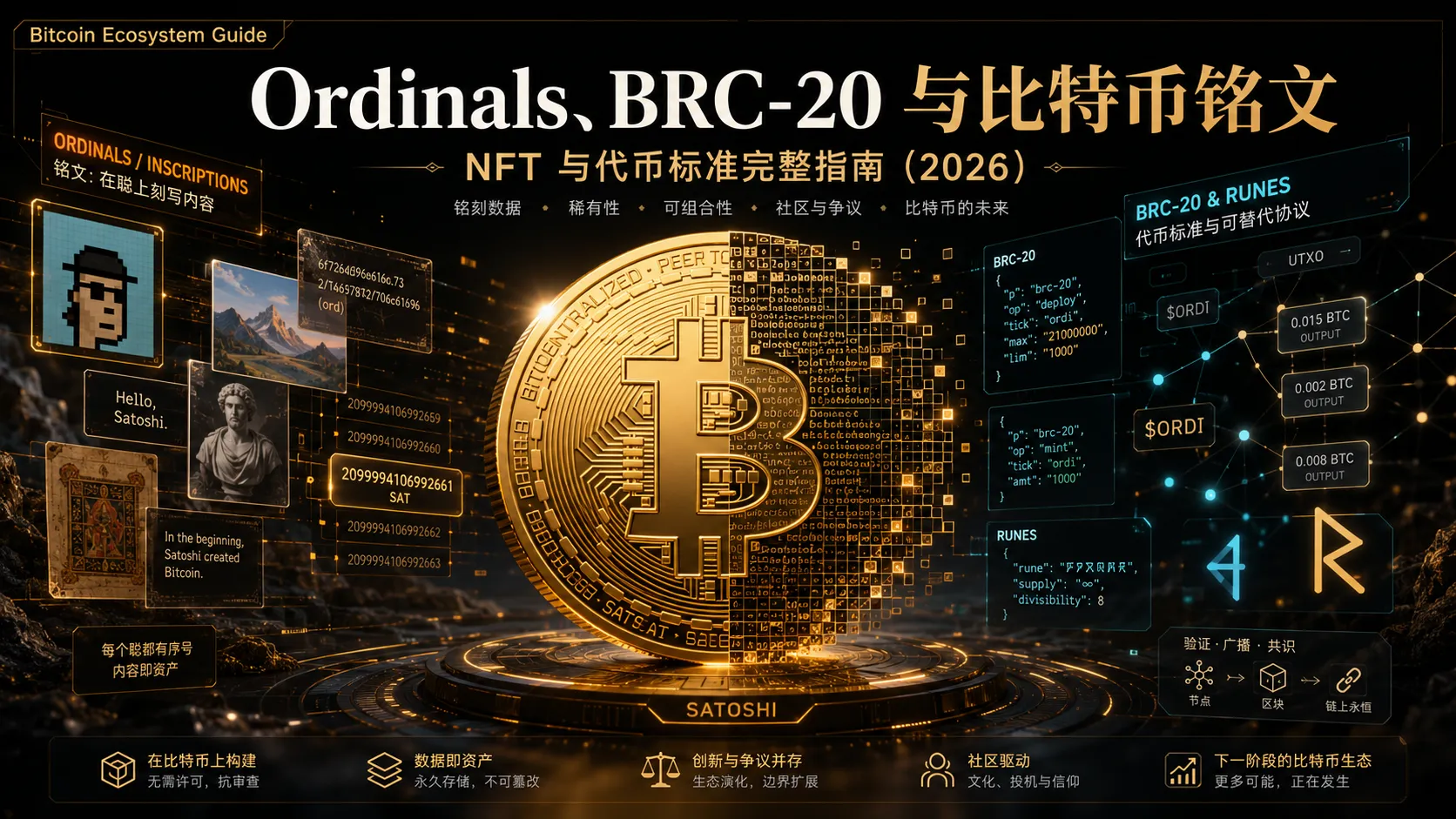
Table of contents

Binance new user rewards
20% trading fee rebate
Official Binance registration. Complete identity verification (KYC) to trade and withdraw.
Ordinals (Bitcoin Ordinals) is a protocol that lets users record arbitrary data on Bitcoin's smallest unit, the "satoshi" (sat). Through Bitcoin Inscription, users can write images, text, audio, and other data into Bitcoin transaction records, which in turn gave rise to experimental token standards like BRC-20.
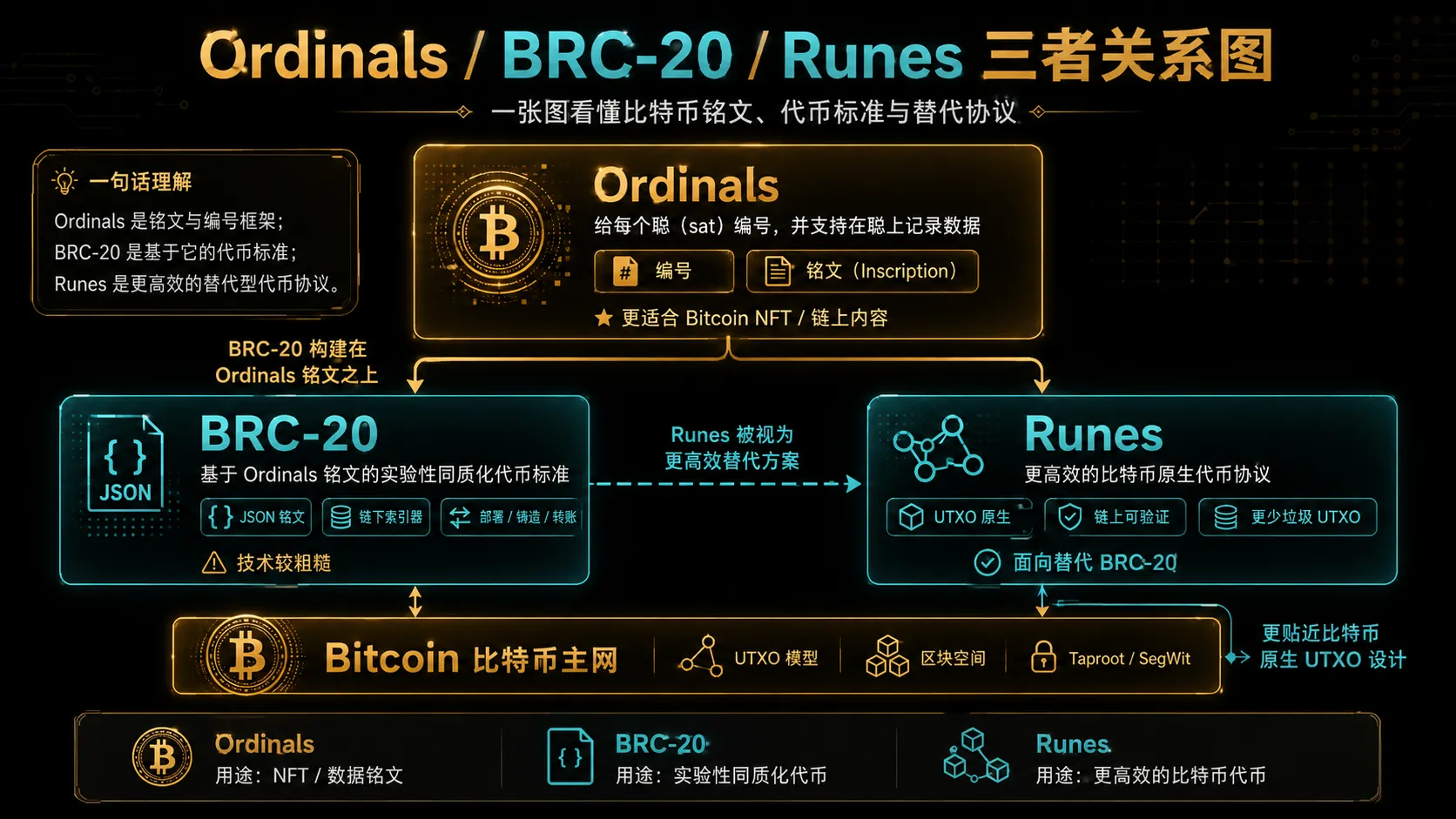
BRC-20 is an experimental fungible token standard for Bitcoin that borrows the naming of Ethereum's ERC-20. Its name mimics Ethereum's ERC-20, but it is technically completely different — BRC-20 has no smart contracts; instead it uses JSON inscriptions and off-chain indexers to deploy, mint, and transfer tokens.
In early 2023, this "on-chain inscription" movement ignited the Bitcoin network: transaction volume surged, gas fees spiked to tens of dollars, and the mempool backlogged hundreds of thousands of transactions. Ordinals and BRC-20 turned Bitcoin from "only able to transfer" into "able to issue assets" — the most important application-layer breakthrough in Bitcoin's 14-year history, and also the source of its most intense community controversy.
This article is a technical-principles explainer and does not constitute investment advice.
Bitcoin's design limitation: it can only transfer, not "issue coins"
Bitcoin's blockchain is essentially a distributed ledger. Its original design goal was peer-to-peer value transfer, not providing a general-purpose smart contract platform like Ethereum. When Satoshi Nakamoto designed Bitcoin, they did not add the ability to "issue custom assets" — this is a fundamental difference from Ethereum.
Ethereum has smart contracts built in; anyone can write a few lines of code to issue an ERC-20 token or mint an NFT (see the Ethereum ecosystem guide for details). Bitcoin's scripting language is deliberately designed to be Turing-incomplete (no loops, no complex logic), and the goal is clear: simpler systems are more secure. Bitcoin is positioned as "digital gold," not a "world computer."
This means that before 2023, if you wanted to issue a token or NFT, you had to go to Ethereum, Solana, or another smart-contract chain. Ordinals changed this — it bypassed the "no smart contracts" limitation with a completely different approach.
SegWit and Taproot: two upgrades that accidentally paved the way
Ordinals was able to emerge not because Bitcoin suddenly supported smart contracts, but because two protocol upgrades greatly relaxed the limit on "how much extra data a transaction can carry."
SegWit (Segregated Witness, 2017): separated transaction signature data from the main body, gave Witness data its own storage space, and applied a 75% fee discount — stuffing data into Witness is much cheaper than stuffing it into the transaction body.
Taproot (November 2021): combined with the data-structure changes introduced by SegWit, allowed complex scripts and extra data to be stored as Witness Data, greatly reducing the technical barriers and cost of embedding data.
The combined effect of the two upgrades: the technical obstacle and economic cost of storing arbitrary data on the Bitcoin chain were greatly reduced by the end of 2021. These upgrades were originally intended to improve scalability and privacy, but in 2023 they unexpectedly became the technical foundation of Ordinals — like a highway widening its lanes, only for people to discover they could set up a stall on it.
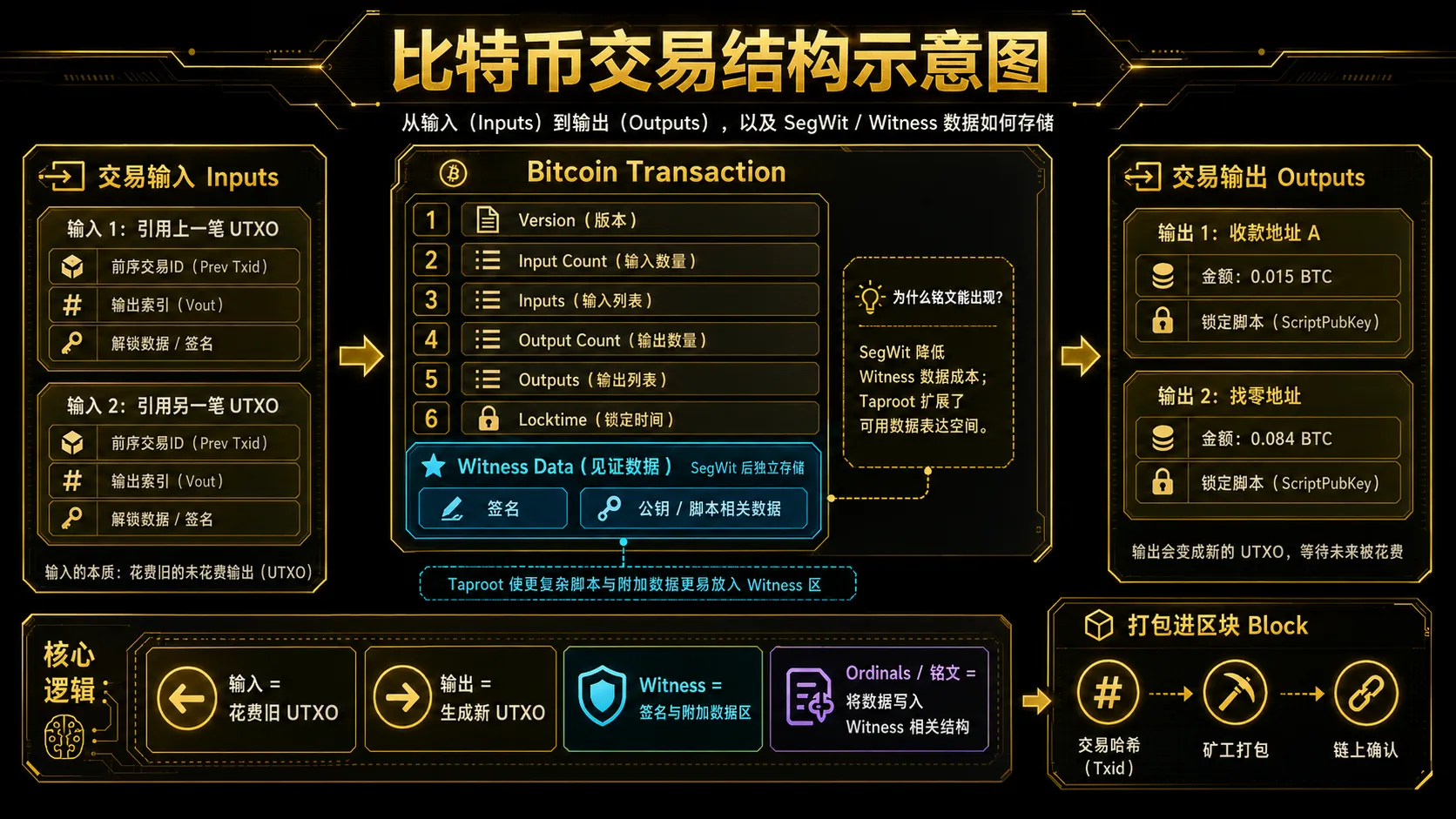
For more details on Bitcoin's transaction structure and the Witness data area, see How the Blockchain Records Transactions: Blocks, Hashes, Proof of Work (2026). To understand why halving affects miner revenue, see Can Bitcoin's 21 Million Supply Cap Be Changed? Source Code and Forks.
What is a Bitcoin Inscription?
Before understanding Ordinals, you need to grasp one core concept: Bitcoin Inscription.
Simply put: Inscription is the process of writing data into a Bitcoin transaction; the Ordinals protocol is responsible for numbering satoshis (sats) and specifying which sats carry which inscription data.
- Ordinals' role: number every sat through "ordinal theory," track the flow path of sats, and turn each sat into an identifiable "digital carrier"
- Inscription's role: embed images, text, JSON, and other data into the Witness data area of a Bitcoin transaction, achieving on-chain data recording
The relationship between the two can be summarized as: Ordinals is responsible for "numbering sats," and Inscription is responsible for "writing content onto sats." Like numbering every page of a book first (Ordinals), then writing on specific page numbers (Inscription).
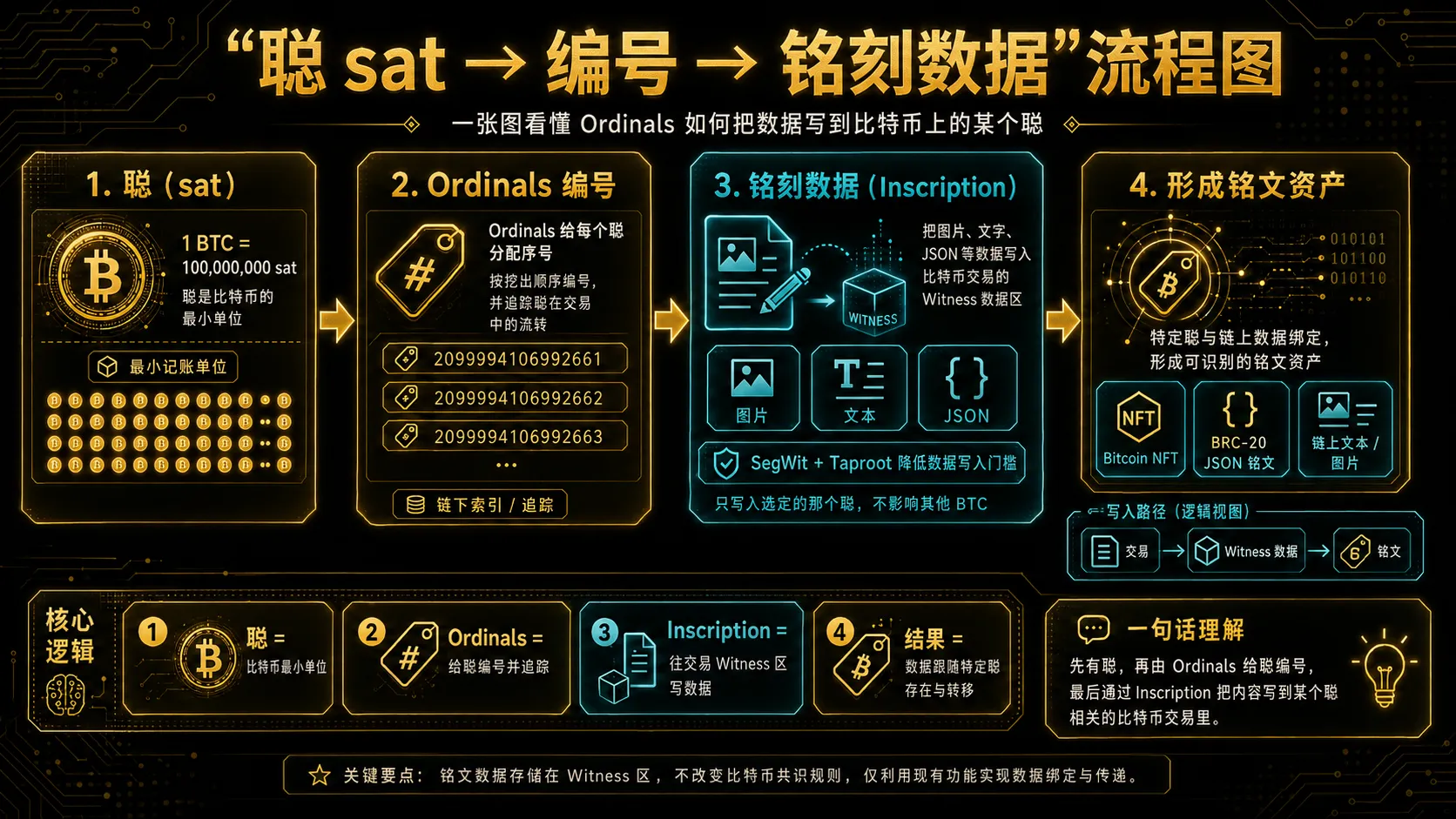
Once inscription data is written, it is immutable — blockchain history cannot be modified or deleted. This is why Ordinals inscriptions are regarded by many as "true digital collectibles": they don't depend on any external server or storage system; the data itself lives on Bitcoin, the world's most secure decentralized network.
What are Ordinals: numbering every sat, then inscribing content on it
The Ordinals protocol was proposed by software engineer Casey Rodarmor in January 2023 (see the Ordinals official documentation). The core idea has two steps:
Step one: number every sat. 1 BTC = 100 million sats, for a total of 2.1 quadrillion sats. Ordinals numbers sats from 0 in the order they were mined. This "ordinal theory" is essentially an off-chain indexing layer: it analyzes historical on-chain transaction data to track the flow path of each sat.
Step two: inscribe data. "Engrave" a piece of data onto a specific sat — images, text, or audio. The data is written into the Witness data area of a Bitcoin transaction via Taproot-related transaction structures. After inscription, the sat "carries" that data, and the inscription moves with it when transferred.
The essential difference from Ethereum NFTs: most Ethereum NFTs store their media files in IPFS, Arweave, or other external storage systems, with the chain usually recording token metadata and resource references. Ordinals inscription data is written into the Witness data area of the Bitcoin blockchain — as long as the Bitcoin network keeps running, these historical records can theoretically be preserved permanently and cannot be tampered with.
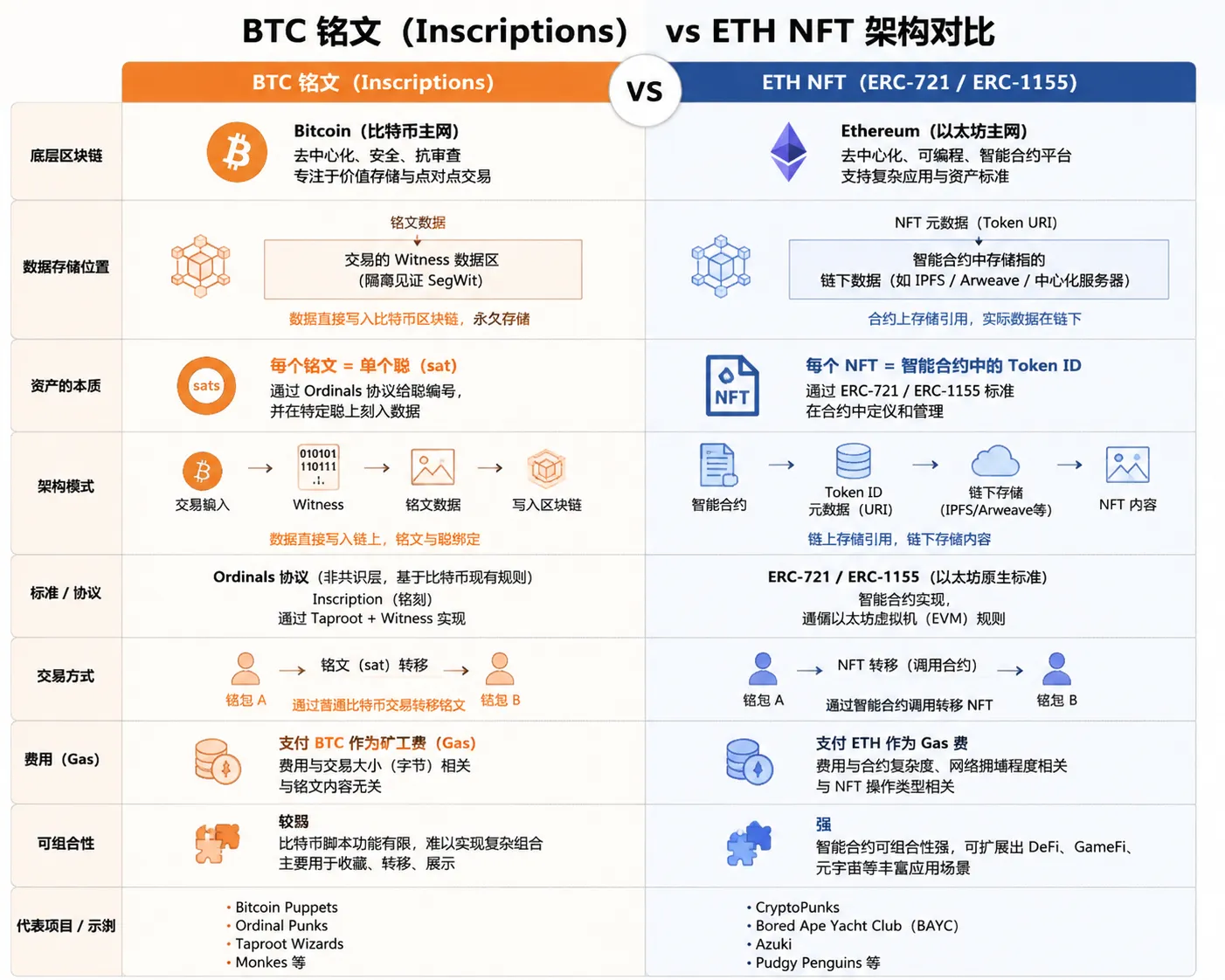
Ordinals also introduced a rarity system for sats (six tiers: common, uncommon, rare, epic, legendary, mythic). Rare sats sparked a collecting frenzy in 2023 — one epic sat once sold for 33 BTC (about $1 million at the time).
Ordinals NFT vs Ethereum NFT vs Solana NFT: core differences
Many beginners conflate Ordinals inscriptions with Ethereum NFTs, but their technical architectures are completely different:
| Dimension | Ordinals (Bitcoin inscriptions) | Ethereum NFT | Solana NFT |
|---|---|---|---|
| Data storage location | On the BTC chain (Witness data area) | Usually off-chain (IPFS/Arweave), on-chain records metadata and references | Usually off-chain (Arweave/IPFS), on-chain records metadata |
| Uses smart contracts | No (no smart contracts) | Yes (ERC-721/ERC-1155) | Yes (SPL Token Metadata) |
| Permanence | Very high (data on-chain, undeletable) | Medium (IPFS may lose data) | Medium (depends on Arweave persistence) |
| Transaction speed | Slow (10 min+ block time) | Medium (12s block time) | Fast (<1s block time) |
| Gas fees | High (BTC mainnet fees) | Medium-high (L1), low (L2) | Very low |
| Ecosystem maturity | Early (2023–present) | Mature (2017–present) | Mature (2021–present) |
| Representative projects | Bitcoin Puppets, NodeMonkes | CryptoPunks, Bored Ape YC | Mad Lads, DeGods |
Core conclusion: Ordinals' biggest advantage is "data stored directly on the Bitcoin chain"; its biggest weakness is "limited functionality due to the absence of smart contracts." If you value on-chain storage security and censorship resistance, Ordinals is the better choice; if you need complex NFT features (royalties, composability), Ethereum or Solana is more suitable.
A brief history of Bitcoin Ordinals
From the release of the Ordinals protocol to the launch of Runes took less than a year and a half:
| Time | Event | Impact |
|---|---|---|
| January 2023 | Casey Rodarmor releases the Ordinals protocol | Bitcoin can inscribe arbitrary data on-chain for the first time |
| March 2023 | @domodata proposes the BRC-20 experimental standard | The first fungible-token craze appears on Bitcoin |
| May 2023 | ORDI minting completes, price surges | BRC-20 speculation frenzy breaks out fully, gas fees hit all-time highs |
| November 2023 | Binance lists ORDI spot trading | ORDI surges 50%+ in 24h, market cap briefly approaches $2 billion |
| December 2023 | Bitcoin Core developer Luke Dashjr publicly opposes Ordinals | Community split deepens, "filter inscriptions" controversy heats up |
| January 2024 | SATS market cap briefly exceeds $1 billion | BRC-20 meme-coin frenzy peaks |
| April 20, 2024 | Bitcoin's fourth halving, Runes protocol launches | Miner single-day fee revenue hits a $100 million+ all-time record |
| H2 2024 | BRC-20 hype cools sharply | ORDI drops to $5–8, 99% of BRC-20 tokens go to zero |
| 2025–present | Ordinals and Runes ecosystems keep evolving | Volume stabilizes, infrastructure gradually improves |
What is BRC-20: "engraving" tokens on Bitcoin with JSON
If Ordinals is engraving images on sats, BRC-20 is engraving token information on sats.
BRC-20 was proposed by anonymous developer @domodata on March 8, 2023 (see the BRC-20 experimental standard documentation). It is the first experimental fungible token standard built on Bitcoin Ordinals inscriptions. Its name clearly mimics Ethereum's ERC-20, but it is technically completely different — BRC-20 has no smart contracts and relies entirely on inscription JSON and off-chain indexers. Its working principle is extremely simple:
Deploy: inscribe a piece of JSON declaring the creation of a token. For example
{"p":"brc-20","op":"deploy","tick":"ordi","max":"21000000","lim":"1000"}— meaning "create a token called ORDI, with a total supply of 21 million and a mint limit of 1,000 each time."Mint: anyone inscribes a piece of JSON to mint tokens.
{"p":"brc-20","op":"mint","tick":"ordi","amt":"1000"}— "I mint 1,000 ORDI."
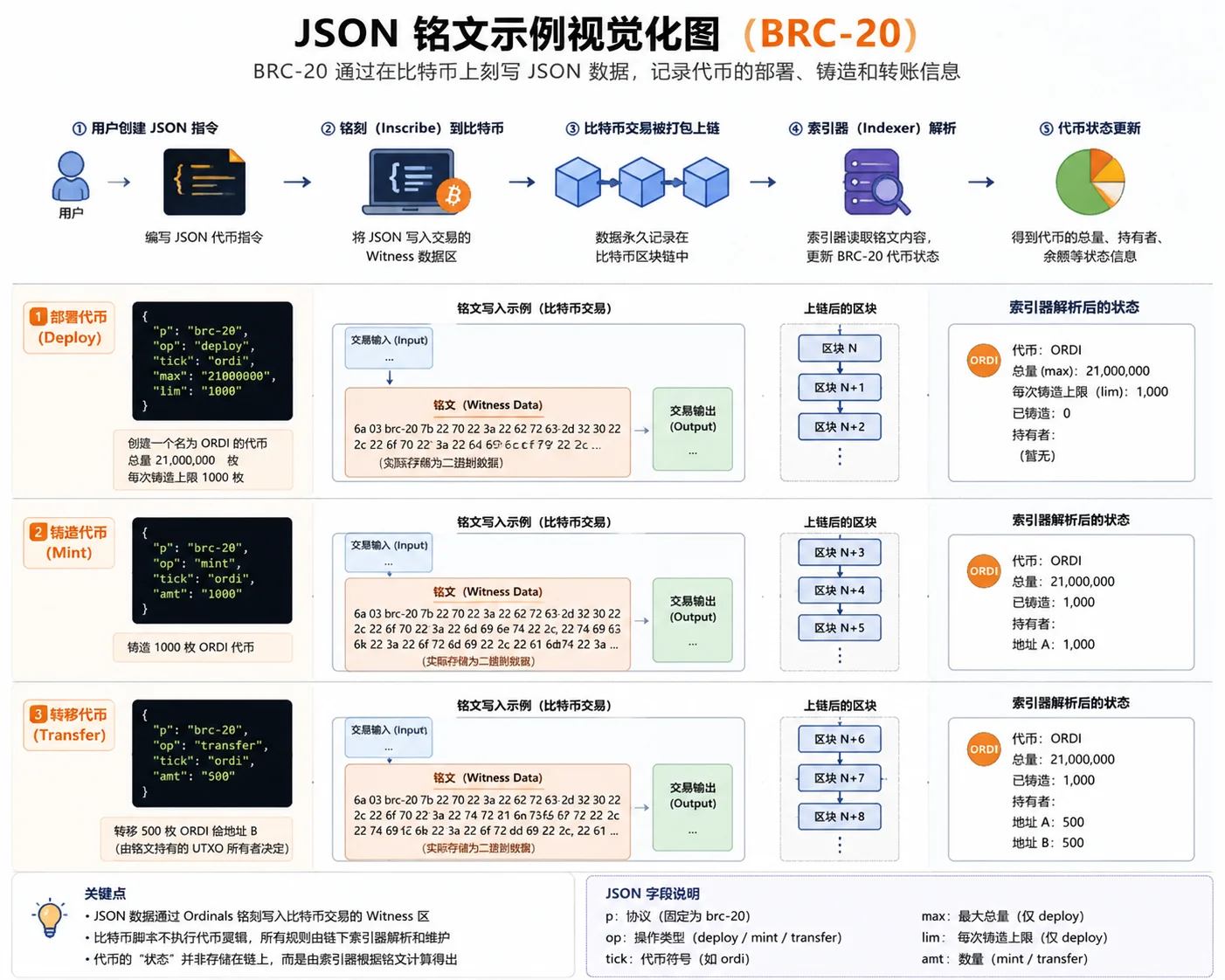
- Transfer: inscribe a piece of JSON declaring a token transfer.
The key flaw: BRC-20 has no smart contracts. All token logic — who holds how many tokens, whether a transfer is allowed — is not executed automatically on-chain; instead, it's maintained by off-chain indexers (third-party services) that scan Bitcoin inscriptions and keep a "who holds how many tokens" ledger. If two indexers interpret an inscription differently, a ledger disagreement occurs.
@domodata themselves wrote in the BRC-20 whitepaper: "This is an experimental standard. It may be worthless. Please do not invest funds you cannot afford to lose."
The rise and fall of ORDI and SATS: a wild speculation experiment
Despite its crude technology, BRC-20 sparked a wild speculation craze in 2023.
ORDI: the first BRC-20 token, with a market cap that once exceeded $1 billion. ORDI was deployed by @domodata personally on March 8, 2023, with a total supply of 21 million. Early minting cost was nearly zero (only gas fees), but by the speculation peak in May 2023, the price once exceeded $60 per token and total market cap surpassed $1 billion. In November 2023, Binance announced the listing of ORDI spot trading, and the price surged over 50% within 24 hours, with market cap briefly approaching $2 billion.
SATS: a meme token named after the "sat." Total supply of 2.1 quadrillion (mirroring Bitcoin's 2.1 quadrillion sats), with market cap briefly exceeding $1 billion in early 2024.
But the boom was short-lived. By H2 2024, BRC-20 hype had cooled sharply: ORDI fell from its high of $90+ to the $5–8 range, SATS dropped over 85%, a large number of low-quality BRC-20 tokens went to zero, and trading volume dropped over 90% (data source: CoinGecko).
The early BRC-20 ecosystem was dominated by meme tokens and speculative trading, while also advancing experiments in Bitcoin asset issuance and accumulating experience for later, more mature protocols like Runes.
The real impact on the Bitcoin network: gas spikes and mempool congestion
Transaction volume surged. Before Ordinals, Bitcoin's daily transaction volume was about 250,000–350,000. At the BRC-20 peak, daily volume repeatedly exceeded 700,000, setting new all-time highs (real-time data can be viewed on Mempool.space).
Gas fees spiked. This was the most direct shock to ordinary users. At the peak, average fees soared from $1–3 to $30–60, the mempool backlogged hundreds of thousands of transactions, and ordinary transfers could wait for hours (on the mempool mechanism, see How Long Does a BTC Transfer Take? From Signing to 6 Confirmations). Small-transfer fees briefly exceeded the transfer amount itself — something never seen in Bitcoin's history.
Block-space value reassessed. Previously, block space was used only for financial transactions; now it also carries cultural content and token issuance. Supporters see this as increasing network value; opponents see it as wasting a scarce resource.
The great community split: fundamentalists vs expansionists
This is the most intense ideological split since the 2017 block-size war.
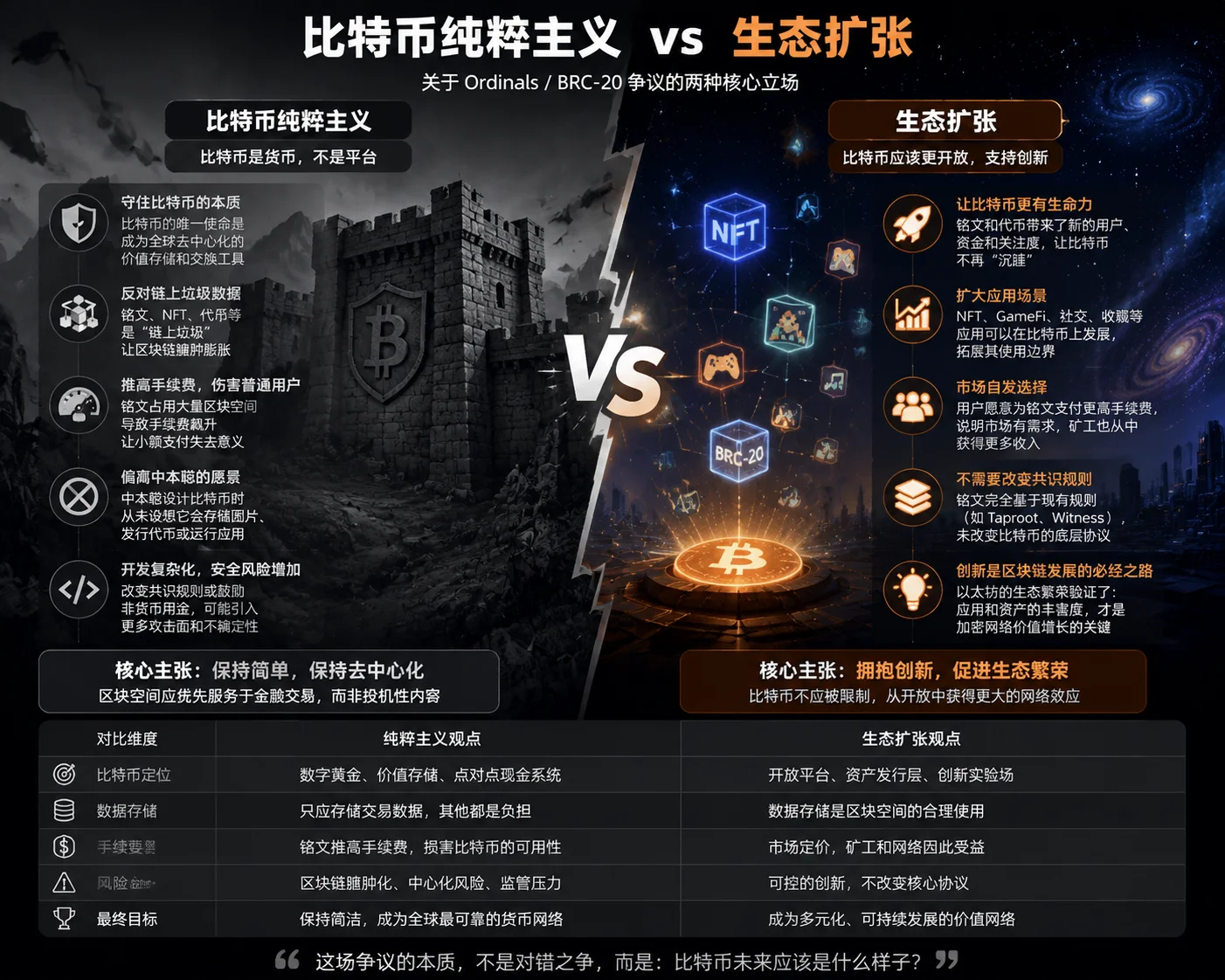
The opposition (led by Bitcoin Core developer Luke Dashjr) argues: Ordinals and BRC-20 inscriptions are spam transactions. The only legitimate use of the Bitcoin chain is financial transactions. Inscription data permanently occupies full-node hard drives, raising operating costs and weakening decentralization over the long term (on the role of full nodes, see What Is a Bitcoin Node? Full Nodes, Light Nodes, and Miner Nodes Explained). A flood of inscription transactions crowds out normal Bitcoin transfers. Luke Dashjr even publicly stated in December 2023 that he was developing a miner patch to filter Ordinals transactions (see the Bitcoin Magazine report).
Supporters argue: block space is a free market — whoever bids the highest uses it; there is no "legitimate" or "illegitimate" use. Ordinals and BRC-20 enrich Bitcoin's ecosystem and provide miners with extra fee revenue. "Digital gold" and "cultural carrier" are not contradictory — as the most secure and decentralized blockchain, everything Bitcoin carries gains unique value because of it.
The essence of the core controversy: fundamentalists see Bitcoin as a currency and store of value, and any deviation is interference. Expansionists see Bitcoin as an open decentralized network, and any use should be legitimate as long as it doesn't violate consensus rules. This debate has no conclusion yet — Bitcoin's decentralized governance means neither side can unilaterally decide the outcome.
The Runes protocol: the more efficient alternative from Ordinals' own author
Interestingly, Ordinals founder Casey Rodarmor himself is critical of BRC-20. He believes BRC-20 produces a large number of useless UTXOs (Unspent Transaction Outputs) and is technically poor. So on April 20, 2024 (the day of Bitcoin's fourth halving), he released the Runes protocol — a more efficient Bitcoin token standard. See Casey Rodarmor's Runes blog post.
Runes' core improvements: based on the UTXO model rather than JSON inscriptions, tokens are bound to Bitcoin's UTXOs and don't require off-chain indexers; data size is much smaller than BRC-20; theoretically compatible with the Lightning Network; a single transaction can transfer multiple token types.
On halving day, Runes-related transaction fees briefly exceeded block rewards. But the hype cooled quickly — as of August 2026, the Runes ecosystem's market cap and volume are far below their peak. Runes is technically better, but first-mover advantage and brand recognition keep BRC-20's user base larger.
| Dimension | BRC-20 | Runes |
|---|---|---|
| Creator | @domodata (anonymous) | Casey Rodarmor |
| Release date | March 2023 | April 2024 (halving day) |
| Data storage | JSON inscriptions (Witness data) | OP_RETURN (transaction output) |
| Balance management | Off-chain indexers | UTXO model, on-chain verifiable |
| Lightning Network compatibility | Almost impossible | Theoretically possible |
| Efficiency | Low (redundant data, junk UTXOs) | High (small data size) |
How to view and trade Ordinals inscriptions
If you're interested in Ordinals, here are the basic tools and platforms to get started:
Viewing inscriptions (explorers):
- Ordinals.com — the most commonly used Ordinals inscription explorer; browse by inscription number, sat rarity, inscription type, and more
- Mempool.space — Bitcoin mempool and block explorer that now supports viewing Ordinals transactions and inscription data
- Magic Eden Bitcoin — one of the largest Bitcoin NFT marketplaces, supporting Ordinals inscription buying and selling
Storing and trading inscriptions (wallets):
- UniSat Wallet — the most popular BRC-20 and Ordinals wallet (browser extension), supporting inscription viewing, minting, and transfer
- Xverse — a Bitcoin wallet supporting Ordinals, BRC-20, and Runes, available on both mobile and browser
- OKX Wallet — the OKX exchange wallet has a built-in Ordinals marketplace, supporting Bitcoin NFT trading
Inscription marketplaces:
- Magic Eden — a cross-chain NFT marketplace whose Bitcoin section covers Ordinals and Runes
- UniSat Marketplace — UniSat's official Ordinals marketplace
Notes:
- Trading Ordinals inscriptions requires BTC to pay gas fees; make sure your wallet has enough balance
- BRC-20 token transfers work differently from ordinary BTC transfers; always use a wallet that supports BRC-20
- Ordinals inscription markets have far lower liquidity than Ethereum NFTs; confirm depth before large trades
What it means for miners: a windfall after the halving
Bitcoin halves every four years; the block reward has been declining from 3.125 BTC in 2024 (see Can Bitcoin's 21 Million Supply Cap Be Changed? Source Code and Forks). How to replace block rewards with fees is the core question of network security.
At the Ordinals/BRC-20 peak, fees once accounted for over 40% of miner revenue. On halving day, April 20, 2024, Runes' frenzy minting gave miners a single-day fee revenue of over $100 million — an all-time record (data source: Glassnode).
But this "windfall" is highly cyclical. After speculation receded, the fee share dropped below 5%. Bitcoin's long-term security still depends on sustained global demand for it as a store of value — not on the temporary frenzy of inscriptions and meme coins.
Are Ordinals safe? Three risks of the inscription ecosystem
Ordinals and BRC-20 are on-chain innovations on Bitcoin, but that doesn't mean they are as safe as Bitcoin itself. Here are three easily overlooked risks:
1. On-chain illegal content risk. Because Ordinals inscription data is stored permanently on the Bitcoin chain and cannot be deleted, if someone inscribes illegal, infringing, or harmful content (such as malicious code, pirated images, or even illegal information), no centralized entity can remove it. This is not only a technical problem but also a legal and ethical one — full-node operators may unknowingly store illegal content. This is one of the core reasons Bitcoin Core developer Luke Dashjr opposes Ordinals.
2. BRC-20 fake tokens and phishing scams. BRC-20 has no smart-contract verification; anyone can inscribe a piece of JSON claiming to be "official ORDI" or "the second ORDI." A large number of fake tokens exploit naming confusion (like ORDI2, ORDIx) to trick beginners into buying, then cash out and run in extremely illiquid OTC markets. When sending BRC-20 tokens, always confirm the token's real ticker through mainstream wallets like UniSat or OKX Wallet.
3. Indexer disagreement risk. BRC-20 balances depend entirely on off-chain indexers scanning and maintaining. If mainstream indexers interpret an inscription differently — say UniSat thinks you have 1,000 ORDI, while OKX thinks you don't — it leads to asset disputes or even lost tokens. Although large indexers are gradually standardizing, this technical risk has not been fundamentally resolved.
How to protect your Ordinals assets:
- Use community-vetted mainstream wallets (UniSat, Xverse); don't use unknown third-party tools
- Consider moving large inscription assets to a hardware wallet (like a Ledger Bitcoin account) to reduce hot-wallet exposure
- Before trading Ordinals, verify the inscription number and content on Ordinals.com or Mempool.space
- Only buy BRC-20 tokens listed on top exchanges (like Binance) to avoid OTC fake-token traps
Risk warning: why beginners shouldn't FOMO into BRC-20
1. Extremely poor liquidity. BRC-20 has no automated market maker (AMM) and no decentralized exchange. Tokens can only be bought and sold on a few centralized exchanges or OTC markets, often facing "orders nobody takes."
2. Highly immature technology. Token balances are entirely maintained by off-chain indexers. If different indexers disagree, you face asset disputes.
3. Extreme speculation, 99% already at zero. Except for ORDI and SATS, the vast majority of BRC-20 tokens have gone to zero. First-mover advantage and exchange listings are the moat of the very few survivors.
4. Community hostility is a time bomb. If core developers push a protocol upgrade to restrict Ordinals-type transactions (technically feasible), the entire ecosystem's value foundation would collapse instantly.
5. "Issuing coins on Bitcoin" is not itself a value proposition. If you just want to buy meme coins, the liquidity and experience on Ethereum, Solana, or even Base are far better than BRC-20.
The right starting point for beginners: understand Bitcoin itself first. Recommended reading: What Is Bitcoin (BTC)? Principles, Value, and Risks (2026).
FAQ (Frequently Asked Questions)
Q1: What are Bitcoin Ordinals? What's the difference between Ordinals inscriptions and Ethereum NFTs?
Bitcoin Ordinals are a protocol that assigns unique serial numbers to individual satoshis (the smallest unit of BTC) and allows arbitrary data (images, text, code) to be inscribed directly onto the Bitcoin blockchain.
The biggest difference is data storage. Ethereum NFT images are generally stored in IPFS or external storage systems, with the chain recording metadata and resource references. Ordinals inscription data is stored directly on the Bitcoin chain — immutable, and theoretically permanent as long as the network keeps running. You can think of Ordinals as "writing a phone number with a pen on a unique banknote," while an NFT is more like "a piece of paper with an IPFS link written on it, kept in a bank safe."
Q2: Is BRC-20 the same as ERC-20? Can BRC-20 tokens be withdrawn to an Ethereum wallet?
No. BRC-20 does not use smart contracts like Ethereum's ERC-20 tokens. It relies on JSON inscriptions and off-chain indexers to maintain token balances, making it fundamentally different from ERC-20.
No. BRC-20 tokens run on the Bitcoin chain and can only be sent or received through Bitcoin wallets that support BRC-20 (like UniSat, Xverse) or centralized exchanges. Sending BRC-20 tokens requires BTC as gas fees — if your wallet has no BTC, you can't transfer them.
Q3: Can Ordinals inscriptions be deleted?
No. Once inscribed, the data becomes a permanent part of Bitcoin's blockchain history and cannot be removed by anyone.
No. Once inscribed, it's written into the blockchain history and cannot be deleted. This is the core value of Ordinals, and also the opponents' biggest concern — if someone inscribes illegal or infringing content on-chain, no one can remove it.
Q4: Will Ordinals cause the Bitcoin blockchain to grow too large?
Theoretically yes. As of 2026, the Bitcoin blockchain is approximately 550GB. If high-volume inscription activity continues, the growth rate will accelerate significantly. Larger blockchain size means higher hardware requirements for running full nodes, which could reduce decentralization.
Currently, the Bitcoin blockchain is about 550GB in total. If Ordinals keeps inscribing data at high speed, growth will accelerate significantly. A larger blockchain means a higher hard-drive threshold for running full nodes, which could reduce the number of full nodes and weaken decentralization. This is one of the core concerns of the opponents.
Q5: Will Runes replace BRC-20?
Not in the short term. BRC-20 has first-mover advantage and exchange listings (ORDI and SATS are on Binance), while Runes offers better technical efficiency. Long-term, if BRC-20's technical flaws lead to a major security incident, Runes could overtake it.
Not in the short term. BRC-20 has first-mover advantage and brand recognition, and ORDI and SATS are listed on top exchanges. But in the long term, if BRC-20's technical flaws cause a major security incident, Runes could catch up. Currently the two coexist, and neither has the maturity of Ethereum's ERC-20.
Q6: Can I still mint BRC-20 tokens for free?
Technically yes — anyone can pay the Bitcoin network fee to mint unminted BRC-20 tokens. But as of 2026, the gas cost of minting new BRC-20 tokens typically far exceeds their market value. The BRC-20 minting window effectively closed in 2023.
Technically yes — as long as a token hasn't been fully minted, anyone can pay gas fees to mint it. But in 2026, the gas cost of minting new BRC-20 tokens typically far exceeds the token's own market value. The BRC-20 minting window basically closed in 2023.
Q7: Are Bitcoin Ordinals NFTs?
Ordinals inscriptions are commonly called "Bitcoin NFTs," but they differ fundamentally from Ethereum NFTs. Ordinals don't rely on smart contract standards like ERC-721 — instead, they use the inscription mechanism to bind data directly to specific satoshis on the Bitcoin blockchain.
Ordinals inscriptions are commonly called "Bitcoin NFTs," but they are fundamentally different from Ethereum NFTs. Ordinals don't rely on smart-contract standards like ERC-721; instead, they bind data directly to specific sats and store it on the Bitcoin chain through the inscription mechanism. Strictly speaking, Ordinals is a more fundamental concept than "NFT" — it's a data-recording method, and NFT is just one of its application scenarios.
Q8: What is the difference between BRC-20 and Runes?
BRC-20 uses JSON inscriptions and requires off-chain indexers to track balances, while Runes uses Bitcoin's native UTXO model and is fully on-chain verifiable. Runes is technically more efficient but BRC-20 has first-mover advantage and wider exchange support.
| Dimension | BRC-20 | Runes |
|---|---|---|
| Technical mechanism | JSON inscriptions + off-chain indexers | UTXO model, on-chain verifiable |
| Requires an indexer | Yes (depends on third-party services) | No (Bitcoin nodes can verify directly) |
| On-chain efficiency | Lower (redundant data, junk UTXOs) | Higher (small data size) |
| Lightning Network compatibility | Almost impossible | Theoretically possible |
| First-mover advantage | Yes (March 2023, Binance listed ORDI) | No (only launched April 2024) |
Simple summary: Runes is technically better, BRC-20 is better known. Currently the two coexist, and neither has the maturity and liquidity of Ethereum's ERC-20.
Summary
Ordinals and BRC-20 wrote a unique chapter in Bitcoin's 16-year history. They are neither a revolution nor a scam — they are a free-evolution experiment of a decentralized network.
A few core conclusions:
Ordinals is a clever technical innovation — using the space created by SegWit and Taproot to achieve on-chain inscription without modifying consensus rules. It's a typical case of "permissionless innovation."
BRC-20 is technically extremely crude — not a true "on-chain token standard," but a JSON inscription specification relying on off-chain indexers. Its market cap far exceeds its technical value, and its speculative nature far exceeds its practical value.
The community split reflects different understandings of Bitcoin's essence — neither side is wrong; they just have different visions of what Bitcoin "should be." Bitcoin's decentralized governance ensures neither side can unilaterally decide the outcome.
The fee revenue brought to miners is a short-term positive — not enough to be a long-term network security solution. True security comes from global consensus on Bitcoin as a store of value.
Runes is technically superior, but technical quality doesn't equal market adoption.
For beginners, Bitcoin itself is far more valuable than its derivative assets — before understanding BTC, don't FOMO into any BRC-20 token.
Bitcoin's most fundamental value lies in being a decentralized, censorship-resistant store-of-value network with an absolutely limited supply. Ordinals and BRC-20 are branches growing from that foundation — they enrich the ecosystem and may also bring risks, but they haven't changed the foundation itself.
Related reading
- What Is Bitcoin (BTC)? Principles, Value, and Risks (2026) — the first Bitcoin primer article
- Why Bitcoin Doesn't Need Banks: UTXO, Nodes, PoW — understand BTC's underlying operating logic
- How the Blockchain Records Transactions: Blocks, Hashes, Proof of Work (2026) — go inside blocks and understand where inscription data lives
- Can Bitcoin's 21 Million Supply Cap Be Changed? Source Code and Forks — understand sat numbering and halving's impact on miners
- What Is a Bitcoin Node? Full Nodes, Light Nodes, and Miner Nodes Explained — understand why full-node operators oppose Ordinals
- How Long Does a BTC Transfer Take? From Signing to 6 Confirmations — understand the mempool mechanism and transaction confirmation process
Disclaimer
This article is for blockchain technical-principles education only. All content herein (including but not limited to token price data, market cap discussion, market analysis, and views on the Ordinals/BRC-20/Runes ecosystem) does not constitute investment advice, financial advice, or trading advice. The crypto market carries extremely high risk; in particular, the BRC-20 tokens mentioned here have extremely poor liquidity, extreme speculation, and immature technology, and their prices may fluctuate violently or even go to zero. Before investing, fully understand the relevant risks and make independent judgments based on your own situation. Past price performance does not indicate future performance. The author and CoinTrailHub are not legally liable for any investment decisions made based on this article.
- Ordinals official documentationInscription and ordinal protocol specification
- BRC-20 experimental standard (@domodata)BRC-20 token standard definition
- Runes protocol documentation (Casey Rodarmor)Runes protocol design notes
- Mempool.spaceTransaction queue and fee congestion data
- Dune AnalyticsOn-chain data for inscriptions and BRC-20
- CoinGeckoORDI/SATS price and market cap data
- GlassnodeMiner fee revenue data
- Bitcoin MagazineCommunity controversy and ecosystem coverage
See ourEditorial Policy and the correction process in ourCorrections Policy.
The CoinTrailHub editorial team focuses on crypto education for beginners, exchange security and P2P trading risk. This article is compiled from official sources and public data, reviewed by humans, and strives for accuracy but is not investment advice.
Last updated:2026-08-08 · Content reviewed by humans · Learn more
© 2026 CoinTrailHub · Original content. Reproduction or rewriting without permission is prohibited.