
What Is a Bitcoin Node? Full Nodes, Light Nodes, and Miner Nodes Explained

Table of contents

Binance new user rewards
20% trading fee rebate
Official Binance registration. Complete identity verification (KYC) to trade and withdraw.
How does the Bitcoin wallet on your phone know you received 0.01 BTC? How does an exchange decide a deposit has arrived? Who exactly is running this "decentralization"?
The answer to all three questions is the same: Bitcoin nodes.
Without nodes, no one would validate the blocks miners produce, no one would tell you your balance, and Bitcoin would be an un-run protocol — a set of rules on paper.
This article unpacks Bitcoin's operating mechanism through three roles: full nodes, light nodes, and miner nodes. No code — just concepts and logic.
After reading, you'll understand:
- What a Bitcoin full node actually does — why it is the network's "referee" rather than the miner;
- How light nodes (SPV) validate transactions in a mobile wallet — downloading only block headers, not full blocks;
- The relationship between miner nodes and full nodes — why miners can't casually change the rules;
- How many Bitcoin nodes exist globally and where they are — what the numbers mean;
- How an ordinary person runs a full node — and what that contributes to the network;
- Why the node network is Bitcoin's last line of defense for decentralization.
This is a technical-principles explainer and does not constitute investment advice.
I recommend reading the earlier articles in this series first — Why Bitcoin Doesn't Need Banks: UTXO, Nodes, PoW, How the Blockchain Records Transactions: Blocks, Hashes, Proof of Work (2026), and How Long Does a BTC Transfer Take? From Signing to 6 Confirmations — before this one, for a smoother read.
Quick glossary of terms used in this article:
| Term | Full name | One-line explanation |
|---|---|---|
| Full Node | Full Node | A node that independently validates all Bitcoin protocol rules; can store the full block history or use pruned mode |
| Light Node | SPV / Light Node | A lightweight client that downloads only block headers and relies on full nodes to validate transactions |
| Miner Node | Mining Node | A node running ASIC miners, participating in PoW competition for the right to record |
| P2P Network | Peer-to-Peer Network | A peer-to-peer network where nodes connect directly, with no central server |
| Block Header | Block Header | Only 80 bytes, containing all the core information needed for validation |
| Pruned Mode | Pruned Mode | A space-optimization option for full nodes, keeping only recent blocks + the UTXO set |
| Bitcoin Core | — | The most mainstream full node client software for Bitcoin |
What is a Bitcoin node? In three sentences
Sentence one: Bitcoin has no central server. Its "servers" are tens of thousands of nodes distributed around the world, each running software with the same rules (mainly Bitcoin Core).
Sentence two: nodes are the "cells" of the Bitcoin network. Each node stores a complete (or partial) copy of the blockchain, independently validates every transaction and every block, and communicates with neighboring nodes via the P2P protocol — no central scheduling, no hierarchy.
Sentence three: a node is not a miner. Running a node requires no mining rig and no hashrate competition — an ordinary computer, enough disk space, and network bandwidth suffice. A node's job is to validate rules; a miner's job is to provide the security budget (PoW). This separation is why tens of thousands of nodes worldwide can coordinate without any administrator.

The division of labor among three node types: full nodes, light nodes, and miner nodes
There are three "node" roles in the Bitcoin network. They aren't mutually exclusive — one computer can run a full node and mine at the same time, but the roles are different.
| Node type | What it stores | What it validates | Can it mine | Hardware needed |
|---|---|---|---|---|
| Full node | The whole blockchain (hundreds of GB+, growing) or a pruned version | Every transaction's signature, UTXO, double-spend, and every block's validity | No | Consumer computer + disk + network |
| Light node (SPV) | Only block headers (tens of MB) | Only whether a transaction is in a block (Merkle Proof); not whether the block is valid | No | Phone/tablet suffices |
| Miner node | Usually connected to its own (or a pool's) full node | Relies on the full node to validate transaction validity | Yes | ASIC miner + full node |
Three easily confused concepts: wallet, node, miner
| Concept | Core role | One line |
|---|---|---|
| Wallet | Manages private keys, signs transactions | Proves "you have the right to spend this BTC" |
| Node | Validates whether transactions and blocks are valid | Proves "this transaction is valid under the rules" |
| Miner | Runs PoW to find a valid hash | Provides the security budget to the network via proof of work |
A wallet proves "you can spend money," a node proves "this money is valid under the rules," and a miner makes "rewriting history economically unprofitable" via PoW. Each has its own job; they are not interchangeable.
One important clarification: the three node types are not a low-to-high hierarchy, but different functional roles. Miners provide the security budget, full nodes enforce the rules, and light nodes lower the barrier to entry — no one "governs" anyone; they check and balance each other.

Key distinctions:
- Full node = referee: enforces the rules, judges whether every transaction and block is valid. Anything invalid is rejected outright.
- Miner node = athlete: competes for the right to record within the bounds of the rules, earning block rewards. Want to cheat? Full nodes reject your block outright.
- Light node = spectator: trusts the data full nodes provide, but independently verifies "whether the transaction has been packaged" via Merkle Proof.
During the 2017 block-size debate, some miners and companies pushed for larger blocks, while a large number of users and node operators chose to support the SegWit approach. The final outcome showed: miners hold block-production power, but cannot unilaterally change the validation rules run by economic participants. This was the most direct demonstration in Bitcoin's history of full nodes acting as the guardians of the rules — a multi-party game where miners' hashrate did not win them the right to define the rules.
Full nodes in depth: why they are the network's "rule enforcers"
What a full node does
After installing and syncing Bitcoin Core on your computer, it does the following in order:
- Downloads the entire blockchain history — from the 2009 genesis block to the latest block, roughly 600GB.
- Validates block by block — from the first block onward, verifying every transaction's signature, the existence of every UTXO, and whether every block's hash is correct. This process is called Initial Block Download (IBD) and can take days.
- Builds the UTXO set — independently establishes a complete "who currently owns how much BTC" state on your computer.
- Enters live listening — once synced to the latest block, your node starts receiving new blocks and transactions in real time and continues independently validating each one.
The end result: your computer gains the complete ability to independently judge "which chain is the real Bitcoin" — without trusting anyone.

The full node's "right to reject" is the real power
This is the single most important point for understanding Bitcoin's decentralization.
Miners hold hashrate, but full nodes hold the right to veto the rules. If a miner (or pool) packages a rule-breaking block — say, creating a 1000 BTC coinbase reward out of thin air — a full node, upon receiving it:
- Independently validates → finds the coinbase reward exceeds the rule-allowed value;
- Discards the entire block — doesn't forward it, doesn't add it to the chain, treats it as nonexistent;
- The hashrate and electricity that miner invested → wasted.
So it isn't "hoping miners won't cheat" — it's that the cost of cheating (a block mined with real hashrate being rejected network-wide) exceeds the benefit of cheating. The existence of full nodes turns miner cheating into a guaranteed-loss proposition.
You can see the real-time count and geographic distribution of publicly reachable full nodes here: Bitnodes.io.
What a full node actually validates: the full journey of a transaction passing a full node's review
When you submit a transaction, the money isn't in your hands yet — but full nodes are already working. Here is every step a transaction takes from broadcast to passing a full node's "security check":
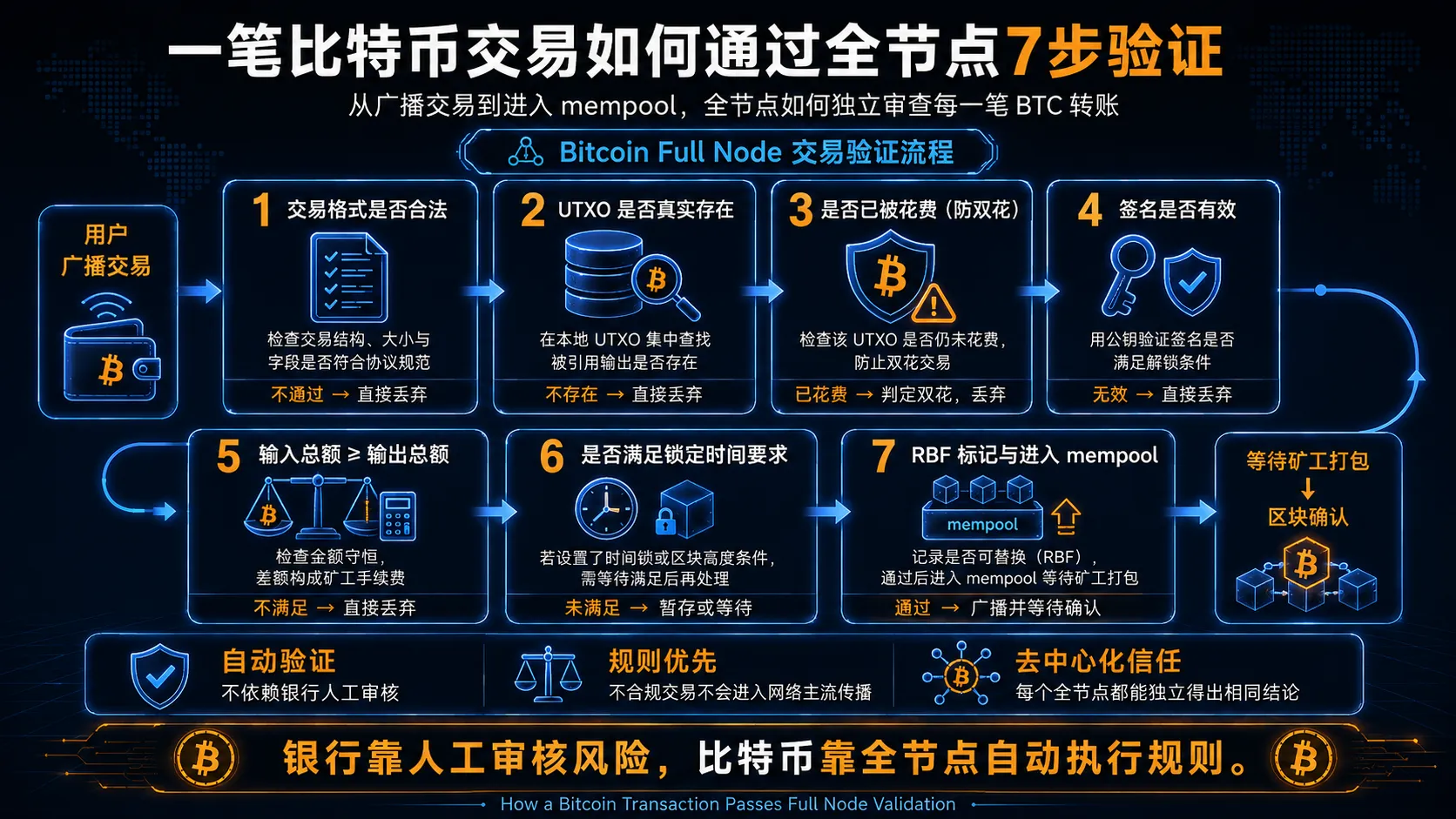
| Step | What is validated | How it's validated | What happens if it fails |
|---|---|---|---|
| ① | Whether the transaction format is valid | Check whether the data structure and size comply with the protocol spec | Discarded outright |
| ② | Whether the referenced UTXO actually exists | Look it up in its own UTXO set — the full node maintains the complete UTXO set | Discarded outright |
| ③ | Whether the UTXO has already been spent (double-spend protection) | Check whether the UTXO still exists in the current UTXO set | If absent, it's spent — flagged as double-spend, discarded |
| ④ | Whether the signature is valid | Use the public key to verify the signature matches the UTXO's unlock condition | Discarded outright |
| ⑤ | Input total ≥ output total | Simple addition/subtraction — the difference is the miner's fee | Discarded outright |
| ⑥ | Whether lock-time requirements are met | Some transactions set "spendable only after block height X" (e.g. Lightning settlement transactions) | Held in the mempool temporarily until the condition is met |
| ⑦ | Whether there's an RBF flag | If the transaction is marked "replaceable," a later higher-fee version can replace it | The flag is recorded, replacement allowed |
These 7 checks are the fundamental reason Bitcoin needs no bank. Banks rely on human reviewers to control risk; Bitcoin relies on full nodes' automated validation rules.
These 7 checks are exactly the core role a full node plays in the complete lifecycle of a BTC transaction, from initiation to confirmation — if you haven't seen the full transaction flow, that article places these 7 steps into the complete lifecycle.
Tens of thousands of full nodes — why don't they "fight each other"? How consensus is reached
This is the question most easily skipped, yet most central to understanding decentralization.
Tens of thousands of full nodes worldwide, each with a copy of the blockchain. How do they guarantee they "see the same chain"?
Answer: not by voting with each other, but by each independently validating the same rules
Every full node runs software that implements the same set of Bitcoin protocol rules (Bitcoin Core is one of the most widely used implementations today, fully open source, anyone can review). When two miners mine valid blocks almost simultaneously, a brief fork occurs — different nodes may temporarily see different chains.
A full node's handling logic is very simple:
- Receive a new block → independently validate it against the protocol rules;
- Valid → add it to its own chain, forward it to neighbors;
- Invalid → discard it outright, treat it as never received.
When a fork occurs:
All full nodes eventually choose the valid chain with the greatest accumulated work (PoW).
Note the two keywords: "valid" and "accumulated work" — not "most blocks," and not "first received." For a chain to be the "real chain" in a full node's eyes, it must satisfy both: ① every block passes protocol-rule validation; ② the chain has the highest total PoW work.
What happens when there's disagreement
Suppose your full node and someone else's full node see different chains — your node won't "negotiate with others" or "check what the majority says." It does exactly one thing: compares the accumulated work of the two chains, and chooses the valid one with more work.
If both chains are valid and have equal work (extremely rare) → your node temporarily follows the one received first, waiting for the next block to break the tie.
What this means
The "consensus" among full nodes is not reached through negotiation — it emerges naturally from each independently running the same rules and each independently reaching the same conclusion.
This is also why "rules written in code" matters so much. As long as all full nodes run the same rules and receive the same data, they will each independently derive the same "true state" — no meetings, no voting, no trusting anyone.
This explains why miners can't unilaterally change the rules: a miner can change the software they run, but if the changed version produces blocks that violate the rules full nodes run → full nodes reject them outright → the miner's blocks become "orphan blocks" → the hashrate is wasted.
Light nodes (SPV): how mobile wallets validate transactions without downloading vast data
What SPV is
SPV = Simplified Payment Verification. The concept comes from Satoshi Nakamoto's design in section 8 of the whitepaper — allowing users who don't need to independently validate the full network rules to still securely verify "whether a certain transaction is in a certain block."

Modern mobile wallets generally use a light-client model — you can't store hundreds of GB of blockchain on a phone. Some are based on the SPV idea (block headers + Merkle Proof verification), while others use more modern protocols like Electrum and Neutrino to further reduce data requirements and trust assumptions. Their shared goal: within a phone's limited resources, minimize dependence on centralized servers as much as possible.
How SPV works
- Downloads only block headers — 80 bytes each; the entire history is only about 60MB (easily fits on a phone).
- When it needs to query a transaction, it requests that transaction + the path from that transaction to the Merkle Root (a Merkle Proof) from a full node.
- Verifies with the Merkle Proof: computes the hashes along that path itself and checks whether the final result equals the Merkle Root in the block header. If equal → the transaction is indeed in this block.
What SPV can and cannot do:
| Capability | SPV light node | Full node |
|---|---|---|
| Verify whether a transaction is in a block | Yes (Merkle Proof) | Yes |
| Verify whether a transaction signature is valid | Needs a full node's help | Independently |
| Verify whether a block is valid | Trusts full nodes | Independently |
| Reject invalid blocks | No | Yes |
| Storage requirement | ~60MB | ~600GB (full) / ~10GB (pruned) |
SPV's trust assumptions
SPV's security model relies on the chain-selection mechanism provided by proof of work — an SPV client follows the chain with the most accumulated PoW. But it does not independently verify whether all blocks on that chain are valid; it trusts the data and proofs provided by the full nodes it connects to. In everyday networks this assumption holds — miners invest real money to mine valid blocks. But if an attacker can manipulate the information provided by the nodes an SPV client connects to, or holds enough hashrate to create special situations — an SPV user's security guarantee is lower than a full node user's, because it lacks the ability to independently validate block validity.
For everyday use (balance queries, small payments), SPV is completely sufficient. For large operations that truly need trust minimization, a full node is the only choice.
That's why mobile wallet apps typically provide a "lightweight verification experience" — enough for daily send/receive needs, but not a full-node-level trust model. For large-asset management, users can choose to connect their wallet to their own full node for the strongest security guarantee.
Miner nodes: the role and limits behind the hashrate
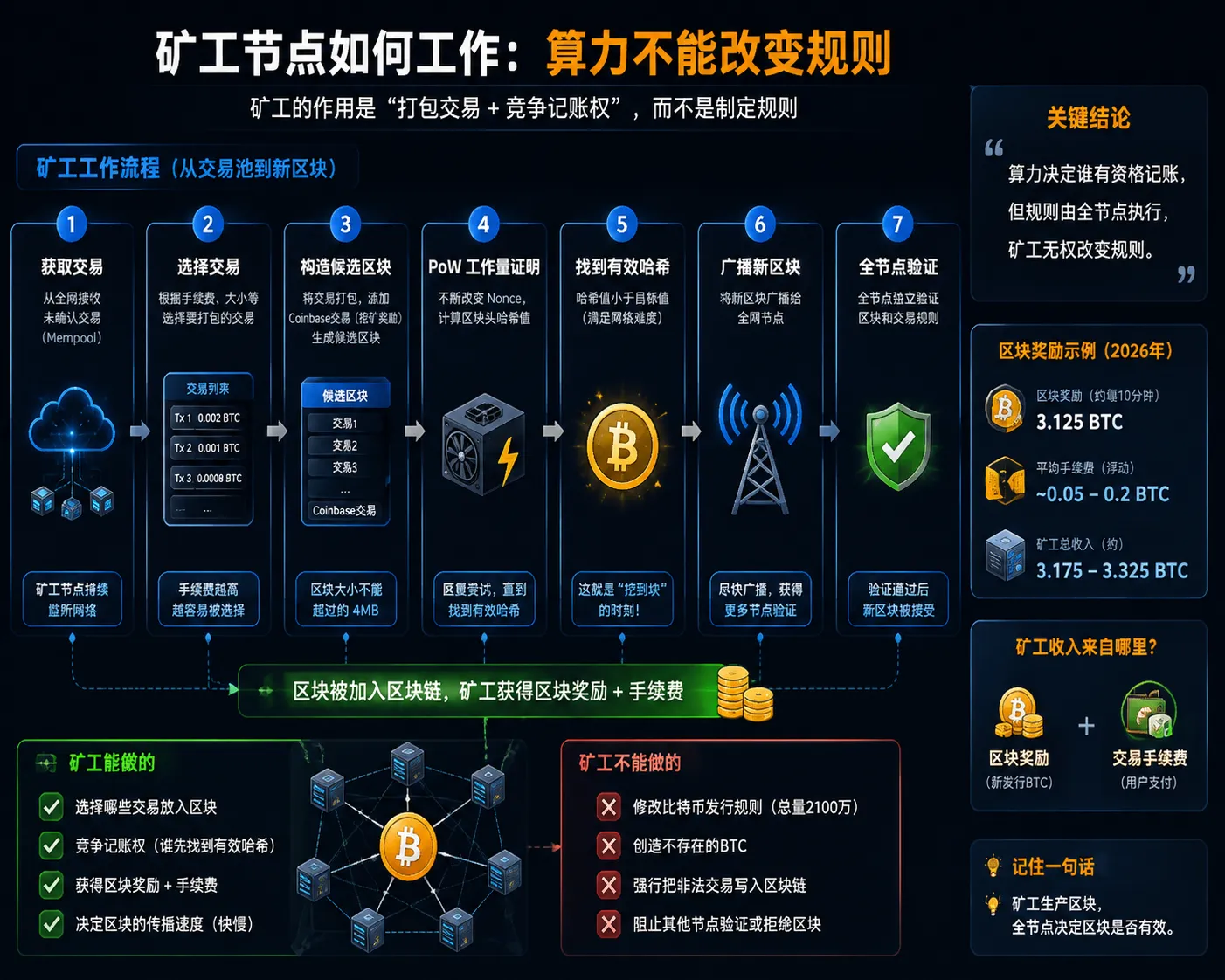
What a miner node does
- Selects transactions from the mempool, ordered by sat/vB fee rate;
- Constructs a candidate block (containing the coinbase transaction + the selected transactions);
- Continuously adjusts block-header fields (including the nonce) to find a hash meeting the difficulty target, i.e. PoW mining;
- Broadcasts the valid block immediately upon finding it.
A miner is not a full node, but depends on a full node
A professional miner usually relies on a full node maintained by themselves or their pool — because only rule-validated transactions and block templates have economic value. If you package an invalid transaction, the entire block is rejected by the full-node network, and your hashrate investment → zero returns.
In practice, most miners mine through pools. The pool runs the full node, and miners connect via the pool's stratum protocol — miners only contribute hashrate, while strategy and block construction are done by the pool's full node.
The boundaries of a miner's power
| What miners can do | What miners cannot do |
|---|---|
| Choose which transactions to package (within the valid pool) | Package transactions that violate protocol rules |
| Prioritize by fee rate | Create BTC beyond the block reward out of thin air |
| Fine-tune the coinbase transaction within valid rules | Modify others' transactions or forge signatures |
| Signal support for a specific soft-fork upgrade (on-chain signaling) | Unilaterally force a network-wide upgrade (full nodes will reject) |
Miners are an important part of Bitcoin's security model — the hashrate they provide makes the cost of rewriting history (a 51% attack) infeasible. But miners are not the rule-makers — that power lies in the hands of everyone running a full node.
Global Bitcoin node distribution: count, geography, and trends
How many full nodes are there
According to real-time data from Bitnodes.io, the number of globally publicly reachable Bitcoin full nodes has long stayed at roughly 15,000–20,000. It's worth emphasizing: Bitnodes can only count nodes that have opened their inbound port and can be detected by crawlers — a large number of hidden nodes that close inbound connections or run on the Tor network are not in the statistics. The true number of running full nodes cannot be counted precisely, but it's widely estimated to be far above the publicly reachable count.
Where the nodes are
| Region | Share (approx.) | Notes |
|---|---|---|
| North America (mainly the US) | ~30% | The densest node region |
| Europe (mainly Germany, France) | ~40% | Highest overall node density in Europe |
| Asia | ~15% | Mostly Japan, South Korea, Singapore |
| Other regions | ~15% | South America, Africa, Oceania, etc. |
Data source: Bitnodes.io real-time statistics.

Why node count matters
More nodes → more rule enforcers → any attempt to change the rules must convince more independent participants. This isn't "majority voting" — every single full node can unilaterally refuse to accept blocks and chains that don't conform to the rules.
Even if only one full node in the world were left running, Bitcoin's rules would be unchanged — the operator of that node would simply be the last guardian of the rules. This is an extreme case, but it illustrates the essence of a full node: independent validation power doesn't depend on numbers, but on the fact that "no one can force you to trust someone else."
Why run your own full node: not for profit, but for sovereignty
Running a full node isn't for profit — a full node has no economic reward. So why are nearly 20,000 people worldwide willing to pay their own disk and electricity to run one?
Four motivations
| Motivation | Explanation | Who does it |
|---|---|---|
| Independent validation | No need to trust any third party to tell you "this chain is real" — verify everything yourself | Large holders, institutions |
| Privacy | When you query transactions with an SPV wallet, the full node knows which transaction you're querying. Run your own full node = query yourself | Privacy-conscious users |
| Network-security contribution | Each additional full node is one more rule enforcer, making tampering harder | Community contributors, Bitcoin believers |
| Business needs | Exchanges, payment processors, and custodians need full nodes to independently confirm user deposits | Coinbase, Binance, Kraken, etc. |
An underappreciated fact
If you hold a large amount of BTC but use a third-party full node to query balances and validate transactions — your knowledge of "the BTC you own" depends entirely on data provided by others.
Running your own full node = shifting from "being told by others" to "verifying yourself." That's the real meaning of Bitcoin's decentralization for an individual.
Running your own full node is only part of a security setup — you also need to protect your seed phrase and guard against wrong-chain transfers and malicious contract authorizations. A full node validates "whether the on-chain data is real," but it cannot protect your private key.
How to run a full node: starting with Bitcoin Core
Running a full node has no technical barrier — an ordinary computer is enough. Here are the basic requirements:
Hardware requirements
| Component | Minimum | Recommended |
|---|---|---|
| CPU | Any recent CPU | 4+ cores |
| RAM | 2 GB | 8 GB+ |
| Disk | 600GB+ free space | 1TB SSD (SSD is several times faster than HDD; IBD time drops from weeks to days) |
| Network | Unmetered broadband | Unmetered broadband (~200GB+ upload/month) |
| OS | Windows / macOS / Linux | Linux (most stable) |
Two modes
| Mode | Storage needed | What it can do | What it can't do |
|---|---|---|---|
| Full mode (default) | ~600GB+ | Fully validate all history + serve historical block data to other nodes | — |
| Pruned mode | ~10GB | Fully validate all history + maintain the UTXO set | Cannot serve historical block data to other nodes |
Pruned mode is an option that only matured in recent years: you still validate block by block from the genesis block, but after validating you can discard old block data, keeping only the UTXO set and recent blocks. This gives you a full node's complete validation capability while cutting storage to roughly 10GB.
Steps (simplified)
- Go to bitcoincore.org and download the Bitcoin Core installer;
- Install and launch — the client starts automatically downloading and validating the blockchain (the IBD process);
- Wait for sync to complete (about 1–2 days with an SSD; possibly weeks with an HDD);
- Once synced, your node automatically becomes part of the network — validating new blocks and forwarding transactions.
When running a full node, make sure your router has port 8333 open — that's how other nodes can proactively connect to your node, and how your node contributes to the network's decentralization.
A full node relies heavily on the chained hash structure of blocks and the Merkle Tree during validation to efficiently confirm transactions — if you're curious about the underlying data structures, that article breaks down the "internal construction" of a block in detail.
The full picture of how the three node types collaborate
The Bitcoin network isn't run by any single role — wallets, full nodes, miner nodes, and light nodes collaborate to complete a transaction confirmation.
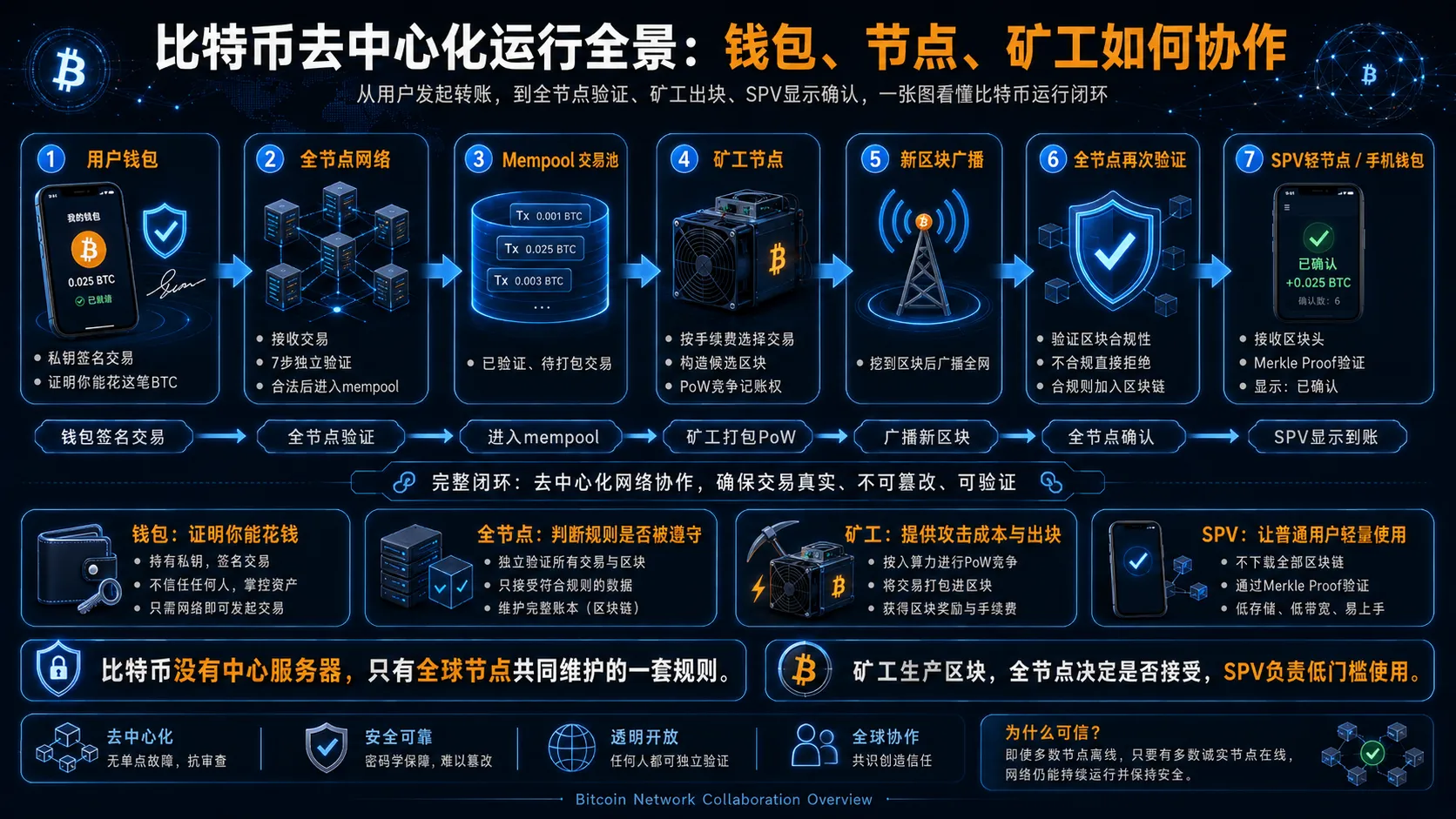
A text-version architecture diagram — one picture of how the three node types divide the work:
              │   A BTC transfer
              │  (wallet signs with private key)
              ↓
    ┌─────────────────────────┐
    │  Full node (rule enforcer)   │
    │  → receives tx → 7-step check │
    │  → puts valid tx in mempool    │
    │  → forwards tx to neighbors    │
    │  → validates new blocks        │
    │  → invalid → discards          │
    └─────────┬───────────────┘
              ↓ (valid tx enters mempool)
    ┌─────────────────────────┐
    │  Miner node (athlete)        │
    │  → picks tx from mempool      │
    │  → builds candidate block     │
    │  → PoW brute-forces nonce     │
    │  → finds block → broadcasts   │
    └─────────┬───────────────┘
              ↓ (new block)
    ┌─────────────────────────┐
    │  Full node again              │
    │  → validates new block        │
    │  → valid → adds to chain      │
    │  → notifies SPV clients       │
    └─────────┬───────────────┘
              ↓
    ┌─────────────────────────┐
    │  Light node (SPV)            │
    │  → receives new block header  │
    │  → verifies via Merkle Proof  │
    │     "my tx is in this block"  │
    │  → phone shows: confirmed     │
    └─────────────────────────┘
One-table summary: full node vs light node vs miner node
| Dimension | Full node | Light node (SPV) | Miner node |
|---|---|---|---|
| Core role | Rule enforcer (referee) | Transaction verifier (spectator) | Security provider (athlete) |
| Storage | ~600GB (full) / ~10GB (pruned) | ~60MB (block headers only) | Usually depends on a pool full node |
| Validation | Independently validates everything | Only whether a tx is in a block | Depends on full node |
| Can reject invalid blocks | Yes | No | — |
| Economic reward | None directly | None directly | Block reward + fees |
| Running cost | Hardware + electricity + bandwidth | Near zero | ASIC + heavy electricity |
| Contribution to decentralization | Highest — each full node = one more rule enforcer | Medium — uses but doesn't enforce rules | Medium — provides security budget but doesn't make rules |
| Typical user | Large holders, exchanges, community contributors | Mobile wallet users | Professional miners, pools |
How much does it cost to run a Bitcoin full node?
This is the most-searched, most practical question.
| Item | Cost | Notes |
|---|---|---|
| Hardware | An existing computer, or a small device costing a few hundred dollars | No ASIC miner needed — an ordinary laptop works |
| Disk | The single largest cost | Full mode needs hundreds of GB; 1TB SSD recommended |
| Electricity | Depends on device power draw | Ordinary computer idle power, unlike a miner's heavy draw |
| Network | Mainly upload bandwidth | Monthly upload may exceed 200GB; check for data caps |
| Revenue | Zero direct economic return | A full node is not a money-making tool |
| First sync | Needs to download and validate years of block history | Sync time depends on hardware, network, and disk; an SSD shortens it substantially |
| Daily operation | Resource demand drops notably after sync | Idle-syncs new blocks and transactions; no continuous heavy computation needed |
A full node is a validation server, not a money-making machine. Those who run one gain independent validation power, better privacy, and the freedom of "not needing anyone to tell you your balance."
What exactly is stored in a full node's computer?
One of the most confusing questions for beginners: "what exactly is this 600GB of blockchain data?"
Bitcoin full node storage structure:

┌─ Block history data (~600GB+)
│  All transaction records from the 2009 genesis block to now
│  Every BTC transfer is here
│
├─ UTXO set (several GB)
│  All current "unspent transaction outputs"
│  This is the core state a node uses to judge "has this money been spent"
│  Also the data source wallets use to show "balance"
│
├─ Mempool (in RAM, variable size)
│  A cache of validated transactions not yet packaged by miners
│  Like a "departure lounge"
│
└─ Network information
   A list of connected neighbor nodes
   Used to receive new block and transaction broadcasts
In pruned mode, old block data is deleted, but the UTXO set and recent blocks are kept — so validation capability is undiminished, while storage drops to about 10GB.
FAQ
What's the real difference between a full node and a miner node? Many people confuse them.
Full node = referee, deciding whether the rules are followed. Miner = athlete, competing within the bounds of the rules. A full node decides "is this block valid," while a miner decides "can I mine a valid block." A user running Bitcoin Core on a home computer and the largest mining pool are equal before the rules — a full node won't let you off just because you have more hashrate. During the 2017 SegWit activation, large pools collectively pushed for larger blocks, but ultimately the choice of full node operators and users prevailed.
Are mobile wallets (like BlueWallet, Trust Wallet) nodes?
They are light clients, not full nodes in the traditional sense. Different implementations may use SPV, Electrum, Neutrino, or other schemes, but they share one feature: they don't download the full blockchain and rely on third-party full nodes to query transaction data. For everyday use they're secure enough, but your transaction privacy and validation ability depend on the full nodes you connect to. If you care strongly about trust minimization, you can connect your mobile wallet to your own full node (for example, through your own Electrum server).
Can running a full node make money?
Not directly. A full node earns no block rewards and shares no transaction fees. Running a full node is a form of self-protection — what you gain is independent validation power, better privacy, and a (non-economic) reward of contributing to network security. If you think of running a full node as "paying insurance to the Bitcoin network to protect your BTC holdings," the logic clicks.
Does a full node need to stay online all the time?
No. You can turn off your computer anytime and turn it back on later. While offline, your node falls behind — when it comes back online it automatically downloads and validates the blocks it missed from where it left off, until it's synced to the latest. But if your full node supports payments or a business service (like an exchange's deposit confirmation), it needs to be online 7×24.
What should I watch out for when running a full node in different regions?
Bitcoin Core itself is open-source software, and P2P communication between nodes doesn't depend on a specific IP or domain. But users running full nodes in different regions must comply with local laws and regulations on network usage and crypto assets. It's recommended to understand your local rules before running a full node and consult a professional if necessary.
If the global full node count dropped to only a few hundred, would Bitcoin still be secure?
This is a common worry. First, Bitnodes only counts "detectable" nodes — a large number of nodes (especially those on Tor, and those without inbound connections open) are not counted, so the real number may be far higher than public data suggests. Second, even if node count dropped significantly, as long as rule enforcers are still running, Bitcoin's rules are still being enforced — the core of decentralization isn't "many nodes," but that "anyone can join as a rule enforcer without permission." Of course, the more nodes there are, the harder the network is to censor or attack — it's a "more is safer" continuum.
Why trust the Bitcoin Core software?
Bitcoin Core is open source — anyone can review its code, and anyone can fork it. Whether it has a backdoor or secretly changed the issuance rules isn't decided by what the developers say, but by the tens of thousands of node-running users worldwide voting with their feet. If you don't like a particular version of Bitcoin Core, you can run a different client (like btcd or libbitcoin). As long as your client follows the same protocol rules, the full node network will accept you. What you trust isn't the software author, but the mechanism of "open source + network-wide review + anyone can fork."
Behind this mechanism is Bitcoin's carefully designed four-layer power structure — ownership (cryptography), propagation (P2P), ordering (PoW + full nodes), maintenance (economic incentives) — miners only play the "orderer" in the third layer, while the final interpretation of the rules lies with the full nodes in the first and fourth layers.
Summary
Bitcoin's node network is the most easily overlooked, yet most important, infrastructure in the crypto world.
Miners often grab the headlines — hashrate hits a new high, a halving is coming. But what truly sets Bitcoin apart from all its "copies" isn't hashrate itself — it's those people running full nodes, who use their own disks and bandwidth to maintain a network-wide consistent set of transaction rules.
The three node types each have their own job:
Full node  → confirms "whether the rules are followed" (referee)
Miner node → provides "the cost an attack must pay" (athlete)
Light node → lets ordinary people "use it without running a full node" (spectator)
Without enough independent validation nodes, the resistance to miners changing protocol rules would drop substantially. Without miners, the full node network has no security budget. Without light nodes, Bitcoin can't reach billions of mobile users. The three are interdependent, but the final power to execute the rules always lies with everyone running a full node.
Bitcoin's real moat isn't a hashrate figure at any moment, but a fact sustained for 15 years: anyone, in any country, using consumer hardware can run a validation node and independently validate Bitcoin's complete history of rules — without needing anyone's approval.
If a family member asks "where does Bitcoin actually run?", you can tell them:
It runs on tens of thousands of computers around the world called "full nodes." Any one of them can unilaterally reject an invalid transaction. Your home computer can become one of them too — no application needed, no fee. That is decentralization.
Next, I suggest returning to the Bitcoin How It Works topic page to browse all the articles in this series.
Related reading
- Why Bitcoin Doesn't Need Banks: UTXO, Nodes, PoW — the first article in this series, UTXO + PoW + the four-layer power structure
- How the Blockchain Records Transactions: Blocks, Hashes, Proof of Work (2026) — the second article, block construction and PoW mining principles
- How Long Does a BTC Transfer Take? From Signing to 6 Confirmations — the third article, the full transaction lifecycle
- What Is Bitcoin (BTC)? Principles, Value, and Risks (2026) — a BTC primer
- What Is Blockchain? Principles, Uses, and Risks (2026) — a full blockchain overview
- What Is a Crypto Wallet? Wallet Addresses, Seed Phrases, and Asset Security (2026) — a wallet primer
- How to Prevent Wallet Theft? Seed Phrases, Wrong-Chain Transfers, and Authorization Risks (2026) — asset security
Disclaimer
This article is for technical-principles education about the Bitcoin node network only, and does not constitute investment advice, financial advice, or trading advice.
Crypto asset prices are volatile. Running a full node involves hardware investment and network-bandwidth consumption; users should judge whether running a full node suits them based on their own circumstances and technical ability, and follow their local laws and regulations.
- Bitcoin whitepaper (Satoshi Nakamoto)Nodes and P2P network principles
- Bitcoin Core official siteFull node software and running requirements
- Bitnodes.ioGlobal node count and distribution data
- Bitcoin developer documentationNode validation process and protocol details
- Bitcoin Wiki (Full Node)Full node definition and role
See ourEditorial Policy and the correction process in ourCorrections Policy.
The CoinTrailHub editorial team focuses on crypto education for beginners, exchange security and P2P trading risk. This article is compiled from official sources and public data, reviewed by humans, and strives for accuracy but is not investment advice.
Last updated:2026-08-05 · Content reviewed by humans · Learn more
© 2026 CoinTrailHub · Original content. Reproduction or rewriting without permission is prohibited.