
What is blockchain? How it works, its uses, and risks (2026)
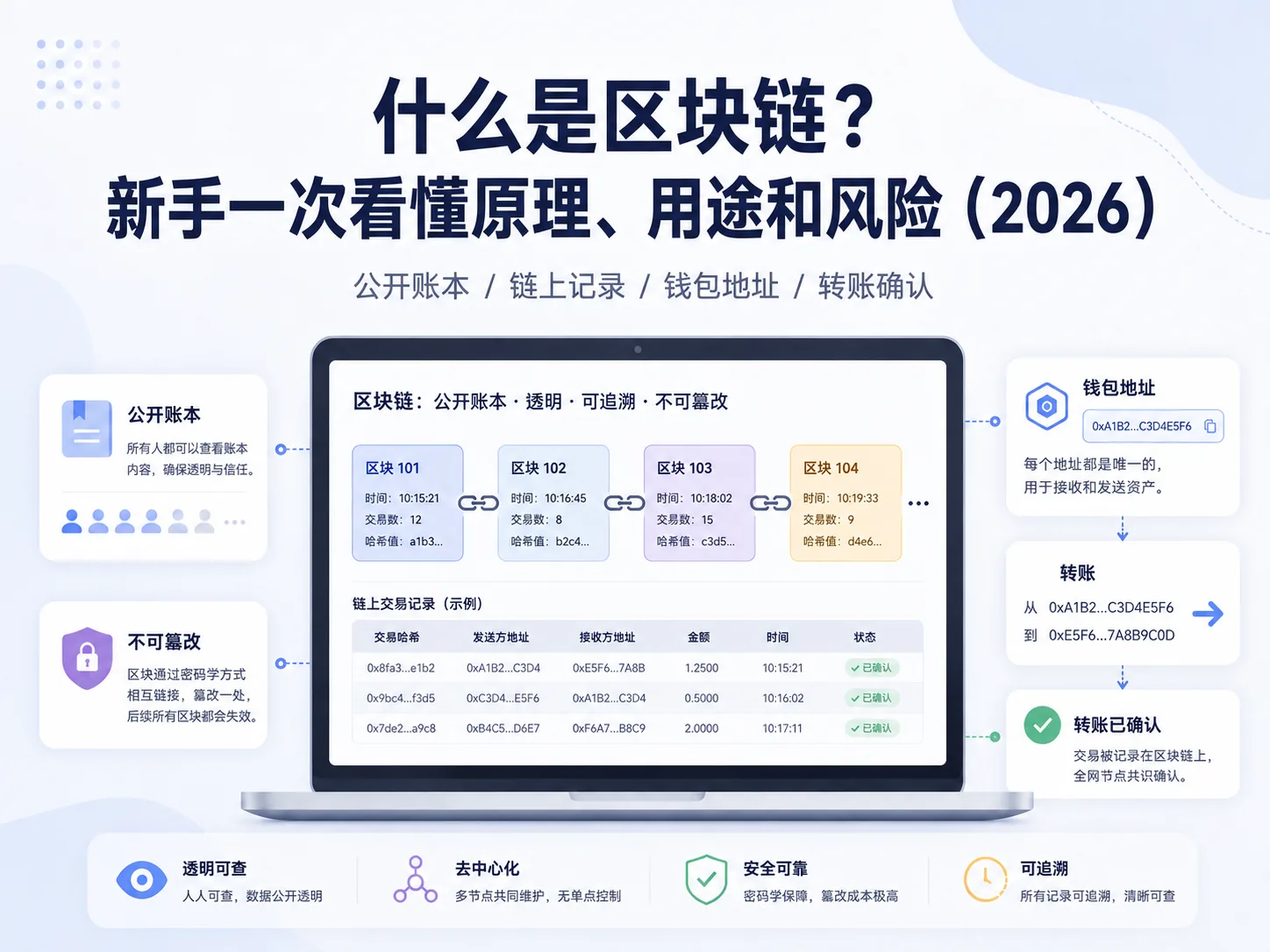
Table of contents

Binance new user rewards
20% trading fee rebate
Official Binance registration. Complete identity verification (KYC) to trade and withdraw.
When you first encounter crypto, many people hear the word "blockchain."
Bitcoin runs on a blockchain, Ethereum is a blockchain, and USDT transfers also use different blockchain networks.
But for beginners, you don't need to study code, algorithms, nodes, and other complex technology at first.
You can first understand blockchain as:
A public ledger.
It is not a specific app, nor a specific coin, but an underlying technology that records transactions and asset states.
Blockchain mainly records these things:
- Who transferred an asset to whom;
- When this transaction happened;
- Whether it has been confirmed;
- What assets a certain address holds.
Learning blockchain isn't about showing off technology, but about understanding an important rule:
Once an on-chain record is confirmed, it is usually hard to reverse, unlike an ordinary platform order.
This article is for basic education only and does not constitute investment, financial, or trading advice.
If you haven't read the overall crypto introduction yet, you can first read What is a crypto wallet? Wallet addresses, seed phrases, and asset security (2026), then come back to this blockchain article — it will be easier to understand.
Understand blockchain in one minute
| Item | Content |
|---|---|
| English name | Blockchain |
| Simple understanding | A public ledger |
| Main function | Records on-chain transactions and asset states |
| Common scenarios | BTC, ETH, USDT transfers |
| Biggest feature | Public and checkable; usually hard to change after confirmation |
| Beginner focus | Address, network, amount, small test |
What exactly is blockchain?
Blockchain is a way of recording data.
Ordinary platforms generally store data in their own systems. For example, the balances, orders, and deposit records you see on an exchange are often the platform keeping the ledger for you.
Blockchain is different.
Records on a blockchain are not stored only on a single company's server, but are saved and verified together by many nodes.
The system packages a batch of transaction records into a "block."
New blocks connect to the back of old blocks, one after another, linked in time order — that forms the "blockchain."
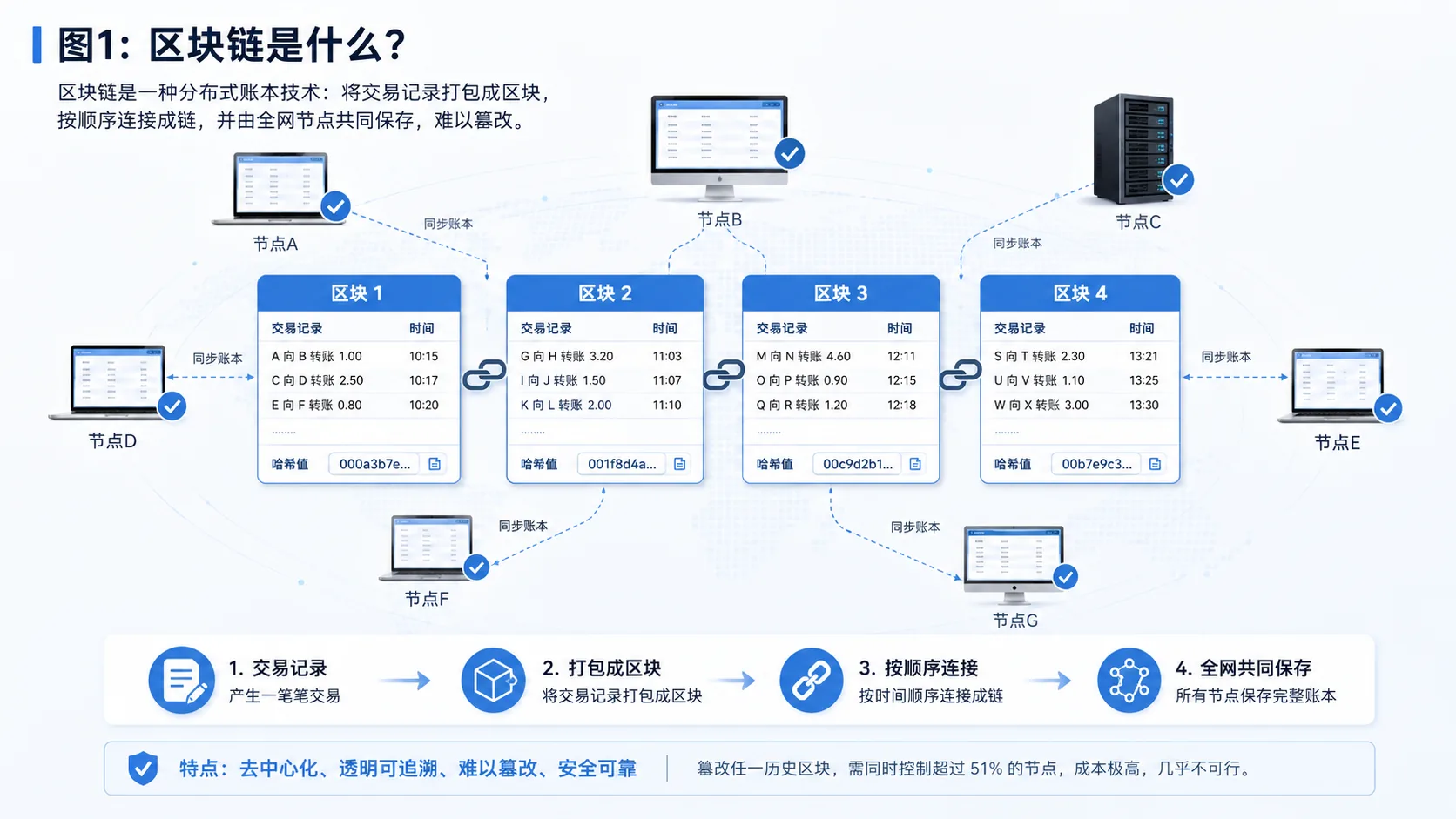
Simply put:
- Block: a batch of transaction records;
- Chain: these blocks connected in time order;
- Blockchain: writing transaction records batch by batch and connecting them in order.
So blockchain is not a real chain, but a way of recording data in order.
For beginners, one sentence is enough:
Blockchain is a public ledger for recording on-chain transactions and asset states.
Why are on-chain records hard to change?
Many people have heard the phrase:
Blockchain is immutable.
This is directionally correct, but more precisely:
Already-confirmed on-chain records are usually hard to change unilaterally.
The reason is simple.
Blockchain doesn't have only one copy of the ledger — many nodes keep the records.
After a transaction is confirmed, many nodes recognize that record.
If someone wants to change a past record, it's not just editing a file — it's getting the whole network to accept the change.
This is usually very difficult.
But there's something beginners must understand here:
Records being hard to change doesn't mean a wrong operation is automatically fixed.
- Fill in the wrong address, and blockchain still records it.
- Choose the wrong network, and blockchain still records it.
- Confirm a wrong operation, and blockchain won't judge whether it was a slip of the hand.
So the most important thing in on-chain operations isn't speed, but confirming clearly.
How does blockchain differ from ordinary platforms?
Beginners easily mix up "platform account" and "on-chain address."
For example, the BTC, ETH, USDT you see on an exchange are usually account balances displayed by the platform's system.
The platform records your balance and provides deposits, withdrawals, trading, and customer support.
But on-chain assets are recorded on the blockchain, tied to wallet addresses, networks, private keys, and seed phrases.
You can understand it this way:
A platform account is the platform keeping the ledger for you; an on-chain address is a public address in the blockchain ledger.
When a platform account has a problem, sometimes you can still get customer support to handle it.
But once an on-chain transaction is confirmed, there is usually no unified customer support that can reverse it for you.
This is the biggest difference between the two.
An ordinary platform is more like "the platform manages it for you."
Blockchain is more like "the rules are written, and everyone executes by the rules."
This brings transparency, but also responsibility.
What's the relationship between blockchain and on-chain transfers?
Many beginners first truly use blockchain when depositing, withdrawing, or transferring between wallets.
For example, when you transfer assets from one address to another, that operation is recorded on the corresponding blockchain network.
When transferring, you need to confirm several things:
- What asset you're transferring;
- Which network you're using;
- Whether the receiving address is correct;
- Whether the fee is sufficient;
- Whether the transaction has been confirmed.
The easiest thing to get wrong here is the "network."
The same asset may exist on different blockchain networks. For example, USDT may exist on TRC20, ERC20, BSC/BEP20, Solana, and other networks.
So when transferring, don't just look at the asset name — also check whether the network matches.
Simply put:
The asset being right doesn't mean the network is right; the address being right doesn't mean it will definitely arrive.
This is also why many experienced users advise: do a small test for your first transfer.
Not because the process is complex, but because once an on-chain transaction is confirmed, it's usually hard to reverse like an ordinary platform order.
What is blockchain used for?
For beginners, you don't need to understand all blockchain applications at first.
Knowing a few of the most common uses is enough.
1. Recording on-chain transfers
This is the most common use.
For example, BTC, ETH, and USDT transfers are often recorded on their corresponding blockchain networks.
You can use a block explorer to check whether a transaction succeeded, when it was confirmed, how much the fee was, and which address the asset moved from and to.
2. Supporting Web3 wallets
Web3 wallets manage on-chain addresses and assets.
When you use a wallet to receive assets, send assets, connect to websites, or authorize operations, you're essentially interacting with the blockchain.
This is also why wallet addresses, seed phrases, and network choice matter.
3. Running smart contracts
Blockchains like Ethereum can run smart contracts.
A smart contract can be understood as on-chain automatic rules.
Many DeFi, NFT, and Web3 applications are related to smart contracts.
But these are advanced topics — beginners don't need to go deep at first.
4. Recording on-chain assets and credentials
Besides ordinary transfers, blockchain can also record certain on-chain assets or digital credentials.
For example, NFTs, membership credentials, ticket credentials, gold tokens, tokenized stocks, and so on.
But remember: having an on-chain record doesn't mean it's definitely safe. It can still involve issuer, platform-rule, liquidity, and regulatory risks.
So for beginners, what blockchain requires understanding first isn't complex applications, but:
Transfers, addresses, networks, confirmation status, and small tests.
The places beginners most easily misunderstand blockchain
Misconception 1: blockchain equals Bitcoin
No.
Bitcoin is one of blockchain's important applications, but blockchain is not only Bitcoin.
Ethereum, TRON, Solana, BNB Chain, and others are also different blockchain networks.
Misconception 2: blockchain is definitely safe
Blockchain makes records harder to change, but user operations aren't necessarily safe.
Seed phrase leaks, visiting fake websites, authorizing malicious contracts, transferring on the wrong network can all cause asset loss.
So don't read "blockchain security" as "however I operate, it's safe."
Misconception 3: all on-chain transactions can be recovered
Not necessarily.
If you transfer to a wrong address, an unknown address, or the platform doesn't support the corresponding network, recovery is usually very hard.
Some cases can be attempted, but that doesn't mean recovery is guaranteed.
So confirming beforehand matters more than remedying afterward.
Before touching blockchain, remember these 5 things
- You can first understand blockchain as a public ledger.
- Once an on-chain record is confirmed, it's usually hard to reverse.
- When transferring, don't just look at the asset name — also check the network and address.
- A wallet isn't an ordinary account; a seed phrase can't be casually stored or sent to others.
- For your first transfer, definitely do a small test.
Many losses happen not because the technology is too hard, but because the operation was rushed.
Slower is actually safer.
FAQ: common blockchain beginner questions
Is blockchain a database?
You can roughly understand it as a special kind of database, but a more beginner-friendly way to put it is: blockchain is a public ledger.
What's the relationship between blockchain and Bitcoin?
Bitcoin is an important application of blockchain. Blockchain is the underlying recording method; Bitcoin is the crypto asset running on the blockchain.
Why do blockchain transfers require a fee?
On-chain transfers need network nodes to process and confirm. The fee can be understood as the cost of using the blockchain network.
Can a transfer to the wrong address be recovered?
Not necessarily. Transferring to a wrong or unknown address usually makes recovery very hard. For your first operation, definitely do a small test first.
Do beginners need to learn code?
No. Beginners just need to understand the public ledger, addresses, networks, wallets, seed phrases, and transfer confirmation.
Summary
Blockchain is not mysterious.
You can first understand it as:
A public ledger jointly maintained by many nodes, recording data in order.
It lets Bitcoin, Ethereum, USDT, Web3 wallets, and on-chain assets run.
But it is not all-powerful.
It makes records public, checkable, and hard to change unilaterally, but it can't judge for you whether the address is right, the network is right, or the website is real.
For beginners, the most important thing in learning blockchain isn't technical details, but understanding:
On-chain records, transfer confirmation, network choice, and wallet security.
Understand first, then operate.
What to read next
What is crypto? Cryptocurrencies, Web3 wallets, and on-chain assets (2026)
What is Bitcoin (BTC)? How it works, its value, and risks (2026)
What is a crypto wallet? Wallet addresses, seed phrases, and asset security (2026)
Can you recover a transfer sent on the wrong chain? Withdrawal networks and wallet addresses (2026)
Are RWA on-chain assets worth investing in? My real experience buying NVDAon
References
This article was compiled with reference to the following public materials:
Content is compiled based on public information from 2026. The crypto industry changes quickly, and rules may differ across countries and regions. Please refer to official pages and the laws and regulations where you live.
Author information
Author: CoinTrailHub Editorial Team
CoinTrailHub focuses on basic education about cryptocurrencies, Web3 wallets, and on-chain assets, helping users new to crypto build foundational understanding.
The CoinTrailHub editorial team has 8 years of experience in the crypto industry and content research. Relevant experience is used only to help beginners understand blockchain, wallets, transfers, and risks, and does not represent any guarantee of asset prices, platform results, or operational returns.
Disclaimer
This article is for basic education about blockchain, crypto, and on-chain assets, and does not constitute investment, financial, or trading advice.
Crypto-asset prices are highly volatile, and related services may carry market risk, platform risk, regulatory risk, network-security risk, and operational risk. Users should follow the laws, regulations, and official pages where they live, and judge carefully based on their own risk tolerance.
The CoinTrailHub editorial team focuses on crypto education for beginners, exchange security and P2P trading risk. This article is compiled from official sources and public data, reviewed by humans, and strives for accuracy but is not investment advice.
Last updated:2026-06-20 · Content reviewed by humans · Learn more
© 2026 CoinTrailHub · Original content. Reproduction or rewriting without permission is prohibited.