
What is XRP Ledger? Ripple and cross-border payments
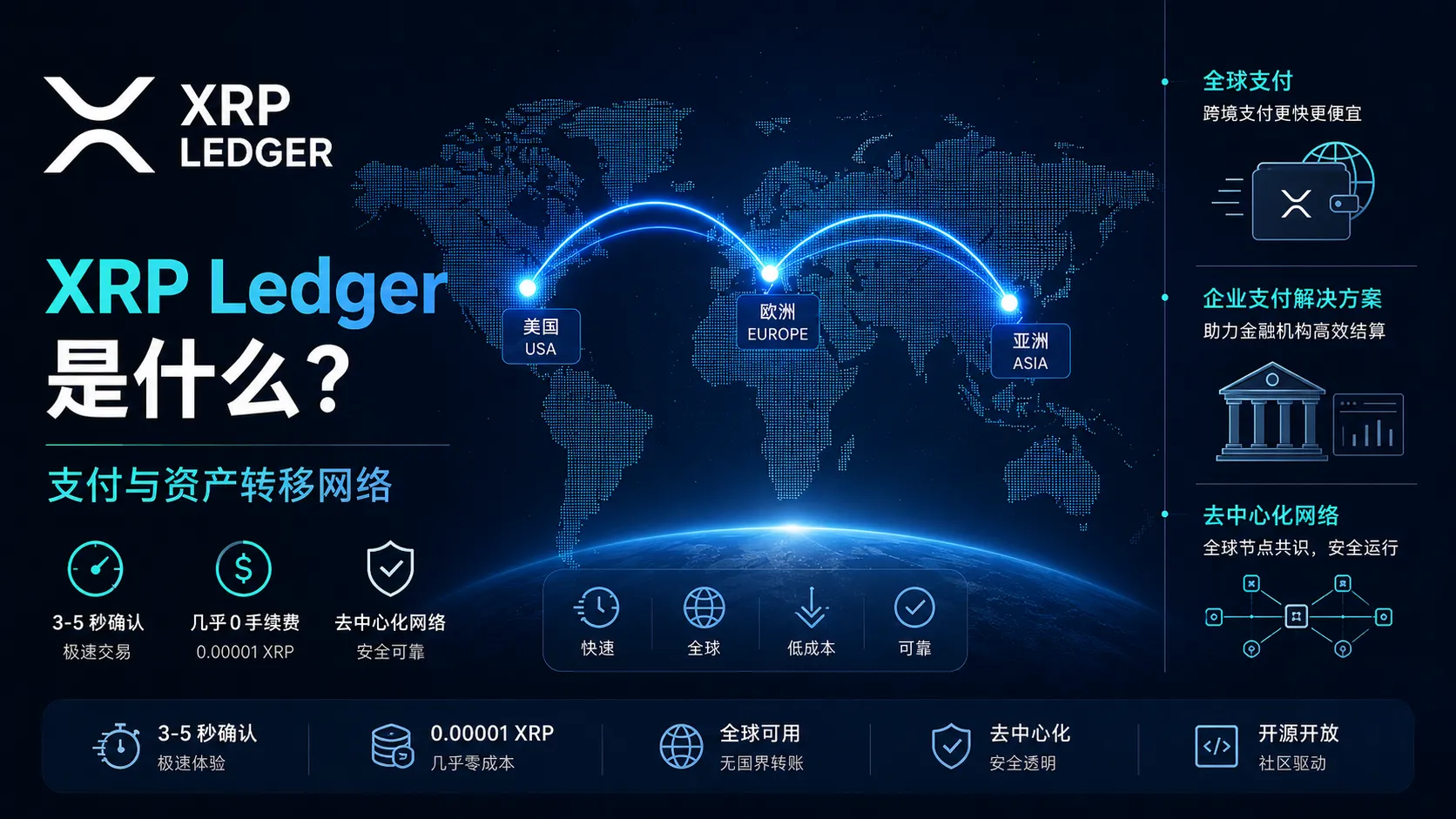
Table of contents

Binance new user rewards
20% trading fee rebate
Official Binance registration. Complete identity verification (KYC) to trade and withdraw.
Different blockchains solve different problems: Bitcoin leans toward store of value, Ethereum leans toward smart contracts, and XRP Ledger was designed from the start to emphasize fast, low-cost payments and asset transfers.
The transfer experience differs a lot: Bitcoin confirmations are usually measured in minutes, and fees fluctuate with network congestion; Ethereum's gas also rises and falls with usage; while XRP transactions usually confirm within a few seconds, with a fee of less than 0.00001 XRP — at the roughly $1 XRP price of August 2026, that's about $0.00001.
Note: this article is a personal learning and usage experience, not investment advice. Numbers change with network conditions and validator voting; please refer to official data.
Remember these three things first
XRP Ledger (XRPL for short) is a public chain optimized for payments and asset transfers. Its most fundamental difference from Bitcoin and Ethereum is that its early design focus was not general-purpose smart contracts, but payments, settlement, and asset issuance.
Remember three key points first:
- It doesn't mine and doesn't stake. Bitcoin confirms transactions through mining and Ethereum through staking; XRPL relies on a group of validator nodes voting — called "consensus" — so there are no miner fees and no staking rewards.
- Transfers are nearly free and confirm within seconds. The per-transaction fee is 0.00001 XRP (about $0.00001 at the ~$1 XRP price of August 2026), and transactions usually confirm within 3–5 seconds.
- Ripple the company ≠ XRP Ledger ≠ XRP. This is where most people get confused; it's broken down separately below.
You only need to know one thing: XRPL is a public chain "optimized for payments and asset transfers." Its reason for existing is a different path from Bitcoin (digital gold) and Ethereum (a smart-contract platform).
How I finally understood it
The first time I seriously studied XRP was because of a very simple question: it's always near the top of the market-cap rankings, but almost no one around me actually "uses" it — I'd only heard it called a "bank coin."
Later I broke it into three questions, and only then did it slowly click:
- What is it? A public chain for transfers.
- Why is it ranked near the top of market cap? Because XRP has a fixed total supply of 100 billion and the big "cross-border payments" narrative behind it; the market cap is built on "expectations," not on-chain activity.
- Should I touch it? Depends on whether you want to use it for transfers. Just hoarding it waiting for a price rise is a different thing from hoarding Bitcoin or Ethereum.
Let me go through each one below.
Ripple the company, XRP Ledger, and XRP — tell the three apart
This is the most important section of this article. 90% of misunderstandings come from treating these three concepts as the same thing.
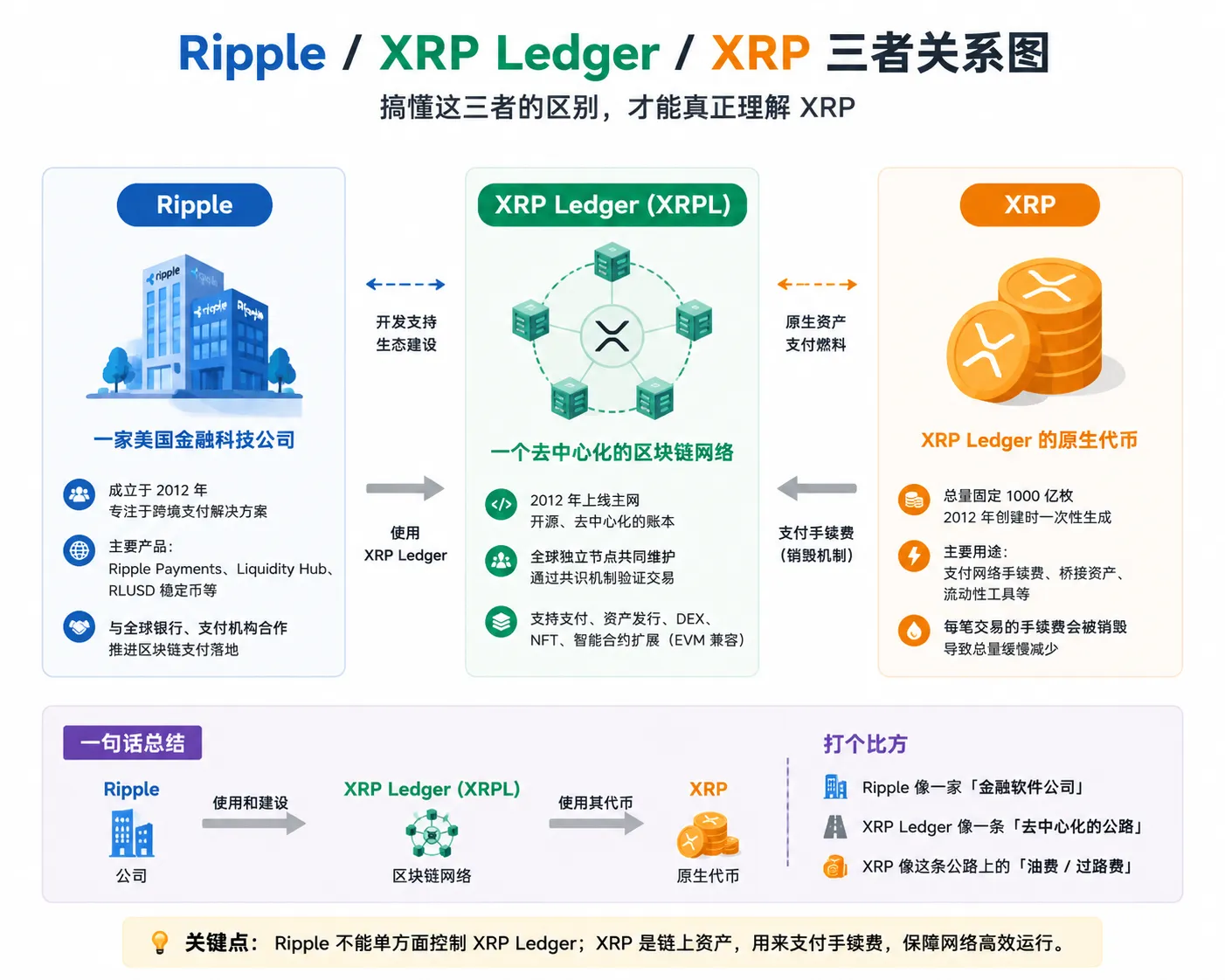
| Concept | What it is | An analogy |
|---|---|---|
| Ripple | A US company that builds cross-border payment software | Like a "financial software company" |
| XRP Ledger | A decentralized public chain; anyone can run a node | Like a "highway" |
| XRP | The native token on this chain, used to pay fees | Like the "fuel/toll" on this highway |
Let me make one thing clear: Ripple the company cannot unilaterally control the XRP Ledger network.
- XRP Ledger is an open-source, decentralized ledger with nodes distributed globally; transactions are confirmed by consensus among nodes, not by Ripple's approval.
- Ripple is only one of the largest ecosystem participants on this chain: when XRP Ledger launched in 2012, it created 100 billion XRP, and early founding team members later founded the Ripple company. Today Ripple holds a large amount of XRP (released slowly through escrow) and uses XRP in its cross-border payment products.
- So the statement "Ripple = XRP" is wrong, just as "Satoshi = Bitcoin" is wrong — a person is not a chain.
- That said, Ripple, as a company that has long participated in ecosystem building, still has important influence over the direction of the XRP ecosystem. "Cannot unilaterally control the network" and "has a lot of influence" are two different things, which is also why many people feel "Ripple is XRP."
Many newcomers hear "Ripple sued by the SEC" and assume XRP is "a coin issued by an illegal company." In reality, the lawsuit was about the relationship between a company and regulators; the XRP Ledger chain itself has been running normally the whole time.
XRPL's history: how it got here over the past decade-plus
To understand why it is the way it is now, look at its timeline. Four stages, quick:
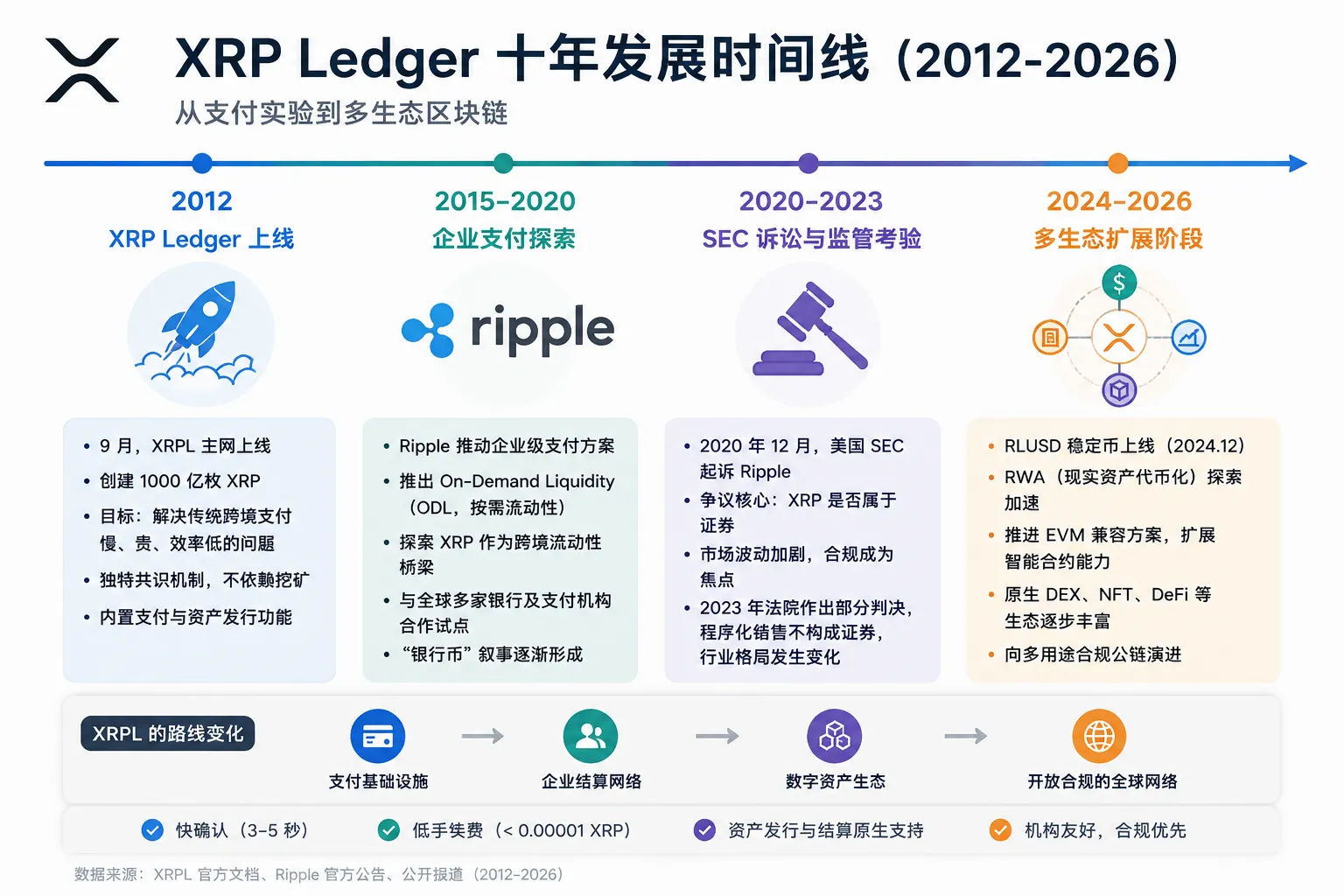
2012: mainnet launch. XRP Ledger launched, creating 100 billion XRP all at once, with a clear goal — to solve the "slow and expensive" problem of traditional cross-border payments. Note: Bitcoin was only 3 years old at the time; this was one of the earliest "payment-direction" attempts in crypto.
2015–2020: Ripple pushed enterprise payment solutions, and real-world adoption lagged early expectations. Ripple promoted bank-facing payment solutions — later On-Demand Liquidity (ODL) — and signed a batch of bank partnerships. But the reality is that traditional financial institutions adopted blockchain payments far slower than expected. This period is also where XRP got its "bank coin" label.
2020–2023: the SEC lawsuit became the biggest variable. In December 2020, the US SEC sued Ripple, with the core dispute being "whether XRP counts as a security." In 2023, the court issued a partial ruling (programmatic sales do not count as securities), reversing market expectations about XRP's compliance. This lawsuit led many newcomers to tie "Ripple" and "XRP" together.
2024–2026: from pure payments toward "payments + stablecoins + RWA + DeFi." The RLUSD stablecoin launched, EVM-compatible solutions advanced, and RWA tokenization was explored… XRPL is clearly expanding from "payment-focused" toward a "multi-purpose public chain."
After reading this line, you'll understand: XRPL is a payment chain that "got an early start," was slowed down by regulation and adoption speed in the middle, and is now, in 2026, catching up on "ecosystem."
How is it actually different from Bitcoin and Ethereum?
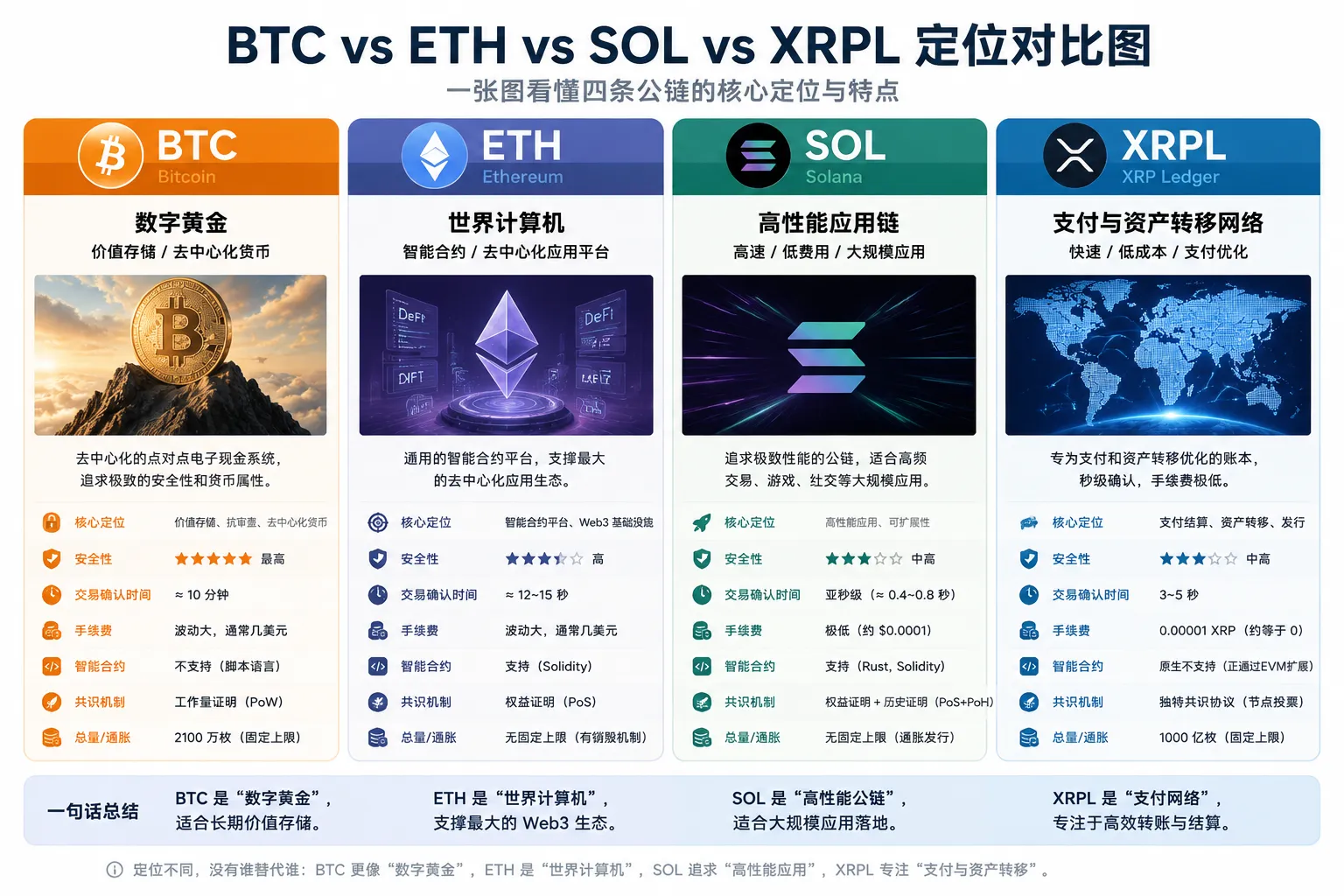
One table makes it clear:
| Dimension | Bitcoin BTC | Ethereum ETH | Solana SOL | XRP Ledger |
|---|---|---|---|---|
| Design goal | Digital gold, store of value | Smart-contract platform, Web3 base | High-performance apps/DApps | Payments, asset transfers |
| Confirmation mechanism | Mining (PoW) | Staking (PoS) | Staking (PoS) | Validator-node consensus |
| Confirmation time | ~10 minutes | ~12 seconds | Sub-second | 3–5 seconds |
| Per-transaction fee | A few dollars (very volatile) | A few dollars (very volatile) | Extremely low | 0.00001 XRP, ≈ 0 |
| Where fees go | To miners | To validators | To validators | Burned directly |
| Can it run smart contracts | Almost not | Yes, largest ecosystem | Yes, active ecosystem | Not natively; expanding via EVM-compatible solutions |
| Total supply | 21 million | No cap (burn offsets) | No cap (inflationary) | 100 billion, fixed |
After this table, you should get one core point: Bitcoin and Ethereum are "asset" and "application" chains, while XRP Ledger is a "payment" chain. They solve different problems; none replaces another.
If you want to understand Bitcoin and Ethereum themselves, see these two articles: What is Bitcoin, What is Ethereum.
Is XRP the same as Stellar (XLM)?
Many newcomers get confused: XRP is cross-border payments, and XLM (Stellar) is also cross-border payments — so what's the relationship?
The answer: same origin, but they took completely different paths.
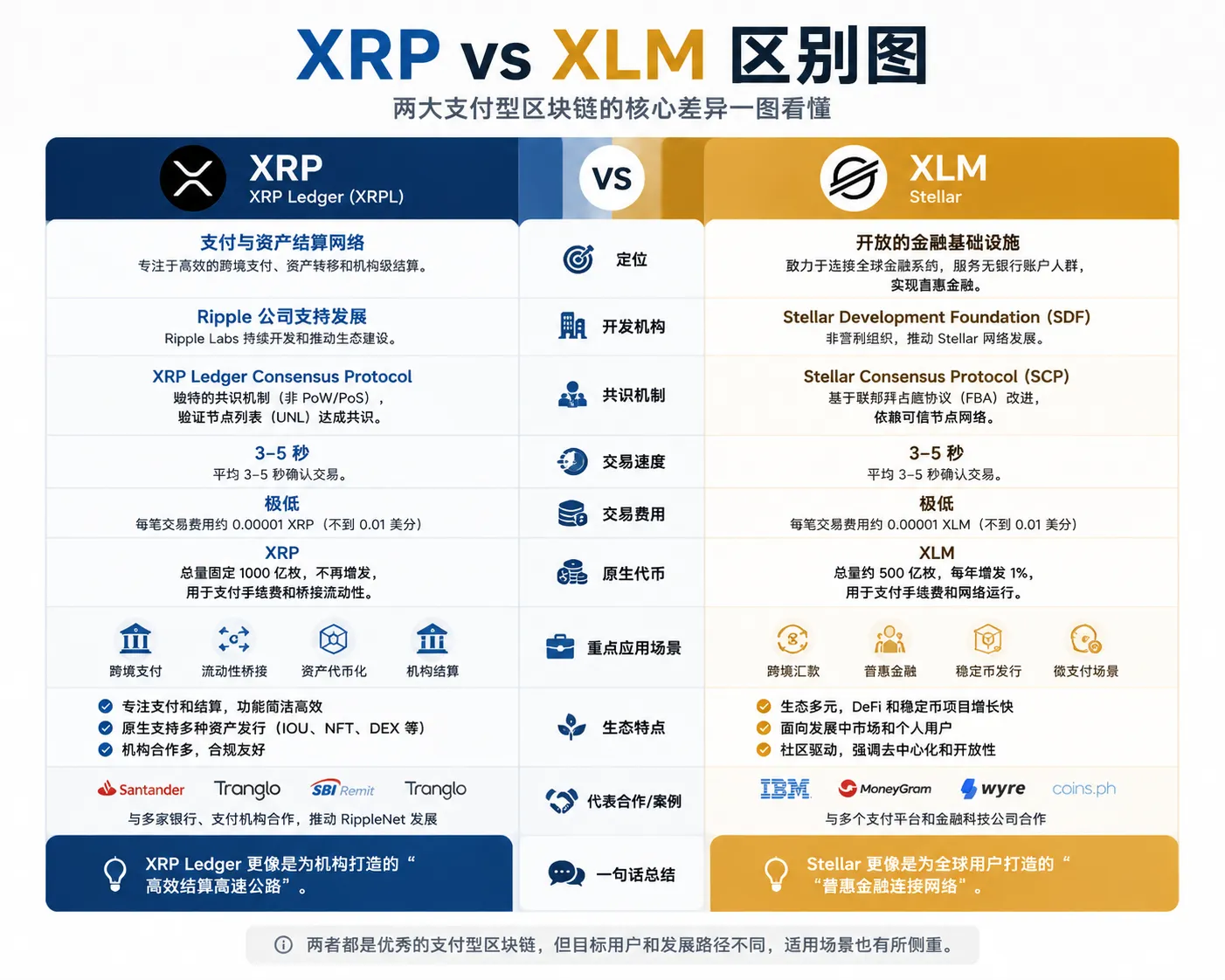
Stellar's founder, Jed McCaleb, was one of the early founding team members of XRP Ledger. In 2013 he left over a disagreement about direction, and in 2014 he created Stellar. So the two chains have similar technical foundations, but their positioning diverged:
| Dimension | XRP Ledger | Stellar (XLM) |
|---|---|---|
| Ecosystem participants | Ripple and other XRPL participants | Stellar Development Foundation (SDF, non-profit) |
| Target customers | Institutional payments, enterprise settlement | Individuals, the unbanked, small remittances |
| One-line positioning | A "settlement layer" for institutions | "Financial inclusion" for individuals |
| Stablecoin | RLUSD | Natively supports USDC / EURC |
| Smart contracts | EVM-compatible solutions | Soroban |
Simply put: XRP is "top-down" targeting institutions, while XLM is "bottom-up" targeting individuals. Neither replaces the other; they solve different sides of the cross-border-payments problem. More details at the Stellar official site.
So people searching "the difference between XRP and XLM" actually want to know "should I buy XLM just because of XRP" — the answer is no need. Their target markets and narratives are very different; don't lump them together just because "both are payment chains."
Why does it neither mine nor stake?
This is the most confusing and most easily misled point for newcomers. Many people assume "every coin either mines or stakes," but XRP is neither.
- Bitcoin relies on mining: miners compete on computing power for the right to record transactions; fees and block rewards go to miners.
- Ethereum relies on staking: validators lock up 32 ETH to participate in recording; fees go to validators, who also earn staking rewards.
- XRP Ledger relies on consensus: a group of validator nodes vote with each other; once a majority of nodes agree that "this transaction is valid," it's written into the ledger. No computing-power competition, no locked coins — so there are no miners and no staking.
You might ask: why not just use Bitcoin's mining or Ethereum's staking? Because neither fits the "second-level payments" goal:
- PoW (mining): high decentralization, but slow block production and high energy consumption, inherently unsuited to "second-level confirmation."
- PoS (staking): more mature security and economic incentives, but requires locked capital, and settlement speed still can't reach seconds, and fees aren't low enough.
XRPL's early design emphasized payment efficiency, so it didn't adopt Ethereum's general-purpose smart-contract path.
It uses a "Federated Byzantine Agreement" style consensus mechanism, specifically the XRP Ledger Consensus Protocol. You don't need to remember the name — just remember one sentence: nodes vote to confirm, and a "block" (it's called a ledger) is produced every 3–5 seconds.
There's also a very counterintuitive point: XRP's fees are burned directly — they go to no one. When you transfer XRP, that 0.00001 XRP disappears forever. This means XRP's total supply theoretically decreases gradually, but extremely slowly — don't treat it as a "deflationary asset." It's similar logic to Ethereum's "burn," except XRPL has done this since day one, not added later.
Because there's no staking, the answer to "can XRP be staked for yield" is: not on-chain. Any "XRP staking" on the market is packaged from exchange wealth-management or lending products, so evaluate the risk separately.
Transfers are nearly free, but there are two points that trip up newcomers
Point one: the account Reserve
I said earlier that transfers are "basically free," but many newcomers are startled by one thing when first using an XRP wallet — activating an account requires locking 1 XRP.
- This is called the account reserve (base reserve). The current (2026) standard is 1 XRP — it was originally 10 XRP, then lowered to 1 XRP by validator vote in December 2024 (data from the XRPL official docs).
- It's not a fee; it's a "deposit": this 1 XRP is locked in the account, and you can get it back later when you close the account and delete the extra objects.
- Each additional trust line or open order locks another 0.2 XRP (owner reserve).
The first time I transferred XRP to a brand-new address, I saw the amount not adding up and thought the fee had cheated me. Later I learned the other account wasn't activated yet and needed 1 XRP locked to "open" it. Almost every newcomer steps on this pit at least once.
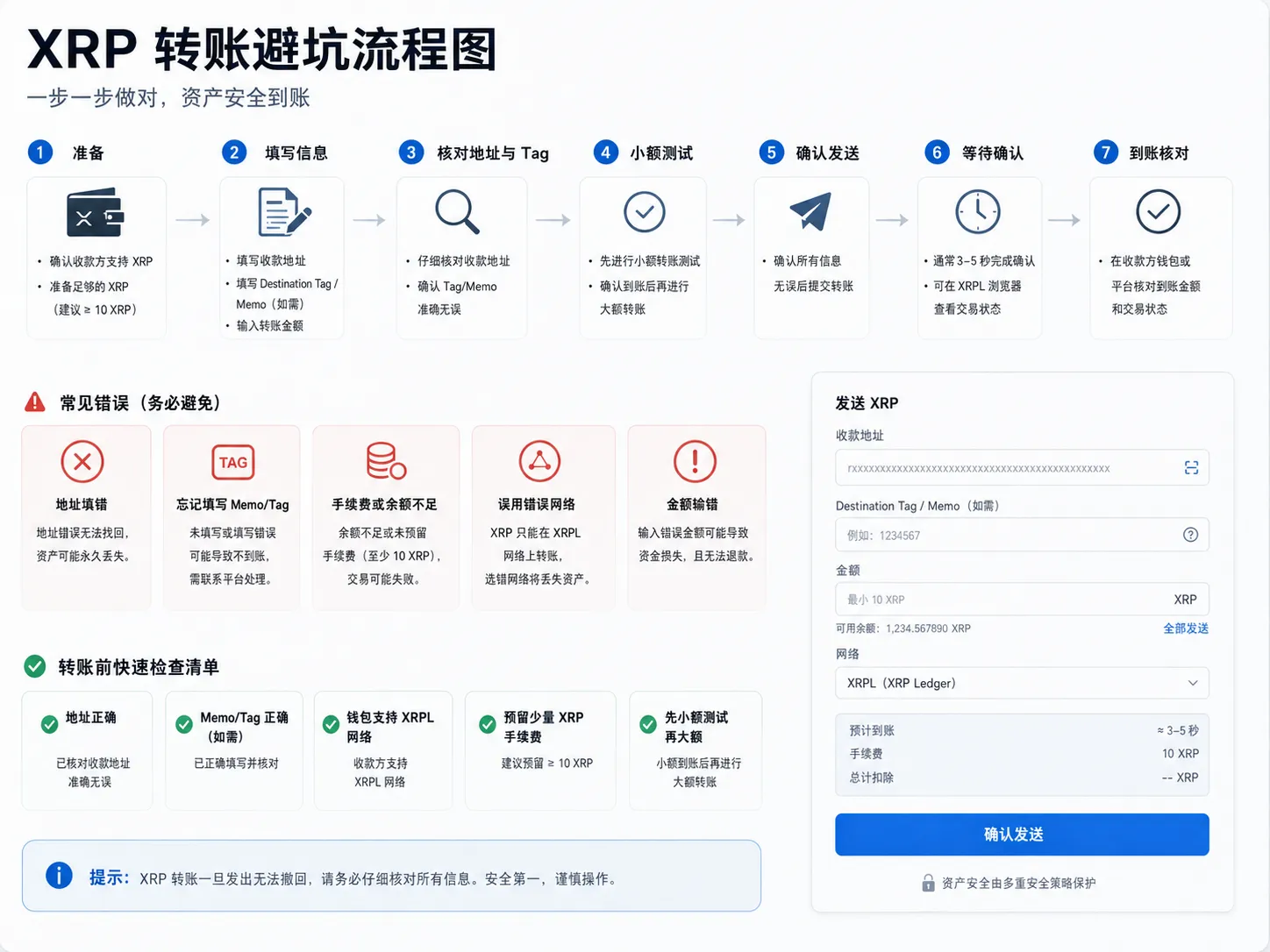
Point two: the Destination Tag
This is XRP's most serious pit, far worse than the reserve.
Many exchanges' and institutions' XRP receiving addresses are shared, and a number called the Destination Tag is used to distinguish "which user this money belongs to."
- If you withdraw XRP from one exchange to another exchange, the receiving side will definitely ask you to fill in a Tag.
- If you forget it or fill it in wrong, the money goes into the other side's "main account," but the system doesn't know it's yours — and the money may be unrecoverable.
This is the same level of pit as choosing the wrong network when transferring. I previously wrote a dedicated article on what to do if you transfer on the wrong network or fill in the wrong address; the logic is universal.
Remember one iron rule: when sending XRP out, if it asks for a Tag, check it character by character.
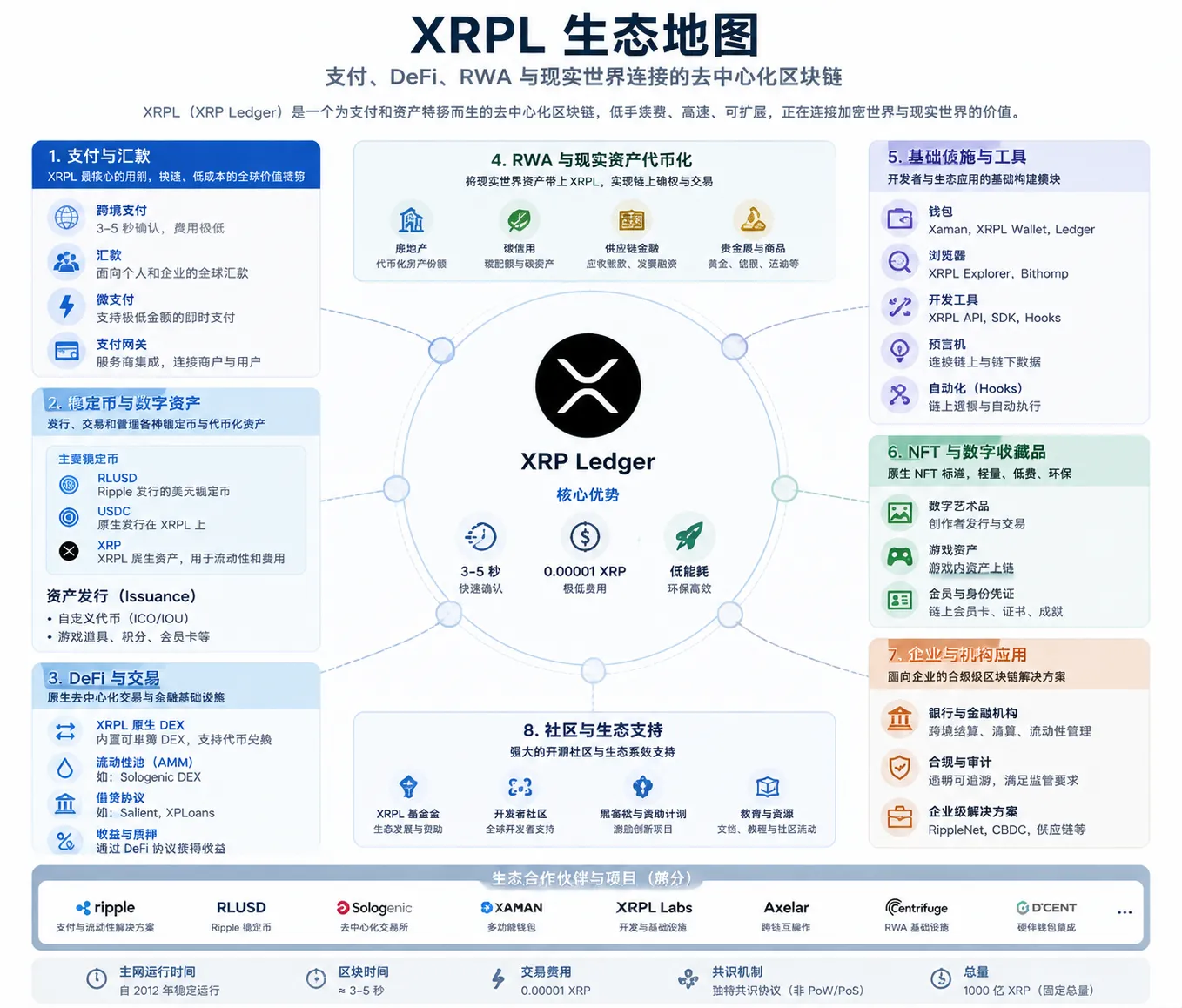
What is it actually used for?
Now that you know what it is and how it works, finally let's talk about what it's "for." This is the key to judging "whether it's worth your attention."
1. Cross-border payments (its original narrative)
The original problem XRP wanted to solve: cross-border transfers are slow and expensive. Traditional bank cross-border remittances take days and cost tens of dollars in fees; using XRP as a "bridge," it's minutes and nearly zero cost.
Ripple's products (early ODL, and various enterprise solutions today) use XRP as the "intermediary" for real-time inter-bank settlement.
2. The RLUSD stablecoin
RLUSD is a US-dollar stablecoin launched by Ripple, running on XRPL (launched December 2024), currently used mainly for payments, settlement, and ecosystem exploration. More info on the RLUSD official page.
Stablecoins are a "compliance-first" path, a different play from the USDT we usually talk about. RLUSD and XRP are two different things — don't confuse them.
3. EVM-compatible expansion
The XRPL ecosystem is expanding smart-contract capability through EVM-compatible solutions, making it easier for developers familiar with the Ethereum environment to participate, and letting users interact via MetaMask. It's like adding the ability to "run Ethereum applications" to an XRPL that originally focused on payment transfers.
The significance: previously the XRP ecosystem could barely do DeFi, but now it's catching up in this direction. If you have no concept of DeFi, see this DeFi intro first.
4. Real-world asset tokenization (RWA)
The XRPL ecosystem has also begun exploring RWA (real-world asset tokenization), with directions including real estate and securities-type assets. Although still early overall, it shows XRPL is making moves on the "compliant tokenization" path.
5. Its "native capabilities" since day one
Many people think XRPL can only transfer, but it has always had several "native" features on-chain; it's just that the ecosystem never grew big:
- Native DEX: XRPL has had a built-in order-book trading function since 2012, allowing direct on-chain buy/sell orders. Unlike Ethereum's "build a Uniswap with smart contracts," XRPL trading is "protocol-level" — more foundational and faster.
- Token issuance: any project can issue its own token on XRPL (called Issued Currencies); stablecoins and enterprise assets all go this route. RLUSD is essentially a kind of Issued Currency.
- NFT: XRPL has a native NFT standard (XLS-20) and can mint and trade NFTs, though the ecosystem is far less active than Ethereum or Solana.
Understanding these, you won't think "XRPL is only for transfers" anymore. Its foundation is actually a "ledger with built-in trading and issuance," with payments always as its main focus.
Its main strength is still "transfers + cross-border settlement," and in 2026 it's expanding into "stablecoins + DeFi + RWA" across multiple fronts, but ecosystem maturity still trails Ethereum and Solana.
A few places it's easily misunderstood
Let me gather the most common misconceptions at once; you've likely stepped on one of them too.
Misconception 1: Ripple is XRP, and XRP is a company coin
Already broken down above: company is company, chain is chain, coin is coin. XRP Ledger is decentralized, and Ripple is only the largest participant.
Misconception 2: XRP is a "bank coin," so it's centralized
"Used by banks" doesn't mean "centralized." XRPL's nodes are independently validated, and Ripple cannot unilaterally control the network. The real question is "whether the ecosystem is open enough," not "whether banks are involved."
Misconception 3: XRP mines like Bitcoin
It doesn't mine, and there are no miners. It's node-voting consensus. So don't expect to "buy a mining rig to mine XRP" — that doesn't exist.
Misconception 4: the 1 XRP deducted on transfer is a fee
That's the reserve (deposit), not a fee; it's returned when you close the account. The real fee is 0.00001 XRP, small enough to ignore.
Misconception 5: XRP's supply can be inflated indefinitely
Total supply is fixed at 100 billion. Fee burning makes supply theoretically decrease slowly, but the magnitude is tiny — don't treat it as "deflation." The "inflation" claim is wrong.
XRPL's biggest challenge: what does it need to keep growing?
Risk is "to you," challenge is "to it." For XRPL to move forward, it must first pass these three hurdles:
Challenge one: competition in the payments track is fiercer than imagined. Its rivals aren't just traditional SWIFT (which is also upgrading), but also stablecoin settlement (many people just use USDC/USDT cross-border), high-speed chains like Solana, and Ethereum Layer2. Too many people are eyeing the cross-border-payments pie.
Challenge two: ecosystem scale is a hard weakness. Ethereum has the most developers and Solana the most active users; XRPL's positioning is clear, but its on-chain application count and user activity aren't in the same league. A precise position is empty if no one uses it.
Challenge three: the decentralization debate never goes away. This is the most sensitive, and most worth understanding, point. Critics (like Cyber Capital's Justin Bons) argue that XRPL relies on the UNL (Unique Node List) mechanism, giving Ripple and the foundation de facto "soft control" over the network, even classifying it as a "permissioned chain." Ripple's CTO David Schwartz counters: the UNL is chosen by each node itself, Ripple can't force it, and the design's original intent was "so that Ripple itself also can't control the network." For both sides of this debate, see Cointelegraph's reporting.
The community hasn't reached a verdict on who's right. But for ordinary users, one point is enough: XRPL's degree of decentralization is contested; this is both its technical feature and a doubt it has never shaken off.
What risks does XRP have?
- Price volatility risk: a large part of XRP's market cap is propped up by "expectations," so rises and falls are both sharp, like all cryptocurrencies. Bitcoin is the same; XRP is only more so.
- Destination Tag error risk: missing or wrong Tag may make funds unrecoverable — this is an operational risk specific to XRP.
- "XRP staking / high yield" scams: it can't be staked on-chain. Anything using "XRP high-APY wealth management" as bait and promising absurd returns is mostly a scam; see our scam-avoidance guide.
- Ecosystem maturity risk: its DeFi and application ecosystem are far behind Ethereum and Solana; don't expect a rich set of on-chain things to play with.
- Regulatory narrative risk: Ripple's relationship with regulators, and countries' attitudes toward cross-border payments, can both affect XRP's narrative.
Before touching XRP, do these 5 things first
Tell the three concepts apart → understand the reserve and the Tag → don't believe "staking wealth management" → do a small test → custody your own private keys (wallet basics, seed phrase security).
FAQ: common XRP Ledger questions
Q1: What's the relationship between XRP Ledger and Ripple? XRPL is a decentralized public chain, and Ripple is the earliest and largest ecosystem-participating company. Ripple cannot unilaterally control the network, but has important influence over the ecosystem's direction.
Q2: How does XRP differ from Bitcoin and Ethereum? Different positioning: BTC leans store of value, ETH leans smart-contract platform, XRP leans payments and asset transfers. The three solve different problems; none replaces another.
Q3: Why do XRP transfers require a Tag? Many platforms share one receiving address and use the Destination Tag to distinguish which user's money it is. Missing or wrong Tag may make funds unrecoverable.
Q4: Can XRP be staked? Not on-chain — it relies on validator-node consensus and doesn't lock coins. Any "XRP staking" on the market is packaged from wealth-management or lending products, so evaluate separately.
Q5: Is XRP worth buying / suitable for long-term holding? Depends on your goal. Its main value is in the "cross-border payments narrative + transfer efficiency," but its ecosystem maturity and application richness trail Ethereum and Solana. This article doesn't recommend coins; it only explains what XRP is.
Q6: Is XRP risky? Not small, mainly four types: market risk (sharp price volatility), regulatory risk, ecosystem-competition risk, and operational risk (missing the Destination Tag). See the "What risks does XRP have" section above.
What to learn next
- What is Bitcoin
- What is Ethereum
- What is blockchain
- What is USDT
- What to do if you transfer on the wrong network or fill in the wrong address
- Solana beginner review
Disclaimer
This article is a personal learning and usage experience, not any investment advice. Cryptocurrencies are extremely volatile and high-risk; please decide on your own after fully understanding the risks.
- XRPL Official Docs - Transaction Cost0.00001 XRP per-transaction fee and its burn mechanism
- XRPL Official Docs - Fee VotingAccount reserve standards and fee validators voting
- XRPSCANXRPL block explorer and on-chain transaction lookup
- CoinGecko - RLUSDPublic data on the RLUSD stablecoin
See ourEditorial Policy and the correction process in ourCorrections Policy.
The CoinTrailHub editorial team focuses on crypto education for beginners, exchange security and P2P trading risk. This article is compiled from official sources and public data, reviewed by humans, and strives for accuracy but is not investment advice.
Last updated:2026-08-18 · Content reviewed by humans · Learn more
© 2026 CoinTrailHub · Original content. Reproduction or rewriting without permission is prohibited.