
Does DeFi Make Money? Where the Yield Comes From + 5 Key Risks (2026)
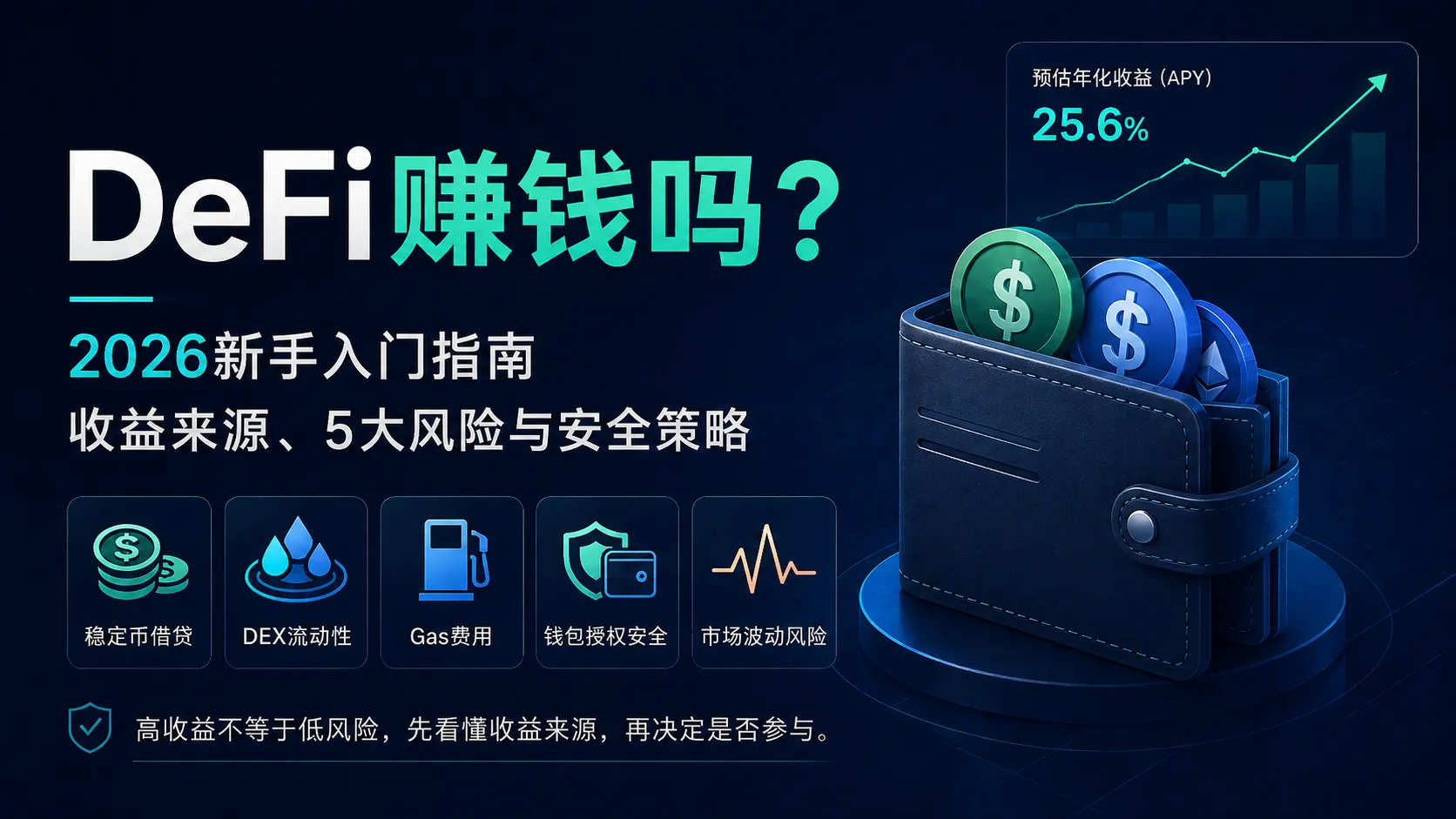
Table of contents

Binance new user rewards
20% trading fee rebate
Official Binance registration. Complete identity verification (KYC) to trade and withdraw.
DeFi can make money, but it is not a risk-free yield tool. In 2026, beginners can still earn on-chain yield through stablecoin lending and DEX liquidity provision, but smart-contract vulnerabilities, mistaken approvals, high gas fees, and market volatility can also cost you your principal. Before entering DeFi, the most important question is not "where is the highest APY," but "is the yield source real, and is the risk manageable."
Of course, some people genuinely make money in DeFi. Early users of protocols like Aave and Uniswap earned meaningful returns from fee sharing and token airdrops. But behind those returns was continuous learning and taking on smart-contract risk and market volatility — there is no free lunch.
"A friend said he made 30% in DeFi in a month, so I put in $5,000. Three days later, only $2,000 was left."
"I thought depositing stablecoins to farm was the safest, and then the protocol got drained by hackers."
"The gas cost $80 and the yield was only $15 — after all that hassle, I still lost money."
These three scenarios aren't made up — they really happened to crypto beginners over the past two years. Here in 2026, DeFi remains the crypto sector with the highest return potential and the deepest traps.
Can DeFi Actually Make Money? (The Real 2026 Answer)
Yes, but you have to survive first.
| Player type | Strategy | Annual yield | Risk level | Best for |
|---|---|---|---|---|
| Conservative | Stablecoin deposits in blue-chip L2 protocols | 3-8% | Low | People who don't want hassle and just want to beat inflation |
| Balanced | Mainstream DEX market-making + lending | 8-25% | Medium | People willing to research and accept volatility |
| Aggressive | New-protocol mining, leveraged strategies | Highly volatile, possible large losses | High | Experienced people who can afford to lose the money |
Past returns do not guarantee future results. Actual returns change dramatically with market conditions; the ranges above are only a reference summary of historical situations.
One-line conclusion: the core of making money in DeFi isn't finding the highest APY — it's avoiding the traps that will zero you out. For most ordinary users, small sustainable returns are usually easier to stick with long-term than chasing short-term spikes.
The UST algorithmic-stablecoin collapse, the FTX blowup, protocol after protocol getting hacked — the crypto world has repeatedly proven one iron rule: return and risk are always proportional. If someone promises "risk-free high returns," they're either lying to you or don't understand it themselves.
What This Article Covers: A Beginner's DeFi Survival Guide
- Can DeFi actually make money? → Yes, but many beginners lose money early on from unfamiliarity with risk management, fees, and protocol mechanics
- What are the 5 most common beginner traps? → High-APY traps, gas-fee losses, contract approvals, MEV attacks, impermanent loss
- Is 2026 still a good time for beginners to try DeFi? → Much friendlier than three years ago; L2 has drastically lowered the barrier
- What are relatively mature DeFi strategies? → Stablecoin lending + blue-chip DEX market-making; historically, some strategies reached the 5-15% range
- How much do you need to start? → At least $1,000 is recommended, so gas fees don't eat your profit
- Is it safe to put money in DeFi? → It depends on which protocols you choose and how you manage approvals
After reading, you will understand:
- Where DeFi yield comes from — it's not printed out of thin air, but trading fees, borrowing interest, and protocol incentives
- What the 5 most common beginner traps look like — and how to avoid them in advance
- 3 tested strategies — from conservative to aggressive, pick what fits you
- A simple decision framework — when to participate and when to stay away
This article is experience and strategy sharing, not investment advice. DeFi carries risk — confirm you can afford to lose everything before putting money in.
What Is DeFi — a 30-Second Explanation (No Fluff)
DeFi = Decentralized Finance.
Traditional finance: you deposit money in a bank → the bank lends it out → the bank earns the spread → it gives you 0.5% interest.
DeFi: you deposit USDC into Aave → borrowers borrow it with over-collateralization → the protocol collects interest → it gives you 4-8% APY.
What's the difference?
- No bank middleman; depositors and borrowers interact directly through smart contracts
- Code is law — the rules are written on-chain and no one can tamper with them
- You control your own money (which also means you're responsible for your own security)
I won't expand on the concepts here. If this is your first time hearing about DeFi, read What Is Ethereum? Smart Contracts, Gas Fees, and Web3 first to understand what a smart contract is, then come back to this article.
Where Does DeFi Yield Come From? 3 Real Yield Sources Explained
This question matters a lot, because charging in without knowing where the yield comes from is like crossing the street blindfolded.
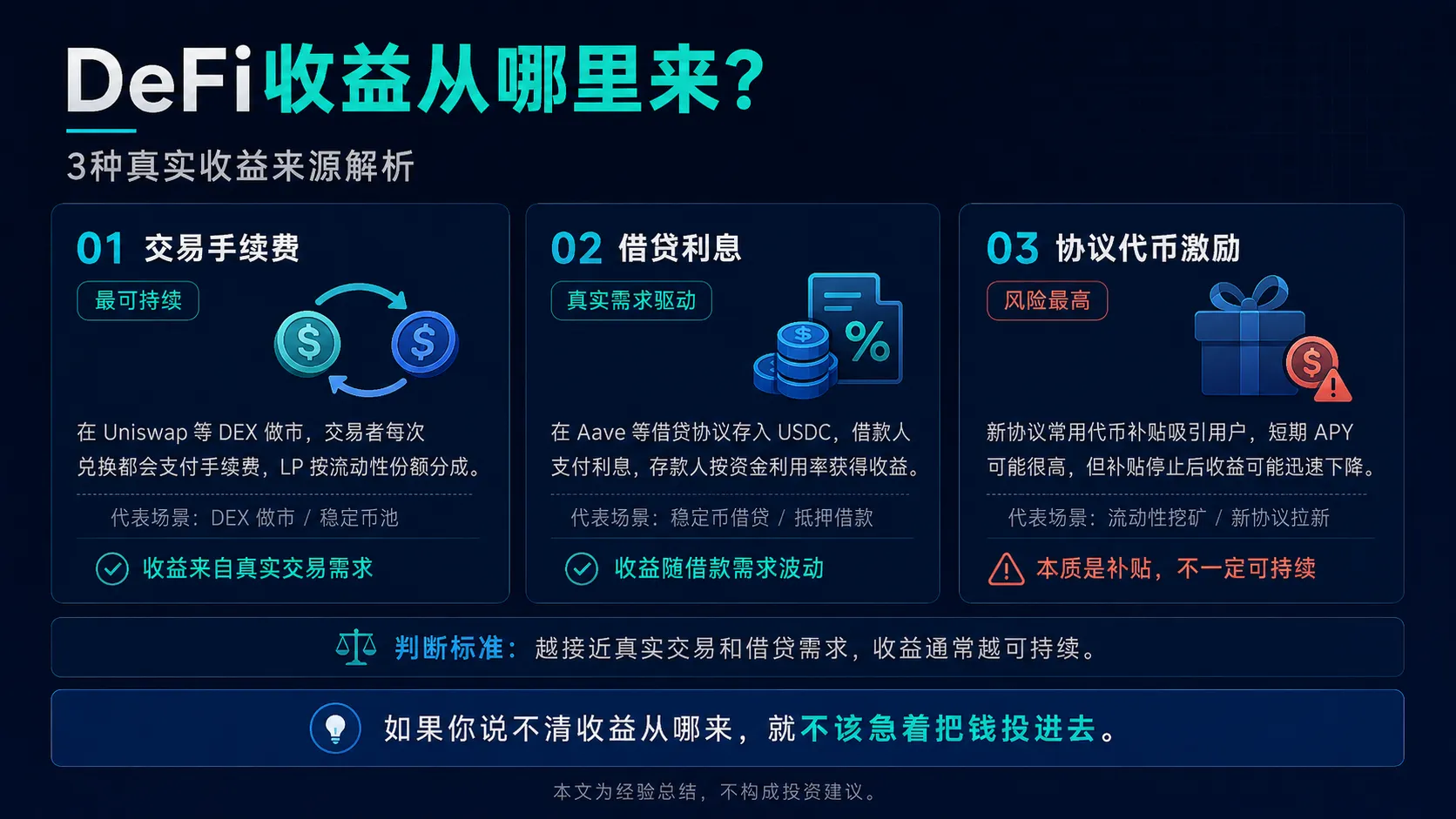
DeFi yield has only three real sources:
1. Trading fees (real demand, the most sustainable) When you provide liquidity on Uniswap, traders pay 0.05%-1% per swap, and LPs share it proportionally. The more volume, the more LPs earn. This is DeFi's "cleanest" yield.
2. Borrowing interest (real demand, but volatile) Deposit USDC on Aave and borrowers pay interest. In bull markets, borrowing demand is high and deposit rates surge to 10-20%; in bear markets nobody borrows and rates fall to 1-2%.
3. Protocol token incentives (some real, some fake — the most dangerous) New protocols issue tokens to incentivize deposits, and APY shoots to 5000% in three days. But this is essentially subsidies in exchange for users; when the subsidies stop, the yield goes to zero and the token price usually crashes. If you see an APY above 50%, your first reaction should be "where does this yield come from," not "let me get in fast."
A simple rule of thumb: if you can't explain where the yield comes from, don't put money in.
How Is DeFi in 2026 Different From Before?
If you heard about DeFi in 2021 but never participated and are now re-learning it, three things have changed:
1. L2 lowered the barrier to entry. Back then, a single operation on Ethereum mainnet cost $50-100 in gas, and small amounts simply couldn't afford to play. Now Arbitrum, Optimism, and Base have brought fees down to a few cents, and a few hundred dollars can participate too.
2. The era of pure token-subsidy high APY is over. Early DeFi protocols issued tokens to attract users, and APYs were routinely in the thousands of percent. In 2026 the market cares more about a protocol's real revenue — whether trading fees and borrowing interest are sustainable.
3. Risk management matters more than finding yield. Before, whoever had the highest yield won; now, the survivors are all protocols that lived through extreme markets. For beginners, "not losing" is more worth learning than "earning more."
The 5 Traps Every Beginner Hits
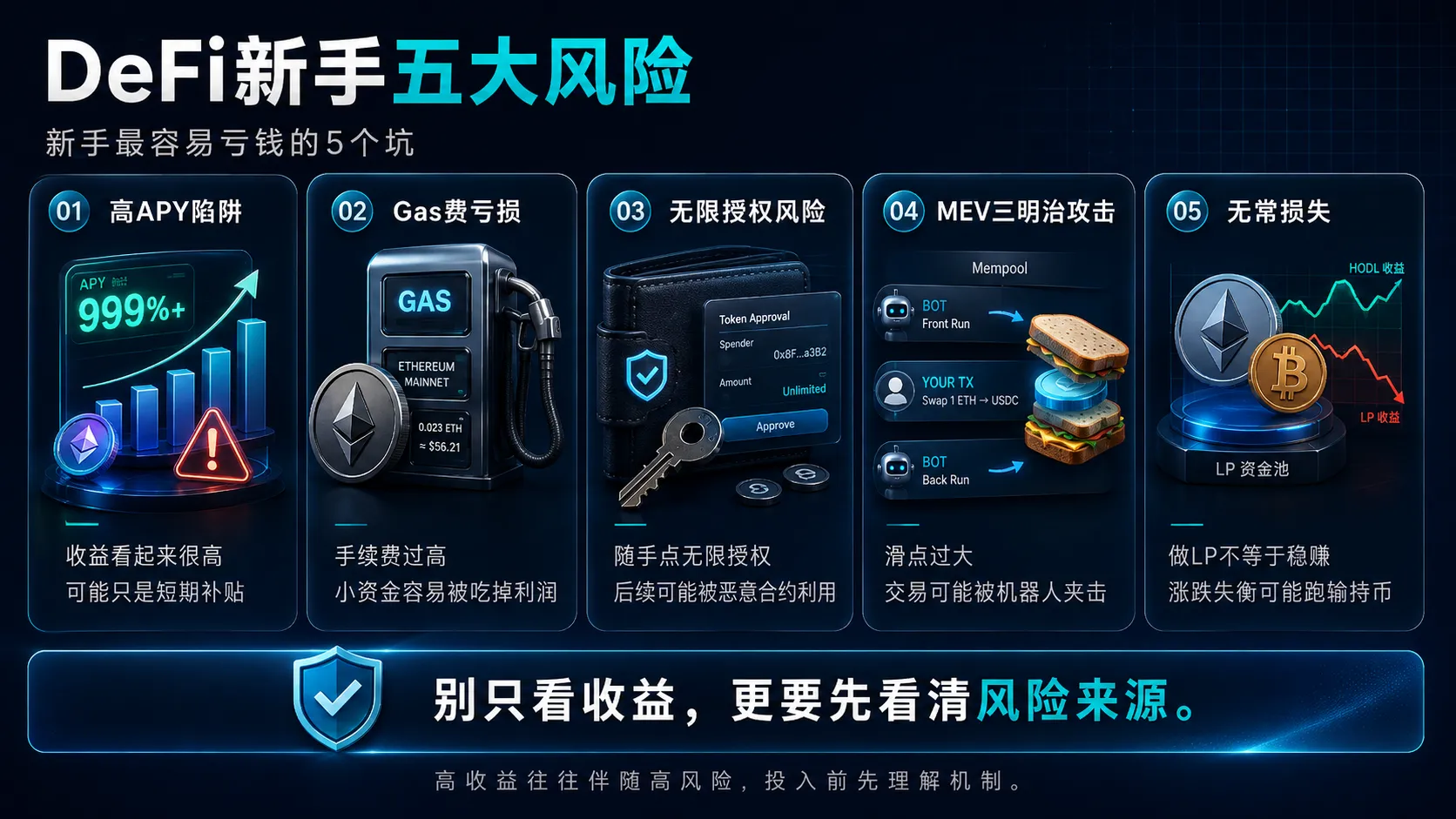
Trap 1: Looking only at APY, ignoring risk and TVL
In 2024, a certain fork protocol advertised "2000% APY on stablecoin deposits." $20 million flooded in over three days, and on the fourth day the team ran off with the money.
How to avoid it:
- If any stablecoin pool shows an APY above 20%, first ask "why"
- Check the TVL (total value locked); be cautious with protocols under $10 million
- Has the protocol's code been audited? Is the auditor a known firm like CertiK or Trail of Bits?
- Check real data on DeFiLlama — don't just read the project's own marketing page
Trap 2: Gas fees eating all your profit
On Ethereum mainnet, a single Uniswap trade costs $15-50 in gas, and adding liquidity to a pool costs $30-100.
If you deposited $500 at 10% APY, that's $50 earned. But a round trip in and out cost $80 in gas. After a whole year of hassle, you're net down $30.
How to avoid it:
- With small amounts (e.g. under a few thousand dollars), Ethereum mainnet fees can noticeably hurt returns; L2 is usually a better learning environment
- Use Layer 2: a Uniswap trade on Arbitrum costs about $0.3-1 in gas, and an Aave deposit about $1-3 (actual fees fluctuate with network congestion)
- Check real-time fees for each L2 on L2Beat
- Not familiar with L2 yet? Read Ethereum Gas Too Expensive? Arbitrum/Optimism/Base Compared (2026)
Trap 3: Unlimited approvals getting your wallet drained
When you approve USDC on Uniswap, MetaMask asks "how much to approve" — and you casually click "unlimited."
Three months later, a vulnerability is found in Uniswap's contract and all your USDC is transferred out. Because the "unlimited allowance" you approved three months ago is still valid.
How to avoid it:
- Only approve the exact amount you need each time; never click "unlimited"
- Regularly check and revoke unnecessary approvals with Revoke.cash
- Use a separate "DeFi wallet" for large amounts, kept apart from your long-term cold wallet
- For wallet-security basics, read first: What Is a Cold Wallet? How to Store Your Seed Phrase Safely (2026, 5 Ways Compared)
Trap 4: MEV sandwich attacks
You buy an obscure token on Uniswap and set slippage to 5%. After the trade is on-chain, you find the fill price was 8% worse than expected.
You got "sandwiched" — an MEV bot saw your trade, bought at a higher price in front of you and sold at a higher price behind you, and you became the filling in the middle.
How to avoid it:
- Set slippage no higher than 1-2% (for mainstream pairs)
- Use an MEV-protecting RPC (like Flashbots Protect)
- Split large trades into multiple small ones
- Trade in pools with good liquidity when possible
Trap 5: Impermanent loss
You deposit $1,000 worth of an ETH-USDC pair on Uniswap. A month later, ETH doubles.
When you withdraw, you find: if you'd done nothing, it would be worth $1,500; as an LP, it's worth $1,300. You earned $20 extra in fees, but missed $200 of upside. That $200 is impermanent loss.
How to avoid it:
- Stablecoin pairs (USDC-USDT) have ≈0 impermanent loss
- Correlated-asset pairs (ETH-wstETH) have very small impermanent loss
- For highly volatile pairs, impermanent loss can far exceed fee income
- Estimate with the Uniswap impermanent-loss calculator before providing liquidity
3 Tested Strategies That Still Work in 2026
The core difference between DeFi strategies isn't just the yield level — it's how much risk you're taking. For beginners, building a "low-risk — medium-risk — high-risk" understanding of strategies matters more than looking at APY directly.
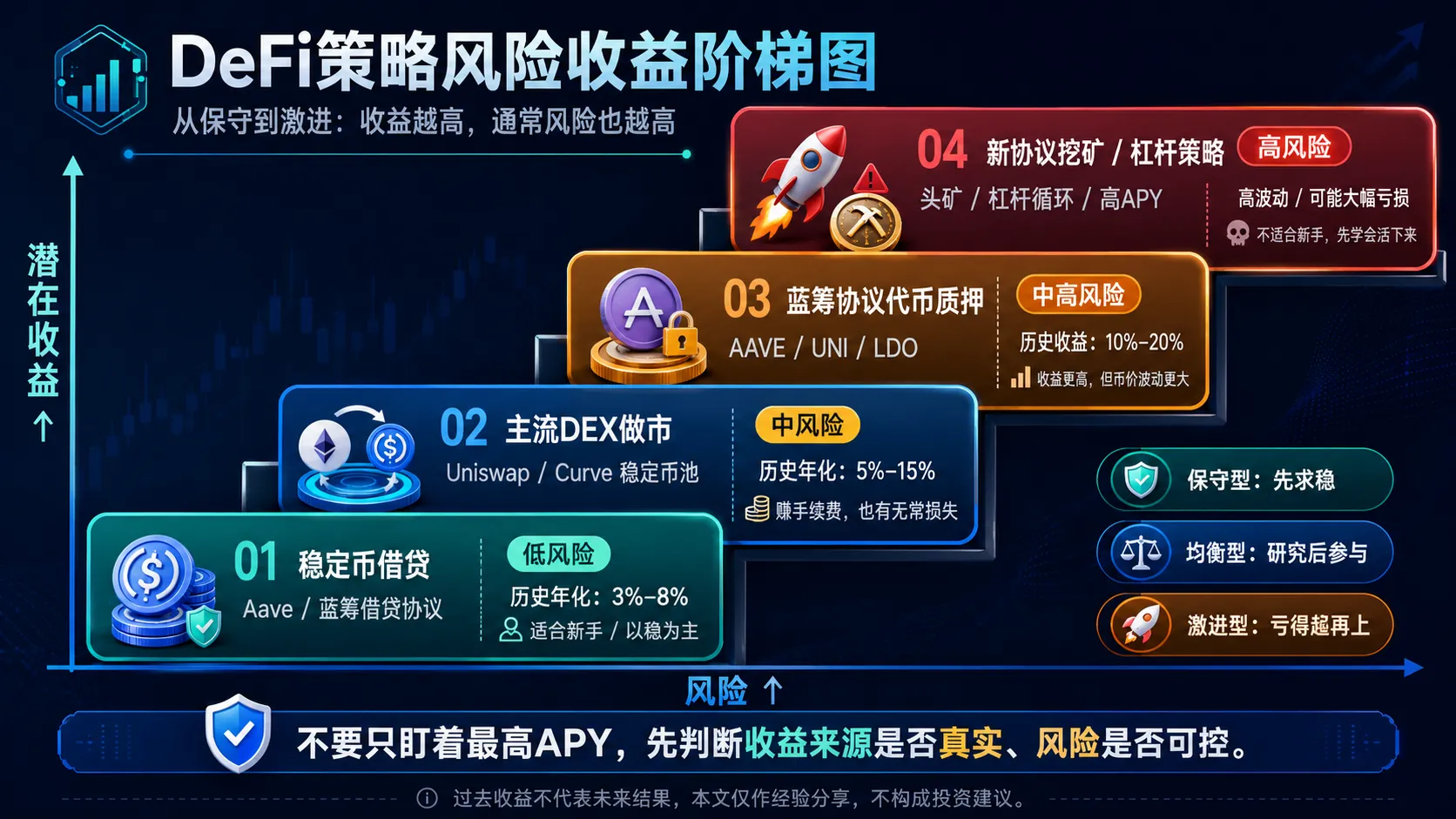
Strategy 1: Stablecoin deposits in blue-chip L2 protocols — low maintenance, historically ~3-8% APY
For: beginners who don't want hassle and are satisfied with beating inflation
How to do it:
- Buy USDC on Binance / OKX and withdraw via the Arbitrum network
- Open Aave (aave.com) and switch to the Arbitrum market
- Deposit USDC; current APY is about 4-6%
- For a bit more, you can use Liquity's stability pool or MakerDAO's DSR
Why it's relatively reliable: Aave is one of the larger and longer-running lending protocols in DeFi, having survived multiple market cycles. According to public data from platforms like DeFiLlama, its TVL has long ranked near the top among lending protocols. Historical yield levels fluctuate with market borrowing demand and do not guarantee future returns.
For the detailed flow, see: USDT Deposit, Withdrawal, and Selling: A Beginner's Full Guide to Fiat On/Off-Ramp (2026)
Strategy 2: Mainstream DEX stablecoin market-making — needs occasional attention, historically some strategies reached 5-15%
For: people willing to spend 1-2 hours a week and accept small fluctuations
How to do it:
- Provide concentrated USDC-USDT liquidity on Uniswap V3 (Arbitrum network)
- Set a narrow price range (e.g. 0.995-1.005)
- The more volume, the more fees you share
Advanced: Curve's stablecoin pools, Beefy's auto-compounding vaults
Note: Stablecoin market-making also carries a very small chance of depeg risk (see the brief 2023 USDC depeg). Don't put all your money in one pool.
Strategy 3: Blue-chip protocol token staking — requires some market judgment
For: people already comfortable with DeFi who have their own market view
At this stage you can allocate part of your portfolio to mainstream protocol tokens (AAVE, UNI, LDO) and single-side stake them for protocol revenue sharing. But the prerequisite is: you understand what the protocol does and believe it has long-term value.
Note: token prices can drop 50% or more. Historical staking yields were roughly in the 10-20% range, but if the token drops 50%, you're still down overall. If you can't understand a protocol's token economics, don't buy it.
Your First Time in DeFi: How to Start With $1,000 (A Learning Case)
The allocation below is for learning reference only, not investment advice. This is what I actually did when testing entry-level DeFi myself, with the goal of walking through the full flow with a controllable amount.
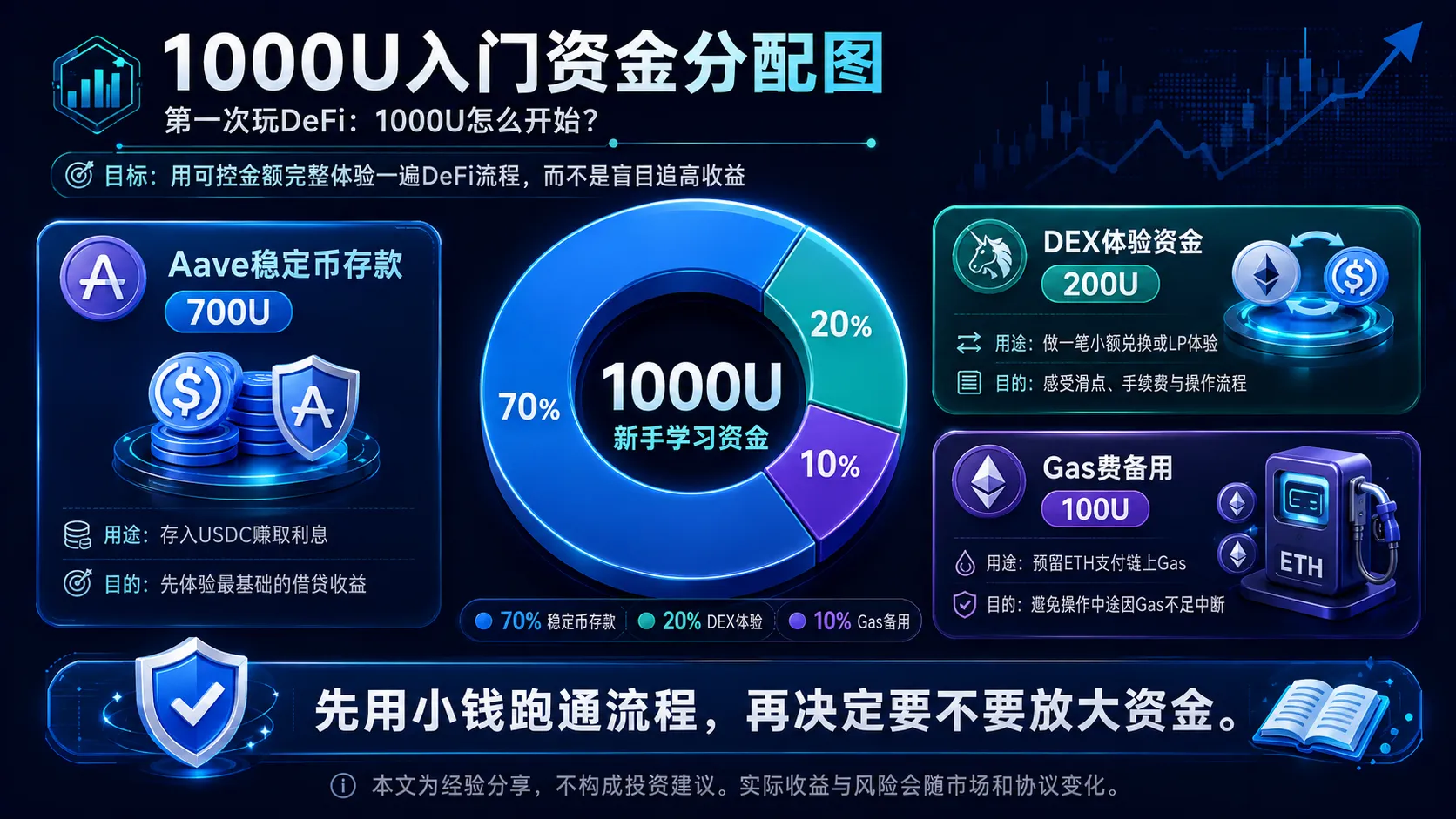
| Purpose | Amount | Notes |
|---|---|---|
| Aave stablecoin deposit | $700 | Deposit USDC to earn deposit interest and watch the yield change |
| DEX trial funds | $200 | Do a small swap on Uniswap to feel gas fees and slippage |
| Gas test | $100 | Keep as ETH in the wallet to pay gas at each step |
The flow (using the Arbitrum network as an example):
- Install a wallet — download the MetaMask browser extension, create a wallet, and write down the seed phrase by hand (see What Is a Cold Wallet? How to Store Your Seed Phrase Safely (2026, 5 Ways Compared))
- Switch networks — add the Arbitrum network in MetaMask (ChainID: 42161, or add it in one click from chainlist.org)
- Fund it — buy USDC on Binance / OKX, and select the Arbitrum network when withdrawing (withdrawal fee about $0.5-1, far cheaper than Ethereum mainnet)
- Reserve gas — also withdraw about 0.01 ETH to the Arbitrum wallet for gas
- Connect to Aave — open aave.com, connect your wallet, switch to the Arbitrum market, and deposit 700 USDC
- Check the approval — when depositing, MetaMask will pop up an approval request; only approve the deposit amount, don't click "unlimited"
- Test a small DEX trade — open Uniswap and swap 50 USDC for a little ETH, watching the slippage and gas
- Check your yield — return to Aave and check the deposit interest after 24 hours. Actual yield fluctuates with market borrowing demand; it's not a fixed rate
After these 8 steps, you've genuinely "used DeFi" — more useful than reading 100 articles.
I suggest running one full "deposit → withdraw" cycle with $100 first, confirming you understand every step before scaling up the amount. The tools and operations aren't as complicated as they seem, but the risks are real — small-amount testing is the best insurance.
A DeFi Participation Decision Framework: 5 Hard Questions
Before putting money into any new protocol, ask yourself these 5 questions:
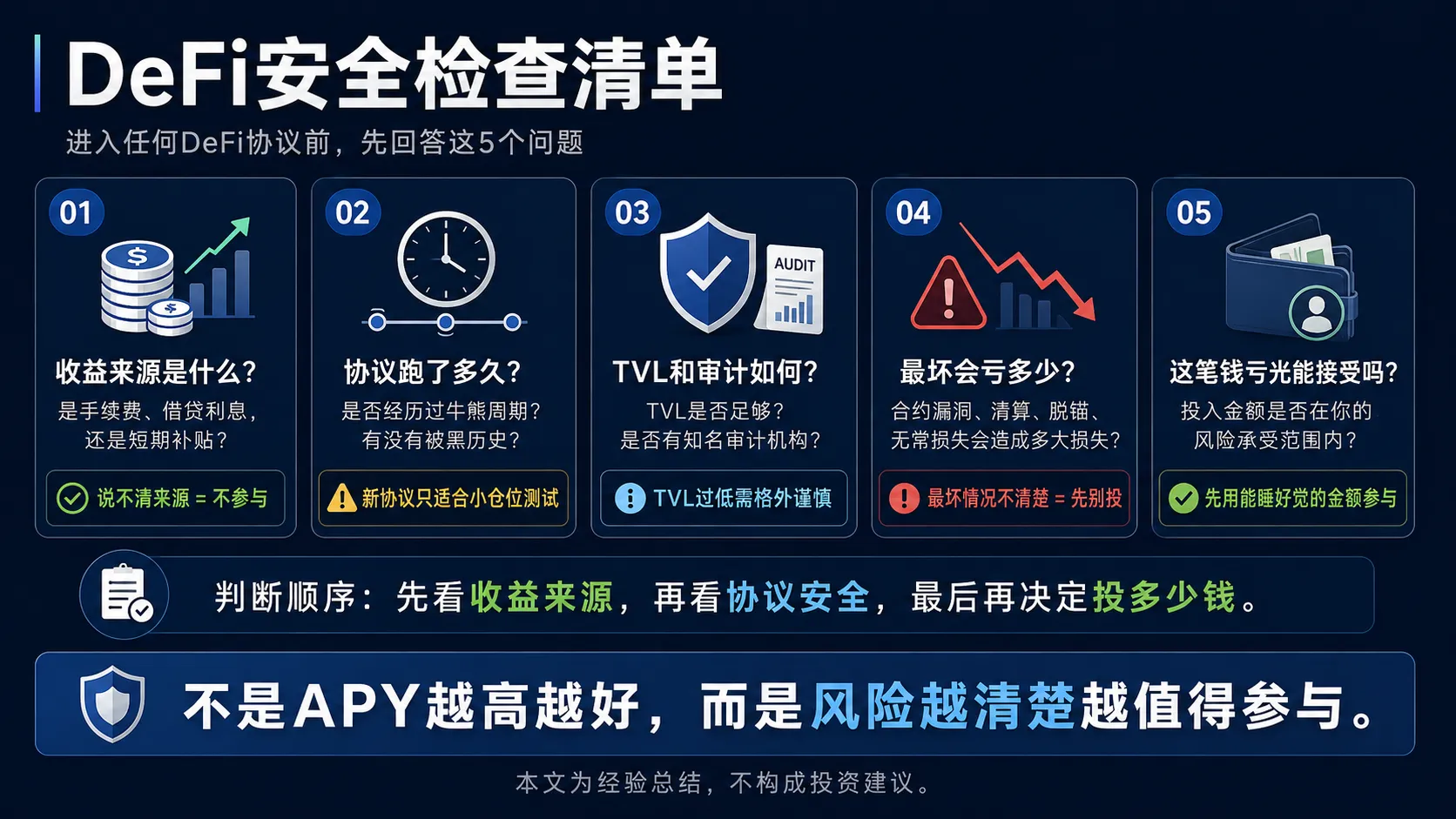
| # | Question | If you can't answer it |
|---|---|---|
| 1 | Where does the yield come from? (fees / interest / subsidies) | Don't invest |
| 2 | How long has the protocol been running? Has it been hacked? | Put at most 5% of funds in new protocols |
| 3 | What's the TVL? Who did the audit? | Be extra cautious if TVL < $10 million |
| 4 | How much can you lose in the worst case? | If you don't know, don't invest |
| 5 | Can you accept losing all this money? | Reduce to an amount that lets you sleep |
FAQ
Can DeFi really make money?
Yes, but return and risk are proportional. Through stablecoin deposits in blue-chip protocols like Aave and market-making on mainstream Uniswap pairs, some users have historically earned positive net returns. But high returns often come with high risk — aggressive strategies like high-APY mining and jumping into new protocols' first mining can cause large principal losses. The key isn't "can it make money," but whether you understand the source of every bit of yield and can bear the corresponding downside.
Can your principal go to zero in DeFi?
It's possible. A few scenarios: a protocol gets hacked and funds are stolen (see the $600 million Ronin Bridge hack in 2022); a stablecoin depegs (see USDC briefly falling to 0.87 in 2023); the team runs off (rug pull). Ways to reduce risk: only use time-tested blue-chip protocols, spread your funds, and regularly check approvals.
Is $100 suitable for trying DeFi?
Not really recommended. A single trade on Ethereum mainnet can cost $15-50 in gas, and $100 would see a big chunk eaten by fees alone. For small-amount testing, use Layer 2 networks like Arbitrum or Optimism, where gas is $0.1-1, and $100 can experience the full flow. But the actual return is limited — $100 at 8% APY is only $8 a year.
Is Aave safe?
Aave is one of the longest-running (over 5 years) and largest (over $10 billion TVL) lending protocols in DeFi, having passed multiple security audits and extreme market tests. But no protocol is 100% safe — smart-contract vulnerabilities, oracle attacks, and extreme-market liquidation risk always exist. Aave's security is in the top tier of the DeFi industry, but "safe" never equals "zero risk."
What's the difference between DeFi and exchange earn products?
| DeFi (Aave, etc.) | Exchange earn (Binance Earn, etc.) | |
|---|---|---|
| Fund custody | You hold it (self-custody) | The exchange holds it |
| Yield source | On-chain lending / trading fees | Distributed by the exchange |
| Transparency | Verifiable on-chain, fully transparent | Depends on exchange disclosure |
| Risk | Smart-contract risk, your own operational mistakes | Exchange exit-scam / freeze risk |
| Barrier | Requires wallet, gas fees, on-chain operations | One-click subscription |
Both have pros and cons. If you're unfamiliar with on-chain operations, you can start with exchange earn products and gradually try DeFi after you're comfortable.
Conclusion: The Right Mindset for Making Money in DeFi
DeFi is not a get-rich-quick tool — at least not for 99% of people.
Those who turned $1,000 into $1,000,000 in the 2020 DeFi Summer either got lucky hitting a 100x coin, or were developers who could spot new-protocol opportunities early, or are the survivorship bias you see on Twitter — most of the people who lost everything don't tweet.
To keep making money in DeFi, you need:
- Safety first — approval management, private-key protection, choosing verified protocols. See: How to Prevent Your Wallet from Being Hacked? Seed Phrase, Wrong-Chain Transfers, and Approval Risks (2026)
- Strategy second — start with stablecoin strategies and level up after gaining experience
- Yield third — get the first two right and the returns will come
The cruelest thing about DeFi is: tuition is inevitable, but some people paid $50 for the lesson, and some paid $5,000.
I hope after reading this, you pay the $50 version.
The CoinTrailHub editorial team focuses on crypto education for beginners, exchange security and P2P trading risk. This article is compiled from official sources and public data, reviewed by humans, and strives for accuracy but is not investment advice.
Last updated:2026-08-06 · Content reviewed by humans · Learn more
© 2026 CoinTrailHub · Original content. Reproduction or rewriting without permission is prohibited.