
Can You Pay Gas with USDT on BNB Chain? BEP20 Transfers and Gas, Tested (2026)
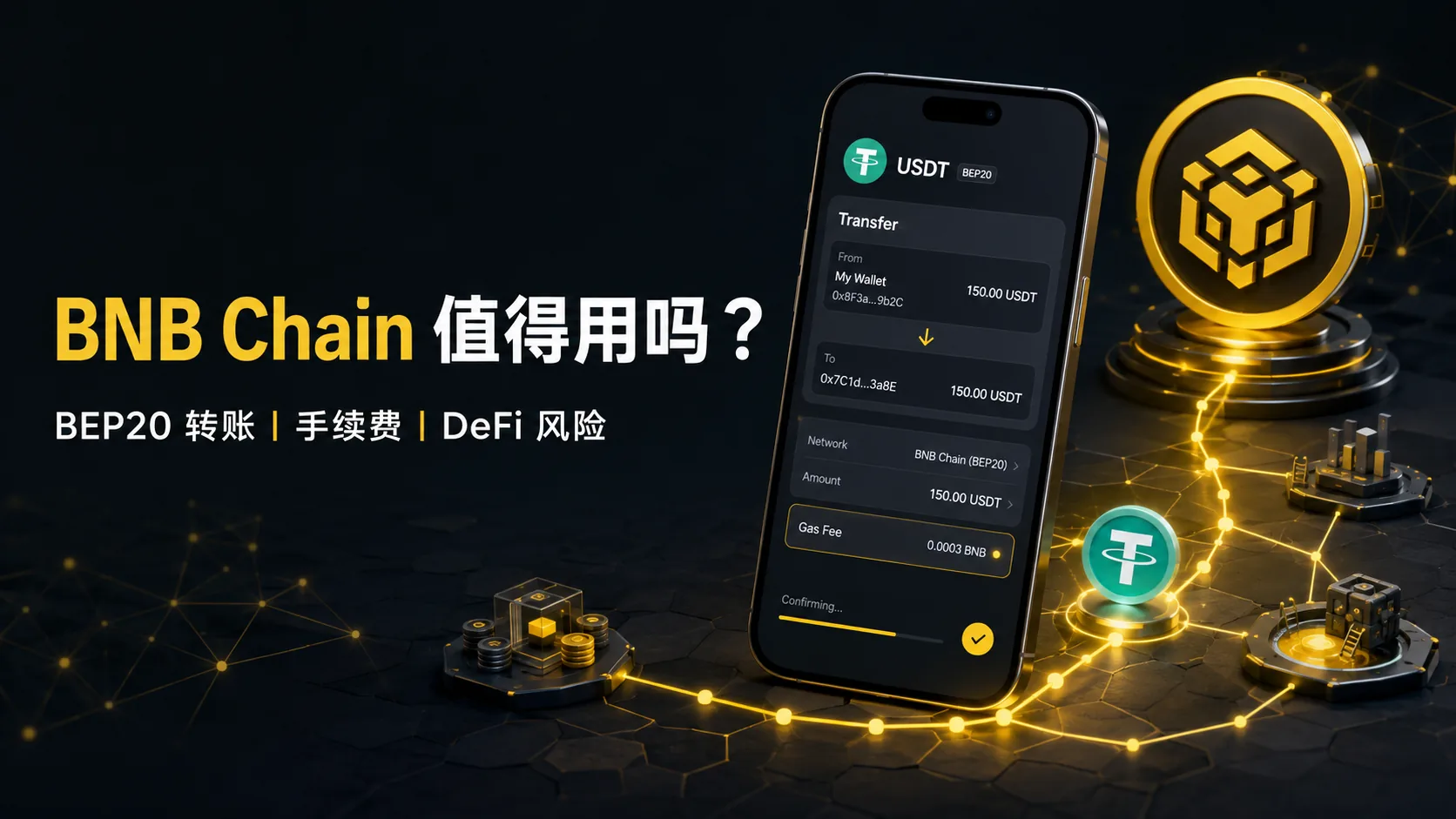
Table of contents

Binance new user rewards
20% trading fee rebate
Official Binance registration. Complete identity verification (KYC) to trade and withdraw.
Whether a beginner should use BNB Chain mainly comes down to three conditions: whether you use Binance often, whether the receiving side supports BEP20, and whether you need low-cost transfers or basic DeFi operations.
If you frequently withdraw USDT from Binance, or want to practice wallets and swaps with small amounts, BNB Smart Chain is genuinely convenient. If you just leave your coins on an exchange, or care more about validator distribution, deep DeFi, and cross-ecosystem compatibility, there's no need to use this chain just because "fees are cheap."
After nearly a year of actual use, my conclusion is:
BNB Chain is best suited as a low-cost operating network for Binance users, but it is not the default network where all assets should be stored long-term.
This article separates BEP20 transfers, on-chain gas, Binance trading fees, and DeFi, to avoid conflating "using BNB Chain" with "investing in BNB."
About 10 minutes to read. First, remember two things: on-chain gas can only be paid in BNB — USDT can't pay it; and a platform's withdrawal fee and on-chain gas are two different costs.
Note: This article is based on personal usage experience; some fee records come from actual operations in August 2026. Platform withdrawal fees, on-chain gas, and trading discounts may change — always refer to what's shown in real time on the operation page. This article does not constitute investment advice.
Core information
| Your need | Is BNB Chain right for you? | Basis |
|---|---|---|
| Withdraw USDT from Binance to a BEP20-supporting wallet | Worth considering | Smooth handoff, usually lower fees |
| Practicing wallets, transfers, and swaps for the first time | Good for small amounts | Low gas, controlled trial-and-error cost |
| Only buying and holding on Binance | Not needed yet | You won't use it if you don't do on-chain operations |
| Want to use BNB to offset Binance trading fees | Worth considering | Related to BNB's use, but not the same as needing to use BNB Chain |
| Researching complex DeFi strategies | Also compare Ethereum L2s | Usually richer in protocol types, liquidity, and analysis tools |
| Care strongly about validator distribution and censorship resistance | Choose carefully | BSC's block production is relatively concentrated |
| Receiving platform doesn't support BEP20 | Don't use it | A network mismatch may prevent proper crediting |
| Storing a large amount long-term | Don't just look at fees | Also consider self-custody, network, and token-contract risk |
In one sentence:
BNB Chain is one of the most convenient public chains for Binance users, but it's not a universal optimum for the whole crypto market.
What is BNB Chain? How does it relate to Binance and BSC?
Let's first untangle a few easily confused names.
Binance is a centralized exchange; BNB Chain is a blockchain network; BNB is the token used within this ecosystem. The three are deeply connected, but they are not the same thing.
In 2022, the former Binance Smart Chain was renamed BNB Smart Chain and brought under the "BNB Chain" brand together with BNB Beacon Chain. In 2024, BNB Chain used BC Fusion to migrate Beacon Chain's functions to BSC, then gradually sunset Beacon Chain.[1]
According to the current BNB Chain official documentation, the BNB Chain ecosystem mainly includes:
- BNB Smart Chain (BSC): Ethereum-EVM compatible; day-to-day transfers and DeFi mostly happen here;
- opBNB: a layer-2 scaling network built on BSC, with lower fees, but its asset network must not be confused with BSC;
- BNB Greenfield: a network for data ownership and decentralized storage.
So when ordinary users say "use BNB Chain," most of the time they actually mean:
Use BNB Smart Chain, commonly known as BSC. An exchange's withdrawal page usually labels this network "BEP20," but strictly speaking, BSC is the network and BEP20 is the token standard adopted by that network.
Also worth distinguishing:
- BNB is the token;
- BNB Smart Chain is the network;
- BEP20 is a common token standard on this network.
Transfers, swaps, or smart-contract calls on BNB Smart Chain require a small amount of BNB to pay gas. But this doesn't mean you must hold or heavily allocate BNB long-term.
Using BNB Chain is not the same as investing in BNB.
If you want to understand the basic principles of public chains first, read What Is Blockchain? How It Works, Uses, and Risks (2026).
Scenario one: is it worth transferring USDT via BEP20?
This is why many people first come into contact with BNB Chain:
Withdrawing USDT from Binance to a wallet, or depositing USDT from a wallet back to Binance.
My real experience is that as long as both the sender and receiver clearly support BEP20, BNB Smart Chain is usually one of the lower-cost, smoother options.
But you must first distinguish between two fees.
1. Platform withdrawal fee
When you withdraw from an exchange like Binance, the platform shows on the withdrawal page:
- the withdrawal network;
- the withdrawal fee charged by the platform;
- the estimated amount credited;
- the minimum withdrawal amount.
The platform withdrawal fee is set by the platform and may adjust dynamically based on network and platform rules, so it is not equal to the gas actually consumed by that transaction on the blockchain.
2. Wallet on-chain gas
When you transfer from your own wallet to another address, you pay BNB Smart Chain's on-chain gas, which requires a small BNB balance in your wallet.
Therefore, "Binance withdrawal fee" and "wallet on-chain gas" must not be treated as the same cost.
To compare the actual withdrawal costs of different networks, on August 14, 2026, I checked the page fees for BEP20, ERC20, and TRC20 using the same 10 USDT withdrawal amount.
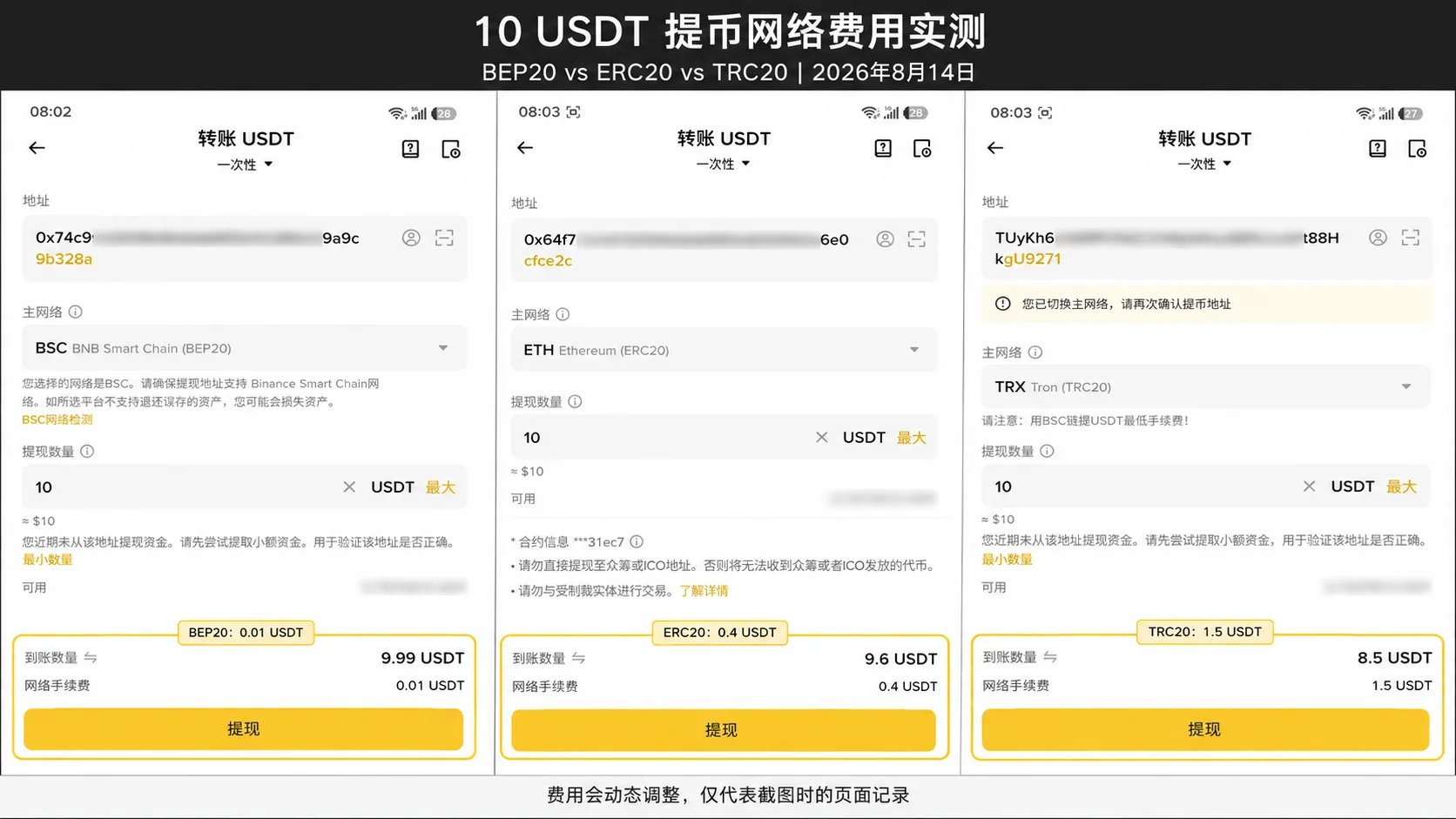
Test result: withdrawing 10 USDT, BEP20 showed a 0.01 USDT fee and an estimated 9.99 USDT credited; ERC20 showed a 0.4 USDT fee and 9.6 USDT credited; TRC20 showed a 1.5 USDT fee and 8.5 USDT credited.[2] Platform withdrawal fees adjust dynamically; the above only represents the page record at the time of the screenshot.
The page data above is a pre-withdrawal fee preview. To confirm the actual result, I then completed this 10 USDT withdrawal via BSC (BEP20). The record shows the platform deducted a 0.01 USDT fee and actually transferred out 9.99 USDT, with status "Completed."
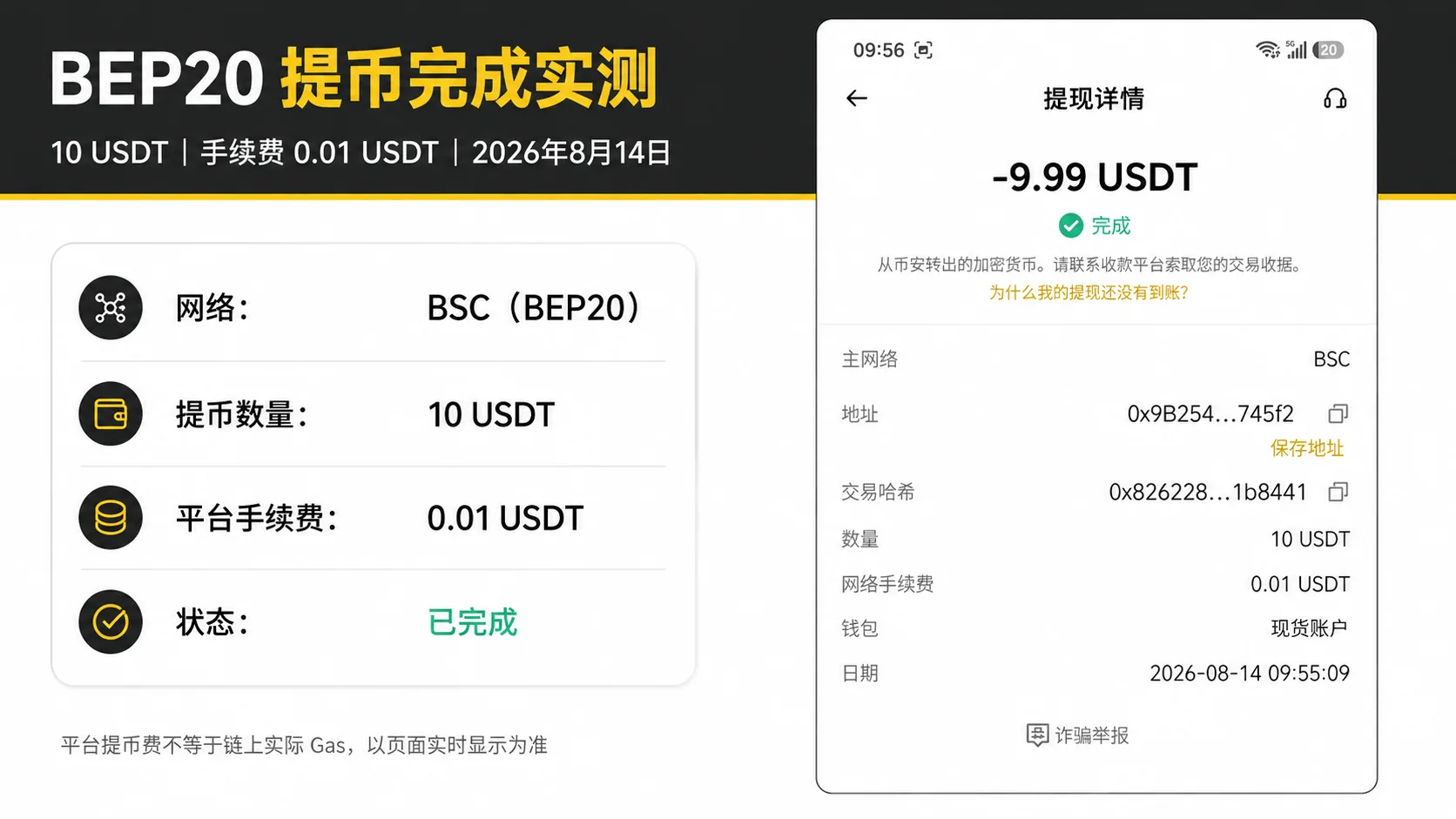
Figure: August 14, 2026 BEP20 withdrawal completion record. Withdrawal amount 10 USDT, platform fee 0.01 USDT, actually transferred out 9.99 USDT. The address and transaction hash have been privacy-processed.
To further verify this withdrawal, I looked up the BscScan on-chain record via the transaction hash. The result shows this transaction's status is Success, actually transferred out 9.99 BSC-USD, the sender is Binance Hot Wallet 10, and the actual on-chain gas was 0.0000034503 BNB, about US$0.002106 at the time of the screenshot.[3]
Here, BSC-USD is BscScan's page display name for the contract, which Binance's withdrawal page shows as USDT. BscScan labels it Binance-Peg BSC-USD, with contract address 0x55d398...3197955. It is a BEP20 pegged token used on BNB Smart Chain, so beyond the issuer risk of USDT itself, you also need to consider peg, custody, and platform-support factors.
Here we need to distinguish: the 0.01 USDT shown on Binance's withdrawal page is the withdrawal fee the platform charges the user; the 0.0000034503 BNB shown on BscScan is the gas Binance's hot wallet actually paid to send this on-chain transaction. They are not the same cost, and they are not required to be the same value.
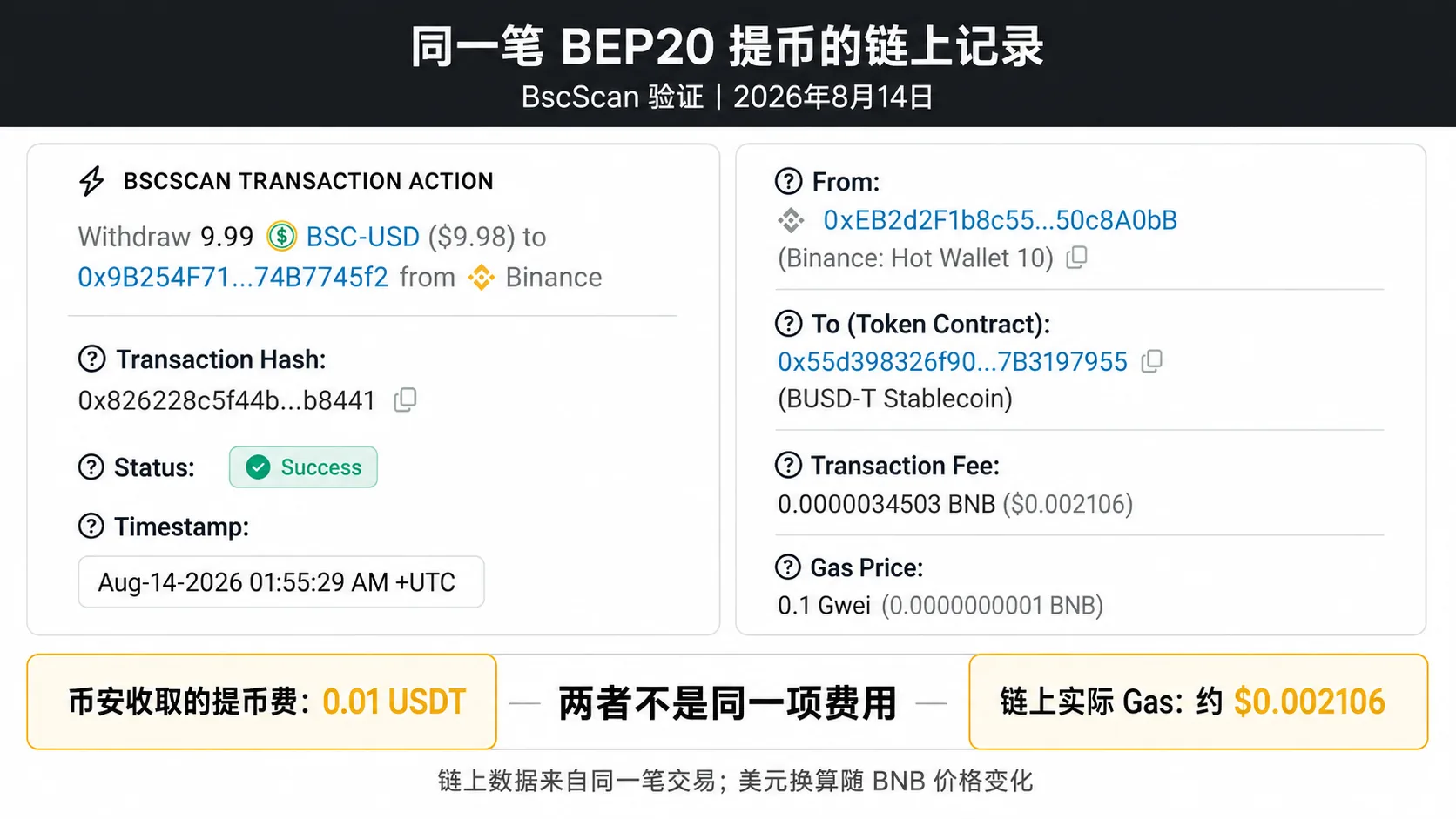
Figure: BscScan on-chain record of the same BEP20 withdrawal. Transaction status is Success, on-chain gas about US$0.002106. The dollar conversion changes with the BNB price.
| Network | Withdraw from an exchange | Wallet on-chain transfer | Key things to note |
|---|---|---|---|
| BEP20 (BNB Smart Chain) | Per the platform's withdrawal page | Pay gas in BNB | Receiver must support BSC/BEP20 |
| TRC20 (Tron) | Per the platform's withdrawal page | Pay network fees in TRX | Receiver must support Tron |
| ERC20 (Ethereum) | Per the platform's withdrawal page | Pay gas in ETH | Fees can rise noticeably when the network is congested |
In this same-amount, similar-time comparison, BEP20 had the lowest fee, but that doesn't mean it's always cheapest at all times and on all platforms. What you should actually compare is the amount actually credited after deducting fees.
If I pick the wrong network, will my assets definitely be lost?
Not necessarily, but how hard it is to resolve depends on the receiving side.
If the receiving address is controlled by you — especially across EVM-compatible networks — the assets sometimes just went to another network. After switching the wallet network and adding the correct token contract, they may still be visible.
However, if the assets were deposited into:
- an exchange that doesn't support that network;
- a third-party custody address;
- a receiving address whose private key you don't control;
- a wrong or invalid address;
you may need to contact the platform for manual handling, pay a recovery fee, or even be unable to recover them.
Therefore, before withdrawing you must verify all of the following at the same time:
- the token matches;
- the sending network matches;
- the receiver supports that network;
- the address is complete;
- whether a Memo or Tag is required.
For the first transfer to a new address, do a small test transfer within the platform's allowed range first, and continue only after confirming it has arrived.
For a more complete handling approach, read Sent to the Wrong Chain? How to Recover — Withdrawal Networks and Wallet Addresses (2026).
Scenario two: what fees can holding a small amount of BNB save?
Here you must distinguish between two kinds of use:
- BNB on BNB Smart Chain, used to pay on-chain gas;
- BNB in your Binance account, used to offset platform-related fees.
Both use BNB, but the location and calculation are completely different.
According to the account rules shown on my Binance App "Use BNB" page, it currently displays:
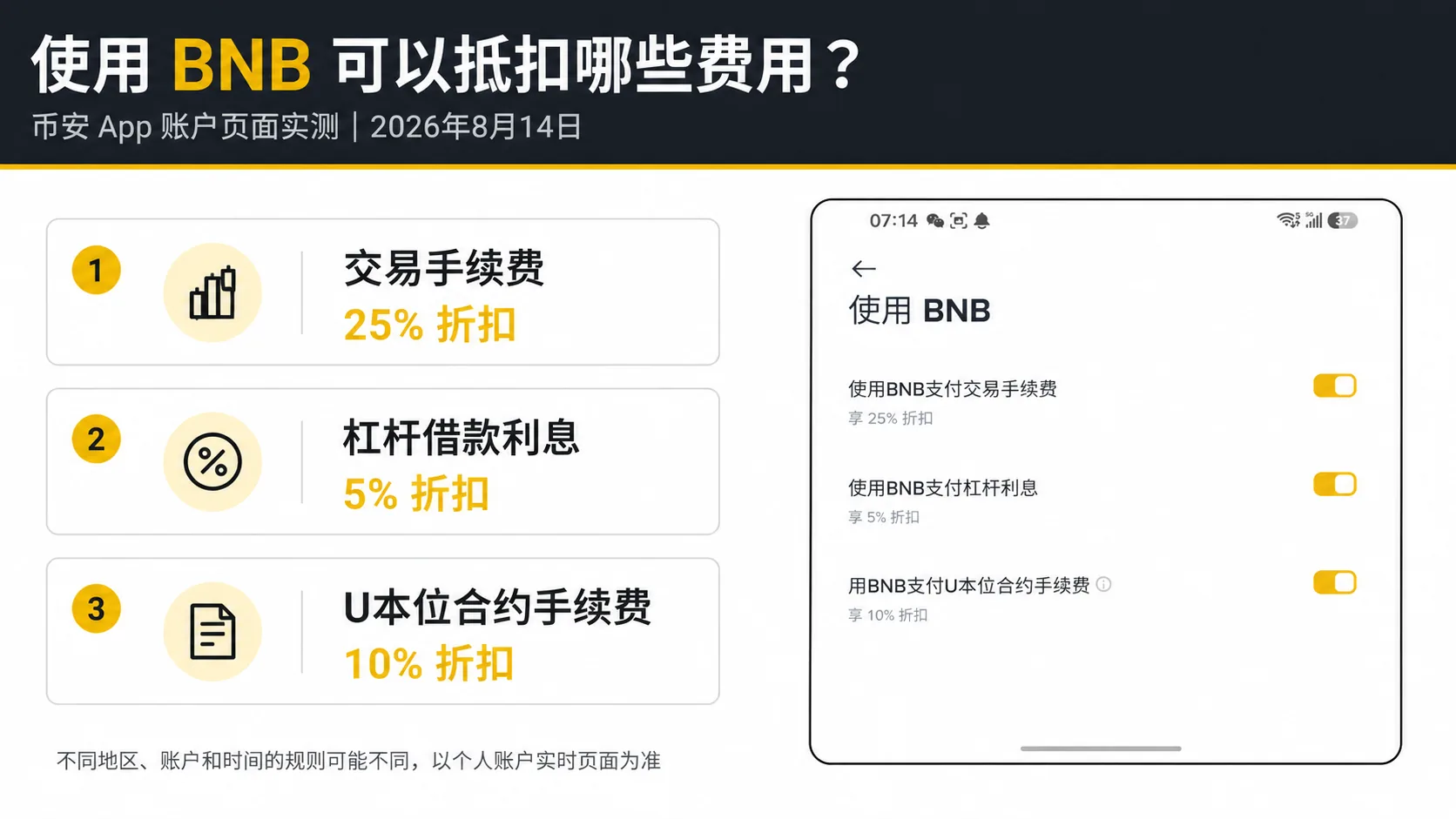
Figure: August 14, 2026, my Binance App "Use BNB" account page. Trading fees, margin loan interest, and USDⓈ-M futures fees show 25%, 5%, and 10% discounts respectively. Rules may differ by region, account, and time.
| Fee type | Discount with BNB | What it means |
|---|---|---|
| Trading fees | 25% | Use BNB to pay trading fees |
| Margin loan interest | 5% | The margin interest on borrowed assets |
| USDⓈ-M futures fees | 10% | Use BNB to pay USDⓈ-M futures fees |
The most easily confused point here is:
The buy/sell fees generated by margin trading are not the same as the interest on a margin loan.
Taking ordinary spot trading as an example, if an account's standard spot fee rate is 0.10%, enabling the 25% BNB discount brings the effective rate to about 0.075%.[4]
If the account also has an active referral rebate, the final actual cost should be based on the account's:
- fee history;
- BNB discount records;
- referral rebate records;
rather than calculated on your own from a referral-code promo page.
Different regions, account tiers, trading products, and platform campaigns can all affect the final rate. Therefore, the figures in this article can only serve as calculation examples, not as fixed long-term rules.
My judgment is:
If you already use Binance often, keeping a small amount of BNB to pay fees has practical use; but buying a large amount of BNB just to get the fee discount is a separate, independent investment decision.
BNB itself is subject to price volatility, and the fee savings may not cover losses from holding BNB during a decline.
If you don't have a Binance account yet, you can register with BN522. Before registering, confirm whether your location permits the relevant services, and refer to the rebate ratio actually shown on your account page.
Scenario three: is BNB Chain's DeFi good enough?
I first practiced swaps, connecting wallets, and reading on-chain transactions on BNB Smart Chain.
Its biggest advantage for beginners isn't "higher yield," but:
Low gas, so you can get familiar with the full workflow at a small cost.
Common applications on BNB Chain include:
| Project | Main function | What beginners should note |
|---|---|---|
| PancakeSwap | Decentralized swap, liquidity pools | Watch slippage, token contracts, and approval scope |
| Venus | Lending protocol | Watch liquidation, oracles, and smart-contract risk |
| BNB Staking | BNB staking | Watch unlock rules, validators, and yield changes |
| opBNB ecosystem apps | Layer-2 network apps | BSC and opBNB are different networks; don't mix them |
For small swaps, reading on-chain records, and understanding wallet approvals, BNB Smart Chain is sufficient.
But if you want to research:
- more complex yield strategies;
- richer lending markets;
- deep on-chain data;
- institutional-grade RWA applications;
- more mature analysis tools;
Ethereum and its L2 ecosystem usually have more options.
Therefore, I won't simply say BNB Chain's DeFi is "inferior to Ethereum." The more accurate statement is:
BNB Chain is better for completing basic operations at low cost; Ethereum L2s are better for researching protocol differences and complex strategies.
5 things I check before using DeFi
Cheap gas doesn't mean low total transaction cost, nor does it mean protocol safety. What actually causes losses is often not a few cents of gas, but the wrong token, malicious approvals, and low liquidity.
1. Verify the token contract address
Don't judge a token only by its name and icon. Fake USDT, fake BNB, and imitation projects can use very similar names.
The contract address should be verified from the project's official site, official documentation, or a trusted block explorer.
2. Check slippage and price impact
Small tokens may lack liquidity. Even if gas is cheap, the buy/sell price gap can still be large.
Before confirming a transaction, check:
- the minimum amount received;
- the slippage setting;
- the price impact;
- the liquidity depth.
3. Check the approval scope
Connecting a wallet doesn't mean your assets will necessarily be moved; what really matters is signatures and token approvals.
If your wallet supports limiting the approval amount, don't grant unfamiliar contracts unlimited approval by default when you don't understand the purpose.
4. Don't treat "high APR" as fixed income
The APR or APY shown on a DeFi page changes, and may include token rewards. Token price declines, liquidity changes, impermanent loss, and smart-contract events can all make the actual result completely different from what the page shows.
5. Judge whether a new protocol is worth touching
If it's only for a very small potential gain, it may not be worth opening long-term approval to an unfamiliar contract.
Saving gas cannot be a reason to lower your security standards.
Protocols like PancakeSwap and Venus have been running for a long time and have relatively more public information, but "long operating time" doesn't mean there's no smart-contract, governance, oracle, or front-end attack risk.
If you don't yet understand the basic risks of DeFi, read Does DeFi Make Money? Where the Yield Comes From + 5 Key Risks (2026) first.
My selection logic: when do I use BNB Chain?
After nearly a year of actual use, I've formed the following judgment approach:
| Daily operation | My choice | Reason |
|---|---|---|
| Withdrawing from Binance to a BEP20-supporting wallet | BNB Smart Chain | Smooth handoff, usually lower fees |
| Practicing wallets and swaps with small amounts | BNB Smart Chain or Solana | Lower operating cost |
| Researching DeFi protocols in depth | Ethereum L2 | Richer protocols and analysis tools |
| Using Solana ecosystem apps | Solana | Use the corresponding native network directly |
| Long-term custody of larger amounts | Evaluate separately | Can't choose a network and wallet based only on gas |
| No on-chain operations at all | Not needed for now | The learning cost brings no practical value |
Choosing BNB Chain isn't necessarily because you're bullish on BNB's price; it may just be because:
- low transfer cost;
- convenient Binance withdrawal support;
- good EVM wallet compatibility;
- suitable for practicing on-chain operations with small amounts.
Network choice, wallet choice, and asset investment are three different decisions.
If you're still comparing public chains, see Solana or Ethereum? How to Choose for Your First On-Chain Experience (2026).
Starting from zero on BNB Chain: a safe 5-step process
Step one: confirm both sender and receiver support BEP20
Don't withdraw just because you see USDT. First confirm whether the exchange, wallet, or recipient clearly supports:
- BNB Smart Chain;
- BSC;
- BEP20.
These three names usually point to the same network environment.
Step two: install a self-custody wallet that supports BSC
Beginners can choose Trust Wallet or MetaMask.
Trust Wallet supports BNB Smart Chain fairly directly; MetaMask also supports BSC, but you may need to confirm the network configuration on first use.
Trust Wallet was acquired by Binance in 2018, but its current public positioning is independent operation, so it's no longer recommended to call it "Binance's official wallet."
Whichever wallet you choose, download it only from the official website or a legitimate app store.
Step three: transfer in a small amount of BNB as gas first
Operating on BNB Smart Chain requires BNB to pay gas.
Beginners don't need to buy a large amount of BNB; just keep a small gas balance based on the wallet's estimated fees. The specific amount should be decided based on the current BNB price and how many operations you actually do — don't mechanically hoard a fixed amount.
Do a small test transfer first for your first withdrawal.
Step four: complete one small swap
Before opening an app like PancakeSwap, verify:
- the website domain;
- the wallet's current network;
- the trading token's contract;
- the slippage and minimum amount received.
The goal of the first operation isn't to make money, but to run through:
Withdraw → wallet credited → connect app → confirm transaction → view on-chain record
Step five: pause after completing, don't rush to add liquidity
Completing a small swap is enough for a first experience.
Before understanding the following concepts, it's not recommended to deposit funds or add liquidity immediately:
- token approvals;
- slippage;
- impermanent loss;
- liquidation;
- smart-contract risk;
- yield-token price volatility.
Learn to read every signature first, then consider more complex operations.
4 pitfalls beginners most easily fall into
Pitfall one: same token, so you assume the network can be chosen freely
USDT can exist on multiple networks, but transfer records and gas systems differ across networks.
The sender and receiver must support the same network. Don't just confirm "both are USDT" — also confirm "both are BEP20 USDT."
Pitfall two: swapping away all your BNB, leaving no gas
BNB Smart Chain's gas is usually low, but without BNB you still can't operate.
Receiving USDT in your wallet doesn't mean you can use USDT as gas. Keep a small amount of BNB to avoid a situation where assets can come in but can't go out.
Pitfall three: connecting to unfamiliar projects frequently because gas is cheap
Issuing tokens and deploying contracts on BNB Chain is cheap, so there are also many imitation tokens, phishing sites, and low-quality projects.
Don't ignore approval risk just because "one try only costs a few dollars." A malicious approval can affect other similar assets in your wallet.
Pitfall four: treating BNB Chain as the same as your Binance account
A Binance account is a custody account where the platform controls the private key; a BNB Chain wallet is usually a self-custody wallet where you keep the seed phrase and private key yourself.
After withdrawing assets from Binance to a wallet, the platform usually cannot reset your seed phrase for you, nor undo an already-confirmed on-chain transaction.
BNB Chain's main security risks
1. Validators and block production are relatively concentrated
BSC uses PoSA consensus.
According to the current BNB Smart Chain official documentation, the active validator set consists of 45 validators:
- 21 Cabinet Validators get more block-production opportunities;
- 24 Candidate Validators get lower-frequency block-production opportunities.[5]
Therefore, the old saying "BNB Chain only has 21 validators" is no longer accurate.
However, compared with networks with broader validator participation, BSC's validator set and block-production rights are still relatively concentrated. This may not be noticeable for everyday small transfers, but for users who especially value censorship resistance and network neutrality, it's a factor worth considering.
2. Deep ties to Binance and the BNB ecosystem
BNB Chain is not the same as the Binance exchange, but its development history, main entry points, ecosystem liquidity, and the BNB token are all deeply connected to Binance.
If Binance or BNB experiences a major regulatory, market, or operational event, the BNB Chain ecosystem may also be affected.
3. Smart-contract and cross-chain risks
The BNB Chain ecosystem has historically seen protocol attacks, cross-chain bridge incidents, and project exits.
Using well-known protocols can reduce some information-opacity problems, but can't eliminate:
- smart-contract vulnerabilities;
- front-end hijacking;
- oracle anomalies;
- governance risks;
- cross-chain bridge risks.
4. Self-custody responsibility
Any website that asks you to enter your seed phrase for "verification," "unlocking," or "syncing" should be treated as a high-risk signal.
The seed phrase is usually only used when creating and recovering a wallet, and must not be sent to customer support, group admins, or project staff.
For related security methods, read What Is a Seed Phrase? Why No One Can Help You Recover Your Assets If You Lose It (2026).
FAQ
What's the relationship between BNB Chain and Binance?
Binance is a centralized exchange; BNB Chain is a blockchain ecosystem. The two have deep historical and ecosystem ties, but they are not the same system. Once you withdraw assets to a self-custody wallet, the responsibility for asset management also shifts from the platform to you.
Are BSC and BNB Chain the same thing?
Not exactly. BSC now refers to BNB Smart Chain, the most commonly used network in the BNB Chain ecosystem. BNB Chain also includes opBNB and BNB Greenfield.
In everyday terms, "transferring BEP20 tokens via BNB Chain" usually means BNB Smart Chain.
Do I need to buy a lot of BNB to use BNB Chain?
No. BNB is mainly used to pay on-chain gas; keep a small amount based on your actual operations.
Whether to hold a large amount of BNB is an investment decision, and is not the same thing as using the network.
How should I choose between BNB Chain, Solana, and Ethereum?
Simple judgment:
- Often use Binance and need BEP20 transfers: consider BNB Smart Chain;
- Small-amount, high-frequency on-chain apps: compare BNB Smart Chain and Solana;
- Researching deep DeFi and richer protocols: look at Ethereum and its L2s;
- No on-chain operations: no need to specifically choose a public chain for now.
Is BNB Chain safe?
BNB Smart Chain itself is a continuously running blockchain network, but "the network runs normally" doesn't mean all tokens, protocols, and websites are safe.
Real risks often come from fake tokens, phishing sites, malicious approvals, smart-contract vulnerabilities, and seed-phrase leaks.
How far should I go on my first use?
For the first time, you only need to complete:
Confirm network → small withdrawal → confirm arrival → small swap → view transaction record
No need to immediately stake, lend, or add liquidity.
Summary
After nearly a year of use, my judgment on BNB Chain is:
It's one of the most convenient low-cost networks for Binance users, but it's not the default answer for all crypto assets and all use cases.
Its most practical value is mainly:
- Binance supports BEP20 deposits and withdrawals;
- BSC on-chain gas is usually low;
- Good EVM wallet and app compatibility;
- Suitable for practicing wallets, transfers, and swaps with small amounts.
Its shortcomings are also clear:
- validator set and block-production rights are relatively concentrated;
- the ecosystem is deeply tied to Binance and BNB;
- low-cost deployment also lowers the barrier for fake tokens and low-quality projects;
- deep DeFi and on-chain analysis tools are not necessarily the richest.
Therefore, what you should really ask is not "is BNB Chain good," but:
Does this operation require it? Does the receiver support BEP20? Is the cost it saves worth the corresponding network, contract, and operational risk?
If you already use Binance, you can first run through with a small amount:
Withdraw → wallet → swap → view transaction record
This builds real on-chain operating experience more effectively than just reading concepts.
But after the experience, don't immediately expand your capital just because gas is cheap, and don't mistake "knowing how to use BNB Chain" for "should hold a large amount of BNB long-term."
Data verification notes
The key facts in this article were verified on 2026-08-14 against BNB Chain official documentation, BscScan records, and Binance account pages, item by item:
- Network renaming and migration: the former Binance Smart Chain was renamed BNB Smart Chain in 2022; in 2024, BC Fusion migrated Beacon Chain's functions to BSC and gradually sunset Beacon Chain. Source: BNB Chain official documentation.
- Withdrawal fee comparison: on 2026-08-14, for the same 10 USDT withdrawal amount, the Binance App showed BEP20 fee 0.01 USDT, ERC20 0.4 USDT, TRC20 1.5 USDT — page-preview records; the platform adjusts dynamically. Source: 2026-08-14 Binance App withdrawal page records.
- On-chain gas: the same BEP20 withdrawal showed gas of 0.0000034503 BNB on BscScan, about US$0.002106 at the time of the screenshot. Source: BscScan.
- BNB discount ratios: on 2026-08-14, the account page showed a 25% trading-fee discount, 5% margin-loan-interest discount, and 10% USDⓈ-M futures-fee discount. Source: Binance App "Use BNB" account page records.
- Validator structure: BSC uses PoSA, with an active validator set of 45 — 21 Cabinet Validators and 24 Candidate Validators. Source: BNB Smart Chain introduction.
Related reading
- How to Save on Binance Fees? BNB Discount + BN522 Rebate Stacked, How Much You Save in 2026
- Solana or Ethereum? How to Choose for Your First On-Chain Experience (2026)
- Sent to the Wrong Chain? How to Recover — Withdrawal Networks and Wallet Addresses (2026)
- Does DeFi Make Money? Where the Yield Comes From + 5 Key Risks (2026)
- What Is Ethereum? Smart Contracts, Gas Fees, and Web3
- Is PancakeSwap Worth It? DEX Swap Fees and Pitfalls to Avoid (2026)
- Ethereum Gas Too Expensive? Arbitrum/Optimism/Base Compared (2026)
- Is Solana Worth It for Beginners? Low Gas + Easy Onboarding, a Real Experience (2026)
Disclaimer
This article contains the Binance referral code BN522. If Binance is available in your location and you decide to experience BNB Chain through Binance, please verify the locally available services, fees, and referral rebate rules before registering.
This article is only for sharing BNB Chain usage experience and basic technical knowledge, and does not constitute investment advice, financial advice, or trading advice.
Crypto asset prices are volatile, and on-chain operations carry network, smart-contract, approval, liquidity, cross-chain, and self-custody security risks. Before participating in any DeFi protocol or token trading, verify the relevant information yourself and comply with the laws and regulations of your location.
The products mentioned in this article — PancakeSwap, Venus, Trust Wallet, MetaMask, and Binance — are only examples of usage scenarios and do not constitute a guarantee of their security, returns, or suitability.
- BNB Chain official documentationBNB Chain ecosystem composition and network overview
- BNB Smart Chain introductionPoSA consensus and the 45-validator structure
- BscScanBEP20 withdrawal on-chain transactions and gas records
- PancakeSwap official documentationSwap fees and liquidity pool rules
- DeFiLlamaBNB Chain on-chain TVL and protocol data
- 2026-10-17UpdateAdded evidence-chain superscripts and the "Data verification notes" section.
See ourEditorial Policy and the correction process in ourCorrections Policy.
The CoinTrailHub editorial team focuses on crypto education for beginners, exchange security and P2P trading risk. This article is compiled from official sources and public data, reviewed by humans, and strives for accuracy but is not investment advice.
Last updated:2026-08-14 · Content reviewed by humans · Learn more
© 2026 CoinTrailHub · Original content. Reproduction or rewriting without permission is prohibited.