
Is Solana worth it for beginners? Real experience of low gas + easy onboarding (2026)
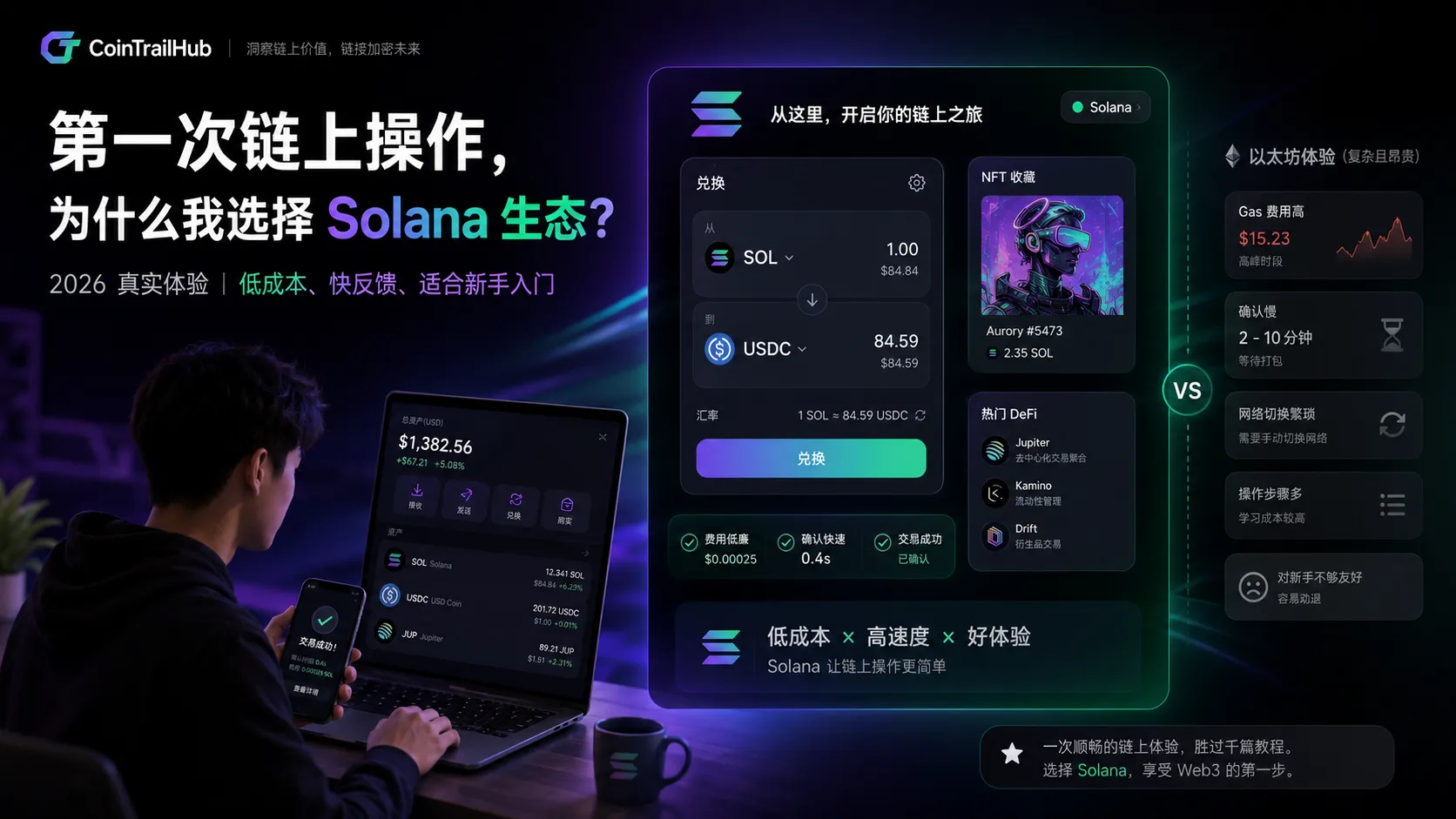
Table of contents

Binance new user rewards
20% trading fee rebate
Official Binance registration. Complete identity verification (KYC) to trade and withdraw.
The first time I actually opened a wallet to do an on-chain operation, what stumped me wasn't how to buy coins, but not knowing which button to click next. Ethereum was how I first understood DeFi, smart contracts, and on-chain applications, but gas fees, network switching, and wallet approvals — these things turned "learning on-chain operations" into something with psychological baggage. After using Solana continuously for nearly a year, I realized its biggest value isn't how high the TPS is, but this: it lets someone doing their first on-chain operation complete it without first understanding a pile of technical concepts.
About 10 minutes to read. First remember two things: Solana can keep the cost of your "first on-chain operation" to within a few dollars; cheap gas doesn't equal asset safety — your seed phrase and approvals are the main risks.
Note: this article is based on my personal on-chain operation experience over nearly a year. All fee data comes from actual usage records and does not constitute investment advice. Crypto asset prices are volatile; please understand the relevant risks before participating in on-chain projects.
Core information
| Your situation | Is Solana worth it? | One-line reason |
|---|---|---|
| Just getting into on-chain operations, want low-cost experience | Worth it | Fees are so low they're negligible; trial-and-error cost is nearly zero |
| Mainly doing DeFi, trading frequently | Worth it | Low cost for frequent small operations, mature DEX experience |
| Interested in NFTs / meme coins | Worth it | Solana's NFT and meme ecosystem is among the most active |
| Already used to Ethereum L2, don't want to switch | It depends | L2 experience isn't bad; no strong reason to switch chains |
| Only buy coins and keep them on an exchange, never operate on-chain | Not needed | Learning Solana adds no value for you |
If I could choose my first on-chain experience entry point again, I'd probably still start with Solana. Low cost, simple wallet experience, rich ecosystem applications. But if your crypto usage stays only on exchanges, you don't need to learn it specifically.
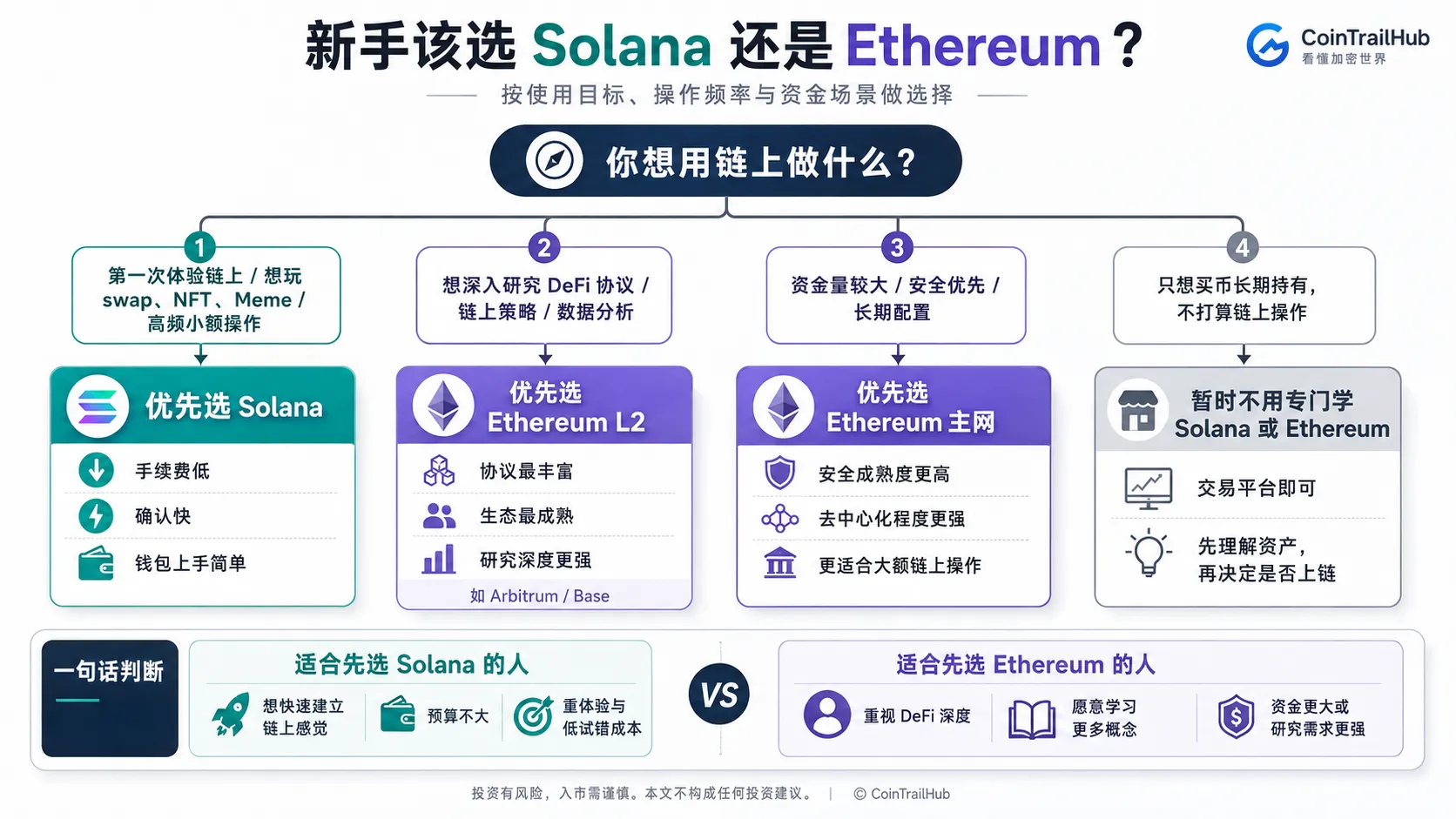
If your goal is different, your choice is different
Beyond the situation judgment above, there's an even simpler dimension — what is your goal:
| Your goal | Recommendation |
|---|---|
| Experience what on-chain operation feels like | Start with Solana — low cost, fast feedback |
| Learn DeFi protocols and strategies | Start with Ethereum L2 (Arbitrum / Base) — richest protocols |
| Long-term asset storage | BTC cold wallet + exchange — no on-chain operation needed |
| Daily trading | An exchange is enough — low fees, simple operation |
Why I chose Solana, not Ethereum, for my first on-chain experience
The first on-chain wallet I used was MetaMask. Honestly, the first time I used MetaMask I was completely lost — gas fees had to be set manually, networks had to be switched manually, and L1 and L2 assets weren't interoperable. After two months of operating, I still checked three times before every "confirm transaction" click.
Later, to vote on a Solana project, I was asked to install Phantom. Five minutes after installing, I moved most of my daily ETH operations over. Not because Solana's technology is so great, but because beginners don't need to spend their energy on "technical complexity."
Phantom opens to a clean wallet interface — balance, tokens, NFTs all clear at a glance, without MetaMask's "engineer's perspective" pressure. The first time I swapped, I expected to wait dozens of seconds, but the transaction confirmed so fast I didn't even react.
This is my core evaluation of Solana: it turns "on-chain operation" from something requiring caution into something as natural as using an app. For beginners, this lowering of the psychological barrier often matters more than comparing TPS numbers.
Comparing my first-operation experience on the two chains makes it clear:
First time on Ethereum: installed MetaMask → didn't know how much gas to set → set it too low and the transaction was stuck for 2 hours → went to Etherscan to check status → couldn't understand it → asked 3 people on Discord → finally confirmed. Just "understanding gas" took a whole afternoon.
First time on Solana: installed Phantom → withdrew 0.1 SOL from Binance as a test → arrived in 10 seconds → opened Jupiter swap → clicked confirm → done in 3 seconds → checked the Phantom balance, the fee was almost invisible.[1]
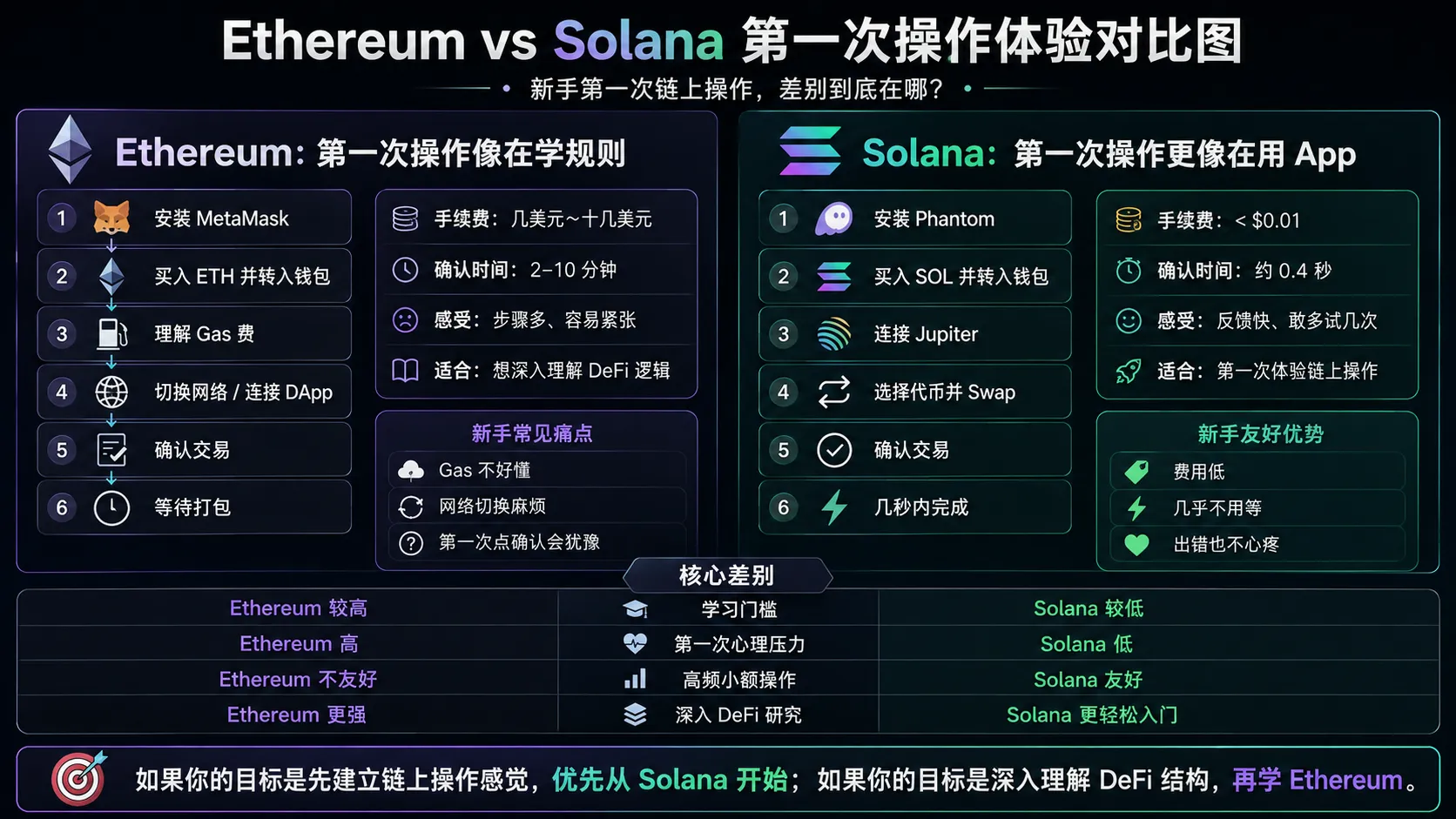
This comparison isn't to say Ethereum is bad — it carries the largest DeFi ecosystem and the most mature smart-contract platform. What I mean is: for the "learning on-chain operations" scenario, Solana lowers the psychological cost, not just the fee. When you know this operation won't cost you dozens of dollars in gas, you dare to click that "confirm" button.
For wallet security basics (seed phrase, private key, cold wallet), I recommend reading What is a seed phrase? Why no one can help you recover your assets if you lose it (2026) first.
After 30 on-chain operations a day: how are Solana's fees and experience really?
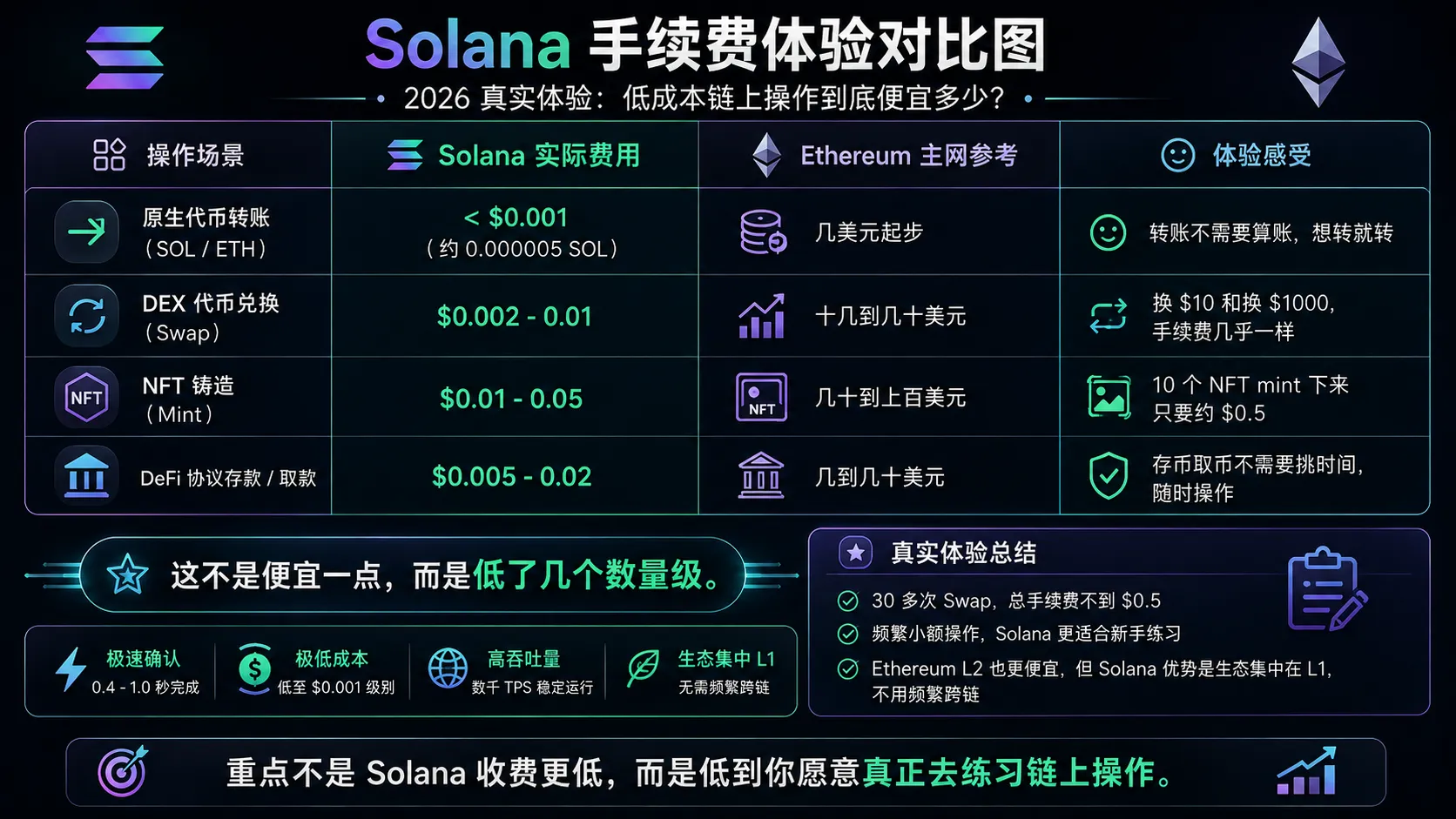
Many people say Solana is cheap, but "cheap" is an abstract word. Let me be specific:
My usual Solana operations include: swapping coins, adding liquidity to LPs, occasionally minting an NFT, depositing and withdrawing coins in DeFi protocols. Below are my actual fee records in four scenarios (August 2026, fees fluctuate with network load):
When fees are low enough to ignore, you dare to actually learn.
A concrete example: when I tested high-frequency Solana operations, I did over 30 swaps in one day, and when I checked the fee record that night, the total was under $0.5.[2] Doing the same volume on the Ethereum mainnet would easily cost over a hundred dollars.
But to be fair: Ethereum has Layer 2. Operating on Arbitrum or Base, per-transaction fees can also drop to the $0.1–1.0 range.[3] So "cheap gas" isn't a moat unique to Solana — L2 is catching up. Solana's real advantage is fees low enough to ignore + everything on L1, no cross-chain needed.
Solana ecosystem experience: DeFi, NFT, and meme applications
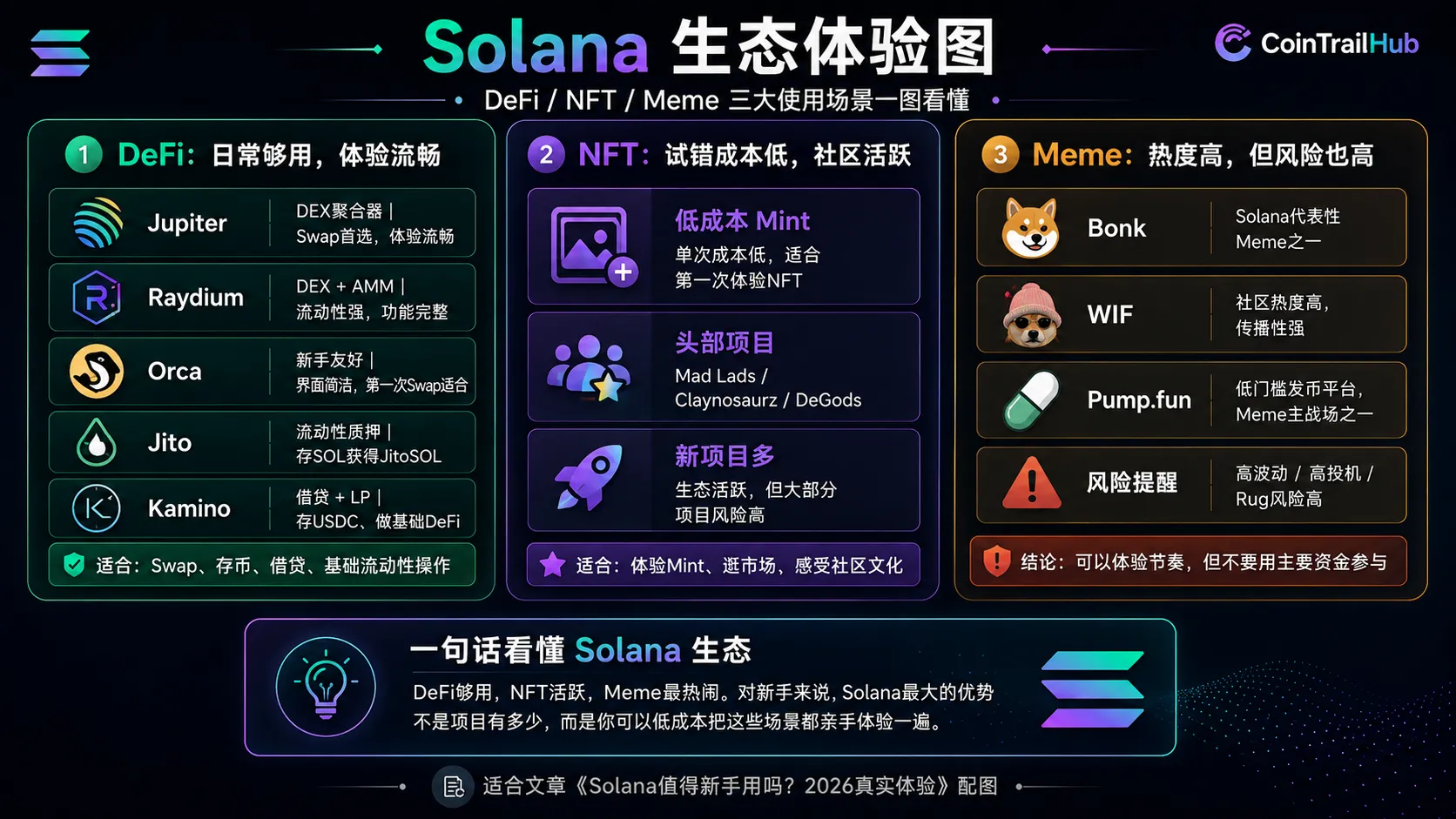
Many beginners ask "what is there to play with on Solana?" The answer: Solana's 2026 ecosystem is already rich. Besides having fewer veteran DeFi projects than Ethereum, it's not behind elsewhere — and even stronger in some areas.[4]
DeFi: enough for daily use, less depth than Ethereum
| Project | What it does | One-line evaluation |
|---|---|---|
| Jupiter | DEX aggregator | One of Solana's largest DEX aggregators, smooth interface |
| Raydium | DEX + AMM | Solana's largest-liquidity DEX, functions similar to Uniswap |
| Orca | DEX | Clean UI, good for a beginner's first swap |
| Jito | Liquid staking | Deposit SOL to earn JitoSOL, equivalent to Ethereum's Lido |
| Marinade | Liquid staking | Another mainstream LSD protocol; you can compare yields |
| Kamino | Lending + LP | The equivalent of Aave, deposit USDC to earn interest |
Real feeling: daily swapping, providing liquidity, and lending deposits — Solana DeFi is fully sufficient. But if you want advanced strategies (like yield splitting on Pendle, complex options strategies), the Ethereum ecosystem offers more choices.
NFT: leading in activity
Solana's NFT ecosystem is stronger than many people imagine. The community activity of top projects like Mad Lads, Claynosaurz, and DeGods is in crypto's first tier. And because minting costs are low, new projects keep appearing — though most end up going to zero, for a beginner wanting to feel what "minting an NFT" is like, the $0.05 trial cost is far friendlier than hundreds of dollars on ETH.
Meme coins: Solana's home turf
What made Solana go viral from 2024–2026 is the meme coin ecosystem. From Bonk to WIF to the endless new coins popping up daily, Solana is already the absolute main battlefield of crypto meme coins. One-click token launch platforms like Pump.fun let anyone issue a meme coin in 2 minutes — which means there's a lot of both prey and opportunity.
But this must be stated: the vast majority of meme coins ultimately can't hold long-term value. You can feel the rhythm of on-chain trading there, but it's not recommended to put your main funds into meme coins. Some participants gain short-term returns from market sentiment, and many others lose because of poor risk judgment — this is essentially not investing but high-risk speculation.
Wallet experience: why Phantom becomes many Solana beginners' first choice
The wallet is the entry point to on-chain operations. If the wallet isn't good, a strong ecosystem doesn't help.
| Dimension | Phantom (Solana) | MetaMask (Ethereum) | Rabby (Ethereum L2) |
|---|---|---|---|
| Install and create | Done in 3 minutes, clear guidance | Many steps, beginners easily stuck on "network selection" | Better than MetaMask, but larger install package |
| Interface design | Clean, modern, like a consumer app | Engineer-style, many options look tiring | In between |
| Transaction experience | Extremely fast, almost no waiting | L1 slow and expensive, L2 fast but needs manual network switching | Smoother than MetaMask, auto-detects network |
| Multi-chain support | Solana-first, Ethereum now supported | Almost all EVM chains | Almost all EVM chains |
| Mobile | Built-in browser, first-class experience | Hampered by App Store review, degraded experience | No standalone mobile |
Phantom's biggest advantage is — you don't need to understand the abstract concept of "network." Open and use, which is also the learning cost many beginners first hit with MetaMask.
But an easy wallet doesn't mean your assets are safe. Seed phrase management is still the first responsibility of on-chain security — never enter your seed phrase into a website popup; Phantom only needs it when you first create the wallet and when you recover it.
Phantom's limitation is also clear: it's still essentially a Solana-native wallet. Although it supports Ethereum, it mainly revolves around the Solana ecosystem. Long term, if you operate on both Solana and Ethereum, you'll likely need two wallets. For wallet choice, you can reference the wallet comparison section in Which chain should you choose, Solana or Ethereum.
My choice logic: when to use Solana
After nearly a year of use, I've summarized my judgment framework:
| Your daily operation | Recommended option | Reason |
|---|---|---|
| Swap a few times a day, small amounts | Solana | Fees negligible, frequent operations don't eat principal |
| Play with NFTs / meme coins | Solana | Most active ecosystem, low minting cost |
| Deposit USDC in Aave for interest, no movement for months | Arbitrum / Base | This scenario doesn't need high frequency; L2 is enough and more mature on security |
| Research DeFi protocols, do on-chain data analysis | Ethereum | Richest DeFi protocols, most complete data tools |
| Experience on-chain governance, voting | Solana | Transactions arrive in seconds, least friction for governance |
| Large capital, safety first | Ethereum mainnet | Highest decentralization, longest runtime |
Choosing Solana isn't for "investing in SOL" — it's because its usage cost is low enough to let you master the feel of on-chain operations through practice. Once that feel accumulates, going to Ethereum won't scare you off with concepts like gas, network, and approvals. If you're only learning on-chain operations, a small test fund is enough; if you start managing more complex assets or deeply researching DeFi, you can gradually expand to the Ethereum ecosystem.
Using Solana ≠ investing in SOL
Many beginners treat "using the Solana ecosystem" and "buying SOL tokens" as the same thing. They're actually two different things:
Using the Solana ecosystem requires:
- A wallet (Phantom)
- A small amount of SOL for fees (0.01 SOL is enough for dozens of operations)
- Curiosity to experience on-chain applications
Whether to hold SOL as an asset:
- That's a separate independent judgment requiring your own research
- It has no direct relationship with "whether to use the Solana chain"
Simply put: you can just use the Solana chain without holding a lot of SOL. Just like you can use WeChat every day without holding Tencent stock.
If I were first getting into crypto today, here's how I'd choose
Everyone's situation is different, but the decision path below can at least save you detours:
You're first getting into crypto — what's your goal?

├── Just buy BTC/ETH and hold long-term
│     └── No need to learn any on-chain operations; buy on an exchange and leave it
│
└── Want to experience what on-chain really is
      │
      ├── Want to play swap, NFT, Meme, experience-first
      │     └── Start with Solana
      │
      ├── Want to deeply research DeFi protocols and on-chain strategies
      │     └── Start with Ethereum L2 (Arbitrum / Base)
      │
      └── Large assets, safety first
            └── BTC cold wallet + mature ecosystem options, reduce reliance on a single new chain
In the end I found there's no absolute good or bad chain — the key is what you plan to do with it.
If I were starting over today, here's how I'd experience Solana
Install Phantom wallet — go to phantom.app to download the browser extension or mobile app, and create a wallet. Write the seed phrase down by hand, keep it somewhere physically safe, don't screenshot it, don't store it in the cloud.
Buy SOL on an exchange and withdraw — if you use Binance, buy USDT → swap to SOL in the spot market → choose the Solana network when withdrawing, and enter the Phantom wallet address. For your first withdrawal, I recommend only withdrawing 0.01 SOL as a test, then withdraw more after confirming it arrived.
Keep SOL reserved for gas — all operations on Solana need SOL to pay fees. Keep at least 0.01 SOL in your account, which is fully enough for daily operations. You don't need to calculate "is my gas enough" for every operation like on ETH.
Do your first swap — open Jupiter, connect the Phantom wallet, and swap a small amount of SOL for USDC or another token. Feel the "click confirm → done in 3 seconds → fee under $0.01" experience.
Explore the ecosystem — go to Magic Eden and mint any NFT ($0.05), deposit a little LP on Orca. If you want to learn more about DeFi, you can research liquid-staking protocols like Jito. The goal is to get familiar with the operation flow, not to make money.
These 5 steps take about 1–2 hours and cost under $2 in total (mainly the exchange withdrawal fee). But you'll build muscle memory for "on-chain operation" — something no amount of tutorials can replace.
One important mindset reminder: this is a learning exercise, not a money-making exercise. The 5 steps aren't meant to make money on a $50 principal — that's unrealistic. The goal is to understand: how a wallet works, what a swap is, what DeFi deposits feel like. Once you've "touched through" these basic operations, you won't panic in front of any chain.
If this is your first time buying crypto, I recommend reading How do beginners buy USDT for the first time? Complete tutorial from registration to arrival (Binance/OKX) first, to understand the full flow from fiat to withdrawal.
The 4 easiest mistakes for beginners on their first Solana operation
Pitfall 1: the SOL account rent mechanism — not every "failure" is a failure
Scenario: my first time swapping a new token on Solana, the transaction "failed," but my SOL balance had clearly decreased. I thought I'd lost money and checked it a dozen times.
Cause: token accounts on Solana need to be "rented," and creating one deducts a bit of SOL as rent, refunded when the account is closed. New tokens need a token account created first; this step consumes about 0.002 SOL, and even if the subsequent swap fails, the account-creation fee is already spent.[5]
Lesson: before swapping a new token, make sure your SOL balance is enough (at least 0.005 SOL), not just the swap fee itself. A failed transaction doesn't lose your swap principal, but the rent is spent.
Pitfall 2: a failed transaction doesn't mean the chain has a problem
Scenario: there was a period when the Solana network was extremely congested, and one swap failed 3 times, which annoyed me enough to want to switch back to Ethereum L2.
Cause: during extreme congestion (like a hot meme coin launch), some transactions fail because the price slipped beyond the set range. This is a normal DEX mechanism, not a chain outage.
Lesson: during congestion, set the slippage tolerance to 1–2%, or trade again after half an hour. A failed transaction only loses the fee (under $0.01); your principal is safe.
Pitfall 3: the "hidden assets" feature in Phantom
Scenario: a friend transferred 1000 meme coins to me, and I searched for ages in Phantom without seeing them.
Cause: Phantom doesn't show all tokens by default, especially low-liquidity new tokens. You need to manually turn on the "show all tokens" switch in the token list.
Lesson: if you can't see a received transfer in the wallet, refresh the wallet first, then check the token display settings. The money isn't lost; it's just "folded."
Pitfall 4: airdrop phishing
Scenario: an unknown NFT or token suddenly appeared in the Phantom wallet, claiming to be worth thousands of dollars, with a link to "claim more."
Cause: this is classic airdrop phishing — the moment you connect your wallet and click "claim," you're actually authorizing the attacker to transfer your wallet's assets out.
Lesson: for NFTs and tokens of unknown origin, don't click, don't interact, don't believe the "value" it displays. That "value" is fabricated by scammers and can't actually be sold on the real market. Just hide or ignore it.
Safety risk reminders
Smart contract risk — most Solana DeFi projects are relatively new (2–3 years), with less audit history and attack-resistance validation than Ethereum's veteran protocols. It's not recommended to put large funds into unknown DeFi protocols. Prioritize top protocols like Jupiter, Raydium, Orca, Jito, and Kamino.
Network stability — Solana has had multiple outages in its history (the most recent in 2024). Although stability has clearly improved over the past year or two, it's still worth noting. Daily operations aren't affected, but key transactions might be delayed if done exactly when the network is unstable.
Widespread airdrop phishing — because Solana's fees are low, scammers can distribute fake airdrops more economically than on Ethereum. Pitfall 4 already covered this; to repeat: never interact with tokens/NFTs of unknown origin.
Meme coin rug pulls — the barrier to issuing a meme coin on Solana is extremely low, and rug pulls (the project team running away with the money) are extremely common. When trading meme coins, only use small amounts you can afford to lose entirely.
Seed phrase security — unrelated to which chain, but never enter your seed phrase into a website popup. Phantom only asks you to record your seed phrase when you first create the wallet; after that, it never asks you to enter it anywhere except wallet recovery. If a website popup asks you to "verify your seed phrase," it's phishing.
FAQ
Should a beginner learn Solana or Ethereum first?
If your goal is to quickly build on-chain operation feel, I'd prioritize Solana — lower learning cost, faster feedback. If your goal is to deeply research DeFi protocols and on-chain strategies, you can start with Ethereum L2 (Arbitrum / Base). Recommended order: Solana to build operation feel (1–2 weeks) → Ethereum L2 to go deeper into DeFi (1–2 months) → Ethereum mainnet (when you have deep needs).
How much does a first on-chain operation cost?
Excluding the principal for buying coins, the pure "learning cost" can stay under $5. What Solana onboarding needs: 0.01 SOL as a test-fee reserve (the actual amount changes with the SOL price) + exchange withdrawal fee (about $0.5–1) + a few swap fees (totaling under $0.1). If you're just testing operations, a small amount of SOL is enough to finish the 5 steps above. The key is that 0.01 SOL of gas is enough for dozens of operations — you don't need to calculate gas for each transaction like on ETH.
Which is safer, Solana or Ethereum?
Ethereum is more decentralized, has run longer (2015 vs 2020), and has a more mature smart-contract audit ecosystem. Solana's consensus mechanism and network stability have improved greatly in recent years, but its overall security maturity is still below Ethereum's. For small daily operations, Solana's security is sufficient; for larger on-chain operations, the Ethereum mainnet offers fuller security.
Will Solana have another outage?
Solana has indeed had network interruptions in its history. After 2024 the core team greatly fixed stability issues, and block-production success rates improved significantly. But no public chain can promise 100% no outages — Ethereum has also had network congestion and fork events. For ordinary users, occasional transaction delays aren't a big problem, and assets won't be lost because of a network pause.
Is Phantom safe? Is it safer than MetaMask?
Phantom is the most mainstream wallet in the Solana ecosystem, having passed multiple security audits and large-scale user validation. Like MetaMask, the key to security isn't the wallet itself but how you use it — don't leak your seed phrase, don't connect to suspicious sites, and use a hardware wallet for large funds. Both have first-tier code quality in the industry.
How much money should I put on Solana?
Don't think about on-chain usage with a "how much to put" mindset. An on-chain wallet holds "money to use" (for fees, swaps, DeFi deposits), not "money to save." My approach: keep a usable amount I can afford to lose entirely + a little reserve in Phantom, with most assets on an exchange or in a cold wallet. This habit has nothing to do with the amount, but with operating habits.
Is it necessary to learn both Solana and Ethereum?
Not at the entry stage. Pick one chain and get familiar with it first, then expand after understanding and familiarizing yourself. My recommended order: Solana to build operation feel → Ethereum L2 to go deeper into DeFi → Ethereum mainnet to learn more of the technical ecosystem. The whole process spans months; don't learn both at once — that causes information overload.
Summary
After nearly a year of continuous use, I think Solana's biggest value isn't turning everyone into an on-chain player, but making someone first touching on-chain willing to actually complete their first operation.
Not because its technology is perfect, but because it's cheap, fast, and has a good wallet. These three things matter more to beginners than any technical metric.
If you haven't started on-chain operations yet, use a small amount and one hour to complete a full experience — from wallet creation and a small transfer to your first swap. You'll gain a more real understanding than reading dozens of tutorials. For users who want to understand the on-chain world for the first time, Solana is one of the entry points worth prioritizing.
Data verification notes
The key facts in this article were checked on 2026-08-10 against Solscan, Etherscan, and DeFiLlama, item by item:
- Arrival and confirmation: on-chain transfers on Solana usually confirm within seconds, depending on network status; the 0.1 SOL test in this article is my own 2026 operation record. Source: Solscan.
- Fee record: in August 2026, over 30 swaps in one day totaled under $0.5 in on-chain fees, fluctuating with network load. Source: my operation records, Solscan.
- L2 fee range: per-transaction fees on Ethereum L2s like Arbitrum and Base are roughly in the $0.1–1.0 range, fluctuating with mainnet gas. Source: Etherscan Gas Tracker.
- Ecosystem scale: Solana's DeFi protocol count and TVL rank near the top among Layer 1s, but its number of veteran DeFi protocols is still lower than Ethereum's. Source: DeFiLlama.
- Token account rent: creating a token account on Solana requires depositing about 0.002 SOL of rent-exempt balance, which can be withdrawn when the account is closed. Source: Solana official documentation.
Related recommendations
Is SOL worth buying? Beyond the two extremes of "Ethereum killer" vs "meme casino" (2026)
Solana or Ethereum? How should a beginner choose for their first on-chain experience (2026) — a horizontal comparison of the two chains to help you choose
What is a seed phrase? Why no one can help you recover your assets if you lose it (2026) — the first lesson of on-chain security, the prerequisite for any on-chain operation
How do beginners buy USDT for the first time? Complete tutorial from registration to arrival (Binance/OKX) — the first step from fiat to on-chain assets
Ethereum gas too expensive? How to choose Arbitrum/Optimism/Base (2026) — learn how Arbitrum / Base / Optimism save money
Does DeFi make money? Income sources + 5 major risks (2026) — understand the basics and risks of DeFi
What is Ethereum? Smart contracts, gas fees, and Web3 — understand the foundations of Ethereum
Disclaimer
This article is only for sharing the usage experience of the Solana public chain and technical education, and does not constitute any investment advice, financial advice, or trading advice.
Crypto asset prices are volatile, and on-chain operations carry smart-contract risk, network risk, and security risk. Before participating in any DeFi protocol, meme coin trading, or NFT minting, please fully understand the relevant risks and follow the laws and regulations of your location. The specific projects mentioned in this article (Phantom, Jupiter, Raydium, Orca, Jito, Kamino, etc.) are only examples of on-chain operations and do not represent endorsement of their security or returns.
- SolscanSolana real-time gas fees and network status
- Etherscan Gas TrackerEthereum mainnet and L2 gas levels
- DeFiLlamaDeFi protocol rankings and TVL data
- 2026-10-17UpdateAdded evidence-chain superscripts and "Data verification notes".
See ourEditorial Policy and the correction process in ourCorrections Policy.
The CoinTrailHub editorial team focuses on crypto education for beginners, exchange security and P2P trading risk. This article is compiled from official sources and public data, reviewed by humans, and strives for accuracy but is not investment advice.
Last updated:2026-08-10 · Content reviewed by humans · Learn more
© 2026 CoinTrailHub · Original content. Reproduction or rewriting without permission is prohibited.