
Is SOL worth buying? Beyond the two extremes of "Ethereum killer" vs "meme casino" (2026)
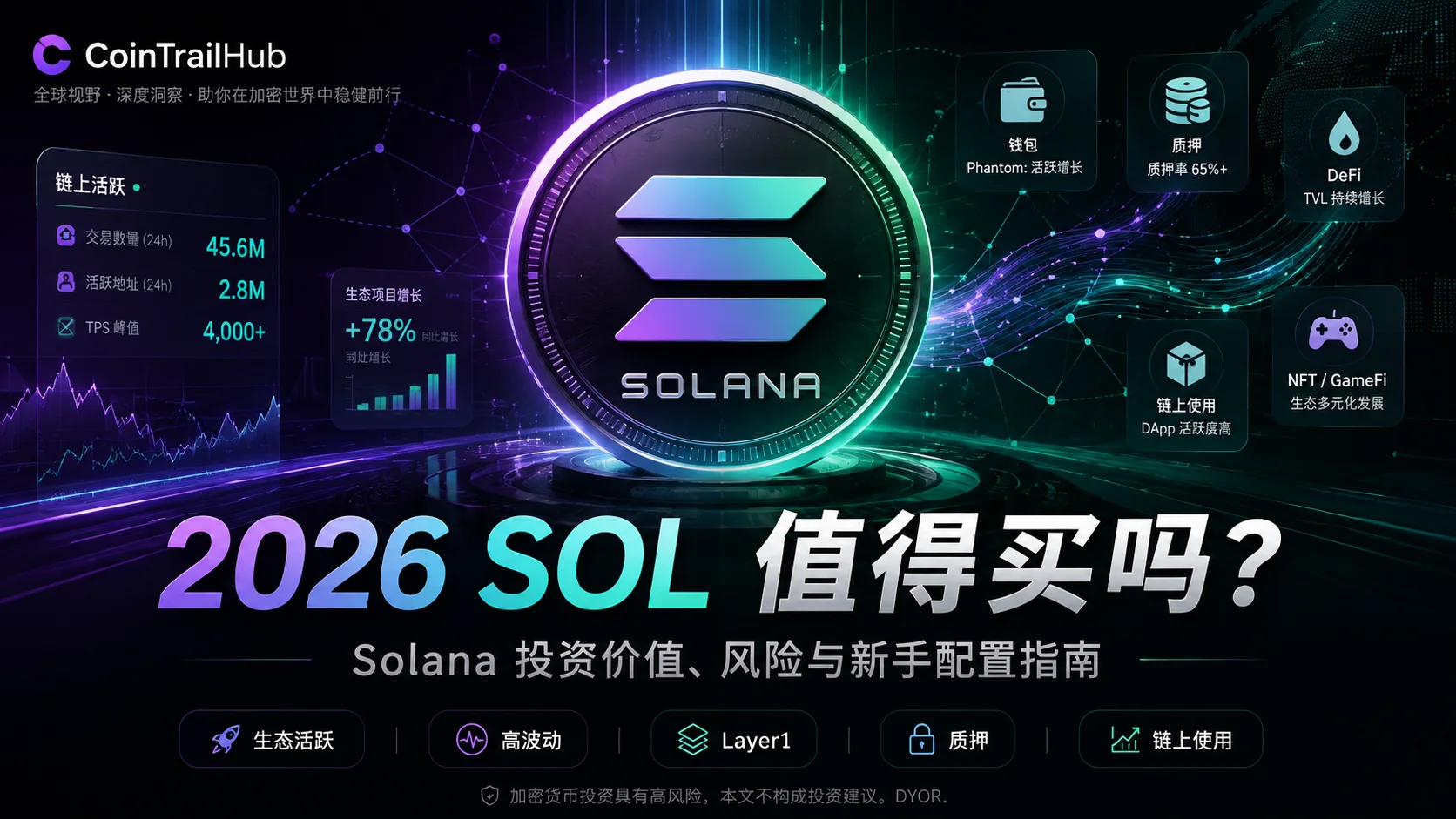
Table of contents

Binance new user rewards
20% trading fee rebate
Official Binance registration. Complete identity verification (KYC) to trade and withdraw.
In 2026, Solana has recovered from the doubts that followed the FTX collapse, and on-chain activity remains high. But my biggest feeling over these two years isn't "how much SOL has risen" — it's that most people's judgment of it is stuck between two extremes: either treating it as an "Ethereum killer" or as a "meme coin casino."
Both views are wrong. SOL has real value, but that value has little to do with the "next Ethereum" narrative — it comes from an on-chain economy that is actually being used.
If you remember only one sentence, remember this: SOL's value comes from real usage of the Solana ecosystem, not from the "replacing Ethereum" story. If you're willing to spend time understanding this ecosystem, a small allocation is reasonable; if you just want a "coin that will double," SOL isn't for you.
This article covers three things: where SOL's real value comes from, my real two-year journey of holding it, and how to judge before you buy. This is not investment advice; the full disclaimer is at the end.
About 10 minutes to read. First remember two things: SOL's price is related to Solana ecosystem usage, and has little to do with the "replacing Ethereum" narrative; staking can increase your coin count, but you can't withdraw during the unlocking period.
What value does SOL actually have? Not "the next Ethereum"
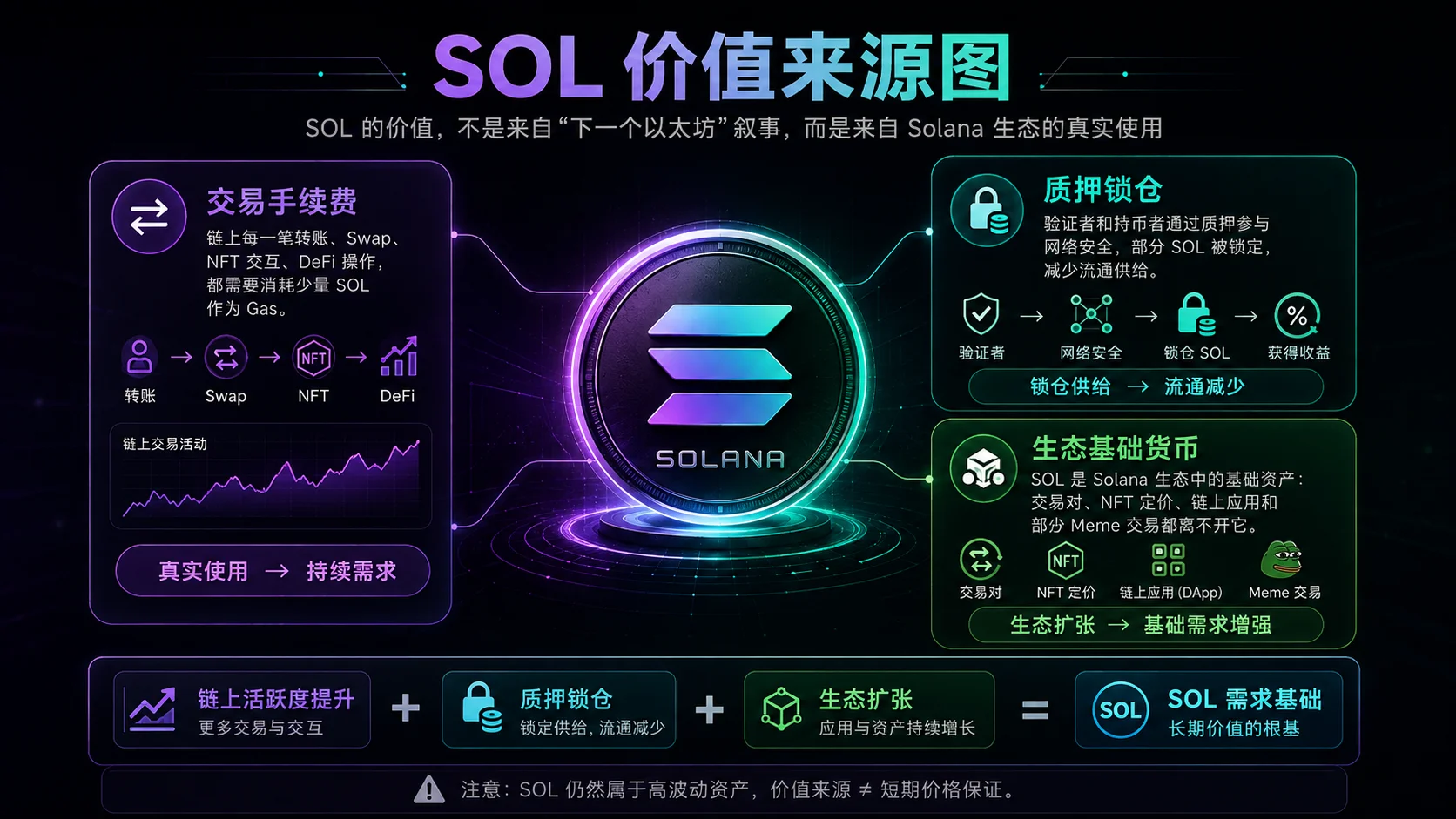
Later I realized the easiest mistake when judging SOL's value is to keep comparing it to ETH. What you really need to look at is whether Solana itself has formed sustained usage demand. Specifically, three levels:
Angle one: transaction fees — real people really using it
My method for judging whether an asset has sustained demand is simple: check whether anyone is actually using it. Real transactions happen on Solana every day, and each one consumes SOL as a fee. Daily transaction volume can be viewed in real time through on-chain tools like Solscan.
When I actually used the Solana ecosystem myself, swap, LP, and NFT interactions consumed about 0.05 SOL in total fees. A single person's amount isn't large, but multiplied by millions of users, it's sustained demand. This isn't value propped up by "consensus" — it's value propped up by fee consumption.
Angle two: staking — what the locked SOL is doing
Besides transaction consumption, SOL has another locked demand source — staking. Solana validators need to stake SOL to participate in block production; currently about 65–70% of SOL is staked (data reference: Solana official docs).[1] The locked SOL reduces market circulating supply, forming another support for the price.
When I staked through Jito, the yield changed with network conditions — it's not a fixed return. I don't touch this part — it's "working." Staking isn't just for yield; it's also a way to participate in the network. But there's a cost: unstaking takes 2–3 days, so you can't get it out when you urgently need cash.[2] I'll cover this pitfall later.
Angle three: "base currency" status in the ecosystem
Within the Solana ecosystem, SOL is the de facto base asset — trading pairs are quoted in SOL, NFTs are priced in SOL, and meme coins are traded with SOL. As long as the ecosystem grows, this base-currency demand exists. Unlike "using WeChat doesn't require buying Tencent stock," using the Solana chain actually requires holding SOL — even just 0.01.
Want to know what applications the Solana ecosystem actually has? → Is Solana worth using for beginners? Low gas + easy onboarding real experience (2026)
Here is a key realization that took me a long time to truly understand:
| Using the Solana ecosystem | Investing in the SOL asset | |
|---|---|---|
| What you need | Phantom wallet + 0.01 SOL (about $2–3) | Buy SOL and hold |
| Purpose | Experience on-chain applications | Hope SOL appreciates |
| Risk | Almost zero (just fees) | SOL's price can swing sharply |
| Time investment | 1–2 hours of learning | Needs continuous tracking of the ecosystem |
| Analogy | Like "using WeChat doesn't require buying Tencent stock" | This is an investment decision |
You can just use the Solana chain without holding a lot of SOL. Separate these two things first, then make a judgment.
My three stages of holding SOL for two years: panic → doubt → understanding
This is my experience gap — not price-trend analysis, but a real psychological change. I'll keep it brief, because your core need isn't to read a story but to judge "am I suited to buy."
Stage 1: panic (early 2023)
After the FTX collapse, SOL was down over 80%, and Solana's TVL fell below $300 million.[3] I didn't add to my position — honestly, I didn't dare. I just didn't sell, because selling would have left less than 20%, and I was too lazy to bother. Looking back, reducing emotional operations during extreme panic may be more worth thinking about than frequent trading. During the maximum panic period, not acting is often better than acting.
Stage 2: doubt (2024)
SOL rose from the teens to over $200, the meme season erupted, and daily active addresses once exceeded Ethereum's.[4] But I was internally conflicted: isn't this just meme-coin speculation rising, and does that count as a healthy ecosystem? I later understood: the meme-coin boom itself doesn't prove SOL's value, but it proves Solana's infrastructure capability — processing extremely high-frequency transactions at extremely low cost. That capability is real, no matter what's being traded.
Stage 3: understanding (now)
My current understanding of SOL: SOL is an "ecosystem index" — it doesn't reflect one project's value, but the activity level of the entire Solana ecosystem. As long as Solana has sustained real transaction activity and developers keep deploying new applications, SOL has fundamental support. This isn't the logic of "SOL will become the next Ethereum," but "Solana is a Layer 1 with real usage, and SOL is its base asset." The difference: the former depends on an uncertain future; the latter depends on currently verifiable data.
Before buying SOL, you must answer 4 questions
From the experience above, I distilled a judgment framework. Before pressing "buy," ask yourself these four questions:
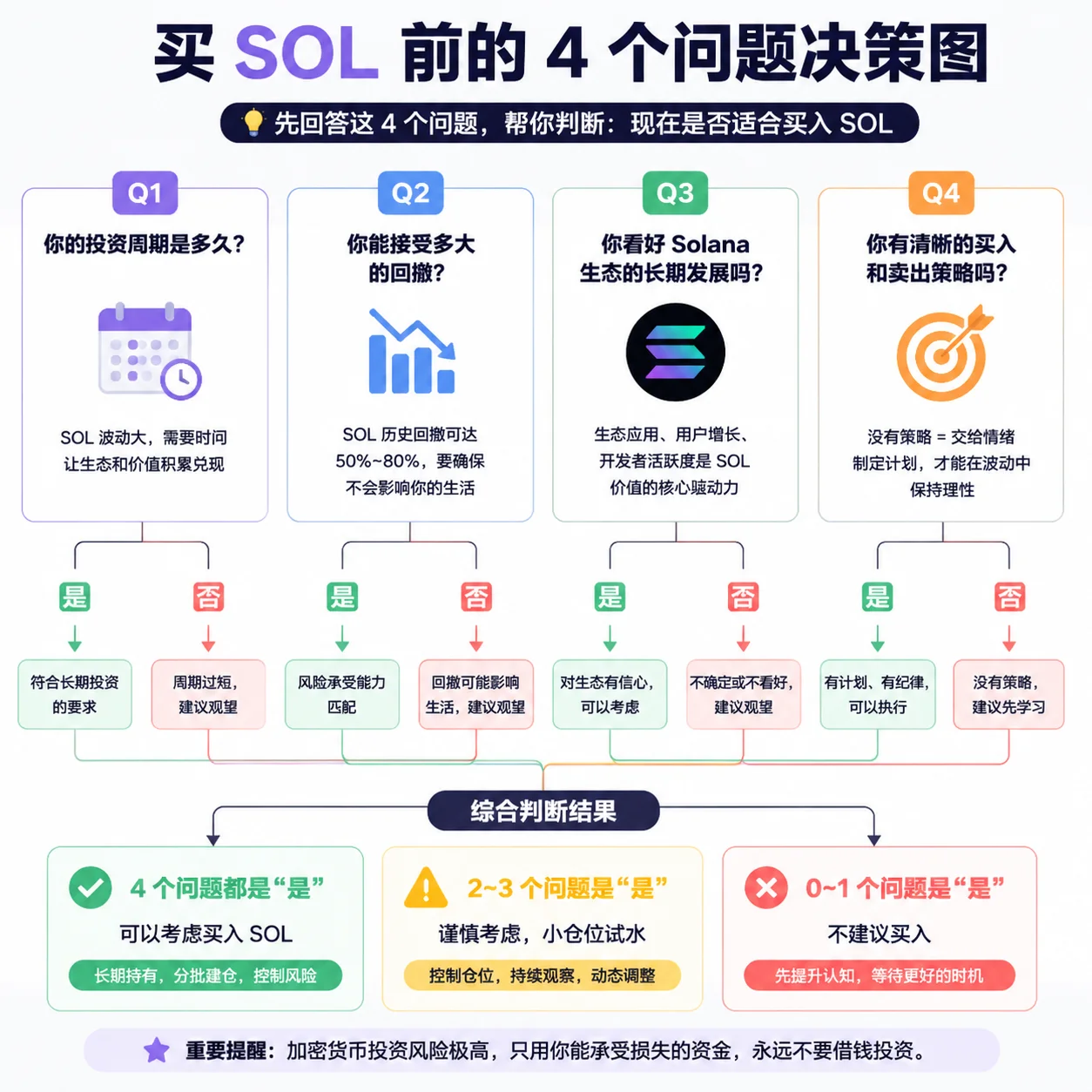
Question 1: how much drawdown can you handle?
This is the most important variable.
SOL has gone through extreme cyclical volatility (the FTX collapse period). Even without black swans, 50–70% drawdowns have happened multiple times in normal market cycles. Based on CoinGecko's historical price data, SOL typically shows higher price volatility than BTC.
| Maximum drawdown you can handle | Attitude toward SOL |
|---|---|
| Over 60% | Can consider a moderate allocation |
| 30–50% | Should strictly control position size |
| Within 20% | Not recommended — BTC suits you better |
This doesn't mean SOL will definitely fall this much. It means: if you can't handle this volatility, you'll sell at the worst possible time.
Question 2: have you spent time understanding the Solana ecosystem?
Buying something you don't understand is the most expensive behavior in investing.
If you can answer these questions, you have a basic understanding of SOL:
- Roughly how many active addresses does Solana have per day? (Answer: tens of millions level daily in 2026)
- Roughly what level is Solana DeFi TVL? What are the top three DeFi protocols?
- What is SOL's inflation rate? Roughly what level is staking yield?
If you can't answer any of these, put your money in assets you understand first.
Recommended reading first: Is Solana worth using for beginners? Low gas + easy onboarding real experience (2026) and Solana vs Ethereum comparison
Question 3: how much BTC/ETH do you already hold?
SOL should not be the first crypto asset you buy.
| Your situation | SOL allocation advice |
|---|---|
| Haven't bought BTC or ETH yet | Buy BTC or ETH first; SOL later |
| Have BTC but not ETH | Prioritize ETH; SOL as a supplement |
| Have both BTC and ETH, want to explore the Layer 1 track | Can make SOL part of a Layer 1 allocation |
| Already diversified across multiple assets | SOL is one of the reasonable choices in the Layer 1 track |
My own allocation logic: BTC → BTC+ETH → BTC+ETH+SOL. SOL is a third-tier choice, not the first two tiers. If you don't yet understand ETH's fundamentals, read What is Ethereum (ETH)? first — understanding ETH is the prerequisite for judging SOL's value.
Not sure how to choose for your first purchase? → First crypto purchase: BTC or ETH? Don't ask which rises more first (2026)
Question 4: how long do you plan to hold?
SOL is not a good target for short-term trading — not just because you can't make money short-term, but because short-term trading SOL as a beginner is basically giving money to the market.
| Your holding plan | Does it suit SOL |
|---|---|
| Under 3 months | SOL's short-term movement is extremely hard to predict |
| 3–12 months | Depends on your ability to judge ecosystem trends |
| 1 year or more | SOL's medium-to-long-term value is supported by ecosystem activity |
| 3 years or more | If you're bullish on blockchain's long-term development, Layer 1 is worth allocating |
What I can say: I've held SOL for over two years, and my most profitable decision was "not selling during panic." The most loss-making decision was "trying to buy low and sell high in swings" — most of the time I got it backwards.
Is SOL worth buying? First judge your investment stage
Before answering "is SOL worth buying," clarify one thing: which stage are you at right now?
| Stage | Characteristics | Does SOL suit you |
|---|---|---|
| Just starting (< 3 months) | Still understanding what BTC is, first time through volatility | No — focus on BTC first |
| Beginner (3–12 months) | Hold BTC, starting to understand ETH and smart contracts | Can learn, but don't rush to buy |
| Advanced (1 year or more) | Have both BTC and ETH, been through a full cycle | Can consider it, as a Layer 1 allocation |
| Deeply involved | Frequently on-chain, tracking ecosystem data | Naturally suited — using is learning |
If you're in the first two stages, the "five user personas" section already gave clear advice. If you're in the advanced stage, keep reading — the content below is for you.
5 risks you must know before buying SOL
Before talking about allocation, put the risks on the table first. These aren't "could happen" assumptions, but things that really happened in SOL's history.
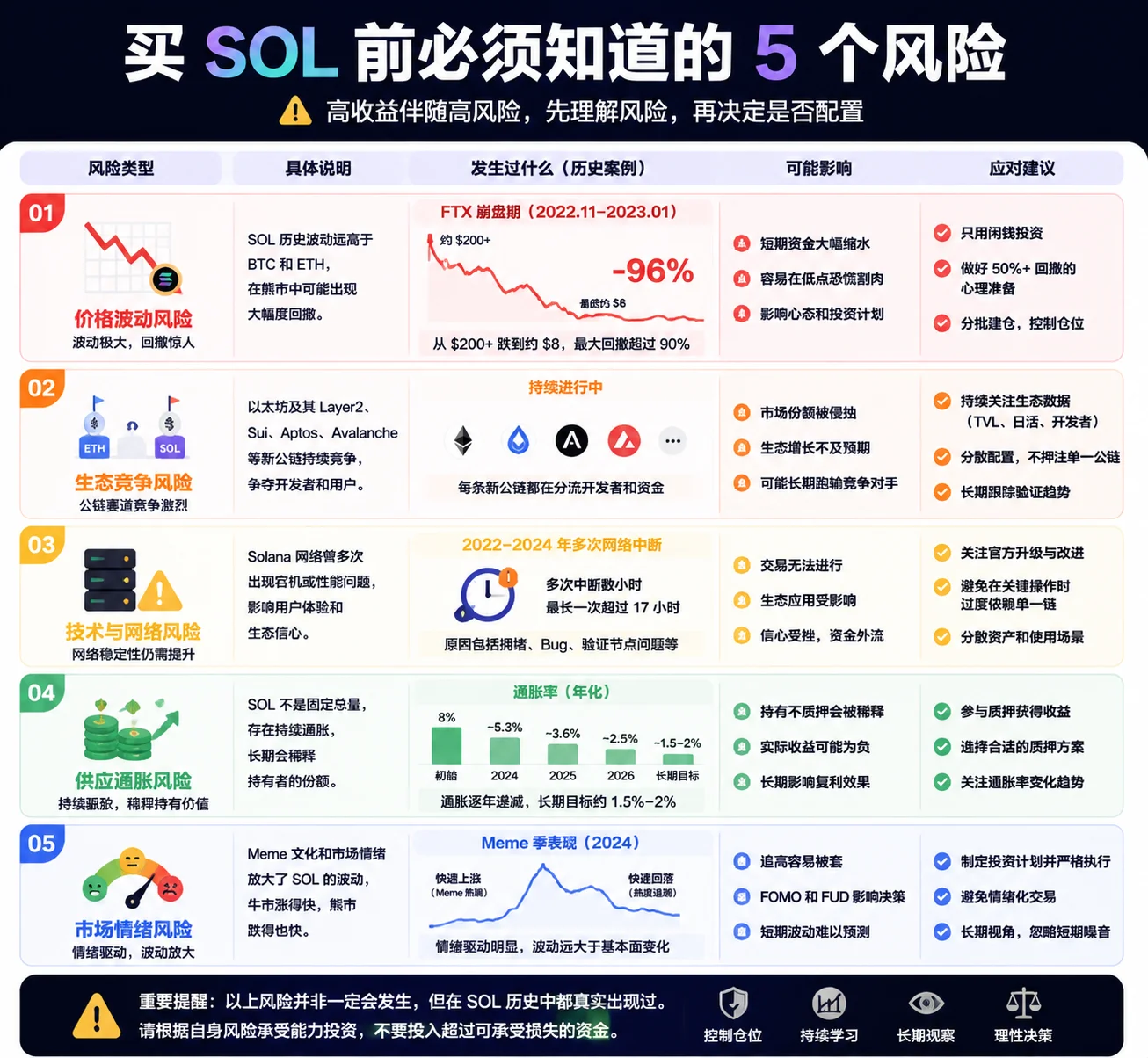
| Risk | Explanation | What has happened |
|---|---|---|
| Price volatility | SOL's historical maximum drawdown exceeded 90% | Fell from $200+ to the teens during the FTX collapse |
| Ecosystem competition | ETH, SUI, APT and other Layer 1s keep competing | Every new public chain fights for developers and users |
| Technical risk | The Solana network has had multiple outages | Several multi-hour network interruptions between 2022–2024 |
| Supply dilution | SOL has no fixed supply; it keeps inflating | Initial inflation 8%, decreasing annually, long-term target ~1.5–2% |
| Market sentiment | Meme cycles amplify SOL's volatility | Rises fast in meme season, falls fast when it recedes |
Understanding these risks isn't to scare you away, but so you know what you're bearing in the allocation advice below.
SOL is not a core asset, but an ecosystem-growth asset
Before getting into specific allocation advice, clarify SOL's position among crypto assets:
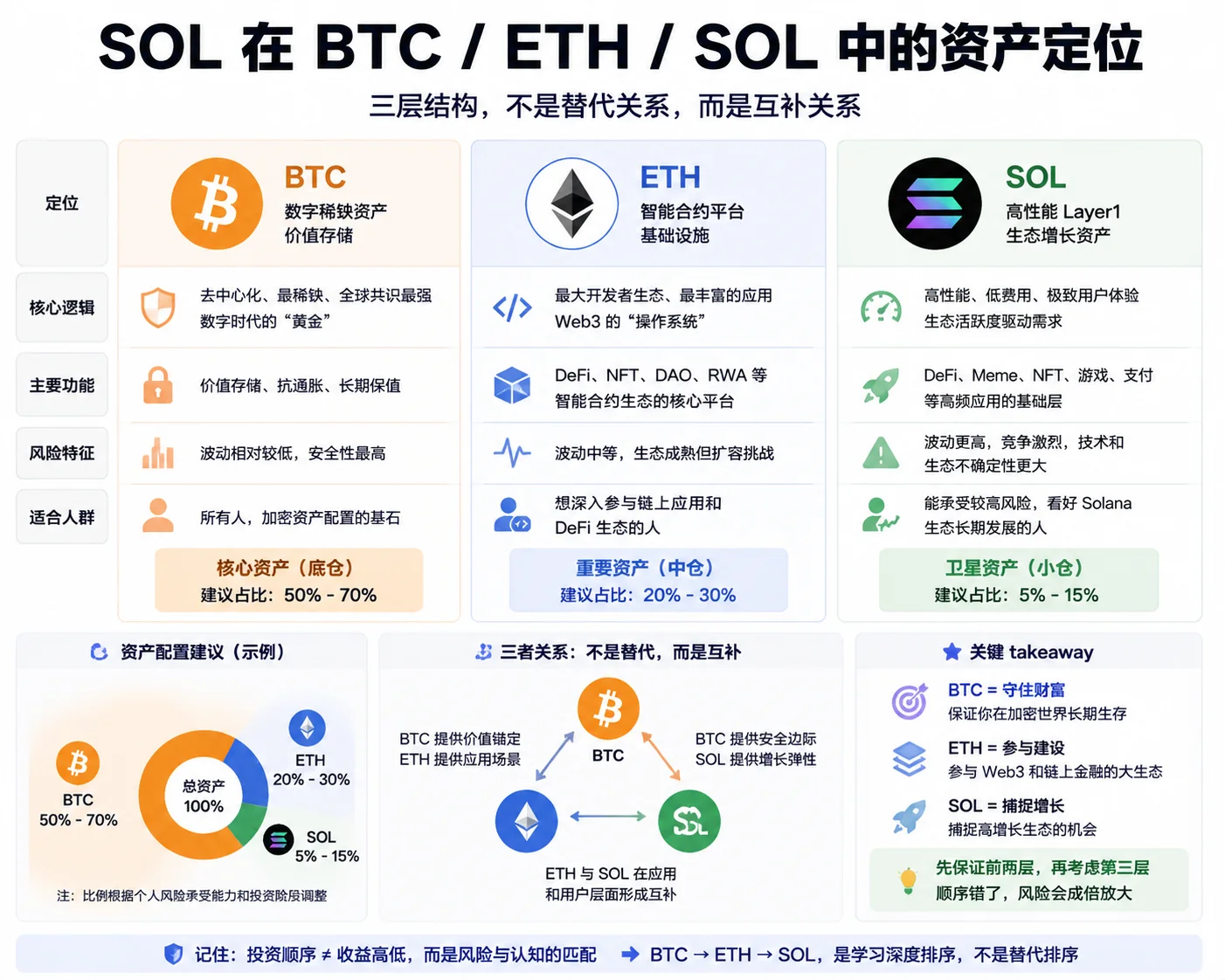
| Asset | Core logic | Volatility risk | Suits whom |
|---|---|---|---|
| BTC | Digital scarcity asset, decentralized store of value | Relatively lowest | Everyone's first choice |
| ETH | Smart-contract infrastructure, largest DeFi ecosystem | Medium | People who want to understand on-chain finance |
| SOL | High-performance Layer 1, ecosystem-growth asset | Higher | People who already understand BTC/ETH and want to explore Layer 1 |
This three-layer structure corresponds to your learning path:
BTC → ETH → SOL. It's not that the later is better, but that the later requires more active judgment. BTC needs understanding store of value; ETH needs understanding smart contracts; SOL needs tracking ecosystem changes.
SOL is a satellite position in my holdings — the core is BTC (store of value), the second layer is ETH (smart-contract platform), and SOL is the third layer of ecosystem-growth allocation. This order isn't about "which is better," but "which suits your stage."
From another angle: BTC is like digital gold — you mainly hold it; ETH is like digital infrastructure — you can build financial facilities on it; SOL is like a digital highway — things run fast and cheap on it. The three solve different problems; none replaces another.
Still torn between BTC and ETH? → First crypto purchase: BTC or ETH? Don't ask which rises more first (2026)
Five user personas: your SOL allocation advice
Combining the four variables, here's the allocation advice for different personas:
Persona A: a beginner who just bought their first BTC
Advice: don't touch SOL yet.
Your only task right now is: get used to BTC's price volatility, and build the psychological muscle of "holding without anxiety." SOL's volatility will interfere with this learning process. After 3 months, if you find you're not panicked when BTC drops 20%, then consider exploring SOL.
Persona B: holding BTC+ETH for over half a year
Advice: consider SOL as a satellite position in the Layer 1 track.
This is the most common "mature beginner" persona. You've been through market volatility and know the rhythm of crypto assets. Some investors who follow the Layer 1 track long-term make SOL part of their satellite position, but the specific ratio depends on individual risk tolerance — SOL has real ecosystem activity in Layer 1, but its volatility is also real.
Persona C: ample capital, seeking diversification
Advice: SOL can be one of the Layer 1 allocations, at satellite-position level.
Don't put all your Layer 1 capital into a single asset. You can consider a diversified combination of SOL and other Layer 1 assets, with the specific ratio depending on your research and judgment of each ecosystem.
Persona D: frequently use the Solana chain, already understand the ecosystem
Advice: you already have your own judgment.
If your daily on-chain operations are all on Solana, you'll sense ecosystem changes earlier than most "pure investors." What you need to judge is only: whether your position ratio is reasonable and whether you need hedging.
Persona E: main activity is on exchanges, never operate on-chain
Advice: SOL has limited value for you.
If your crypto usage is just exchange buy → hold → sell, SOL has no unique advantage over other crypto assets. In that case, putting effort into understanding BTC and ETH is more efficient.
The 5 easiest mistakes to make after buying SOL
Pitfall 1: using "will SOL surpass ETH" as your holding reason
Scenario: when I first held SOL, I compared "which is better, SOL or ETH" every day, looking for evidence that "Solana will replace Ethereum."
Cause: this is the most addictive and most dangerous holding logic. You're not analyzing value — you're looking for a confirmation-bias story.
Lesson: SOL doesn't need to become "the next Ethereum" to have value. A healthy crypto world can have multiple Layer 1s coexisting. Stop the zero-sum "SOL vs ETH" mindset.
Pitfall 2: adding to SOL because you made money on meme coins
Scenario: in the 2024 meme season, a friend made money on Solana meme coins, then reasoned "if even meme coins can make money, SOL itself must be good," and heavily added to SOL.
Cause: meme-coin profits and SOL's asset value are two completely different things. Meme coins are driven by short-term speculative sentiment, and can't be a reason for long-term SOL holding.
Lesson: don't use short-term speculative profits to guide long-term allocation decisions. They're judgments at different levels.
Pitfall 3: panic-selling SOL when Solana has an outage
Scenario: every time the Solana network had a problem, community FUD erupted — "Solana is finished again." Once the network paused for a few hours, and I almost dumped everything.
Cause: outages are a problem, but they can't alone decide SOL's long-term value. If every outage drained all the users, Solana would have been gone long ago. The fact is users came back after the outages.
Lesson: network stability is a technical challenge Solana needs to keep solving. But for a holder, what matters is the ecosystem's long-term trend, not any single technical failure.
Pitfall 4: staking all your SOL, then not being able to withdraw when you urgently need money
Scenario: I staked a large amount of SOL in Jito, suddenly needed money, and found that unstaking takes 2–3 days (one epoch cycle).
Cause: Solana staking has an unlocking period; it's not available anytime. I hadn't left enough liquid SOL before staking.
Lesson: always leave a portion of unstaked SOL (at least 30%). Staking looks like free yield, but the cost of locked liquidity is real — you only feel it when you urgently need money.
Pitfall 5: not looking at the inflation rate, assuming SOL is limited like BTC
Scenario: beginners often assume SOL is "limited in supply" like BTC, and just buy and hold without care.
Cause: SOL's supply mechanism is completely different from BTC's. According to Solana's official economics documentation, SOL's initial inflation rate is about 8%, decreasing 15% annually, with a long-term target inflation of about 1.5–2%.[5] This means supply keeps increasing, and your share is being diluted.
Lesson: staking SOL earns yield that hedges inflation (staking yield changes with network conditions, and usually still has positive return after covering inflation). But if you only hold without staking, inflation silently dilutes your value. This is completely different from BTC — BTC's supply is fixed; not holding BTC is what gets diluted by inflation.
Steps for buying SOL for the first time
After deciding to buy SOL, how do you do it?
Step 1: choose an exchange. If you already have a Binance account, buy directly on Binance. If not, complete registration and KYC verification first.
Step 2: buy USDT → swap to SOL. Buy SOL with USDT in the spot market. For the first time, buy only one-third of your planned position — don't go all in; building the position in a few batches can smooth price volatility.
Step 3: decide where to keep it.
- On the exchange — convenient for trading, suits SOL you may need to sell short-term
- Phantom wallet — can participate in on-chain activities, staking, DeFi
- Hardware wallet — a safer choice for larger amounts
Step 4: consider staking. Stake through Jito, Marinade, or other staking options; the yield changes with network conditions. Staking has two benefits: the yield hedges inflation + locked SOL prevents impulsive selling during short-term volatility.
On-chain operation details → Is Solana worth using for beginners?
When SOL is not for you
Having said so much about "when you might consider SOL," I must state clearly: when not to buy SOL.
- Money you plan to use within 3 months → don't buy SOL
- Can't accept losing over 50% → don't buy SOL
- Don't understand the Solana ecosystem and don't want to spend time learning → don't buy SOL
- Don't have any BTC or ETH yet → buy BTC or ETH first
- Want to buy only because "SOL rose recently" → wait 72 hours calmly before deciding
- Plan to put most of your assets into SOL → over-concentrating in any single crypto asset amplifies risk
SOL is a "satellite position" in my holdings, not the core. The core is BTC, the second layer is ETH, and SOL is the third layer's supplement. This order has a reason: BTC is the most decentralized, longest-tested crypto asset; ETH has the largest smart-contract ecosystem; SOL has the most active ecosystem in the Layer 1 track but also the most volatility.
The 9 questions beginners ask me most about SOL
Q1: Does SOL still have long-term value?
I've asked myself this many times. Honestly, no one can be sure what Solana will look like in 5 years. But some things can be continuously observed: whether on-chain daily active addresses are increasing or decreasing, whether developers are flooding in or leaving, whether DeFi TVL is rising or falling. These indicators won't tell you tomorrow's price, but they're closer to the truth than staring at candlestick charts. From my current observation, none of these dimensions has shown a worrying trend yet.
Q2: SOL vs ETH — which is more worth buying?
Every time someone asks me this, I don't give a direct conclusion. ETH has been around for 9 years, through complete bull and bear cycles, and its smart-contract ecosystem depth and L2 network maturity are plain to see. SOL has been around for less than 5 years — fast, cheap, good experience, but a short history is a short history. I hold both and don't feel the need to choose one.
Detailed comparison → Solana or Ethereum? How should a beginner choose for their first on-chain experience (2026)
Q3: How much of my portfolio should SOL be?
To be specific: if your total crypto assets are $1,000, putting a few dozen to a bit over a hundred dollars in SOL is about right; the rest should prioritize BTC and ETH positions. My approach is simple — SOL is always a small position for me; I won't chase it when it rises or panic when it falls. The biggest benefit of a small position isn't earning more — it's that you can hold through it.
Q4: Will SOL still be affected by FTX?
The direct shock of the FTX collapse on SOL has been largely digested. The sale of FTX-related assets and market digestion have kept progressing, and market attention has gradually shifted from the FTX event to Solana's own ecosystem development. Indirect effects remain: the market is still sensitive to assets associated with "SBF/Solana," but as Solana's ecosystem develops independently and the new developer community grows, this effect keeps weakening.
Q5: Is SOL suitable for dollar-cost averaging (DCA)?
If you've already built BTC and ETH positions, SOL can be one of the DCA targets. But I don't recommend making SOL a higher DCA priority than BTC or ETH. The correct mindset for DCA-ing SOL is "I'm bullish on Solana's ecosystem long-term," not "I want to get rich by DCA-ing SOL."
Q6: I made money on meme coins — should I buy more SOL?
Not recommended. Meme-coin short-term gains and SOL's long-term value are two separate things. If you made money on meme coins, the first thing is to take out your principal and convert part of the profit into stablecoins or BTC — don't let short-term speculative sentiment dominate long-term allocation decisions.
Q7: Is staking SOL safe? Can I lose coins?
Staking SOL through top liquid-staking protocols like Jito and Marinade is relatively mature — audited multiple times and validated by large-scale users. The core risk isn't the staking contract itself, but that you can't withdraw anytime when you urgently need money (there's an unlocking period). Also, don't chase a few extra points of yield on unknown staking platforms.
Q8: How does SOL compare to new public chains like SUI and APT?
Solana's advantage is ecosystem maturity — DeFi TVL, daily active addresses, and developer count all rank near the top among Layer 1s. SUI, APT, and other new chains each have their own innovation directions in technical architecture. Right now Solana is one of the most active Layer 1s, but that doesn't mean it'll lead forever. Diversification is more robust than betting on a single public chain.
Q9: Is SOL suitable for long-term holding?
The answer to this question doesn't depend on price prediction but on which indicators you watch. If you watch: whether Solana's developer count is growing, whether on-chain daily active addresses are increasing, whether ecosystem applications are expanding into new tracks — these are verifiable judgment bases. If you only make decisions by looking at price, no asset is suitable for long-term holding. Right now Solana maintains high ecosystem activity in the Layer 1 track, but the blockchain industry's competitive landscape changes fast, and no project can promise 10 years of leadership.
Data verification notes
The key facts in this article were checked on 2026-08-12 against Solana official docs, CoinGecko, and DeFiLlama, item by item:
- Staking ratio: about 65–70% of SOL is staked, with the exact ratio changing by epoch. Source: Solana official staking docs.
- Unlocking period: unstaking requires a cooldown cycle, usually about 2–3 days, during which the asset cannot be moved out. Source: Solana official staking docs.
- Post-FTX drawdown: after the FTX collapse, SOL fell over 90% from its 2021 high, and Solana ecosystem TVL once dropped below $300 million. Source: CoinGecko, DeFiLlama.
- Price range: SOL once fell to the teens at the end of 2022 and recovered above $200 in 2024, with higher volatility than BTC. Source: CoinGecko.
- Inflation model: SOL's initial inflation rate is about 8%, decreasing 15% annually, with a long-term target of about 1.5–2%. Source: Solana official economics documentation.
Related recommendations
- Is Solana worth using for beginners? Low gas + easy onboarding real experience (2026) — evaluating Solana from an on-chain operation angle
- Solana or Ethereum? How should a beginner choose for their first on-chain experience (2026) — horizontal comparison of two Layer 1s
- First crypto purchase: BTC or ETH? Don't ask which rises more first (2026) — CoinTrailHub's core entry article for beginners
- What is Ethereum? Smart contracts, gas fees, and Web3 — understanding the veteran leader of the Layer 1 track
- Ethereum gas too expensive? How to choose Arbitrum/Optimism/Base (2026) — learn how Layer 2 solves scaling
- How to do Binance KYC? Review time, failure reasons, and solutions (2026) — the first step before buying SOL
Disclaimer
This article is only for SOL asset value analysis and personal usage experience sharing, and does not constitute any investment advice, financial advice, or trading advice.
Crypto asset prices are extremely volatile, and SOL's historical maximum drawdown exceeded 90%. Any crypto asset may face sharp price declines, regulatory changes, technical risks, and market liquidity risks. Please judge carefully according to your own risk tolerance, and don't invest more than you can afford to lose. Investment decisions should be based on independent research and the laws of your location.
- CoinGecko - SolanaSOL historical price and volatility data
- CoinMarketCap - SolanaSOL market cap and public price data
- DeFiLlama - SolanaSolana ecosystem TVL and protocol rankings
- SolscanOn-chain daily active addresses and transaction lookup
- Solana official economics documentationSOL inflation rate and staking economic model
- 2026-10-17UpdateAdded evidence-chain superscripts and "Data verification notes".
See ourEditorial Policy and the correction process in ourCorrections Policy.
The CoinTrailHub editorial team focuses on crypto education for beginners, exchange security and P2P trading risk. This article is compiled from official sources and public data, reviewed by humans, and strives for accuracy but is not investment advice.
Last updated:2026-08-12 · Content reviewed by humans · Learn more
© 2026 CoinTrailHub · Original content. Reproduction or rewriting without permission is prohibited.