
Ethereum gas fees too expensive? How to choose Arbitrum / Optimism / Base (2026)
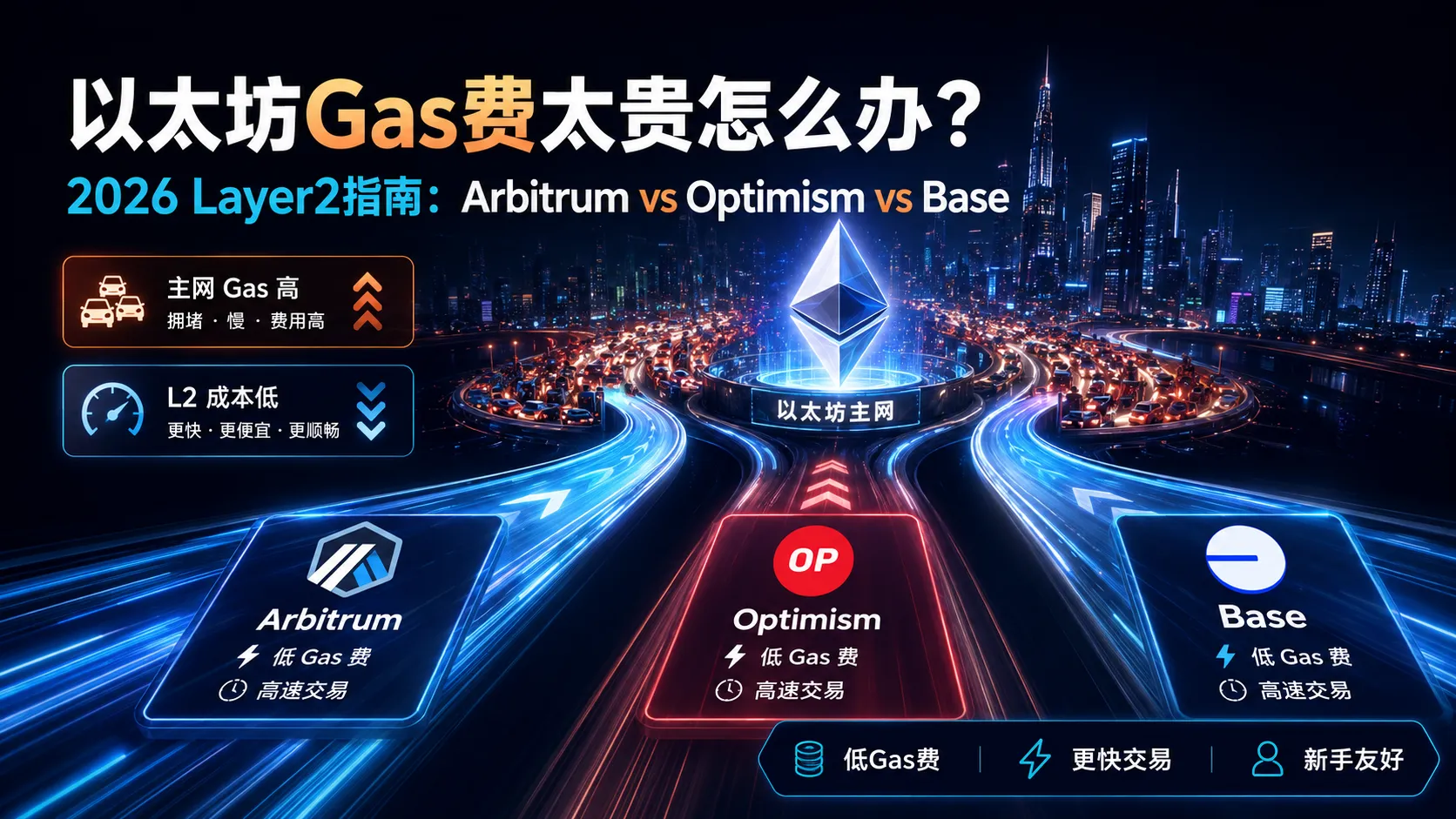
Table of contents

Binance new user rewards
20% trading fee rebate
Official Binance registration. Complete identity verification (KYC) to trade and withdraw.
TL;DR — Ethereum Layer 2 uses Rollup technology to lower transaction costs. In 2026, the main choices for beginners are: Arbitrum (most mature DeFi ecosystem, most protocols), Base (lowest gas, easiest entry for Coinbase users) and Optimism (for users interested in the OP Superchain ecosystem). Not sure which to pick? Start with Arbitrum or Base. Withdrawing from an exchange that supports L2 networks usually lets you complete your first low-cost on-chain operation in a few minutes.
Reading time: about 12 minutes. Remember one thing first: when choosing an L2, look at the ecosystem first, then gas — and withdrawing back to mainnet takes about 7 days.
A simple transfer on Ethereum mainnet: $8 in gas. A Uniswap swap: $15–30. Adding liquidity: $50–100.
You earned $20 of interest in DeFi, and spent $80 on fees. For small-balance users, high gas fees can eat up most of the returns, making on-chain operations not worth it.
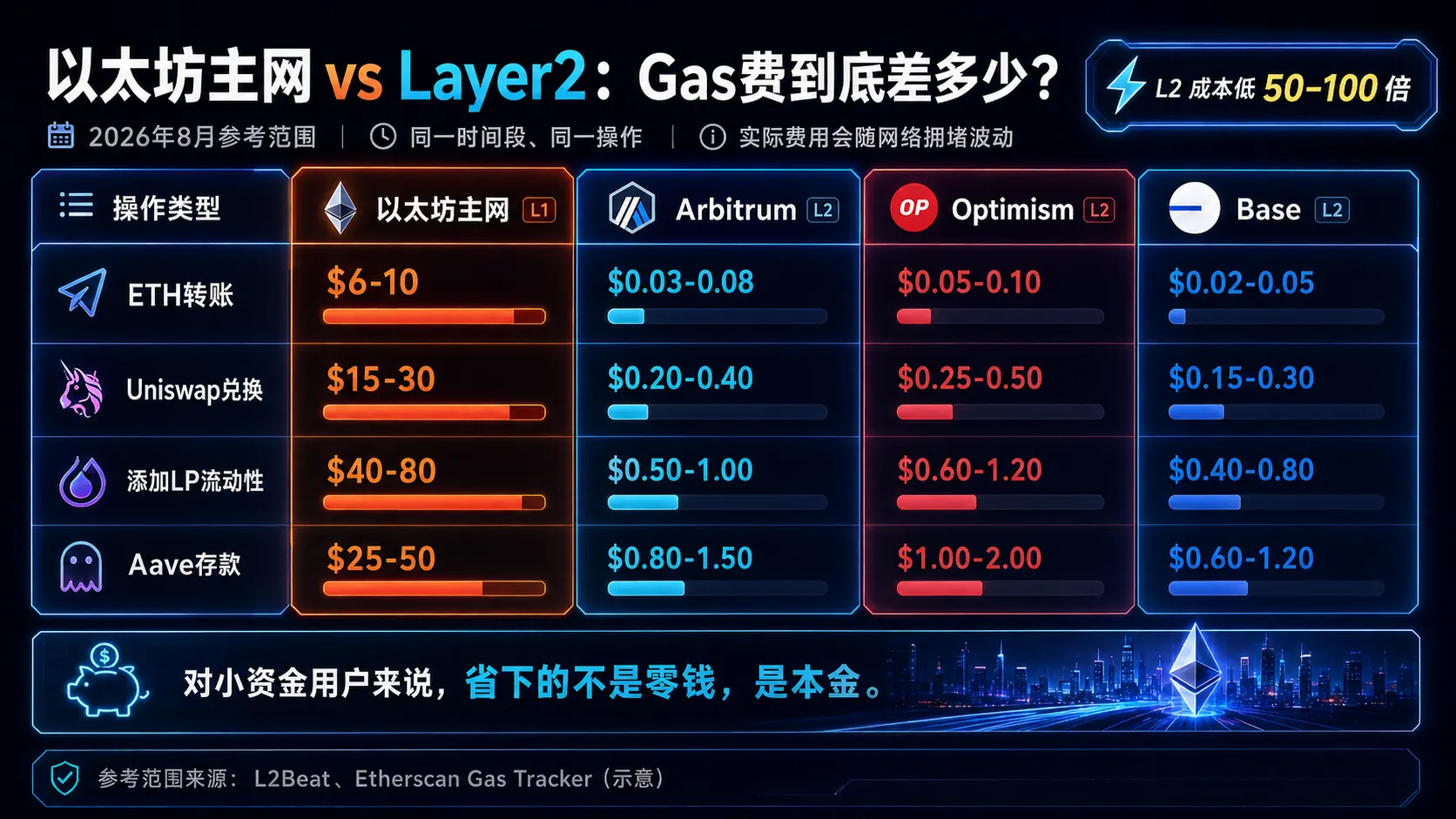
But move the same operation onto Layer 2: $0.05 for a transfer, $0.3 for a swap, $1 for adding liquidity. The same operation costs 50–100x less.[1]
That is the whole point of Layer 2 — it doesn't make you earn more, it makes you lose less.
Ethereum mainnet vs Layer 2: how big is the gas difference? (2026 fee comparison)
Here are the reference gas fee ranges for the same operations across four chains in August 2026 (actual fees fluctuate with network congestion — use a real-time gas tool for the latest numbers):
| Operation | Ethereum mainnet | Arbitrum | Optimism | Base |
|---|---|---|---|---|
| ETH transfer | $6-10 | $0.03-0.08 | $0.05-0.10 | $0.02-0.05 |
| Uniswap swap | $15-30 | $0.20-0.40 | $0.25-0.50 | $0.15-0.30 |
| Adding LP liquidity | $40-80 | $0.50-1.00 | $0.60-1.20 | $0.40-0.80 |
| Aave deposit | $25-50 | $0.80-1.50 | $1.00-2.00 | $0.60-1.20 |
What you save isn't spare change — it's principal. For small-balance users, frequent operations can let fees take up a meaningful share of returns. On L2, the same operations may total under $5 in fees.
Data sources: real-time gas for each chain can be checked on L2Beat and Etherscan Gas Tracker.[2]
What is Layer 2 — understand the core logic in 30 seconds
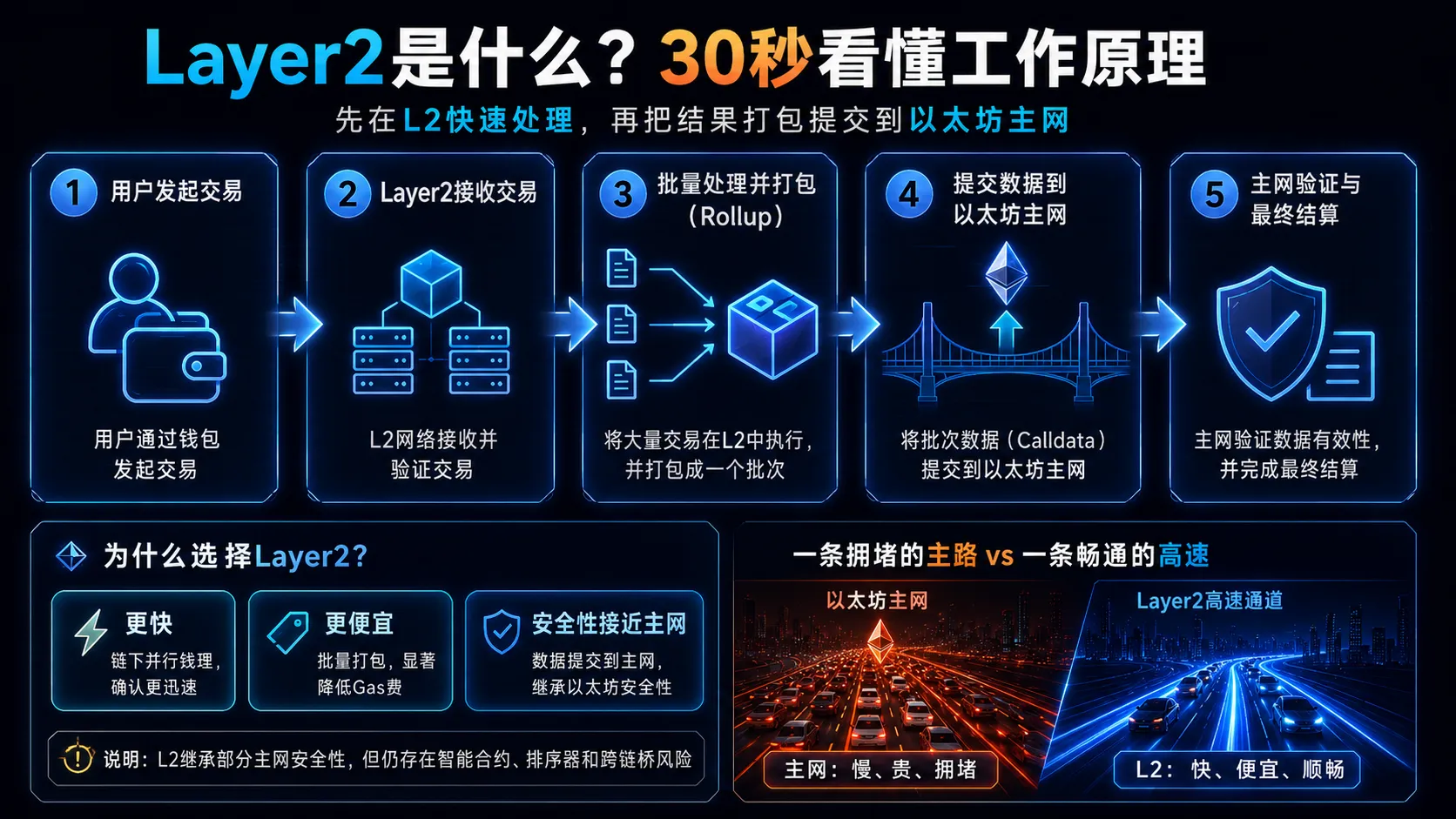
No deep tech here. In one sentence: Layer 2 moves transactions onto a "fast lane" next to Ethereum, processes them, then bundles the results back onto Ethereum mainnet.
An analogy:
- Ethereum mainnet = the main road through downtown — lots of traffic, many red lights, expensive tolls, but the safest
- Layer 2 = the highway built alongside — fewer cars, fast, cheap, with an exit connected to the main road
Rollup submits transaction data to Ethereum mainnet and inherits part of the mainnet's security, but users still bear the independent risks of L2 smart contracts, sequencers and bridges. Day-to-day operations happen on L2, and final settlement data is anchored to Ethereum — that's why L2 is fast and cheap while its security approaches the mainnet's.
For the basics of Ethereum mainnet, start with What is Ethereum? Smart contracts, gas fees and Web3.
Three major L2s compared: which suits you?
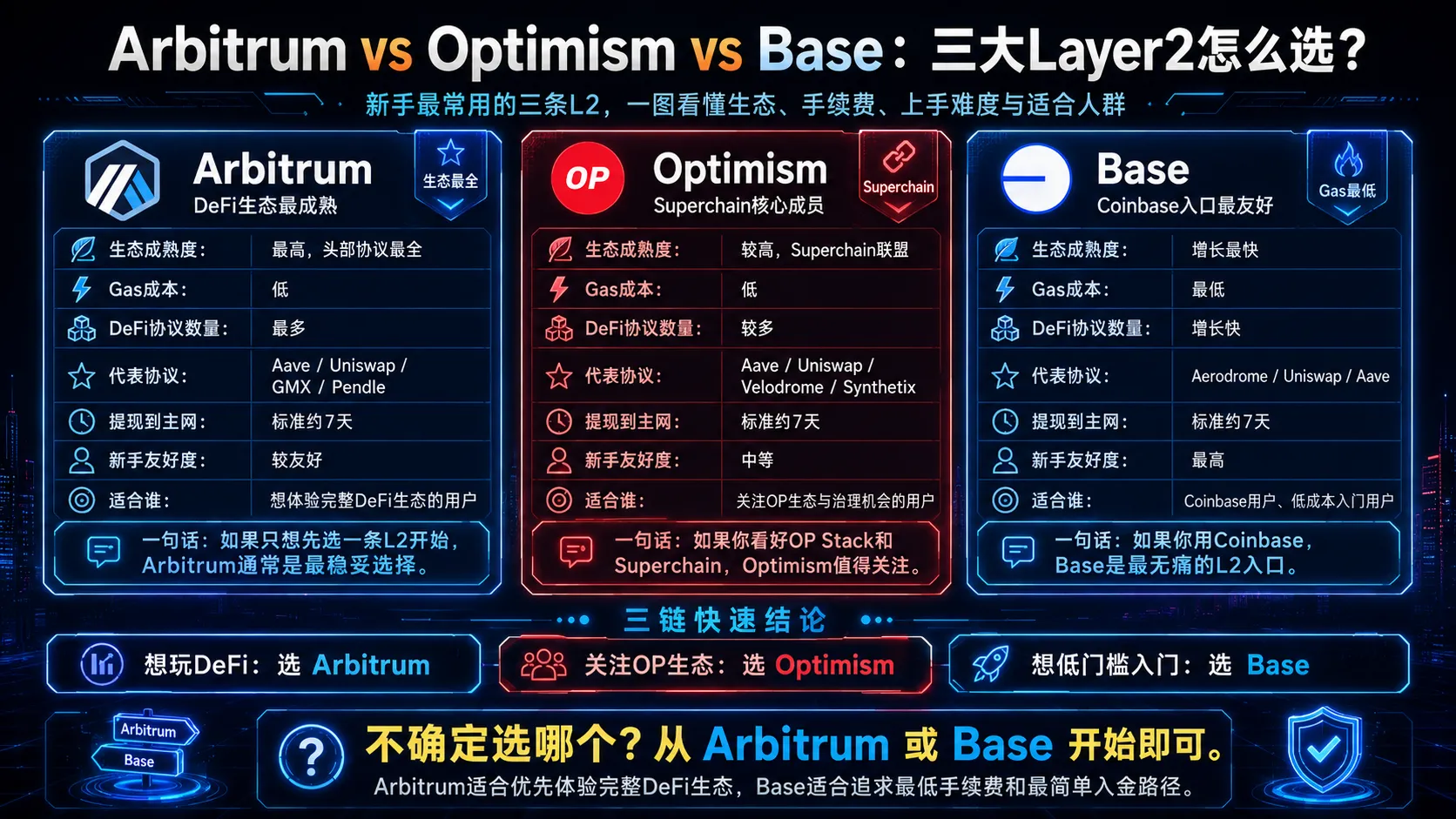
There are many L2 projects in 2026, but for beginners there are really only three worth considering: Arbitrum, Optimism and Base. All three are time-tested, rank near the top in TVL, and have all the major DeFi protocols deployed.
Arbitrum — the L2 with the richest ecosystem
| Dimension | Assessment |
|---|---|
| Launch | August 2021, the longest-running L2 |
| Team | Offchain Labs (US team, backed by a16z) |
| Rollup type | Optimistic Rollup |
| TVL | Has long ranked first among L2s (see DeFiLlama for real-time data) |
| Representative DEX | GMX, Camelot, Uniswap V3 |
| Ecosystem | Full coverage of top protocols like Aave, Uniswap, GMX, Pendle |
| Gas fees | Slightly higher than Base and OP, but still in the $0.2–1.5 range |
| Withdrawal to mainnet | Standard ~7 days (Optimistic Rollup challenge period — only withdrawals back to mainnet require waiting; transfers/trades within the L2 settle instantly), can be accelerated via bridges like Hop, Across |
| Best for | Users who want the full DeFi ecosystem and don't want to switch chains often |
One-line takeaway: if your goal is to experience the full DeFi ecosystem, Arbitrum is usually one of the safest choices for beginners.
Optimism — the veteran L2 with active governance
| Dimension | Assessment |
|---|---|
| Launch | December 2021, the same era as Arbitrum |
| Team | OP Labs (leads OP Stack development) |
| Rollup type | Optimistic Rollup |
| TVL | Top 3 among L2s |
| Representative DEX | Velodrome, Uniswap V3 |
| Ecosystem | Aave, Uniswap, Synthetix, Velodrome and more |
| Notable | OP Stack is adopted by Base, Worldcoin and others; strong Superchain alliance ecosystem |
| Gas fees | Slightly higher than Arbitrum, $0.25–2.00 |
| Withdrawal to mainnet | Standard ~7 days (only withdrawals back to mainnet require waiting; L2 internal operations settle instantly) |
| Best for | Users focused on OP ecosystem governance and airdrop opportunities |
One-line takeaway: if you're bullish on the Superchain ecosystem (OP Stack alliance), Optimism is worth a position.
Base — by Coinbase, the most beginner-friendly
| Dimension | Assessment |
|---|---|
| Launch | August 2023, launched by Coinbase |
| Team | Coinbase (NASDAQ-listed company) |
| Rollup type | Optimistic Rollup (built on OP Stack) |
| TVL | Fastest growing, now in the L2 top three |
| Representative DEX | Aerodrome, Uniswap V3 |
| Ecosystem | Uniswap, Aave, Aerodrome and more; active meme coin trading |
| Notable | Coinbase withdraws directly to Base — zero-barrier onboarding |
| Gas fees | Lowest of the three chains, $0.15–0.80 |
| Withdrawal to mainnet | Standard ~7 days (only withdrawals back to mainnet require waiting; L2 internal operations settle instantly) |
| Best for | Coinbase users and beginners who want to experience L2 at the lowest cost |
One-line takeaway: if you use Coinbase, Base is the most painless L2 entry point.
Side-by-side comparison of the three chains
| Metric | Arbitrum | Optimism | Base |
|---|---|---|---|
| Ecosystem maturity | Highest, full coverage of top protocols | High, Superchain alliance | Fast-growing, active meme coins |
| Gas cost | Low | Low | Lowest |
| Number of DeFi protocols | Most | Many | Fast-growing |
| Sequencer status | Centralized sequencer, decentralization roadmap in progress | Centralized sequencer, decentralization roadmap in progress | Coinbase-operated sequencer, relatively high centralization |
| Beginner friendliness | Requires withdrawal from a CEX | Requires withdrawal from a CEX | Coinbase one-click withdrawal, most friendly |
What are the risks of Layer 2?
Layer 2 saves gas, but it's not a "clone" of Ethereum mainnet — it has its own independent risk layers.
Smart contract risk
If the core contracts of a Rollup have vulnerabilities, they can affect the assets of all users on that L2. Arbitrum and Optimism have been live for over 4 years, with multiple rounds of audits and battle-testing, but "zero risk" still doesn't exist. Base is maintained by Coinbase and its code is built on OP Stack; Coinbase as a large infrastructure provider improves entry convenience, but sequencer centralization remains a factor worth watching.
Sequencer risk
Most Optimistic Rollups currently rely on a single sequencer to order transactions. If the sequencer fails or stops, the process of submitting transactions to mainnet can be delayed. Arbitrum and Optimism have designed exit mechanisms that don't depend on the sequencer — even if it fails, users can still bypass it to withdraw assets from mainnet, but this requires waiting through the challenge period (~7 days) and is relatively complex in practice.
Cross-chain bridge risk
Bridges between L2 and mainnet are among the most frequently targeted attack points. Withdrawing from an exchange directly to L2 (Binance/OKX → Arbitrum, Coinbase → Base) is usually safer than using a third-party bridge, because the exchange handles the bridging step and you don't manually interact with a cross-chain contract.
Differences in decentralization
Arbitrum and Optimism are further ahead on decentralization; Base's sequencer is still operated by Coinbase, a higher degree of centralization. If you place a high premium on decentralization, watch each L2's governance progress and sequencer decentralization roadmap.
How should beginners choose? Three scenarios
Don't get stuck on "which chain is best" — different needs point to different chains:
Scenario 1: you mainly use Binance/OKX → choose Arbitrum. Both exchanges support direct withdrawals to the Arbitrum network; it has the fullest ecosystem, and depositing into Aave or trading on Uniswap is a one-step process.
Scenario 2: you mainly use Coinbase → choose Base. Coinbase natively supports Base network withdrawals, skipping the cross-chain step, with the lowest gas.
Scenario 3: you mainly do DeFi but aren't sure → pick one of the three, recommend Arbitrum. The most complete ecosystem, and switching to another L2 later costs very little.
For the specific steps of withdrawing from an exchange to L2, see How to deposit, withdraw and sell USDT? Complete beginner flow for fiat on/off-ramps (2026) and choose the Arbitrum/Optimism/Base network.
First time on L2: a 5-step onboarding flow
- Prepare a wallet — the MetaMask browser extension; skip this if you already have it
- Add the L2 network — it's recommended to manually add network parameters from each L2's official documentation first; you can also use tools like chainlist.org to help, searching "Arbitrum One" to add it to MetaMask in one click (same for other L2s)
- Withdraw from exchange to L2 — buy USDC on Binance/OKX, and when withdrawing choose Arbitrum as the network, enter your wallet address as the recipient; the fee is about $0.5–1
- Reserve ETH for gas — gas on L2 is also paid in ETH; before your first operation, transfer about 0.005–0.01 ETH to your wallet[3]
- Connect to a DeFi protocol — open Aave or Uniswap, switch to the Arbitrum network in your wallet, and start
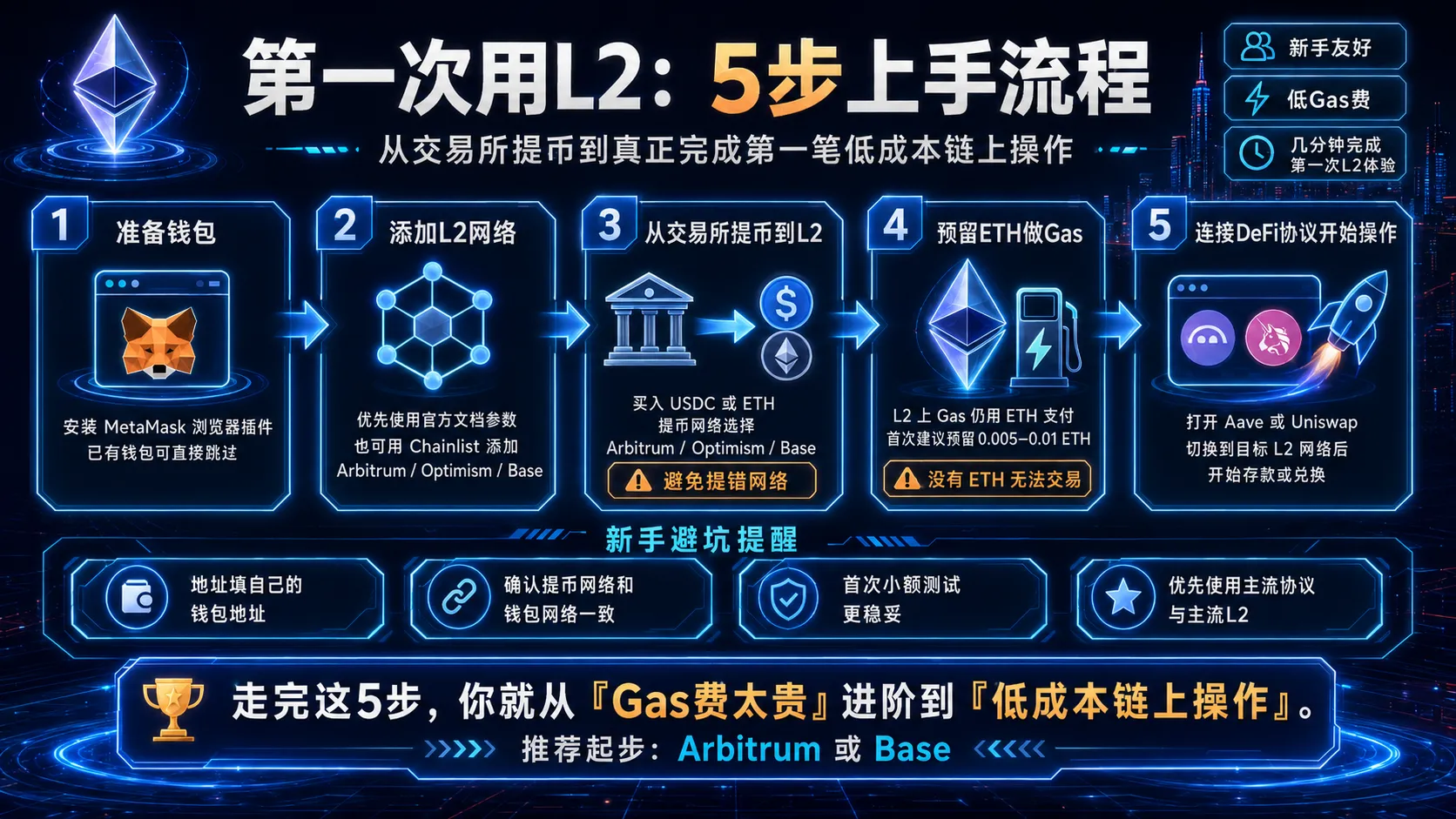
After these 5 steps, you'll graduate from "Ethereum is insanely expensive" to "I don't flinch at gas fees anymore."
2026 Layer 2 selection advice
| Your situation | Recommendation | Reason |
|---|---|---|
| First time using L2 | Arbitrum / Base | Fullest ecosystem or lowest gas |
| Mainly doing DeFi | Arbitrum | Most protocols, best liquidity |
| Coinbase user | Base | One-click withdrawal, zero barrier |
| Chasing the lowest fees | Base | Lowest gas |
| Watching OP ecosystem airdrops | Optimism | Superchain ecosystem |
| Larger capital | Spread across multiple mature L2s | Reduce single-L2 risk |
FAQ
Is Layer 2 safe? Can I lose my money?
Arbitrum, Optimism and Base are all time-tested L2s with security approaching Ethereum mainnet. But every on-chain operation carries risk: smart contract vulnerabilities and cross-chain bridge attacks are the risk categories specific to L2. Stick to mainstream L2s and don't put large capital on obscure new L2s.
How long does it take to withdraw from L2 back to Ethereum mainnet?
Optimistic Rollup-type L2s (Arbitrum, Optimism, Base) have a standard withdrawal time of about 7 days.[4] For fast withdrawals, you can use third-party bridges (like Hop, Across), which arrive in minutes but charge extra fees.
Are assets on L2 the same as assets on Ethereum mainnet?
ETH and USDC on L2 are "bridged versions," pegged 1:1 in value. In the vast majority of cases they can be treated as equivalent, but in extreme cases (a bridge attack) they can de-peg. This is one of the core risks of L2.
Which of the three L2s should I choose?
If you don't want to overthink it: choose Arbitrum — fullest ecosystem, longest running, highest fault tolerance. Coinbase users should prefer Base for the lowest gas.
Do I still need ETH to operate on L2?
Yes. Gas on L2 is also paid in ETH, just in much smaller amounts than mainnet. Before using L2 for the first time, remember to withdraw a small amount of ETH from the exchange to your L2 wallet.
Summary
Ethereum mainnet gas is expensive not because Ethereum is bad — quite the opposite: expensive gas means lots of users and high network demand. Layer 2 was born for exactly this demand: move high-frequency operations onto low-cost chains, and leave final settlement to the protection of Ethereum mainnet.
For beginners, the most important step is simply switching from mainnet to L2. After the switch you'll find that a transaction that cost $50 on mainnet is done for $0.3 on L2 — and the fees you save can stay in your strategy principal instead of being consumed by transaction costs.
Now that you understand how Layer 2 saves gas, the next step is actually operating on it — Is DeFi profitable? Yield sources + 5 major risks (2026) explains how to earn on-chain yield on L2 with Aave and Uniswap. If you also want to understand why Ethereum needs L2 and the value logic of ETH itself, start with What is Ethereum? Smart contracts, gas fees and Web3.
Data verification notes
All key facts in this article were verified on 2026-10-17, item by item:
- L2 vs mainnet fee gap: the Ethereum Foundation's Layer 2 page shows average transaction fee comparisons where L2 costs are significantly lower than mainnet; the exact multiple varies with network congestion. Source: Ethereum.org — Layer 2.
- Real-time data: each L2's TVL and risk data can be checked on L2Beat, and Ethereum mainnet gas prices on Etherscan Gas Tracker. Source: L2Beat; Etherscan Gas Tracker.
- Gas asset on L2: gas fees on Ethereum must be paid in native ETH, and transaction fees on L2 are also settled in ETH. Source: Ethereum.org — Gas.
- Withdrawal challenge period: Arbitrum documentation states the default challenge period is about one week; standard withdrawals back to Ethereum mainnet must wait for that challenge period to end. Source: Arbitrum docs — Challenge period.
Related articles:
- Solana or Ethereum? How to choose for your first on-chain experience (2026) — Don't want to pay gas? Solana may be the friendlier option
- Is Solana worth it for beginners? Low gas + easy onboarding, real experience (2026) — A firsthand account of your first on-chain operation
- Ethereum.org — Layer 2Average transaction fee comparison and main networks for L2 as a scaling solution
- L2BeatReal-time TVL, risk and activity data for each L2
- Etherscan Gas TrackerReal-time gas prices on Ethereum mainnet
- Ethereum.org — GasGas fees must be paid in native ETH
- Arbitrum docs — Challenge periodDefault challenge period is about one week; withdrawals back to mainnet require waiting
- 2026-10-17UpdateAdded evidence-chain superscripts and "Data verification notes"; refreshed key fact verification date.
See ourEditorial Policy and the correction process in ourCorrections Policy.
The CoinTrailHub editorial team focuses on crypto education for beginners, exchange security and P2P trading risk. This article is compiled from official sources and public data, reviewed by humans, and strives for accuracy but is not investment advice.
Last updated:2026-08-06 · Content reviewed by humans · Learn more
© 2026 CoinTrailHub · Original content. Reproduction or rewriting without permission is prohibited.