
What is Ethereum? Smart contracts, gas fees, and Web3
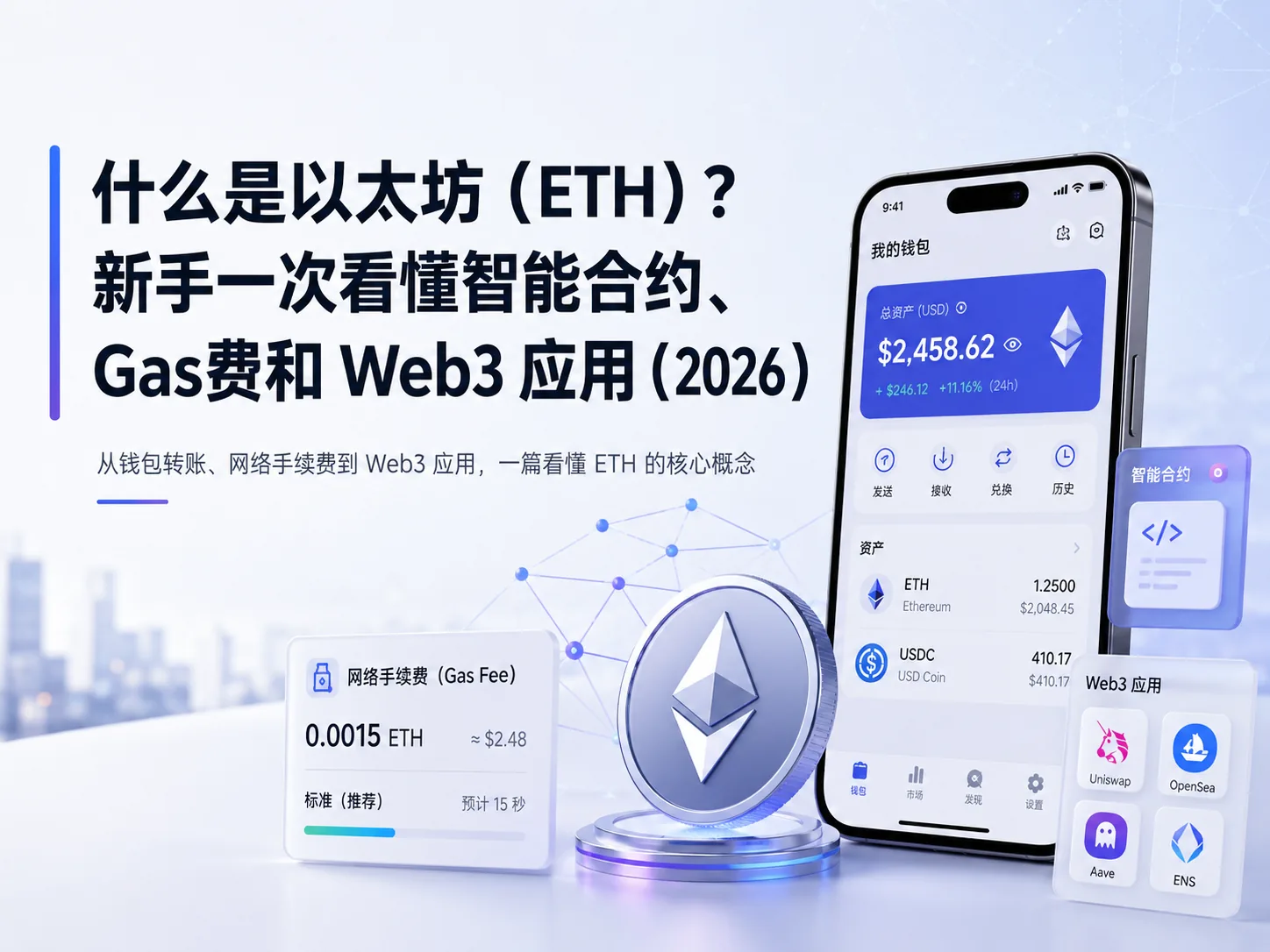
Table of contents

Binance new user rewards
20% trading fee rebate
Official Binance registration. Complete identity verification (KYC) to trade and withdraw.
Before I get into this, let me tell you a dumb thing I did when I first got into crypto.
At the time I had just started using wallets, had some USDT in hand, and wanted to send it to a friend. I opened the wallet, copied the address, pasted it, and hit send. Then a red line popped up: Insufficient funds.
My first reaction was: isn't my USDT enough? Is the wallet broken? Did I copy the address wrong?
I fiddled with it for over ten minutes, and finally asked someone else, only to learn — my wallet only had USDT, no ETH. To transfer on the Ethereum ERC20 network, the fee has to be paid in ETH, and I didn't have a single ETH.
So for a lot of people, ETH isn't first learned about in a price-chart app — it's understood only after it blocks you inside a wallet.
ETH isn't just a coin you can buy and sell. It's also the fee asset you often need when operating on the Ethereum network.
Get these two things straight:
- Ethereum is the network
- ETH is the native asset in this network
Bitcoin let many people first understand "on-chain assets" and "value transfer"; Ethereum lets people see further — blockchain can not only transfer, but also run smart contracts and Web3 applications.
This article is for basic education only, does not discuss price predictions, and does not constitute any investment advice.
If you're just starting to learn crypto systematically, you can first read these basic articles I wrote, then come back here — it will flow better:
- What is crypto? Cryptocurrencies, Web3 wallets, and on-chain assets (2026)
- What is blockchain? How it works, its uses, and risks (2026)
- What is Bitcoin (BTC)? How it works, its value, and risks (2026)
A few key points first
After reading this, remember a few things and you'll be fine:
- Ethereum is the network, and ETH is the network's native asset.
- Operating on the ERC20 network often requires ETH to pay gas fees.
- The common reason you have USDT in a wallet but can't send it isn't that your USDT is short — it's that you have no ETH for the fee.
Once you understand smart contracts, DeFi, NFT, and Layer2 later on, things will flow much more easily.
What is Ethereum?
Ethereum is a blockchain network that supports smart contracts, officially launched in 2015.
If Bitcoin made more people realize that blockchain can record and transfer value,
then Ethereum made people see further: blockchain can not only transfer, it can also run applications.
You can first understand Ethereum as:
A blockchain network that can run on-chain programs.
This is also one of its biggest differences from Bitcoin.
Bitcoin is more like an on-chain asset, while Ethereum is more like an on-chain application platform. A lot of DeFi, NFT, stablecoin, Layer2, Web3 wallet, and RWA content is related to Ethereum.
But when you're first learning ETH, you don't need to understand every application at once.
Understanding three things is enough to start:
- Ethereum is the network.
- ETH is the native asset.
- Gas fees are usually paid in ETH.
What is ETH?
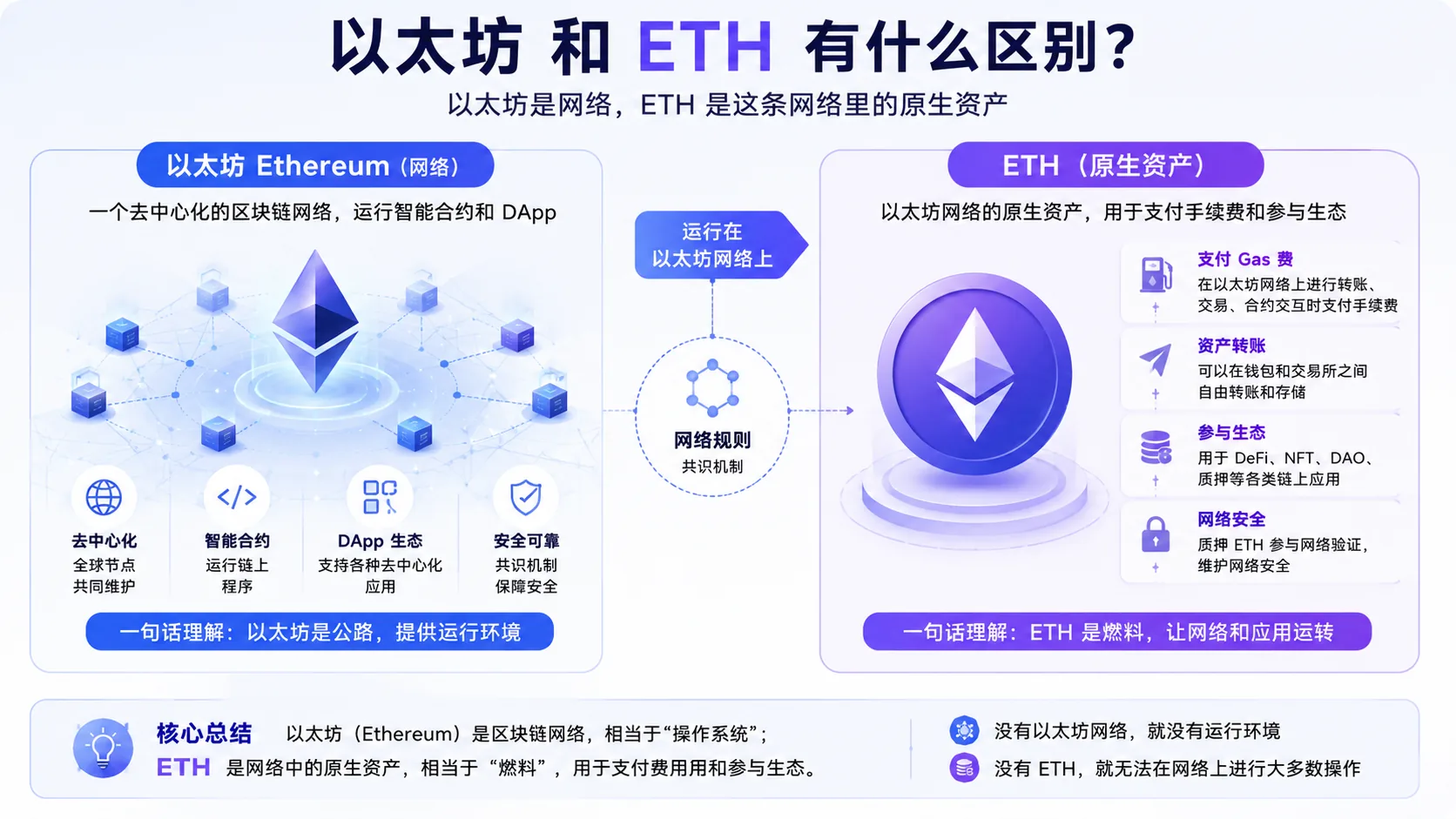
ETH is the native asset of the Ethereum network.
In daily conversation, many people use "Ethereum" and "ETH" interchangeably — including me when I was first learning. But the two are not the same thing.
- Ethereum: the blockchain network
- ETH: the network's native asset
For ordinary people, ETH has two most common uses.
One is as a digital asset that you can see in an exchange account or a Web3 wallet.
The other is more practical: ETH is often used to pay gas fees on the Ethereum network.
I once helped a friend check his wallet. It had 500 USDT plus some unknown altcoin, but the ETH balance was 0. He asked me why he couldn't send USDT, and I told him what he was missing wasn't USDT but the fee. He was confused: I'm sending USDT, why can't the fee come out of my USDT?
I asked that exact question back in the day too.
The answer is: on the Ethereum network, fees are usually paid in ETH. The system won't automatically convert your USDT into ETH to pay the fee for you.
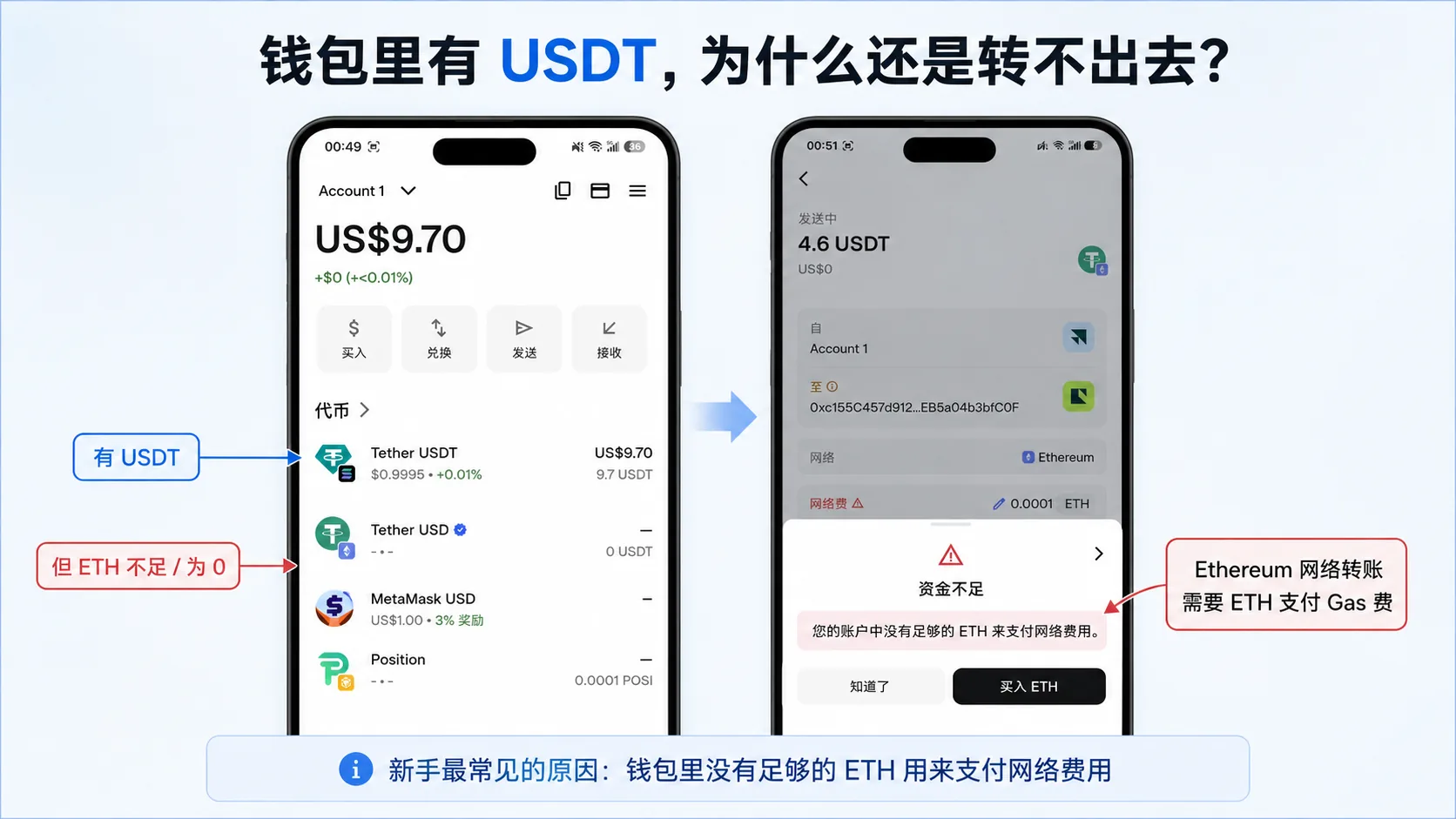
So his problem wasn't a lack of USDT, but a lack of ETH.
What's the difference between ETH and BTC?
One sentence to make it clear:
BTC is more like an on-chain store-of-value asset; ETH is more like the fuel of the on-chain application world.
This comparison helps you tell them apart quickly. No need to memorize — just glance at it for a rough impression:
| Dimension | BTC | ETH |
|---|---|---|
| Core positioning | Leans store of value | Leans Web3 applications |
| Common understanding | Digital gold | Fuel for on-chain apps |
| Network role | Records transfers and balances | Supports transfers, smart contracts, and DApps |
| Smart contracts | Not supported | Supported |
| Common uses | Transfers, store of value | Paying gas fees, participating in the ecosystem |
| Beginner pitfalls | Whether the address is right, whether it's on mainnet | Whether gas is enough, whether authorization is safe |
| Key risks | Price volatility, custody risk | Contract risk, authorization risk, fake websites |
Core positioning: BTC → store of value · ETH → Web3 applications
Common understanding: BTC → digital gold · ETH → fuel for on-chain apps
Network role: BTC → records transfers and balances · ETH → supports transfers + smart contracts + DApps
Smart contracts: BTC not supported · ETH supported
Application ecosystem: BTC → relatively simple · ETH → DeFi, NFT, stablecoins, Layer2, Web3 wallets
Common uses: BTC → transfers, store of value · ETH → paying gas fees, participating in the ecosystem
Common beginner questions: BTC → whether the address is right, whether it's on mainnet · ETH → whether gas is enough, whether authorization is safe
Key risks: BTC → price volatility, custody risk · ETH → contract risk, authorization risk, fake websites
Remember one core difference and that's enough:
BTC helps you understand what an on-chain asset is; ETH helps you understand how on-chain applications run.
Many people first learn What is crypto? Cryptocurrencies, Web3 wallets, and on-chain assets (2026) through BTC, then understand Web3 through ETH. I followed that same order myself.
What is a smart contract?
A smart contract can be understood in plain terms as:
A program deployed on the blockchain.
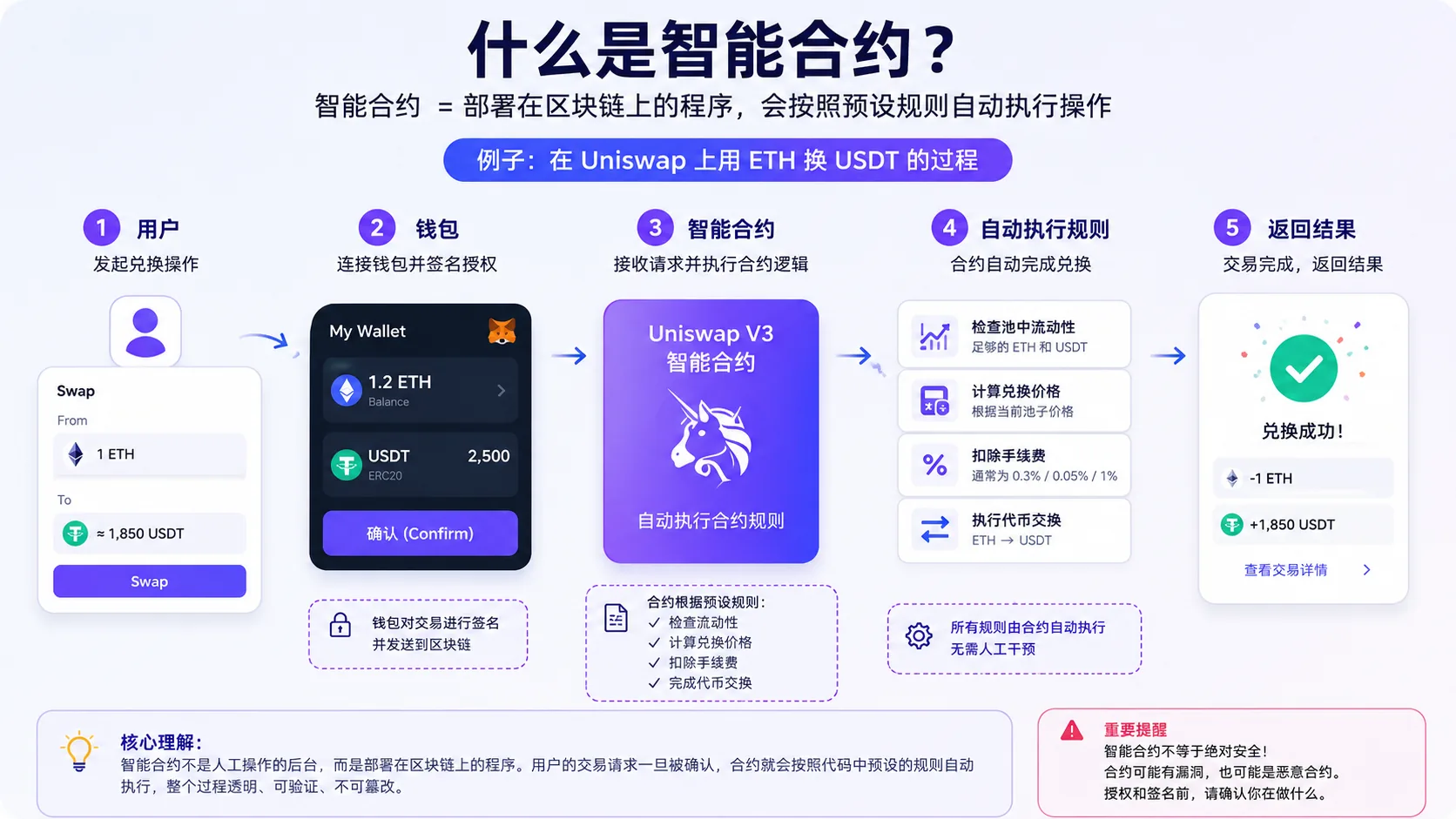
It isn't a paper contract in the traditional sense, nor a contract you sign and stamp with someone.
You can think of it as a set of rules written in advance. When a user triggers an action, the contract executes automatically according to the rules.
An example makes it much clearer.
You go to Uniswap to swap ETH for USDT — there's no customer service handling it, no backend changing your balance. Instead, your wallet interacts directly with the smart contract. The contract calculates the price, deducts assets, and returns the swap result according to the written rules, all in one go.
This is where Ethereum differs from Bitcoin: it can not only record asset transfers, but also let applications run automatically on-chain.
But here I want to seriously warn you:
A smart contract does not equal absolute safety.
Contracts can have vulnerabilities, and they can also be malicious contracts. I've seen more than one person casually click a "free airdrop" website, authorize a contract from an unknown source, and a few minutes later the assets in their wallet were swept away. It wasn't stolen — they authorized it with their own hands.
So when a wallet pops up "authorize," "sign," or "confirm," don't just look at the button — look carefully at what you're actually doing. If you don't understand it, don't click it.
What is a gas fee?
A gas fee can be understood as:
The fee you pay to use the Ethereum network.
Any action you initiate on Ethereum can incur a gas fee.
For example, sending ETH, sending ERC20-USDT, swapping tokens, approving tokens, revoking approvals, and interacting with smart contracts all use gas fees.
The way gas fees are calculated isn't complicated: Gas Used × Gas Price.
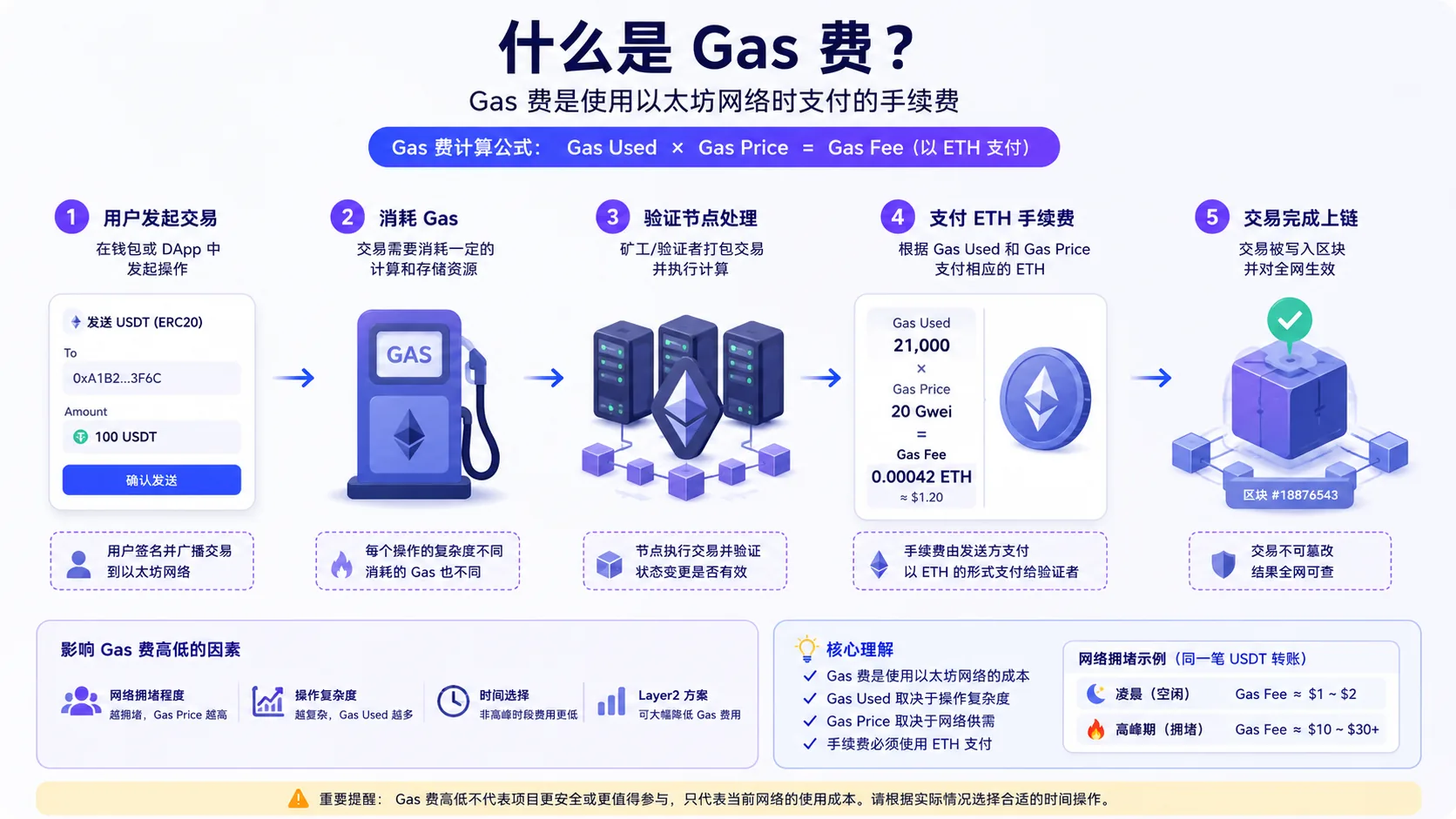
Gas Limit is the maximum amount of gas you're willing to pay for an operation, and Gas Price is the unit price you're willing to pay (official Ethereum explanation).
The more congested the network, the higher the Gas Price usually is. The same USDT transfer might cost only $2 in the early morning, but $20 or more at peak times — I've seen both.
Why gas fees?
Because these operations need the Ethereum network to process and verify, and they occupy network resources. The gas fee is the cost of using the network.
Why are gas fees sometimes expensive?
Gas fees aren't fixed.
When the network is idle, fees can be relatively low. When it's congested, fees can rise noticeably.
Especially during market hot spots, when many people compete to trade, mint NFTs, or join on-chain activities, gas fees tend to get expensive. A couple of years ago, during the launch of a hot NFT project, a single failed transaction burned several dozen dollars of my gas and got me nothing in return.
So don't understand gas fees as "the platform overcharging."
It's more like a supply-and-demand price for using the Ethereum network — more users, higher cost.
Do higher gas fees mean it's safer?
No.
High gas fees only mean this operation's network cost is high, or the network is currently congested.
It doesn't mean the project is safer, nor that this transaction is more worth doing.
If it's just an ordinary transfer and you're not in a hurry, you can check the current gas situation first — you don't have to operate during congestion.
Why do I have USDT in my wallet but can't send it?
This is the most common pitfall for first-time wallet users. I've stepped in it myself and helped others through it, so I especially want to explain it clearly.
The wallet clearly still has USDT, but when you hit send it shows:
Insufficient Funds
Very often, it's not that your USDT is short — it's that the wallet has no ETH.
The reason is simple:
On the ERC20 network, the fee usually needs to be paid in ETH.
The system won't deduct the fee from your USDT just because your wallet has USDT. You're sending USDT, but you're using the Ethereum network, and the network only recognizes ETH.
So you need to distinguish:
- USDT is the asset you're sending out
- ETH is the fee asset you need when using the Ethereum network
If you're using ERC20-USDT, you usually need to keep a little ETH in the wallet for gas.
My own habit is: as long as a wallet holds ERC20 assets, I always keep at least 0.005 to 0.01 ETH on the side specifically for fees. Otherwise, when I actually need to send, I suddenly realize I have no ETH, and I have to buy some on an exchange and move it in — a round trip that costs another gas fee. Not worth it.
What is ETH used for?
For ordinary people, ETH mainly does three things.
1. Paying gas fees
This is ETH's most basic and common use.
Transferring, approving, swapping, and interacting with contracts on the Ethereum network usually require ETH as the fee asset.
Without ETH, many Ethereum operations can't be completed.
2. As an on-chain asset
ETH can be transferred between wallets and exchanges, and held as an on-chain asset.
But that doesn't mean everyone is suited to holding ETH.
ETH's price is quite volatile — understanding the risk matters more than only watching short-term price moves.
3. Participating in Ethereum-related applications and mechanisms
Many Web3 applications are related to ETH, such as DeFi, NFT, DAOs, Layer2, and on-chain assets.
After Ethereum adopted proof of stake, ETH is also related to network validation and staking mechanisms.
But staking does not mean no risk. It can involve lock-up periods, platform risk, validator-node risk, liquidity risk, and price-volatility risk.
Don't only look at yield — understand the rules and risks first.
Why is ETH so closely tied to Web3?
Many Web3 applications are built on the Ethereum ecosystem, or on EVM-compatible networks.
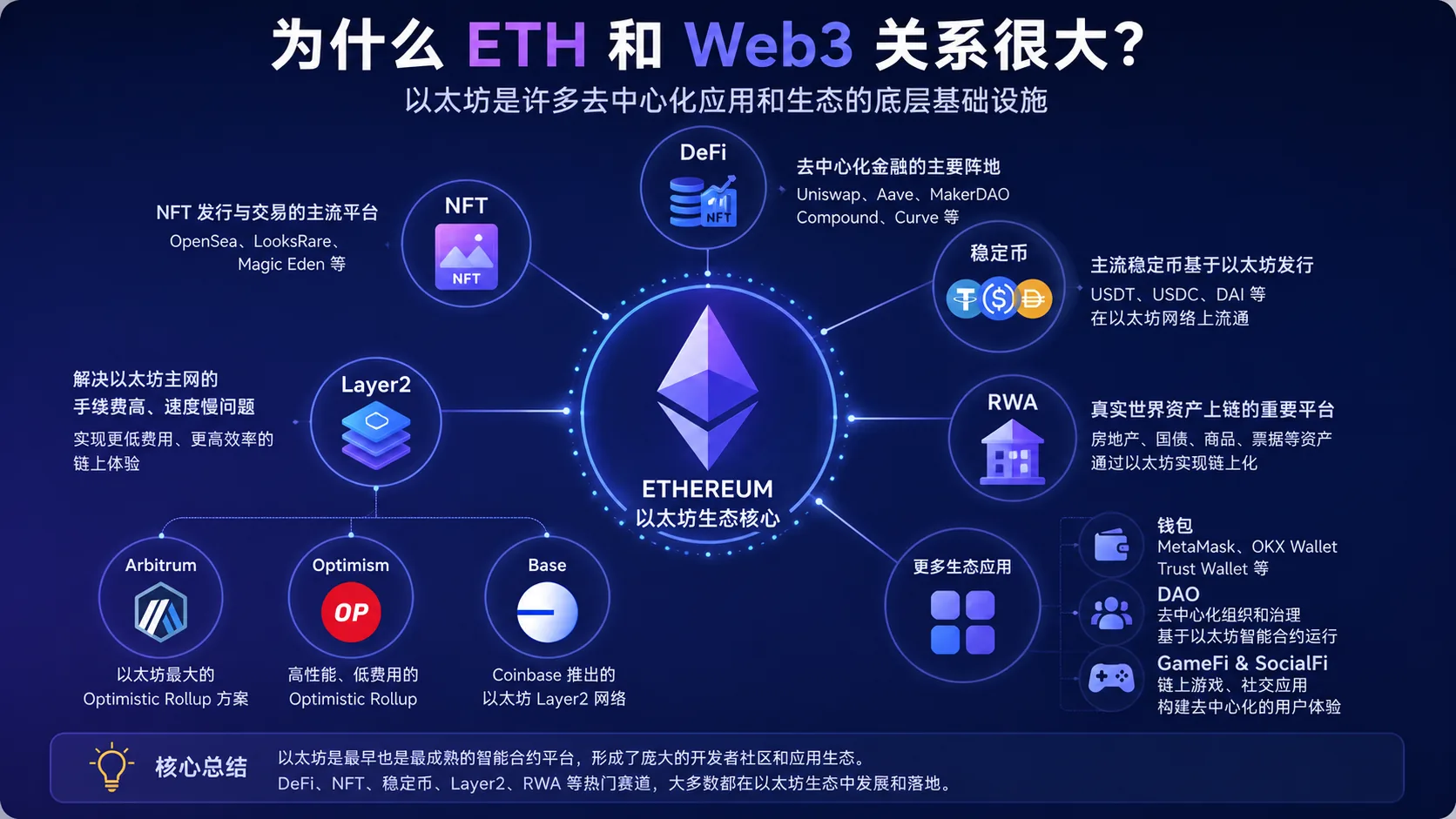
The reason is simple: Ethereum formed a large-scale smart-contract ecosystem relatively early, and many important on-chain applications and tools developed around it.
For example, stablecoins, DeFi, NFT, Layer2, and RWA are all frequently discussed alongside Ethereum.
Stablecoins like USDT, USDC, and DAI can circulate on the Ethereum network. DeFi applications like Uniswap, Aave, and MakerDAO are also deeply connected to the Ethereum ecosystem.
Layer2 networks like Base, Arbitrum, and Optimism mainly solve the mainnet fee and processing-efficiency problems, letting users access the Ethereum ecosystem at lower cost.
You don't need to learn all of this at the start. When first getting into it, understand wallets, gas fees, authorization, and network choice first, then go deeper — that's more stable.
As of 2026, Ethereum is still a mainstream network that many wallets, DeFi, NFT, stablecoin, and Layer2 applications can't avoid.
This doesn't mean ETH is necessarily better, nor that it has no competition. It means: learning Ethereum helps you understand the underlying logic of many Web3 applications.
Does ETH have competitors?
Yes.
Over recent years, many smart-contract platforms have been developing, all trying to solve the problems of fees, speed, user experience, and ecosystem expansion.
For example, Solana, BNB Chain, Sui, Aptos, and others.
Solana is known for speed and low fees; BNB Chain has a large user base and is easier for exchange users to access; Sui and Aptos are newer ecosystems that have developed quickly in recent years.
I use Solana and Base myself too, and the experience is genuinely good.
But when first learning, I don't recommend studying many chains at once.
The more chains, the easier it is to pick the wrong network, and the more likely wallets and assets get mixed up.
As of 2026, Ethereum is still a mainstream network many Web3 applications can't avoid.
This doesn't mean Ethereum has no competition, nor that ETH is necessarily better than other assets.
For people just getting started, understand Ethereum first, then slowly understand other public chains — that's smoother.
Why do many people eventually come to ETH from BTC?
Many people only hear about Bitcoin at first, then later come across USDT for transfers or deposits. After that, they start learning Web3 wallets, on-chain transfers, network choice, and gas fees.
When you truly start using a wallet, you'll find many questions can't avoid Ethereum:
- Why do ERC20 transfers need ETH?
- Why do DApp connections require authorization?
- Why are DeFi, NFT, Layer2, and RWA so often discussed alongside Ethereum?
So ETH isn't just the name of a crypto asset. It's more like a key to understanding the world of Web3 applications.
What important upgrades has Ethereum gone through?
Ethereum didn't stay the same after launch. It has been continuously upgrading, and I've been following its changes over the years.
You don't need to memorize every technical detail, but understanding these key upgrades helps you see why today's Ethereum is different from a few years ago:
2022 · The Merge: Ethereum moved from PoW to PoS. Energy consumption dropped sharply, and ETH became more closely tied to the staking mechanism.
2023 · Shanghai / Shapella: enabled staked ETH withdrawals. Staked ETH could be withdrawn according to rules, making the staking mechanism more complete.
2024 · Dencun: lowered Layer2 data costs. Base, Arbitrum, Optimism, and other Layer2 networks have lower fees and a better user experience.
There are three core directions: lower usage cost, improve scalability, and improve user experience.
After the Dencun upgrade, my Layer2 transfer fees dropped noticeably. Before, a mainnet transfer could cost several dozen dollars; now, going through Base or Arbitrum often costs only a few cents. That's also why more and more users are increasingly touching Layer2 networks.
A few places where Ethereum is easily misunderstood
Misconception 1: Ethereum is ETH
Not entirely correct.
Ethereum is the network, and ETH is the network's native asset. I couldn't tell them apart at first either, and remembered it after eating a loss once.
Misconception 2: higher gas fees mean safer
Wrong.
Gas fees reflect network cost, not safety. A high-gas operation can still be a risky operation.
Misconception 3: just confirm whatever the wallet pops up
Dangerous.
A wallet popup can be a transfer, approval, signature, or contract call. Each operation means something different. Don't hit "confirm" just because you see it — always read what the operation is first. I've seen too many people clear out their wallet by casually tapping "confirm."
What risks does ETH have?
1. Price volatility risk
ETH is a highly volatile crypto asset, and its short-term price can rise or fall noticeably.
Don't decide whether to participate based only on community hype, short-term price, or other people's recommendations.
Understanding risk matters more than chasing price.
2. Gas fee risk
When the network is congested, fees can rise noticeably. Sometimes even a simple operation can feel expensive.
Before operating, it's best to check the current gas situation, and confirm whether this operation is worth the cost.
3. Authorization and fake-website risk
Wrong authorization is one of the risks beginners most easily overlook.
Many DApps require you to approve token spending. If you authorize a malicious contract, or give overly broad permissions, your assets can be touched.
At the same time, many scammers impersonate wallet official sites, trading platforms, airdrop pages, and NFT project pages. Once you enter your seed phrase or sign a malicious transaction, your assets can be moved.
Real wallets and official customer support will never ask you for your seed phrase. If someone says they need your seed phrase to help you solve a problem, block them.
4. Smart contract risk
Once a smart contract is deployed, it can run for a long time. If the contract has vulnerabilities, or the project team's design is flawed, user assets can be at risk.
Don't only look at project marketing — understand contract risk too.
5. Network-choice risk
ETH, ERC20-USDT, Layer2 networks, and other EVM-compatible chains are often easy to confuse.
Before transferring, always confirm that the sender and receiver support the same network.
For your first operation, always do a small test. This isn't being overly cautious — it's a lesson I and people around me have both learned.
Before touching ETH, do these 5 things first
1. First understand the difference between ETH and Ethereum
Ethereum is the network, and ETH is the native asset on the network.
Get this difference straight first. Back then I didn't understand it, so when someone said "Ethereum is up," I thought ETH hadn't risen and missed a chance.
2. First understand gas fees
Without ETH to pay gas fees, many Ethereum operations can't be completed.
Don't wait until a transfer fails to realize there's no ETH in the wallet.
3. Distinguish ERC20, TRC20, BEP20
The same USDT on different networks is completely different.
Don't only look at the asset name — look at the network. The first time I sent USDT I almost chose the wrong network, and was lucky a friend stopped me.
4. Don't casually authorize unfamiliar contracts
Before authorizing, first confirm whether the website is real, where the contract comes from, and what the operation does.
When you don't understand it, don't rush to hit confirm. If you don't understand, ask first, check first, or do a small test first.
5. Do a small test for your first operation
Whether sending ETH, sending ERC20-USDT, or connecting to a DApp, it's recommended to do a small test the first time.
Confirm the process first, then consider later operations. This habit has saved me quite a bit of money.
Related reading
- Ethereum gas too expensive? How to choose Arbitrum/Optimism/Base (2026)
- Can BNB Chain pay fees in USDT? BEP20 transfers and gas, tested (2026)
- Solana or Ethereum? How to choose for your first on-chain experience (2026)
FAQ: common Ethereum questions
Are ETH and Ethereum the same thing?
Not exactly the same. Ethereum is the network, and ETH is the native asset of the Ethereum network.
In daily conversation, many people use the two interchangeably — including me — but it's best to keep them straight in your mind.
Why do I need ETH to send USDT?
If you're sending ERC20-USDT, the transaction happens on the Ethereum network. Fees on the Ethereum network are usually paid in ETH. So when a wallet has only USDT and no ETH, the transfer may not complete.
Does ETH have a total supply cap?
ETH is different from BTC.
BTC is usually considered to have a 21 million total cap, but ETH doesn't have the same fixed cap as BTC.
However, Ethereum has fee-burning and staking mechanisms that affect supply changes. You don't need to go deep at first — just know that ETH's supply logic is different from BTC's.
Will ETH halve like Bitcoin?
No. Bitcoin has halving, which is written into its code, once every four years. Ethereum doesn't have this mechanism. Many people apply BTC logic to ETH when they're first learning, which is easy to confuse.
Can ETH be staked?
Yes. After Ethereum adopted proof of stake, ETH can be used in staking-related scenarios.
But staking does not mean no risk — it can involve lock-up periods, platform risk, validator-node risk, liquidity risk, and price-volatility risk.
Don't only look at yield — understand the rules and risks first.
Will ETH go to zero?
Any digital asset has risks.
As of 2026, Ethereum is still a mainstream network that many wallets, DeFi, NFT, and Layer2 applications can't avoid.
But this doesn't mean ETH has no risk, nor that it will necessarily keep its current position forever.
What's more worth focusing on is whether you truly understand the price-volatility, gas-fee, authorization, contract, and network-choice risks.
What to learn next?
If you're learning crypto systematically for the first time, I suggest continuing in this order:
- What is USDT — understand stablecoins, deposits, withdrawals, and network choice;
- What is a Web3 wallet — understand wallets, seed phrases, private keys, and on-chain addresses;
- What is a gas fee — further understand the fee logic across different chains;
- What is a seed phrase — understand why you might not recover assets if it's lost;
- Can a transfer sent on the wrong chain be recovered — one of the most common problems people hit when actually operating.
If you haven't read the earlier basic articles, you can go back and read them first, building a foundation before moving on:
- What is crypto? Cryptocurrencies, Web3 wallets, and on-chain assets (2026)
- What is blockchain? How it works, its uses, and risks (2026)
- What is Bitcoin (BTC)? How it works, its value, and risks (2026)
Summary
When first getting into crypto, you don't need to study complex smart contracts or DeFi at the start.
Understanding these questions matters more:
- Ethereum is the network;
- ETH is the native asset;
- Gas fees usually need to be paid in ETH;
- Why ERC20-USDT transfers need ETH;
- Why wallet authorization and smart contracts carry risk.
Once these are clear, learning Web3 wallets, Layer2, RWA, and on-chain assets becomes much easier.
Learning Ethereum isn't about operating right away, but about understanding how the whole Web3 world runs.
Disclaimer
This article is for basic education about Ethereum, crypto, and on-chain assets only, and does not constitute any investment, financial, or trading advice.
Crypto-asset prices are quite volatile, and related services may carry platform risk, market risk, liquidity risk, regulatory risk, network-security risk, contract risk, and operational risk. Regulatory requirements differ across countries and regions, so please refer to official pages and the laws and regulations where you live, and judge carefully based on your own risk tolerance.
This content is for reference only. Please verify on your own and consult professionals before operating. Any operation involving account registration, identity verification, deposits, withdrawals, wallet authorization, smart-contract interaction, and asset management should first confirm the official channel, and only proceed after fully understanding the risks.
- Ethereum.orgOfficial basics on the Ethereum network and ETH
- Ethereum Smart ContractsHow smart contracts work and their operating mechanism
- Ethereum Gas FeesGas Limit and Gas Price pricing explanation
- Ethereum RoadmapEthereum upgrade roadmap and core direction
- Ethereum The MergeThe merge upgrade from PoW to PoS
- Ethereum DencunThe upgrade that lowered Layer2 data costs
- Binance AcademyPublic-chain and Web3 basics
- Coinbase LearnBeginner explanations of Ethereum and on-chain assets
See ourEditorial Policy and the correction process in ourCorrections Policy.
The CoinTrailHub editorial team focuses on crypto education for beginners, exchange security and P2P trading risk. This article is compiled from official sources and public data, reviewed by humans, and strives for accuracy but is not investment advice.
Last updated:2026-06-18 · Content reviewed by humans · Learn more
© 2026 CoinTrailHub · Original content. Reproduction or rewriting without permission is prohibited.