
What Is Crypto? Cryptocurrencies, Web3 Wallets and On-Chain Assets (2026)

Table of contents

Binance new user rewards
20% trading fee rebate
Official Binance registration. Complete identity verification (KYC) to trade and withdraw.
The first time you meet Crypto, it probably isn't a whitepaper — it's a pile of words you can't parse: Bitcoin, Ethereum, USDT, exchanges, Web3 wallets, seed phrases, gas fees. They all look crypto-related, but they aren't quite the same thing.
Some people finish registering on an exchange and then discover they still have to do KYC. Others make their first transfer and can't understand why the same USDT comes with different networks like TRC20 and ERC20. And after touching wallets, they run into private keys, seed phrases and approvals on top of addresses.
These confusions are all normal.
Crypto isn't one product, and it isn't just Bitcoin. It's more like an ecosystem made of blockchains, digital assets, trading platforms, wallets and all kinds of on-chain applications.
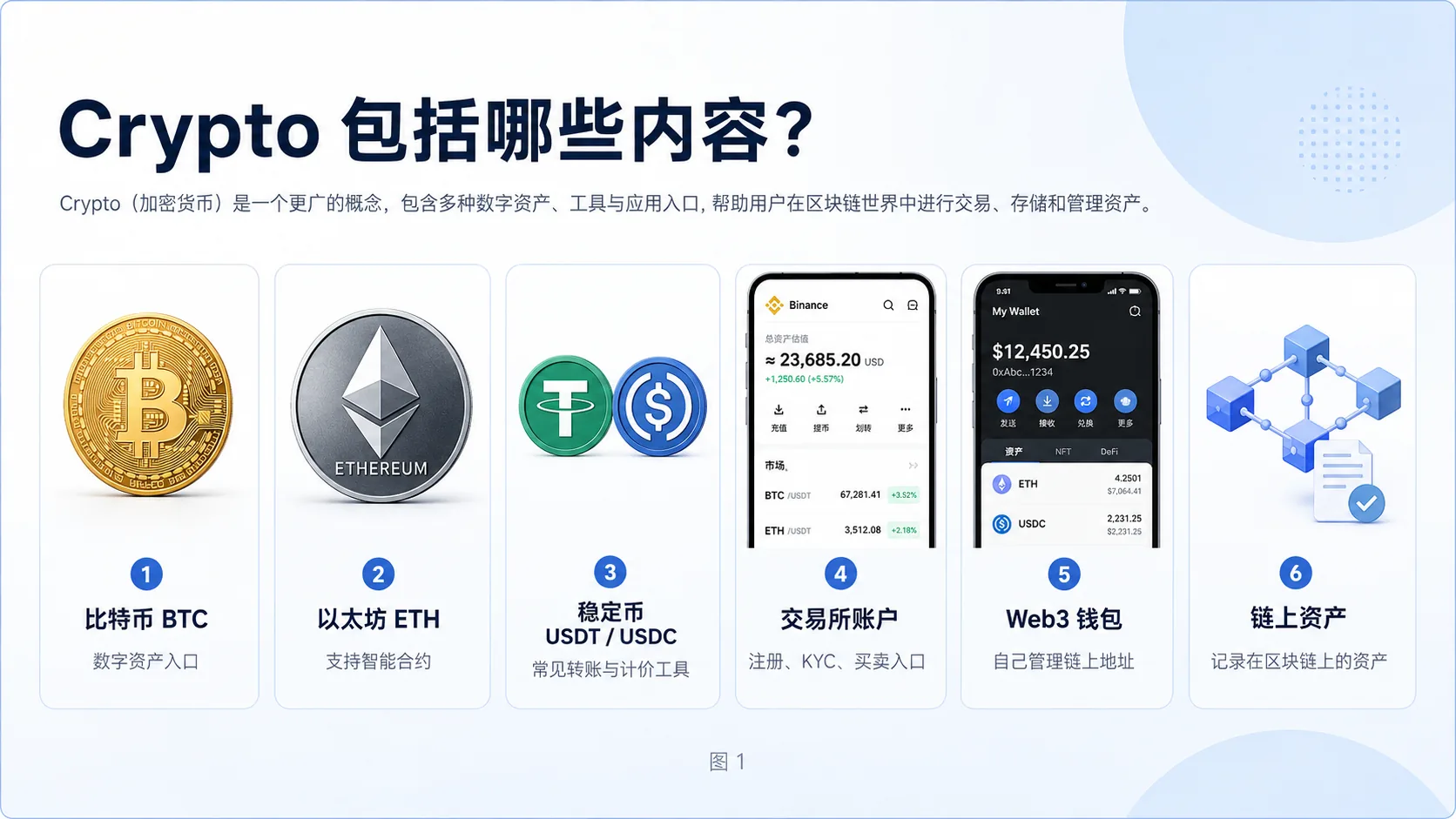
For beginners, you don't need to study complex technology right away. It's more important to first understand what Crypto includes, how the different concepts relate to each other, where to start, and which mistakes are most likely to cost you assets.
This article walks you through Crypto from zero, in the simplest way possible, and helps you build a complete basic understanding.
About 7 minutes to read. First remember one sentence: Crypto isn't a single product — it's an ecosystem made of assets, networks, platforms and wallets.
This article is for basic education only and does not constitute investment, financial or trading advice.
Meet Crypto in one minute
| Item | Beginner's understanding |
|---|---|
| English name | Crypto |
| Common Chinese names | cryptocurrency, crypto assets |
| Is it only Bitcoin | No, Crypto also includes ETH, USDT, Web3 wallets and on-chain assets |
| Does it equal trading coins | No, trading is only one behavior some users do with Crypto |
| A beginner's first step | Understand the basic concepts first; don't rush to operate |
| Most important keywords | wallet, network, seed phrase, security, small-amount test |
| Study focus | Understand first, then operate |
If you only want the key point, remember one sentence: Crypto isn't a single product — it's a whole ecosystem made of digital assets, blockchain networks, trading platforms, wallets and on-chain applications.
What problem does CoinTrailHub try to solve?
CoinTrailHub has a clear positioning: helping beginners systematically understand Crypto and on-chain assets.
We don't pump coins, don't lead trades, and don't talk about "100x coins".
What we care about more are these basic questions:
- What exactly is the difference between Bitcoin and Ethereum
- Why USDT has different networks
- Whether an exchange account and a Web3 wallet are the same thing
- What to watch for with KYC, P2P, deposits and withdrawals
- Why you must not screenshot your seed phrase or send it to anyone
- Whether a wrong-chain transfer can still be fixed
- How to recognize fake support, fake airdrops and fake official sites
These questions aren't cool or complex, but they're exactly where beginners run into trouble.
So CoinTrailHub would rather you understand first and act second. Get the order right, and everything after becomes much easier.
What does Crypto include?
Crypto isn't one thing. It's a whole system with assets, accounts, tools, networks and applications. Beginners can start with these parts.
1. Bitcoin (BTC)
Bitcoin is where many people first meet Crypto. It's a digital asset running on a blockchain network — not points issued by some company, and not an ordinary virtual balance inside a platform.
Bitcoin's total supply is generally considered capped at 21 million, and it's the asset most people first learn about when they touch blockchain.[1]
2. Ethereum (ETH)
Ethereum isn't just a coin. Behind it is a blockchain that can run smart contracts.[2] Many DeFi, NFT and Web3 applications are tied to the Ethereum ecosystem.
Simple version: Bitcoin is more like an asset, while Ethereum is more like a network that runs applications.
With Ethereum, beginners should also note one concept: gas fees. You can think of gas as the network fee paid for on-chain operations.[3] When the network is busy the fee may rise; when it's quiet the fee is usually lower. If you're not in a hurry, check the current gas price before you decide to act.
3. Stablecoins (USDT, USDC)
For many users, the first contact with Crypto isn't BTC — it's USDT. Stablecoins are often used for deposits, withdrawals, P2P, on-chain transfers and moving assets between platforms.
But a stablecoin is not a bank deposit. It still depends on the issuer, reserve assets, platform support, the on-chain network and the regulatory environment.[4] A stablecoin does not mean no risk. When beginners see the word "stable", they shouldn't translate it straight to "completely safe".
4. Exchange accounts
An exchange is where most people enter the Crypto world. Registering, KYC, deposits, withdrawals and swapping assets mostly happen here.
But note: an exchange account is not a Web3 wallet. The assets you see on a platform are essentially recorded and managed by the platform for you. Exchanges suit beginners, but you should also understand platform rules, account security, withdrawal networks and risk controls.
5. Web3 wallets
A wallet is the tool you use to control your own on-chain assets. It's closely tied to wallet addresses, private keys, seed phrases and contract approvals.
Custodying assets yourself means more control — and more responsibility. The thing beginners most easily overlook with their first wallet isn't complex technology; it's the importance of the seed phrase. If you don't yet understand seed phrases, private keys, approvals and networks, don't rush to move assets into a wallet.
What are on-chain assets?
Simply put: any asset recorded on a blockchain can be called an on-chain asset.
For example, BTC, ETH, USDT, USDC, NFTs, gold tokens, RWA and on-chain stocks can all be on-chain assets.
The biggest difference from traditional account assets is that traditional assets are mainly recorded in a platform's system, while on-chain assets are recorded in the blockchain network and controlled through wallet addresses, private keys and seed phrases.
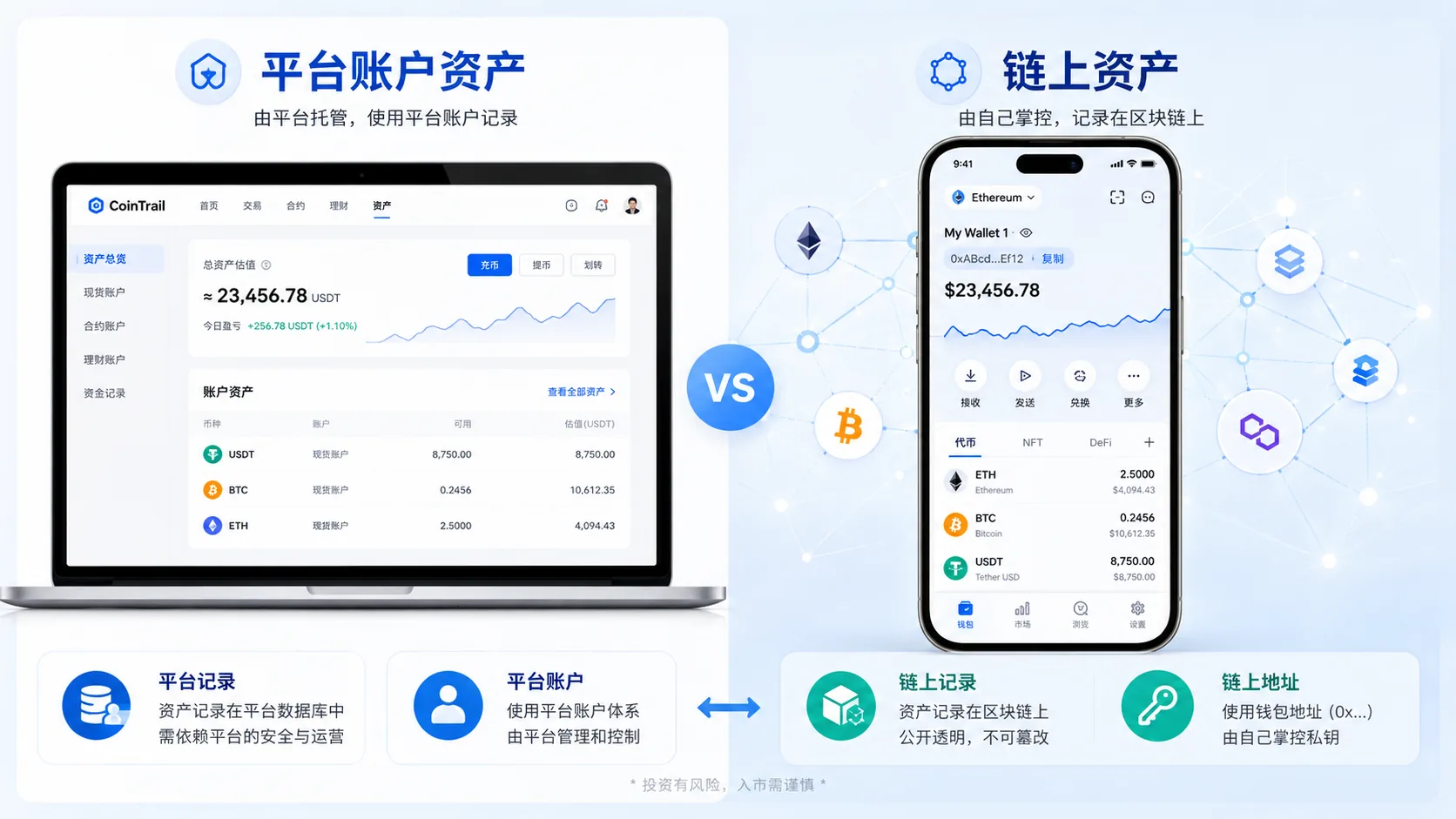
This means more freedom, but usually a smaller margin for error. Account records on a traditional platform can often still be handled through customer support or the order system. But once an on-chain transfer is confirmed, it's usually very hard to undo.
Our team also ran into TRC20 vs ERC20 confusion when we first tested USDT transfers. Fortunately we sent a very small amount first and only continued after confirming it arrived. Since then we've always told beginners: for your first transfer, test with a small amount. It costs a little time, but it's usually far less trouble than fixing things afterward.
A recommended order for learning Crypto
Many people, at first, mostly worry about which concept to read first, which platform to use, how to download a wallet, and when to start on-chain operations. The truth is, the order matters more than the answer.
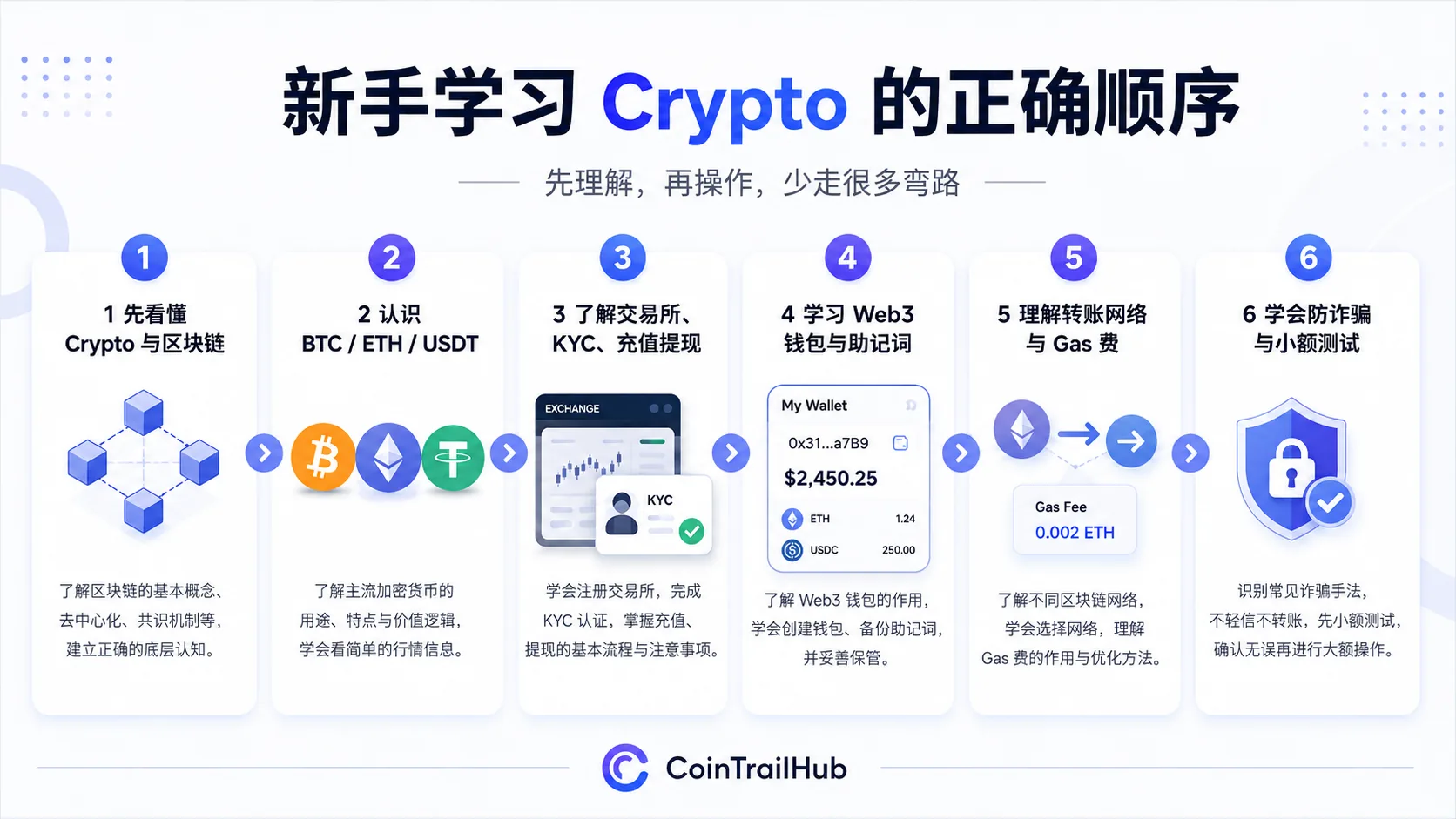
Step one: understand Crypto and blockchain
You don't need to study code. First understand why on-chain transfers usually can't be undone freely, why addresses and networks matter, why a seed phrase must not leak, and why blockchain records are hard to change casually. Basic concepts matter more than complex technology.
Step two: get to know BTC, ETH and USDT
These are the assets most people meet first. Knowing what they are before chasing price and market makes things much easier.
- BTC is more like the entrance through which many people meet Crypto
- ETH is more like a network asset that supports smart contracts and applications
- USDT shows up most often in deposits, withdrawals, transfers and pricing
Step three: understand exchange accounts
Registering, KYC, deposits, withdrawals and swapping assets usually all go through an exchange. Understanding the difference between a platform account and a wallet is very important. Exchanges suit beginners, but that doesn't mean there's no platform risk. Don't download apps or log in through unfamiliar links.
Step four: learn Web3 wallets and seed phrases
This is the core of asset security. If you don't yet understand seed phrases, don't rush into wallets. A wallet isn't an ordinary app. A seed phrase isn't a verification code or an ordinary password — it's more like the only key that restores your wallet.
Step five: understand networks and gas fees
Many assets that "don't arrive" aren't a platform problem — it's a wrong network, a wrong address, insufficient fees, or a receiving platform that doesn't support that network. On your first transfer, a small-amount test often avoids a lot of trouble.
Step six: then move to on-chain assets and advanced topics
For example RWA, gold tokens, on-chain stocks, DeFi and NFT. Once the basics are clear, these are much easier to approach. Beginners shouldn't jump into complex plays on day one.
A risk ladder for Crypto beginners
| Risk level | Common problem | What a beginner should do |
|---|---|---|
| High | Seed phrase leaked, private key lost | Don't screenshot, upload or send it to anyone; store it safely offline |
| High | Fake support, fake sites, fake airdrops | Don't click unfamiliar links, don't enter your seed phrase, don't trust private-message support |
| Medium | Wrong network, wrong address | Confirm coin, network and address before transferring; test small the first time |
| Medium | Approving a malicious contract | Don't connect to unfamiliar DApps casually; don't confirm an approval you don't understand |
| Low | High gas fees, slow arrival | Check network congestion; avoid peak times when not in a hurry |
Most problems can be reduced by testing small, checking carefully and not rushing. For beginners, understanding risk matters more than chasing speed.
Related reading
FAQ: common questions from Crypto beginners
What's the difference between Crypto and blockchain?
People often mix the two. Simply put, Crypto is the whole cryptocurrency ecosystem and blockchain is the underlying technology. Blockchain records data, while BTC, ETH, USDT, wallets and on-chain assets are all part of the Crypto world.
What should a beginner do first?
Don't rush to operate or allocate assets. It's more important to first understand blockchain, BTC, ETH, USDT, wallets and seed phrases. Once the basic concepts are clear, operating becomes much easier.
Which suits beginners better, an exchange or a wallet?
For people new to Crypto, an exchange is usually easier to pick up. A wallet gives more autonomy, but also means you keep the seed phrase yourself, confirm addresses and networks yourself, and bear the operating risk yourself. There's no absolutely safer choice — the key is whether you understand the corresponding risks.
Can I get a lost seed phrase back?
Usually not. This is the thing beginners most easily overlook when they first touch wallets. A wallet isn't an ordinary app — there's no password reset and no recovery button. It's best to store your seed phrase offline: don't screenshot it, don't upload it to cloud drives, and don't send it to anyone.
Why does USDT have different networks?
USDT can exist on different blockchains, such as TRC20, ERC20, BEP20 and Solana.[5] So when transferring, confirm not just the coin but also the network. Many "asset didn't arrive" problems ultimately come down to network choice.
Can I learn Crypto without technical skills?
Of course. For most ordinary users, you don't need to learn code or complex algorithms. What matters more is understanding wallets, networks, seed phrases, the transfer flow and safety risks. This knowledge matters more than technical details.
What to learn next?
If you're just starting to study Crypto systematically, continue in this order.
- What Is Blockchain? A Beginner's Guide (2026) → understand why on-chain records can't be changed casually
- What Is Bitcoin (BTC)? A Beginner's Guide (2026) → meet the earliest widely accepted asset in the Crypto world
- What Is Ethereum (ETH)? A Beginner's Guide (2026) → understand smart contracts and gas fees
- What Is USDT? Tether Uses and Risks (2026) → learn stablecoin uses and common networks
- USDT vs USDC: What's the Difference? Which Is Safer and How to Choose (2026) → understand the difference between USDC and USDT, and where USDC is used among on-chain assets
- What Is a Crypto Wallet? Wallet Addresses, Seed Phrases and Asset Security → understand addresses, private keys and asset management
- Are on-chain RWA assets worth investing in? My real experience buying NVDAon → understand how real-world assets enter the on-chain world
- Can You Recover a Wrong-Chain Transfer? Withdrawal Networks and Wallet Addresses → the most common real problem beginners run into
Data verification notes
The key facts in this article were checked on 2026-10-17, item by item:
- Bitcoin supply cap: the Bitcoin protocol sets the total supply cap at 21 million. Source: Bitcoin.org — FAQ.
- Ethereum and smart contracts: Ethereum is a blockchain network that supports smart contracts, where DeFi, NFT and other applications can be deployed. Source: Ethereum.org — What is Ethereum.
- Gas fees: gas is the transaction fee on the Ethereum chain, must be paid in native ETH, and varies with network congestion. Source: Ethereum.org — Gas.
- Stablecoin reserve dependence: Tether's official transparency page explains that USDT keeps a one-to-one peg to the corresponding fiat and is backed by reserves, with circulation data updated regularly. Source: Tether — Transparency.
- USDT's multi-network issuance: Tether's official supported-networks page lists Ethereum (ERC20), Tron (TRC20), Solana, BNB Smart Chain and other networks. Source: Tether — Supported networks.
References
This article was compiled with reference to the following public resources:
Content is compiled from public information as of 2026. The Crypto industry changes quickly, and rules may differ by country and region. Please follow official pages and local laws and regulations.
Author info
Author: CoinTrailHub Editorial Team
Published: 2026-06-14
Updated: 2026-06-14
The CoinTrailHub editorial team has 8 years of crypto industry and content research experience, with long-term focus on Bitcoin, Ethereum, stablecoins, exchange registration and KYC, Web3 wallets, seed-phrase security, on-chain transfers and common scam risks.
This site's content is mainly aimed at beginners new to Crypto, focusing not on pumping coins or predicting the market, but on helping users understand basic concepts, operating flows and common risks in a simpler way. This article is for basic education only, does not represent any platform's official position, and does not constitute investment advice.
Disclaimer
This article is for basic education on Crypto, blockchain and on-chain assets, and does not constitute investment, financial or trading advice.
Crypto asset prices are highly volatile, and related services may carry market risk, platform risk, liquidity risk, regulatory risk and operational risk.
Regulatory requirements differ by country and region. Users should follow local laws and official pages, and make cautious judgments based on their own risk tolerance.
Any operation involving account registration, deposits, withdrawals, wallet approvals and asset management should first confirm the official channel, and only proceed after fully understanding the risks.
- Bitcoin.org — FAQBitcoin's 21 million supply cap and divisible units
- Ethereum.org — What is EthereumEthereum is a blockchain network that runs smart contracts
- Ethereum.org — GasGas fees must be paid in native ETH
- Tether — TransparencyUSDT's one-to-one peg to fiat, reserves and circulating supply data
- Tether — Supported networksUSDT is deployed on Ethereum, Tron, Solana and other networks
- 2026-10-17UpdateAdded evidence-chain superscripts and Data Verification Notes; updated the key-fact verification date.
See ourEditorial Policy and the correction process in ourCorrections Policy.
The CoinTrailHub editorial team focuses on crypto education for beginners, exchange security and P2P trading risk. This article is compiled from official sources and public data, reviewed by humans, and strives for accuracy but is not investment advice.
Last updated:2026-06-20 · Content reviewed by humans · Learn more
© 2026 CoinTrailHub · Original content. Reproduction or rewriting without permission is prohibited.