
What are on-chain assets? Common types and risks
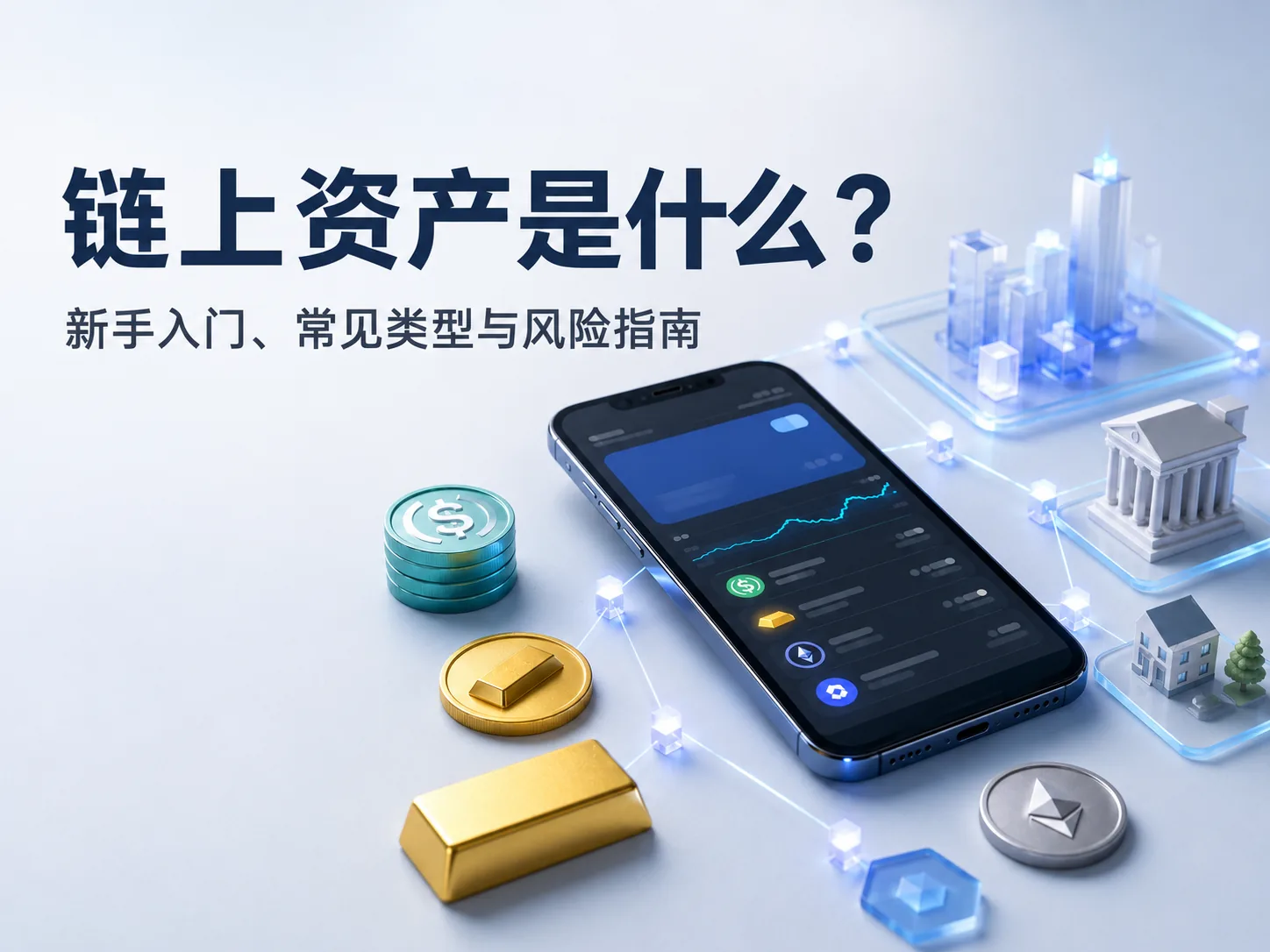
Table of contents

Binance new user rewards
20% trading fee rebate
Official Binance registration. Complete identity verification (KYC) to trade and withdraw.
The term "on-chain assets" now packs in more and more things.
Bitcoin, stablecoins, NFTs, DeFi, treasury token, on-chain gold, on-chain stocks — all can be filed under this category.
But aside from all being related to blockchain, their underlying value sources and risks are completely different.
The point many beginners most easily misjudge is treating "on-chain" as a certification of value: as if putting an asset on a blockchain automatically makes it more transparent and safer.
I don't see it that way.
Going on-chain only changes how an asset is recorded and transferred; it doesn't automatically add value to it.
Blockchain can make transaction records public, but it can't prove reserves on behalf of the issuer, nor guarantee that a custodian can actually redeem.
So when looking at on-chain assets, the point is never which chain it uses, but what actually backs it, who controls it, and how you eventually exit.
If you're unclear about what blockchain actually solves, start with What is blockchain? How it works, its uses, and risks (2026).
Common on-chain assets — what's the difference?
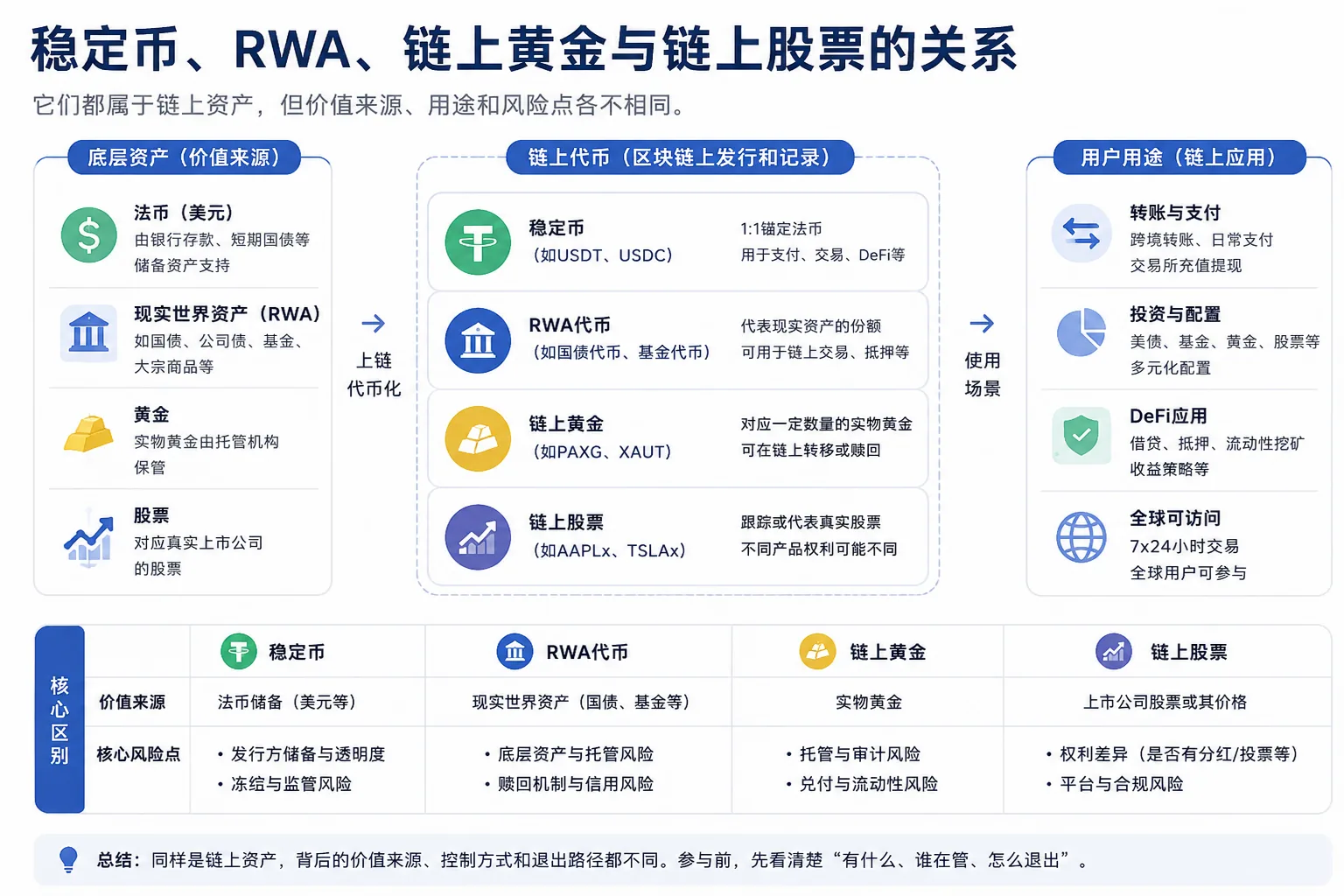
| Type | Main use | What matters most | My take |
|---|---|---|---|
| BTC, ETH | Network transfers, settlement, smart contracts | Price volatility and network utility | Understand them first; no need to rush into too many tokens |
| Stablecoins | Settlement, transfers, on-chain payments | Issuer, reserves, transfer network | What beginners should understand first |
| RWA | Bringing Treasuries, funds and other assets on-chain | Custody, user rights, redemption | A worthwhile direction, but judge each product individually |
| On-chain gold | Gaining gold-related exposure | Physical backing, audit, redemption | Gold being reliable doesn't mean the token is reliable |
| On-chain stocks | Gaining stock-price-related exposure | Underlying stock, rights, exit method | The easiest to be misled by a stock's name |
| NFT, complex DeFi | Digital certificates, swaps, lending | Liquidity, authorization, contract risk | Not a required course for beginners |
Things called "on-chain assets" can be completely different in what you actually own.
Some assets mainly rely on the blockchain network itself to run; others still depend on the issuing company, the custodian and real-world legal arrangements behind them.
Beginners should understand stablecoins first
Among on-chain assets, stablecoins have the most direct use.
USDT and USDC are used for settlement, wallet transfers, DeFi and RWA products. Many new products look complex, but in the end money flowing in and out still relies on stablecoins.
But a stablecoin is not a bank deposit.
It still depends on the issuer, the reserve assets and the redemption arrangement. The same stablecoin may also run on multiple networks; if you pick the wrong network when transferring, your assets may never arrive properly.
So beginners don't need to study dozens of projects at the start — it's more practical to understand a few things first:
- Who issues USDT and USDC;
- Why the same stablecoin appears on different networks;
- Why the withdrawal and receiving networks must match;
- How to check and transfer the stablecoins in your wallet.
For the difference between the two mainstream stablecoins, see USDT vs USDC: which is safer and how to choose (2026).
For reserve information, try to look at official disclosures rather than screenshots on social media:
Stablecoins aren't risk-free, but their use is already clear enough, and they're a good entry point for understanding on-chain assets.
RWA is worth watching, but don't just look at "real assets"
I care more about RWA not because the concept is new, but because the Treasuries, funds, gold and stocks behind it already have real markets.
If blockchain can lower issuance and settlement costs, this direction is naturally meaningful.
But "real-world asset" doesn't mean a product is automatically reliable.
What a user gets is usually still a token; who buys the underlying asset, where it's kept, what rights the user has and whether it can be redeemed all depend on the specific structure.
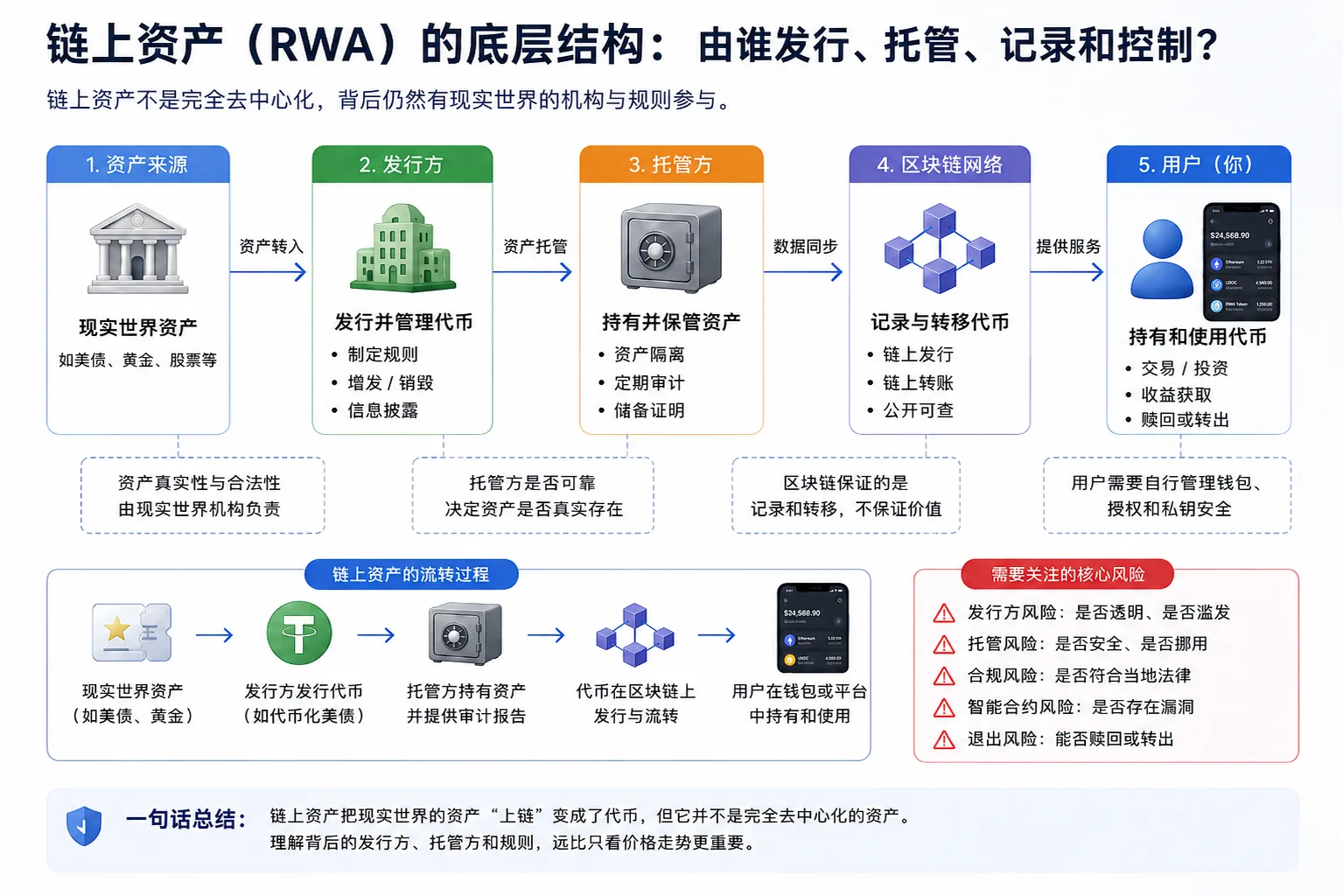
If you want to sort out the basic logic of RWA first, see Are RWA on-chain assets worth investing in? My real experience buying NVDAon.
On-chain gold
On-chain gold sounds simple: gold as backing, token in your wallet.
But some products are backed by physical gold, while others mainly provide gold-price-related exposure — the two are not the same thing.
When I look at this type of product, I mainly check three things:
- Who custodies the gold;
- Whether reserves and audits are continuously public;
- Whether ordinary users can redeem normally.
Taking PAXG as an example, you can check the Paxos transparency page directly, rather than only believing the "backed by physical gold" claim.
For more details on the differences, see What are gold tokens? PAXG/XAUT and their main risks.
Gold being valuable doesn't mean every gold token deserves trust.
On-chain stocks
On-chain stocks are even easier to misunderstand.
Seeing AAPL, NVDA or TSLA in your wallet doesn't mean you actually hold the shares in a traditional brokerage account.
Some products are backed by real stocks, some only track the stock price, and some can only be used inside the platform.
When I look at this type of product, what I care about most is not how many stocks are supported, but:
- Whether the underlying stocks actually exist;
- Whether users have dividends or other rights;
- Whether assets can be transferred out of the platform;
- Whether you get dollars or stablecoins after selling;
- How it's handled if the platform stops service.
The price following the stock doesn't mean the rights are the same.
For the different structures of on-chain stocks, see What are on-chain stocks? Do wallet stock tokens really equal US stocks (2026).
NFT and complex DeFi — no need to rush in
NFT isn't completely useless.
Tickets, memberships, game items and digital copyrights may all use NFTs. But historically a large number of NFT prices mainly relied on hype; after the project stops, the image is still there, but the buyer's rights may already be gone.
DeFi also has real functions; the problem is that beginners easily see airdrops and APY numbers first, without understanding wallet authorization, contracts and liquidation rules.
If you're not even familiar with networks and authorization, the more complex the protocol, the easier it is to make a mistake in a single "confirm".
These products aren't unusable — they're just not necessary as a beginner's first stop.
A wallet doesn't make risk disappear either
Assets held on an exchange mean taking on platform and account risk; withdrawing to a wallet means taking on seed phrase, transfer and authorization risk yourself.
The risk just moves.
So I don't suggest beginners transfer large amounts right after creating a wallet.
First complete a few operations with small amounts, learn to verify networks, read transaction records and understand authorization, then gradually expand your usage.
For the difference between wallet, seed phrase and private key, see What is a crypto wallet? Wallet addresses, seed phrases and asset security (2026).
Judging on-chain assets — you don't actually need to look at much
When I see a new on-chain product, I usually look at three things first:
What actually backs it, who controls it, and how you eventually exit.
If the underlying asset is unclear, set it aside for now.
If issuance, custody and freeze authority are too concentrated, keep observing.
If the exit method is vague, there's no need to rush to hear the other stories.
There will definitely be more and more on-chain assets in the future, but ordinary people don't need to participate in all of them.
First sort out the basics like stablecoins and wallets, then look at RWA, on-chain gold and on-chain stocks — that's already enough.
The chain is just a tool, not value itself.
Risk note: this article introduces the basic structure and common risks of on-chain assets and does not constitute investment advice. The issuance, custody, trading and redemption rules of different products may vary; before actual use, please refer to the information published by the issuer and the platform.
Related reading
The CoinTrailHub editorial team focuses on crypto education for beginners, exchange security and P2P trading risk. This article is compiled from official sources and public data, reviewed by humans, and strives for accuracy but is not investment advice.
Last updated:2026-07-16 · Content reviewed by humans · Learn more
© 2026 CoinTrailHub · Original content. Reproduction or rewriting without permission is prohibited.