
What is TSLAon? Why its price differs from TSLA and TSLAx (2026)
Table of contents

Binance new user rewards
20% trading fee rebate
Official Binance registration. Complete identity verification (KYC) to trade and withdraw.
TSLAon is a tokenized Tesla stock product issued by Ondo, not common stock issued directly by Tesla. It mainly provides economic exposure related to Tesla stock (TSLA), but holders usually do not directly obtain Tesla shareholder status, voting rights or statutory information rights.
On August 16, 2026, the same Binance page showed the Ondo version of the Tesla token priced at $343.60 and the xStocks version at $337.89, a difference of about 1.66%. This difference does not necessarily represent an arbitrage opportunity; it may relate to price source, quote refresh timing, issuance mechanism, bid-ask spread, market liquidity and how the page displays it.
About 11 minutes to read — remember this one line first: TSLAon is an economic-exposure product, not common stock issued directly by Tesla.
Risk notice: This article is for education on Crypto and tokenized stocks and does not constitute investment, trading, tax or legal advice. Tokenized stocks carry issuer, custody, smart contract, liquidity, price-deviation and regional compliance risk. The prices and data in the screenshots only represent the page state at the time of recording.
Understand TSLA, TSLAon and TSLAx in 30 seconds
| Name | Product nature | Issuer / service provider | Directly issued by Tesla? | Main purpose |
|---|---|---|---|---|
| TSLA | US-listed common stock | Tesla, Inc. | Yes | Holding and trading in traditional securities markets |
| TSLAon | Tokenized Tesla stock product | Ondo Stocks related issuer | No | Gain TSLA-related economic exposure on-chain |
| TSLAx | Tokenized Tesla stock product | xStocks related structure | No | Gain TSLA-related exposure on supported blockchains and platforms |
| bStocks Tesla product | Third-party tokenized product | bStocks related party | No | Determined by the specific product rules |
The most important point is:
Having "TSLA" in the code does not mean it is Tesla common stock.
Before buying, you must continue to verify the issuer, contract address, supported networks, redemption rules, holder rights and regional restrictions.
Table of contents
- Why does the same Tesla show three prices on the page
- What exactly is TSLAon
- What does a "token-to-share ratio of 1" mean
- Why TSLAon may differ from the traditional TSLA price
- How to verify the TSLAon and TSLAx contract addresses
- What Ondo means by "real asset backing"
- What Ondo's daily report can prove
- How to understand the "5 holders" and "15.62B volume" on the Binance page
- Which is safer, TSLAon or TSLAx
- Checklist before buying tokenized stocks
- FAQ
- Related reading
1. Why does the same Tesla show three prices on the page?
At about 13:05 on August 16, 2026, I recorded the following reference prices on the Binance Tesla asset page:
| Product | Page display price | Change at the time |
|---|---|---|
| bStocks version | $343.45 | +0.43% |
| Ondo Finance version | $343.60 | +0.44% |
| xStocks version | $337.89 | -0.72% |
The Ondo version and the xStocks version differ by $5.71, about 1.66%.
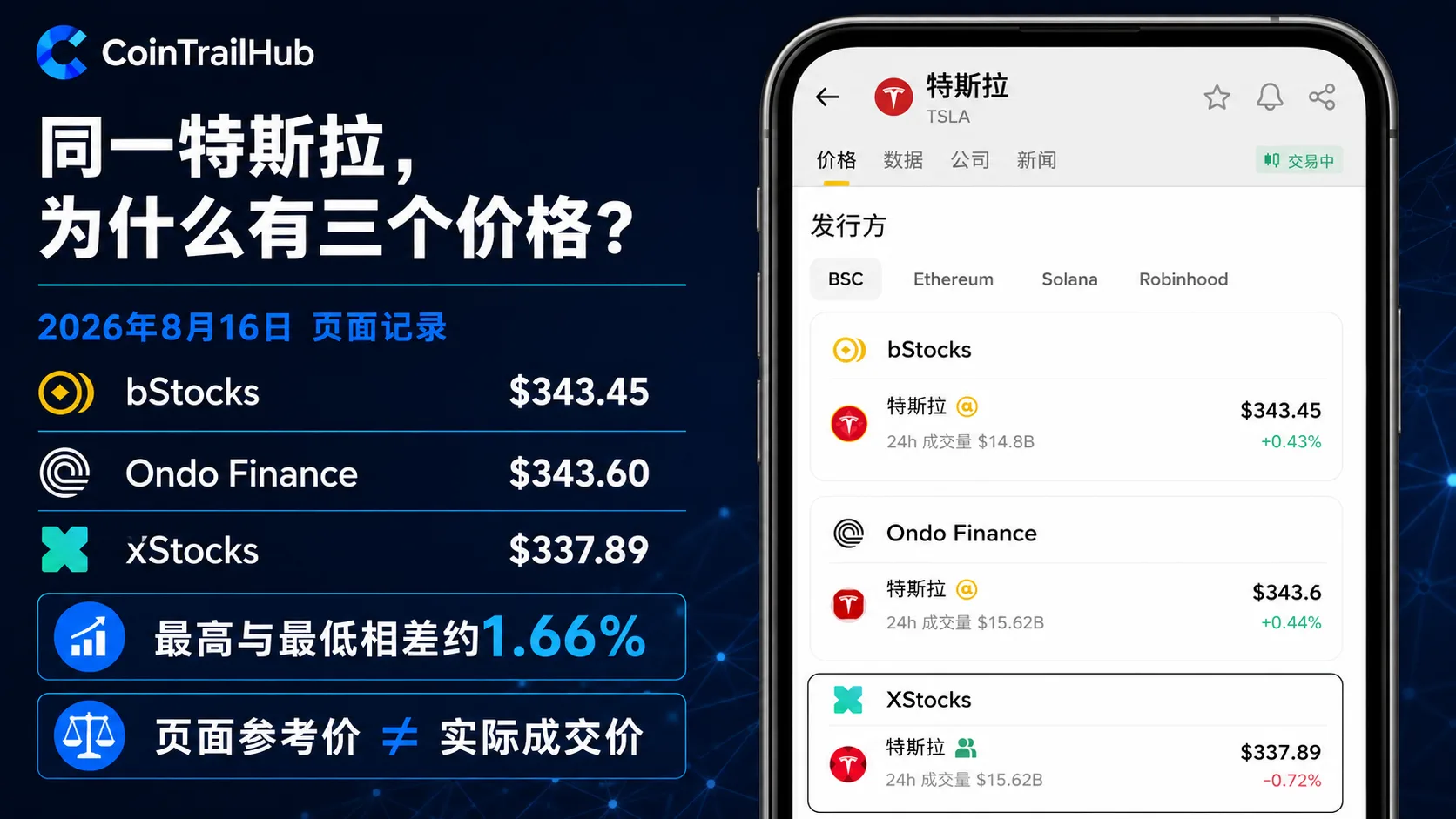
Caption: Recorded from the Binance page on August 16, 2026. The prices are page reference information and do not necessarily equal the price at which a user can actually execute an order.
This data can prove that the three products showed different page prices at that time, but it cannot, from the screenshot alone, identify the single cause of the price difference, nor directly prove the existence of risk-free arbitrage.
Factors that may affect the displayed price include:
- Each product uses a different price source;
- The page quote refresh times are not fully synchronized;
- The issuers' quote and market-making mechanisms differ;
- The bid, ask and mid reference price differ;
- Liquidity differs between normal US stock trading hours and after-hours;
- Products handle dividends and corporate actions differently;
- The blockchain secondary market may have independent supply and demand;
- The wallet or trading platform may display balance and price differently.
Therefore, when judging the price difference, don't just compare the headline numbers — also check the actual buy quote, sell quote, executable quantity, fees and on-chain gas cost.
2. What exactly is TSLAon?
According to Ondo's official documentation, Ondo Stocks aims to provide eligible non-US investors with on-chain economic exposure to US-listed stocks and ETFs.
Tesla's stock ticker is TSLA, and the corresponding Ondo tokenized stock is named TSLAon. The "on" can be understood as Ondo or onchain.
TSLAon's core features include:
- Tracks the economic performance of Tesla stock;
- Issued by an Ondo Stocks-related issuer, not Tesla, Inc.;
- Uses a total-return tracking mechanism;
- Designed to account for price changes, dividend reinvestment and certain corporate actions;
- Can be transferred or used on supported blockchains and platforms;
- Is not the same as directly holding TSLA stock in a traditional securities account.
Ondo also explicitly states that these tokens provide economic exposure rather than direct ownership of the underlying securities. Holders generally do not obtain Tesla shareholder voting rights, statutory information rights or other traditional shareholder rights as a result.[1]
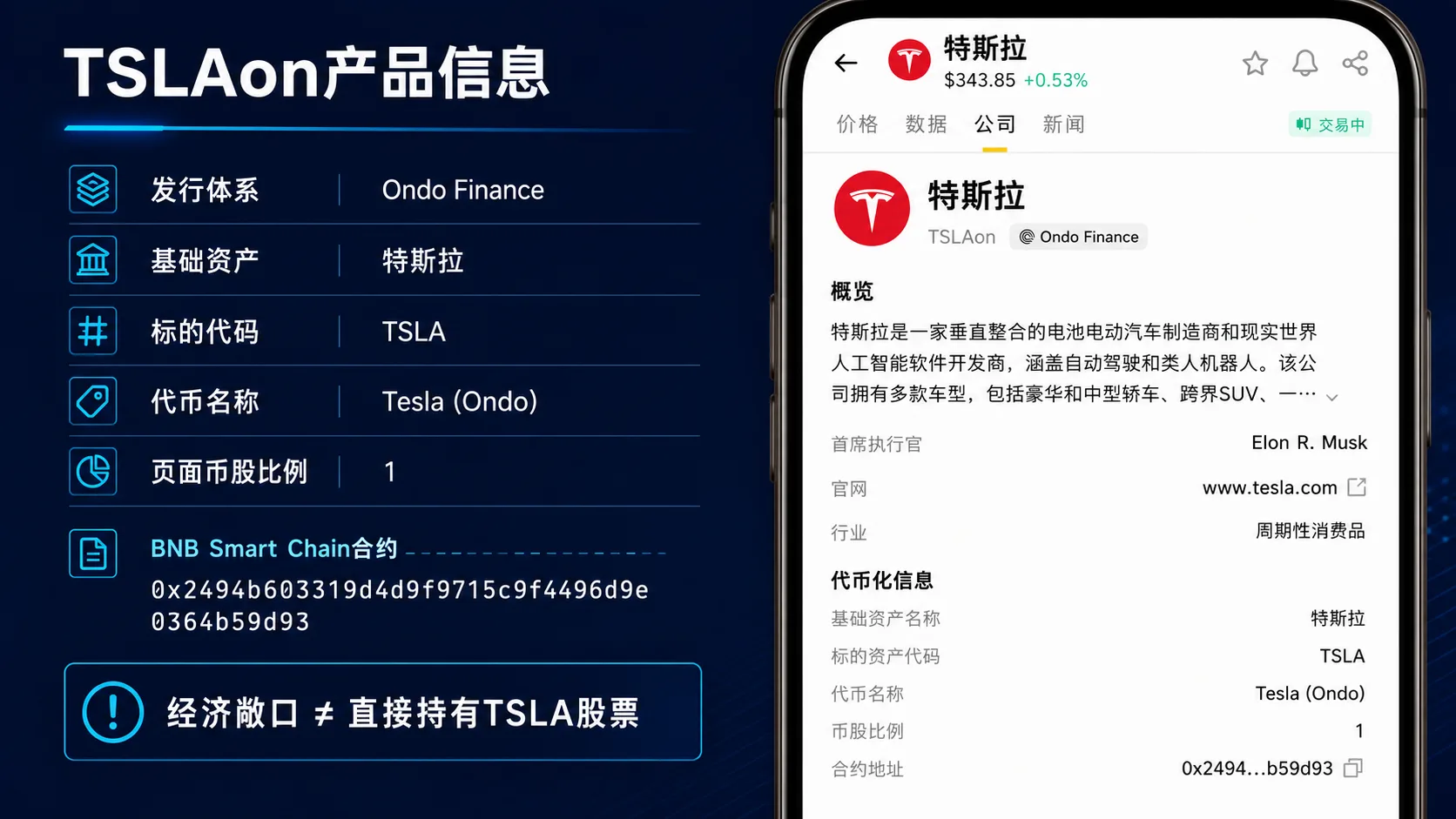
Caption: The page shows TSLAon's underlying asset is Tesla and the underlying ticker is TSLA; at the time of recording the token-to-share ratio showed 1.
If you don't yet fully understand the difference between "tokenized stocks" and "traditional stocks," start here: Are the US stocks on Binance real stocks? Stock tokens vs real US stocks (2026).
3. What does a "token-to-share ratio of 1" mean?
The page screenshot provided by the user shows that, at the time of recording, TSLAon's "token-to-share ratio" was 1.
For a beginner, you can temporarily understand this as: the page uses a display approach close to "one token corresponds to one share of economic exposure."
But this does not mean the ratio is permanently fixed.
Ondo describes its product as a "total-return tracker." If the underlying stock pays dividends, after applicable taxes are deducted, the relevant value may be reinvested into the underlying asset. Over time, the economic exposure corresponding to one token may change.[2]
Ondo also explains that on BNB Chain and Solana, applications that support Scaled UI can adjust the displayed token quantity and unit price so that the displayed price is closer to the underlying stock price.
This adjustment mainly affects the interface display and does not change the total economic value of the assets held in the account.[3]
Therefore, a user cannot look only at "how much one token costs," but should also check:
- The share ratio corresponding to each token;
- Whether the page uses Scaled UI;
- Total position quantity;
- Total position value;
- The rules for handling dividends and corporate actions.
4. Why might TSLAon differ from the traditional TSLA price?
1. TSLAon tracks total return
The TSLA price shown on an ordinary quote page mainly reflects the stock market price.
TSLAon uses a total-return tracking approach — besides price changes, it may also factor in reinvested net dividends into the product's economic value. Over the long term, TSLAon's unit price may not always be exactly the same as one share of TSLA.
2. The page reference price is not the actual execution price
Ondo's official documentation explains that the page's main price is usually close to the mid price of the underlying asset's bid and ask, combined with the number of shares corresponding to each token.
What users actually get when buying or selling is a specific quote. The quote also considers:
- Order size;
- The platform's existing inventory;
- Underlying market liquidity;
- Bid-ask spread;
- Market status;
- Fees that the secondary platform may charge.
So even if the page shows $343.60, the actual buy and sell prices may differ.
3. The spread may widen when the US stock market is closed
Traditional US stocks do not trade continuously all day, while some tokenized stocks may show quotes or offer trading over a longer window.
When the main US stock market is closed:
- Referenceable traditional market liquidity decreases;
- Quote uncertainty rises;
- The bid-ask spread may widen;
- The token price may temporarily deviate from the underlying price at the next open.
4. Different issuers use different product structures
TSLAon and TSLAx are both related to Tesla stock, but they are not the same token.
They may differ in the following respects:
| Comparison item | TSLAon | TSLAx |
|---|---|---|
| Product system | Ondo Stocks | xStocks |
| Token name | Tesla (Ondo) | Tesla xStock |
| BSC contract | 0x2494…b59d93 | 0x8ad3…eb7cf0 |
| Dividend handling | Officially a total-return mechanism with net dividend reinvestment | Per xStocks product documents |
| Quote mechanism | Ondo quote and pricing rules | Per xStocks and trading platform rules |
| Legal and custody structure | Per Ondo issuance documents | Per xStocks issuance documents |
| Holder rights | Not equivalent to directly holding TSLA common stock | Not equivalent to directly holding TSLA common stock |
Therefore, TSLAon and TSLAx should not be treated as fully interchangeable assets.
5. How to verify the TSLAon and TSLAx contract addresses?
On the blockchain, token names and icons can be imitated. When identifying a token, the contract address matters more than the name.
TSLAon's contract address on BNB Smart Chain
0x2494b603319d4d9f9715c9f4496d9e0364b59d93[4]
BscScan verification entry:
https://bscscan.com/token/0x2494b603319d4d9f9715c9f4496d9e0364b59d93
TSLAx's contract address on BNB Smart Chain
0x8ad3c73f833d3f9a523ab01476625f269aeb7cf0[5]
BscScan verification entry:
https://bscscan.com/token/0x8ad3c73f833d3f9a523ab01476625f269aeb7cf0
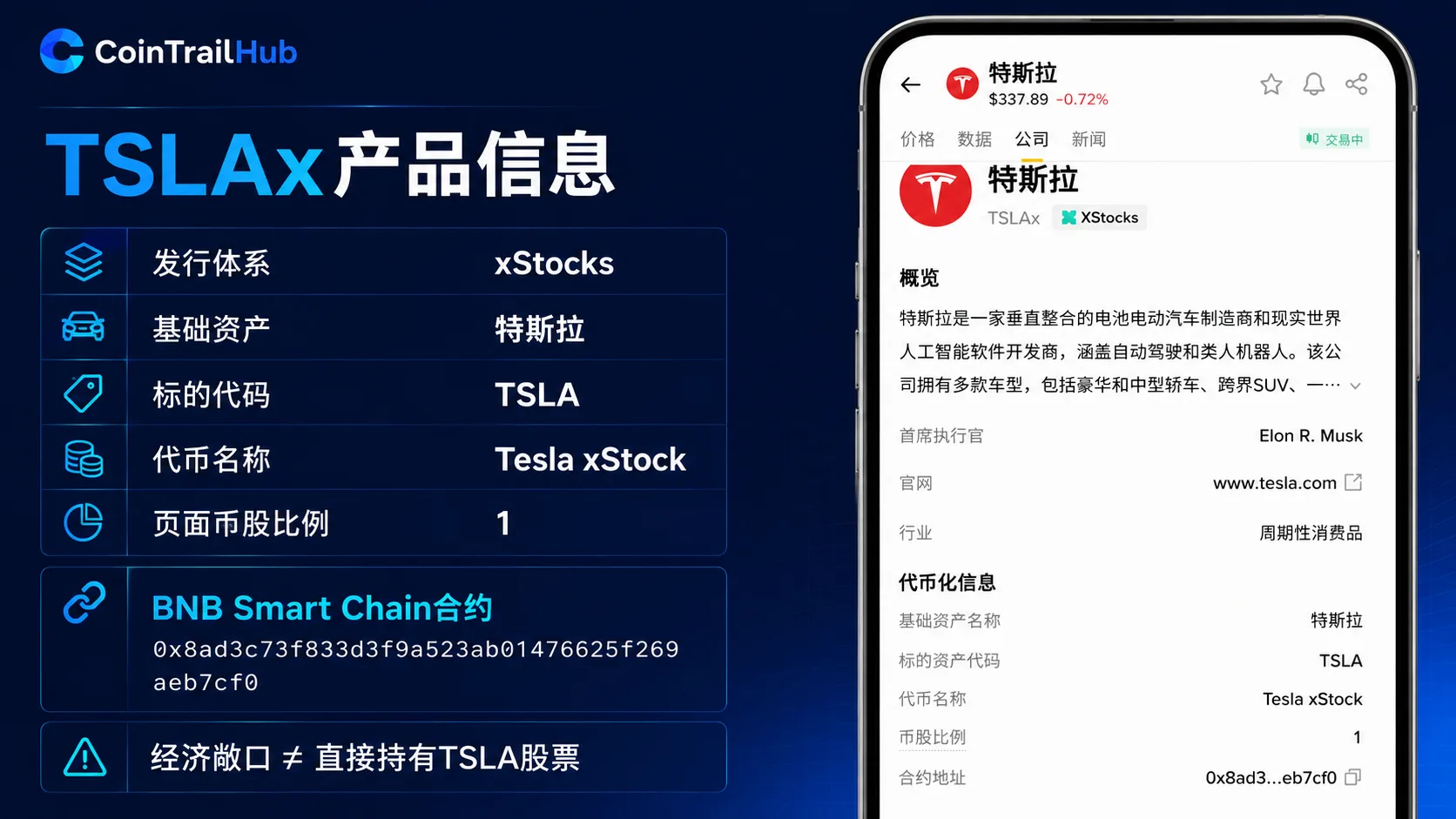
Caption: TSLAx and TSLAon are two different contracts. Before transferring or adding a token, confirm the network, the full contract address and the official source.
When verifying, complete at least these steps:
- Confirm the current network is BNB Smart Chain;
- Obtain the contract address from the issuer's official documents or a trusted block explorer;
- Compare the full address, not just the first and last few characters;
- Check the token name, symbol and decimals;
- Check whether the contract is verified;
- Do not add tokens via links from search ads or unsolicited private messages.
The same product can have different contract addresses on different blockchains — you can't use the BSC address directly on Ethereum or Solana. On the risks of choosing the wrong network or transferring to the wrong chain, read this: Can a transfer sent to the wrong chain be recovered? Withdrawal networks and wallet addresses (2026).
6. What does Ondo mean by "real asset backing"?
The Binance page provided by the user marks TSLAon as supported by:
- Real asset backing;
- Dividend reinvestment;
- Collateral security interest;
- Bankruptcy remoteness;
- Daily verification reports.
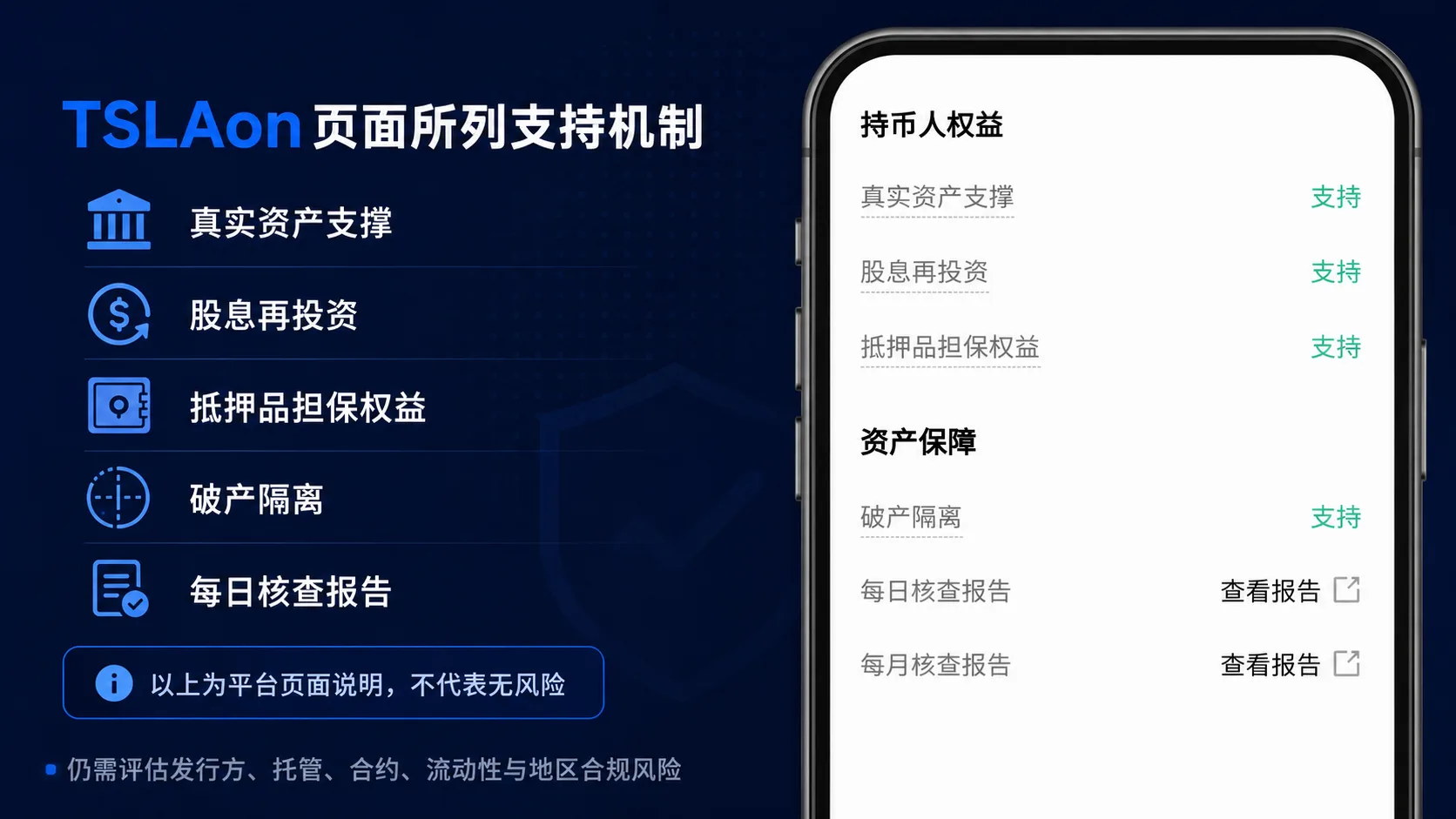
These items should be understood in combination with Ondo's official documents, and cannot simply be equated with "absolutely safe."
According to Ondo's public documents, its structure includes:
- Issuing tokens through a special purpose entity;
- Isolating relevant assets, books and accounts from certain related entities;
- Officially stating that tokens are backed by corresponding stocks, ETFs and cash in transit;
- The issuance structure sets additional collateral arrangements;
- A third-party security agent holds the relevant senior security interest;
- A third-party verifier performs daily asset attestation;
- Providing monthly reconciliation and annual audit arrangements.[6]
These mechanisms can improve transparency and asset verification capability, but they cannot eliminate all risk. Investors still face risks of issuer performance, custodian, legal enforcement, smart contract, liquidity and regional compliance.
7. What can Ondo's daily report prove?
The Ondo Stocks Daily Report of August 11, 2026 provided by the user shows:
- Total assets of about $1.1284 billion;
- Total liabilities of about $1.0409 billion;
- An assets-to-obligations ratio of about 108.41%;
- Ondo Stocks-related asset market value of about $1.0123 billion;
- Verifier is Ankura Trust Company;
- The report lists supporting materials including fiat account statements, trading account screenshots, securities account summaries and stablecoin wallet holdings.
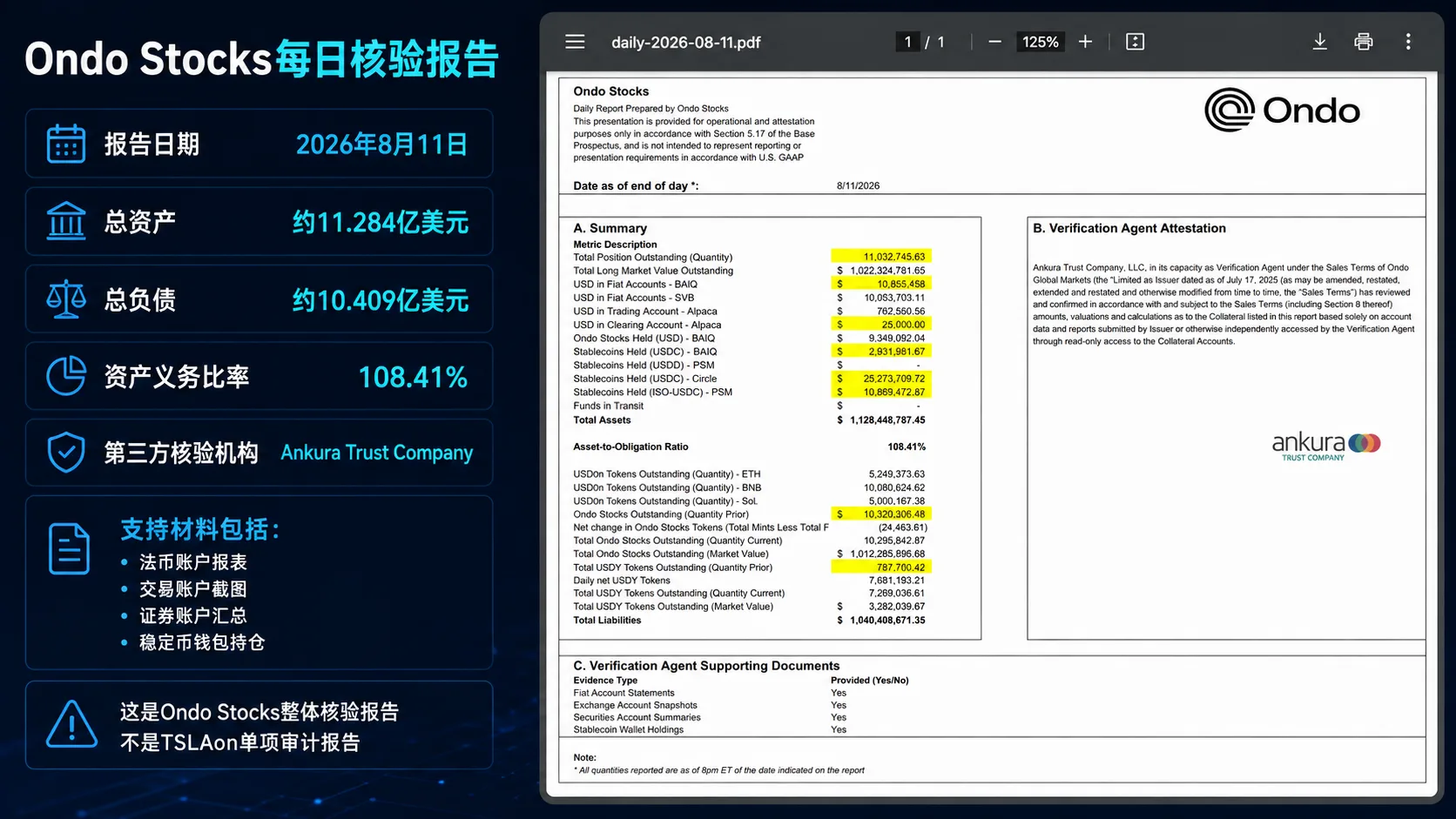
It must be noted: this document is a daily verification or attestation report at the Ondo Stocks overall level, not a complete audit report specifically for the single TSLAon product.
It can be used to observe:
- Whether total assets exceeded total liabilities on the report date;
- Whether there is third-party verification;
- Which accounts and materials the verification covers;
- Whether the report dates are continuously updated.
But it cannot by itself prove:
- That every TSLAon can be immediately redeemed at any time;
- That the smart contract has no vulnerabilities;
- That the custodial assets have no legal disputes;
- That users in any region can legally buy or redeem;
- That the product has no market, liquidity or counterparty risk.
Therefore, a more accurate phrasing in the article is "daily verification report" or "daily asset attestation" — it should not be directly called a complete independent audit specific to TSLAon.
8. How to understand "5 holders" and "15.62B volume" on the Binance page?
This is where misreading happens most easily.
"Binance holders: 5" is not the total on-chain holder count
The page's "Binance holders: 5" and "Binance traders: 15" belong to Binance platform interface statistics.
They cannot be directly interpreted as:
- Only 5 TSLAx holders on BSC;
- Only 15 people trading TSLAx globally;
- These being all market participants of the token.
To judge the on-chain holder count, check the Holders data for the corresponding contract on a block explorer such as BscScan, and note that an exchange custody address may represent many platform users.
15.62B is most likely underlying TSLA stock data
The 15.62B in the screenshot appears together with:
- Tesla market cap;
- P/E ratio;
- 52-week high and low prices;
- Trading volume in shares;
- Average daily volume.
Judging from the context of this data set, 15.62B is more likely the underlying Tesla stock's market turnover or a related stock quote indicator, rather than the on-chain volume of the TSLAx token on BSC.
Therefore it should not be written as "TSLAx on-chain 24-hour volume reached $15.62 billion."
To judge the token's own liquidity, check separately:
- Specific trading pairs;
- Pool liquidity;
- On-chain volume;
- Bid-ask spread;
- Executable depth;
- Price impact of large orders.
9. Which is safer, TSLAon or TSLAx?
You can't draw a conclusion based only on the name, the issuer's fame or a single page screenshot.
A more reasonable comparison is to verify the following items separately:
| Verification item | What needs to be confirmed |
|---|---|
| Issuing entity | Who bears the issuance and redemption obligations |
| Underlying asset | Whether there is stock, cash or other collateral backing |
| Custodian | Who holds the underlying assets |
| Third-party verification | Whether there is continuously updated attestation or audit |
| Legal structure | How assets are handled in bankruptcy |
| Redemption mechanism | Who can redeem, minimum amount and fees |
| Regional restrictions | Whether the user's location is allowed to participate |
| Smart contract | Whether audited, upgradeable, and who has admin rights |
| Liquidity | Whether there are stable bid/ask quotes and sufficient depth |
| Corporate actions | How dividends, splits, mergers and delistings are handled |
Ondo has disclosed relatively detailed product mechanisms, quote methods and daily verification arrangements — this is verifiable informational depth. But "more disclosure" does not mean "no risk," nor does it automatically prove it is suitable for all users.
For a more systematic comparison of tokenized US stocks and traditional US stocks, read this: Tokenized US stocks vs traditional stocks? Platform assets vs broker account (2026).
10. Checklist before buying tokenized stocks
Before buying TSLAon, TSLAx or other tokenized stocks, complete the following checks:
- I know it is not common stock issued directly by Tesla;
- I have confirmed the issuing entity and official product documents;
- I have verified the correct network and full contract address;
- I understand I'm getting economic exposure, not full shareholder rights;
- I have checked the token-to-share ratio and dividend handling rules;
- I have compared the page reference price with the actual buy/sell quote;
- I have checked trading depth, spread, fees and gas;
- I know whether the product supports redemption and who is responsible;
- I understand the usage restrictions in my country or region;
- I can bear the issuer, custody, contract and liquidity risk.
If several of these cannot be confirmed, holding off is usually more prudent than deciding based only on the product name or a short-term price.
FAQ
1. Is TSLAon real Tesla stock?
It is not TSLA common stock in a traditional securities account. It is a tokenized stock product in the Ondo Stocks system, mainly providing economic exposure related to Tesla stock.
2. Can holding TSLAon let me vote in Tesla shareholder meetings?
Usually not. Ondo's official documentation states that token holders receive economic exposure rather than direct ownership of the underlying stock, and do not therefore obtain traditional shareholder voting rights and statutory information rights.
3. Why might TSLAon be priced higher than TSLA?
It may relate to the total-return mechanism, the number of shares per token, Scaled UI, quote refresh timing and quote method. The actual reason should be judged in combination with the token-to-share ratio and execution quotes at the time.
4. Why do TSLAon and TSLAx have different prices?
They are issued by different systems and may use different price sources, refresh times, market-making methods, liquidity arrangements and product rules. Different page reference prices do not necessarily mean there is executable arbitrage.
5. Can a 1.66% price difference be directly arbitraged?
You can't judge it from the page numbers alone. You also need to confirm the actual bid, ask, executable quantity, transfer restrictions, gas, fees, redemption conditions and settlement time.
6. Is a correct contract address enough to be safe?
Not necessarily. A contract address only helps identify a specific token; it cannot eliminate issuer, custody, smart contract, liquidity and legal compliance risk.
Summary
TSLAon can be understood as a Tesla stock on-chain economic-exposure product provided by Ondo, but it is not common stock issued directly by Tesla.
The different prices of TSLAon, TSLAx and other Tesla tokenized products are not necessarily page errors, nor can they be directly treated as arbitrage opportunities. The price difference may come from price source, refresh time, total-return mechanism, bid-ask spread, product structure and market liquidity.
For beginners, the most important thing is not to find which page shows the lowest price, but to first confirm five things:
- Who issues it;
- What assets back it;
- Whether the contract address is correct;
- What rights holders actually get;
- Who is responsible for redemption and handling assets if something goes wrong.
To first understand the basic concepts of tokenized stocks, continue reading:
What are on-chain stocks? Do stock tokens in a wallet really equal US stocks? (2026)
Related reading
- Are the US stocks on Binance real stocks? Stock tokens vs real US stocks (2026) — First understand the underlying logic of "tokenized US stocks"
- Are on-chain RWA assets worth investing in? My real experience buying NVDAon — Tokenized stocks are just one type of RWA
- What are on-chain stocks? Do stock tokens in a wallet really equal US stocks? (2026) — Understand the real rights of stock tokens in a wallet
- Can on-chain stocks be withdrawn? Selling NVDAon back to USDT, tested (2026) — How to exit after holding tokenized stocks
- Can a transfer sent to the wrong chain be recovered? Withdrawal networks and wallet addresses (2026) — Verify network and contract address to avoid transferring to the wrong chain
Data verification notes
The key facts in this article were verified on 2026-10-17, listed as follows:
- Rights of Ondo tokens: Ondo states that its tokens provide economic exposure to the underlying asset rather than direct ownership, and holders do not obtain shareholder voting rights and statutory information rights. Source: Ondo Stocks — Product overview.
- Total-return mechanism: Ondo designs tokenized stocks as total-return trackers; cash distributions such as dividends are handled as reinvestment, so over the long term the token price won't always equal the underlying stock price. Source: Ondo Stocks — Token and quote pricing.
- Scaled UI: Applications on BNB Chain and Solana that support Scaled UI can adjust the displayed balance and unit price, but do not change the on-chain balance or economic exposure. Source: Ondo Stocks — Token and quote pricing.
- TSLAon contract address: This full address corresponds to the TSLAon token contract page on BNB Smart Chain. Source: BscScan — TSLAon contract.
- TSLAx contract address: This full address corresponds to the TSLAx token contract page on BNB Smart Chain. Source: BscScan — TSLAx contract.
- Asset backing structure: Ondo states that issuance is through a BVI bankruptcy-remote SPV, assets are isolated from related entities, a senior security interest is set up, and a third party performs daily verification. Source: Ondo Stocks — Trust and transparency.
References
- Ondo Stocks product overview
- Ondo token and quote pricing
- Ondo trust and transparency
- xStocks official documentation
- TSLAon BSC contract
- TSLAx BSC contract
Page observation time for this article: August 16, 2026. Product rules, contract information, prices and regional restrictions may change — refer to the issuer's latest documents and block explorer records.
Disclaimer
This article is for education on tokenized stocks and Crypto only, and does not constitute any investment, financial or trading advice.
Tokenized stocks carry issuer, custody, smart contract, liquidity, price-deviation and regional compliance risk, and price swings can be large. Users should judge carefully based on their own risk tolerance and follow the laws and regulations of their location.
- Ondo Stocks — Product overviewFor non-US investors; tokens provide economic exposure rather than direct ownership
- Ondo Stocks — Token and quote pricingTotal-return tracking; Scaled UI and actual quotes may deviate from the indicative price
- Ondo Stocks — Trust and transparencySPV issuance, bankruptcy remoteness, collateral arrangements and daily verification reports
- BscScan — TSLAon contractTSLAon contract address on BNB Smart Chain
- BscScan — TSLAx contractTSLAx contract address on BNB Smart Chain
- 2026-10-17UpdateAdded evidence-chain superscripts and the "Data verification notes"; updated key-fact verification date.
See ourEditorial Policy and the correction process in ourCorrections Policy.
The CoinTrailHub editorial team focuses on crypto education for beginners, exchange security and P2P trading risk. This article is compiled from official sources and public data, reviewed by humans, and strives for accuracy but is not investment advice.
Last updated:2026-08-16 · Content reviewed by humans · Learn more
© 2026 CoinTrailHub · Original content. Reproduction or rewriting without permission is prohibited.