
On-chain stocks vs traditional US stocks: wallet assets vs broker account
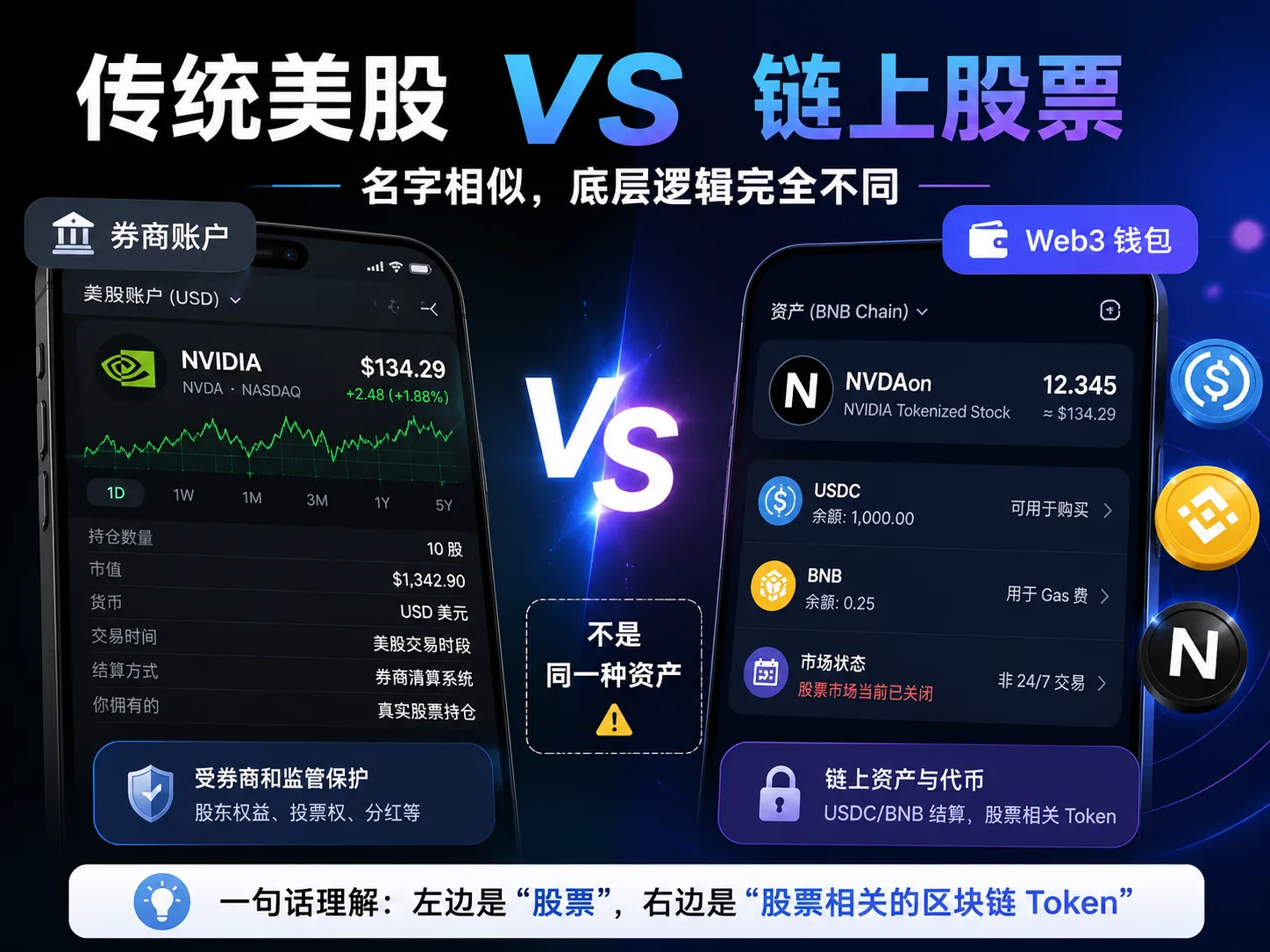
Table of contents

Binance new user rewards
20% trading fee rebate
Official Binance registration. Complete identity verification (KYC) to trade and withdraw.
Many beginners who first see names like NVDAon, TSLAon, AAPLon have a very natural reaction:
Is this the same as buying US stocks in a wallet?
The names really do look alike.
NVDA corresponds to Nvidia, TSLA to Tesla, AAPL to Apple.
But slow down here.
When you buy NVDA in a broker account, you see stock holdings inside a traditional securities account.
When you see NVDAon in a wallet, you're looking at something more like a stock token related to NVDA.
They're connected, but they are not the same thing.
This article won't talk about grand "future of finance" ideas, or wander around concepts.
We're only solving one question:
What exactly is the difference between a stock token in a wallet and a US stock in a broker account?
About 7 minutes to read — remember this one line first: an NVDAon in your wallet is not the same as NVDA stock in a broker account.
This article is for basic Crypto education only and does not constitute investment, financial or trading advice. On-chain stocks, stock tokens, tokenized US stocks and RWA products involve issuer, custody, KYC, regional restriction, liquidity, smart contract and market risk. Before acting, follow the platform's official documentation, wallet prompts, project documents and local regulations.
Information in this article was organized on: June 21, 2026. Product rules, available regions, swap entry points and platform documentation may change — always check the official page before acting.
Understand the difference in 30 seconds
Traditional US stocks: usually held as stock in a broker account.
On-chain stocks: usually held as a stock-related Token in a wallet or on-chain platform.
The biggest difference: one belongs to the traditional securities account system, the other to the on-chain Token system.
The most common beginner misunderstanding:
Seeing NVDAon in your wallet does not mean you necessarily own NVDA stock in a traditional broker account.

Remember this line first and you won't get confused later.
| Dimension | Traditional US stocks | On-chain stocks (stock tokens) |
|---|---|---|
| Where held | Broker account | Wallet / on-chain platform |
| Asset nature | Stock holdings in a securities account | On-chain Token related to a stock |
| Settlement asset | Fiat (USD, etc.) | USDC, USDT, BNB, etc. |
| Trading hours | Limited by stock market hours | Wallet opens 24/7, but trades may still be limited by market/platform rules |
| Main costs | Commission, FX, deposits/withdrawals | Gas fees, slippage, platform fees |
| Voting rights | Usually yes (depending on share type) | Not guaranteed — depends on product structure |
What real observations is this article based on?
This article is not built from concepts alone.
I actually saw a stock token entry in a wallet page, and saw names like NVDAon, TSLAon and AAPLon.

The swap page also showed:
- USDC
- USDT
- BNB
- A "stock market closed" notice
- A BNB network fee notice
So this article isn't about judging "whether on-chain stocks are worth buying."
It's about helping beginners understand:
A stock token that appears in a wallet is simply not the same thing as a traditional US stock in a broker account.
If you don't yet understand what on-chain stocks are, start here: What are on-chain stocks? Do stock tokens in a wallet really equal US stocks? (2026).
Scenario 1: You buy NVDA in a broker, and see NVDAon in a wallet
Suppose you buy NVDA at a traditional broker.
Here you're dealing with a broker account, the securities market, clearing/custody and local regulatory rules.
After buying, you'll usually see the NVDA holding in your broker account.
If the company pays dividends, does a stock split or other corporate action, it's usually handled through the broker system.
But if you see NVDAon in a wallet, the situation is different.
You're seeing a Token.
This Token may be related to NVDA stock, may track its price, and may have some underlying asset or structural arrangement.
But it cannot be directly equated to NVDA stock in a traditional broker account.
What's easiest to confuse here isn't the name — it's the rights.
What you really need to look at isn't "does it look like a stock," but:
What rights does this Token actually give you?
Some stock tokens may only be price exposure.
Some may be structured notes.
Some may have underlying asset backing, but don't necessarily give you voting rights.
I cite Ondo's legal documentation here not to recommend Ondo, but to illustrate that different stock tokens can have different legal structures — you can't judge the rights by the name alone.
Ondo's official legal documentation states that Ondo tokenized stock is a structured note, and Token holders do not directly appear on the shareholder register of the underlying stock, nor do they enjoy shareholder rights such as voting rights of the underlying securities issuer. You can refer to: Ondo Global Markets legal and regulatory documentation.[1]

So when you see NVDAon, don't directly interpret it as:
I am now a Nvidia shareholder.
The safer way to say it is:
I hold a stock token related to NVDA — the specific rights depend on the official rules.
Scenario 2: The wallet opens, but that doesn't mean you can always trade
Many people assume:
Since it's an on-chain asset, it should be tradable 24 hours a day, right?
It depends.
Ordinary cryptocurrencies like USDT, ETH and BNB run closer to 24/7.
But stock tokens aren't necessarily the same.
Because behind them they may still reference the traditional stock market's quotes, trading hours, market makers, liquidity and platform rules.
Some pages will directly show:
The stock market is currently closed.
This sentence matters.
It shows that although a stock token appears in a wallet, it hasn't fully detached from the real stock market.
You can open your wallet 24 hours a day.
The blockchain can run 24 hours a day.
But the swap, quote or execution of a stock-related Token may not always complete normally at any time.

This is a clear difference between on-chain stocks and ordinary cryptocurrencies.
It's not an ordinary meme coin.
It's not an ordinary stablecoin.
It's a new form of stock-related asset entering the chain.
Scenario 3: Traditional US stocks use a USD account; on-chain stocks usually use USDC, USDT, BNB
Traditional US stocks are usually settled with funds in a broker account.
You may deposit from a bank, convert to USD, then buy the stock.
After selling, funds return to the broker account, then you withdraw to the bank.
On-chain stocks more commonly settle in on-chain assets.
For example:
- USDC
- USDT
- BNB
- ETH
- Other stablecoins or main-chain coins supported by the platform

For example, Binance's official documentation on NVDAon mentions that users can buy the relevant asset through entry points such as Alpha or in-app Swap. You can refer to: Binance official documentation on NVDAon.[2]
The most common beginner misunderstanding here is:
It looks like a Swap, so you assume it's just an ordinary token swap.
But a stock token is not an ordinary token swap.
Because what you're getting isn't an ordinary Token, but a stock-related on-chain asset.
So besides price, slippage and fees, you also need to check:
- Whether the stock market is open;
- Who the issuer is;
- Whether there are regional restrictions;
- Whether KYC is required;
- Whether you can transfer it out;
- What asset you get after selling;
- Whether you have enough gas fees.
If you're still unsure about the difference between USDT and USDC, start here: USDT vs USDC: which is safer and how to choose (2026).
Scenario 4: On-chain stocks can be transferred, but they're also easier to get wrong
Traditional US stocks generally aren't transferred from one wallet address to another like USDT.
You mostly buy, sell, transfer positions or deposit/withdraw within a broker account.
Because on-chain stocks are Token-form, they may enter the wallet and on-chain environment.
That sounds more flexible.
But for beginners, it's also easier to get wrong.
You need to look carefully at:
- Which chain this Token supports;
- Whether it can really be transferred out;
- Where it can be received after transfer;
- Whether the target platform supports it;
- Whether there are whitelist restrictions;
- Whether KYC is required;
- Whether there are regional restrictions;
- What to do if you transfer to the wrong network.
Being transferable doesn't mean you can sell it anywhere.
Having a balance in your wallet doesn't mean every platform recognizes this Token.
An address looking right doesn't mean the network is right.
If you're not familiar with network selection yet, start here: Can a transfer sent to the wrong chain be recovered? Withdrawal networks and wallet addresses (2026).
Different fee structures: broker fees vs gas fees
Traditional US stock fees mainly depend on the broker and account rules.
They may include:
- Trading commission;
- FX cost;
- Deposit/withdrawal fees;
- Platform fees;
- Tax-related costs.
Many brokers now look very cheap on commission, but you still need to watch FX, spread and deposit/withdrawal costs.
On-chain stocks add an extra layer of on-chain fees.
You may encounter:
- Gas fees;
- Swap slippage;
- Liquidity spread;
- Platform fees;
- Cross-chain fees;
- Approval operation costs.
For example, on BNB Chain, BNB is usually the gas fee asset.
If you use all your BNB to swap for stock tokens, you may get stuck later when selling, transferring or approving because you have no BNB left to pay the network fee.
This rarely happens in a traditional broker.
You won't be unable to sell traditional US stocks because your account has no BNB.
But in an on-chain wallet, if you don't have enough main-chain coins, many operations will indeed fail.
If you're not yet familiar with wallets, gas fees and seed phrases, start here: What is a crypto wallet? Wallet addresses, seed phrases and asset security (2026).
The risk didn't shrink — it moved
Traditional US stocks have risk.
For example, company share price volatility, market decline, FX changes, broker service restrictions, and tax and regulatory issues.
These risks don't disappear just because you're buying a large company's stock.
On-chain stocks also have price volatility.
But they add several more layers of on-chain and platform risk.
For example:
- Token issuer risk;
- Underlying asset custody risk;
- Legal structure risk;
- Redemption rule risk;
- Smart contract risk;
- Wallet private key risk;
- Wrong network selection risk;
- Stablecoin settlement risk;
- Regional restriction and KYC risk;
- Insufficient liquidity risk.
So on-chain stocks aren't "safer US stocks."
More precisely, they are:
Stock market risk + platform rule risk + on-chain operation risk.
If you only look at the stock name — NVDA, TSLA, AAPL — it's easy to underestimate the complexity behind it.
What would I look at first when seeing a stock token for the first time?
If I saw a stock token for the first time, I wouldn't look at the price change first.
I'd look at these questions first.
1. Who issued it?
The issuer matters a lot.
Different issuers can have completely different legal structures, custody methods and regional restrictions.
2. What does it actually represent?
Is it stock ownership?
Is it a structured note?
Is it price exposure?
Or a platform internal certificate?
A name that looks like a stock doesn't mean the rights equal a stock.
3. Is there underlying asset backing?
Some products may have underlying asset backing.
Some may only track price.
Some may have a special legal structure.
Look at the official documentation, not just the marketing language.
4. Are there dividends and voting rights?
Don't assume they exist.
Especially on voting rights, shareholder registers and corporate governance — always read the product documents.
5. Can it be transferred out?
Whether it can be transferred out, where it can go, which chain it supports, and whether the target platform recognizes it — all of this needs to be confirmed in advance.
6. What do I get after selling?
USDC?
USDT?
BNB?
Or a platform internal balance?
The exit path matters more than the buy entry point.
7. Can my region use it?
These products usually have regional and eligibility restrictions.
Taking Ondo as an example, its eligibility page lists restrictions for different jurisdictions; whether a user can subscribe to, obtain or redeem the relevant Token depends on the specific rules. You can refer to: Ondo Global Markets eligibility.[3]
Don't make large transactions before you understand these questions.
Which is more suitable for you?
There's no single answer to this question.
If you just want to hold stocks or ETFs long-term, and you're not yet familiar with wallets, stablecoins and gas fees, then a traditional broker account is easier to understand.
Because the path is more intuitive:
- Open an account;
- Deposit;
- Buy;
- Hold;
- Sell;
- Withdraw.
Traditional US stocks also carry risk, but the overall rules are more mature.
If you already understand wallets, USDC, gas fees, transfer networks, small-amount testing and on-chain risk, then studying on-chain stocks is more stable.
But even if you understand wallets, don't only look at price.
You should look more at:
- Official documents;
- The issuer;
- Custody arrangements;
- Whether there's underlying asset backing;
- Whether there are voting rights;
- Whether there's a dividend arrangement;
- Whether you can redeem;
- Whether your region is supported;
- The sell and transfer paths.
For example, Ondo's official documentation mentions that Ondo tokenized stocks use the on suffix; Kraken's xStocks official page also describes xStocks as tokenized representations of real stocks and ETFs, and explains its underlying asset backing method. You can refer to: Ondo Global Markets overview and Kraken xStocks.[4]
If you actually see TSLAon and TSLAx priced differently on the same page and want to understand why, read this: What is TSLAon? Why is its price different from TSLA and TSLAx (2026).
These materials matter more than the price page.
Because they tell you:
What exactly you're buying.
FAQ
Do on-chain stocks equal traditional US stocks?
No. You can understand them as "a stock-related on-chain Token." What they specifically represent depends on the issuer and platform rules.
Does holding NVDAon equal holding NVDA stock?
You can't directly understand it that way. NVDAon may be related to Nvidia stock, but it is not the NVDA stock in a traditional broker account.
Can on-chain stocks trade 24 hours a day?
Not necessarily. The wallet can open 24 hours a day, but the quote, swap or execution of a stock token may still be affected by stock market hours and platform rules.
Do on-chain stocks pay dividends?
Not necessarily. It depends on the specific product. Some may handle corporate actions through price adjustments, reinvestment or other mechanisms, and some may not have a dividend right in the traditional sense.
Can on-chain stocks be transferred to a wallet?
It depends on the specific product. Some can be transferred out, some can only be used on a designated platform. Even if transferable, you need to check the network, whitelist, regional restrictions and whether the target platform supports it.
Are on-chain stocks suitable for beginners to buy directly?
I don't recommend jumping straight in. First understand wallets, gas fees, stablecoins, network selection and exit paths, then study specific products — that's more stable.
A few final honest words
The most misleading thing about on-chain stocks vs traditional US stocks is that the names look too similar.
NVDAon looks like NVDA.
TSLAon looks like TSLA.
AAPLon looks like AAPL.
But a similar name doesn't mean the same rights.
One-line summary:
Traditional US stocks are more like stock holdings in a broker account; on-chain stocks are more like a stock-related Token in a wallet.
Before acting, first ask clearly:
What exactly am I buying?
What rights does it give me?
Can I sell it?
Can my region use it?
Once these questions are clear, then look at price — that's more stable.
This article does not constitute investment, financial or trading advice. On-chain stocks are not risk-free assets, and traditional US stocks aren't risk-free either. Before acting, follow the platform's official documentation, wallet prompts, project documents and local regulations.
Data verification notes
The key facts in this article were verified on 2026-10-17, listed as follows:
- Legal structure of Ondo tokens: Ondo tokenized stock is a structured note; holders do not appear in their own name on the underlying stock's shareholder register, and do not enjoy shareholder voting rights. Source: Ondo Global Markets — Legal and regulatory documentation.
- Binance NVDAon entry points: Binance's official documentation lists two purchase entry points, Alpha and in-app Swap, and notes that some features are subject to regional availability. Source: Binance — How to buy NVDAon.
- Regional eligibility restrictions: Ondo's eligibility documentation lists jurisdictions that are prohibited from participating and those that must meet conditions such as professional investor status; the US is on the prohibited list. Source: Ondo Global Markets — Eligibility.
- xStocks product positioning: Kraken's official page calls xStocks tokenized shares of US stocks and ETFs, while also stating clearly that they do not confer ownership. Source: Kraken — xStocks.
What to read next
- What are on-chain stocks? Do stock tokens in a wallet really equal US stocks? (2026)
- Are the US stocks on Binance real stocks? Stock tokens vs real US stocks (2026)
- What is a crypto wallet? Wallet addresses, seed phrases and asset security (2026)
- Can a transfer sent to the wrong chain be recovered? Withdrawal networks and wallet addresses (2026)
Author's note
This article was organized by the CoinTrailHub editorial team, based on public information, official documentation, wallet page observations and crypto wallet usage experience, mainly for beginners new to on-chain stocks, stock tokens, traditional US stocks and Web3 wallets.
We've long followed crypto beginner onboarding, wallet security, stablecoins, trading platforms, RWA, on-chain stocks, US stock tokenization and tokenized assets.
The on-chain stocks, traditional US stocks, stock tokens, Ondo, xStocks, USDC, wallet swaps and related platform features mentioned in this article may change as the market, regulation and platform rules evolve.
Before acting, follow the platform's official documentation, wallet prompts, project documents and local regulations.
- Ondo Global Markets — Legal and regulatory documentationTokens are structured notes; holders are not on the shareholder register and have no voting rights
- Binance — How to buy NVDAonBuy tokenized stocks via Alpha or in-app Swap
- Ondo Global Markets — EligibilityProhibited and restricted eligibility requirements by jurisdiction
- Kraken — xStocksxStocks are tokenized shares of US stocks/ETFs and do not confer ownership
- 2026-10-17UpdateAdded evidence-chain superscripts and the "Data verification notes"; updated key-fact verification date.
See ourEditorial Policy and the correction process in ourCorrections Policy.
The CoinTrailHub editorial team focuses on crypto education for beginners, exchange security and P2P trading risk. This article is compiled from official sources and public data, reviewed by humans, and strives for accuracy but is not investment advice.
Last updated:2026-06-21 · Content reviewed by humans · Learn more
© 2026 CoinTrailHub · Original content. Reproduction or rewriting without permission is prohibited.