
Tokenized US stocks vs traditional stocks: platform asset vs broker account (2026)
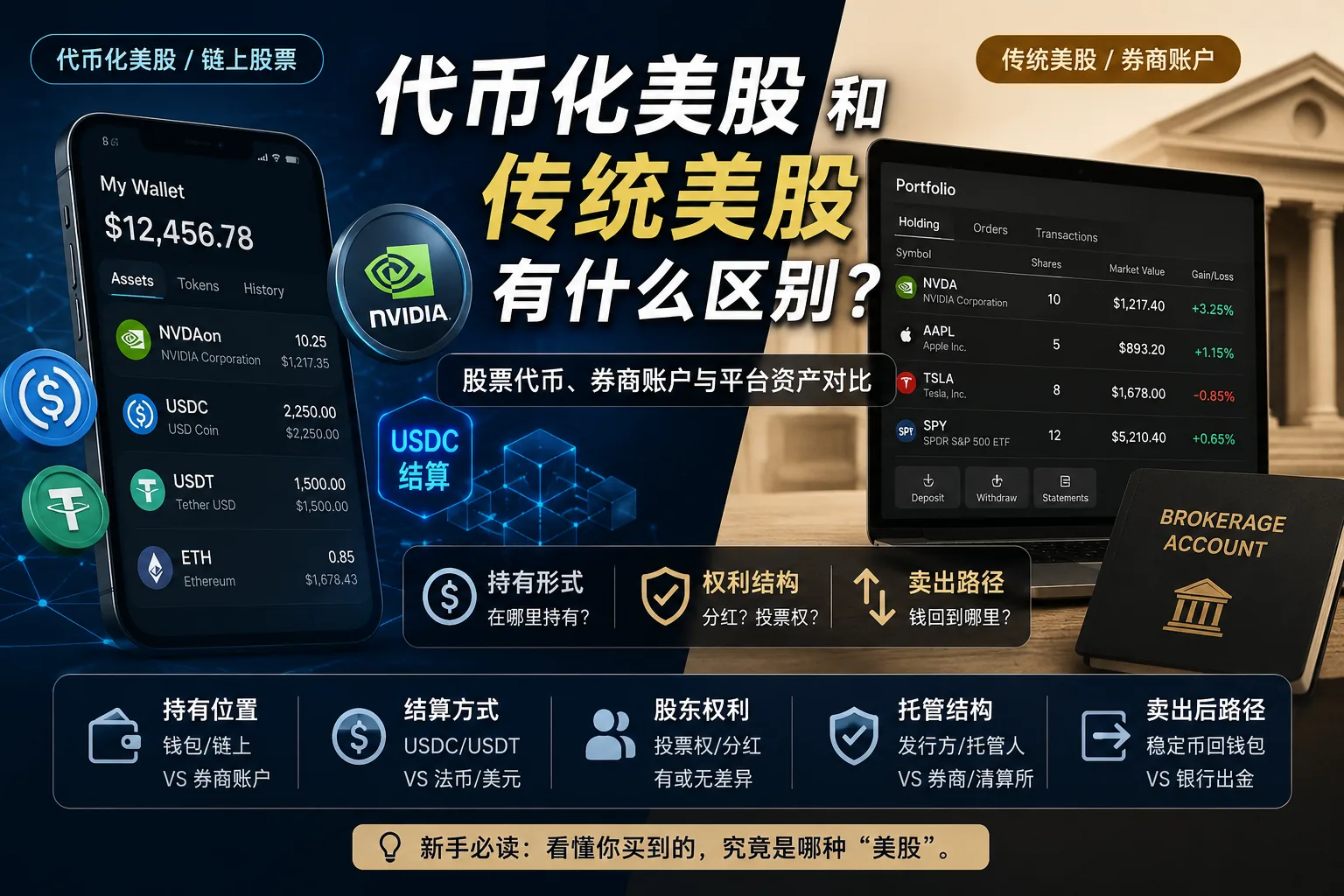
Table of contents

Binance new user rewards
20% trading fee rebate
Official Binance registration. Complete identity verification (KYC) to trade and withdraw.
The first time I saw "tokenized US stocks", my reaction was simple:
Isn't this just another way to buy US stocks?
Because the page showed NVDA, AAPL, TSLA, and it supported USDC trading.
For a beginner, this kind of interface is very easy to misread.
You instinctively assume:
As long as the price tracks Nvidia, Apple or Tesla, it must be a US stock.
But I later realized the problem isn't the price.
The problem is:
Where the thing you bought actually sits.
If it's in a brokerage account like Interactive Brokers, Schwab or Fidelity, I'd understand it as a traditional US stock.
If it's in a crypto platform account, I'd check the platform rules and partner broker first.
If it shows up in a Web3 wallet, next to USDT and USDC, I no longer treat it as a traditional brokerage stock.
This article doesn't recommend any platform, nor argue which is better.
It only answers one question:
Tokenized US stocks, platform stocks and traditional stocks all look like "US stocks" — but are you actually buying the same thing?
About 7 minutes to read. Remember one line first: a name that looks like a stock doesn't mean the rights are a stock's.
This article is for general education on crypto, RWA and tokenized US stocks only, and does not constitute investment, financial, securities or trading advice. Traditional US stocks, tokenized stocks, stock tokens, USDC settlement and platform stock products all involve market volatility, platform rules, custody structure, KYC, regional restrictions, regulatory change and liquidity risk. Before acting, follow the platform page, official documents and local regulations.
Why I misjudged at first
What misleads beginners most isn't the word "tokenized".
It's that the stock names on the page are too familiar.
For example, you see:
- NVDA
- AAPL
- TSLA
- SPY
- QQQ
Your first reaction is certainly:
Isn't this just a US stock?
I thought so at first too.
Especially when the page also shows price, change, a buy button and a sell button, it looks even more like a simplified broker app.
But I later found that just looking at the ticker name is meaningless.
What really matters isn't "does it look like a US stock".
It's:
Does it appear in a securities account, a platform account, or a wallet asset list.
This positional difference determines everything that follows — dividends, voting rights, custody, selling, and where the money returns to.
The first thing that felt off: NVDAon appeared on the wallet asset page
What actually made me stop and rethink was seeing NVDAon on a wallet asset page.
It wasn't in a traditional brokerage account.
Nor was it a normal stock-holding page.
It was sitting in the same wallet asset list as USDT and USDC.

This observation matters a lot for beginners.
Because it tells you one thing:
NVDAon behaves more like an on-chain token in a Web3 wallet than a stock in a traditional brokerage account.
In a traditional brokerage account, I'd look at:
- Stock holdings
- Dividend records
- Trade records
- Account cash
- Bank withdrawal
But once it appears in a wallet, the things I need to check change:
- Which chain it's on
- Whether it can be transferred
- Whether it can be swapped
- Whether selling returns USDT or USDC
- Whether it can be sent back to an exchange
- Whether choosing the wrong network causes problems
This was the first time I realized:
A name that looks like a stock doesn't mean the operating logic is a stock's.
For a deeper base, start here: What is an on-chain stock? Do wallet stock tokens really equal US stocks (2026).
The second thing that confirmed it: official wording isn't "traditional stock"
Looking at the wallet position alone isn't enough.
I later checked the official explanations.
That made things even clearer.
For example, the Ondo Global Markets official page and the disclaimers in Ondo's docs explicitly warn that the relevant tokens are not stocks or ETFs themselves, and do not mean the holder can directly hold or receive the corresponding underlying assets.[1]
This sentence is crucial for beginners.
Because it spells out an easy point of confusion:
What you're seeing is a tokenized product related to a stock, not necessarily the stock itself in a traditional brokerage account.
This isn't telling you "this product can't be used".
It's reminding you:
Don't read a stock token directly as a traditional stock.
Binance Academy's explanation of tokenized stocks also notes that stock tokens usually provide price exposure to the underlying asset, but may not carry the full rights of a traditional shareholder, such as voting rights or the right to attend shareholder meetings.[2]
So now I don't just look at the product name.
I first check how the official source actually defines it:
- Is it a stock?
- Is it an ETF?
- Is it a platform asset?
- Is it a token?
- Is it price exposure?
- Does it have shareholder rights?
- Does it clearly state it isn't a traditional stock?
These matter more than "can I buy NVDA".
The third thing that settled it: the sell path isn't like a traditional broker
There's another, more practical question:
Where does the money go after you sell?
In a traditional broker, selling a US stock is usually:
Stock → broker cash account → bank withdrawal
But when I did a small test, the on-chain stock token path looked more like:
Stock token → stablecoin → wallet / exchange
For example, I tested selling NVDAon back to USDT.
That step made me more certain:
The most dangerous thing isn't a name that looks like a stock — it's a sell path that looks like a stablecoin.
If selling doesn't land in a broker cash account, but first turns into USDT or USDC and then returns to a wallet or exchange, it isn't the traditional broker withdrawal logic.
Also, selling an on-chain stock token requires attention to liquidity and slippage.
Popular tickers may be smoother, but if the market is volatile or trading depth is thin, the sell price may differ from the page estimate, and may even trade at a discount or premium.[3]
This is one of the biggest practical differences between tokenized and traditional US stocks.
Not whether you can buy.
But in what form the money actually returns to you after selling.
This is when I split "US stocks" into three kinds
After these observations, I no longer say "buy US stocks" loosely.
I first separate three kinds.
Kind one: US stocks in a traditional brokerage account
This is the easiest to understand.
For example, buying NVDA, AAPL, SPY, QQQ in a broker like Interactive Brokers, Schwab or Fidelity.
It's closer to a traditional US-stock account.
You're dealing with:
- A brokerage account
- Securities clearing
- US market trading hours
- Fiat deposit and withdrawal
- Dividends and tax
- Traditional securities regulation
It isn't necessarily the most convenient.
Account opening, deposit, FX, withdrawal and tax all need understanding.
But its asset logic is fairly clear:
You hold stocks or ETFs within a traditional securities system.
So when a beginner cares most about full shareholder rights, dividend handling, tax documents and bank deposits/withdrawals, a traditional brokerage account is easier to understand.
Kind two: stock products inside a platform
Some crypto platforms offer:
- Buying US stocks with USDC
- Fractional-share trading
- ETF trading
- An in-platform stock account feature
These products also look like buying US stocks.
But I don't equate them directly with a traditional broker.
I first check:
Is this platform itself a broker? Or does it route orders through a partner broker?
If the platform connects you to the US-stock market, I keep checking:
- Who executes the orders
- Who custodies the securities
- How dividends are handled
- Whether KYC is required
- Whether your region is supported
- After selling, whether the funds are USDC, a USD balance, or another platform asset
The advantage of these platform stocks may be convenience, especially for users already familiar with USDC.
But they depend on platform rules.
So it isn't simply a "broker account in disguise".
To grasp the broader idea of "tokenized US stocks", see: Are Binance US stocks real stock? Stock tokens vs real stocks (2026).
Kind three: stock tokens / on-chain stocks in a wallet
This kind is the easiest for crypto beginners to misunderstand.
Because its name looks like a stock, its price tracks a stock, but it appears in a wallet.
For example, assets like NVDAon, TSLAon and xStocks. Tesla alone has two versions — TSLAon and TSLAx — whose prices can even differ; for the reason, see: What is TSLAon? Why its price differs from TSLA and TSLAx (2026).
If it shows up in a wallet, I read it by on-chain asset logic:
- Who the issuer is
- Who the custodian is
- Which chain it's on
- Whether there's contract risk
- Whether it can be transferred
- Whether it can be swapped
- What stablecoin you receive after selling
- Whether it can be sent back to an exchange
The core question for this kind of asset isn't "does it look like a US stock".
It's:
Is it a tokenized asset that can flow on-chain.
Once it's a tokenized asset, wallet security, network selection, swap paths and stablecoin settlement all become important.
To compare wallet stock tokens against a traditional US-stock account further, see: On-chain stocks vs traditional stocks: wallet asset vs broker account.
Finally, look at this comparison table
After all that, the table makes things clearer.

| Dimension | Traditional broker US stock | Platform US stock | Stock token / on-chain stock |
|---|---|---|---|
| Asset location | Broker securities account | Platform account | Wallet address / on-chain contract |
| Asset form | Stock or ETF holding | Platform ledger asset or stock product | Token or tokenized right |
| Common settlement | USD / fiat | USDC, USDT or USD | USDC, USDT or other stablecoins |
| Dividends | Credited per broker rules | Handled per platform rules | Not guaranteed, or handled per issuer rules |
| Voting rights | May carry shareholder rights | Partially supported or none | Mostly no full shareholder rights |
| Custody structure | Broker, clearing house, securities custody system | Partner broker + platform rules | Issuer, custodian, smart contract |
| Post-sale fund path | Enters broker cash account, then bank withdrawal | Becomes USDC, USD balance or platform asset | Becomes stablecoin, then sent to wallet or exchange |
| Main risks | Market, FX, broker, tax | Platform, broker, regional restriction | Platform, custody, contract, liquidity, regulatory, network |
Note: rules differ by platform and issuer; dividends, voting rights, custody and redemption all follow the product's official terms. Some products may handle related rights through reinvestment, platform distribution or price adjustment.
The two rows most worth reading:
Asset location.
Post-sale fund path.
Because these two points determine whether you're using a securities account, a platform account, or operating an on-chain token.
When I see a similar product now, I check these pages in order
Before, I'd look at price and ticker first.
Now I open several places first.
1. Check where the asset is displayed
This is step one.
Is it shown in a brokerage account, a platform account, or a Web3 wallet?
If it's in a wallet, I no longer read it with traditional broker logic.
Because later it will inevitably involve:
- Chain
- Address
- Transfer
- Swap
- Approval
- Network selection
This is a completely different operating logic from a traditional broker.
2. Then read the official explanation and disclaimers
Many stock tokens have names that look a lot like stocks.
But the official explanation may state clearly:
It isn't a stock, isn't an ETF, and doesn't mean you can directly receive the underlying asset.
You must read this.
Don't just look at the product name.
Even more, don't just look at the price chart.
What really affects your rights is the official documents and platform rules.
3. Check how dividends and voting rights are handled
A traditional stock may carry dividends and voting rights.
But a stock token may not.
Some products are just price exposure.
Some may handle dividends via platform rules.
Some may handle related rights through reinvestment, price adjustment or platform distribution.
Others carry no traditional shareholder rights at all.
So now I separate "dividends" from "shareholder rights".
Having a dividend arrangement doesn't make you a traditional shareholder.
4. Check what you receive after selling
This is what I care about most now.
After selling, is it a USD balance?
USDC?
USDT?
Or an internal platform asset?
If selling still requires sending to a wallet, choosing a network and depositing back to an exchange, it isn't traditional broker withdrawal logic.
If this step isn't clear, don't operate with large amounts.
5. Run the path once with a small amount
Reading page descriptions isn't enough.
I prefer to run the full path once with a small amount:
Buy.
Hold.
Sell.
See where the funds return to.
Only after running it once do you know whether the product is worth studying further.
My actual judgment
This is how I now separate them.
If a beginner just wants to hold US stocks long-term, and cares about dividends, tax documents, bank deposits/withdrawals and a traditional securities account, a traditional broker is easier to understand.
If you're already familiar with USDC, wallets, exchanges and on-chain transfers, you can treat tokenized US stocks as a learning entry into RWA and on-chain finance — but don't treat it as a drop-in replacement for a traditional brokerage account.
If you haven't yet figured out stablecoins, wallet addresses and transfer networks, I don't recommend touching stock tokens directly.
Because where you're most likely to go wrong isn't the buying.
It's after selling:
Where did the money actually go?
Can it still return smoothly to the wallet, exchange or bank path you're familiar with?
If you haven't systematically understood RWA, start with: Are on-chain RWA assets worth investing? My real experience buying NVDAon.
One-line summary
Tokenized US stocks aren't simply "another way to buy US stocks".
They're more like:
Using a platform asset or token structure to express stock-related price and economic exposure.
Traditional US stocks depend more on a brokerage account.
Platform stocks depend more on platform and broker rules.
Stock tokens depend more on issuer, custody, wallet, chain and the post-sale fund path.
Understand these before researching a specific platform, and you're less likely to confuse "a name that looks like a stock" with "actually holding stock rights".
Data verification notes
Key facts in this article were verified on 2026-10-17, item by item:
- Ondo tokens are not stocks: Ondo's disclaimers state clearly that the tokens are not stocks or ETFs, and do not grant the holder the right to hold or receive the underlying assets. Source: Ondo — Legal disclaimers.
- Rights scope of tokenized stocks: Binance Academy explains that tokenized stocks usually provide only price exposure and do not carry full shareholder rights; voting rights and part of the dividends are not returned directly to investors. Source: Binance Academy — What are tokenized stocks.
- Price divergence: Ondo's docs state that the token price may diverge from the underlying stock price long-term, and the actual quote may differ from the page price. Source: Ondo Stocks — Token and quote mechanism.
FAQ
Are tokenized US stocks the same as traditional US stocks?
No.
Tokenized US stocks are more a mapping of price and economic interest. The specific rights follow platform rules, issuer documents, custody arrangements and official explanations.
Do stock tokens have voting rights?
In most cases, no full traditional shareholder voting rights.
Some products may offer only economic exposure or price tracking, without the right to attend shareholder meetings, vote or directly hold the underlying stock.
Do stock tokens pay dividends?
Not necessarily.
Some products may reflect dividend-related value in the token price, some may distribute it via platform rules, and some may not pass through dividends at all. How it's handled must follow the product's official terms.
Is buying US stocks with USDC more convenient and safer?
Convenience is one of its advantages, but it doesn't mean safer.
USDC is only a settlement tool. What really matters is the platform, custody, issuer, regional restrictions and the post-sale fund path.
Is the regulatory risk of tokenized US stocks high in 2026?
RWA and stock tokens are still developing rapidly, and policies differ clearly by region.
Beginners shouldn't only look at whether the feature is available, but whether the product supports your region, whether KYC is required, and whether the platform has clear risk disclosure.
Should beginners look at traditional brokers or tokenized US stocks first?
If you don't understand stablecoins, wallets and transfer networks at all, start with traditional brokers and basic US-stock concepts.
If you're already familiar with USDC, exchanges and wallets, you can then study tokenized US stocks and on-chain stocks.
Next-step reading
- How to buy US stocks on Binance: order steps, fees and dividend withdrawal (2026)
- Are Binance US stocks real stock? Stock tokens vs real stocks (2026)
- What is an on-chain stock? Do wallet stock tokens really equal US stocks (2026)
- On-chain stocks vs traditional stocks: wallet asset vs broker account
- Are on-chain RWA assets worth investing? My real experience buying NVDAon
Author note
This article was compiled by the CoinTrailHub editorial team based on public material, official documents and first-hand observation, for general education only. All products involve market, platform, custody, regulatory, contract, liquidity and custodian-credit risk. Before acting, read the official terms carefully and comply with local laws and regulations.
- Ondo — Legal disclaimersTokens are not stocks or ETFs and do not grant rights to the underlying assets
- Binance Academy — What are tokenized stocksTokenized stocks usually offer only price exposure, not full shareholder rights
- Ondo Stocks — Token and quote mechanismToken price may diverge from the underlying stock price long-term; actual quote differs from the page price
- 2026-10-17UpdateAdded evidence-chain superscripts and "Data verification notes"; updated the verification date of key facts.
See ourEditorial Policy and the correction process in ourCorrections Policy.
The CoinTrailHub editorial team focuses on crypto education for beginners, exchange security and P2P trading risk. This article is compiled from official sources and public data, reviewed by humans, and strives for accuracy but is not investment advice.
Last updated:2026-10-17 · Content reviewed by humans · Learn more
© 2026 CoinTrailHub · Original content. Reproduction or rewriting without permission is prohibited.