
How to buy US stocks on Binance: order steps, fees and dividend withdrawal full guide (2026)
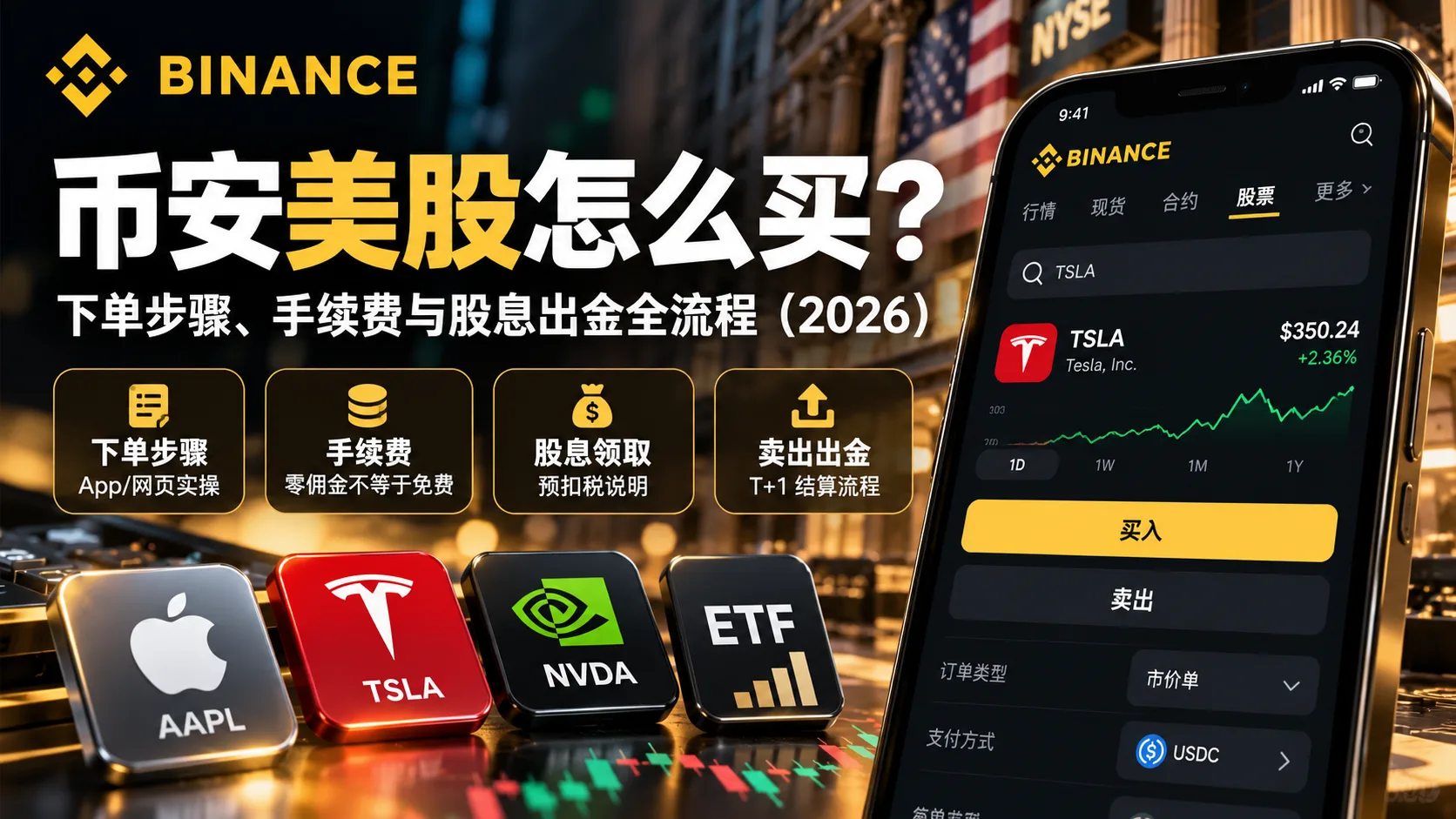
Table of contents

Binance new user rewards
20% trading fee rebate
Official Binance registration. Complete identity verification (KYC) to trade and withdraw.
Binance US stocks is the US stock and ETF trading feature provided by Binance Stocks. Eligible users can buy US stocks and ETFs such as AAPL, TSLA and NVDA directly in the Binance app or on the web, with fractional shares supported and a minimum investment of about $5.[1]
But before using it for the first time, you must clearly separate one thing:
Direct Stocks, bStocks and stock perpetual contracts are not the same product.
If your goal is to "actually own a piece of Apple, Tesla or Nvidia", you should enter the Stocks page and buy Direct Stocks — not place an order the moment you see a TSLA or NVDA ticker.
The conclusion first
The full path to buying US stocks on Binance is:
Confirm the account has Stocks access → prepare USDC or USDT → search the ticker → confirm it is Direct Stocks → choose a market/limit order → check the fees in Preview → place the order → sell → wait for T+1 settlement → withdraw or convert USDC.[2]
If you just want quick answers:
| Question | Answer |
|---|---|
| Can Binance buy US stocks? | Yes, but only for users who meet the region and account eligibility |
| Are they real stocks? | Direct Stocks are beneficial interests in the stock; bStocks are not direct shareholding |
| What's the minimum? | As low as about $5, with fractional shares on some stocks |
| What currency do I pay with? | Mainly USDC; USDT can be auto-converted to USDC |
| How much are the fees? | 0 commission ≠ 0 cost; small orders have a minimum platform fee |
| What do I receive after selling? | USDC |
| Can I withdraw immediately after selling? | Usually you must wait for T+1 settlement |
| Are there dividends? | Eligible Direct Stocks can participate in dividends and corporate actions |
If you only want to know "how to buy US stocks on Binance", the core is not finding TSLA — it's first confirming you're buying Direct Stocks and checking the fees and product type in Preview before ordering.
If all goes well, you can go from confirming access to placing an order in about 10 minutes. The two easiest places to trip: buying bStocks or a stock perpetual thinking it's Direct Stocks, and confirming without checking the fees in Preview.
No Binance account yet? Take a few minutes to register — new users who enter referral code BN522 get a spot and futures fee rebate. See the Binance registration tutorial (2026) for the signup flow.
1. What exactly are Binance US stocks?
Binance Stocks is the stock trading entry Binance provides; eligible users can buy and sell US-listed stocks and ETFs through it.
Direct Stocks are processed and held by a partner securities system, and the user is the beneficial owner of the corresponding stock.[3]
This is not the same concept as the "stock tokens" many people have heard of before.
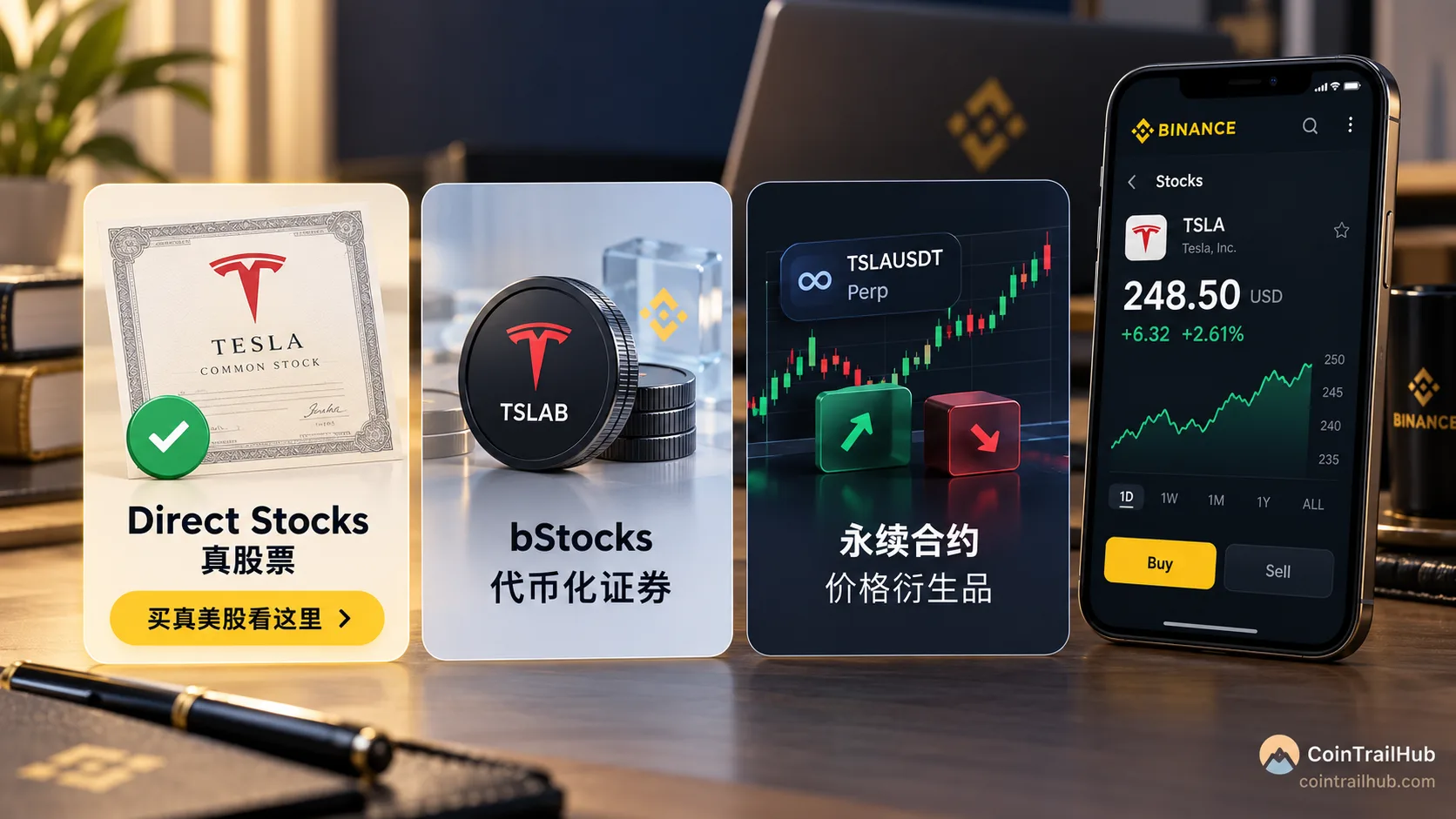
Image: the three common "US-stock-related products" on Binance — to actually buy a stock, first confirm it is Direct Stocks.
What's the difference between Direct Stocks, bStocks and perpetual contracts?
| Item | Direct Stocks | bStocks | Stock perpetual contract |
|---|---|---|---|
| TSLA example | TSLA | TSLAB | TSLAUSDT Perp |
| Nature | Stock | Tokenized security | Derivative |
| Directly holds beneficial stock interest | Yes | No | No |
| Involves securities settlement | Yes, usually T+1 | Product rules differ | Not a stock settlement |
| Dividends | Eligible to participate | Handled per bStocks rules | No ordinary shareholder dividend |
| Who it's for | People who want to buy stocks | People who want tokenized securities | People trading price |
Seeing TSLA doesn't mean you're buying a stock.
You also need to confirm:
Stocks page + TSLA + Direct Stocks
Instead of:
TSLAB
Or:
TSLAUSDT Perpetual.
If your goal is "I want to actually buy a piece of Apple, Tesla or Nvidia", choose Direct Stocks first; only consider bStocks if you want to trade tokenized securities; if you're just trading the price, that's the perpetual contract category.
For a full explanation of the difference between tokenized securities and real stocks, see Tokenized US stocks vs traditional stocks (2026).
2. How do I know whether my Binance account can buy US stocks?
Binance Stocks is not open to every region and every account.
Being able to see the TSLA or AAPL price doesn't mean your account has stock trading access.
The simplest way to check
Open Binance:
Trade → Stocks
Then enter any stock, for example:
- AAPL
- TSLA
- NVDA
- AMZN
- MSFT
If you can see:
- Buy;
- Market / Limit Order;
- Payment Account;
- Preview;
- Trading Session;
it usually means you can already enter the relevant stock trading flow.
How to judge account status?
| What you see | What it means |
|---|---|
| Can search TSLA/AAPL quotes | Only means you can see quotes |
| Can enter the Stocks buy page | Usually means there is a trading entry |
| Page says the region isn't supported | The account can't use it now |
| No Stocks at all | May not be available, or the account doesn't qualify |
| Can Preview an order | Already close to actually tradable |
Whether you can buy US stocks ultimately depends on account eligibility, not your IP address.
It's mainly decided by:
KYC residence region + account eligibility + the actual status of the Binance Stocks page
Don't bypass region eligibility by changing your IP, using a VPN or falsifying residence details.
Don't guess whether you can buy. Open Binance → Trade → Stocks → find TSLA → see whether there's a Buy button — that's the fastest way to check.
3. What do I need to prepare before buying US stocks on Binance?
Two main things before placing an order:
- Complete KYC;
- Prepare USDC, USDT or another supported payment asset.
1. Complete KYC first
Stock trading is a securities-type service, so the account must meet Binance's identity verification and region eligibility requirements.
If KYC isn't done yet, start with:
Binance KYC guide: how long the review takes, failure reasons and fixes (2026)
If you don't have a Binance account yet, register first and then do KYC — new users who enter referral code BN522 get a spot and futures fee rebate. See the Binance registration tutorial (2026).
2. Prepare USDC, or hold USDT in the account
Binance Stocks mainly uses USDC as the stock trading settlement asset.
But that doesn't mean:
You must manually convert USDT to USDC in advance.
If the account holds a supported asset like USDT, the system can complete the conversion during the order process and then execute the stock order with USDC.
Simply put:
USDT → USDC → stock
Not:
USDT → buy the stock directly.
What's the difference between ordering with USDT and USDC?
| Payment asset | How it works | What to watch |
|---|---|---|
| USDC | Used directly for stock trading | Simplest path |
| USDT | Auto-converted to USDC first | Watch the conversion rate |
| Other supported assets | Auto-converted | Check the Preview rate |
| Fiat | Depends on region | Go by the account page |
If you already hold USDC, using USDC directly is simplest. If your funds are mostly USDT, you don't need to convert them in advance just to buy a stock once, but always check the real-time USDT → USDC conversion rate on the Preview page.
4. How to buy US stocks on Binance: app order steps
This is the most important operational part of the article.
Step 1: Enter Stocks
Open the Binance app.
Go to:
Trade → Stocks
If you can't find it on the home screen, you can also search a ticker, for example:
TSLA
But make sure you're entering the Stocks page.
Step 2: Search the stock
Using Tesla as an example:
Search:
TSLA
and open the stock detail page.
Don't just look at the company name — also confirm the product type.
Correct: TSLA — Stocks.
Don't buy the wrong thing: TSLAB is bStocks; TSLAUSDT Perpetual is a perpetual contract.
Step 3: Tap Buy
Tap:
Buy
to enter the order page.
Common order types include:
- Market Order
- Limit Order
- Some stocks may offer other order types
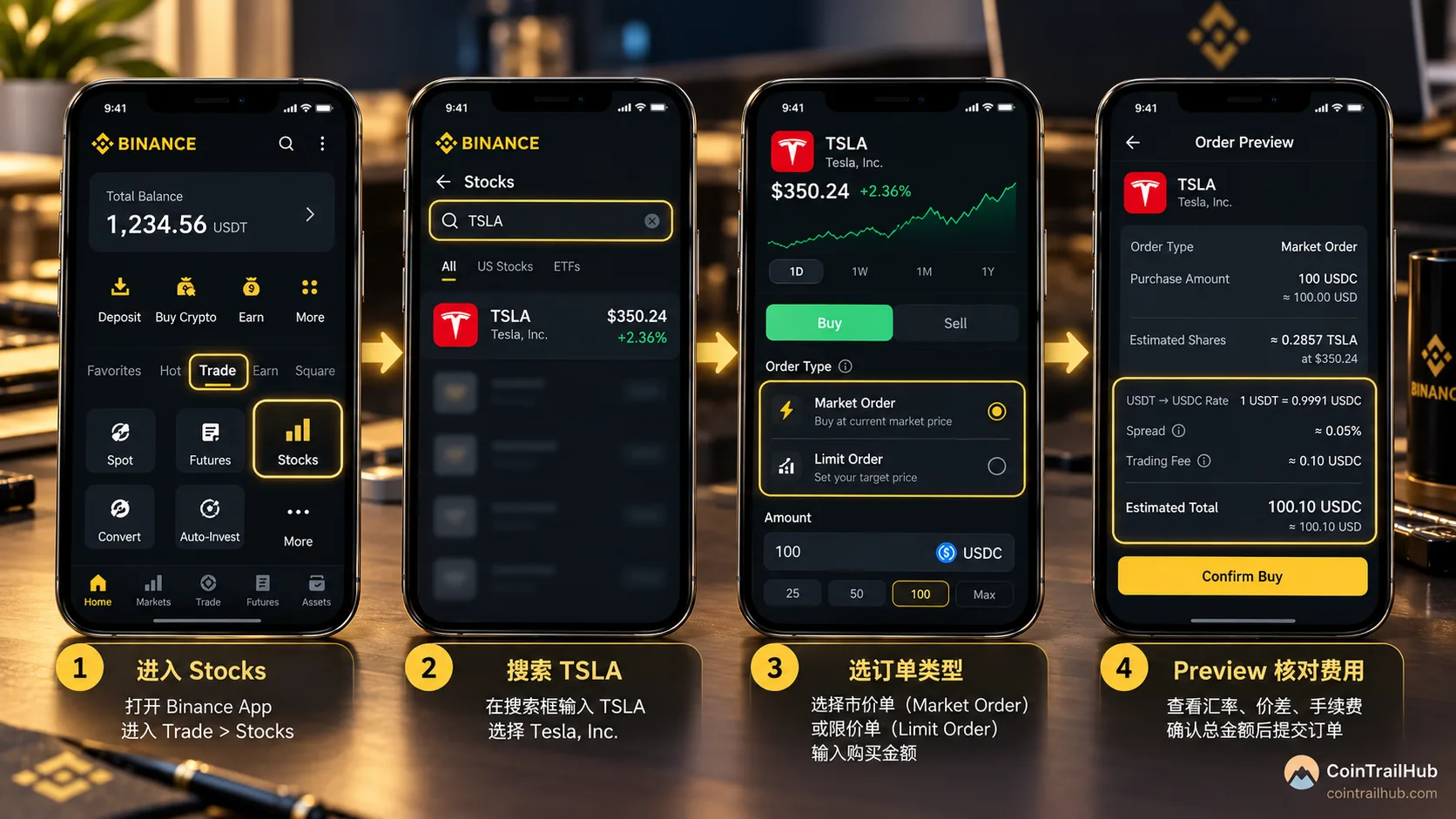
Image: the basic flow for buying US stocks in the Binance app — before submitting, check the ticker, order type, conversion rate and fees in Preview.
5. Market order or limit order?
What is a market order?
A market order is an order to buy or sell as soon as possible at the current market price.
Pros:
Fast execution.
Cons:
Possible slippage during rapid price moves.
For example, if TSLA is around $350 and you submit a market order, it doesn't mean it will necessarily fill at exactly $350.
What is a limit order?
A limit order only fills when the price reaches your specified price or better.
For example:
TSLA is currently:
$350
and you only want to:
buy at $345 or lower
then you can set:
Limit Price = $345
If the price never reaches $345, the order may never fill.
Market order vs limit order
| Item | Market order | Limit order |
|---|---|---|
| Goal | Fill quickly | Control price |
| Fill probability | Higher | May not fill |
| Price control | Weaker | Stronger |
| Slippage risk | Yes | Relatively lower |
| Easy for beginners to understand | Easy | Requires understanding price |
| Better for | Quick buys | Controlling buy cost |
If you're testing the feature for the first time, understand limit orders first. Not because they're always better, but because you can clearly know "the maximum I'm willing to pay". If you care more about filling fast, consider a market order.
6. What's the minimum to buy US stocks on Binance?
Binance Stocks supports fractional shares on some stocks, so you don't need to buy a full share at once.
The overall minimum can be as low as about:
$5.
For example, even if one TSLA share costs a few hundred dollars, you can buy:
- 0.01 shares;
- 0.02 shares;
- 0.1 shares;
The specific minimum is still subject to the trading page.
Small-order example
You can try:
| Order amount | Purpose |
|---|---|
| 5 USDC | Walk through the flow |
| 10 USDC | Small test |
| 50 USDC | Lower fee ratio |
| 100 USDC | Easier to observe actual cost |
But there's a very important issue here:
Being able to buy $5 doesn't mean $5 is the most cost-effective.
The fees section explains this later.
7. Why must you check Preview before ordering?
Preview is the final confirmation page before a stock order is submitted.
For your first stock purchase, don't just click confirm all the way through.
At minimum, check in Preview:
- Ticker;
- Quantity;
- Order amount;
- Market / limit order;
- Trading Session;
- Time-in-Force;
- Platform fee;
- Spread;
- USDT → USDC rate;
- Final estimated shares received.
Final pre-order checklist
| Item | Why it matters |
|---|---|
| Ticker | Avoid buying the wrong company |
| Direct Stocks | Avoid buying bStocks / Perp by mistake |
| Quantity | Confirm fractional share amount |
| Order type | Judge possible slippage |
| Platform Fee | See the real fee |
| Spread | Key for large orders |
| Conversion rate | Especially important when ordering with USDT |
| Session | Determines when it may fill |
What actually decides your order's cost isn't the "0 Commission" in the ad — it's the final total cost on the Preview page.
For any Binance Stocks order, check Preview first. Understanding it before submitting matters more than memorizing any fee table online.
8. How much are Binance US stock fees?
This is the part users misunderstand the most.
Binance Stocks can be 0 trading commission, but 0 commission ≠ 0 trading cost.
As of October 5, 2026, the current standard fee structure can be understood like this:
| Fee | Current rule | When it applies |
|---|---|---|
| Stock commission | 0 | Buying and selling stocks |
| Platform fee | Minimum ~0.35 USDC for orders ≤ $350 | Small orders |
| Spread | ~0.1% for orders > $350 | Larger orders |
| ADR Fee | ~0.01–0.05 per share on some ADRs | ADR products |
| Maintenance fee | Currently 0 | No regular maintenance/idle fee yet |
| Currency conversion | Real-time rate | Converting USDT etc. to USDC |
| Taxes | Varies by account and security | Dividend and other scenarios |
Example 1: buying $100 of stock. The minimum platform fee is about 0.35 USDC, a fee ratio of about 0.35%.[4]
Example 2: buying $400? Above the platform-fee threshold, it's mainly calculated at about 0.1% spread, roughly 400 × 0.1% ≈ 0.40 USDC. The actual amount is still subject to Preview.
9. Why is buying $5 of stock actually not worth it?
Because the minimum platform fee pushes the fee ratio of a small order up.
For example:
Buy $5
If the fee is:
0.35 USDC
the fee ratio is about:
7%.
If:
Buy $100
with the same 0.35 USDC:
the fee ratio is only:
0.35%.
A comparison
| Buy amount | Assumed platform fee | Fee ratio |
|---|---|---|
| 5 USDC | 0.35 | 7% |
| 10 USDC | 0.35 | 3.5% |
| 50 USDC | 0.35 | 0.7% |
| 100 USDC | 0.35 | 0.35% |
$5 is the "minimum you can buy", not the "cheapest in fees".
If you just want to confirm Binance Stocks works, 5–10 USDC is fine for a test. If you're actually investing, don't only look at the minimum threshold — first calculate the platform fee as a share of the order amount.
10. Why did I only pay 0.17 USDC when I bought TSLA before?
CoinTrailHub actually tested Binance Stocks once in August 2026.
The purchase at the time:
0.015 TSLA shares
Stock value:
5.16 USDC
Platform fee:
0.17 USDC
Total cost:
5.33 USDC
But this must be noted clearly:
0.17 USDC was a promotional rate at the time, not the standard fee as of October 2026.[5]
What this real test proves is:
- Fractional shares can be bought;
- Small orders can fill;
- USDC can be used for settlement;
- The Direct Stocks flow really works;
But it doesn't prove:
Any stock you buy now only costs 0.17 USDC.
Historical tests prove the flow works. Current fees are always what the Preview shows on the day you order. For the full test, see Can Binance buy US stocks? Real purchase of 0.015 TSLA shares in 2026.
11. When can I trade US stocks on Binance?
Some Binance Stocks support up to 24 hours a day, 5 days a week, but not all stocks and order types support full-session fills.
Mainly including:
| Session | ET (US Eastern) | Market order | Limit order |
|---|---|---|---|
| Regular | 9:30–16:00 | Yes | Yes |
| Pre-Market | 4:00–9:30 | Usually waits for regular | Some can fill |
| Post-Market | 16:00–20:00 | Usually waits for regular | Some can fill |
| Overnight | 20:00–next day 4:00 | Usually waits | Only some stocks support |
Why is the regular session better for beginners?
Because the regular session usually has:
- Higher volume;
- Better liquidity;
- Smaller bid-ask spread;
- Easier-to-judge prices.
For your first buy, prefer the US stock Regular Session. Not because you can't buy in other sessions, but because the regular session makes the actual fill price easier to understand.
12. Are there dividends on Binance US stocks?
If you hold Direct Stocks and meet the corresponding company's dividend eligibility, you can participate in relevant cash dividends and corporate actions.
But buying a stock:
doesn't mean there will definitely be a dividend.
First the listed company must announce a dividend.
For example:
Whether Tesla pays a cash dividend depends on whether Tesla actually announces one.
It's not that holding TSLA on Binance automatically gives you a dividend.
Where do dividends go?
Eligible cash dividends are usually handled as:
USDC
and may take a few business days to credit.
13. Can fractional shares receive dividends?
Fractional shares that meet corporate-action eligibility generally receive rights in proportion to the actual holding.
For example:
You hold:
0.1 shares
and meet the dividend conditions.
You don't necessarily have to hold a full:
1 share
to possibly receive the corresponding dividend.
The final result is subject to Binance Stocks' Corporate Actions records.
14. How much tax is withheld on Binance US stock dividends?
You can't simply write here:
Everyone is charged a fixed 30%.
Stock dividend withholding tax depends on the user's tax status, the stock's issuing region, tax documents and applicable rules.
Influencing factors may include:
- Tax residency;
- Stock issuing region;
- Tax forms;
- Tax treaties;
- Broker processing rules.
"A 30% withholding on all US stock dividends" is too simple a statement.
After actually receiving a dividend, go by the Dividend / Corporate Actions record + tax documents.
15. What do I receive after selling Binance US stocks?
After selling Direct Stocks, the sale proceeds are credited to the Funding Account as USDC.
For example:
You sell TSLA.
What you receive is not:
USDT
nor does it directly become:
local currency / USD bank balance
but rather:
USDC.
The full fund path is:
Stocks → USDC → stablecoin / fiat withdrawal
16. Can I withdraw immediately after selling?
Not necessarily.
Here you must clearly separate two concepts:
Fill
and:
Settlement completion.
The order showing "sold" only means the trade has filled.
But securities settlement still takes time.
Binance Stocks settlement cycle
Usually:
T+1 Trading Day
that is:
the trade fills on a trading day, and normal securities settlement completes on the next trading day.[6]
What does T+1 mean?
If you sell on Monday:
it usually completes settlement by:
Tuesday
If there is:
- A weekend;
- A US market holiday;
- A public holiday;
the time may be pushed back.
What can I do with the money before settlement?
Not-fully-settled funds may still be usable for:
- Spot;
- Stocks;
- Earn;
and other supported in-platform uses.
But:
Being able to keep trading ≠ being able to fully withdraw.
Seeing a USDC balance doesn't mean this stock sale can already be withdrawn to an on-chain wallet immediately.
Before withdrawing, check the Settlement Date.
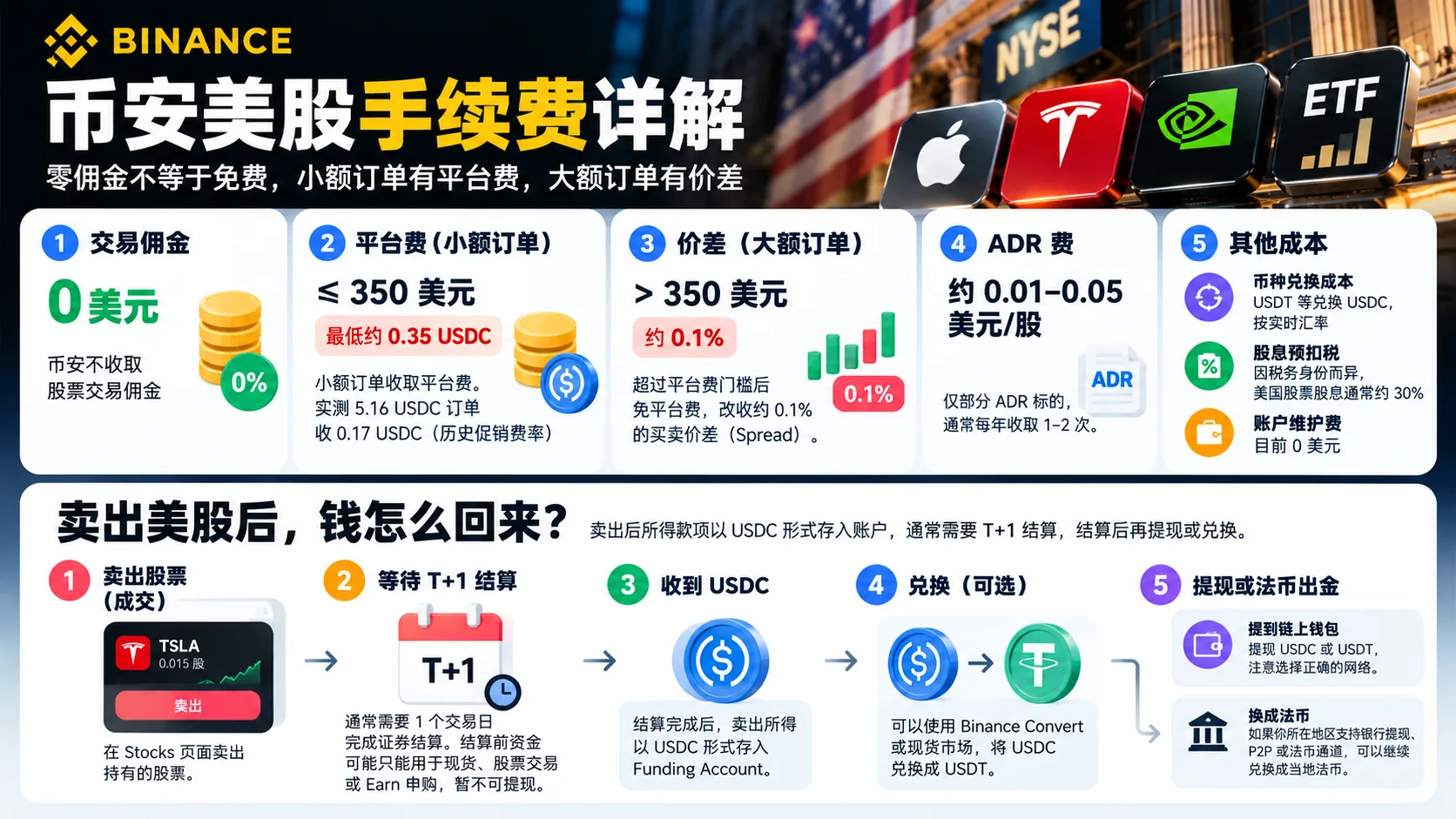
Image: the main trading costs and the sale proceeds path for Binance US stocks. Zero commission ≠ zero cost; after selling, you usually wait for T+1 settlement, after which USDC enters the account, and you convert or withdraw as needed.
17. How do I withdraw after selling Binance US stocks?
The full path is:
Sell stock → receive USDC → wait for settlement → USDC becomes available → convert to USDT or withdraw USDC directly → withdraw to wallet / fiat channel.
Option 1: keep holding USDC. If you need stablecoins anyway, no need to convert.
Option 2: convert USDC to USDT. Use Binance Convert or the spot market to convert USDC → USDT.
Option 3: withdraw to your own wallet. Choose the corresponding network and withdraw USDC or USDT to your own on-chain wallet; note the withdrawal network must match the network supported by the receiving wallet.
Option 4: convert to fiat. If your region and Binance account support bank withdrawal, P2P or a fiat channel, you can continue converting to local fiat.
Withdrawal flow table
| Stage | Asset state |
|---|---|
| Holding stock | TSLA / AAPL / NVDA etc. |
| Sell fills | Waiting for settlement |
| Settlement complete | USDC |
| Conversion | USDC → USDT |
| Withdrawal | USDT/USDC → wallet |
| Fiat cash-out | Depends on region-supported methods |
"Sold the stock" and "the money is in my bank account" are two different things. In between there is at least: securities settlement → USDC → withdraw / convert to fiat.
18. Binance Stocks vs a traditional broker?
The biggest feature of Binance Stocks isn't "the absolute lowest fees".
It's:
the short fund path from digital assets to stocks.
A traditional broker's biggest advantage is:
a more mature securities business.
Binance vs traditional brokers
| Need | Binance Stocks | Traditional brokers (e.g. IBKR, Schwab, Fidelity) |
|---|---|---|
| Already hold USDT/USDC | More convenient | Usually need to move bank funds in |
| Just want a small taste of US stocks | Convenient | Also possible |
| Fractional shares | Supported on some stocks | Mostly supported too |
| Long-term large holding | Possible, but compare | Usually more mature |
| Tax documents | Check specific support | Usually more complete |
| Stock transfer | Check rules | Usually more mature |
| Corporate actions | Supported, but newer | Relatively mature |
| Options and research tools | More limited | Usually richer |
| Buy stocks directly with stablecoins | Clear advantage | Generally not supported |
If your funds are already on Binance, the biggest advantage of Binance Stocks is not having to withdraw USDT to a bank first and then deposit into a traditional broker; if you plan to hold long-term (5–10 years), allocate large amounts, transfer positions frequently, need complex tax documents, or need options and research tools, a traditional broker is still worth comparing first.
Short path, small test: Binance is convenient. Long-term, large, tax- and transfer-heavy: traditional brokers are usually more mature. For a full comparison, see Binance stocks vs Futu/Tiger? Fees and transfer test comparison (2026).
19. The 5 most common mistakes beginners make buying Binance US stocks
1. Buying the moment you see TSLA. You might buy bStocks or a perpetual contract; the right approach is to confirm Stocks + Direct Stocks first.
2. Thinking "zero commission" means no fees. Commission is only one cost — there are also platform fees, spread, auto-conversion cost, ADR Fee and tax costs; the right approach is to check the Preview total cost.
3. Buying only $5 to test. $5 works, but the minimum platform fee can push the fee ratio very high; a small test is fine, but for real investing, calculate the fee ratio.
4. Withdrawing immediately after selling. Stock trading still has a securities settlement process; the right approach is to first wait for the Settlement Date.
5. Treating USDT as the stock settlement currency. Binance stocks settle mainly in USDC; when ordering with USDT it's USDT → USDC → stock.
FAQ
Can Binance buy US stocks?
Yes.
Eligible Binance users can use Stock Trading to buy and sell 7,000+ US stocks and ETFs.
Whether it's available depends on account eligibility and region.
How do I buy US stocks on Binance?
The simplest path is:
Binance → Trade → Stocks → search the ticker → confirm Direct Stocks → Buy → choose market or limit order → enter amount → Preview → submit the order.
Are Binance US stocks real stocks?
If you're buying:
Direct Stocks
the user is the beneficial owner of the corresponding stock.
If you're buying:
bStocks
it's a tokenized security, not a direct holding of the listed company's ordinary shares.
What's the minimum to buy Binance US stocks?
The minimum is about:
$5.
Some stocks support fractional shares.
But a $5 order is affected by the minimum platform fee, so the actual fee ratio may be high.
Can I buy Tesla, Apple or Nvidia on Binance?
If your account has Stocks access and the ticker is tradeable in your account, you can search:
- TSLA
- AAPL
- NVDA
The actual range is subject to the account page.
Can I buy Binance US stocks with USDT?
Yes.
The actual flow is:
USDT → auto-convert to USDC → buy the stock.
Preview shows the corresponding conversion rate.
How much are Binance US stock fees?
As of October 5, 2026:
- Stock trading commission: 0;
- Orders ≤ $350: minimum ~0.35 USDC platform fee;
- Orders > $350: ~0.1% spread;
- Some ADRs may have an ADR Fee;
- Ordering with USDT also requires watching the conversion cost.
Actual fees are subject to Preview.
Why does Binance charge fees when it says zero commission?
Because:
commission is only one part of the trading cost.
0 Commission means the stock trading commission is 0, not that:
- The platform fee is 0;
- The spread is 0;
- The conversion cost is 0;
- The ADR Fee is 0;
- The taxes are 0.
Why is buying $5 of stock not worth it?
Because if the minimum platform fee is:
0.35 USDC
then buying $5 of stock has a fee ratio of about:
7%.
Therefore:
the minimum threshold ≠ the most economical order amount.
Can Binance US stocks receive dividends?
If you hold eligible Direct Stocks and meet the corresponding company's dividend conditions, you can participate in relevant dividends and corporate actions.
Dividends are usually handled in USDC.
Can fractional shares receive dividends?
Eligible fractional shares can in principle participate in relevant corporate actions in proportion to the holding.
The final result is subject to the stock and account's Corporate Actions records.
Does Tesla pay dividends on Binance?
Whether it pays depends on whether Tesla announces a cash dividend.
Buying TSLA itself doesn't guarantee a cash dividend.
After selling Binance US stocks, do I receive USDT or USDC?
USDC.
Direct Stocks sale proceeds enter the Funding Account as USDC.
How soon after selling can I withdraw Binance US stocks?
After selling, you usually go through:
T+1 trading-day settlement.
Only after settlement completes can you perform the full withdrawal or cash-out according to the account's actual status.
Can I buy Binance US stocks 24 hours a day?
Some stocks support up to:
24/5.
But different stocks and order types support different sessions.
For your first trade, prefer the US stock regular session.
Can I transfer Binance stocks to another broker?
Some stocks have a Transfer feature, but:
- Which brokers are supported;
- Whether fractional shares are supported;
- Transfer fees;
- Estimated time;
may all change.
Before submitting a transfer, confirm with both Binance and the receiving broker.
Which regions can buy US stocks on Binance?
Whether you can use Binance Stocks cannot be judged only by IP address.
It ultimately depends on:
KYC residence region + account eligibility + whether the Stocks page is available.
The most direct way to check is:
Binance → Trade → Stocks → see whether the account shows Buy.
Don't bypass region limits with fake identity, a fake residence or other means.
Final summary: how to buy US stocks on Binance?
If you only remember one flow, it's:
Open Binance → Trade → Stocks → search TSLA/AAPL/NVDA → confirm Direct Stocks → choose the order type → enter the amount → check fees in Preview → submit the order.
After selling:
Sell stock → receive USDC → wait for T+1 settlement → convert USDC to USDT or withdraw directly.
What you really need to remember isn't the buttons, but four judgments:
First, confirm whether the account has Stocks access.
Second, Direct Stocks, bStocks and perpetual contracts must not be mixed up.
Third, 0 commission ≠ 0 cost.
Fourth, a filled sale ≠ you can already withdraw — stock trading still has a T+1 settlement process.
If you just want to experience the feature:
a small test is fine.
If you plan long-term, large holding:
compare Binance Stocks and traditional brokers on tax, transfer, corporate actions and account management first.
Related reading
- Binance registration tutorial (2026) — email/phone signup, KYC and security settings; new users enter referral code BN522 for a fee rebate
- Binance referral code BN522 tested: is the 20% rebate real? — rebate rules and credit conditions
- Can Binance buy US stocks? Real purchase of 0.015 TSLA shares tested — fill and fee records
- Binance stocks vs Futu/Tiger? Fees and transfer comparison — how to choose between the account types
Data verification notes
The key facts in this article were verified against Binance's official stock trading documentation on 2026-10-16, item by item:
- Product nature and minimum of Binance Stocks: eligible users can buy US-listed stocks and ETFs in the Binance app or on the web, with fractional shares supported and a minimum investment of about $5. Source: Binance Stocks eligibility and availability FAQ.
- Full path of buying US stocks: confirm the account has Stocks access → prepare USDC or USDT → search the ticker → confirm Direct Stocks → choose the order type → check fees in Preview → place the order → sell → wait for T+1 settlement → withdraw or convert USDC. Source: Binance Stocks trading FAQ.
- Holding form of Direct Stocks: Direct Stocks are processed and held by a partner securities system, and the user is the beneficial owner — a different structure from tokenized securities. Source: Binance Securities Trading Terms.
- Standard fee structure and examples: stock commission is 0, orders ≤ $350 have a minimum platform fee of about 0.35 USDC, orders > $350 are charged roughly 0.1% spread; buying $100 of stock, a 0.35 USDC platform fee is about 0.35%. Source: Binance Stocks fees and trading overview.
- Nature of the historical 0.17 USDC rate: the 0.17 USDC charged in the August 2026 test buying 0.015 TSLA shares was a promotional rate at the time, not the standard fee as of October 2026. Source: Binance Stocks fees and trading overview.
- Settlement cycle after selling: Binance Stocks is usually T+1 Trading Day, i.e. normal securities settlement completes on the next trading day after the fill, and may be pushed back by weekends, US market holidays or public holidays. Source: Binance Stocks trading FAQ.
Disclaimer
This article only introduces the product structure and operating flow of Binance Stocks and does not constitute investment advice, a securities recommendation, tax advice or legal advice.
Stock prices may rise or fall, and there is a risk of principal loss.
- 2026-10-17UpdateAdded the registration CTA (referral code BN522) and the related-reading block, completing the conversion path to signup.
- 2026-10-16UpdateAdded evidence-chain superscripts and "Data verification notes"; updated key-fact verification date.
- 2026-10-05UpdateInitial release explaining the order steps, fee structure and dividend/withdrawal flow for Binance stocks.
- 2026-10-05CorrectionSecond verification — standard small-order fee unified to a minimum 0.35 USDC, orders above $350 charged roughly 0.1% spread; the 0.17 USDC from the Aug 2026 test marked as a historical promotional rate; ADR fee updated to 0.01–0.05 per share; strengthened T+1 settlement; distinguished Direct Stocks, bStocks and stock perpetual contracts.
See ourEditorial Policy and the correction process in ourCorrections Policy.
The CoinTrailHub editorial team focuses on crypto education for beginners, exchange security and P2P trading risk. This article is compiled from official sources and public data, reviewed by humans, and strives for accuracy but is not investment advice.
Last updated:2026-10-17 · Content reviewed by humans · Learn more
© 2026 CoinTrailHub · Original content. Reproduction or rewriting without permission is prohibited.