
Can You Buy US Stocks on Binance? My Real 0.015 TSLA Buy — Fill and Fee Record (2026)
Table of contents

Binance new user rewards
20% trading fee rebate
Official Binance registration. Complete identity verification (KYC) to trade and withdraw.
On 2026-08-17, I bought 0.015 share of Tesla in the Binance App.
The only real catch: it's still unclear whether fractional shares can be transferred back out to a traditional broker — if you plan to buy and then move the position elsewhere, you should think this through first.
This is not a simulated trade, and not a screenshot stuck on the order preview page — it's a real order that filled 100%:
| Item | Actual data |
|---|---|
| Ticker | TSLA |
| Order type | Limit buy |
| Limit price | 344.25 USDC |
| Avg fill price | 344.1975 USDC |
| Quantity | 0.015 share |
| Stock value | 5.16 USDC |
| Platform fee | 0.17 USDC |
| Total cost | 5.33 USDC |
| Fill ratio | 100% |
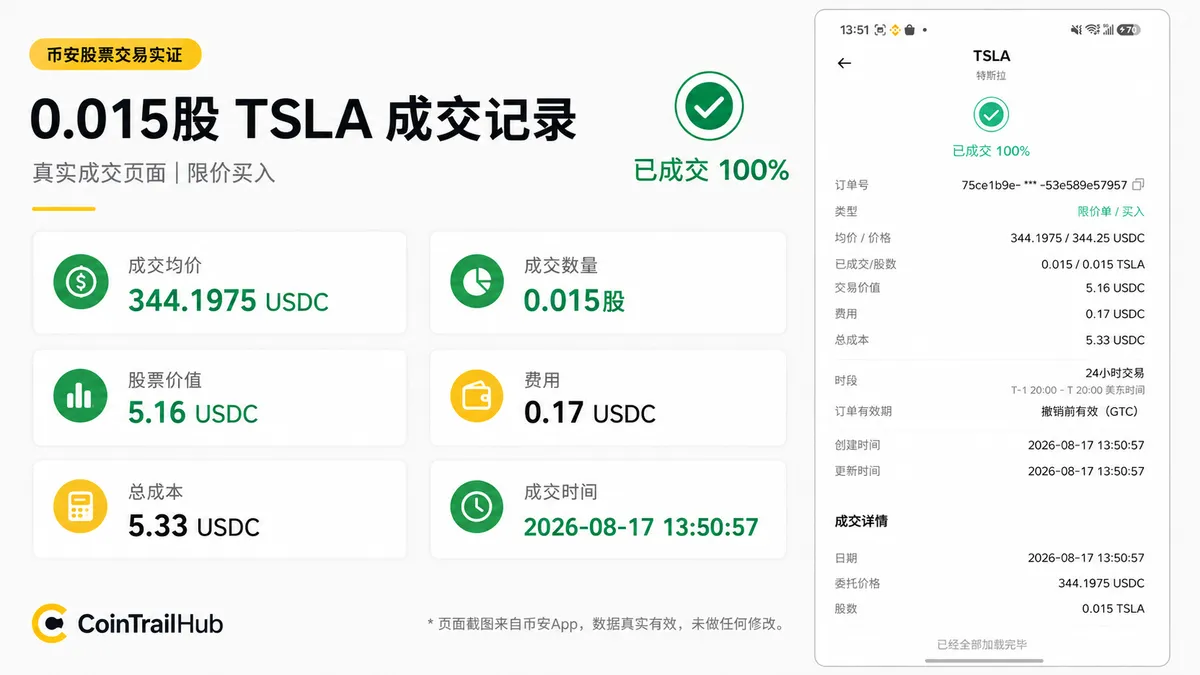
What genuinely surprised me was not that ~$5 could buy a fractional Tesla share, but that this 5.16 USDC order produced a 0.17 USDC platform fee — about 3.29% of the stock value.
Binance has indeed opened US stock and ETF trading, but not every region and account can use it.
Region note: Binance's stock service is not available to US residents — it is offered to eligible users in permitted jurisdictions outside the United States. Availability depends on your location, identity verification and account eligibility. The bStocks tokenized securities (TSLAB) also exclude US persons. Check what your own account actually shows.
When you search for Tesla, the App may show TSLA, TSLAB and TSLAUSDT Perp at the same time. All three are tied to Tesla's price, but what you actually buy is a stock, a tokenized security and a perpetual contract respectively.
This post records my actual purchase process in the Binance App, for product experience and operational reference only — not investment advice. Stock features, fees, trading hours and account entitlements vary by region, account and platform rules. Always go by the actual pages and agreements in your own account.
About 8 minutes to read. Remember two things first: TSLA, TSLAB and TSLAUSDT Perp in Binance are three different products — don't order just because you see the ticker; and on a ~$5 small order, the platform fee will be a higher percentage than you expect.
What did I actually buy on Binance?
This order filled under the "Stocks" section:
TSLA | Tesla
When placing the order I did not turn on "Tokenize current order", so what I bought is what Binance calls Direct Stocks — not the tokenized security under ticker TSLAB, and not the TSLAUSDT perpetual contract.
Binance launched its stock service in 2026, offering eligible users in some regions more than 7,000 US stocks and ETFs combined, with fractional trading from roughly $5 and 24/5 trading on some instruments.[1]Reuters report
Not every Binance account has this feature.
Some accounts can search and view TSLA quotes but cannot enter the stock order page. Whether you can trade usually depends on your location, identity verification and account eligibility.
So to judge whether your account has the stock feature, don't just check whether TSLA shows up in search — check whether you can enter the stock buy page and submit an order.
For specific eligibility and rules, see the Binance Stock Trading FAQ.
Where do you find TSLA on Binance?
I used Binance App 3.18.4 this time.
Open the bottom "Markets" tab, enter the "Traditional Finance" section, choose "Stocks — US", and search TSLA to find the Tesla stock page.
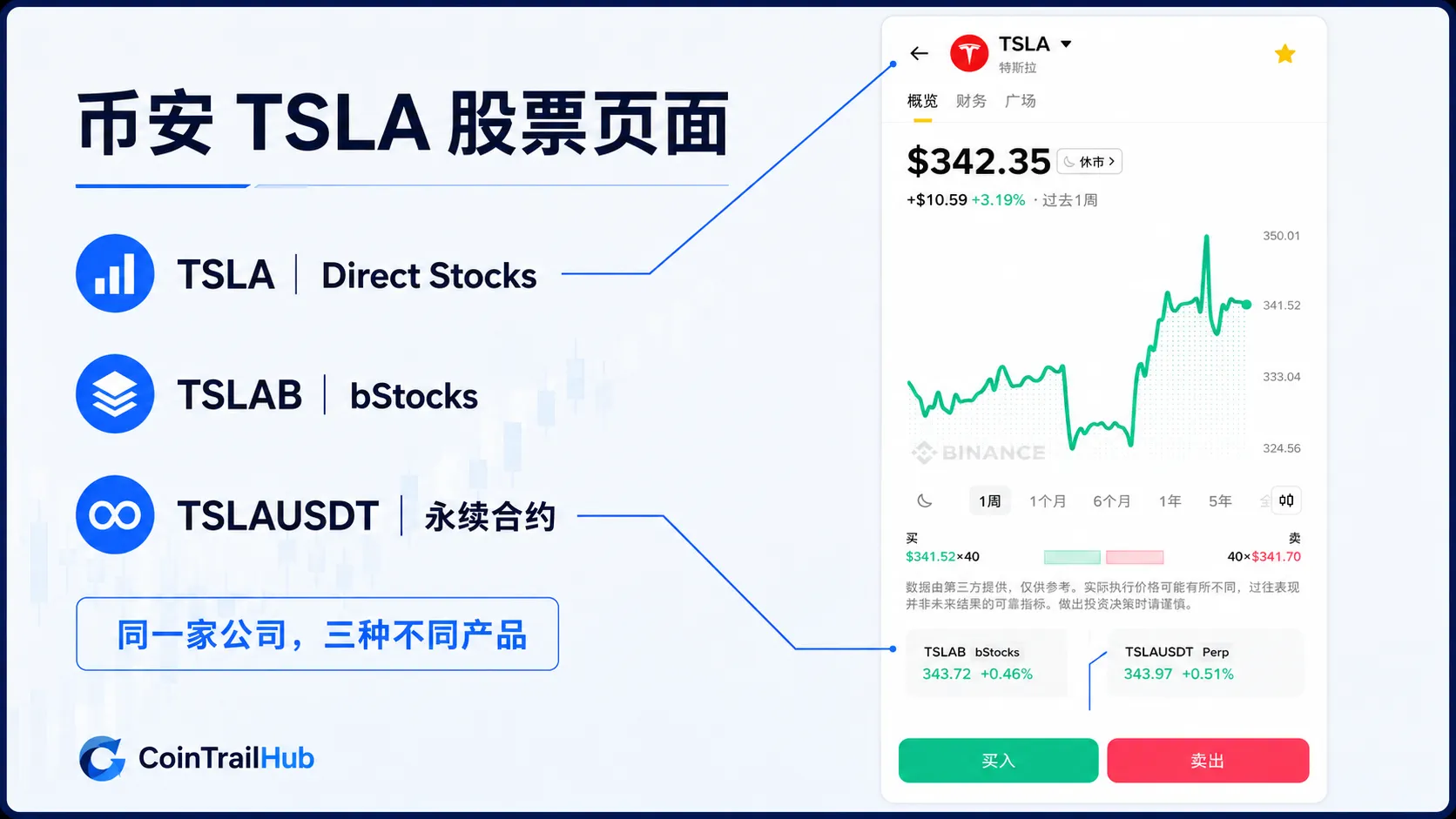
On the page you can see the price chart, bid/ask quotes and related products. Tap "Buy", choose an order type, enter the share count, and you'll reach the order confirmation page.
The first time I entered 0.02 share, the preview data was:
| Item | Preview data |
|---|---|
| TSLA price | 342.35 USDC |
| Quantity | 0.02 share |
| Stock value | 6.85 USDC |
| Estimated fee | 0.17 USDC |
| Estimated total | 7.02 USDC |
For the actual buy I changed the quantity to 0.015 share.
Can you buy TSLA with about $5?
Yes.
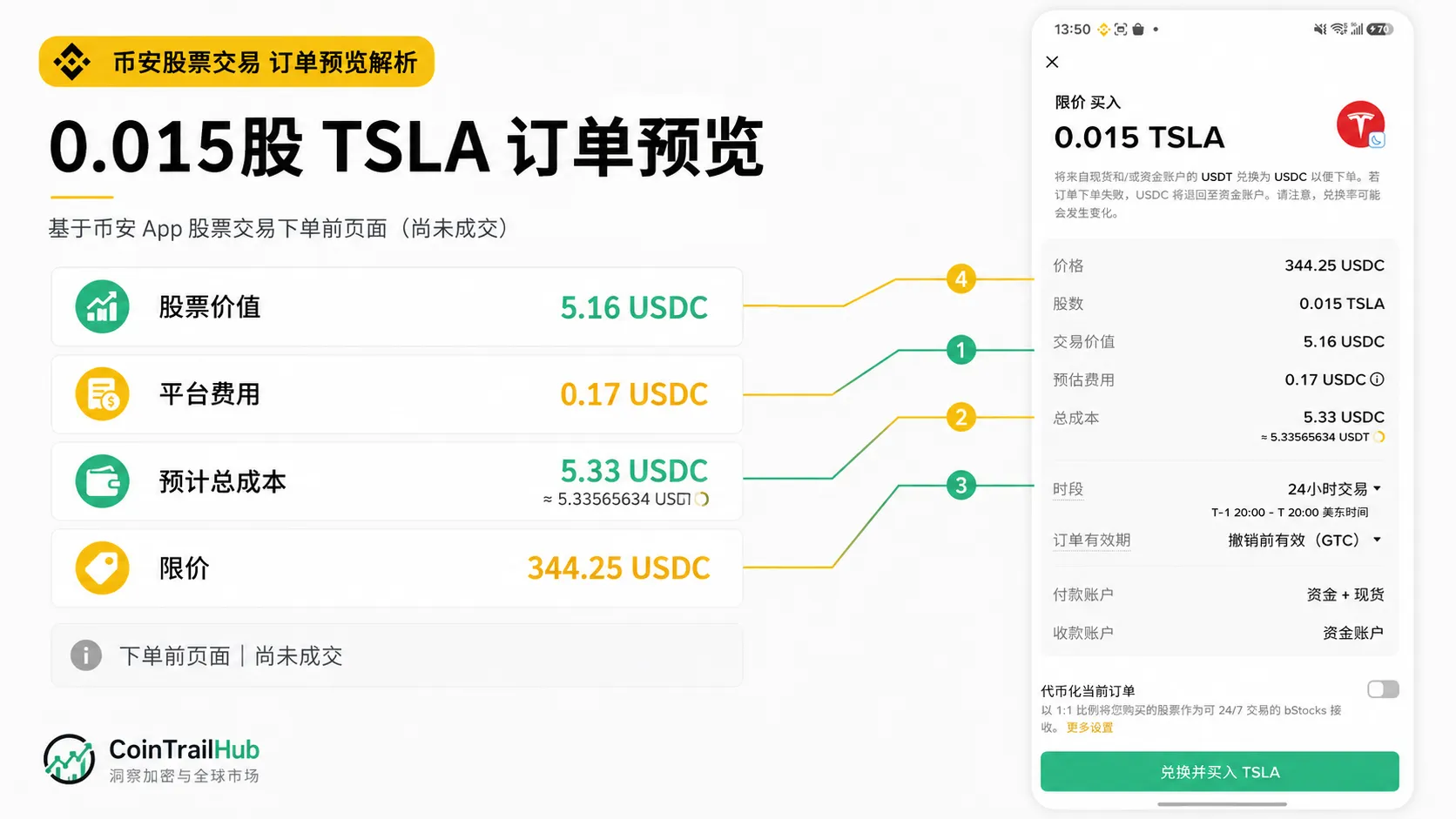
I submitted a limit buy order:
| Item | Actual order |
|---|---|
| Limit price | 344.25 USDC |
| Quantity | 0.015 share |
| Stock value | 5.16 USDC |
| Platform fee | 0.17 USDC |
| Total cost | 5.33 USDC |
| Time in force | GTC, valid until cancelled |
| Avg fill price | 344.1975 USDC |
| Fill status | 100% filled |
The order was created and filled on 2026-08-17 at 13:50:57; all 0.015 share was executed.
One Tesla share was over $300 at the time, so I only ended up buying 0.015 share. Fractional trading lowers the entry barrier per order, but the platform fee does not become negligible just because the order is small.
Note that "minimum about $5" usually refers to the stock value or minimum order amount, and does not necessarily include the platform fee and any costs from currency conversion.
For this order, the stock value was 5.16 USDC and the actual total cost was 5.33 USDC.
How much did this order cost in fees?
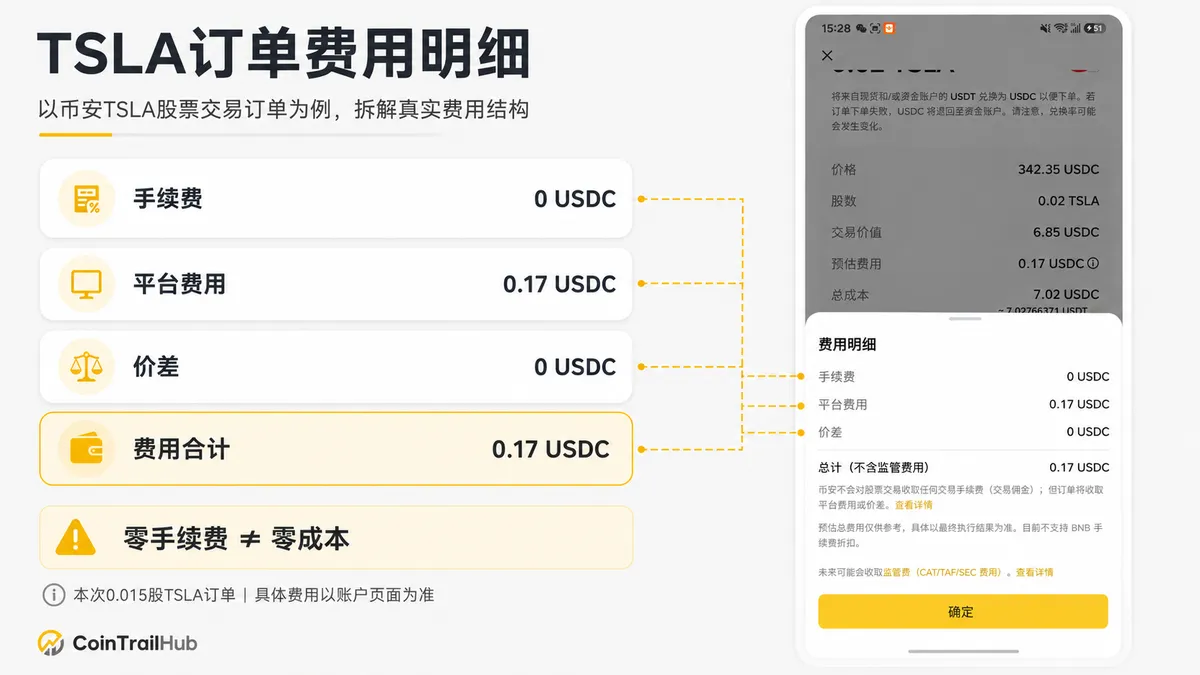
The fee breakdown for this order was:
- Trading fee: 0 USDC
- Platform fee: 0.17 USDC
- Spread: 0 USDC
- Total fees: 0.17 USDC
Calculated against the 5.16 USDC stock value:
0.17 ÷ 5.16 ≈ 3.29%
That's not a low percentage, but you can't conclude from it that Binance charges a flat 3.29% on stocks.
3.29% is just the share that the 0.17 USDC platform fee takes up in my small order. The smaller the order, the more noticeable the same fee looks.
Putting this real fill next to the two earlier order previews:
| Quantity | Stock value | Fee shown | Fee / stock value |
|---|---|---|---|
| 0.015 share | 5.16 USDC | 0.17 USDC | ~3.29% |
| 0.02 share | 6.85 USDC | 0.17 USDC | ~2.48% |
| 1 share | 342.35 USDC | 0.17 USDC | ~0.05% |
From these three page figures, the smaller the order, the higher the 0.17 USDC fee is as a share of stock value. As to whether 0.17 USDC is the minimum platform fee, the current sample is not enough to judge.
Testing the flow once with about $5 is fine, but if you plan to frequently buy very small fractional shares long term, calculate the fee share in advance.
This order also shows that "trading fee 0" does not mean zero cost. When confirming an order, also check:
- Platform fee;
- Bid/ask spread;
- USDT-to-USDC conversion;
- The final deducted amount.
How to save on Binance fees: BNB discount + referral code BN522 cashback, how much you can save in 2026 covers fees for spot and futures crypto trading; for stocks, check the stock order page separately.
Why does USDT get converted to USDC first?
My Binance account mainly holds USDT, but the TSLA order is priced in USDC.
The order page gave this notice:
USDT from your spot and/or funding account will be converted to USDC to place the order. If the order fails, the USDC will be returned to your funding account. Please note the conversion rate may change.
So the funding process for this order was:
Deduct USDT → convert to USDC → use USDC to buy TSLA
Stock value was 5.16 USDC, plus 0.17 USDC platform fee, total cost 5.33 USDC, and about 5.33565634 USDT was deducted from the account in the end.
That is, although I used a USDT balance, TSLA is not settled directly in USDT. The system completes the USDT-to-USDC conversion first, and the final USDT deducted may be affected by the conversion rate at the time.
If your account already holds USDC, the funding path may differ — go by the order page at the time.
What's the difference between TSLA, TSLAB and TSLAUSDT?
When you search for Tesla, Binance may show three products at once:
| Ticker | Product type | What you actually hold |
|---|---|---|
| TSLA | Direct Stocks | Shares held through a partner securities firm |
| TSLAB | bStocks tokenized security | A tokenized certificate tied to the underlying TSLA |
| TSLAUSDT Perp | Perpetual contract | A derivative that tracks the TSLA price |
The tickers look similar, but the product structures are completely different.
TSLA: Direct Stocks
What I bought this time is TSLA.
According to Binance's disclosed structure, Nest Trading Limited acts as the introducing broker, and customer orders are executed, cleared, settled and held by Alpaca, a regulated US clearing broker.[2]
Binance provides the App entry and account interface, but securities custody is handled by the partner securities firm.
Direct Stocks corresponds to the share position and the applicable economic rights. However, specific voting arrangements, transfer capability, tax documents and the scope of investor protection still depend on the client agreement, your region's rules and the actual holding form.
So the more accurate understanding is not "shares are registered directly under Binance's name", but that users hold shares through the Binance entry and the partner broker system.
TSLAB: bStocks tokenized security
TSLAB is not ordinary stock issued by Tesla.
Per the relevant product materials, it is a bStocks tokenized security, backed by the underlying stock, and holders receive economic rights tied to the corresponding asset.
Its differences from ordinary TSLA include:
- Who issues the product;
- Who holds the underlying stock;
- Whether on-chain transfer is supported;
- How dividends are handled;
- Whether it carries voting rights;
- How it can be redeemed;
- What happens if the issuer or custodian runs into problems.
To learn more about these products, keep reading:
- Are the US stocks on Binance real stock? The difference between stock tokens and real shares (2026)
- Are RWA on-chain assets worth it? My real experience buying NVDAon
- Tokenized US stocks vs traditional stocks: platform assets vs broker accounts (2026)
TSLAUSDT Perp: stock perpetual contract
TSLAUSDT Perp is a perpetual contract.
It is not Tesla stock, and it does not give the holder the shareholder rights of ordinary stock. Traders face contract price, margin, funding rate, leverage and liquidation risk.
For beginners, the most common mistake is not choosing the wrong company — it's entering the wrong product page after seeing "TSLA".
Before ordering, check:
- Whether the page is under "Stocks" or "Futures";
- Whether the ticker is just TSLA;
- Whether there's a letter B after it;
- Whether it shows USDT Perp;
- Whether the page shows leverage or a funding rate;
- Whether "Tokenize current order" is turned on.
There are also TSLAon, TSLAx and other tokenized Tesla products on the market. See What is TSLAon? Why its price differs from TSLA and TSLAx (2026).
What does "Tokenize current order" mean?
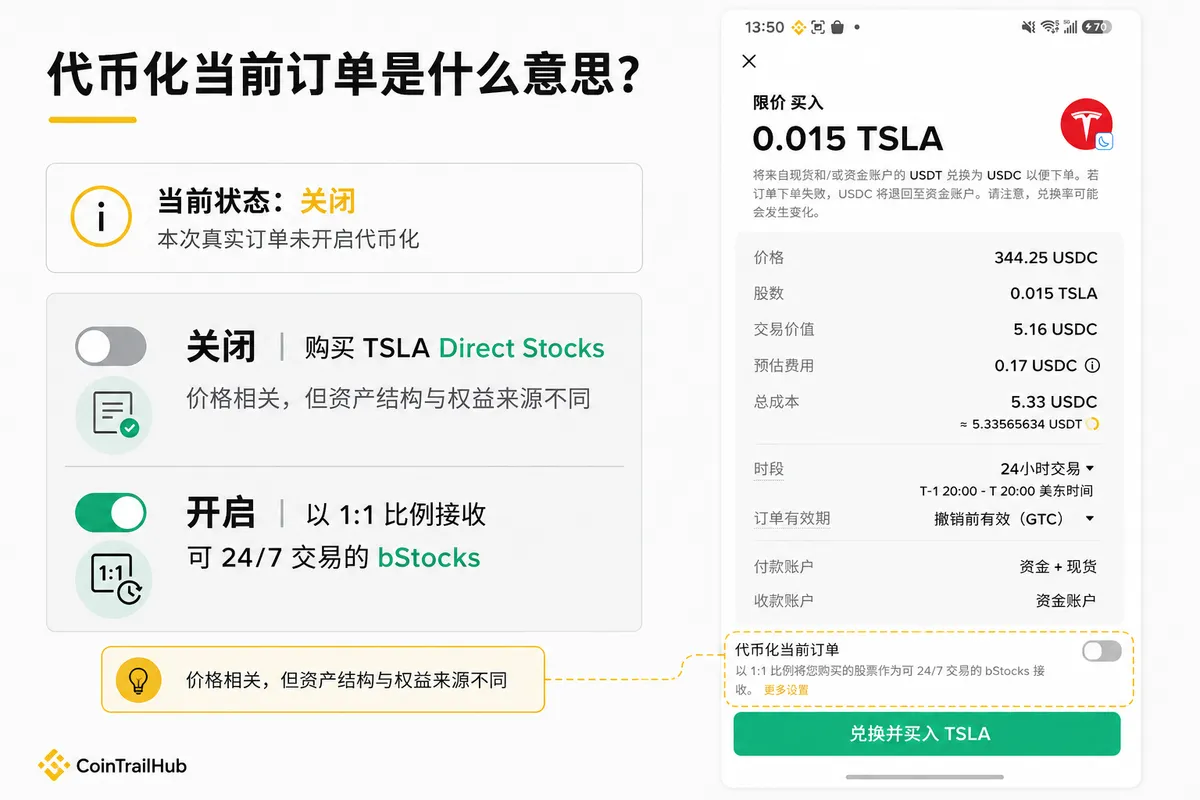
The TSLA order page has a "Tokenize current order" toggle at the bottom, with text next to it:
Receive your purchased stock as bStocks, tradable 24/7, at a 1:1 ratio.
I did not turn on this option this time.
Per the page:
- Off: the order buys TSLA under Direct Stocks;
- On: you receive the corresponding bStocks tokenized security.
Both products may be tied to Tesla's share price, but the asset structure, trading method and source of rights differ.
If your goal is to hold TSLA under Direct Stocks, confirm this toggle is off before ordering.
Can Binance stocks be traded around the clock?
My TSLA order page showed:
24-hour trading: T-1 20:00 to T 20:00, US Eastern Time.
Binance offers 24/5 trading on some stocks and ETFs — that is, nearly all day on weekdays, not 24 hours a day, 7 days a week.[4]Binance also publicly mentioned the 24/5 arrangement when it launched the stock business.Reuters report
Extended hours are convenient, but outside regular US market hours you may see:
- Lower volume;
- Wider bid/ask spreads;
- Larger price swings;
- Limit orders sitting unfilled for a long time;
- Quotes temporarily diverging from regular trading hours.
I used a GTC limit order. GTC means the order stays valid until it fills or is actively cancelled.
For a small test, I prefer a limit order because it caps the highest price I'm willing to accept for buying.
Do Binance stocks pay dividends?
Direct Stocks supports processing applicable cash dividends and corporate actions, but whether you actually receive a dividend depends on whether the listed company declared one, and whether your account meets the relevant conditions.
The main factors include:
- Whether the listed company declared a dividend;
- Whether you held the shares on the required date;
- Whether your account and region are eligible;
- Tax and withholding rules;
- How the partner broker processes corporate actions.
What I bought this time is Tesla.
Tesla officially states that the company has never paid cash dividends on its common stock and does not expect to pay any in the foreseeable future.[3]So don't expect regular cash dividends from holding TSLA.Tesla investor Q&A
If Tesla changes its dividend policy later, the board decision and formal announcement prevail.
TSLAB and other tokenized securities may also process the economic rights generated by the underlying asset, but their distribution mechanism cannot be directly equated with Direct Stocks — check the relevant issuance documents and product terms.
Can the stock be transferred to another broker?
The Binance App already has a "Stock transfer" entry where you can submit an inbound transfer request.
The transfer-in flow shown on the page is:
- Submit a transfer-out request to the original broker;
- Obtain the settlement instructions (SSI) from the original broker;
- Enter the stock transfer feature in your Binance funding account;
- Fill in and submit the stock transfer-in request.
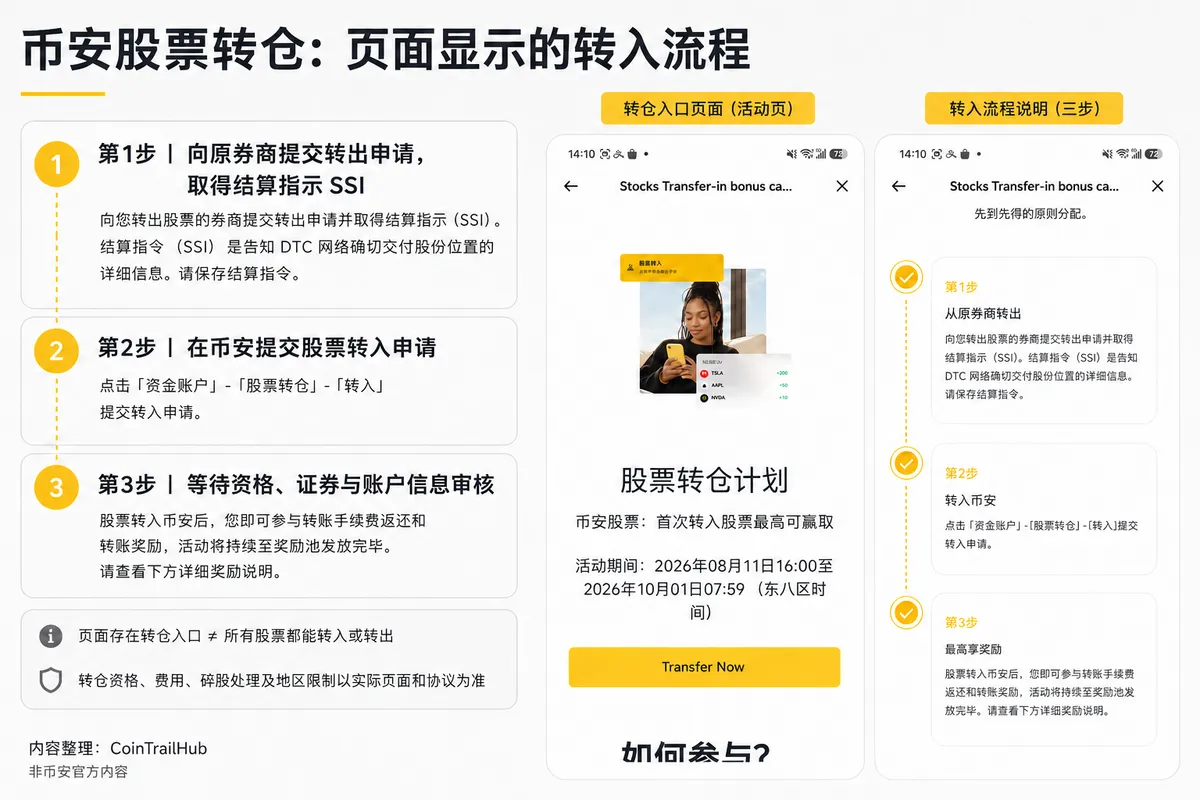
However, having a transfer entry does not mean every stock can be freely moved in or out. In practice you also need to confirm:
- Whether the outgoing broker supports it;
- Whether the stock is an eligible security;
- Whether the account names match on both sides;
- Whether your region has it open;
- Which transfer and settlement method is used;
- Whether there are transfer-out or receiving fees.
Fractional shares need special attention. Some traditional securities transfer systems cannot directly move fractional shares — you may need to sell the fraction first or transfer only whole shares. It's best to confirm with both sides before operating.
How is Binance stock trading different from a traditional broker?
The most intuitive feature of Binance stocks is that they connect to the digital assets in your account.
| Item | Binance Direct Stocks | Traditional broker |
|---|---|---|
| Common funding source | USDT, USDC and other digital assets | Bank deposit or broker cash |
| Fractional trading | Supported | Supported by some brokers |
| Trading hours | 24/5 on some instruments | Regular hours plus pre/after market |
| Securities custody | Handled through a partner securities firm | Handled by the broker and its custody system |
| Dividends | Processed for eligible stocks | Processed for eligible stocks |
| Transfer | Entry exists, subject to eligibility | Usually a more mature transfer system |
| Tax documents | Depends on account and region | Usually more mature |
| Crypto integration | Relatively convenient | Usually needs bank deposit/withdrawal |
If you already use Binance and hold USDT or USDC, buying US stocks through the same App is genuinely convenient — you don't need to move digital assets to a bank and then remit them into a traditional broker.
Traditional brokers usually offer more complete tax documents, research tools, voting arrangements and transfer services. Whether Binance offers the same depends on your account region and the specific terms.
So Binance stocks are better understood as an additional US-stock entry point for crypto users, not a full replacement for a traditional broker in every case.
If you don't have a Binance account yet, register first and then check whether the stock feature is available — new users who enter the referral code BN522 get spot and futures fee rebates; see the Binance registration guide (2026).
What do I think after this real test?
What this order confirms: the Binance stock section really can fill fractional US-stock orders, but small orders aren't cheap — 0.015 TSLA was worth 5.16 USDC with a 0.17 USDC platform fee, about 3.29%. Watch the product names too: TSLA, TSLAB and TSLAUSDT Perp look alike but are respectively Direct Stocks, a tokenized security and a perpetual contract — you must check the section and the "Tokenize current order" toggle before ordering.
My conclusion, mapped to your situation:
| Your situation | My suggestion |
|---|---|
| Already use Binance with USDT or USDC in the account | Worth trying once — saves the trouble of moving digital assets to a bank |
| Just want to spend a few dollars to test the flow and understand the feature | Fine — about $5 completes one real buy |
| Want to hold long term or buy US stocks in size | Use a traditional broker first; Binance's transfer, tax docs and custody still need observation |
| Need stable dividends and voting rights | Use a traditional broker; Tesla itself pays no dividend, don't expect one |
| Will frequently buy very small fractions | The 0.17 USDC share gets magnified each time — do the math first |
FAQ
Can you really buy US stocks on Binance?
Yes, but currently only for eligible users in some regions — not for US residents. On 2026-08-17, the 0.015 share of TSLA I bought filled 100%.
What's the minimum amount?
Binance's published fractional minimum is about $5. My stock value was 5.16 USDC, plus a 0.17 USDC platform fee, for a total cost of 5.33 USDC.
Can I pay directly in USDT?
You can use a USDT balance, but in my order the system converted USDT to USDC first and then used USDC to buy TSLA. The final USDT deducted is affected by the conversion rate.
Did I buy stock or a token?
I did not turn on "Tokenize current order", so what filled was TSLA under Direct Stocks. TSLAB is the bStocks tokenized security.
Do Binance stocks pay dividends?
Eligible Direct Stocks can process applicable cash dividends and corporate actions, but only if the listed company declares a dividend and your account meets the holding-date, region and tax requirements. Tesla currently pays no cash dividend.
Is stock trading zero-fee?
My order showed a trading fee of 0, but produced a 0.17 USDC platform fee. So "zero fee" or "zero commission" does not necessarily mean zero cost.
Related reading
- Binance referral code BN522 review: is the 20% rebate real? — rebate rules and payout conditions
- How to buy US stocks on Binance: order steps, fees and dividend withdrawal (2026) — the full order, fee and dividend flow
- Is Binance safe? 2026 real-account fees and OKX comparison
- How to save on Binance fees: BNB discount + referral code BN522 cashback, how much you can save in 2026 — spot, futures and other common fees
- What is TSLAon? Why its price differs from TSLA and TSLAx (2026) — the differences between several Tesla-related products
- Tokenized US stocks vs traditional stocks: platform assets vs broker accounts (2026) — stock tokens, broker accounts and platform assets compared
- Are the US stocks on Binance real stock? The difference between stock tokens and real shares (2026) — stock tokens, USDC settlement and platform risk
- Binance registration guide (2026) — account opening, KYC and security setup
Data verification notes
The key facts in this article were checked on 2026-10-16 against Binance's official guidance, a Reuters report and the Tesla Investor Relations page, item by item:
- Stock service scope: Binance launched its stock service in 2026, offering eligible users in some regions more than 7,000 US stocks and ETFs, with fractional trading from roughly $5. Source: Reuters report.
- Custody structure: Nest Trading Limited acts as the introducing broker, and orders are executed, cleared, settled and held by the US clearing broker Alpaca. Source: Binance Stock Trading FAQ.
- Dividends: Tesla has never paid cash dividends on its common stock and does not expect to pay any in the foreseeable future. Source: Tesla Investor Relations page.
- Trading hours: some stocks and ETFs offer 24/5 trading, not 24 hours a day, 7 days a week. Source: Reuters report.
Risk disclaimer
This article is for crypto platform operation and product experience reference only, and is not investment, trading or legal advice. US stocks, ETFs, tokenized securities, perpetual contracts and digital assets all carry risk. Whether you can use the relevant services depends on your location, account eligibility, applicable law and the platform's latest rules.
Author's note
The CoinTrailHub editorial team has long focused on beginner crypto tutorials, exchange account flows, on-chain assets and related financial products. Our content aims to help beginners understand, avoid pitfalls and make informed decisions. We do not encourage blind trading and do not make any profit promises.
- Binance Stock Trading FAQDirect Stocks eligibility, custody structure and trading hours
- Reuters reportBinance launch of US stocks and ETFs, 7,000+ instruments, 24/5 trading
- Tesla Investor RelationsTesla has not declared cash dividends
- 2026-10-16UpdateAdded evidence-chain citations and "Data verification notes", updated the key-fact verification date.
See ourEditorial Policy and the correction process in ourCorrections Policy.
The CoinTrailHub editorial team focuses on crypto education for beginners, exchange security and P2P trading risk. This article is compiled from official sources and public data, reviewed by humans, and strives for accuracy but is not investment advice.
Last updated:2026-10-17 · Content reviewed by humans · Learn more
© 2026 CoinTrailHub · Original content. Reproduction or rewriting without permission is prohibited.