
Are Binance US stocks real stock? Stock tokens vs real stocks (2026)
Table of contents

Binance new user rewards
20% trading fee rebate
Official Binance registration. Complete identity verification (KYC) to trade and withdraw.
The conclusion first: "US stocks" in Binance have to be looked at as two separate lines, and the answer is different for each.
- Direct stocks (SPCX, GOOG, AAPL, NVDA and the like) — you may be the beneficial owner of the underlying shares, custodied by a partner broker. These are "real US stocks". But it isn't the same as a traditional brokerage account: after selling, the proceeds return to a USDC fund account, and you generally can't withdraw the shares to an on-chain wallet.
- Stock tokens (TSLAon, bStocks and the like) — these are third-party-issued, 1:1 backed certificates, not the stock itself. They can usually be withdrawn to a supported on-chain wallet, but the holder generally doesn't obtain shareholder status or voting rights.
| Item | Direct stocks (SPCX, GOOG etc.) | Stock tokens (TSLAon, bStocks etc.) |
|---|---|---|
| What you hold | Beneficial ownership of real shares, custodied by a broker | Third-party-issued, 1:1 backed certificate, not the stock itself |
| Is it a "stock" | Yes (beneficial owner) | No (economic exposure / certificate) |
| Trading hours | 24/5 (Monday to Friday) | 24/7 |
| Withdraw to on-chain wallet | Generally not | Usually yes (e.g. BEP-20) |
| Dividends / voting | Handled like a stock; may carry dividend rights | Usually no voting rights; dividend handling varies by product |
| Post-sale settlement | USDC back to the fund account | USDC or on-chain asset |
One line: a ticker with TSLA or GOOG in it doesn't mean it's a stock; first check whether you're buying "direct stocks" or "stock tokens".
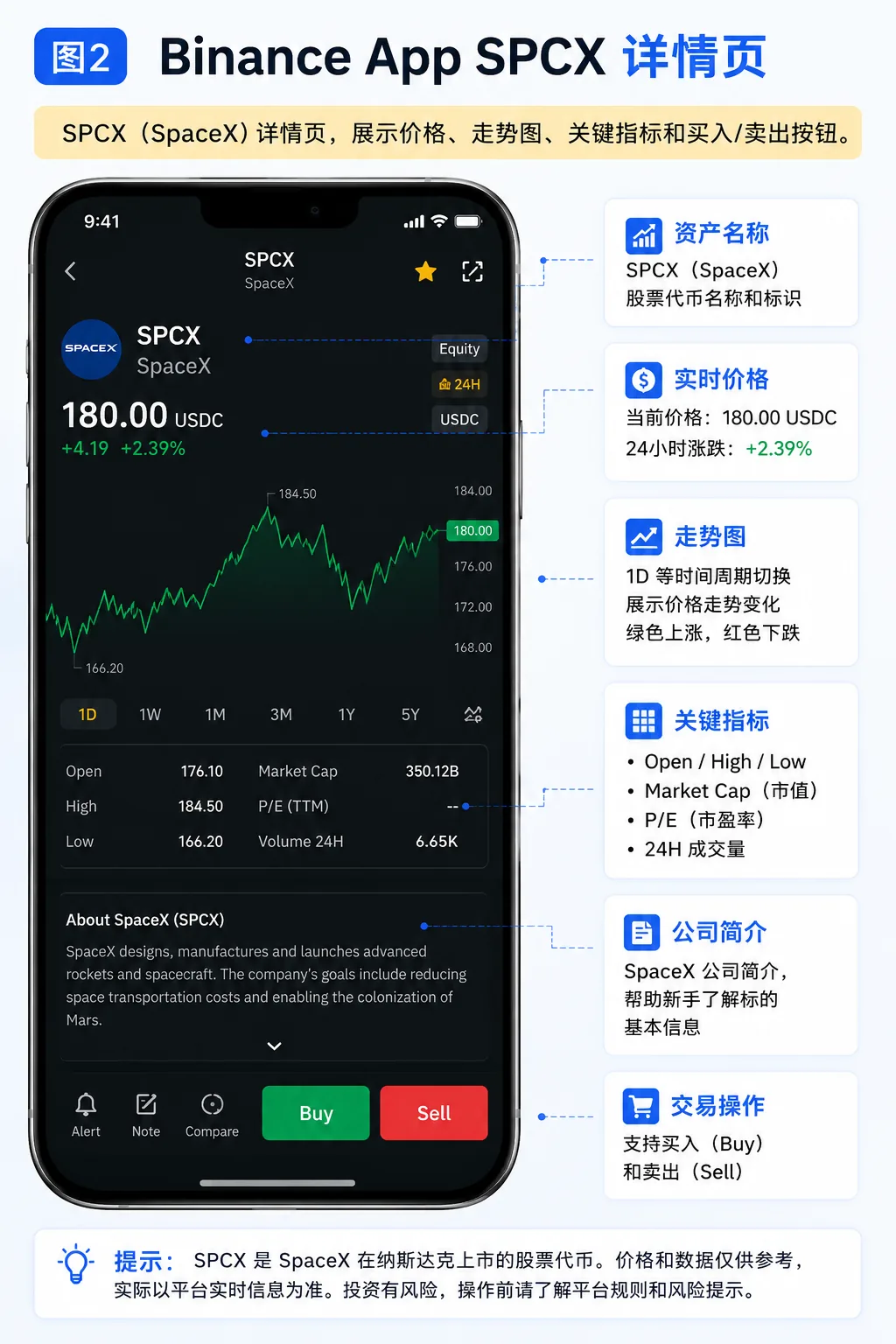
It was when I saw the SPCX page in the Binance App that I clearly felt:
tokenized US stocks are no longer just a concept.
The page showed SpaceX (SPCX) price, chart, key metrics, plus "Buy" and "Sell" buttons.
Judging by the interface alone, it really looks like an ordinary crypto trading page.
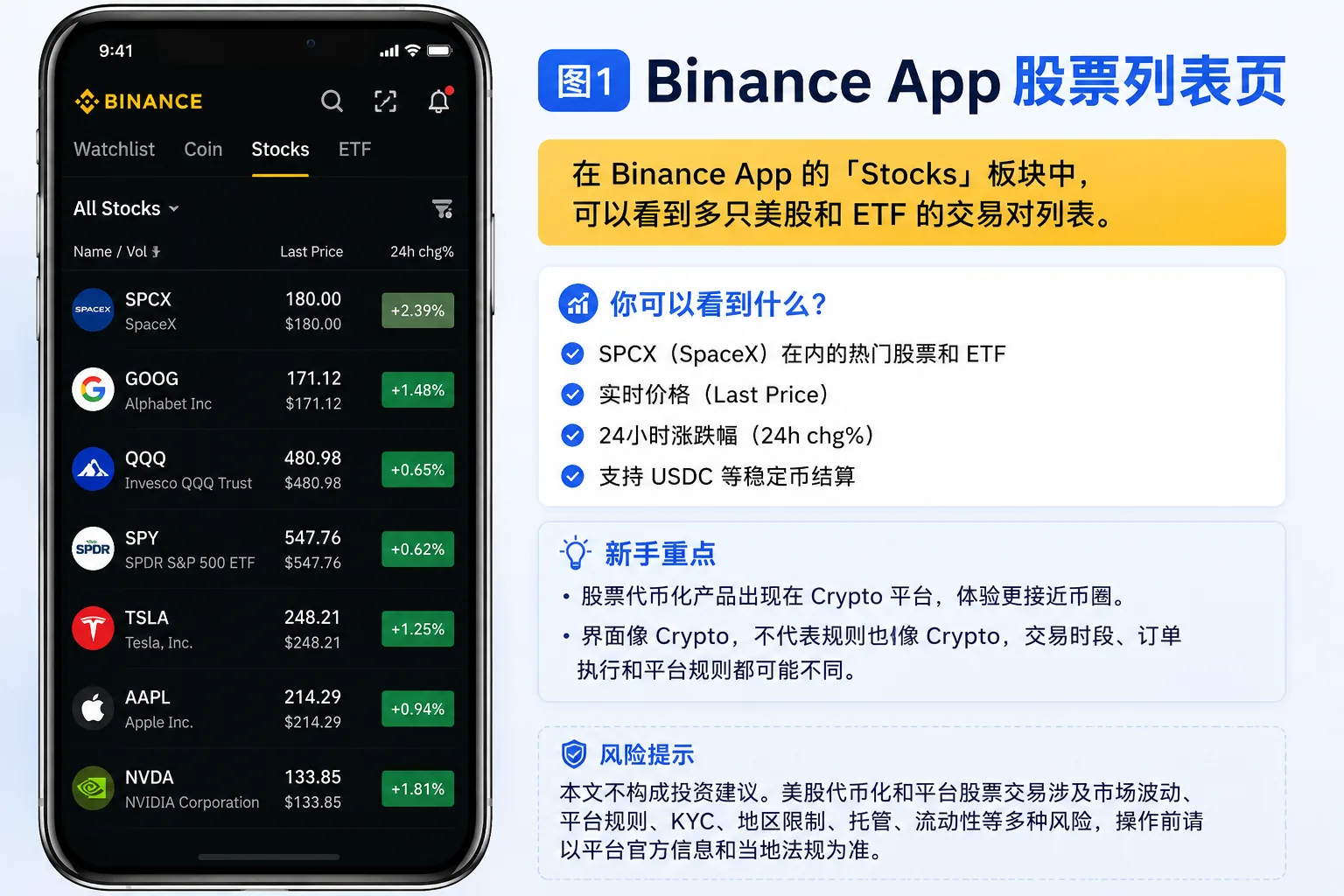
Later I looked at the stock list and saw assets like SPCX, GOOG, QQQ, SPY, TSLA, AAPL, NVDA.
This screen is quite striking for a beginner.
Because it doesn't look like a traditional brokerage page — it looks more like a stock entry added to a crypto app.
When I actually tapped into the buy page this time, I also noticed that even outside normal US market hours, the app could still show that placing an order was possible.
That makes it even easier to form a misunderstanding:
Can US stocks be bought and sold anytime, like USDT, BTC or ETH?
Have stocks been fully moved on-chain?
Is buying US stocks with USDC basically the same as buying an ordinary token?
These questions are all very natural.
But I need to be clear up front:
Tokenized US stocks are not simply Apple, Nvidia, Tesla or SpaceX shares being moved directly onto a blockchain or into a wallet.
It's more like:
the platform combining stock-related rights, a trading entry, custody arrangements and USDC settlement into a product that fits crypto users' habits.
So when you see "stock tokens", "SPCX", "USDC settlement" and "Buy" buttons on a platform, don't immediately read it as:
"I now fully hold this stock just like in a traditional broker."
And don't immediately read it as:
"this stock can definitely be withdrawn to a wallet like an ordinary token."
This article doesn't teach you to buy US stocks, nor does it recommend any platform.
It only helps beginners clarify a few basic questions:
What is tokenized US stock?
What's the difference between a stock token and an ordinary US stock?
Why do many platforms settle in USDC?
Does "the app shows you can place an order" mean it will definitely fill immediately?
And, within Binance's US stocks, what exactly is the difference between direct stocks and stock tokens?
This article is for general education on crypto fundamentals and on-chain assets only, and does not constitute investment, financial or trading advice. Tokenized US stocks, stock tokens and platform stock trading involve securities rules, KYC, regional restrictions, custody, dividends, redemption, liquidity, platform rules and market-volatility risk. Before acting, follow the platform's official page, product terms, risk warnings and local regulations.
What this article covers
- Why I noticed the stock-token entry in the Binance App
- Whether tokenized US stocks equal "stocks on-chain"
- How stock tokens differ from traditional US stocks
- Why these products commonly settle in USDC
- Why "the app shows you can place an order" doesn't mean it fills immediately
- What the SpaceX (SPCX) example illustrates
- The risks beginners most easily misunderstand
- How to separate the two lines — direct stocks vs stock tokens
- How an ordinary beginner should study these products
What I mainly referenced when writing this
These products change fast, so I didn't only look at the app page.
When writing this article, I mainly referenced a few kinds of material:
- Binance's official Stock Trading FAQ
- Binance's announcement on SpaceX (SPCX) on Binance Stocks
- Reuters reporting on SpaceX (SPCX.O) Nasdaq listing and trading
- Circle's official USDC explanation
- The stock list, SPCX detail page, limit-buy page and market-closed notices I saw myself in the Binance App
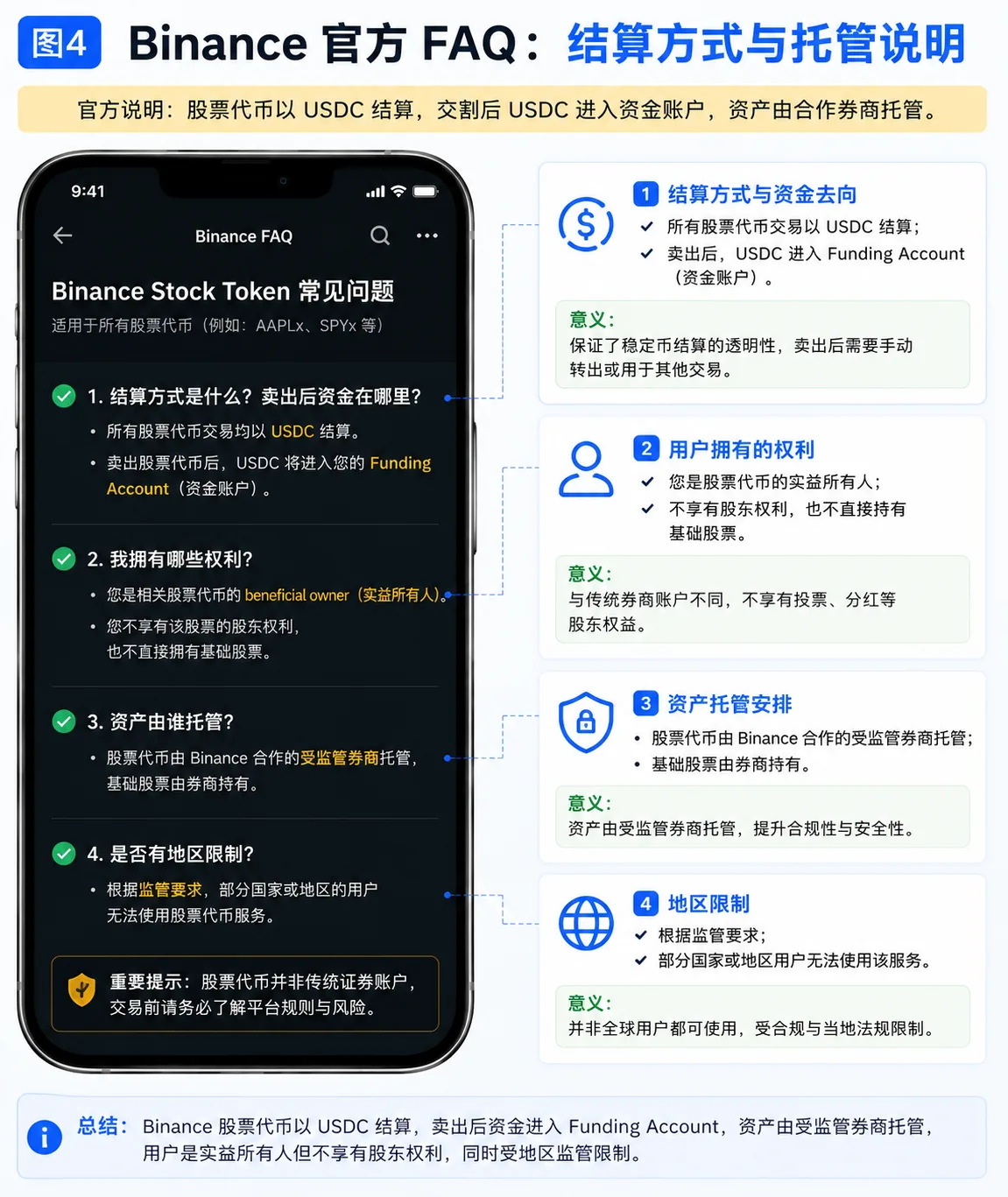
A few pieces of information in Binance's official FAQ are key:
Stock purchases mainly use USDC.
Other supported assets may be converted to USDC at order time.
After selling, the proceeds also enter the fund account as USDC.
You may be the beneficial owner of the purchased stock, but the stock is custodied by a partner broker.
Services and features vary by region.
This information helps us separate "platform stock trading" from "ordinary on-chain tokens".
Don't rush to read it as "stocks on-chain"
Many people see "tokenized US stocks" and their first reaction is:
have Apple, Nvidia, Tesla and SpaceX shares already been moved onto the blockchain?
That understanding is only a small part right.
More precisely, tokenizing US stocks isn't moving the stock itself into the blockchain.
The stock is still a real-world financial asset.
What actually gets digitally expressed may be:
stock-related rights.
trading records on the platform.
stock tokens.
some kind of economic-yield arrangement.
or a trading service designed between the platform and a partner broker.
These things all look related to "US stocks", but their essence may differ.
So I don't recommend a beginner immediately read "stock token" as:
"I directly hold the full shares of this company."
What you really need to check is what this product actually represents.
Is it the underlying stock rights?
Is it a platform stock-trading service?
Is it a tokenized security?
Or is it some kind of platform certificate?
These questions matter more than "does the page look like stock trading".
Why the pages I saw in the Binance App easily mislead beginners?
When I saw the stock pages in the Binance App, my first feeling was:
this entry is far too familiar to crypto users.
It isn't the style of a traditional broker.
It looks more like the market pages crypto users see every day.
You can see stock name, price, change, chart, key metrics, plus buy and sell buttons.
The SPCX page, for example, looks very intuitive.
The stock list also shows familiar names like GOOG, QQQ, SPY, TSLA, AAPL, NVDA. Among them, Tesla's tokenized version TSLAon and the original TSLA don't have exactly the same price; to understand why, see: What is TSLAon? Why its price differs from TSLA and TSLAx (2026).
If you're already used to looking at BTC, ETH and USDT in Binance, seeing these US stocks and ETFs easily creates an intuition:
"So US stocks can be bought and sold in the platform just like coins."
But pause here.
An interface that looks like crypto doesn't mean the rules are like crypto.
An ordinary crypto asset — you might be able to withdraw it to a wallet, check its on-chain address and manage your own private key.
But platform stock trading isn't necessarily like that.
Often what you see is a stock-trading service provided by the platform, backed by a partner broker, custody arrangements, order execution, compliance restrictions and platform rules.
So this kind of screenshot is valuable.
It shows the real scenario.
But it alone can't prove "stocks have been fully moved on-chain".
Beginners must separate these clearly.
What could the "stock token" you see on a platform actually be?
"Stock token" — you can't draw a conclusion from these words alone.
Different platforms may design it differently.
Some platforms may make you the beneficial owner of the underlying shares.
Some products may be tokenized securities.
Some may be internal platform certificates.
Some may just be tools that track the stock price.
Some may support on-chain transfers.
Some may only be tradable within the platform.
So you can't just look at the name.
Even less can you just look at the icon.
For example, seeing familiar names like SpaceX (SPCX), Nvidia (NVDA) or Apple (AAPL), you naturally feel it's the same as a traditional stock.
But in a crypto platform, you need to ask one more layer:
Is this the stock itself?
Or stock-related rights?
Or a trading service the platform provides?
Or some product that can be settled in USDC?
This is the biggest difference between tokenized US stocks and ordinary coin buying.
When buying BTC or ETH, you mainly look at chain, wallet, exchange, price and security.
When looking at stock tokens, besides those, you also have to look at the traditional-finance stack:
Custody.
Broker.
Dividends.
Corporate actions.
KYC.
Regional restrictions.
Platform rules.
So it isn't simply "crypto just got a US-stock entry".
It's a new product form born from combining traditional finance and crypto account systems.
Why do many platforms settle in USDC?
This question is key.
Because when you look at tokenized US stocks, you'll quickly run into USDC.
The reason is simple:
US stocks are dollar-denominated assets.
And in the crypto world, USDC is often treated as an on-chain dollar tool.
So platforms using USDC for stock-trade settlement is a natural choice.
For example, when buying, you may use USDC.
If you use another supported asset, the platform may first convert it to USDC.
After selling, what arrives may not be dollars in your bank account, but USDC in your fund account.
This is convenient for crypto users.
Because USDC can continue to be used for other platform functions, and can be transferred or withdrawn where supported.
But convenience doesn't mean no risk.
USDC is not a bank deposit.
It's a stablecoin.
You still need to understand the issuer, reserves, redemption, platform limits, on-chain networks and transfer risk.
Especially when you later want to withdraw USDC to a wallet, you'll also run into the network-selection problem.
Choosing the wrong network may not be "a bit of hassle" — it can mean assets are hard to recover.
So I'd rather beginners understand it this way:
USDC makes tokenized US stocks closer to crypto users' habits, but it also adds a layer of stablecoin and transfer-network risk.
If you don't understand USDC yet, start with:
What's the difference between USDT and USDC? Which is safer, and how to choose (2026)
A real page example: a 180 USDC SPCX order
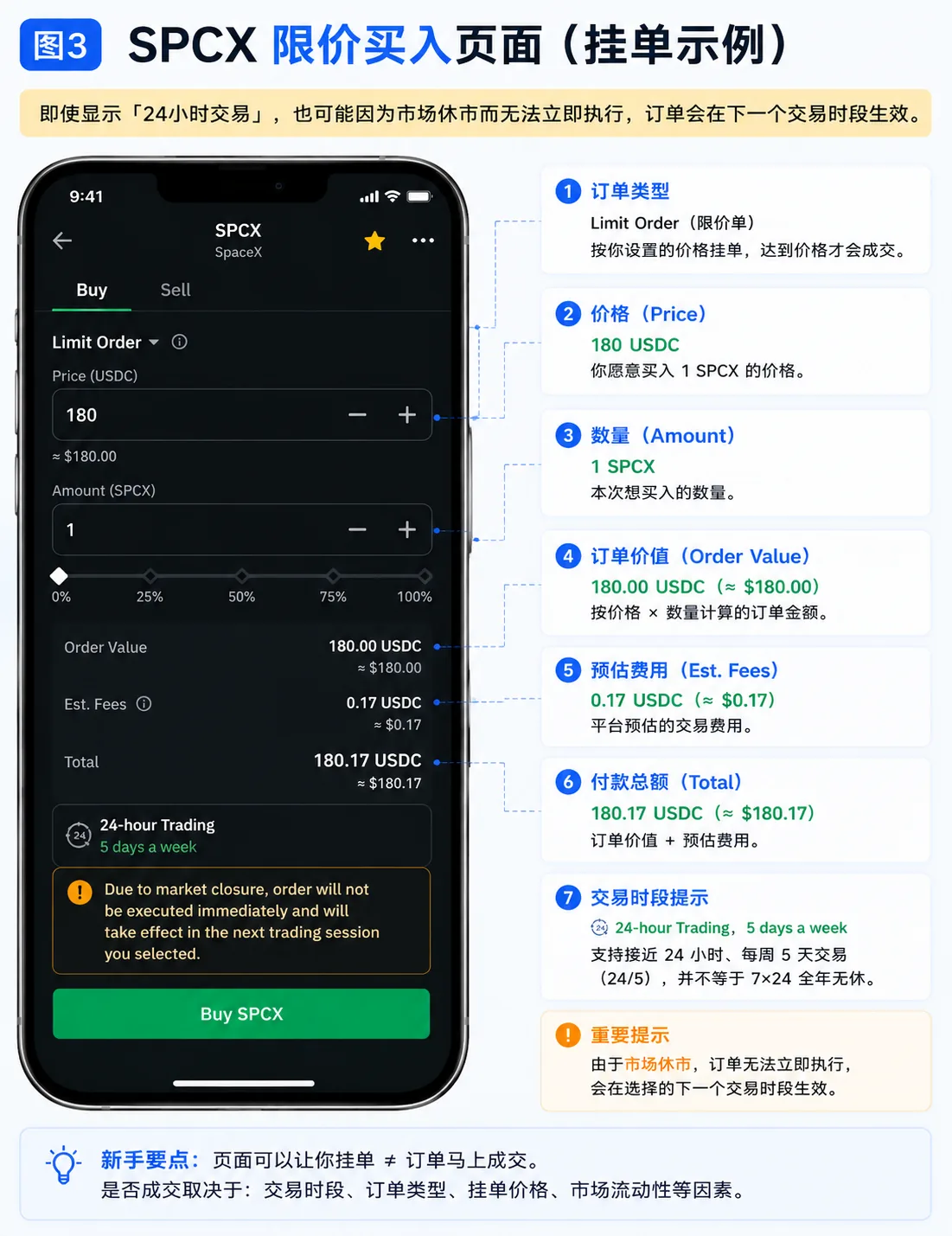
When I tapped into SPCX's limit-buy page this time, the page showed:
1 SPCX.
Price of 180 USDC.
Trade value of 180.00 USDC.
Estimated fee of 0.17 USDC.
Total payable of 180.17 USDC.
The page also showed the trading session as "24-hour trading".
If you only look at this information, a beginner easily feels:
"Isn't this just buying a stock with USDC?"
But the most important part of this page isn't the price.
It's the note below:
Because the market is closed, the order can't execute immediately and will take effect in the next selected trading session.
This illustrates a very key point:
The app showing you can place an order doesn't mean it will definitely fill immediately.
The buy button is only an entry.
What actually decides whether the order executes is the trading session, order type, price and liquidity.
Why "the app shows you can place an order" doesn't mean it fills immediately
This is a point I particularly want to flag in this article.
When I actually checked the app this time, I could see buy and order entries.
But that doesn't mean every stock can fill immediately at any time.
Here we need to separate two concepts:
You can submit an order.
versus:
The order fills immediately.
They aren't the same thing.
Some stocks may support longer trading sessions.
Some orders can be placed first and executed in the corresponding trading session later.
Some limit orders can participate in pre-market, after-hours, and even 24-hour trading for certain stocks.
But that doesn't mean every stock fills instantly 24/7.
A more accurate way to put it:
Some stocks support near-24-hour, 5-days-a-week trading, i.e. 24/5.
Not 7×24.
And not 7×25.
Weekends, US public holidays, insufficient liquidity, unsuitable order price and different order types can all affect the fill.
So an article shouldn't write:
"tokenized US stocks support non-stop trading all year".
Nor:
"buy and sell anytime".
A more solid understanding:
The app may let you submit an order, but whether it actually fills depends on whether the stock supports the corresponding trading session, the order type, the price and market liquidity.
This point is important for beginners.
Because seeing "you can buy" easily leads to thinking "you can buy immediately".
That isn't necessarily true.
Trading sessions and order rules matter more than the page button
Later I looked at the trading-session explanation in Binance's official FAQ.
Officially, stock trading is split into states like normal trading, pre-market, after-hours, overnight and closed.
Under different trading states, the execution rules for market orders and limit orders also differ.
During normal trading hours, orders are easier to understand.
But in pre-market, after-hours, overnight or closed states, orders may just be queued and take effect in the next eligible trading session.
So I'd rather beginners not just look at the "Buy" button.
Also check:
What trading session is it now?
Is the order a market order or a limit order?
Does this stock support 24-hour trading?
Is it a weekday, a weekend, or a US public holiday?
Does the order take effect immediately, or is it queued for the next trading session?
These rules matter more than the button itself.
How is this really different from buying US stocks in a traditional broker?
Buying US stocks in a traditional broker usually happens in a securities account.
Your funds, stocks, dividends, tax and corporate actions are all handled in a relatively mature brokerage system.
Tokenized US stocks or platform stock trading is more like putting stocks into the account environment crypto users are familiar with.
What you see isn't just stocks.
There's also stablecoins.
A platform fund account.
KYC.
Regional restrictions.
Custody and settlement rules.
So its biggest difference from a traditional broker isn't the page design, nor the minimum purchase amount.
It's the entire fund path.
A traditional broker is more like:
bank card or brokerage account → buy stock → after selling, return to the brokerage fund account.
Platform stock trading is more like:
USDC or another supported asset → platform stock trading → after selling, return to the USDC fund account.
This path is smooth for crypto users.
But it also requires you to understand platform rules better.
If you don't understand USDC, wallets, withdrawal networks or platform limits, you'll get stuck at the exit stage.
So this kind of product isn't about just looking at the buy button.
Look at the exit path first.
What does the SpaceX (SPCX) example best illustrate?
SPCX is a great example for beginners to understand tokenized US stocks.
Because it's hot enough.
And easy enough to misunderstand.
When you see an SPCX page in the Binance App with price, chart, key metrics and buy/sell buttons, it looks a lot like an ordinary trading page.
But it isn't an ordinary altcoin.
It's linked to a real listed company's stock.
That gives it two attributes at once:
on one side, it appears in a crypto platform, and the experience feels like a crypto product.
on the other, it's tied to traditional stocks, securities rules, custody arrangements, company fundamentals and market volatility.
So SPCX best illustrates one line:
Tokenizing US stocks isn't turning stocks into ordinary coins; it's putting traditional stock-related rights into a platform environment crypto users are more familiar with.
That's what makes it appealing.
And what makes it complex.
What do I check first when looking at this kind of product?
I don't look at the price change first.
Nor "what's the minimum purchase".
These aren't the core.
I first look at a few more practical questions.
First, what rights it actually represents.
Is it underlying stock rights?
Is it a stock token?
Is it a platform certificate?
Or some kind of price-tracking product?
Second, who custodies the underlying asset.
If there's real stock behind it, where is the stock?
Who holds it?
Does the platform clearly state the partner broker or custody arrangement?
Third, what you receive after selling.
If what arrives after selling is USDC, then you still need to check whether USDC can be withdrawn, which networks it supports, and whether there are fees and regional restrictions.
Fourth, whether there's a dividend and corporate-action explanation.
Traditional stocks involve dividends, splits, mergers, voting and so on.
Platform stock products may not support all of them.
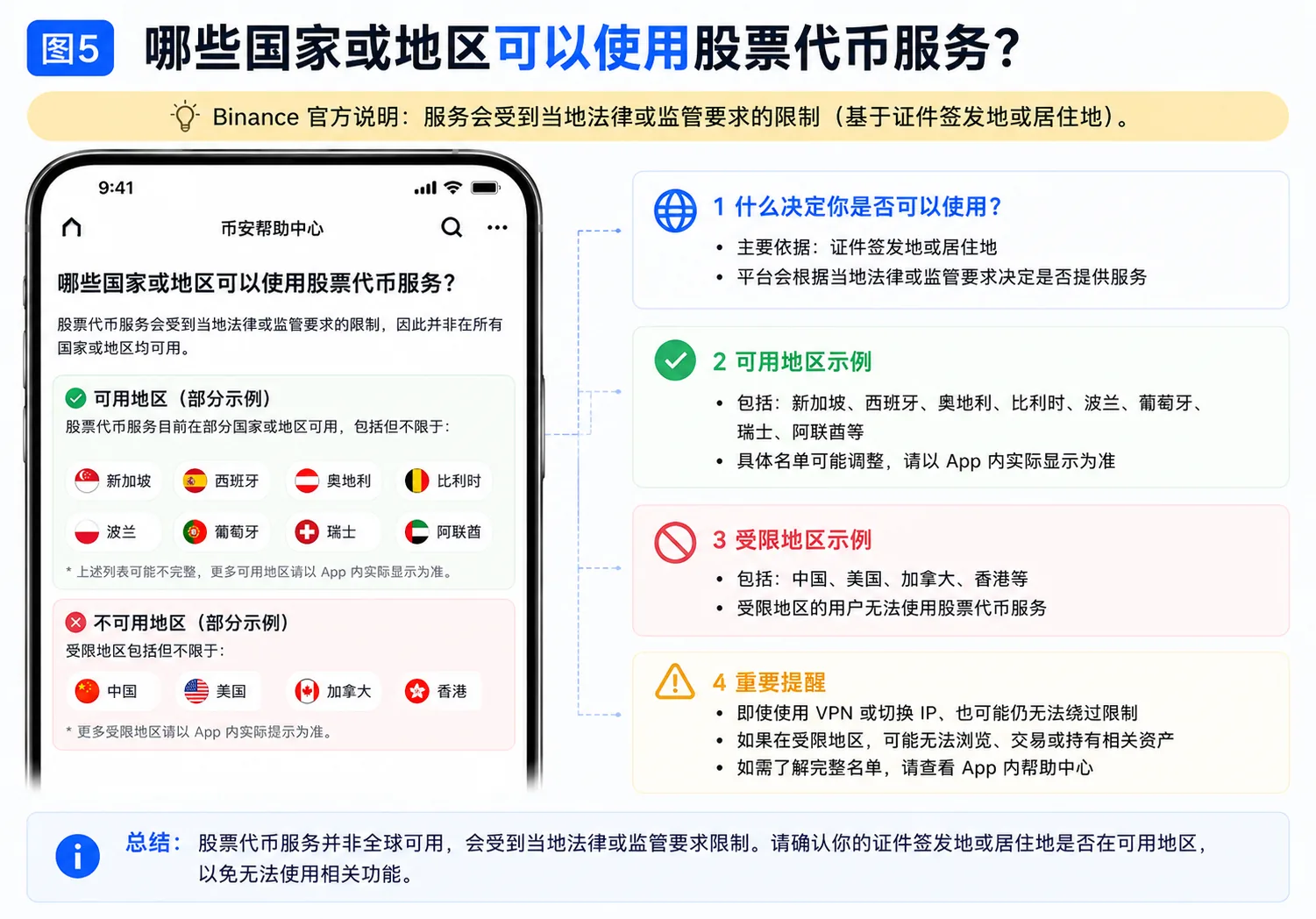
Fifth, whether your region can use it.
These products involve securities and compliance rules, which differ a lot by region.
Just because someone else can see it doesn't mean you can use it.
Just because you can use it today doesn't mean the rules won't change later.
Sixth, the order rules.
The app showing you can place an order doesn't mean it fills instantly.
Order type, trading session, price and liquidity all affect the final fill.
These questions look tedious, but they matter more than the price itself.
Because at least you can see price moves.
Rule restrictions are often things you only discover at some step of operating.
The trap beginners fall into most isn't price volatility
Many people think the biggest risk of these products is the ups and downs.
Ups and downs are certainly risky.
Hot stocks like Apple, Nvidia, Tesla and SpaceX do fluctuate.
But the trap beginners fall into more easily, I think, is misunderstanding the product from the start.
You think you bought a traditional stock.
What you actually got may be platform stock-related rights.
You think what you receive after selling is dollars.
What actually arrives is USDC.
You think you can withdraw it to a wallet later.
The platform rules may not support it.
You think it's the same as an ordinary coin because it appears in Binance.
Behind it are still a broker, custody, compliance and regional restrictions.
You think "the app shows you can buy" means it will definitely fill immediately.
It may only mean you can place an order; whether it fills depends on the trading session and order rules.
This kind of "misunderstanding" is more dangerous than short-term price moves.
Because when the price drops, at least you know it's market volatility.
But if you don't even know what you bought, you'll easily get confused later when you hit dividends, withdrawals, redemption, regional restrictions or order queues.
So the most important thing with these products isn't rushing in.
It's understanding the rules first.
Are these products suitable for beginners to act on right away?
I don't recommend a brand-new beginner act right away.
At least don't go in with a large amount first.
Not because it's necessarily bad.
But because it involves too much.
You need to understand stablecoins.
Platform accounts.
Stocks and ETFs.
KYC.
Custody.
Dividends.
USDC settlement.
Order types and trading sessions.
And regional restrictions and withdrawal paths.
If these fundamentals aren't clear, you'll easily see only the convenience and ignore the rules.
A more solid learning order is:
First understand stablecoins like USDT and USDC.
Then understand wallet addresses, seed phrases and transfer networks.
Then understand RWA.
Finally look at specific directions like tokenized US stocks, stock tokens, on-chain stocks and tokenized gold.
That way, when you open the platform page again, you won't just stare at the buy button.
You'll know you should check the rules first.
How can an ordinary beginner study this?
The simplest method isn't to buy right away.
It's to use the platform page as study material first.
You can first check:
Where the entry is.
Which stocks or ETFs are supported.
What the buying fund is.
What arrives after selling.
Whether there are regional restrictions.
Whether there's a dividend explanation.
Whether transfer-out is supported.
Whether 24/5 or extended-hours trading is supported.
How the order and fill rules are written.
Whether there are risk warnings.
After reading all of these, decide whether to study further.
If you really want to test, use only a very small amount and run the full flow once.
The point isn't how much you make.
It's verifying:
whether buying goes smoothly.
whether selling goes smoothly.
whether USDC arrives.
whether withdrawal works.
what the fee is.
whether the order fills immediately.
whether there are restrictions you didn't notice before.
This is more valuable than hearing someone say "it's convenient".
FAQ
What does tokenized US stock mean?
Tokenized US stock usually means presenting US stock-related rights through stock tokens, platform certificates, digital-asset accounts or stablecoin settlement.
It doesn't necessarily equal directly holding the full stock rights in a traditional brokerage account.
Is a stock token the same as really buying a US stock?
Not necessarily.
Some products may represent the economic rights of the underlying stock.
Some may be tokenized securities.
Some may just be internal platform certificates or price-tracking tools.
It depends on the platform rules and product description.
Why do many stock tokens settle in USDC?
Because US stocks are dollar-denominated assets, and USDC is a common dollar stablecoin in the crypto world.
USDC fits as a settlement tool for buying, selling and the fund account in platform stock trading.
But USDC itself carries stablecoin risk and is not a bank deposit.
If the app shows I can place an order, will it fill immediately?
Not necessarily.
Being able to place an order doesn't mean it fills immediately.
Whether it fills depends on whether the stock supports the corresponding trading session, the order type, the order price and market liquidity.
Some stocks may support near-24-hour, 5-days-a-week trading, i.e. 24/5, but that doesn't mean all stocks fill instantly 24/7.
What does SpaceX (SPCX) appearing in the Binance App tell us?
It shows that stocks and crypto platforms are integrating more closely.
But it doesn't mean stocks have fully become ordinary on-chain tokens.
You still need to check platform rules, custody arrangements, USDC settlement, regional restrictions and risk warnings.
Can tokenized US stocks be withdrawn to a wallet?
Not necessarily.
Some platforms only provide in-platform stock trading and USDC settlement, and may not support withdrawing stock-related assets to an external wallet.
If a platform does support withdrawing stock tokens, keep checking the supported networks, contract address, transfer limits and regional rules.
What's the difference between direct stocks and stock tokens?
Direct stocks make you the beneficial owner of the underlying shares, custodied by a partner broker; after selling, proceeds return to a USDC fund account, and generally can't be withdrawn to an on-chain wallet.
Stock tokens are third-party-issued, 1:1 backed certificates, not the stock itself; they can usually be withdrawn to a supported on-chain wallet, but the holder generally doesn't obtain shareholder status or voting rights.
Should beginners learn tokenized US stocks or wallets first?
Learn stablecoins and wallets first.
Because many tokenized US-stock products involve USDC settlement.
If you don't understand USDC, wallet addresses, network selection and withdrawal paths, you'll easily make mistakes in the operating stage.
One last thing
Tokenized US stocks are indeed worth watching.
They connect traditional US stocks, stablecoins and crypto platforms.
In terms of experience, they're closer to ordinary users than before.
But the more convenient an entry is, the easier it is to overlook the complex rules behind it.
When you see Apple, Nvidia, Tesla or SpaceX appearing in a crypto platform, don't just think:
"Finally, I can buy US stocks with USDC."
More importantly, first figure out:
What rights are you buying?
Who custodies it?
What do you receive after selling?
Are there regional restrictions?
Can you withdraw?
What do the platform rules say?
Will the order actually fill immediately?
Once you understand these, then study a specific platform — that way you're less likely to fall into a trap.
Next steps
How to buy US stocks on Binance: order steps, fees and dividend withdrawal (2026)
Are on-chain RWA assets worth investing? My real experience buying NVDAon
What's the difference between USDT and USDC? Which is safer, and how to choose (2026)
What is a crypto wallet? Wallet address, seed phrase and asset security (2026)
Can you recover a transfer sent to the wrong chain? Withdrawal networks and wallet addresses (2026)
Author note
This article was compiled by the CoinTrailHub editorial team, based on public material, official page information and observations after actually checking the Binance App, aimed mainly at beginners new to crypto, stablecoins, wallets, RWA and on-chain assets, to help understand the relationship among tokenized US stocks, stock tokens and USDC settlement.
We have long followed crypto beginner guides, stablecoins, wallet security, exchange usage, RWA, on-chain US stocks and tokenized assets. The Binance Stocks Trading, tokenized US stocks, USDC settlement, SpaceX (SPCX) and related platform features mentioned in this article may change as markets, regulation and platform rules evolve.
This article does not constitute investment, financial or trading advice. Tokenized US stocks and stock tokens are not risk-free products, and USDC is not a bank deposit. Before acting, follow the platform's official site, product terms, risk warnings and local regulatory requirements.
The CoinTrailHub editorial team focuses on crypto education for beginners, exchange security and P2P trading risk. This article is compiled from official sources and public data, reviewed by humans, and strives for accuracy but is not investment advice.
Last updated:2026-10-18 · Content reviewed by humans · Learn more
© 2026 CoinTrailHub · Original content. Reproduction or rewriting without permission is prohibited.