
Can on-chain stocks be withdrawn? NVDAon sell-to-USDT real test (2026)
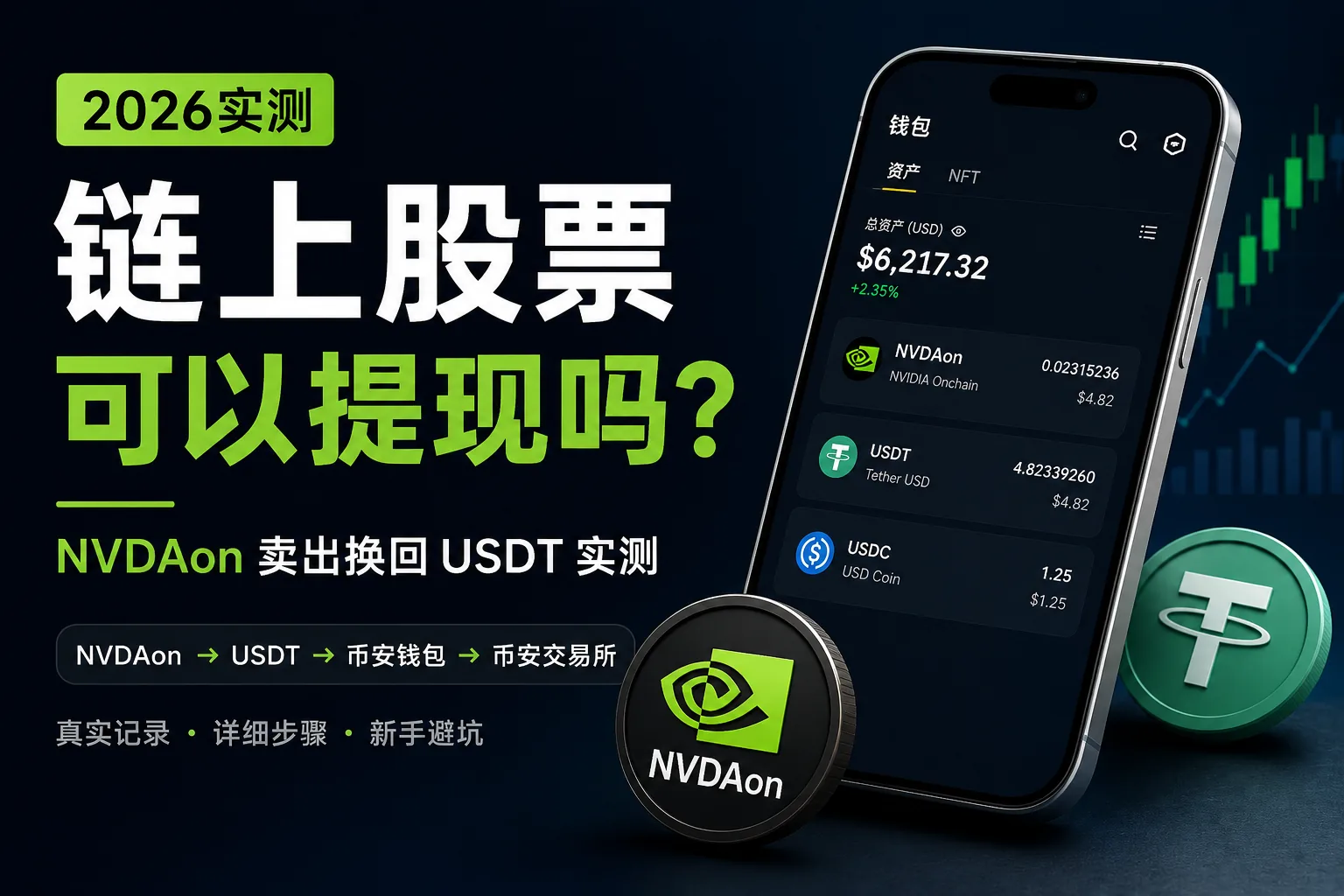
Table of contents

Binance new user rewards
20% trading fee rebate
Official Binance registration. Complete identity verification (KYC) to trade and withdraw.
When many people buy an on-chain stock for the first time, what they worry about most is not the price going up or down.
It's this:
If I don't want to hold it anymore, can I sell it? Can I turn it back into cash?
For example, NVDAon in a wallet.
It looks like an on-chain stock token related to Nvidia. But if you want to exit, will it work like a traditional stock, with the funds going straight to your bank card after selling?
This time I ran through the exit path with a very small amount.
The actual flow I confirmed is:
NVDAon → USDT → Binance Web3 Wallet → Binance exchange
During the whole process, I did not find an operation like "withdraw the stock directly to a bank card."
Instead, I confirmed one thing:
The real exit route for on-chain stocks is usually to first swap the stock token into a stablecoin.
This article doesn't cover how to buy, and it doesn't judge whether it's worth buying.
It only covers the real path I saw in this small test, plus the few places I was most worried about during the process.
This article is for basic education about crypto and on-chain assets only, and does not constitute investment advice, financial advice, trading advice, or withdrawal advice. On-chain stocks, stock tokens, RWA, stablecoins, and Web3 wallet operations involve market volatility, platform rules, regional restrictions, KYC, network choice, wallet security, and arrival risk. Before acting, refer to the platform page, wallet prompts, official rules, and local regulations.
The 30-second version
On-chain stocks are not withdrawn as stock directly; they're first swapped back into a stablecoin.
The real test path here was: NVDAon → USDT → Binance Web3 Wallet → Binance exchange.
What I worried about most was not whether I could click "sell," but whether the money would actually return to a usable account.
The small real-test path at a glance
| Path | Actual operation | What beginners should watch |
|---|---|---|
| NVDAon already in the wallet | NVDAon shows in the Binance Web3 Wallet asset page | It's more like an on-chain token in a wallet, not a traditional brokerage stock |
| Sell / swap | Swap NVDAon into USDT | Check the pay asset, receive asset, minimum received, and network fee |
| Stablecoin arrives | USDT first returns to the Binance Web3 Wallet | A successful sale doesn't mean it's already on the exchange |
| Move back to Binance | Send USDT from the Binance Web3 Wallet to the Binance exchange | Coin, network, and address must all match |
| Exchange arrival | The Binance exchange shows the USDT deposit completed | This only returns to the exchange account, not a bank-card withdrawal |
The two things I was really worried about
In this small test, I was only really worried about two things.
First, whether NVDAon could actually be swapped back into USDT.
Second, whether the USDT I got back could return to the Binance exchange.
Because if these two steps don't work, on-chain stocks get awkward for many beginners:
You can see the holding, but you don't know how to exit.
The sale succeeded, but you don't know where the funds actually stopped.
So this time I didn't test with a large amount.
I just wanted to confirm whether the most basic exit path could work at all.
The final result was:
NVDAon can be swapped back into USDT, and the USDT can be moved from the Binance Web3 Wallet back to the Binance exchange.
But this is not "withdrawal to a bank card."
It only completed:
stock token → stablecoin → wallet → exchange
Whether you can then convert it to fiat, sell it via P2P, or withdraw to a bank card depends on exchange rules, KYC, regional restrictions, and fiat channels.
If you don't understand on-chain stocks themselves yet, read this first: What are on-chain stocks? Does a stock token in your wallet really equal a US stock? (2026).
Why can't NVDAon be understood as a traditional stock?
NVDAon looks related to Nvidia, but don't understand it as the NVDA stock in a traditional brokerage account.
On the Ondo official NVDAon asset page you can see NVDAon's price, underlying assets, supported chains, and other information.[1]
But in practice, it behaves more like an on-chain token in a wallet.
It shows up in the Web3 wallet asset list together with USDT and USDC.

When I look at this asset page, what I care about most is not the balance.
It's where it appears.
NVDAon shows in the wallet asset list just like USDT and USDC.
This means the logic behind it is not the traditional brokerage flow:
sell stock → securities-account funds → bank-card withdrawal
It's closer to:
wallet asset → swap → network transfer → exchange deposit
If you don't get this straight, it's easy to misjudge later.
For more on the difference between on-chain stocks and traditional US stock accounts, continue reading: On-chain stocks vs traditional US stocks: wallet assets vs brokerage account.
Also, the Ondo Global Markets official page states that the related tokens themselves are not stocks or ETFs, and do not give holders the right to hold or receive the corresponding underlying assets.[2]
If you want to observe NVDAon's on-chain asset information from a third-party data page, you can also refer to the RWA.xyz NVDAon data page, where you can see the asset classification, supported networks, and related data.[3]
So beginners shouldn't just look at whether the name resembles a US stock.
More important is to check:
- where it's held;
- whether it can be swapped;
- which networks it supports;
- whether it can finally return to a platform account you're familiar with.
If you want to first understand why this kind of asset belongs to the RWA direction, read: Are RWA on-chain assets worth investing in? My real NVDAon experience.
The real-test process: how does NVDAon get swapped back into USDT?
In this test, I didn't find a path to "withdraw NVDAon to a bank card."
The actual operation is to swap NVDAon back into USDT.
The swap confirmation page shows:
- how much NVDAon you pay;
- roughly how much USDT you'll receive;
- the minimum received;
- the network fee;
- the provider;
- the receiving address;
- the current network.

What you should look at most on this page is not the "Confirm" button.
It's three questions:
What are you paying? What are you receiving? Which chain does it complete on?
This time I didn't skip the confirmation page.
Because a wallet swap is not the same as a traditional stock sale.
With a traditional stock sale, you mainly look at price and quantity.
With a wallet swap you also have to check minimum received, network fee, provider, and receiving address.
The amount this time was very small, so I wasn't particularly worried about slippage.
But if the amount gets larger, minimum received and the actual arrival quantity can't just be ignored.
If you're still unsure what USDT is for, read: What is USDT? Tether's uses and risks (2026).
After the swap succeeds, where does USDT first return to?
After this swap completed, the page showed:
0.02315236 NVDAon → 4.82339260 USDT

This image is the most important real-test trace in the whole article.
Because it's not telling you that "on-chain stocks can make you rich."
It just proves one thing:
NVDAon was indeed swapped back into USDT at this step.
But the first time I saw "swap succeeded," I also almost took it as "exit completed."
It wasn't until I looked at the wallet asset page again that I confirmed:
USDT had only returned to the Binance Web3 Wallet first.
Not a bank card.
And not automatically into the exchange account.
So you need to be clear here:
A successful sale only means the stock token became a stablecoin.
If you want to put the funds back on the exchange, you still need to transfer.
If you're still unfamiliar with wallet assets, addresses, and seed phrases, read: What is a crypto wallet? Wallet address, seed phrase, and asset security (2026).
How does USDT get moved from the wallet back to Binance?
I double-checked the network several times at this step.
Because the wallet side was using BNB Smart Chain.
If the exchange deposit page is set to ERC20 instead, even if the address looks the same, it may not credit automatically and needs manual handling — and in serious cases it can't be recovered.
So I didn't send from memory.
I first opened the Binance exchange deposit page to confirm the networks USDT supports, then went back to the Binance Web3 Wallet to send.
Beginners unfamiliar with deposit networks can also read the Binance official crypto deposit tutorial first, focusing on how the coin, network, and deposit address must correspond.[4]
On the send page I focused on these:
- whether the coin is USDT;
- whether the network is BNB Smart Chain;
- whether the recipient is the Binance exchange deposit address;
- how much the fee is;
- whether the exchange deposit page supports this network.

The easiest thing to get wrong at this step is not the address.
It's the network.
What an on-chain transfer really needs to match is:
coin + network + address.
A correct address doesn't mean the network is also correct.
This sentence matters a lot to beginners.
If you're worried about picking the wrong network, continue reading: Can it be recovered after sending on the wrong chain? Withdrawal network and wallet address (2026).
Only when the exchange shows the deposit completed is the path fully closed
Finally, the Binance exchange showed the USDT deposit completed.

At this point, the small-test path is closed:
NVDAon → USDT → Binance Web3 Wallet → Binance exchange
For me, only at this step was it truly confirmed:
The stablecoin after selling can return to the exchange account.
But it's still not a bank-card withdrawal.
Whether to then convert it to fiat, sell via P2P, or use another withdrawal method depends on exchange rules and regional restrictions.
This article only covers how an on-chain stock token exits into USDT and is moved back to Binance.
Bank-card withdrawal is best not mixed into this article.
In practice, where is it easiest to go wrong?
1. Treating NVDAon as a traditional stock
The name looks like a stock, but in practice it behaves more like an on-chain token.
NVDAon's holding, swapping, and transfer paths are all different from a traditional brokerage stock.
2. Assuming a successful swap means the withdrawal is complete
This is a place where I almost misjudged it myself during the test.
A successful swap only means NVDAon became USDT.
If the USDT is still in the wallet, it hasn't returned to the exchange account yet.
3. Choosing the wrong network
This is the most practical risk.
USDT on BSC, ERC20, TRC20, and Solana are not the same thing.
The sending network and receiving network must be the same.
4. Testing with a large amount from the start
Small amounts succeeding doesn't mean large amounts will be just as smooth.
Large amounts can hit slippage, quote changes, insufficient liquidity, and minimum-received changes.
This time I used a small test precisely to confirm the path, not to aim for a one-shot completion.
5. Carelessly approving the wallet
A wallet swap may involve an approval.
On unfamiliar pages, don't approve carelessly.
When the path is uncertain, don't test with a large main wallet.
If you want to first understand the general concept and risks of stock tokens, you can also refer to Binance Academy's explanation of Tokenized Stocks.[5]
A pre-operation checklist for beginners
Don't aim to complete it all in one shot the first time.
First run through the path with a small amount.
Before acting, at least confirm:
- whether the wallet holds NVDAon;
- which chain it's on;
- whether it can be swapped back into USDT or USDC;
- roughly how much stablecoin you'll receive;
- what the minimum received is;
- what the network fee is;
- whether the receiving address is your own;
- when moving to the exchange, whether the deposit network matches;
- whether the exchange shows the deposit completed.
What you're really verifying the first time is not "can I make money."
It's:
whether this exit path actually works.
FAQ
Can on-chain stocks be withdrawn?
You can exit or cash out, but usually not by withdrawing the stock directly.
The more common path is: first swap the stock token into a stablecoin like USDT or USDC, then move it to a wallet or exchange. Whether you can then convert it to fiat or withdraw to a bank card depends on exchange rules, KYC, regional restrictions, and fiat channels.
Is NVDAon real Nvidia stock?
Don't understand it as a traditional brokerage stock.
NVDAon is an on-chain stock-token asset related to Ondo Tokenized, and it's related to Nvidia stock, but the holding method, rights structure, trading path, and risks are all different. Beginners shouldn't just look at whether the name resembles a US stock; more importantly, look at where it's held, whether it can be swapped, and which networks it supports.
After selling NVDAon, does USDT automatically arrive on the Binance exchange?
It doesn't automatically reach the exchange.
In this small test, NVDAon was first swapped into USDT, and the USDT first returned to the Binance Web3 Wallet. After that you still need to send it from the Binance Web3 Wallet to the Binance exchange and wait for the exchange to show the deposit completed before it counts as returned to the exchange account.
When moving from the wallet back to Binance, what's the easiest thing to get wrong?
The easiest thing to get wrong is the network.
For example, if the wallet sends USDT over BNB Smart Chain, the Binance deposit page must also select a USDT address that supports BNB Smart Chain. An address that looks the same doesn't mean the network is correct. Before sending, it's best to reopen the exchange deposit page to confirm, rather than operating from memory.
What to read next
- On-chain stocks vs traditional US stocks: wallet assets vs brokerage account
- Are RWA on-chain assets worth investing in? My real NVDAon experience
- What is USDT? Tether's uses and risks (2026)
- Can it be recovered after sending on the wrong chain? Withdrawal network and wallet address (2026)
Data verification notes
The key facts in this article were checked on 2026-10-16 against Ondo, RWA.xyz, and Binance official materials, item by item:
- NVDAon asset information: NVDAon's price, underlying assets, and supported chains are based on the Ondo official asset page. Source: Ondo official NVDAon asset page.
- Rights structure: the related tokens themselves are not stocks or ETFs, and do not give holders the right to hold or receive the corresponding underlying assets. Source: Ondo Global Markets official page.
- On-chain data: NVDAon's asset classification and supported networks can be referenced from the RWA.xyz data page. Source: RWA.xyz NVDAon data page.
- Deposit network: the coin, network, and deposit address must correspond. Source: Binance official crypto deposit tutorial.
- Stock-token concept: the general concept and risks of tokenized stocks. Source: Binance Academy "What Are Tokenized Stocks".
Author's note
This article is based on Ondo official materials and a small NVDAon swap-and-return-to-exchange record, and is only for on-chain asset education. It does not constitute investment advice, trading advice, or withdrawal advice.
- Ondo official NVDAon asset pageNVDAon price, underlying assets, supported chains
- Ondo Global Markets official pageTokens are not stocks or ETFs
- RWA.xyz NVDAon data pageAsset classification, supported networks
- Binance official crypto deposit tutorialCoin, network, and deposit address must match
- Binance Academy: What Are Tokenized StocksTokenized stocks concept and risks
- 2026-10-16UpdateAdded evidence-chain superscripts and "Data verification notes"; updated the fact-verification date.
See ourEditorial Policy and the correction process in ourCorrections Policy.
The CoinTrailHub editorial team focuses on crypto education for beginners, exchange security and P2P trading risk. This article is compiled from official sources and public data, reviewed by humans, and strives for accuracy but is not investment advice.
Last updated:2026-06-22 · Content reviewed by humans · Learn more
© 2026 CoinTrailHub · Original content. Reproduction or rewriting without permission is prohibited.