
What are on-chain stocks? Do stock tokens in your wallet really equal US stocks (2026)
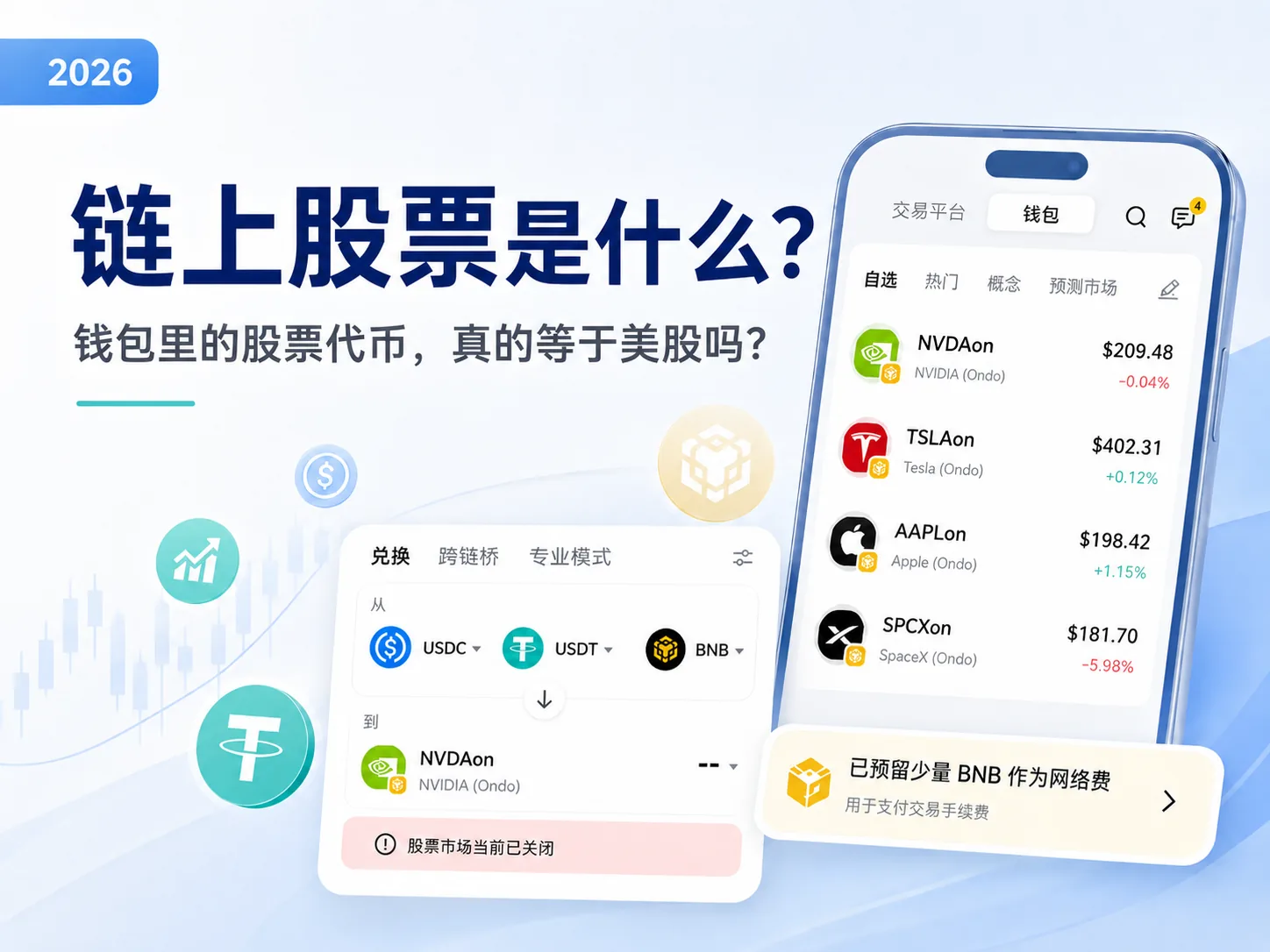
Table of contents

Binance new user rewards
20% trading fee rebate
Official Binance registration. Complete identity verification (KYC) to trade and withdraw.
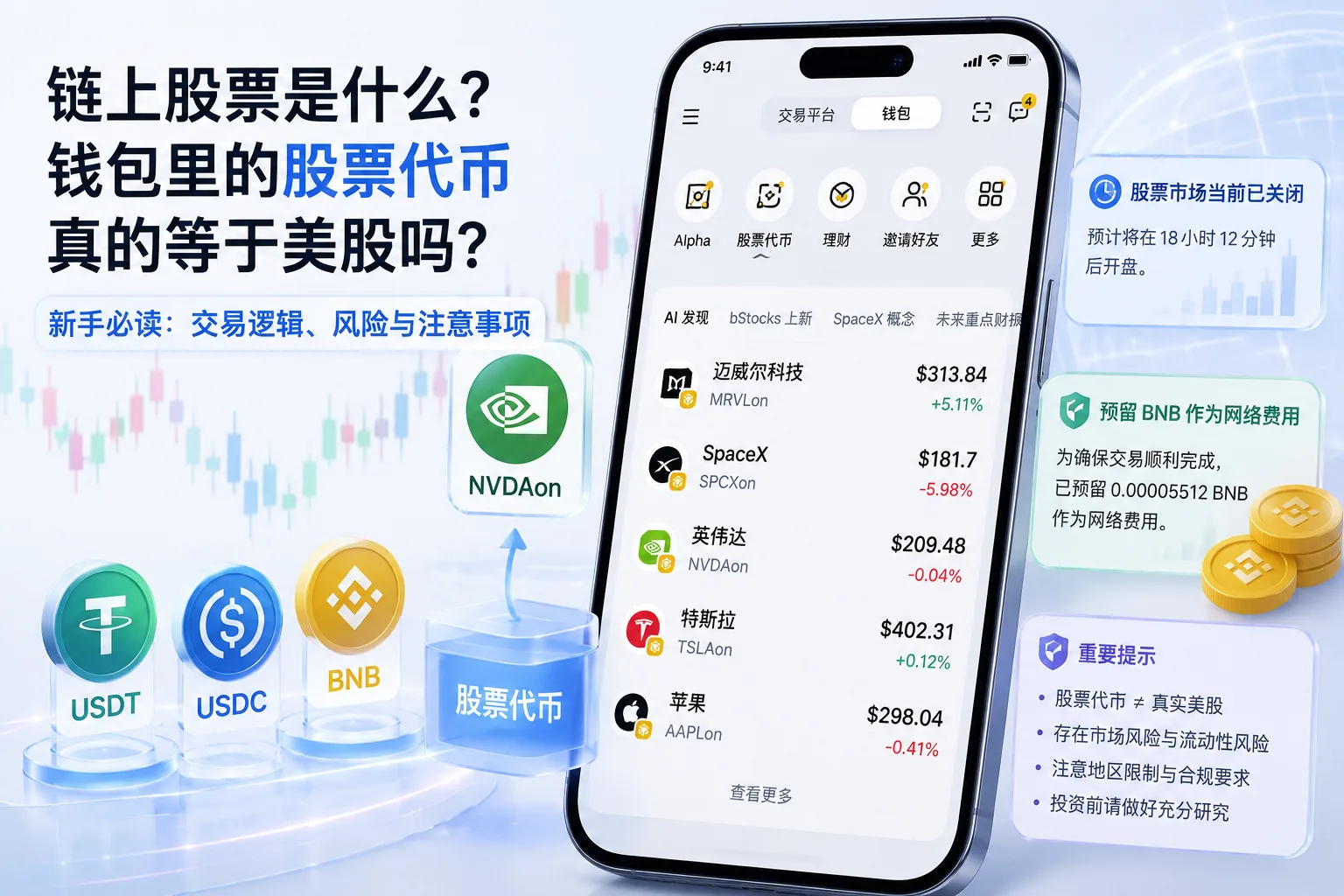
Recently I saw an entry in my wallet that read "Stock Tokens."
After tapping in, the page was not BTC, ETH or USDT, but names that look a lot like US stocks.
For example:
- NVDAon
- SPCXon
- MRVLon
To be honest, the first time I saw NVDAon, I instinctively thought:
Is this Nvidia stock?
Because the name is too similar.
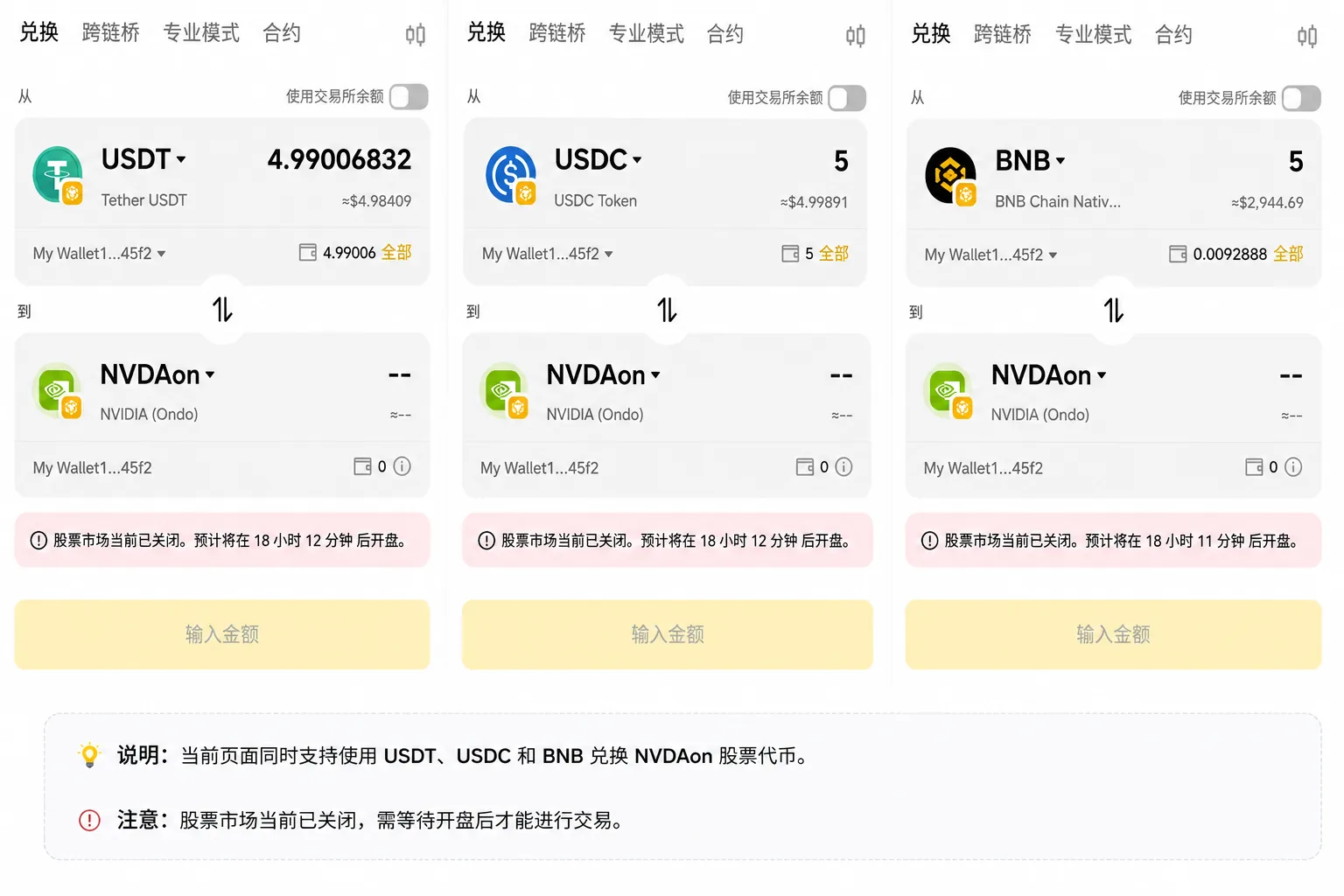
On top of that, the page also showed you could swap using BNB, USDT or USDC, which easily makes a beginner feel:
Can I now buy US stocks directly in a wallet?
But reading further, I found it is not that simple.
The page warns:
The stock market is currently closed.
And if you swap with BNB, the wallet also automatically sets aside a small amount of BNB as a network fee.
Those two details are key.
On one hand, it behaves like a stock and is affected by stock-market opening hours; on the other hand, it behaves like an on-chain token, requiring a wallet, a network and gas fees.
So I would not suggest a beginner immediately treat "stock tokens" as traditional US stocks.
More precisely:
What you are seeing is an on-chain token related to a stock.
It is related to a stock, but it is not the same as buying a real US stock in a brokerage account.
This article is for general Crypto fundamentals education only and does not constitute any investment, financial or trading advice. On-chain stocks, stock tokens, tokenized US stocks and RWA-type products involve issuer, custody, KYC, regional restrictions, liquidity, smart-contract and market risks. Before acting, follow the wallet page, the platform's official explanation, project documents and local regulations.
On-chain stocks can also be understood within the broader RWA framework. If you are not yet clear on what RWA is, start with: Are on-chain RWA assets worth investing in? My real experience buying NVDAon.
Which real page observations is this article based on?
This was not written from concepts alone.
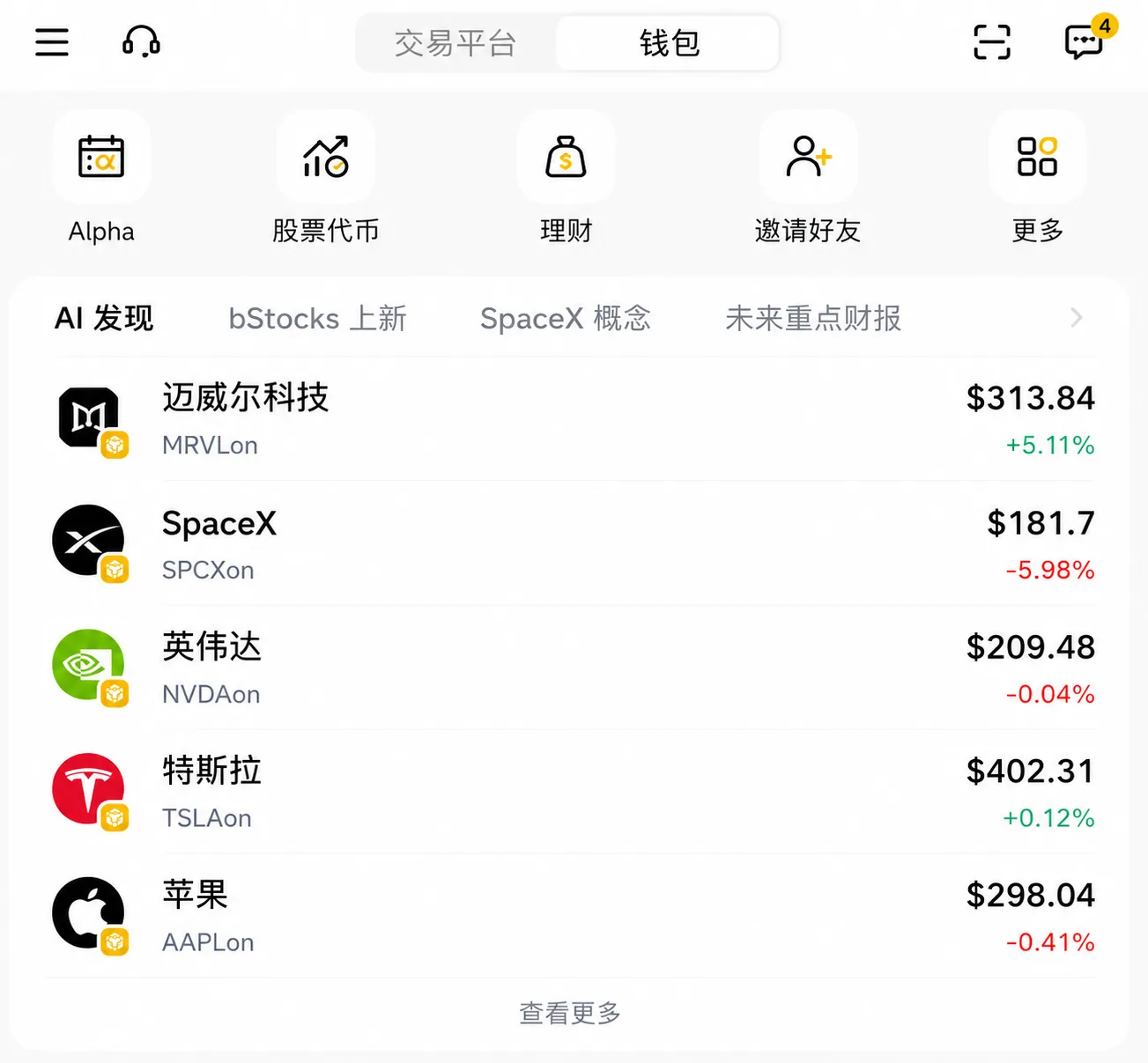
This time I actually tapped into the "Stock Tokens" entry in the wallet and looked at the related swap page.
The page shows a few key pieces of information:
- It has stock-token names like NVDAon, SPCXon and MRVLon;
- The swap page supports using on-chain assets like BNB, USDT and USDC;
- When swapping with BNB, the page warns that a small amount of BNB will be set aside as a network fee;
- The page shows the stock market is currently closed and you need to wait for it to open;
- The same page shows both "stock-market hours" and "on-chain network fee" at the same time.
Putting this information together reveals a very important point:
A stock token in a wallet is neither an ordinary US stock in a traditional brokerage, nor an ordinary Crypto token fully detached from the real market.
It connects wallets, gas fees and transfer networks on one side, and is affected by stock-market hours, issuer rules and platform restrictions on the other.
So this article only does beginner education based on page observations and public information. It will not equate these assets with traditional US stocks, nor package them as low-risk products.
The page observations and information in this article were organized on June 21, 2026. On-chain stocks, stock tokens and wallet swap features change quickly; for the specific supported assets, networks, fees, regional restrictions and trading rules, follow the wallet page you actually see and the platform's official explanation.
If you want to see an official baseline explanation of this type of product, you can refer to the Ondo Global Markets official documentation. It has a more formal explanation of Ondo tokenized stocks, the on suffix, underlying-asset exposure and trading restrictions.
Why I did not directly treat NVDAon as Nvidia stock
Because the name is too misleading.
NVDA is Nvidia's stock ticker.
So when NVDAon appears in a wallet, many people's first instinct is:
Isn't this just Nvidia?
But you have to slow down here.
NVDAon and NVDA are not the same thing.
You can say it is related to NVDA, but you cannot directly say it is the NVDA stock in a traditional brokerage account.
This is like seeing a gold-related token on-chain and not being able to immediately say you are holding physical gold.
In between there are issuer, custody, rules, redemption and liquidity questions.
Stock tokens are the same.
What you see in the wallet is a token. What that token actually corresponds to needs to be read from the product description, not guessed from the name.
So when I see a name like NVDAon, my first reaction is not "buy or not," but to first ask:
Who issued it?
Is it backed by real assets?
Can it be transferred out?
After transferring out, can it still be sold?
These questions matter more than the price change.
It looks like a stock, but it is not an ordinary stock
| Dimension | Traditional US stock | Stock token in wallet |
|---|---|---|
| Where you buy | Brokerage account | Wallet or platform swap entry |
| What is in the account | Stock position | An on-chain token |
| Underlying system | Broker, exchange, clearing and custody | Chain, wallet, contract, gas, issuer and platform rules |
| What matters most | Broker rules | Also chain, wallet, contract, gas, issuer and platform rules |
| Is it shareholding | It is a stock position | Not necessarily; read the product description |
Ordinary US stocks are generally bought in a brokerage account.
You buy NVDA, AAPL or TSLA, and the account shows a stock position, backed by a broker, exchange, clearing and custody system.
But a stock token in a wallet is different.
What you see is not a traditional stock position, but a token.
That token may be related to a stock's price, may have underlying-asset backing, or may only be usable on certain wallets, platforms or networks.
So it is not "a US stock entering your wallet unchanged."
It is more like:
A stock-related asset packaged into a token that can be shown and swapped on-chain.
This difference matters.
For traditional stock questions, you mainly look at broker rules.
For on-chain stock tokens, you also need to look at the chain, wallet, contract, gas, issuer and platform rules.
It is not simply adding one more buying entry — the whole usage logic has changed.
Why can you swap with BNB, USDT or USDC?
In a traditional brokerage, you usually buy stocks with dollar funds in the account.
But a wallet is different.
Wallet users mostly hold on-chain assets, such as:
- BNB
- USDT
- USDC
- ETH
- Other stablecoins or mainnet coins
So the page offers a "swap" experience, which looks a bit like an ordinary Swap.
For example, Binance's official NVDAon explanation also mentions that users can buy the related asset through entries like Alpha or in-App Swap, but specific features are affected by availability in their country or region. You can refer to Binance's official explanation of NVDAon.
But it is not an ordinary swap either.
Because what you get is not an ordinary meme coin or stablecoin, but a stock-related token.
For an ordinary swap, you may mainly look at price, slippage and fees.
But for a stock token you also need to look at:
- Whether the stock market is open;
- Whether the quote is normal;
- Whether liquidity is sufficient;
- Who the issuer is;
- Whether there are regional restrictions;
- Whether it can be transferred out or sold.
So BNB, USDT and USDC appearing on the page only means it supports these on-chain assets as swap entries.
It does not mean it is as simple as an ordinary swap.
If you are still unclear about the difference between USDT and USDC, start with: What is USDT? The uses and risks of Tether (2026), and What is the difference between USDT and USDC? Which is safer and how to choose (2026).
What do I look at first when swapping BNB for NVDAon?
Take the BNB → NVDAon example on the page. A beginner should not only look at "can I swap."
I first look at the market status.
If the page warns the stock market is closed, it means this is not like an ordinary USDT transfer that can always complete normally. The chain itself can run, but the quote, liquidity or execution rules behind the stock token may still be affected by traditional market hours.
Then the network fee.
The page warns that a small amount of BNB is set aside as a network fee, which means this step is still an on-chain operation. You cannot use up all the BNB in your wallet, otherwise you may not be able to continue with transfers, approvals or selling later.
There is also an easily overlooked point:
What exactly did you swap into?
The name NVDAon easily makes people think of Nvidia stock, but it is not an NVDA position in a traditional brokerage account.
It is a stock token related to NVDA. What rights it specifically represents needs to be read from the issuer and platform explanation.
Finally, I think about the exit path first.
The buy entry is usually obvious.
But selling, transferring out, redemption, liquidity and regional restrictions matter more.
What a beginner really needs to confirm first is not "can I buy."
It is:
After buying, can I get out smoothly.
"The stock market is closed" matters more than the buy button
I think what most deserves a beginner's attention on this kind of page is not the buy button, nor the price.
It is this line:
The stock market is currently closed.
This line reveals a problem:
It is not an ordinary on-chain token.
If you transfer USDT, you don't need to wait for the US market to open.
If you transfer BNB, you also don't need to check whether Nasdaq is open.
But a stock token is different.
Behind it, it may depend on the stock market's price, liquidity, market makers or platform rules.
So even though a wallet can be open 24 hours and the blockchain runs 24 hours, a stock token's swap or execution may not always complete normally at any time.
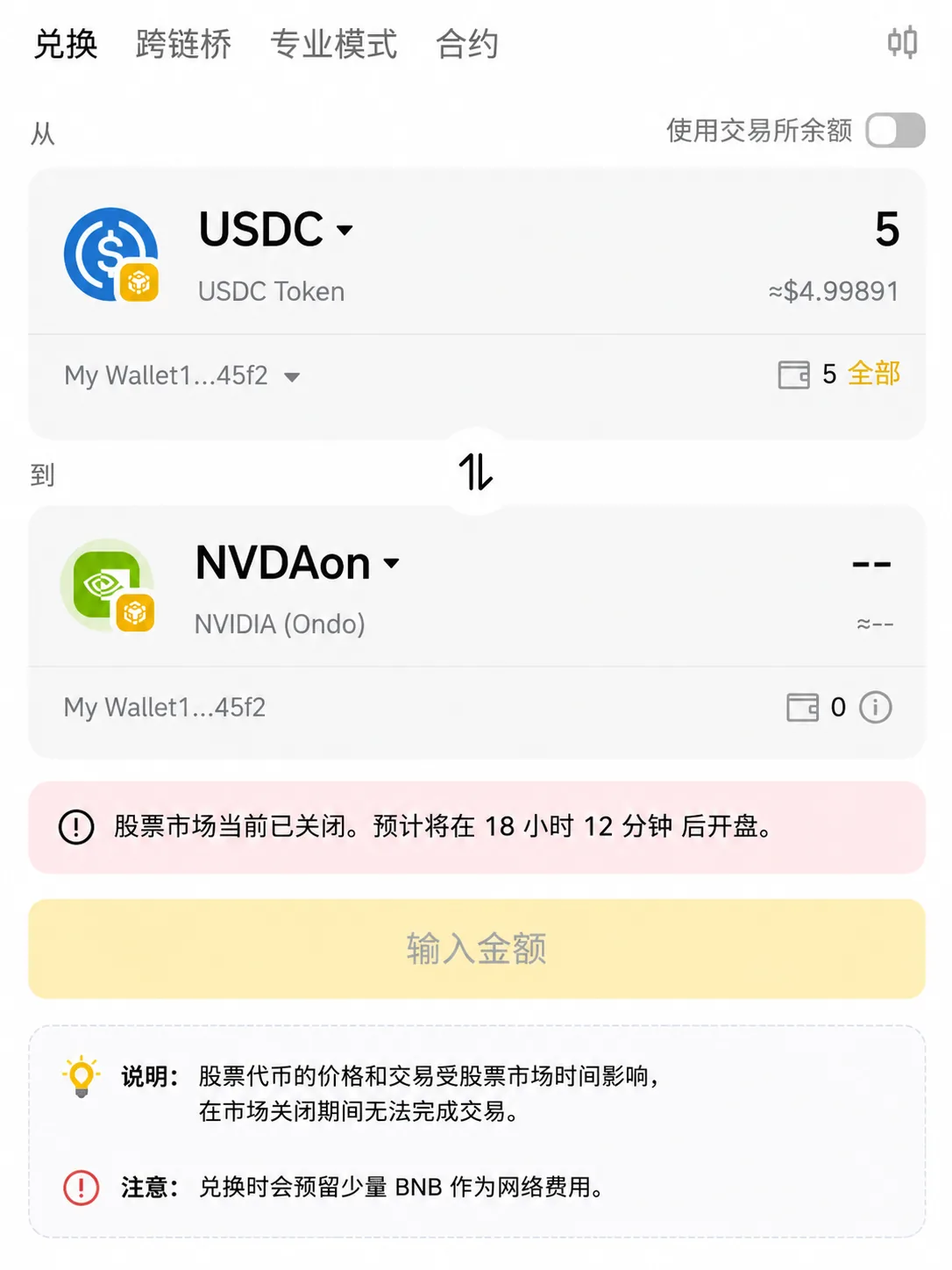
This is what makes on-chain stocks most special.
It is in your wallet, but it has not fully detached from the real market.
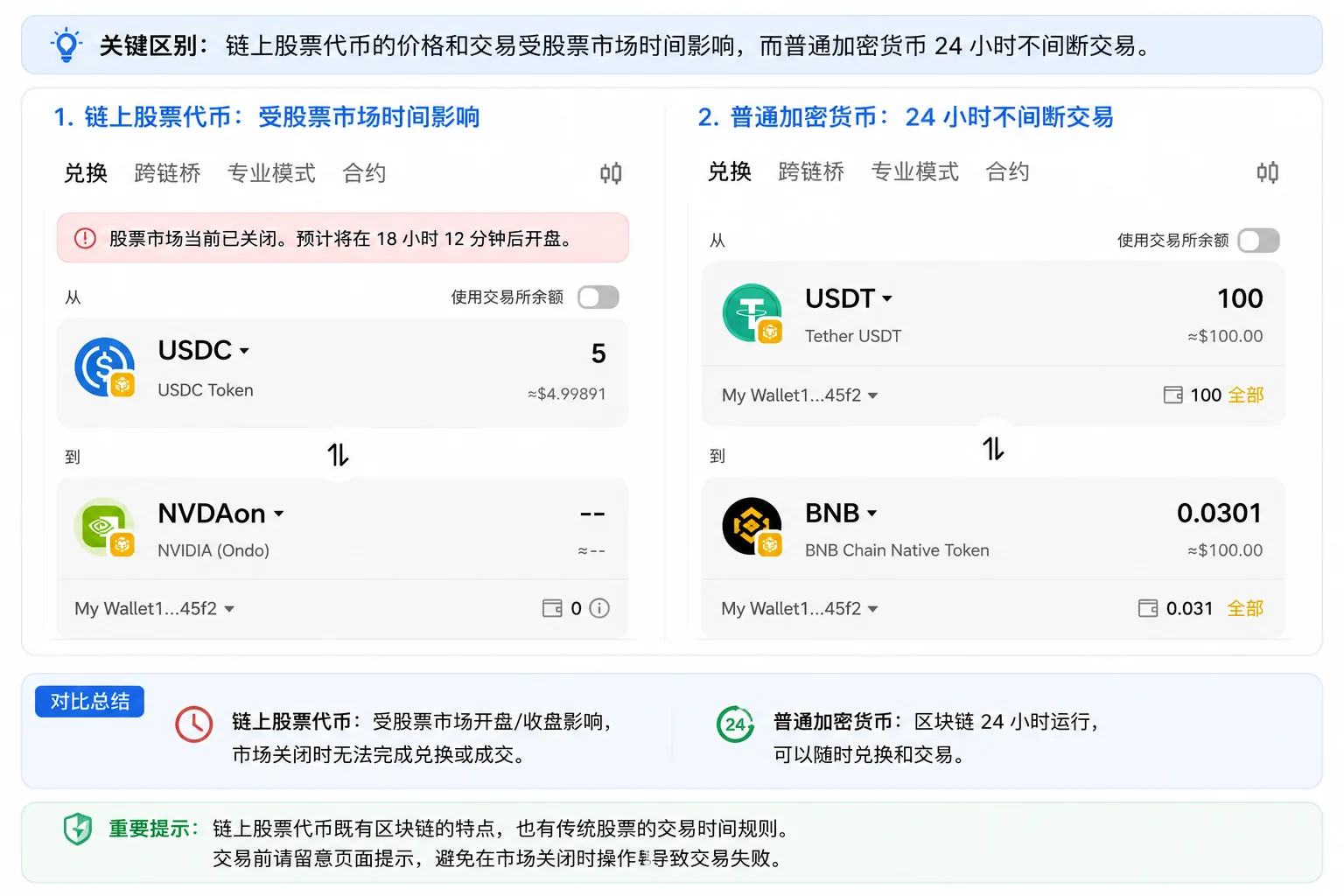
Setting aside BNB for network fees also shows it is still an on-chain operation
Another easily overlooked detail is the BNB network fee.
The page warns that a small amount of BNB is set aside as a network fee.
This is very "on-chain."
An ordinary brokerage buying US stocks would not ask you to keep BNB for fees.
But operating on BNB Chain, BNB is usually the gas-fee asset.
This brings a common beginner problem:
Using up all your BNB means you cannot move anything afterward.
For example, you use all the BNB in your wallet to swap for a stock token. Later, when you want to transfer, sell or approve, you may find the operation fails.
Not because you have no assets, but because you have no BNB to pay the network fee.
So as long as you operate on-chain, build a habit:
Do not empty out your mainnet coin.
Keep a little BNB on BNB Chain.
Keep a little ETH on Ethereum.
On other networks, also keep the corresponding gas coin.
On-chain stocks carry the word "stock," but operationally it is still wallet logic.
If you don't understand gas fees, it is best not to rush into complex assets.
If you are still unfamiliar with wallet addresses, seed phrases, gas fees and transfer networks, I suggest you read this basic article first: What is a crypto wallet? Wallet address, seed phrase and asset security (2026).
Reading this far, I would split it into two layers
I would not simplify on-chain stocks into a single sentence like "you can buy US stocks now."
That is too fast and easily misunderstood.
I would split it into two layers.
The first layer is the on-chain side.
Here you look at:
- Wallet;
- Network;
- Gas;
- Contract;
- Transfer;
- Approval.
The second layer is the stock side.
Here you look at:
- Issuer;
- Custody;
- Quote;
- Liquidity;
- Market hours;
- Regional restrictions.
So it is neither a pure stock nor a pure coin.
It is more like:
Stock-asset logic + token form + wallet operation.
Treating it only as a stock means ignoring on-chain risks.
Treating it only as a token means ignoring stock-market rules.
Besides on-suffix assets like Ondo, the market also has tokenized-stock products like xStocks. Kraken's official explanation of xStocks mentions that xStocks are tokenized representations of real stocks and ETFs, and describes their on-chain issuance, underlying-asset backing and trading restrictions. You can refer to Kraken's official xStocks explanation.
Taking Tesla as an example, the same page may show two versions, TSLAon and TSLAx, with different prices; the reason can be read here: What is TSLAon? Why its price differs from TSLA and TSLAx (2026).
Having NVDAon in your wallet does not mean you own NVDA stock
Remember this line on its own.
A stock token showing in your wallet only means you hold that token.
It does not automatically mean:
- You own NVDA stock in a traditional brokerage account;
- You have shareholder voting rights;
- You will definitely receive dividends;
- You can definitely redeem real stock;
- You can definitely transfer it to any platform to sell;
- Your region can definitely use it.
These all need to be read from the specific product description.
Some stock tokens may have underlying-asset backing.
Some may have custody arrangements.
Some may support a redemption mechanism.
Some may only trade on specific platforms or wallets.
Different products differ greatly.
Taking Ondo as an example, its legal and regulatory explanation describes Ondo tokenized stock as a structured note, and explains that token holders do not appear directly on the underlying stock's shareholder register and do not enjoy shareholder rights such as voting rights of the underlying security issuer. You can refer to Ondo Global Markets legal and regulatory explanation.
So don't see a balance in your wallet and automatically understand it as "I own stock."
A more reliable way to judge is:
I hold a stock-related token. What rights this token gives me depends on the issuer and platform rules.
This line is less exciting, but closer to reality.
What you should look at first is not how to buy, but how to get out
Many people immediately study how to buy when they see this kind of page.
But when I look at this type of product, the first thing is not the buy button.
I look at the exit path first.
Because the buy entry is often made very obvious, while the exit rules are not necessarily as visible.
I would first ask:
- What do I get after selling?
- Is it BNB, USDT, USDC, or another asset?
- Can it be transferred to an external wallet?
- Which network is supported?
- Where do I sell after transferring out?
- Is KYC required?
- Are regions restricted?
- Can I sell when the market is closed?
- What happens if the platform pauses?
These questions matter more than "can I buy."
Buying in smoothly does not mean getting out smoothly.
Seeing it in a wallet does not mean you can sell it anywhere.
Being able to transfer out does not mean there is liquidity after transferring out.
This is where beginners most easily overlook things.
If an on-chain stock token involves transferring out, the network choice is very important. Before transferring, I suggest reading: Can you recover a transfer sent to the wrong chain? Withdrawal networks and wallet addresses (2026).
In which situations would I suggest a beginner hold off?
If you have just started using wallets, it is best not to rush in the following situations.
You can't tell what this token represents.
You only know "it looks like Nvidia," but you can't explain whether it is a stock, who issued it, or whether it can be transferred out — then hold off.
You can't tell which network you're on.
If you don't know whether you are operating on BNB Chain, Ethereum or Solana, don't rush to transfer.
There is not enough gas in the wallet.
Especially when operating with BNB, don't swap away all your BNB.
The page warns the market is closed.
At least understand that it may not execute immediately like an ordinary token.
You don't know where to sell after transferring out.
If you don't think about the exit path before buying, it is easy to get stuck later.
Just because the stock name is familiar.
Names like NVDA and SPCX do easily spark interest.
But a stock token is not a traditional stock account.
Operating just because the name is familiar easily leads you to underestimate the risk.
Let me be clear about the boundaries
To avoid misunderstanding, let me also be clear here.
This article does not recommend any stock token.
It does not judge whether NVDAon, SPCXon or similar assets are worth buying.
It does not equate stock tokens in a wallet with real stock in a traditional brokerage account.
It does not assume all stock tokens follow the same rules.
It does not claim to have completed a real buy execution, transfer-out or redemption test.
This article is based only on actual page observations and public information, to help beginners understand:
Why stock tokens appear in a wallet, why they look both like stocks and like tokens, and which risks to look at before acting.
This type of product usually also has eligibility, regional and compliance restrictions. Taking Ondo as an example, its eligibility page lists restrictions in different jurisdictions, and whether a user can subscribe, obtain or redeem the relevant token must follow the specific rules. You can refer to Ondo Global Markets regional eligibility explanation.
Before actually acting, still follow the wallet page, the platform's official explanation, issuer documents and local regulations.
How is this article different from the previous "tokenized US stocks" piece?
The previous piece, "Tokenized US stocks," explains the concept at the platform level.
It focuses more on:
- Stock assets on the platform;
- Stock-token pages;
- USDC settlement;
- Custody arrangements;
- Regional restrictions;
- Platform rules.
This article leans more toward the real experience in a wallet.
It focuses more on:
- Why stock tokens appear in a wallet;
- Why you can swap with BNB, USDT or USDC;
- Why there is a network fee;
- Why a closed market affects operations;
- Whether holding a token in a wallet means owning stock;
- How a beginner judges the exit path.
Simply put:
"Tokenized US stocks" explains the track.
"On-chain stocks" explains the thing you see in your wallet.
The two are related, but not duplicates.
Read the previous one first, and you will understand the big picture of platform US stocks and stock tokens.
Then read this one, and you will more easily understand the stock-token page in your wallet.
If you haven't read the platform-level introduction, start with: Are the US stocks on Binance real stocks? The difference between stock tokens and real US stocks (2026).
A few questions beginners ask most
Are stock tokens in a wallet real stocks?
Not necessarily.
A stock token shown in a wallet is usually an on-chain token related to a stock, not a stock position in a traditional brokerage account.
Whether it has underlying-asset backing, can be redeemed, or carries dividends or other rights depends on the issuer and platform rules.
Is NVDAon Nvidia stock?
You cannot understand it that way directly.
NVDAon may be related to Nvidia stock, but it is not the NVDA stock in a traditional brokerage account.
A beginner is better off first understanding it as:
A stock token related to NVDA.
Why can you swap for stock tokens with BNB, USDT or USDC?
Because Web3 wallet users mostly hold on-chain assets.
The wallet or platform provides a swap entry so users can exchange BNB, USDT, USDC and other assets for stock tokens.
But this does not mean it is exactly the same as an ordinary swap.
Why does the page warn that the stock market is closed?
Because a stock token may depend on the traditional stock market's quote, liquidity or platform rules.
The blockchain can run 24 hours.
But stock-type assets do not necessarily have a normal execution environment 24 hours a day.
Why do I still need to set aside BNB when swapping with BNB?
If the operation happens on BNB Chain, BNB is usually also needed to pay the network fee.
Using up all your BNB may cause later transfers, approvals or selling to fail.
Can stock tokens be withdrawn?
It depends on the specific product and platform rules.
Some stock tokens may support transfer to an external wallet.
Some can only be used on a specified platform.
It may also be affected by network, KYC, whitelist and regional restrictions.
Is it safer to buy stock tokens with USDT or USDC?
Not necessarily.
USDT and USDC are just payment tools and cannot remove the stock token's own price-volatility, liquidity, issuer, platform and regulatory risks.
Can a beginner buy on-chain stocks directly?
I would not suggest starting with a large amount.
A beginner should at least first understand wallet addresses, transfer networks, gas fees, stablecoin networks and exit paths before considering a small test.
A few honest closing words
The most confusing thing about on-chain stocks is that they look like stocks and operate like tokens at the same time.
Seeing NVDAon in your wallet does not mean you own NVDA in a traditional US-stock account.
Seeing that you can swap with BNB, USDT or USDC does not mean it is as simple as an ordinary swap.
It is more like:
A stock-related asset entering wallets and on-chain scenarios in token form.
This is imaginative.
But it is also more complex.
If I were touching this kind of thing for the first time, I would not rush to study how to buy.
I would first clarify three things:
Who issued it.
Whether it can still be sold afterward.
If I want to exit, where I should exit.
Once these are clear, studying how to buy will actually feel much safer.
On-chain stocks are a direction worth watching.
But for beginners, what really matters is not catching the first moment, but understanding what you are actually buying.
Continue reading next
- Are the US stocks on Binance real stocks? The difference between stock tokens and real US stocks (2026)
- Are on-chain RWA assets worth investing in? My real experience buying NVDAon
- What is a crypto wallet? Wallet address, seed phrase and asset security (2026)
- What is USDT? The uses and risks of Tether (2026)
- What is the difference between USDT and USDC? Which is safer and how to choose (2026)
- Can you recover a transfer sent to the wrong chain? Withdrawal networks and wallet addresses (2026)
Author's note
This article was organized by the CoinTrailHub editorial team, based on public information, wallet-page observations and Crypto wallet usage experience, mainly for beginners new to on-chain assets, stock tokens, stablecoins and Web3 wallets.
We have long followed Crypto beginner onboarding, wallet security, stablecoins, trading platforms, RWA, on-chain stocks, tokenized US stocks and tokenized assets.
The on-chain stocks, stock tokens, BNB, USDT, USDC, wallet swaps and related platform features mentioned in this article may change with the market, platform rules and regulatory requirements.
This article does not constitute investment, financial or trading advice.
On-chain stocks are not risk-free assets, and stock tokens do not equal a traditional brokerage stock account.
Before acting, follow the platform's official explanation, wallet prompts, project documents and local regulatory requirements.
The CoinTrailHub editorial team focuses on crypto education for beginners, exchange security and P2P trading risk. This article is compiled from official sources and public data, reviewed by humans, and strives for accuracy but is not investment advice.
Last updated:2026-06-21 · Content reviewed by humans · Learn more
© 2026 CoinTrailHub · Original content. Reproduction or rewriting without permission is prohibited.