
Binance stocks vs Futu/Tiger: fees and transfer, tested (2026)
Table of contents

Binance new user rewards
20% trading fee rebate
Official Binance registration. Complete identity verification (KYC) to trade and withdraw.
On August 17, 2026, I bought 0.015 shares of Tesla on Binance.
The order's stock value was 5.16 USDC, plus a 0.17 USDC platform fee, for a total of 5.33 USDC. The order filled smoothly, and the process felt close to how I usually buy crypto on Binance.
After buying, I had a few more questions:
Who holds these 0.015 shares? Can I transfer them to Futu, Tiger or Interactive Brokers later? If the company pays a dividend, how does the money reach me? Now that Binance can buy US stocks, do I still need a separate traditional broker account?
I re-checked Binance's stock service and public material from several traditional brokers. Comparing them, the biggest difference is not "whether you can buy US stocks", but how you hold after buying, how fees are calculated, and what operations that account can do later.
This article includes my real trade record in the Binance app and is compiled with public material from each platform. Features and fees may differ by region, account and contracting entity, so follow the page and agreement in your own account. This article contains no account-opening links for Binance, Futu, Tiger or Interactive Brokers, and is not investment, legal or tax advice.
About 10 minutes to read. Two easy-to-miss points to remember first: a "0 fee" shown on the order page doesn't mean there are no costs; and fractional shares being buyable doesn't mean they can transfer smoothly to another broker.
What I actually bought on Binance
I bought TSLA in Binance's stock section, and did not enable "tokenized order" when placing the order.
The trade record:
| Item | Actual data |
|---|---|
| Product | TSLA Direct Stocks |
| Order type | Limit buy |
| Limit price | 344.25 USDC |
| Average fill price | 344.1975 USDC |
| Quantity | 0.015 shares |
| Stock value | 5.16 USDC |
| Platform fee | 0.17 USDC |
| Total cost | 5.33 USDC |
| Fill status | 100% filled |
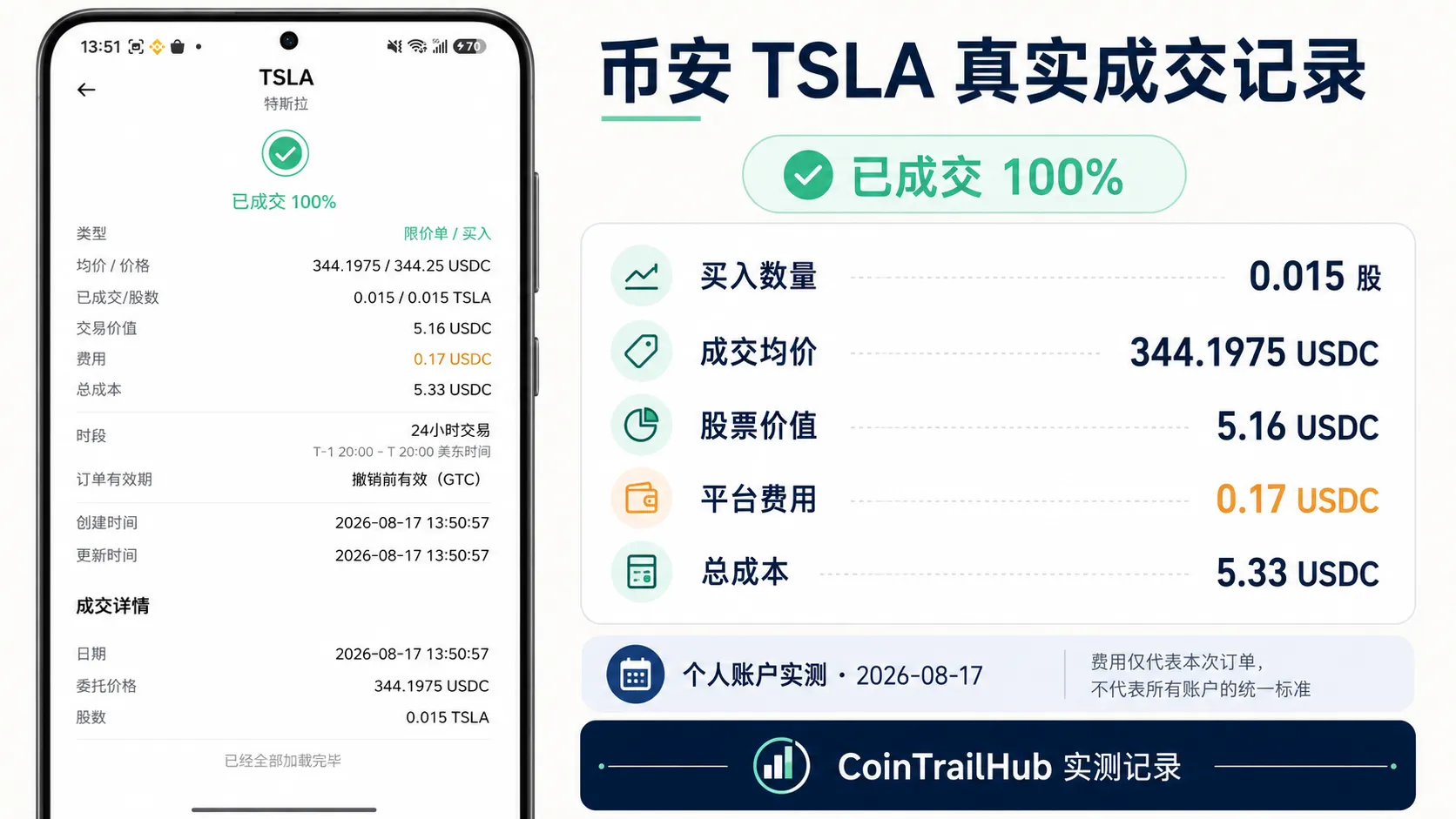
This fill confirmed at least two things:
First, an eligible Binance account can indeed buy fractional US stock shares; second, "0 fee" shown on the order page does not mean the whole trade has no costs at all.
The full order preview, fill record and fee screenshots are in Can Binance buy US stocks? A real 0.015-share TSLA purchase in 2026.
I won't repeat every order step here — the focus is comparing the account, fees, dividends and transfer differences after buying.
They can all buy US stocks, but the account relationship differs
Binance's most convenient point is that you don't need a separate securities app.
My account originally held USDT. When I submitted the TSLA order, the system first converted the needed USDT into USDC, then completed the stock trade in USDC.
In terms of feel, it's like a stock section was added to the existing Binance account. But the trading and custody behind the stock are not the same as holding USDT in an ordinary digital-asset account.
In this account's US-stock transfer page, Binance showed the receiving broker as Alpaca Securities LLC with DTC clearing number 3021.[1] This confirms the receiving-broker information used when this account transfers in US stocks, but you can't infer from this one page that every region and every Binance account uses the exact same execution and custody arrangement. The specific contracting entity, how securities are recorded and the account-protection scope should still follow the agreement you accepted when opening the account.
Futu, Tiger and Interactive Brokers may also use different legal entities depending on the account-opening region, but their products were designed around securities accounts from the start.
Position statements, tax documents, corporate actions and securities transfer are usually placed more prominently.
If you're only buying one familiar stock, the difference is hard to notice at first. It only shows gradually when you need dividends, transfer, tax reporting or corporate actions.
Binance, Futu, Tiger and Interactive Brokers side by side
I did not place an identical order (amount, time, instrument) on Futu, Tiger and Interactive Brokers, so I won't write their public rates as my own test results.
What I compare below is my Binance fill record, plus the common differences I can confirm from each platform's public rules.
| Item | Binance Direct Stocks | Futu / Tiger | Interactive Brokers |
|---|---|---|---|
| Account form | Stock feature sits in the same app as Binance digital-asset services; securities service per the account agreement | Separate securities account | Separate securities account |
| Common deposit methods | Mainly USDC; some orders can auto-convert USDT to USDC | Bank transfer, local deposit and currency exchange | Bank transfer and multi-currency account |
| US stocks and ETFs | Over 7,000 US stocks and ETFs[2]; actual range depends on region and account eligibility | US stocks and ETFs; range depends on opening region | US stocks, ETFs and multiple international markets, depending on account permissions |
| Fractional shares | Some instruments supported; I actually bought 0.015 shares of TSLA with about $5 | Some markets and instruments; rules vary by region | Some eligible US stocks and ETFs support fractional shares |
| Trading fees | Fee shown before ordering; my 5.16 USDC order charged a 0.17 USDC platform fee | Commission, platform and regulatory fees vary by region and promo | Fixed or tiered pricing, plus exchange and regulatory fees |
| Dividends & corporate actions | Can process eligible cash dividends and corporate actions, per the agreement | Supported; tax handling depends on opening region | Supported; statements and corporate actions are relatively complete |
| Stock transfer | This account has transfer-in and transfer-out entry points; the page shows 150 USDC per ticker for DTC transfer out, up to 21 business days, non-refundable even if it fails; fractional-share eligibility needs separate confirmation | Scope, fees and fractional-share handling vary by region and security | Transfer system relatively mature, but method, instruments and fractional shares still have limits |
| Options & advanced products | Stock service is mainly stocks and ETFs; permissions per the account page | Some options and advanced trading, by region | Options, bonds, futures and multi-market products are relatively complete |
| Research tools | Good for quotes and basic trading | Chinese-language news, quotes and community tools are richer | Order types, market data and pro analysis tools are more complete |
| Ease of use | Easier for users already on Binance | Friendly Chinese interface for regular US-stock users | More complex, better for users willing to learn pro tools |
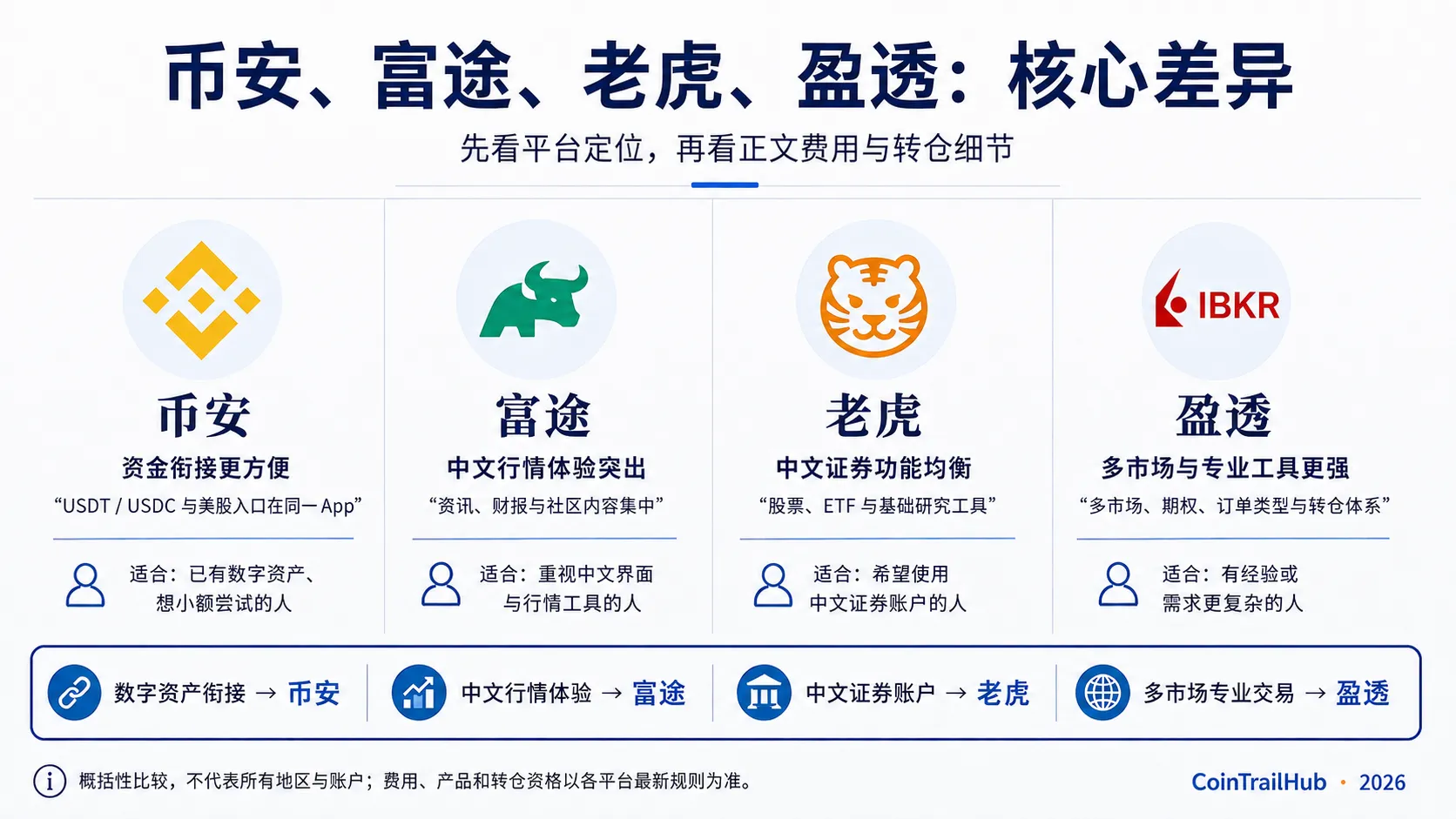
Putting them side by side, the positioning differences are clear:
- Binance suits users who already hold USDT or USDC and want to connect digital assets directly to US stocks;
- Futu and Tiger have richer Chinese-language quotes, news and community tools;
- Interactive Brokers covers more markets and pro tools, but its permissions, data subscriptions and fee structure are also more complex.
No platform wins in every dimension — the key is how you plan to use the account.
Being able to buy with $5 doesn't mean small trades are cheap
My TSLA order had a stock value of only 5.16 USDC, yet generated a 0.17 USDC platform fee.
As a percentage of the stock value:
0.17 ÷ 5.16 ≈ 3.29%
That ratio was higher than I expected at first.
But it does not mean Binance charges a uniform 3.29% fee, and you can't conclude from this one order that 0.17 USDC is a fixed minimum fee for all regions and accounts.
It only shows: when the order amount is very small, a platform fee that looks small can be a noticeable percentage of the stock value.
I also previewed orders of 0.02 shares and 1 share of TSLA, and the page showed the same 0.17 USDC fee:
| Quantity | Stock value | Fee shown | Fee as % of stock value |
|---|---|---|---|
| 0.015 shares (actual fill) | 5.16 USDC | 0.17 USDC | ~3.29% |
| 0.02 shares (preview) | 6.85 USDC | 0.17 USDC | ~2.48% |
| 1 share (preview) | 342.35 USDC | 0.17 USDC | ~0.05% |
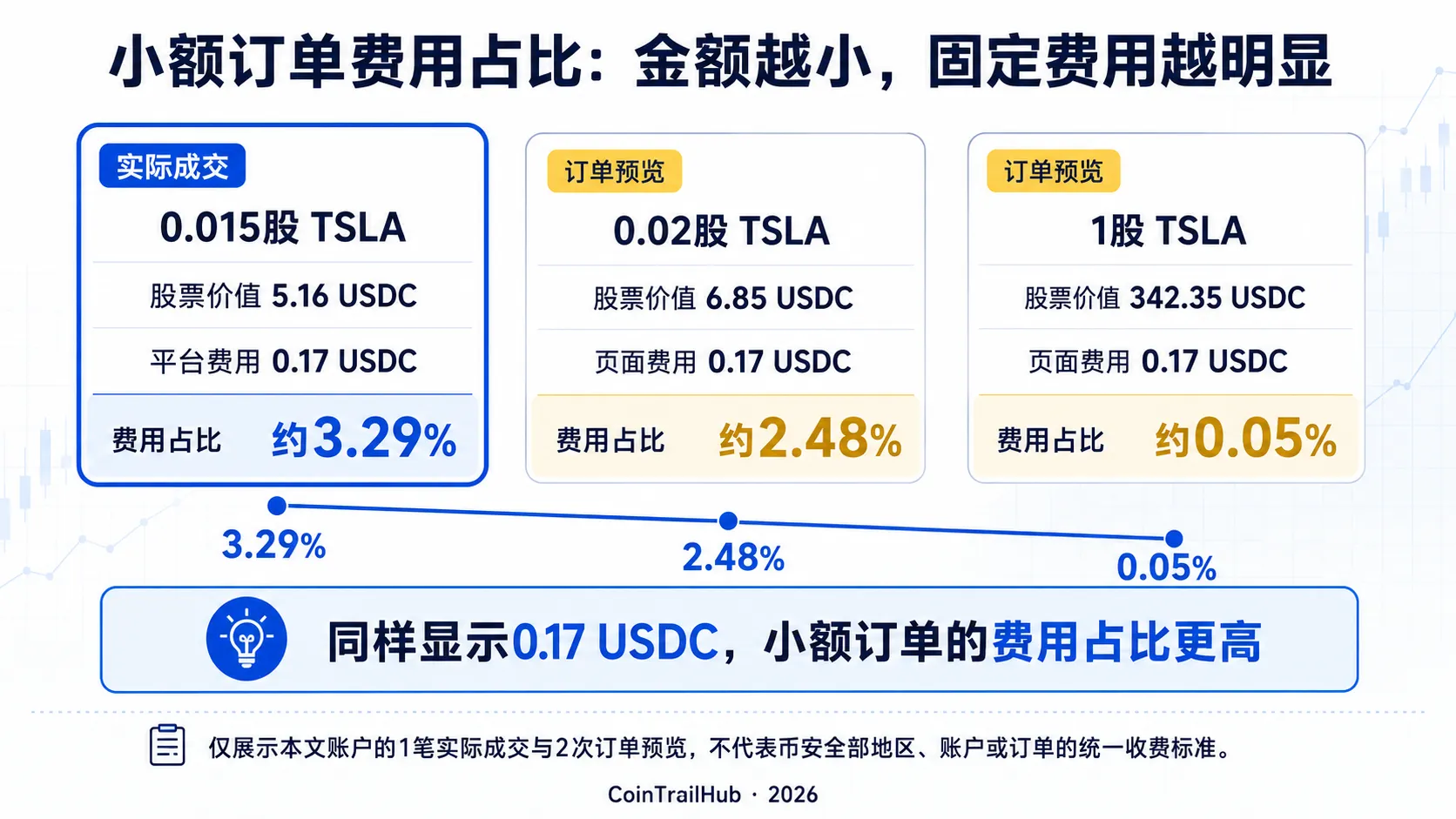
Three samples can't derive a universal fee formula for Binance stocks, but it's already clear that small orders have a higher fee ratio.
Traditional brokers' costs also can't be judged by the words "zero commission" alone.
Futu and Tiger may involve commission, platform fees, regulatory fees and different regional promos; Interactive Brokers offers fixed or tiered pricing, and actual cost also depends on order size, market and account type.
Bank deposits and currency exchange can also add cost.
Now, when I compare fees, I look at how much a single order actually deducts, not just the commission number on the ad page.
0.17 USDC is the fee shown for this account's TSLA order, not a uniform standard for all Binance regions, accounts and orders. Follow the fee breakdown before ordering for the actual cost.
Fractional shares are easy to buy, but transfer may be restricted
One Tesla share was over $300 at the time, and I completed a real fill by buying only 0.015 shares. For someone trying US stocks for the first time, that lowers the capital threshold.
Futu, Tiger and Interactive Brokers also support fractional shares to some extent, but "you can buy fractional shares" and "you can transfer fractional shares to another broker" are two different things.
The 0.015 TSLA shares I bought on Binance filled, but that doesn't mean they can transfer out like whole shares by default.
Securities-transfer systems usually handle eligible whole shares more easily; fractional shares may need to stay in the original account, be sold first, or accumulate into whole shares before processing.
Similar limits appear in traditional brokers' public rules:
- moomoo fractional-share disclosure says fractional shares cannot transfer via ACATS;
- Tiger Brokers transfer-out guide lists fractional shares as non-transferable assets;
- Interactive Brokers fractional-share disclosure also says fractional shares cannot transfer to other brokers.
So the appearance of a stock-transfer entry in the Binance app is a good thing, but I won't write "an entry exists" as "0.015 shares can transfer out freely."
Binance transfer costs can't be ignored
This account's transfer-out page showed a 150 USDC fee per ticker for DTC transfer out, non-refundable even if the transfer fails. The page also noted the transfer could take up to 21 business days, processed in batches every Wednesday.[3]
This means a transfer fee can far exceed the value of a small position. For example, my 0.015 TSLA shares are worth about $5, so paying 150 USDC to transfer them out doesn't make economic sense.
However, I did not actually submit this transfer, nor verify whether 0.015 TSLA shares qualify for transfer out. What I can confirm now is that the page has transfer-in and transfer-out functions, plus the fees and processing time shown — not that fractional shares can definitely transfer out.
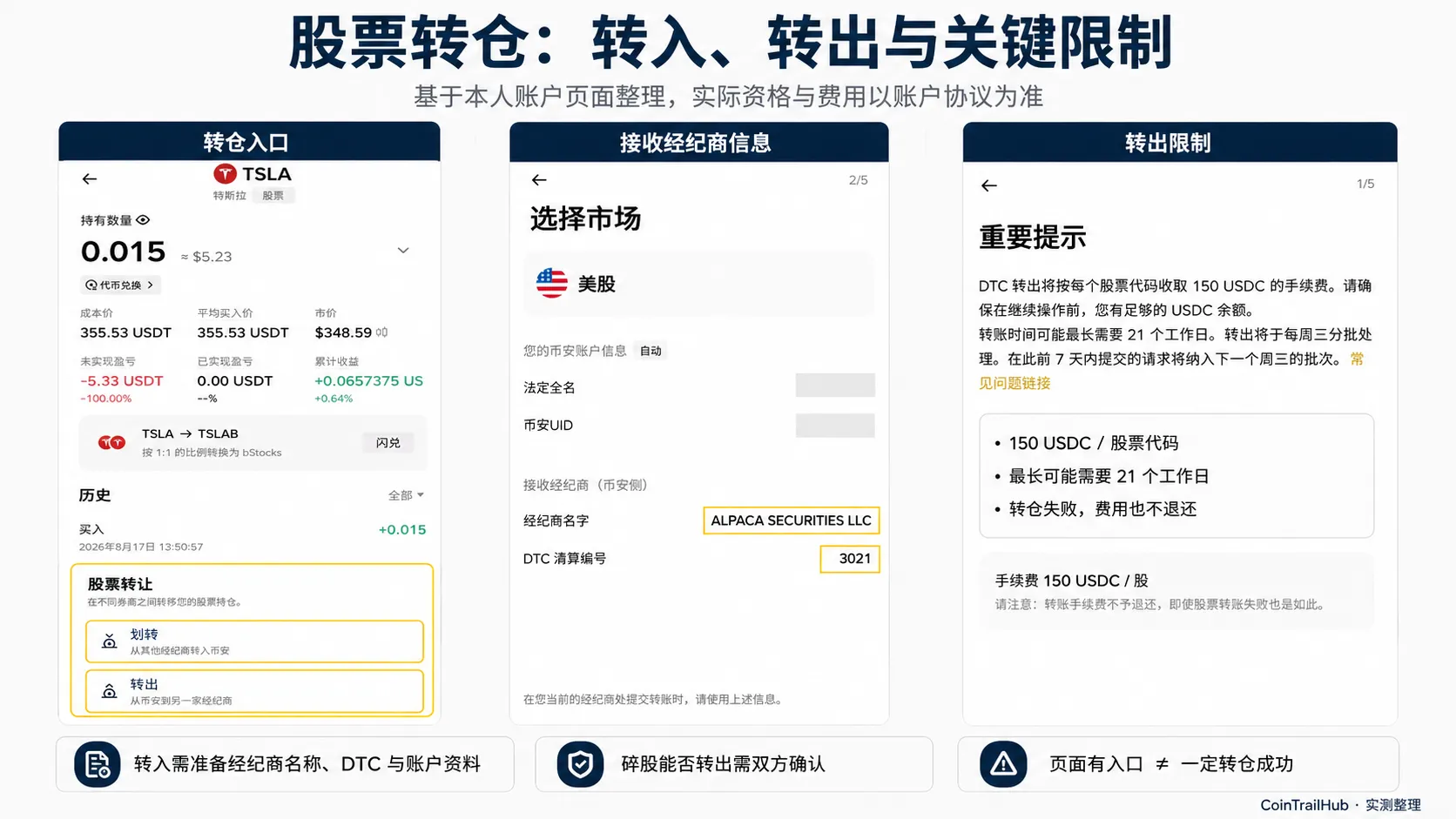
I haven't actually completed a Binance stock transfer, so this section is based only on the page description, the client agreement and written confirmation from both brokers.
If I prepare to transfer in the future, I'll send the ticker, share count and receiving-account info separately to both the transfer-out and receiving sides to confirm before submitting.
Asking only "do you support transfer" is usually not enough.
Dividends are processed, but they're not a platform-promised return
I saw NVDA cash-dividend records in Binance's stock page. This shows the stock service has display and processing entries for dividends and corporate actions.
But "supports dividends" doesn't mean buying any stock guarantees cash.
Whether you receive a dividend mainly depends on:
- Whether the listed company declares a payout;
- Whether you held the stock on the record date;
- Whether the account and residence qualify;
- How fractional-share dividends are calculated;
- What withholding-tax rules apply;
- Which party processes corporate actions.
What I bought this time was TSLA.
Tesla currently does not pay a cash dividend to common shareholders. Even though Binance's stock service can process cash dividends, this TSLA position won't automatically generate regular cash income because of it.[4] Tesla investor relations page
For long-term holders, what's really worth comparing isn't whether a platform writes "supports dividends", but:
- Where dividend records are viewed;
- How taxes are deducted;
- How fractional-share dividends are calculated;
- Where notifications go when a corporate action requires an active choice;
- Whether the annual statement lists these records clearly.
Traditional brokers are usually more mature in corporate actions, securities statements and tax documents. Whether Binance meets long-term holding needs depends on the service scope and account documents in your region.
When searching TSLA, the easiest mistake isn't the company
Binance has more than one Tesla-related product.
These products' prices may all move around Tesla's stock, but what you actually buy is completely different.
| Ticker | Product type | What you're buying |
|---|---|---|
| TSLA | Direct Stocks | Tesla stock held through a securities-service system |
| TSLAB | bStocks tokenized security | A tokenized certificate provided by the issuer under product terms |
| TSLAUSDT Perp | Perpetual contract | A derivative tracking the TSLA price |
I turned off "tokenized order" when placing the order, and what filled was TSLA under Direct Stocks.
Even if TSLAB is backed by the corresponding stock per product material, it is not ordinary stock issued by Tesla. Buying TSLAB does not make you a registered shareholder of Tesla.
TSLAUSDT Perp is even less of a stock. It involves margin, funding rate, leverage and liquidation risk.
A beginner's most common mistake isn't necessarily buying the wrong company — it's wanting Tesla stock but entering a tokenized-security or contract page just because they saw "TSLA".
I now confirm the page belongs to "stocks" or "contracts" first, then check the full ticker, and finally the tokenization toggle. The price chart is not the first thing to look at.
Related:
- What is TSLAon? Why its price differs from TSLA and TSLAx (2026)
- Tokenized US stocks vs traditional US stocks: what's the difference?
- Are Binance US stocks real stock? Tokenized stock vs real stock (2026)
"Who holds the stock" doesn't answer every safety question
Many people ask: is buying US stocks on Binance safe?
I think this question can't be answered with a simple "safe" or "not safe".
Even if securities orders are executed and held by regulated institutions, you still need to confirm which company you're contracting with, which region's rules apply, and who to contact in a dispute.
What's really worth confirming before opening an account:
- Which legal entity provides the stock service;
- Who handles order execution, clearing, settlement and custody;
- How customer securities are recorded;
- Which jurisdiction the account falls under;
- Whether local investor-protection or compensation arrangements apply;
- Which company to complain to when something goes wrong.
This information can't be judged by the brand shown in the app alone.
Futu, Tiger and Interactive Brokers may also be served by different entities in different regions. Fees, account rights and protection scope under the same brand may not be identical.
Binance's public material discloses the division between Nest Trading Limited and Alpaca Securities LLC, but I still use the client agreement my own account actually accepted as the final basis.
A partner institution being regulated doesn't mean no risk for any account or any amount, and can't be simplified into "absolutely safe".
How buying US stocks with USDT differs from a traditional-broker deposit
The clearest place where Binance stocks connect with the crypto ecosystem is the funding source.
My account mainly held USDT, while the TSLA order was priced in USDC. When submitting the order, the system auto-converted the needed USDT into USDC, then completed the stock trade.
The fund flow can be understood as:
USDT balance → converted to USDC → USDC used to buy TSLA
This is convenient for users already holding stablecoins — no need to move digital assets to a bank first, then wire into a securities account.
But convenience doesn't mean no extra variables. The actual deduction may also be affected by:
- The real-time USDT-to-USDC conversion rate;
- Platform fees;
- Bid-ask spread;
- How funds return if the order doesn't fill;
- Settlement time after selling the stock;
- The cost of converting USDC back to other assets later.
Traditional brokers usually take deposits via bank transfer or a multi-currency cash account.
If your income and daily funds are already in the banking system, that route is more direct; if your funds are mainly in USDT or USDC, Binance's route is more convenient.
This is one of the most practical differences between Binance stocks and traditional brokers: it turns stablecoins into a funding entry connecting crypto assets and securities trading.
If you're not yet familiar with USDT and USDC, read What's the difference between USDT and USDC?.
Traditional brokers' advantages only appear with long-term use
If you just want to spend a few dollars on a bit of TSLA, Binance's current features are enough. I could view quotes, enter a quantity, submit a limit order and complete the fill.
As needs grow, traditional brokers' advantages become clearer, for example:
- More complete company financials and research;
- More order types and conditional orders;
- Option chains and portfolio analysis;
- More mature corporate-action notifications;
- Tax documents and position statements;
- Multi-market trading and securities transfer.
Futu and Tiger's Chinese news, quotes and community are relatively easy to pick up. Interactive Brokers covers more markets and pro tools, but needs time to understand account permissions, market-data subscriptions and fee structure.
Binance's advantage is more direct.
If your funds are already in a digital-asset account, buying US stocks doesn't require moving USDT to a bank, converting to USD and wiring into another broker. For people already familiar with Binance, the interface and learning curve are also lower.
This isn't about one replacing the other. Binance solves the connection between digital-asset funds and US-stock trading; traditional brokers solve more complete securities-account management.
If it were me, what would I choose now
If your account already has USDT or USDC and you just want to try common US stocks with a few dollars, without needing complex research or transfer, Binance saves the process of opening another account, bank transfer and currency exchange.
If you go the Binance route, register an account first and confirm whether the stock feature is open — new users who enter referral code BN522 get a spot and futures fee rebate; the entry is in the Binance registration tutorial (2026).
If you want Chinese quotes, news and a relatively complete ordinary securities-account experience, compare Futu and Tiger on fees, deposit methods and transfer rules in your own region.
If you plan to trade multiple countries' markets, options or other professional products, and are willing to invest time learning the account and trading tools, focus on Interactive Brokers.
The two account types can also be used together.
A traditional broker handles long-term securities positions, while Binance stocks connect a portion of digital-asset funds — this division is usually more practical than looking for one "universal account".
I won't replace all my existing securities accounts just because Binance can buy US stocks, nor will I ignore Binance's convenience in small trades and stablecoin-fund connection just because traditional brokers have more features.
Account-opening bonuses are easy to see; what really affects later use is the detail in the fee pages and account agreements.
What to check before opening an account
After this 0.015-share TSLA trade, I'd confirm these questions first:
- The full name of the contracting company in the client agreement;
- Who executes, clears and holds securities orders;
- How much an order of the amount you plan to place will actually deduct;
- Whether you're buying ordinary stock, tokenized securities or a contract;
- Whether fractional shares can transfer out later;
- Where dividends, tax and corporate actions are queried;
- How long after selling a stock settlement completes;
- Whether to contact the platform or the securities-service institution when something goes wrong.
If these aren't clear, even a smooth account opening and purchase can still run into trouble with long-term holding.
Final thoughts
After buying 0.015 shares of TSLA, my view of Binance stocks is much more concrete than before.
It really does lower the threshold for buying US stocks. With USDT in the account, a few dollars completes a real fractional-share trade, without learning a completely unfamiliar process.
But small trades aren't necessarily cheap.
My 5.16 USDC stock generated a 0.17 USDC platform fee, about 3.29% of the stock value. Fractional shares are easy to buy, but whether they can transfer later still needs separate confirmation.
Binance is more like adding an entry into US stocks for crypto users. Futu, Tiger and Interactive Brokers are closer to a complete securities account.
The former wins on easy connection with USDT, USDC and other digital assets; the latter wins on research, statements, transfer and corporate-action management after buying.
If it's just a small experience, Binance has its convenience; if you plan long-term, large or more professional US-stock management, a traditional broker's account structure and tools still have value.
FAQ
What's the minimum to buy US stocks on Binance?
The specific threshold follows the account page and instrument. I actually bought 0.015 shares of TSLA with a stock value of 5.16 USDC, plus a 0.17 USDC platform fee, for a total cost of 5.33 USDC.
Does Binance support fractional US stock shares?
It supports fractional shares for some eligible US stocks and ETFs. My 0.015 shares of TSLA filled 100%; the minimum amount or quantity may differ by region, account and security.
How many US stocks and ETFs does Binance offer?
Binance's official stock page shows eligible users can trade over 7,000 US-listed stocks and ETFs. The actual visible range depends on residence and account eligibility.
Does Binance buy stock or tokens?
It depends on the product you choose. The TSLA I bought with the tokenization toggle off is Direct Stocks; TSLAB is a bStocks tokenized security; TSLAUSDT Perp is a perpetual contract.
Can I buy US stocks directly with USDT?
My order used a USDT balance, but the system first converted USDT to USDC, then used USDC to buy TSLA. The final USDT deducted may be affected by the conversion rate.
Do Binance stocks pay dividends?
Eligible Direct Stocks can process applicable cash dividends and corporate actions, but this requires the listed company to actually declare a payout, and is subject to holding date, tax and account eligibility. Tesla currently has no cash dividend.
Can Binance stocks transfer to another broker?
This account already shows stock transfer-in and transfer-out entries. The transfer page shows that US-stock transfer out requires the broker name, DTC number and account details for receiving or delivery; DTC transfer out charges 150 USDC per ticker, may take up to 21 business days, and the fee is non-refundable even if the transfer fails. Whether a specific stock or fractional share can transfer out still needs confirmation with Binance and the receiving broker before submitting. I have not actually completed a transfer.
Can fractional shares transfer directly?
Don't assume so. Several traditional brokers' public rules restrict fractional-share transfer, and eligible whole shares are usually easier to process. How Binance handles fractional shares should follow the transfer agreement and written confirmation from both sides at the time.
Are Binance stocks zero-fee?
No. My order showed a 0 commission, but there was an additional 0.17 USDC platform fee. "Zero commission" or "zero fee" doesn't mean the whole trade has no other costs.
Which is better for beginners, Binance or a traditional broker?
If you already use Binance and hold USDT or USDC, a small trial is more convenient; if your main goal is long-term US-stock holding and you value research tools, tax documents and securities transfer, a traditional broker's features are usually more complete.
Related reading
- Binance registration tutorial (2026) — email/phone sign-up, KYC and security settings; new users enter referral code BN522 for a fee rebate
- Binance referral code BN522 tested: is the 20% rebate real? — rebate rules and crediting conditions
- How to buy US stocks on Binance: order steps, fees and dividend withdrawal (2026)
- Can Binance buy US stocks? A real 0.015-share TSLA purchase, fill and fees
- What is TSLAon? Why its price differs from TSLA and TSLAx (2026)
- Tokenized US stocks vs traditional US stocks: what's the difference?
- Are Binance US stocks real stock? Tokenized stock vs real stock (2026)
- Are RWA on-chain assets worth investing? My real experience buying NVDAon
Data verification notes
The key facts in this article were verified on 2026-10-16 against Binance's official guidance, the Reuters report and Tesla's investor relations page, item by item:
- Receiving broker: this account's US-stock transfer page showed the receiving broker as Alpaca Securities LLC with DTC clearing number 3021. Source: Binance stock trading FAQ.
- Stock range: eligible users can trade over 7,000 US-listed stocks and ETFs; the actual range depends on region and account eligibility. Source: Reuters report.
- Transfer fee: DTC transfer out charges 150 USDC per ticker, non-refundable, and the transfer may take up to 21 business days. Source: Binance stock trading FAQ.
- Dividend situation: Tesla currently does not pay a cash dividend to common shareholders. Source: Tesla investor relations page.
Last updated: October 17, 2026.
If the fees, account structure or transfer rules in this article have changed, feel free to send feedback via CoinTrailHub's contact page. I'll continue updating based on public material and the actual pages.
This article is for education and product-experience reference only and does not constitute investment, legal or tax advice. Platform features, fees and securities-service terms may change; before trading or transferring, read the latest agreement that applies to your account.
- Binance stock trading FAQDirect Stocks custody, transfer rules and eligibility
- Reuters reportBinance launched US stock/ETF trading with over 7,000 instruments
- Tesla investor relations pageTesla has not paid a cash dividend
- 2026-10-17UpdateAdded a registration CTA (referral code BN522) in the decision section, and moved the registration tutorial and referral-code entry to the front of the related reading.
- 2026-10-16UpdateAdded evidence-chain superscripts and "Data verification notes"; updated the verification date of key facts.
See ourEditorial Policy and the correction process in ourCorrections Policy.
The CoinTrailHub editorial team focuses on crypto education for beginners, exchange security and P2P trading risk. This article is compiled from official sources and public data, reviewed by humans, and strives for accuracy but is not investment advice.
Last updated:2026-10-17 · Content reviewed by humans · Learn more
© 2026 CoinTrailHub · Original content. Reproduction or rewriting without permission is prohibited.