
What are gold tokens? PAXG/XAUT and their main risks
Table of contents

Binance new user rewards
20% trading fee rebate
Official Binance registration. Complete identity verification (KYC) to trade and withdraw.
Many beginners seeing PAXG, XAUT, on-chain gold, gold tokens for the first time usually react with:
Is this a gold version of USDT?
The short answer first:
No.
USDT and USDC are dollar stablecoins; their core is staying as close to 1 dollar as possible.
PAXG and XAUT are gold-price assets; their core is not 1 dollar, but gold, custody, proof of reserves, redemption rules and transfer networks.
The single most important sentence in this article is:
The core of a gold token is not its price, but its rules.
Price is just the thing you see most easily.
What actually determines whether you can understand a gold token are these questions:
- Where is the gold?
- Who is custodying it?
- Is there a reserve report?
- Can it be redeemed?
- Is there a redemption threshold?
- Could the network be chosen wrong when withdrawing to a wallet?
If you remember only one point, remember this:
A gold token = a digital certificate of gold, not gold itself.
This article is for basic crypto knowledge education only and does not constitute any investment, financial or trading advice. Gold tokens, PAXG, XAUT, on-chain gold and RWA products involve gold price volatility, issuer, custody, proof of reserves, redemption thresholds, regional restrictions, KYC, wallet security and on-chain transfer risks. Before actually operating, please refer to the project's official website, platform rules, wallet prompts and local regulations.
Information in this article was compiled on: June 22, 2026. Product rules, reserve reports, fees, redemption requirements and supported networks may change; before actually operating, please refer to the latest official pages.
Understand gold tokens in 3 sentences
It's not gold itself, but a gold certificate.
It's not a dollar stablecoin, but a gold-price asset.
The biggest pit is not buying, but redemption and the transfer network.
What real observations is this article based on?
This article doesn't just explain concepts; it was compiled from PAXG/XAUT official documentation, reserve reports, exchange market pages and withdrawal network pages.
Three questions were the focus:
- How PAXG and XAUT display price, trading pairs and buy/sell entries on exchanges;
- How official materials explain gold reserves, custody, attestations and redemption rules;
- Whether the withdrawal pages list consistent networks for PAXG and XAUT.
These observations all point to the same conclusion:
A gold token is not just about the price, but about the rules.
Many beginners only look at the exchange page.
Seeing the price, the candlestick chart and the buy button, they think they already understand.
Actually, not yet.
The market page can only tell you "whether it can be traded."
The information that really matters is usually in the official documentation, reserve reports, FAQ, redemption rules and withdrawal network prompts.
What exactly is a gold token?
The short answer first:
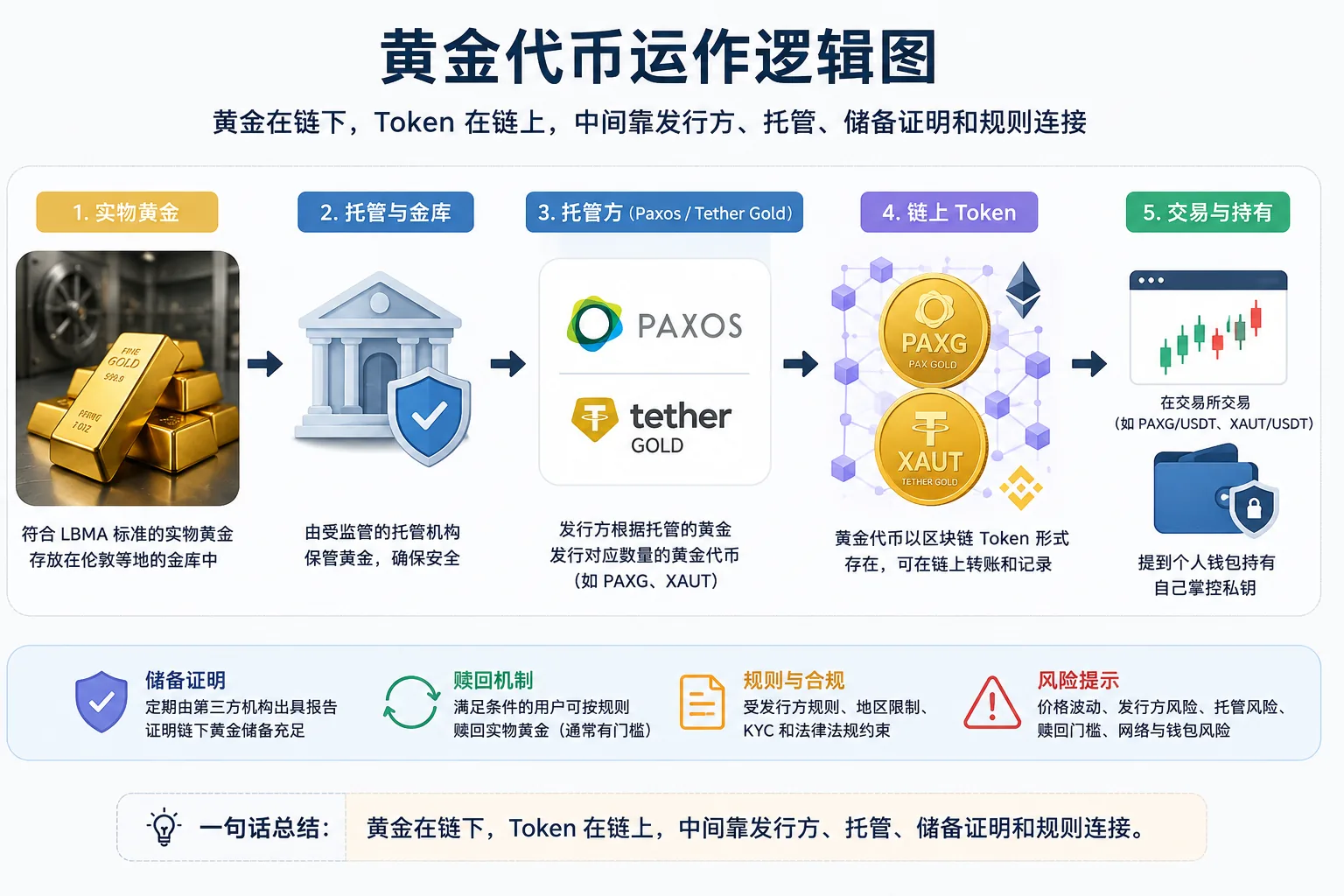
A gold token is not gold bars put on-chain, but an on-chain certificate of gold rights.
Gold doesn't actually enter the blockchain.
What the blockchain records is the token, wallet addresses, transfer records and balances.
The actual gold remains in an off-chain vault or with a custodian.
A gold token can be broken into three layers:
| Components of a gold token | How a beginner can understand it |
|---|---|
| Off-chain gold | The actual physical gold, still in a vault or with a custodian |
| On-chain token | The digital asset you see in a wallet or exchange |
| Issuer rules | Decide proof of reserves, redemption method, fees and usage restrictions |
This is where many beginners misjudge.
Seeing PAXG or XAUT in their wallet, they think they are "holding gold."
More precisely:
What you hold is a gold-related token.
Whether that token is reliable doesn't depend on its name, but on the rules behind it.
What's the difference between on-chain gold and physical gold?
The short answer first:
Physical gold depends on custody; gold tokens depend on rules.
When buying physical gold bars, you care about:
Are the bars real or fake? Where are they stored? How do you sell later? Is the custody safe?
When buying gold tokens, you care about:
Is there gold behind the token? Where is the gold? Who custodies it? Who issues the report? Can it be redeemed? Which transfer network do you choose?
Both are related to gold, but they are not the same holding experience.
| Comparison | Physical gold | Gold token |
|---|---|---|
| What you see | Gold bars, coins, bank or vault certificates | A token in a wallet or exchange |
| Where the gold is | In your own hands, a bank, a gold shop or a vault | An off-chain vault or custody system |
| How to buy/sell | Gold shops, banks, precious-metals platforms | Exchanges, wallets or on-chain platforms |
| Small transactions | May have premium and thresholds | Usually easier to buy/sell in small amounts |
| Core risk | Custody, authenticity, bid-ask spread | Issuer, custody, attestation, redemption, network |
| Can you get gold bars | Depends on the purchase channel | Depends on the official redemption rules |
A gold token is not "more advanced gold."
It just turns gold-related rights into a token form that is easier to trade and transfer.
Convenient does not mean risk-free.
What is PAXG?
The short answer first:
The point of PAXG is not the word Gold in its name, but how Paxos custodies, attests and redeems the gold.
PAXG's full name is Pax Gold.
It is a gold token issued by Paxos.
According to the Paxos official introduction to Pax Gold (PAXG), each PAXG is backed by 1 fine troy ounce of gold, stored in London LBMA vaults.
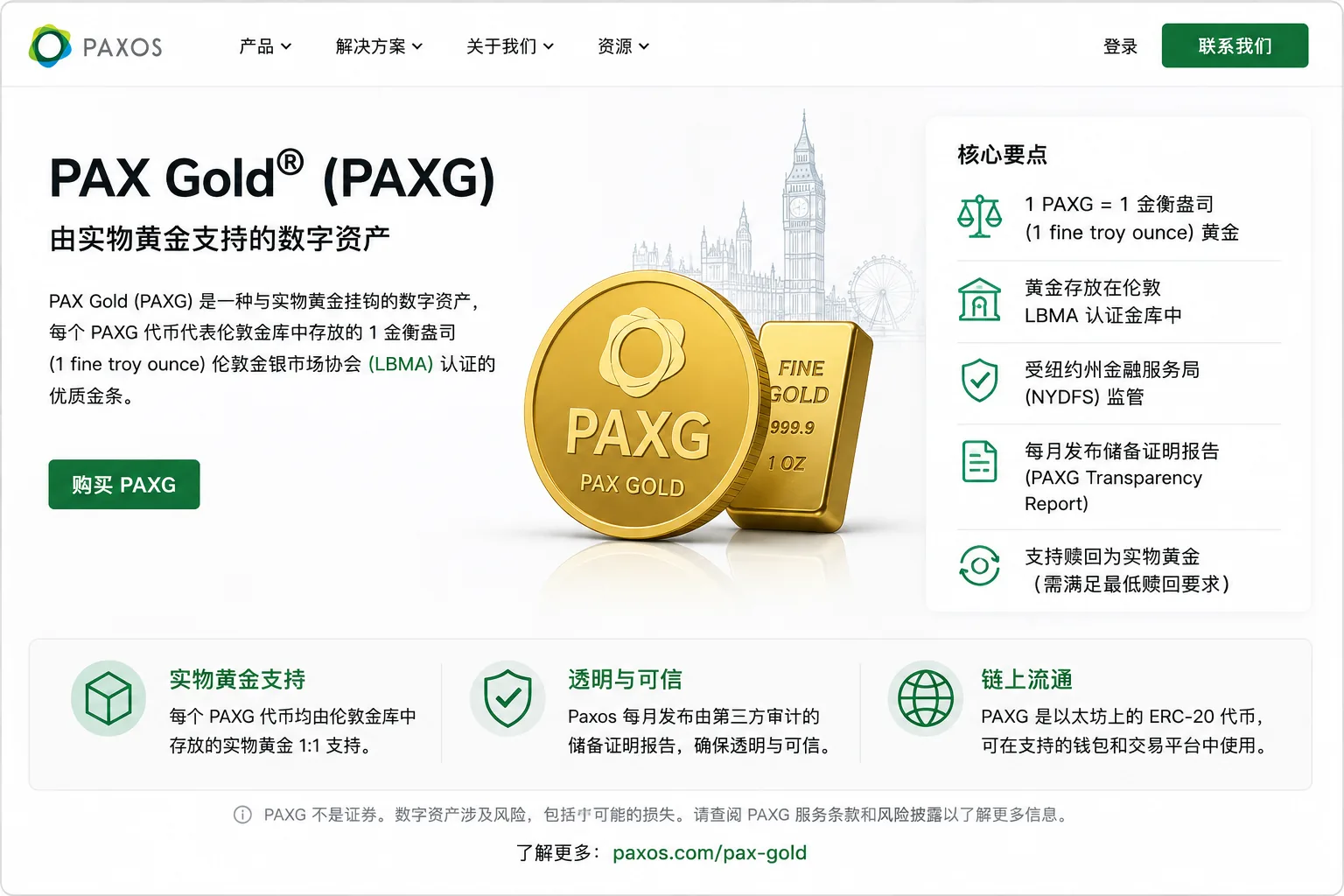
PAXG is an ERC-20 token on Ethereum.
This means it can be displayed, transferred and traded in supported wallets and platforms, like other ERC-20 assets.
When looking at PAXG, beginners shouldn't fixate on the price first.
Look at these questions first:
- Is the issuer Paxos?
- How much gold does 1 PAXG correspond to?
- Is the gold stored in LBMA-related vaults?
- Are there transparency reports or monthly attestations?
- Is redemption supported?
- Is ERC20 the only network supported on withdrawal?
Paxos also provides PAXG Transparency Reports / Attestations, which beginners can use to check whether the transparency reports are continuously updated.
The truly key point is this sentence:
Corresponding to gold does not mean threshold-free gold withdrawal.
Being able to buy a small amount of PAXG on an exchange doesn't mean you can definitely redeem physical gold bars in small amounts.
This is where many beginners most easily misjudge.
What is XAUT?
The short answer first:
Don't understand XAUT by USDT's logic; it's not a dollar stablecoin, but a gold-price asset.
XAUT usually refers to Tether Gold, also written XAU₮.
It is a gold token under the Tether Gold system.
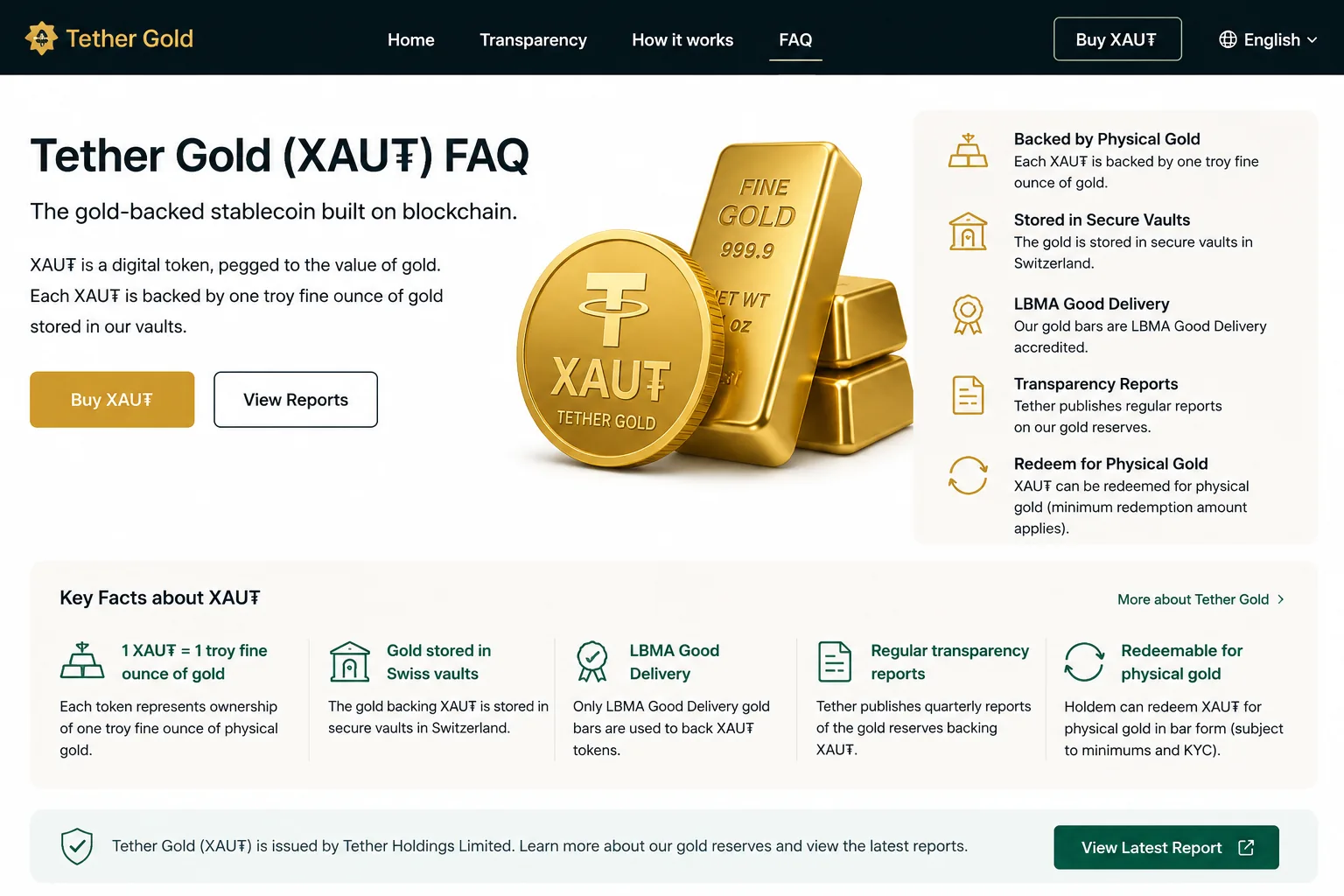
According to the Tether Gold official FAQ, XAU₮ is related to physical gold and involves rules on designated gold bars, gold ownership, redemption and account verification.
Many people seeing XAUT/USDT for the first time instinctively think:
"Is it as stable as USDT?"
No.
XAUT's core is not staying stable at 1 dollar.
Its price follows the gold price.
So when you see XAUT/USDT on an exchange, you are essentially looking at:
The quote of a gold-price asset against USDT.
It goes up, and it goes down.
Don't treat it as USDT just because it's related to Tether.
What really needs to be looked at here is the Tether Gold official introduction, the FAQ, reserve reports, redemption thresholds and supported networks.
PAXG vs XAUT: what should beginners focus on?
The short answer first:
PAXG and XAUT are both gold tokens, but they are not the same product.
Don't just ask "which is better."
Better to ask:
Can I understand its reserves, redemption and transfer rules?
| Comparison | PAXG | XAUT |
|---|---|---|
| Full name | Pax Gold | Tether Gold / XAU₮ |
| Issuing system | Paxos | Tether Gold / TG Commodities-related system |
| Token unit | 1 PAXG corresponds to 1 troy ounce of gold | 1 XAU₮ corresponds to 1 troy ounce of gold |
| Gold standard | Paxos materials mention LBMA vault gold | FAQ mentions LBMA Good Delivery standard bars |
| Proof of reserves | Paxos Attestations / monthly reports | Tether Gold Reports / BDO ISAE 3000R reports |
| Common trading pairs | PAXG/USDT, etc. | XAUT/USDT, etc. |
| Transfer network | Commonly Ethereum ERC20; platform rules prevail | May support Ethereum ERC20, BSC, etc.; platform rules prevail |
| Beginner focus | Transparency reports, redemption rules, ERC20 network | Reports, FAQ, redemption thresholds, BSC/ETH networks |
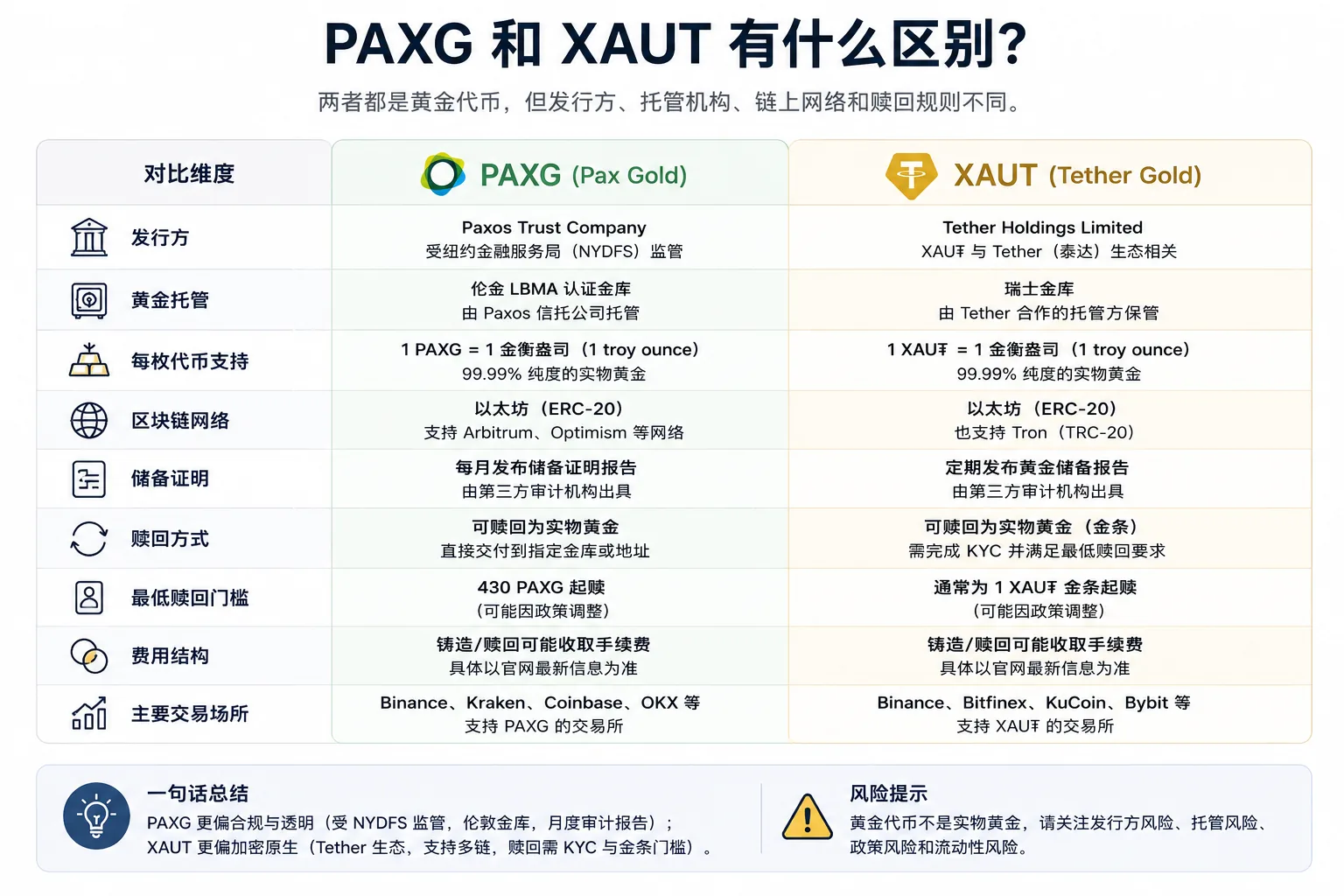
This table isn't meant for you to make a choice directly.
It just reminds you:
A gold token is judged by its rules, not its name.
If you haven't even understood the supported networks, reserve reports and redemption thresholds, you're not suited for large operations.
Is there gold behind a gold token? How to check
The short answer first:
Don't only look at the exchange price; look at official attestations.
The exchange page can tell you:
Price, candlestick, volume, change, and the buy and sell buttons.
But these only show that it can be traded.
They can't fully prove the gold situation behind it.
To judge a gold token, focus on these places:
- Official product documentation
- Reserve reports
- Transparency reports
- Third-party attestation reports
- Custody documentation
- Vault documentation
- Redemption rules
- Risk documentation
For PAXG, focus on Paxos product materials, the whitepaper and PAXG Transparency Reports / Attestations.
For XAUT, focus on Tether Gold Reports, the FAQ, and related third-party attestation reports.
But keep one sober judgment here:
A reserve report is not a talisman.
Reports matter, but they usually only correspond to a single point in time.
They raise transparency, but don't guarantee nothing will change at any future point.
So beginners shouldn't just look at a single screenshot.
A steadier approach is to check whether the official Reports page keeps updating.
Can a gold token be sold, transferred and redeemed for gold bars?
The short answer first:
Being sellable doesn't mean you can withdraw gold bars; being transferable doesn't mean you can pick any network.
Many people ask "can gold tokens be withdrawn," but they're actually asking three different questions.
1. Can it be sold back for USDT?
Usually yes.
If an exchange supports PAXG/USDT or XAUT/USDT, you can sell it like ordinary spot and swap it for USDT or other supported assets.
But don't only look at the "sell" button.
What really needs to be checked is:
- Volume
- Bid-ask spread
- Depth
- Slippage
- Whether the platform supports your region
Sellable doesn't mean easy to sell.
That's the first real-world issue.
2. Can it be transferred to a wallet?
Yes, but the key is the network.
PAXG and XAUT are both tokens.
Being tokens, they run into the network-selection problem.
The common situation is:
PAXG may show Ethereum ERC20.
XAUT may show BSC and Ethereum ERC20.
This is where many beginners make mistakes:
Looking only at the address, not the network.
But in on-chain transfers, both the address and the network must be right.
If the address is right but the network is wrong, things can still go wrong.
ERC20 and BEP20 are not the same thing.
BSC and Ethereum are not the same chain.
For the first transfer, it's recommended to test with a small amount first.
3. Can it be exchanged for physical gold bars?
Maybe.
But this is the biggest misconception.
Many people see "redeemable" and automatically interpret it as:
"I buy 0.01 PAXG or XAUT, and I can exchange it for a small piece of gold bar anytime."
Reality is usually not like this.
Physical gold redemption may involve:
- Account verification
- KYC
- Minimum redemption quantity
- Whole-bar units
- Delivery region restrictions
- Redemption fees
- Review time
- Official rule changes
In particular, the Tether Gold FAQ page explains that buying XAU₮ directly on the Tether Gold platform has a minimum purchase quantity, while also noting that users can buy smaller amounts on trading platforms that list XAU₮.
Understand this sentence:
Being able to buy small amounts on an exchange doesn't mean you can redeem gold bars directly from the issuer in small amounts.
The biggest pit of gold tokens is not buying.
It's thinking you can redeem anytime.
5 places beginners most easily misunderstand
Misunderstanding 1: a gold token is gold
No.
It's a token of gold-related rights.
The gold bar is still off-chain.
Misunderstanding 2: a gold token is a gold version of USDT
No.
USDT is a dollar stablecoin.
PAXG and XAUT are gold-price assets.
It's not a stablecoin, it's a gold asset.
Misunderstanding 3: having a reserve report means zero risk
Wrong.
A reserve report is only a point-in-time reference.
Issuer, custody, redemption, liquidity and on-chain transfer risks still exist.
Misunderstanding 4: buying small amounts means you can withdraw gold bars
Not necessarily.
An exchange may let you buy small amounts, but that doesn't mean the issuer supports small physical redemption.
This is the biggest misconception.
Misunderstanding 5: when transferring, the address alone being right is enough
Not enough.
The network must also be right.
ERC20, BEP20, BSC, ETH — these aren't decorative words.
They directly determine whether your assets arrive.
Main risks of gold tokens
This isn't telling you to buy, nor telling you not to buy.
Gold tokens are best suited for beginners to first learn the logic of RWA: the real-world asset is off-chain, the token is on-chain, and the two are connected by the issuer, custody, reports and rules.
The short answer first:
Gold tokens aren't risk-free — the risk has just moved.
The risks of ordinary coins mostly come from narrative, ecosystem, scheme and market sentiment.
The risks of gold tokens come more from the issuer, custody, reserves, redemption and transfer network.
1. Gold price risk
PAXG and XAUT are not dollar stablecoins.
If the gold price falls, they can fall too.
Don't equate the word "gold" with "won't lose money."
2. Issuer risk
Gold tokens depend on the issuer.
Whether the issuer operates stably, discloses continuously and has compliance arrangements all affect user confidence.
This risk isn't on the candlestick.
It's in the rules and trust structure.
3. Custody risk
Gold isn't on-chain.
It needs a custodian to hold it.
You need to look at where the gold is, who custodies it, and whether there's vault and reserve documentation.
This isn't something a blockchain explorer can fully solve.
4. Proof-of-reserves risk
Reports should be read, but not worshipped.
Focus on who issued the report, what its date is, what its scope is, and whether it keeps updating.
An old report doesn't equal permanent safety.
5. Redemption threshold risk
This is the risk ordinary beginners most easily overlook.
You may be able to buy, but not necessarily redeem physical gold at a low threshold.
Small-amount users especially should check the official rules.
6. Liquidity risk
Having a trading pair on an exchange doesn't mean liquidity is necessarily good.
If depth is insufficient, the bid-ask spread can be large.
When selling large amounts, slippage can also be significant.
7. Transfer network risk
PAXG and XAUT may support different networks.
The same token may also support different networks on different platforms.
Before transferring, you must confirm the receiving side supports the same network.
8. Wallet security risk
After withdrawing to a wallet, the risk becomes your own responsibility.
Seed phrase leaks, careless authorizations, fake support, phishing sites and malicious DApps can all cause your assets to be moved away.
A gold token doesn't become immune to wallet security problems just because there's gold behind it.
First time looking at a gold token? Check in this order
The short answer first:
Don't ask first whether it will rise; ask first whether you understand it.
Checking in this order is enough.
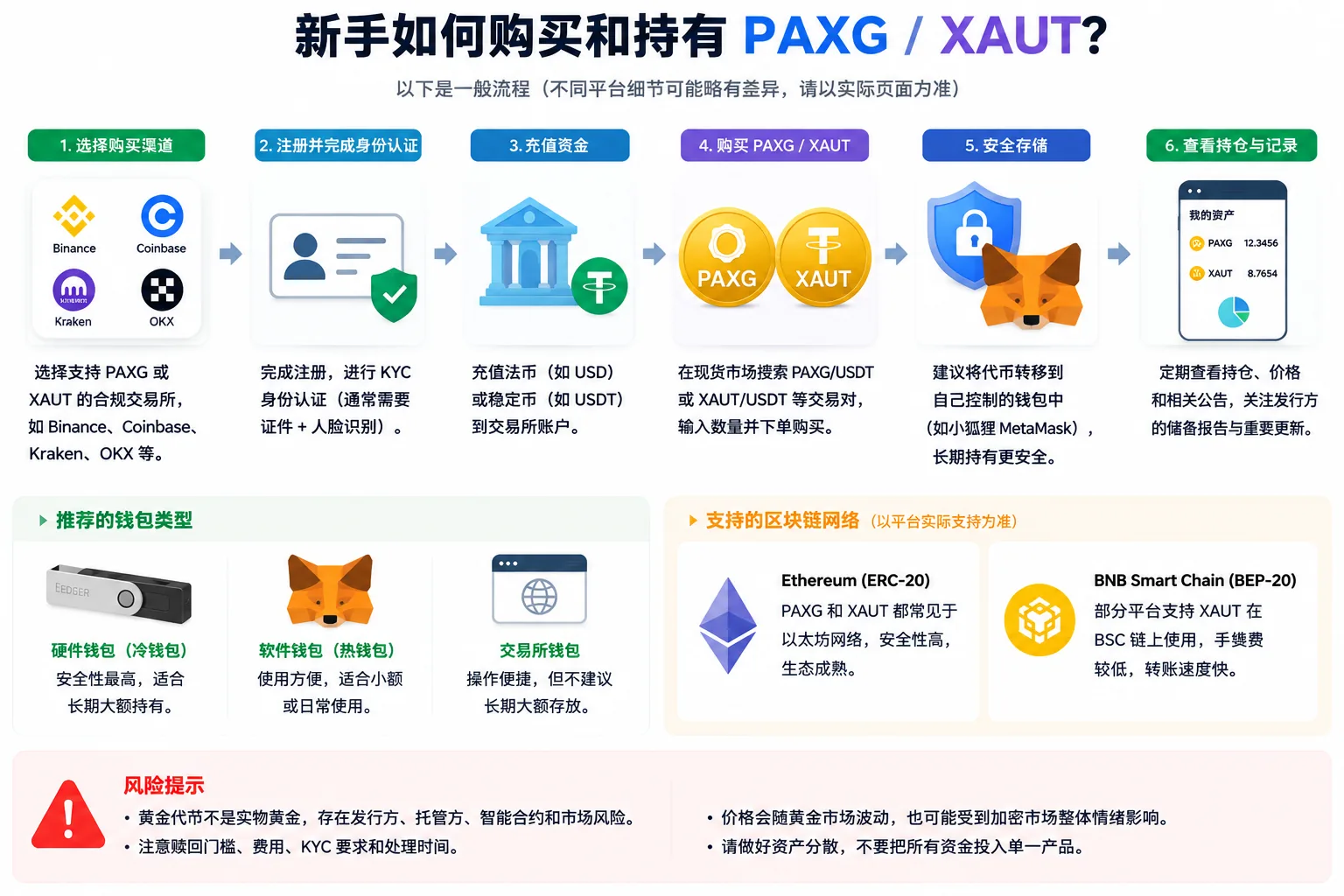
Step 1: see if it's a mainstream gold token
First figure out whether what you're seeing is PAXG, XAUT, or some other niche gold token.
Don't default to trusting it just because "Gold" is in the name.
Step 2: see who the issuer is
For PAXG, look at Paxos.
For XAUT, look at Tether Gold / TG Commodities-related rules.
The issuer is the first layer of trust.
Step 3: see the gold correspondence
How much gold does 1 token correspond to?
Is it 1 troy ounce, or another unit?
Does the official documentation state it clearly?
Step 4: see the reserve report
Is there a Reports or Attestations page?
Are the reports continuously updated?
Is there third-party attestation?
Step 5: see the redemption rules
Can it be redeemed?
What's the minimum?
Is KYC required?
Is your region supported?
Must it be whole gold bars?
Step 6: see exchange liquidity
Don't only look at the price.
Also look at volume, bid-ask spread and depth.
Step 7: see the withdrawal network
Does it support ERC20 or BSC?
Does the receiving wallet support it?
What are the fee and minimum withdrawal amount?
Step 8: ask whether you need to withdraw to a wallet
Beginners who just started shouldn't force withdrawals just for the sake of "being on-chain."
If you're only learning, small-amount observation is enough.
FAQ
Are gold tokens a gold version of USDT?
No.
USDT is a dollar stablecoin, aiming to stay near 1 dollar.
PAXG and XAUT are gold-price assets whose prices follow gold.
What's the difference between gold tokens and physical gold?
Physical gold is gold bars, coins or gold in a vault.
A gold token is an on-chain token that corresponds to physical gold through the issuer and custody rules.
In one sentence:
Physical gold depends on custody; gold tokens depend on rules.
What is PAXG?
PAXG is a gold token issued by Paxos.
According to Paxos's official introduction, 1 PAXG is backed by 1 fine troy ounce of gold, stored in London LBMA vaults.
What is XAUT?
XAUT is Tether Gold's gold token, also written XAU₮.
According to the Tether Gold FAQ, XAU₮ is related to physical gold in designated gold bars; specific rights and redemption rules are subject to the official pages.
Which of PAXG and XAUT is better for a beginner to learn?
Both are suitable for learning.
PAXG suits looking at Paxos's product materials, LBMA vaults, ERC20 structure and transparency reports.
XAUT suits looking at Tether Gold Reports, the FAQ, reserve reports and multi-network withdrawal rules.
This isn't an investment recommendation, just a learning path.
Can gold tokens be exchanged for physical gold bars?
Maybe, but it doesn't mean everyone can redeem anytime, in small amounts, without thresholds.
Usually you need to look at account verification, minimum redemption quantity, regional restrictions, fees and official rules.
Can I withdraw gold bars by buying 0.01 PAXG or XAUT?
Don't assume you can.
Small-amount purchases on an exchange and physical redemption from the issuer are two different things.
Small-amount users should check the official redemption threshold first.
Will gold tokens fall?
Yes.
Gold tokens are usually related to the gold price, and the gold price itself fluctuates.
It's not a risk-free asset.
Can gold tokens be transferred to a wallet?
Yes, but you must check the network.
PAXG may be ERC20, and XAUT may support BSC or ERC20.
In practice, the platform's withdrawal page prevails.
Are PAXG's and XAUT's transfer networks the same?
Not necessarily.
Different platforms may support different networks.
Before transferring, you must confirm the receiving side supports the same network.
What's the difference between gold tokens and gold ETFs?
Gold ETFs are usually traded in a securities account.
Gold tokens are held and transferred in an exchange or wallet environment.
Both may be related to the gold price, but their legal structure, holding method, redemption method and risks differ.
What should a beginner remember at the end?
A gold token is a very good RWA entry case.
Because gold is intuitive.
Everyone knows what gold is, and everyone knows gold has a price.
But precisely because it's so easy to understand, beginners easily oversimplify it.
Seeing "Gold," they think it's safe.
Seeing "1 token corresponds to 1 ounce of gold," they think there's no risk.
Seeing "redeemable," they think they can withdraw gold bars anytime.
Slow down here.
The true core of a gold token is not its name, nor its price.
It's this sentence:
Gold is off-chain, the token is on-chain, and the two are connected by the issuer, custody, reports and rules.
Once you understand this sentence, you won't be led around by concepts when looking at PAXG, XAUT and on-chain gold.
Gold tokens aren't something you can't learn about.
They're very suitable for beginners to understand "putting real-world assets on-chain."
But don't only look at the price.
First look at where the gold is, who custodies it, how reports are issued, whether there's a redemption threshold, and whether the transfer network is supported.
Once you understand these, then study specific products — that way you're less likely to fall into pits.
What to read next
- Are RWA on-chain assets worth investing in? My real experience buying NVDAon
- What are on-chain stocks? Do wallet stock tokens really equal US stocks (2026)
- The difference between on-chain stocks and traditional US stocks: wallet assets vs brokerage account
- What is a crypto wallet? Wallet addresses, seed phrases and asset security (2026)
- Can you recover from a wrong-chain transfer? Withdrawal networks and wallet addresses (2026)
Author's note
This article was compiled by the CoinTrailHub editorial team, for beginners new to crypto, RWA, stablecoins, wallets and on-chain assets.
While compiling it, we referenced the Paxos / Pax Gold official introduction, PAXG Transparency Reports / Attestations, the Tether Gold official FAQ, Tether Gold Reports, and the PAXG/XAUT market and withdrawal network pages on exchanges.
The point of this article is not to judge whether PAXG or XAUT is worth buying, but to help beginners understand the basic structure, redemption thresholds, proof of reserves and on-chain transfer risks of gold tokens.
This article does not constitute investment, financial or trading advice. Gold tokens are not risk-free assets; PAXG and XAUT's rules, reserve reports, redemption conditions, supported networks and platform entries may change. Before actually operating, please refer to the project's official website, trading platform pages, wallet prompts and local regulatory requirements.
The CoinTrailHub editorial team focuses on crypto education for beginners, exchange security and P2P trading risk. This article is compiled from official sources and public data, reviewed by humans, and strives for accuracy but is not investment advice.
Last updated:2026-06-22 · Content reviewed by humans · Learn more
© 2026 CoinTrailHub · Original content. Reproduction or rewriting without permission is prohibited.