
Solana or Ethereum? How to choose for your first on-chain experience (2026)
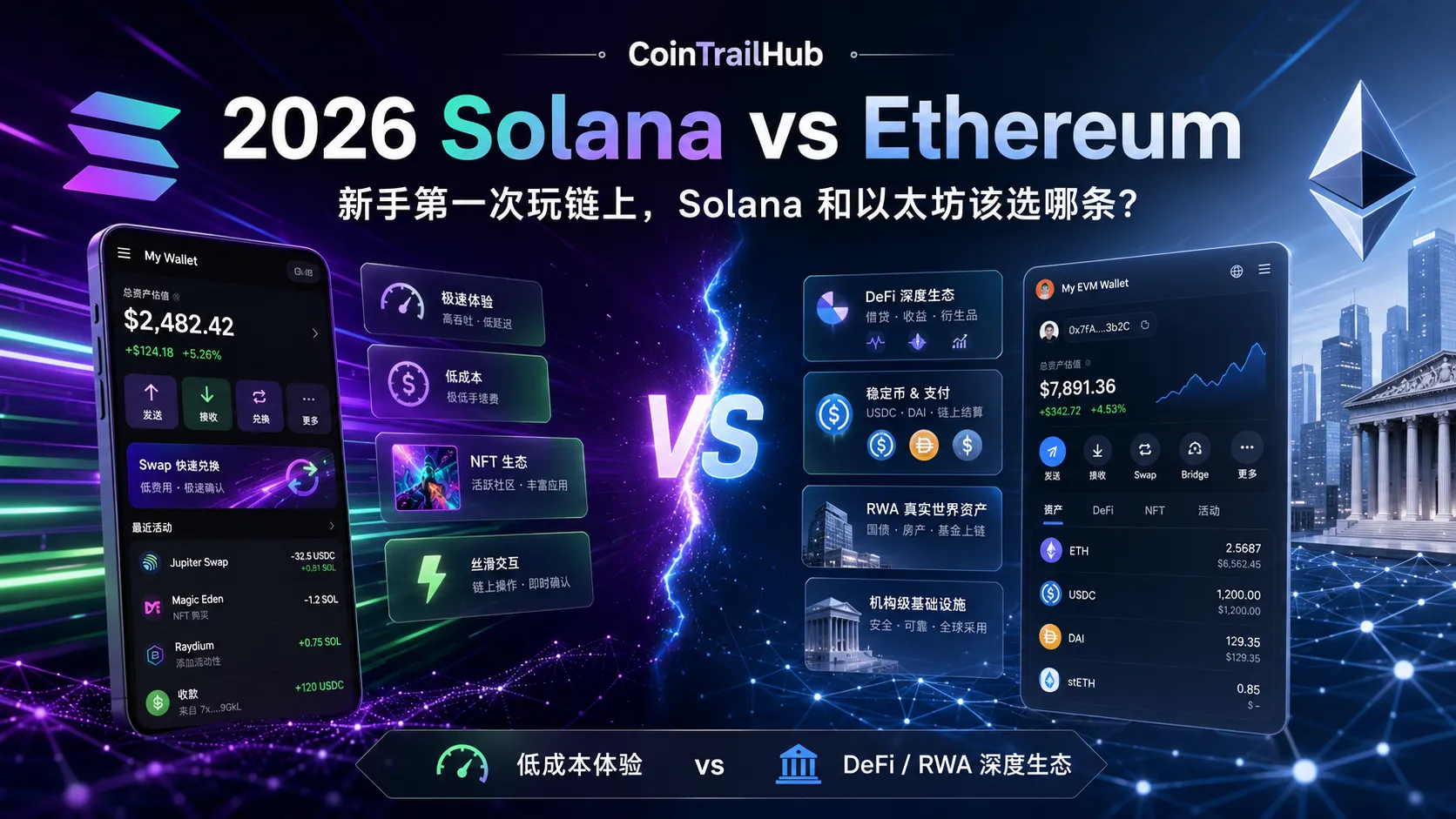
Table of contents

Binance new user rewards
20% trading fee rebate
Official Binance registration. Complete identity verification (KYC) to trade and withdraw.
If you're only buying mainstream crypto assets and holding long-term without on-chain operations, which ecosystem you pick hardly matters — after buying on an exchange you don't need to use on-chain functions often; but if you're experiencing Web3 for the first time, Solana makes it easier to build the "on-chain operation" feeling, while Ethereum is better for going deep into DeFi, RWA, and institutional-grade applications. Neither is "better" — only one is a better fit for your current stage.
Note: this article is compiled from actual wallet operations, on-chain interaction experience, and public data, and does not constitute investment advice. Crypto-asset prices are quite volatile; please judge carefully based on your own risk tolerance.
If you don't yet understand the basics of wallets and on-chain transactions, read first: What is crypto? Cryptocurrencies, Web3 wallets, and on-chain assets (2026) and What is a seed phrase? Why no one can recover your assets if you lose it (2026).
Core info
Don't rush to scroll; look at this table first:
| Use case | Recommended ecosystem | Why |
|---|---|---|
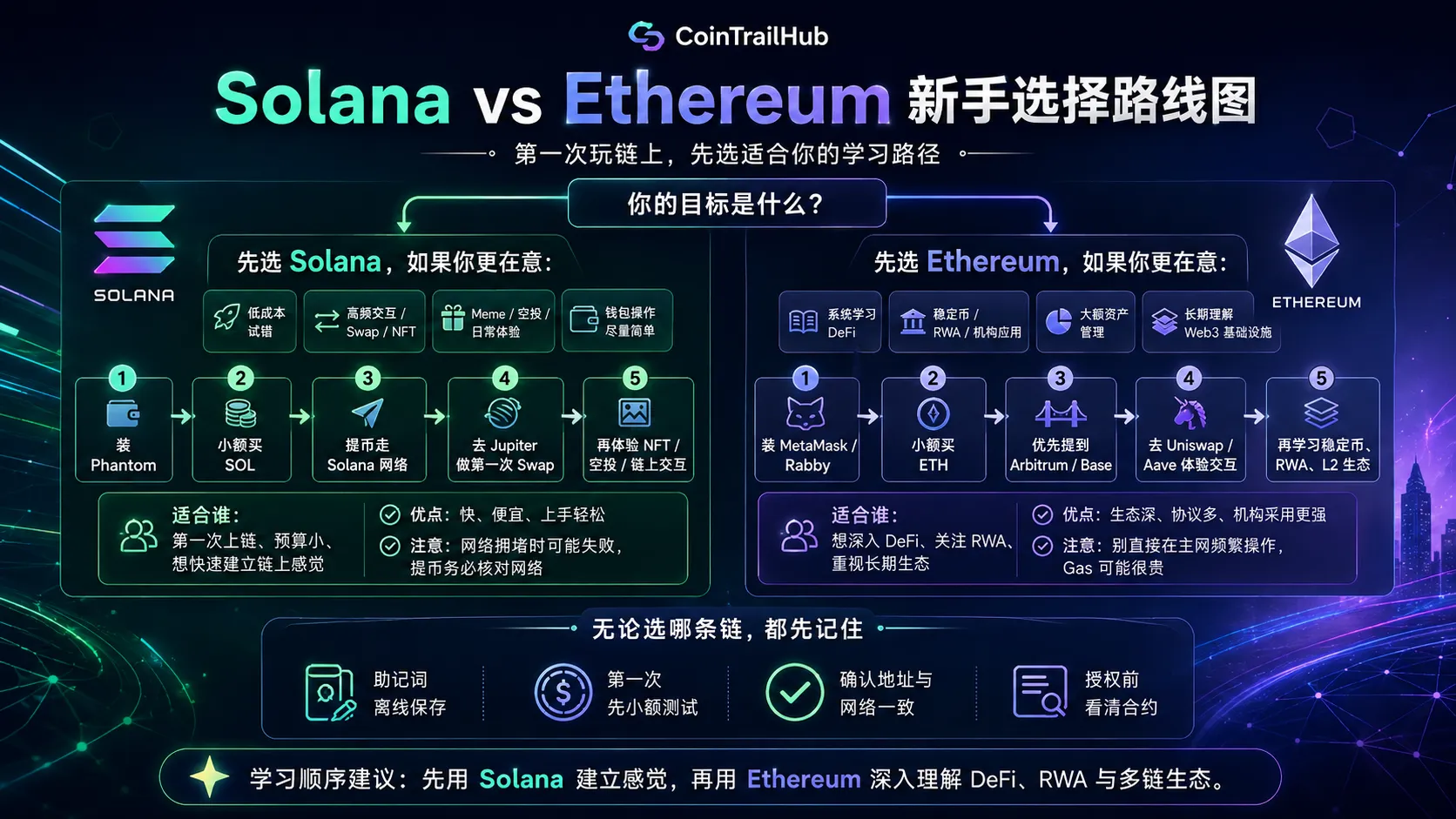
| First-time on-chain experience | Solana | Extremely low cost, simple wallet, great for learning |
| Learning DeFi basics | Ethereum | Seven years of accumulation; Uniswap/Aave/MakerDAO are all on ETH, and most tutorials revolve around the ETH ecosystem |
| High-frequency on-chain activity (swap, mint, interactions) | Solana | A transaction costs less than a cent, while ETH mainnet starts at a few dollars |
| Long-term on-chain asset management | Ethereum + hardware wallet | Network participation scale and node distribution remain industry-leading |
| Playing memes, farming airdrops | Solana | Fast, low gas, most active community |
| Focused on stablecoins and RWA | Ethereum ecosystem | USDC issuance scale, RWA tokenization, and institutional projects are currently concentrated in the Ethereum ecosystem |
| Multi-chain ecosystem coverage | Ethereum + L2 | Arbitrum/Base/OP are all within the EVM system; one wallet covers all |
My advice: if you're just learning and experiencing, you don't need to invest much money. Understanding the wallet, transfer, swap, and authorization flows matters more than how much you put in. Use it first; after you use it, you'll have your own answer.
Who needs it / who doesn't
| Your situation | Recommendation |
|---|---|
| New to crypto, fees too high to dare operate | Start with Solana — extremely low cost, no pressure to try and fail |
| Goal is learning mainstream DeFi (lending, LP, staking) | Start with Ethereum — most DeFi tutorials and tools revolve around the ETH ecosystem |
| Want to play memes, farm airdrops, high-frequency interactions | Prioritize Solana — fast enough, gas low enough, meme culture most active |
| Large assets, security first | Ethereum + hardware wallet — higher decentralization, more mature security infrastructure |
| Just buying BTC/ETH to hold, no on-chain operations | No need to agonize — buy on an exchange and leave it; it has nothing to do with chain choice |
The shock of my first time using Solana
Before first using Solana, I'd already been tinkering on Ethereum for over a year.
At the time, my understanding of on-chain operations was: a transfer takes seconds to minutes, gas fees start at a few dollars, and DeFi interactions start at double digits in dollars. I'd gotten used to the mindset of "calculate whether the fee is worth it before operating."
Then a friend had me try Solana. I installed the Phantom wallet, withdrew 50 USDT from an exchange, and casually did a swap — the transaction confirmed in under a second, and the fee was 0.00002 SOL, worth less than a cent.
I froze for a second, then did another one. Still under a second, still less than a cent.
That moment I understood why so many people flock to Solana. It's not that Solana's tech is superior, but that the usage cost is so low it's negligible. On Ethereum, I'd hesitate before every "confirm"; on Solana, I don't even think about it.
But is that the whole story? Of course not. Over the following months of using it, I also hit Solana network congestion, failed transactions, and an incomplete ecosystem. So in this article, I want to write out the real experience of both sides.
Core comparison: one table to see how Solana and Ethereum differ
Many beginners first encountering on-chain operations understand Solana and Ethereum as:
"One is fast, one is slow."
But the real differences go far beyond speed.
The two chains' design goals, ecosystem focus, and suitable users are actually completely different:
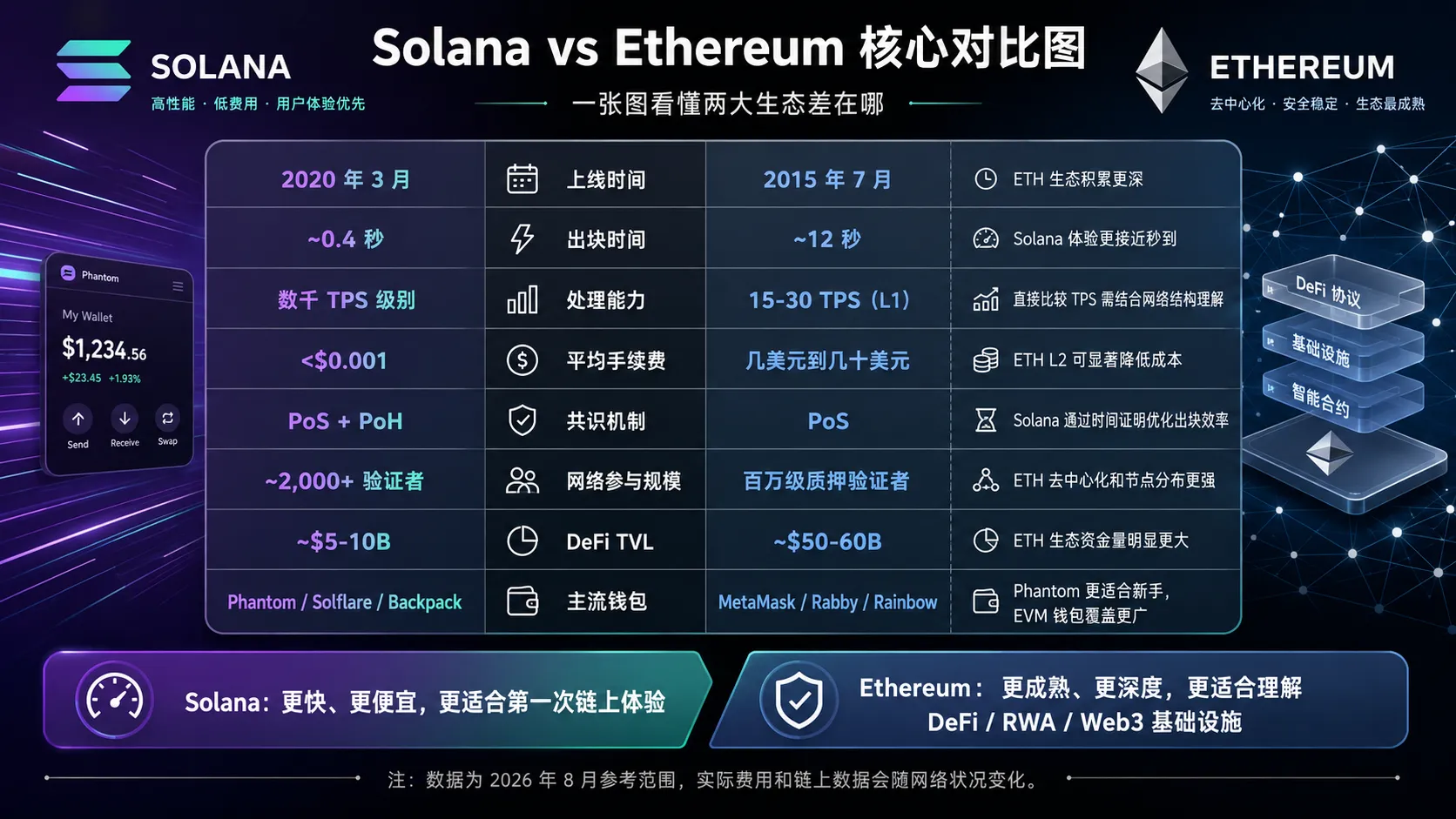
| Dimension | Solana | Ethereum (mainnet) | What it means for beginners |
|---|---|---|---|
| Launch time | March 2020 | July 2015 | ETH has run 5 more years; deeper ecosystem accumulation |
| Block time | ~0.4 seconds | ~12 seconds | Solana feels near-instant; ETH makes you wait |
| Processing capacity | Thousands of TPS level (including voting transactions; effective TPS is affected by network load and app type) | 15-30 TPS (L1) | Solana's theoretical throughput is higher, but directly comparing TPS can ignore network-structure differences |
| Average fee | <$0.001 | A few dollars to tens of dollars | The gap is real; day-to-day Solana operations are basically free |
| Consensus mechanism | PoS + PoH | PoS | Both PoS, but Solana adds a proof-of-history mechanism to optimize block speed |
| Network participation scale | ~2,000+ validators | Millions of staked validators, widely distributed nodes | ETH's participation scale and node distribution remain industry-leading |
| DeFi TVL | ~$5-10B | ~$50-60B | ETH ecosystem capital is 6-10x Solana's |
| Native token | SOL | ETH | Both require holding the native token to pay fees |
| Mainstream wallets | Phantom, Solflare, Backpack | MetaMask, Rabby, Rainbow | Phantom is friendlier for beginners |
| Programming language | Rust, C | Solidity | Irrelevant to ordinary users, but affects developer count and tooling richness |
Data source: live data for each chain is available on DeFiLlama and Solana Explorer. TVL and fees fluctuate with the market; the table above is an August 2026 reference range.
Fee test: the same operation really is 100x different
Below are my actual fee comparisons for four common operations in the same time period. Ethereum mainnet figures are from non-congested periods (congestion can 2-3x them):
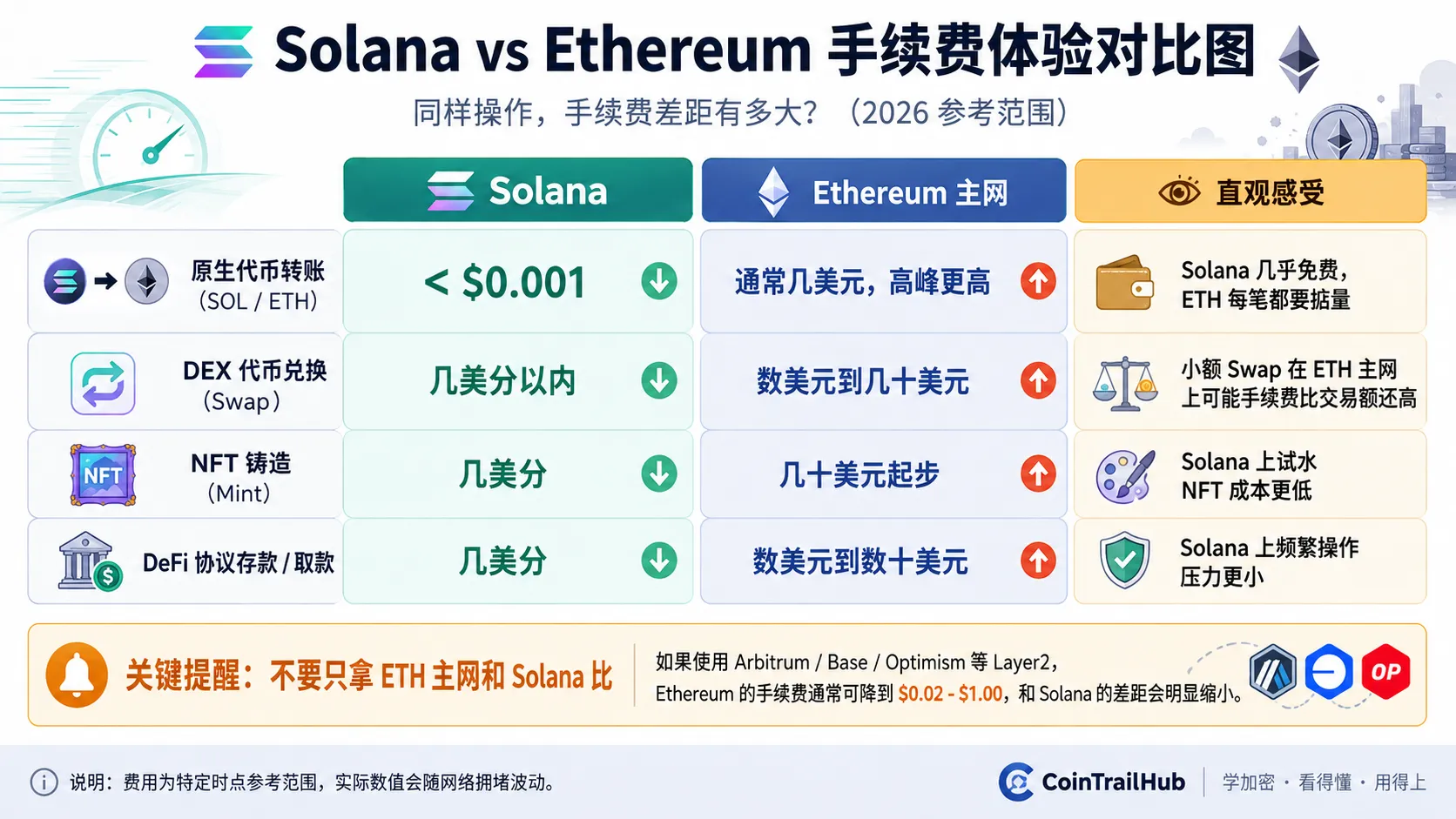
| Operation | Solana | Ethereum mainnet | Intuitive feel |
|---|---|---|---|
| Native token transfer (SOL / ETH) | <$0.001 | Usually a few dollars, higher at peak | Solana is almost free; every ETH mainnet transfer makes you think twice |
| DEX token swap | Within a few cents | A few to tens of dollars | A small swap on ETH mainnet may cost more in fees than the trade amount |
| NFT mint | A few cents | Starts at tens of dollars | Minting on Solana is cheap enough to ignore |
| DeFi protocol deposit/withdraw | A few cents | A few to tens of dollars | Frequent operations on Solana are stress-free |
But here's a key premise: Ethereum's fee problem can be solved with Layer2.
If you operate on Arbitrum, Base, or Optimism, fees can drop to $0.02-1.00, and the gap with Solana isn't so dramatic. This is a point I'll keep reminding you of: don't compare ETH mainnet prices against Solana — if you compare, include L2 too.
Ecosystem comparison: which is stronger in DeFi, NFT, and Meme?
DeFi: Ethereum has a clear advantage, Solana is growing fast
The ETH ecosystem's DeFi protocols are still the richest in quantity, depth, and tooling. Uniswap, Aave, MakerDAO, Lido, EigenLayer — these are names you can't avoid once you touch DeFi.
But Solana also has mature protocols like Jupiter (aggregator), Raydium (DEX), Marinade (liquid staking), Jito (MEV + staking), and Kamino (lending). For ordinary users, they're more than enough.
One line: if you want to play DeFi deeply (lending loops, LP mining, yield aggregation), the ETH ecosystem has more options. If you just want swap + staking + simple LP, Solana is enough and much cheaper.
NFT: ETH used to be stronger, now each has its strengths
ETH has OpenSea and Blur, a longer history, and blue-chip NFTs (BAYC, Punks) are all on ETH. Solana has Magic Eden and Tensor, with smoother trading and low gas that makes small-value NFT trades possible.
For beginners: Solana's low gas lets you test the NFT waters with tens of dollars, without agonizing over a single mint fee.
Meme coins: Solana's home turf
In recent years, meme trading activity has concentrated heavily in the Solana ecosystem, especially attracting lots of short-term users with low fees and fast transactions. Pump.fun issues thousands of tokens a day; although the vast majority go to zero, it has also generated tons of on-chain activity and new users.
ETH also has memes (PEPE, SHIB), but high gas keeps small-capital meme players away.
Stablecoins and RWA: Ethereum has a clear advantage
If your goal is dealing with stablecoins and real-world assets, the Ethereum ecosystem is currently the more mature choice:
| Direction | Ethereum ecosystem | Solana ecosystem | What it means for beginners |
|---|---|---|---|
| USDC circulation & apps | Ethereum has long been one of the important ecosystems for USDC circulation and institutional stablecoin apps | Growing fast, use cases expanding | Large USDC flows are currently more mainstream on ETH |
| RWA tokenization | Institutional projects like BlackRock BUIDL and Ondo are currently concentrated in the Ethereum ecosystem | Has related projects but smaller scale | To understand RWA, the ETH ecosystem is a required course |
| On-chain stocks | Most institutional exploration and compliant tokenized-asset projects revolve around Ethereum-compatible ecosystems | Fewer related projects | See What are on-chain stocks? Do wallet stock tokens really equal US stocks (2026) |
| Low-cost payments | Acceptable via L2 | Clear advantage, nearly free | Solana is more suitable for day-to-day small payments |
| Institutional adoption | Institutional projects prefer ETH | Getting started | Institutional-grade RWA projects lean toward ETH |
Simply put: if you're focused on USDC apps, RWA research, and on-chain stocks, learning the Ethereum ecosystem is unavoidable. This is also why most of my RWA content and What is USDT? Tether's uses and risks (2026) revolve around the ETH ecosystem.
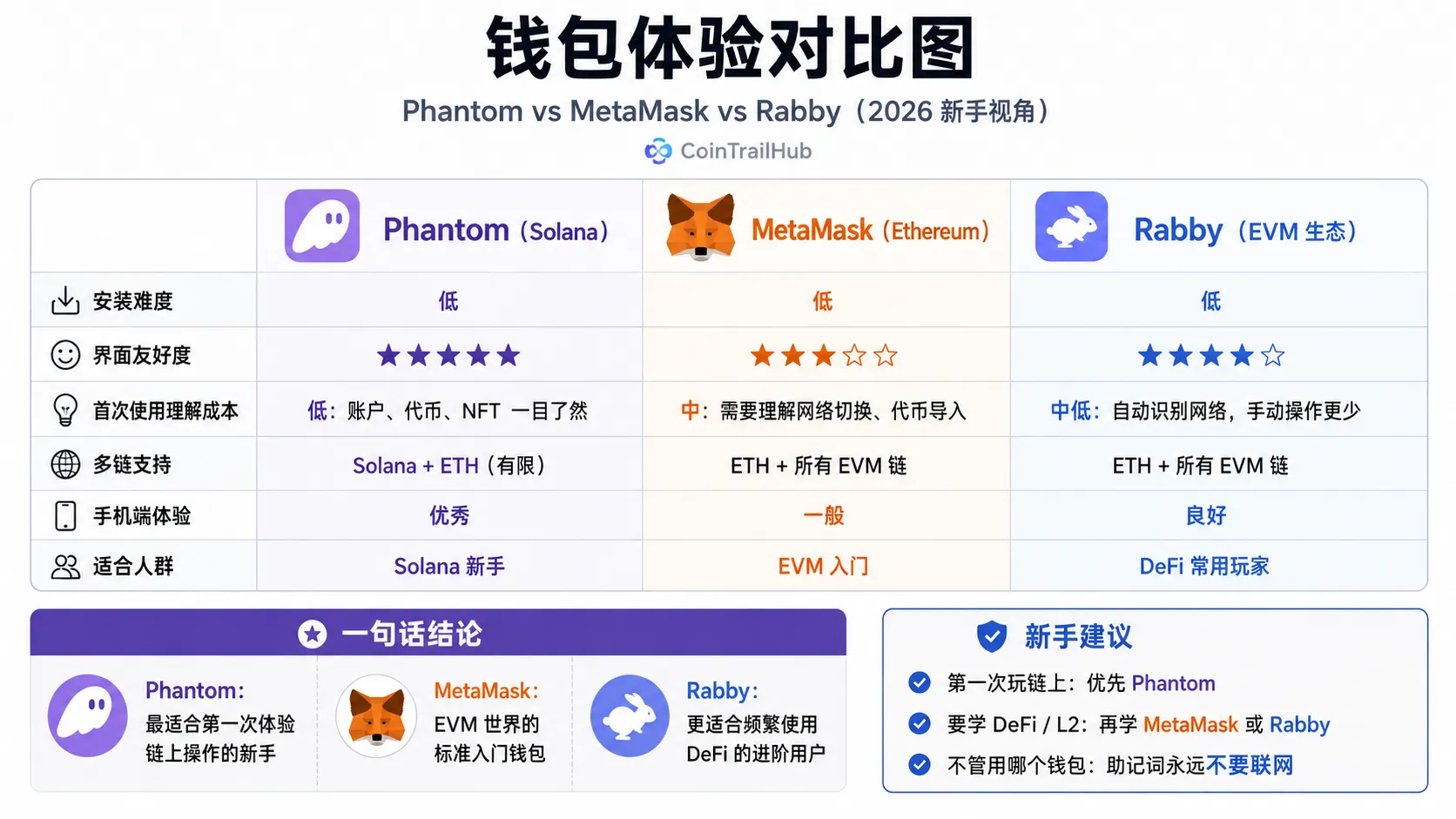
Wallet experience: Phantom vs MetaMask
| Dimension | Phantom (Solana) | MetaMask (Ethereum) | Rabby (EVM ecosystem) |
|---|---|---|---|
| Install difficulty | Low | Low | Low |
| Interface friendliness | 5/5 | 3/5 | 4/5 |
| First-use comprehension cost | Low — accounts, tokens, NFTs at a glance | Medium — needs understanding network switching, token import | Medium-low — auto-detects networks, fewer manual steps than MetaMask |
| Multi-chain support | Solana + ETH (limited) | ETH + all EVM chains | ETH + all EVM chains |
| Mobile experience | Excellent | Average | Good |
| Suitable users | Solana beginners | EVM entry | Frequent DeFi players |
Phantom's user experience within the Solana ecosystem is usually simpler and more intuitive than MetaMask. Most common operations don't require users to frequently handle RPC configs and token contract addresses, nor agonize over Gas Limit and Gas Price. This is one of the biggest reasons I recommend beginners start with Solana.
But MetaMask and Rabby have their own irreplaceability: they cover a wider EVM ecosystem — EVM-compatible chains (Arbitrum, Base, BNB Chain, Avalanche, etc.) are all there; switching chains only requires switching networks, not wallets. If you'll frequently use DeFi later, Rabby's transaction preview and authorization management are more intuitive than MetaMask's.
MetaMask and Phantom are just tools. What matters is basic security habits — how to store your seed phrase, read the content before authorizing, and not connecting to unfamiliar sites. If you haven't read the wallet-security content, I suggest taking a look before operating.
My selection logic: how to choose in different situations
| Your situation | Recommendation | Why |
|---|---|---|
| Small capital, want to try more | Solana | Low fees, great for learning on-chain flows |
| Large assets, security first | Ethereum + hardware wallet | ETH has higher decentralization and more mature security infrastructure |
| Mainly playing DeFi (lending, LP) | Ethereum L2 | More complete protocols, more transparent rates, more mature tools |
| Mainly playing memes / short-term trading | Solana | Fast, low cost, strong meme culture |
| Learning purpose, want to understand the full Web3 picture | Use both | Without using each yourself, you won't understand what others are talking about |
| Only holding, no on-chain activity | Neither | Buy on an exchange and leave it |
| Want to farm airdrops / do interactions | Both | Different projects distribute airdrops on different chains; betting on one may miss opportunities |
From zero: a 5-minute onboarding guide for both chains
Want to try Solana
Step 1: install a wallet Go to Phantom.app to download the browser extension or mobile app. Create a wallet, and write the seed phrase on paper (don't screenshot it, don't store it in a phone note).
Step 2: get some SOL Go to Binance or OKX to buy some SOL. You can also buy USDT first, then swap it for SOL on the exchange.
Step 3: withdraw to Phantom Find "withdraw" on the exchange, choose SOL, select the Solana network, and paste your Phantom wallet address. First withdraw 5-10 USDT to test, then withdraw large amounts after it arrives. Solana withdrawal fees are extremely low, so testing a couple more times is no burden at all.
Step 4: do a swap Open Jupiter, connect Phantom, and swap a tiny bit of SOL for USDC. Feel the speed and the fee.
Step 5: browse around Go to Tensor to look at NFTs, and Drip to claim a free NFT. Costs are extremely low, so explore freely.
Want to try Ethereum
Step 1: install a wallet Install MetaMask. Create a wallet and store the seed phrase safely.
Step 2: get some ETH Buy ETH on an exchange and withdraw to MetaMask. Key reminder: withdraw via the Ethereum mainnet; don't pick the wrong network.
Step 3: use L2 first, not mainnet For your first operation, don't interact directly on ETH mainnet. Withdraw ETH to an exchange that supports L2 withdrawals (Binance/OKX already support Arbitrum and Base network withdrawals), and withdraw directly via the L2 network to your wallet.
For choosing an L2, see the Layer2 guide.
Step 4: try a DeFi protocol With ETH on L2, go to Uniswap to do a swap, or deposit some ETH on Aave. Gas fees on L2 are very low, so don't worry about fees.
The pits I've stepped in
Pit 1: Solana transaction failure, the "fake failure"
Scenario: while swapping on Jupiter, a red box popped up saying the transaction failed. I thought my money was lost and checked my balance three times.
Cause: on Solana, a failed transaction doesn't mean assets are lost. Common causes are three: slippage set too low, network congestion, or insufficient token liquidity. Solana's trait is that a failed transaction only costs a tiny gas fee (about 0.000005 SOL), not tens of dollars like ETH.
Lesson: on Solana, don't panic if a transaction fails; first look at the reason. If it's a slippage issue, raise it 0.5-1% and try again. Failure cost on Solana is extremely low, so you can first check the reason, then retry.
Pit 2: doing too many operations on ETH mainnet at once
Scenario: when first getting into DeFi, I did seven or eight operations on ETH mainnet in one day — approve, deposit, withdraw, then deposit into another protocol. Adding it up at night, fees alone cost nearly $200.
Cause: every operation on ETH mainnet needs gas, and the "approve" step itself is an on-chain transaction. Beginners don't realize this, thinking "it's just a few confirmations," completely unaware that every one costs money.
Lesson: for Ethereum operations, use L2 first. The same 8 operations on Arbitrum might cost only $2-3. If you really must operate on mainnet, pick a non-congested period, and check the current gas price on Etherscan Gas Tracker first.
Pit 3: filling a Solana wallet address into the ETH network
Scenario: withdrawing from an exchange, I selected the ETH network but filled in a Solana address. Luckily the exchange's address validation flagged "wrong format" and it didn't go out.
Cause: ETH addresses start with 0x, while Solana addresses are a string of letters+digits (no 0x prefix). The formats are completely different. But beginners don't know this difference, thinking "a wallet address is a wallet address."
Lesson: before every withdrawal/transfer, confirm the sender and receiver support the same network. Address formats differ completely across chains: ETH → starts with 0x, Solana → no 0x, TRON → starts with T. Always do a small test for your first operation.
Pit 4: choosing the wrong network when withdrawing USDT from an exchange
Scenario: after buying USDT on an exchange to withdraw to a wallet, I opened the withdrawal page and froze — the same USDT listed seven or eight network options: ERC20, TRC20, BEP20, SPL, Arbitrum, Optimism, Polygon…
The most common beginner mistake: hearing Solana's fees are cheap, choosing the SPL network to withdraw to a Phantom wallet. Then in Phantom, the USDT never arrived — because the withdrawal address was a MetaMask address on the ETH network.
Cause: USDT is the same asset, but it's not interchangeable across different networks. USDT issued on different networks (e.g. ERC20, SPL, TRC20, BEP20) shares the same name but is an asset on different chains and can't be transferred directly. It's like the same money deposited in two different banks — same currency, but different account systems, so you can't transfer directly between them.
Lesson: confirm three things before withdrawing:
- Which network the receiving wallet supports
- Whether the exchange's withdrawal network matches the receiving network
- Withdraw a minimum amount to test first
For specific steps, see the USDT deposit/withdrawal pit-avoidance guide and what to do if you transfer on the wrong network.
Decision framework: when to use Solana, when Ethereum
What do you want to do?
  ├── High-frequency trading / memes / airdrop farming → Solana
  ├── Deep DeFi (lending, yield aggregation, LP) → Ethereum L2
  ├── Buying blue-chip NFTs → Ethereum
  ├── Small-scale NFT testing / browsing → Solana
  ├── Large asset storage → Ethereum + hardware wallet
  ├── First on-chain experience → Solana (low learning cost)
  ├── Understanding the full Web3 picture → use both
  └── Just buying BTC/ETH to hold → no need to agonize, exchange handles it
The core logic of this framework is one sentence: high-frequency, small, fast → Solana; low-frequency, large, stable → Ethereum.
Security risk reminders
Whichever chain you choose, pay attention to these points:
Never put your seed phrase online — don't screenshot it, don't store it in cloud notes, don't send it to anyone. Write it on paper and keep it somewhere safe. If you forget your seed phrase, you can't recover your assets. See the seed phrase security guide.
Always do a small test for your first operation — no matter how cheap Solana's fees or how mature the ETH network, test with a small amount first. Only transfer large amounts after the address is confirmed right. This habit has saved me a lot of money.
Don't casually authorize unfamiliar contracts — when a wallet pops up an authorization request, look carefully at what you're authorizing. Both Solana and Ethereum have malicious-contract authorization scams. If you don't understand it, don't click.
Solana also gets congested — although blocks are fast, Solana's network load is very high during meme frenzies, and transaction success rates drop. If you hit consecutive failures, wait a few minutes and retry.
ETH L2 has independent security risks — L2's Sequencer is mostly single-point; if the Sequencer has problems, your transactions may get stuck. L2 doesn't equal mainnet security. For L2's specific risks, see this article.
FAQ
Q1: Is Solana better than Ethereum?
It's not "better" or "worse," but "fits" or "doesn't fit."
Solana is fast, cheap, and a great experience; Ethereum is stable, deep in ecosystem, and highly decentralized. It's like asking "are EVs better than gas cars" — depends on what road you drive, how many people you carry, and your budget.
Q2: Which chain should a beginner's first on-chain operation be on?
I suggest Solana. The reason: cost is so low it's negligible, failure doesn't hurt, and the wallet (Phantom) is friendlier for beginners. First build a feel for "on-chain operation," then go to Ethereum to understand gas, authorization, and L2 — it'll be much easier.
Q3: Is Solana centralized?
Solana's decentralization is indeed lower than Ethereum's, but it's not "a chain controlled by one company."
Solana has ~2,000 validators, but the hardware bar is high (needs high-performance servers), making it hard for ordinary people to run a node at home. Ethereum has a validator count corresponding to millions of staked ETH, with wider node distribution and a relatively lower hardware bar for participation, letting individual users run nodes and maintain the network.
But decentralization isn't black-and-white — for day-to-day use, Solana's decentralization is sufficient; but if your core need is maximum decentralization and censorship resistance, Ethereum is still stronger.
Q4: I heard Solana often goes down. Is it still safe?
Solana did experience several network outages between 2021-2023, the longest lasting 20 hours. But stability has improved markedly since 2024, and independent validator clients like Firedancer are improving network redundancy, helping reduce single-point-of-failure risk over time.
As of 2026, Solana has run continuously for a long stretch without a full-chain outage. But any blockchain can have technical issues; this is a foundational risk you accept when using blockchain.
Q5: If I use Solana, do I not need to learn ETH at all?
No. Ethereum is still Web3's "infrastructure layer" — most DeFi protocols, stablecoins, Layer2, NFT standards, and technical docs revolve around the ETH ecosystem. Even if you mainly use Solana, understanding ETH helps you see where many on-chain concepts come from.
Suggestion: finish the ETH intro first, then open a wallet on both chains and try them.
Q6: Is USDC on Solana the same thing as USDC on ETH?
It's the same USDC (both issued by Circle), but on different chains.
It's like depositing the same money in two different banks — same currency, but the accounts are in different banking systems. To transfer USDC from Solana to Ethereum, you need a cross-chain bridge or an exchange intermediary; you can't send it directly.
Q7: Does Solana have a chance to surpass Ethereum?
Don't know. And it doesn't matter.
For ordinary users, the key is which chain solves your current need, not betting on which chain ultimately "wins." You're not a VC; you don't need to bet on one ecosystem for a decade. Use both, whichever works use that one — a very simple strategy.
Learning path: the recommended order to master both chains from zero
If you're just starting with crypto, I suggest learning in this order; it's much more efficient than studying both chains at once:
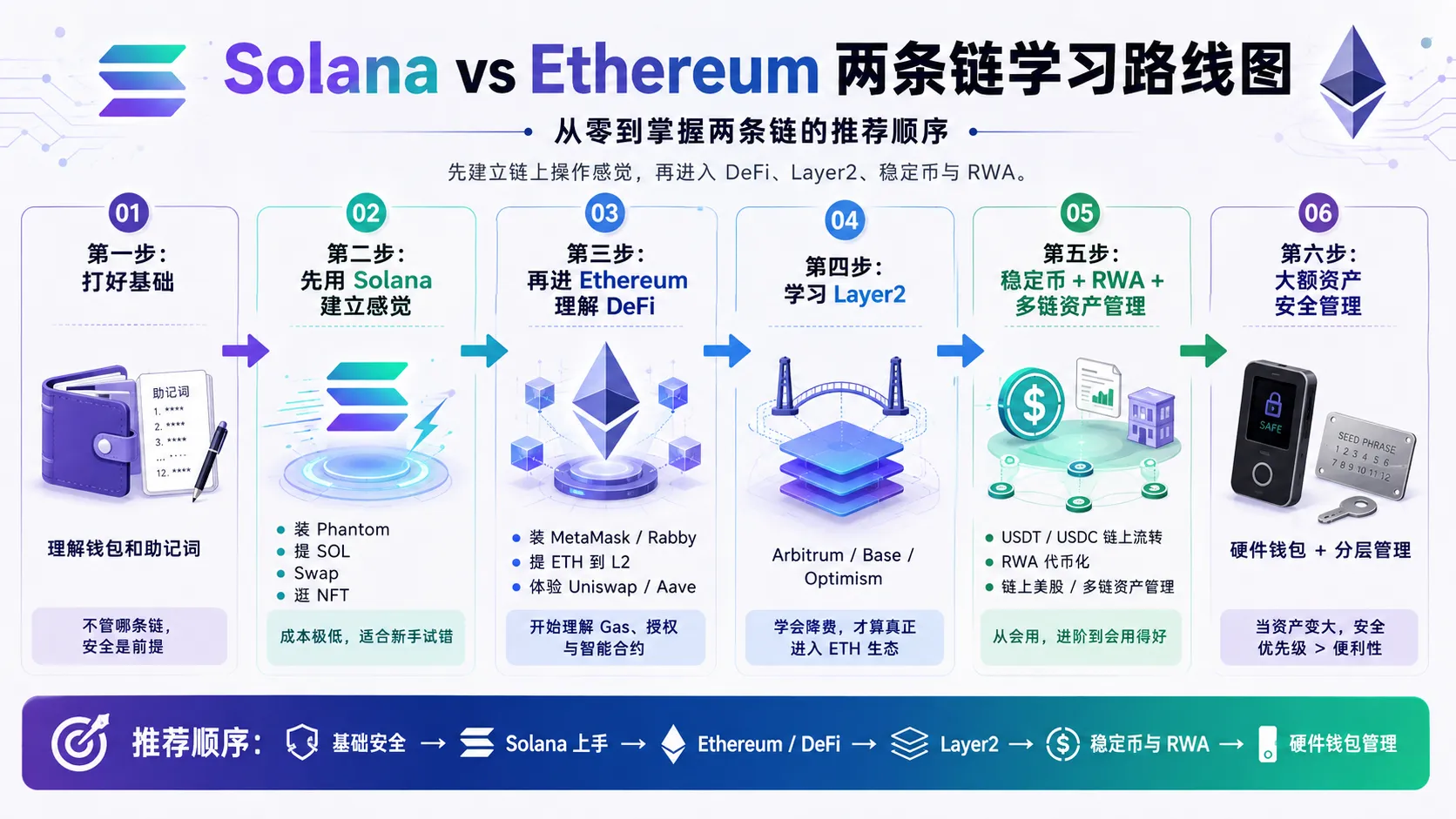
Step 1: build the foundation — understand wallets and seed phrases
  └── Whatever the chain, security is the premise
        ↓

Step 2: build the "on-chain operation" feeling on Solana
  ├── Install Phantom → withdraw SOL → swap → browse NFTs
  └── Extremely low cost, try and fail freely
        ↓

Step 3: understand smart contracts and DeFi on Ethereum
  ├── Install MetaMask/Rabby → withdraw ETH to L2 → try Uniswap/Aave
  └── By now you have an on-chain foundation, and won't get stuck on gas, authorization
        ↓

Step 4: learn Layer2 to lower costs
  ├── Arbitrum / Base / Optimism
  └── Understanding L2 is truly understanding the full Ethereum ecosystem play
        ↓

Step 5: learn stablecoins, RWA, and multi-chain asset management
  ├── USDT/USDC on-chain flows, RWA tokenization, on-chain stocks
  └── This is the key step from "can use" to "uses well"
        ↓

Step 6: manage large assets with a hardware wallet
  └── Once your assets exceed a certain scale, security priority > convenience
The benefit of this path: you won't be turned off at the start by Ethereum's high gas and complex concepts, and you won't miss Solana's smooth experience, while ultimately going deep into Web3's core infrastructure.
Corresponding articles:
- Step 1 → What is a seed phrase? Why no one can recover your assets if you lose it (2026)
- Step 2 → this article's "From zero: Solana 5-minute onboarding guide"
- Step 3 → What is Ethereum? Smart contracts, gas fees, and Web3 + What is DeFi?
- Step 4 → Ethereum gas too expensive? How to choose Arbitrum/Optimism/Base (2026)
- Step 5 → RWA intro + What is USDT? Tether's uses and risks (2026) + USDT secure storage
- Step 6 → What is a cold wallet? The safest ways to store your seed phrase (2026, 5 methods compared)
Related recommendations
- What is Ethereum? Smart contracts, gas fees, and Web3 — the complete ETH ecosystem intro
- What is blockchain? How it works, its uses, and risks (2026) — understand what blockchain is first, and this article becomes clearer
- Ethereum gas too expensive? How to choose Arbitrum/Optimism/Base (2026) — use L2 to solve ETH's high fees
- Does DeFi make money? Yield sources + 5 big risks (2026) — understand the on-chain "banking system"
- What is crypto? Cryptocurrencies, Web3 wallets, and on-chain assets (2026) — the most basic crypto concepts, start here
- Are RWA on-chain assets worth investing in? My real experience buying NVDAon — understand the next stage of on-chain assets
- What is USDT? Tether's uses and risks (2026) — whatever chain you use, understand stablecoins first
- Beginner exchange choice: Binance/OKX, look at safety and liquidity first — pick the right exchange before buying SOL/ETH
- What is a seed phrase? Why no one can recover your assets if you lose it (2026) — whatever chain you use, seed phrase security is the first lesson
Disclaimer
This article is only for sharing usage experience and technical education about Solana, Ethereum, and the blockchain ecosystem, and does not constitute any investment, financial, or trading advice. Crypto-asset prices are quite volatile, and related services carry multiple risks. Regulatory requirements differ across countries and regions; please refer to local laws and regulations, verify on your own, and fully understand the risks before operating.
- Solana Official DocsSolana network mechanism and ecosystem basics
- Ethereum Official DocsEthereum mainnet mechanism and ecosystem
- DeFiLlamaDeFi TVL and fee comparison of the two chains
- L2BeatEthereum Layer2 scaling and security data
See ourEditorial Policy and the correction process in ourCorrections Policy.
The CoinTrailHub editorial team focuses on crypto education for beginners, exchange security and P2P trading risk. This article is compiled from official sources and public data, reviewed by humans, and strives for accuracy but is not investment advice.
Last updated:2026-08-10 · Content reviewed by humans · Learn more
© 2026 CoinTrailHub · Original content. Reproduction or rewriting without permission is prohibited.