
How to Buy Crypto as a Beginner? 7 Things to Know Before Buying USDT (2026)
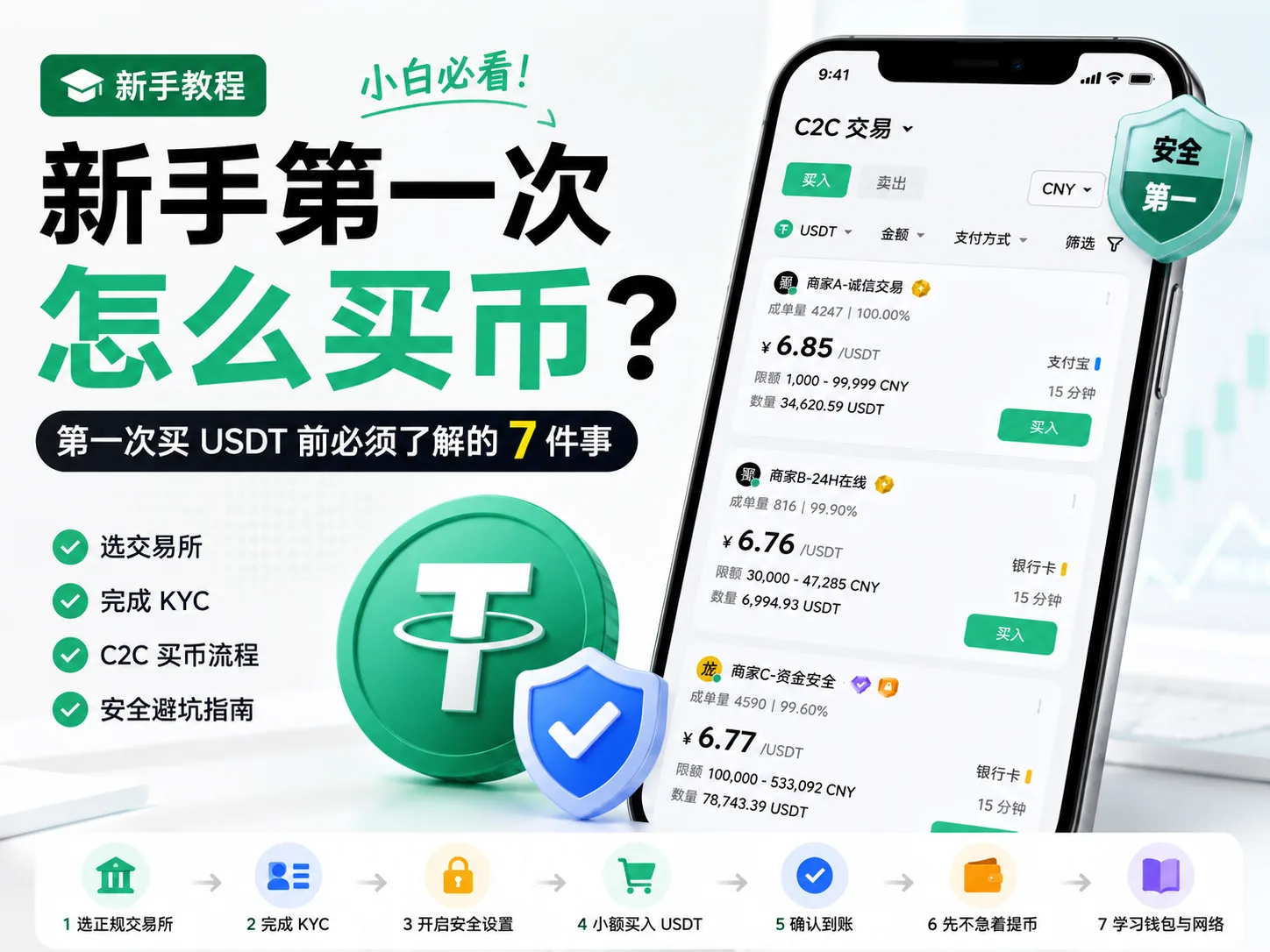
Table of contents

Binance new user rewards
20% trading fee rebate
Official Binance registration. Complete identity verification (KYC) to trade and withdraw.
Your first crypto purchase should not start with "which coin will pump."
The more realistic question is usually:
How do I safely buy my first batch of USDT?
Many beginners, after registering on an exchange, don't actually get stuck at registration — they get stuck after entering the P2P page.
The page is full of merchants, prices, payment methods, completion rates, limits, and note requirements.
On first look, it's easy to have no idea where to click.
I've met plenty of beginners with very similar questions:
"I already bought USDT — why can't I see it in my balance?"
"The merchant told me not to write 'USDT' in the payment note — is that normal?"
"After I paid, the seller didn't release the coins. Can I cancel the order?"
"After buying USDT, should I withdraw it to a wallet right away for safety?"
These questions look small.
But during a first-time operation, it's often exactly these details that go wrong.
So this article doesn't teach you which coin to buy.
And it doesn't tell you how much money to put in.
It solves one thing only:
What does a beginner actually need to understand before buying USDT for the first time?
If all goes smoothly, it takes under 15 minutes. The two easiest places to trip: writing sensitive words in the payment note, and rushing to withdraw without understanding networks.
This article is for crypto-basics education only and is not investment, financial, or trading advice. Crypto asset prices are highly volatile. Beginners should start small, and never borrow money, go all-in, or follow strangers' trade calls.
Table of Contents
- Quick overview: first-time buying, in this order
- 1. You think you're buying coins, but you're actually completing an onboarding flow
- 2. Before buying, confirm: which platform will you use?
- 3. Before buying, confirm: will your payment method work?
- 4. The first USDT purchase flow is actually not complicated
- 5. The 5 moments beginners really get wrong
- 6. If I could start over, here's what I'd do
- 7. Before your first purchase, one final check
- Buying coins and investing are not the same thing
- FAQ: common beginner questions
- Next recommended reading
- About this article
- Summary: prepare first, then operate
Quick overview: first-time buying, in this order
Many beginners first entering crypto think the most important thing is which coin to pick.
In reality, for most people, a first purchase is more like learning a new operating flow.
If the order is reversed, it's easy to run into problems at payment, withdrawal, or the wallet step.
If this is your first time with crypto, I'd recommend learning in the order below.
Step 1: Choose a legitimate exchange
Goal:
Complete registration and confirm you're using the official app or website.
You'll learn:
- What a crypto exchange is
- How to register an account
- Why identity verification (KYC) is required[1]
- How to avoid fake websites and phishing links
Many beginners' first loss doesn't come from market volatility — it comes from fake support and fake websites.
So the first step is always to confirm the platform is legitimate.
Step 2: Complete identity verification and security settings
Goal:
Make sure your account works normally while lowering the risk of it being hacked.
You'll learn:
- What KYC is
- Two-factor authentication (2FA)
- Anti-phishing code
- Login security settings
Many beginners put security settings off until the end.
But in reality, security settings should be done before buying.
Step 3: Buy a small first batch of USDT
Goal:
Get familiar with the P2P buying flow.
You'll learn:
- How to choose a merchant
- How to create an order
- How to pay
- How to confirm the funds arrived
The point of a first purchase isn't how much you earn.
It's confirming you know what each step is doing.
Step 4: Confirm where the USDT landed
Goal:
Know where the coins you bought actually are.
You'll learn:
- Funding account
- Spot account
- Asset account
- Account transfers
This is where many beginners are most confused after their first purchase.
They clearly bought USDT, but don't know where to look for it.
Step 5: Don't rush to withdraw
Goal:
Avoid losing assets from choosing the wrong network.
You'll learn:
- ERC20
- TRC20
- BEP20
- Wallet address
- Network selection
Many wrong-chain transfer problems start here.
If you don't yet understand the network differences, don't withdraw right away.
Step 6: Learn wallets and on-chain transfers
Goal:
Understand the difference between an exchange account and a Web3 wallet.
You'll learn:
- Wallet address
- Seed phrase
- Withdrawal flow
- Small test transfer
- On-chain transfer
Once you finish this step, you'll have the basic ability to independently manage on-chain assets.
For most beginners:
Safely buying your first USDT matters more than rushing to figure out which coin will pump.
Once the flow runs through, learning BTC, ETH, wallets, and on-chain assets gets much easier.
1. You think you're buying coins, but you're actually completing an onboarding flow
Many beginners understand "buying crypto" as:
Open an exchange and directly buy BTC or ETH.
But in practice, most people's first contact is with USDT.
More precisely, a first USDT purchase isn't just one buying action.
It includes several steps:
- You need an exchange account first;
- You need to complete identity verification;
- You need to understand the P2P merchant list;
- You need to pay with a payment method in your own name;
- You need to confirm the USDT arrived;
- You need to know which account the USDT is in.
In other words, USDT is more like your base balance after entering the crypto trading environment.
But one thing must be made clear:
USDT is not a US dollar deposit.
USDT is a stablecoin, usually pegged to the US dollar.[2]
But it's not dollars in a bank account, and it's not a risk-free cash deposit.
If you don't yet understand USDT's purpose and risks, you can read this article first:
What Is USDT (Tether)? Uses and Risks (2026)
To check USDT's price, market cap, and circulating supply, see:
To understand Tether's official reserve and transparency disclosures, see:
Tether Transparency official page
For your first USDT purchase, don't focus on "how much."
More importantly, get clear on:
Where the money leaves from, where the USDT goes, and whether the next step can be done safely.
2. Before buying, confirm: which platform will you use?
The least recommended way for beginners is buying directly in group chats on WhatsApp, Telegram, Discord, or private messages from strangers.
Because you simply don't know who the other person is.
Common lines include:
- "My price is cheaper than the platform."
- "Just transfer to me and I'll send you the coins right away."
- "I'm official support — follow my instructions."
- "The platform is too slow, we're faster privately."
- "Cancel the order first and I'll redo it for you."
The first time you buy, if you hear these lines, best to stop right there.
A better approach for beginners is to use a mainstream platform's P2P feature, such as Binance, OKX, or Bitget.
If you don't have an exchange account yet, see:
Binance Registration Tutorial (2026)
When choosing a platform, don't just look at who's cheaper.
You should also look at:
- Whether it's the official website or app;
- Whether it supports P2P buying of USDT;
- Whether KYC is required;
- Whether there's an order system;
- Whether there's an appeal entry;
- Whether you can view merchant trade records;
- Whether it has 2FA, anti-phishing code, and other security settings.
For a first purchase, whether the platform is legitimate matters more than saving a little money.

3. Before buying, confirm: will your payment method work?
P2P USDT buying is essentially trading with a merchant on the platform.[3]
You pay the merchant.
The merchant releases the coins to you in the platform order.
So you need a payment method that actually works.
Common ones include:
- Bank card
- Local payment tools
- Other payment methods the platform page supports
There's one detail beginners easily miss:
The payment account name should match your exchange KYC name.[4]
For example, the exchange is verified in your own name, but the paying bank card belongs to a friend.
In that case the merchant may refuse, or the order may become abnormal.
There's also one very easy pitfall:
Don't write random things in the payment note.
Many P2P merchants ask you not to note:
- USDT
- BTC
- Buying crypto
- Virtual currency
- Binance
- OKX
- Cryptocurrency
Don't improvise as a beginner.
Follow whatever the order page requires.
If no note is required, don't write anything random.
4. The first USDT purchase flow is actually not complicated
Different platforms have different pages, but the general flow is similar.
Beginners can understand it as these actions:
1. Enter the P2P buying page
Find the platform's P2P buying entry.
Choose "Buy."
Choose USDT as the coin.
2. Enter the amount you plan to buy
Don't make the amount too large the first time.
Starting with a small test amount is more reliable.
3. Choose a merchant
Don't only look at price.
Also check trade volume, completion rate, payment method, limits, and note requirements.
4. Create the order and pay
Always create the platform order first, then pay according to the order page.
Don't transfer to a stranger without an order.
5. Click "I've paid"
After paying, go back to the platform order page.
Don't pay without returning to the order to confirm.
6. Wait for the merchant to release the coins
After the merchant confirms receipt, the USDT will arrive.
If the other party delays, keep the payment proof and communicate or appeal within the platform.
The most critical point in this flow:
Have the platform order first, then pay.

Don't transfer to anyone before placing an order.
Don't cancel the order and then keep communicating privately.
Don't leave the platform to pay through an unknown link.
The platform order is your important basis for later appeals.
Without an order, problems are hard to resolve.
If you're ready to actually operate, continue reading:
How to Buy USDT on Binance 2026: P2P Process, Choosing a Merchant, and Payment
You can also check the official help centers:
5. The 5 moments beginners really get wrong
Many tutorials only tell you which buttons to click.
But the first purchase doesn't usually go wrong at the buttons.
It goes wrong at these moments below.
| Easy-to-miss moment | Correct approach |
|---|---|
| Seeing a low-price merchant | Also check order count, completion rate, registration time, verification, payment method, and reviews |
| The payment-note moment | Pay per the order requirements; don't write "buy USDT," "buy crypto," or other sensitive words |
| When a merchant tells you to cancel the order | If you've already paid, don't cancel easily; keep proof, communicate in-platform, or appeal |
| When someone claims to be support and contacts you | Real support never asks for passwords, verification codes, or seed phrases |
| Wanting to withdraw right after buying USDT | Don't rush to withdraw before understanding networks and wallets |
1. When you see a low-price merchant
Beginners are easily drawn to low prices.
But P2P buying can't just look at price.

You should also check:
- Order count
- Completion rate
- Registration time
- Whether they're a verified merchant
- Supported payment methods
- Coin-release speed
- Order note requirements
- Recent reviews
I made this mistake myself the first time I used P2P.
I saw a merchant with a slightly cheaper price and thought saving a little was better than nothing.
Then after paying, I waited a long time for them to process.
Later I realized another merchant with a slightly higher price had clearly better trade volume and completion rate.
Since then I've known:
For a first purchase, don't pick a merchant with almost no information just to save a tiny bit.
What matters most for beginners is safely running through the flow.
2. The payment-note moment
The payment note is a very easy place to make mistakes.
Many beginners think:
"If I write it clearly, will the other person more easily know this is my order?"
But P2P doesn't work that way.
If the order page asks you not to note sensitive words, don't write them.
Don't write:
- "Buy USDT"
- "Buy crypto"
- "Virtual currency"
- "Binance"
- "OKX"
- "Cryptocurrency"
And don't write a bunch of explanations.
Just pay according to the order requirements.
Save the payment proof after paying.
3. When a merchant tells you to cancel the order
If you've already paid but the merchant tells you to cancel, be very careful.
Especially with these lines:
- "Cancel first, and I'll process it for you."
- "The order timed out — let's redo it."
- "Add me privately and I'll release the coins."
- "Cancel and I'll refund you right away."
Beginners easily get nervous here.
But remember:
If you've already paid, don't cancel the order lightly.
Keep the payment proof first and communicate within the platform order.
If the other party keeps delaying, appeal according to platform rules.
4. When someone claims to be support and contacts you
A beginner's first purchase most fears fake support.
The other person might say:
- "Your account is abnormal."
- "Your order is frozen."
- "You need to verify funds."
- "Send me the verification code."
- "Download this software and I'll operate remotely for you."
Real platform support will never ask for your password, verification code, or seed phrase.
And will never ask you to send coins to some private address.
If anyone asks you to send a verification code, seed phrase, or password, or to download remote-control software, stay highly alert.
5. When you want to withdraw right after buying USDT
Many beginners, after buying USDT, react with:
"Is it safer to withdraw to a wallet?"
That thought is correct.
But only if you actually understand wallets.
If you haven't yet figured out:
- What a wallet address is
- What a seed phrase is
- The difference between ERC20 / TRC20 / BEP20
- How to choose the withdrawal network on an exchange
- Why a small test transfer matters
then don't rush to withdraw.
I've seen a very typical beginner problem:
After buying USDT, he saw a balance in the exchange and wanted to transfer it to a wallet right away.
Then at the withdrawal page, he saw ERC20, TRC20, BEP20 and had no idea which to choose.
Never click based on a gut feeling in that situation.
After buying USDT, the most dangerous thing isn't not knowing how to buy.
It's transferring without understanding networks.

If you don't yet understand exchange accounts, Web3 wallets, and seed phrases, read this first:
What Is a Crypto Wallet? Wallet Address, Seed Phrase, and Asset Security (2026)
6. If I could start over, here's what I'd do
If I were re-entering crypto from zero today, I wouldn't start with a large purchase.
I'd do this:
Step 1: First choose a mainstream exchange.
Step 2: Complete registration, KYC, and 2FA.
Step 3: First understand the P2P page — don't rush to place an order.
Step 4: Choose a merchant with high trade volume and high completion rate.
Step 5: Buy only a small amount of USDT.
Step 6: After confirming USDT arrived, first see which account it's in.
Step 7: Keep learning about USDT, wallets, and withdrawal networks before deciding the next step.
Many beginners' problem isn't too little knowledge.
It's that the first operation is too rushed.
A first purchase shouldn't be an "investment sprint."
It should be a "flow rehearsal."
7. Before your first purchase, one final check
Before placing the order, quickly review.
Platform check
- Are you using the official website or app?
- Is KYC complete?
- Is 2FA enabled?
- Do you know where the order appeal entry is?
Payment check
- Is the payment account in your own name?
- Did you create the order before paying?
- Did you check the payment amount?
- Did you avoid writing random sensitive notes?
- Did you save the payment proof?
Merchant check
- Did you check trade volume and completion rate?
- Did you check the payment method?
- Did you avoid merchants with abnormal prices?
- Were you asked to chat off-platform?
Arrival check
- Did you confirm you're buying USDT?
- Did you confirm the USDT arrived?
- Do you know which account the USDT is in?
- Did you avoid rushing to withdraw to an unknown address?
For beginners, the core of a first USDT purchase isn't chasing the lowest price.
It's confirming the platform is legitimate, the payment name matches, the order is completed in-platform, the USDT arrived, and that you don't move the coins before understanding withdrawal networks.
Buying coins and investing are not the same thing
Learning to buy USDT only means you've learned the basic flow of entering crypto.
It doesn't mean you should immediately buy some coin.
And it doesn't mean you should chase trends, trade futures, or follow a group leader's trade calls.
A more reasonable approach is to slow the learning order a bit.
You can first ask yourself a few questions:
Do I know how crypto differs from a regular internet account?
If not yet clear, don't rush to buy.
Do I know what USDT, BTC, and ETH each are?
If you only heard someone say "buy this," you're not ready to keep increasing the amount.
Do I know the difference between an exchange account and a Web3 wallet?
If not, keep your USDT in the exchange to learn first, and don't rush to withdraw.
Do I know what happens if I pick the wrong withdrawal network?
If you don't know the difference between ERC20, TRC20, and BEP20, don't transfer on gut feeling.
Once you can roughly answer these questions, then consider whether to keep allocating assets — that's more reliable.
Data verification notes
Key facts in this article were verified on 2026-10-17, item by item:
- KYC requirement: mainstream exchanges usually require identity verification before you can use fiat services like P2P. Source: Binance Official Help Center.
- USDT peg mechanism: Tether states USDT keeps a 1:1 peg with the corresponding fiat currency and is backed by reserves, with circulating data updated regularly. Source: Tether — Transparency.
- P2P order flow: both the Binance P2P Help Center and OKX Help Center state that P2P trades are completed within platform orders, and order records can be used for payment confirmation and appeals. Source: Binance Official Help — Fiat and P2P Trading; OKX Official Help Center.
- Payment account name matching: platform P2P rules usually require a payment account in your own verified name; paying from someone else's account may cause an abnormal order or risk control. Source: Binance Official Help Center.
- USDT multi-network issuance: Tether's official supported-networks page lists Ethereum (ERC20), Tron (TRC20), Solana, BNB Smart Chain, and other networks. Source: Tether — Supported Protocols.
FAQ: common beginner questions
1. Does a beginner's first purchase have to be USDT?
Not necessarily.
But USDT is a common base trading asset on many exchanges.
Learning USDT first helps you understand the later flow of buying BTC, ETH, or other assets.
2. Is P2P buying safe?
P2P is a common way to buy.
But safety depends on whether you use a legitimate platform, follow the order flow, and avoid private trades and fake support.
3. How much should I buy the first time?
Start with a small test amount.
The first-time focus is getting familiar with the flow, not chasing returns.
4. Can I buy with someone else's bank card?
Not recommended.
The payment account name should match your exchange KYC name.
Otherwise you may face an abnormal order, merchant refusal, or account risk control.
5. Can I withdraw USDT right after buying?
Yes, but beginners are advised not to withdraw right away.
Because withdrawing involves wallet addresses and network selection.
Learn the ERC20, TRC20, BEP20 network differences first, then operate.[5]
6. What if the merchant delays releasing the coins?
Don't cancel the order and don't transfer privately.
Keep the payment proof first and communicate within the platform order.
If it still isn't resolved, appeal according to platform rules.
Next recommended reading
If this is your first time with crypto, I'd suggest continuing in this order.
1. What Is Crypto? Cryptocurrency, Web3 Wallets, and On-Chain Assets (2026)
Build the overall picture first.
Get clear on what crypto, on-chain assets, and Web3 wallets are, and later content gets much easier.
2. What Is USDT (Tether)? Uses and Risks (2026)
Many people's first purchase involves USDT.
Learn its uses, risks, and common scenarios first.
3. Binance Registration Tutorial (2026)
Before actually operating, complete account registration and basic security settings.
4. How to Do Binance KYC? Review Time, Failure Reasons, and Solutions (2026)
After identity verification, your account can use most features normally.
5. How to Buy USDT on Binance 2026: P2P Process, Choosing a Merchant, and Payment
When you're ready to buy your first USDT, read this hands-on tutorial to understand the P2P buying flow, payment notes, and how to avoid pitfalls.
If this is your first USDT purchase and you want to walk through the whole flow in order starting from registration, see this general beginner tutorial: How to Buy USDT for the First Time? A Complete Tutorial from Registration to Arrival (Binance/OKX).
After buying USDT, if you start wondering "is it safe to leave USDT sitting around" or "what's the difference between USDC and USDT," read: USDT vs USDC: Which Is Safer and How to Choose (2026)
6. What Is a Crypto Wallet? Wallet Address, Seed Phrase, and Asset Security (2026)
After buying USDT, don't rush to withdraw.
First understand wallet addresses, seed phrases, and on-chain asset management.
7. What Is Blockchain? How It Works, Uses, and Risks (2026)
After completing your first purchase, dive deeper into why blockchain can record and verify transactions.
8. What Is Bitcoin (BTC)? How It Works, Value, and Risks (2026)
Understand why Bitcoin is the most important asset in the whole crypto market.
9. What Is Ethereum? Smart Contracts, Gas Fees, and Web3
When you start touching on-chain apps and Web3, Ethereum is usually a lesson you can't skip.
About this article
This article was compiled by the CoinTrailHub editorial team based on mainstream exchange P2P flows, common beginner questions, and actual page operations.
It's written for beginners buying USDT for the first time.
The CoinTrailHub editorial team keeps a long-term focus on:
- Exchange registration
- KYC identity verification
- P2P buying flow
- Web3 wallet security
- On-chain asset basics
- Common beginner scam risks
Last updated: June 2026.
P2P page entries, payment methods, KYC requirements, and merchant-screening rules may change by region and platform.
This article will be updated based on actual page changes and beginner feedback.
If this article involves exchange tutorials or referral links, it may earn commission income for this site.
But that does not affect the article's risk warnings or content judgment.
We do not recommend that beginners make large purchases because of referral bonuses, discounts, or others' recommendations.
And we do not recommend participating in futures, leverage, or high-risk trading before understanding the risks.
Summary: prepare first, then operate
A first purchase's most important thing isn't how much to buy or which coin.
It's getting the basic flow clear first:
- Choose a legitimate platform
- Complete identity verification
- Prepare a payment method in your own name
- Understand P2P orders
- Choose a reliable merchant
- Start with a small test
- Confirm USDT arrived
- Don't trade privately
- Don't click random links
- Don't rush to withdraw
For friends new to crypto, steady beats fast.
Run through the first USDT flow first.
Then continue learning wallets, on-chain transfers, BTC, ETH, and asset security — that's more reliable.
This article is only beginner buying-flow and security education, not investment advice. Crypto assets carry price volatility, platform, network-transfer, and scam risks. Operate carefully according to your own situation.
- Binance Official Help — Fiat and P2P TradingP2P ordering, payment, coin release, and order appeal process
- Binance Official Help CenterKYC verification, payment accounts, and account security requirements
- OKX Official Help CenterOKX P2P buying and order rules
- Tether — TransparencyUSDT 1:1 peg and reserve disclosure
- Tether — Supported ProtocolsUSDT issued on ERC20, TRC20, Solana, and other networks
- 2026-10-17UpdateAdded evidence-chain superscripts and Data verification notes, updated key fact verification date
See ourEditorial Policy and the correction process in ourCorrections Policy.
The CoinTrailHub editorial team focuses on crypto education for beginners, exchange security and P2P trading risk. This article is compiled from official sources and public data, reviewed by humans, and strives for accuracy but is not investment advice.
Last updated:2026-06-20 · Content reviewed by humans · Learn more
© 2026 CoinTrailHub · Original content. Reproduction or rewriting without permission is prohibited.