
Where should you keep USDT bought on Binance/OKX? Exchange or wallet (2026)
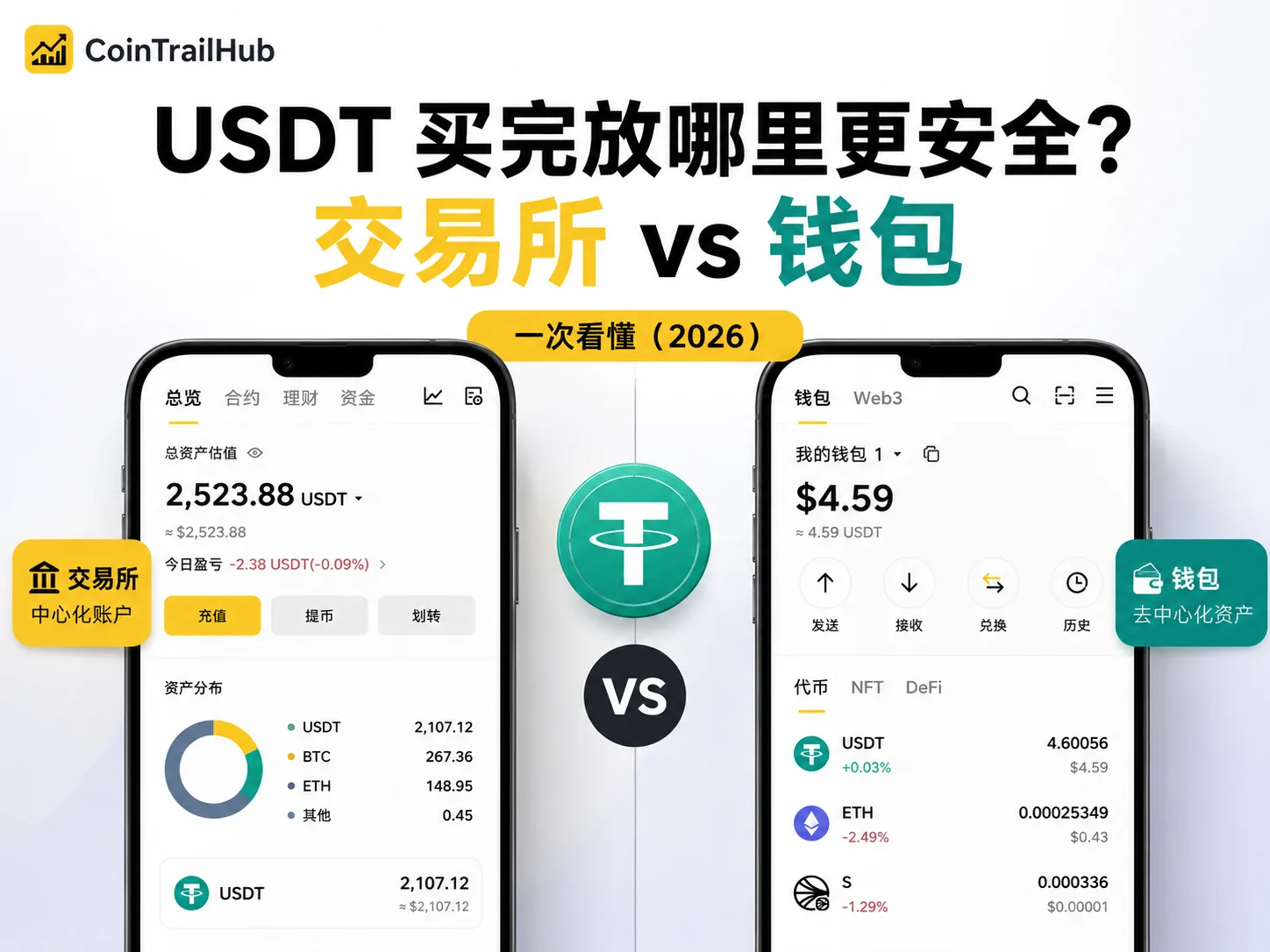
Table of contents

Binance new user rewards
20% trading fee rebate
Official Binance registration. Complete identity verification (KYC) to trade and withdraw.
Many beginners face a very practical question right after their first USDT purchase:
You've bought the coins — where do you keep them now?
Leave them on the exchange?
Or withdraw them to a wallet?
If you leave them on the exchange, is there platform risk?
If you withdraw to a wallet, could you actually lose your assets by choosing the wrong network or losing your seed phrase?
I wrestled with this same question when I first got into Crypto.
After my first USDT purchase, I didn't withdraw right away.
The reason was simple:
At the time I didn't understand wallet addresses, couldn't tell ERC20, TRC20, and BEP20 apart, and didn't know why the same 0x address could appear on different chains.
Later, the first time I withdrew USDT from an exchange to a wallet, I didn't send a large amount — I made a small test transfer first.
What I remember most from that operation wasn't the "withdrawal successful" message, but the first time I truly understood three things:
- Wallet addresses must be double-checked
- The withdrawal network must be selected correctly
- After arrival, it's best to check on a block explorer
Since then, for any new address or new network, I always test with a small amount first.
This article explains the difference between keeping USDT on an exchange and in a wallet, in beginner-friendly terms.
This article is for Crypto basics education only and does not constitute investment, financial, or trading advice. This article does not recommend keeping all your assets in any single method. Exchanges, hot wallets, and cold wallets each carry their own risks; readers should decide based on their own understanding, capital size, and risk tolerance.
30-second summary
If you've just bought your first USDT, remember these points first:
- During the small-amount learning phase, you can keep it on the exchange
- If you trade often, the exchange is more convenient
- To learn on-chain operations, you need to start understanding wallets
- To control your assets yourself, you need to understand seed phrases
- For your first withdrawal, always test with a small amount first
- Once your assets grow, don't keep everything in one place
Simply put:
Exchanges are better for trading and account management.
Wallets are better for self-custody and learning on-chain operations.
There's no absolutely safer option — only the choice that better fits your current stage.
If you don't yet understand USDT, read first:
What is USDT? Uses and risks of Tether (2026)
To learn about the issuer behind USDT and its transparency, you can also check the Tether official transparency page.[1]
If you're a beginner, start here
If this is your first time buying USDT, here's what I'd suggest:
During the small-amount learning phase, you can keep it on the exchange — you don't have to withdraw to a wallet immediately.
After you've learned about wallet addresses, withdrawal networks, and seed phrases, test a withdrawal with a very small amount.
If the test succeeds, consider whether to move some assets to a wallet.
Don't withdraw all your USDT at once at the start.
And don't keep all your assets on one platform long-term just because the exchange is convenient.
Simply put:
The exchange is good for "convenient operations."
The wallet is good for "self-custody."
The exchange's risk mainly comes from the platform.
The wallet's risk mainly comes from your own operational mistakes.
Table of contents
- Why do beginners hesitate after buying USDT?
- What does keeping USDT on an exchange mean?
- What does keeping USDT in a wallet mean?
- Exchange vs wallet: quick comparison
- When is it better to keep it on the exchange?
- When is it better to withdraw to a wallet?
- My tiered fund management approach
- What's the difference between Binance Wallet, OKX Wallet, and MetaMask?
- Is it worth withdrawing small amounts of USDT to a wallet?
- What must you check before withdrawing?
- How to confirm your USDT has arrived
- The 5 most common beginner mistakes
- FAQ
- Recommended reading
- References
- Summary
Why do beginners hesitate after buying USDT?
Because when most people first enter Crypto, the first thing they encounter is an exchange.
For example:
- Binance
- OKX
- Bitget
Registration, identity verification, buying USDT, and checking balances mostly happen on the exchange.
So many beginners naturally assume:
"My coins are on the exchange."
More precisely:
You're seeing your asset balance in an exchange account.
At this point, assets are held in custody by the platform, and users manage their accounts through passwords, email, phone numbers, and security verification.
Later, when you start using Web3 wallets, DApps, DeFi, RWA, and on-chain stocks, you'll find that wallets become increasingly important.
Exchanges and wallets don't replace each other.
They're two different tools.
Exchanges handle trading and account management.
Wallets handle on-chain operations and asset self-custody.
What does keeping USDT on an exchange mean?
Keeping USDT on an exchange means your USDT shows up in your exchange account.
For example, when you open the assets page on Binance or OKX, you can see:
- Spot account
- Funding account
- Futures account
- Earn account

For beginners, this is the most intuitive approach.
Because you don't need to immediately understand:
- Wallet addresses
- Withdrawal networks
- Gas fees
- Seed phrases
- On-chain confirmations
After logging in, you can check balances, buy and sell USDT, swap for BTC or ETH, and continue with P2P operations.
If you haven't registered on an exchange yet, read these two basic guides first:
Binance registration guide (2026)
Advantages of keeping it on the exchange
Simple to operate
An exchange is more like a complete account system.
Buying, selling, P2P, and spot swaps can all be done in the app.
No copying wallet addresses.
No selecting on-chain networks.
No managing seed phrases yourself.
This has a lower barrier for complete beginners.
Relatively easy account recovery
Exchange accounts are usually linked to:
- Phone number
- Identity verification
- Two-factor authentication
If you forget your password, you can usually recover it through the platform's process.
This is completely different from Web3 wallets.
If you lose your wallet's seed phrase, in many cases no one can help you recover it.
About seed phrases, read:
What is a seed phrase? Why no one can help you recover your assets if you lose it (2026)
On wallet recovery and seed phrase security, the MetaMask official help center repeatedly reminds users not to share their seed phrase with anyone[2]; see the MetaMask official support docs.
Good for frequent trading
If you still need to:
- Buy USDT
- Sell USDT
- Swap for BTC
- Swap for ETH
- Do P2P
- Check market prices
Keeping it on the exchange is more convenient.
Because funds don't need to be moved on-chain frequently.
Disadvantages of keeping it on the exchange
An exchange account is convenient, but it's a custodial model.
Simply put:
What you see is an account balance.
But you don't hold the on-chain private key yourself.
In other words, you rely on the platform to manage your assets.
If the platform experiences:
- Risk-control review
- Account restrictions
- System maintenance
- Withdrawal suspension
You may not be able to freely operate your assets immediately.
This is also why many users eventually start learning about Web3 wallets.
What does keeping USDT in a wallet mean?
Keeping USDT in a wallet usually means withdrawing USDT from the exchange to your own Web3 wallet address.
Common wallets include:
- Binance Wallet
- OKX Wallet
- MetaMask
- Trust Wallet
- Ledger (hardware wallet)

For many beginners, their first contact with a wallet isn't MetaMask.
It's seeing Binance Wallet and OKX Wallet in the Binance or OKX app.
These wallets are also Web3 wallets.
After creating a wallet, the system usually generates a seed phrase, and users keep asset control themselves.
To learn the basics of wallets, you can refer to the Ethereum official wallet guide, which gives a basic explanation of what wallets do, how to use them, and security considerations.[3]
If you're not yet clear on what a wallet is, read first:
What is a crypto wallet? Wallet address, seed phrase, and asset security (2026)
Note: an exchange account and a wallet are not the same thing
This is where beginners get confused most easily.
USDT in your Binance exchange account is not the same as USDT in Binance Wallet.
The former is a platform account balance.
The latter is an on-chain asset in a Web3 wallet.
OKX follows similar logic.
The OKX exchange account and OKX Wallet need to be understood separately.
So on first use, be sure to distinguish:
- Exchange account
- Web3 wallet
- Wallet address
- Withdrawal network
Don't assume assets are in the exact same place just because the app name looks the same.
A wallet is not a magic safe
Many beginners hear this advice:
"Keeping coins on an exchange is unsafe — withdraw to a wallet quickly."
This is only half right.
A wallet does let you control your assets yourself.
But it also means:
- You must keep your seed phrase yourself
- You bear the consequences of a wrong-network transfer
- Authorizing malicious websites can lead to asset theft
- Copying a wrong wallet address can cause losses
If you don't understand these risks, a wallet isn't necessarily safer than an exchange.
A wallet is not a magic safe.
It just hands asset control back to you.
More freedom also means more responsibility.
If you've never used a wallet, think of it this way
An exchange is more like online banking.
After logging in, you can check balances, buy and sell assets, and do P2P.
The platform manages the account system for you.
A wallet is more like holding the key to your own safe.
The key is in your hand, and so is asset control.
But if you lose the key, no one can help you recover it.
So:
The exchange is more convenient.
The wallet is freer.
The price of freedom is taking responsibility yourself.
Exchange vs wallet: quick comparison
| Dimension | Exchange | Web3 wallet |
|---|---|---|
| Asset control | Platform custody | You hold the seed phrase / private key |
| Recovery method | Email / phone / support recovery | Losing the seed phrase is basically unrecoverable |
| Best for | Beginner learning, frequent trading, P2P | On-chain operations, DApps, long-term self-custody |
| Main risks | Platform risk-control, withdrawal restrictions | Seed phrase leak, wrong network, phishing authorization |
| Barrier to entry | Low | High (need to understand address / network / gas) |
Exchange
Best for:
- Beginners new to Crypto
- Small-amount learning
- Frequent trading
- P2P operations
- People who haven't learned wallets yet
Advantages:
- Simple to operate
- Convenient trading
- No seed phrase management needed
- Forgetting a password can usually be recovered through the platform process
Note:
- Assets are in platform custody
- Depends on the exchange account system
- May be affected by platform risk-control and withdrawal restrictions
Web3 wallet
Best for:
- Learning on-chain operations
- Using DApps
- Managing some assets long-term
- People who want to control their assets themselves
Advantages:
- You control the seed phrase and private key
- Can connect to on-chain applications
- Not dependent on a single exchange account
Note:
- You must keep the seed phrase yourself
- Wrong-network transfers can cause losses
- No one resets your seed phrase for you
- Authorizing phishing websites can put assets at risk
It's not that one is definitely safer.
Rather, they fit different stages.

When is it better to keep it on the exchange?
If you've just bought your first USDT and are still in the learning phase, keeping it on the exchange isn't necessarily a wrong choice.
In the following situations, keeping it on the exchange first is better for beginners.
1. Small amount, just for learning
If it's just tens or a few hundred USDT to get familiar with the exchange, P2P, and spot features, you can keep it on the exchange first.
Withdrawing to a wallet prematurely may actually increase your learning cost.
2. You'll trade again soon
If you'll soon need to:
- Buy other coins
- Sell USDT
- Do P2P
- Swap for BTC or ETH
Keeping it on the exchange is more convenient.
Frequent withdrawals and deposits are not only troublesome but can also incur fees.
3. You haven't learned wallets yet
If you don't yet know:
- What a wallet address is
- How to select a network
- The difference between ERC20 and TRC20
- How to store a seed phrase
- What to do after a wrong-network transfer
Then don't rush to withdraw.
Learn the wallet basics first, then test with a small amount.
When is it better to withdraw to a wallet?
If you already understand wallet basics and can store your seed phrase correctly, you can start considering moving some USDT to a wallet.
1. You want to learn on-chain transfers
Learning Crypto ultimately can't avoid on-chain operations.
Wallet addresses, network selection, gas fees, and block explorers all need to be understood through real operations.
But your first operation must be small.
Don't transfer a large amount right away.
2. You want to use on-chain applications
If you want to use DApps, DeFi, or other on-chain tools, you need a wallet.
An exchange account can't directly connect to most on-chain applications.
3. Your asset amount is gradually growing
Once your assets grow, keeping all your funds on one platform or in one wallet isn't a good habit.
A safer approach is tiered management:
Keep daily operating funds on the exchange.
Keep small on-chain operating funds in a hot wallet.
Keep long-term assets in a cold wallet or offline solution.
My tiered fund management approach
Here's my own approach. It may not suit everyone, but beginners can use this framework as a reference.
I no longer keep all my USDT in one place.
When the amount is tiny, it may feel unnecessary to split things this finely; but as assets gradually grow, tiered management becomes more reassuring.
I usually split into three tiers.

Tier 1: Exchange
This part is mainly for convenient operations.
For example:
- Buying and selling
- P2P
- Temporary swaps
- Short-term use
- Maintaining liquidity
I don't keep long-idle funds on the exchange, but I don't avoid it entirely either.
Because for beginners, the exchange really is the most convenient entry point.
Tier 2: Hot wallet
This part is mainly for on-chain operations.
For example:
- On-chain transfers
- DApps
- RWA
- On-chain stocks
- Small-amount testing
Common hot wallets include:
- Binance Wallet
- OKX Wallet
- MetaMask
I usually don't keep too much here.
The reason is simple:
Hot wallets frequently connect to websites, there are more opportunities to operate, and the chance of error is higher.
So they're better for learning and small daily operations, not for keeping all your assets.
Tier 3: Cold wallet or offline solution
This part is better for long-term assets.
For example, USDT, BTC, or ETH that you don't plan to move frequently.
For these assets, I minimize connecting to unfamiliar websites and don't move them around often.
If the amount is large, a cold wallet or stricter offline custody is relatively safer.
But cold wallets aren't absolutely safe either.
If you back up the seed phrase incorrectly, leak the recovery phrase, or make a mistake when signing a transfer, you can still lose assets.
The benefit of this tiered management is:
Even if something goes wrong in one link, it won't affect all your assets.
For beginners, you don't need to make it complicated from the start.
You can begin with the simplest approach:
Keep a small amount on the exchange to learn.
Withdraw a small amount to a wallet to practice.
After you truly understand addresses, networks, seed phrases, and block explorers, consider more complete fund tiering.
What's the difference between Binance Wallet, OKX Wallet, and MetaMask?
When learning wallets, these are usually the first ones beginners encounter.
Binance Wallet
Advantages:
- Usage path is close to Binance
- Simple to operate
- Easy for beginners
Best for:
Users just moving from the exchange into Web3.
OKX Wallet
Advantages:
- Supports many chains
- Rich DApp entry points
- Good Chinese-language experience
Best for:
Users who want to explore more on-chain applications.
MetaMask
Advantages:
- Extremely widely used in the industry
- Supports a huge number of DApps
- Plenty of tutorial resources
Best for:
Learning the Ethereum ecosystem and EVM on-chain operations.
In fact, no matter which wallet you use, the most important thing isn't the brand, but:
Seed phrase custody.
Is it worth withdrawing small amounts of USDT to a wallet?
Not necessarily.
If it's a very small amount of USDT, especially in the beginner stage, you don't necessarily need to withdraw to a wallet right away.
You can first ask yourself a few questions:
Can I store a seed phrase properly?
Do I know which chain my current USDT is on?
Do I know how to select the withdrawal network?
Can I look up on-chain transaction records?
If these questions aren't clear yet, it's better not to rush to withdraw.
If you really want to practice, you can also test with a very small amount first.
For example, withdraw a small amount first.
After confirming the address, network, and arrival process are all fine, consider the next steps.
When I test, I also use a small transfer that doesn't affect my overall funds — confirming the address, network, and arrival record are all fine before deciding whether to continue.
What must you check before withdrawing?
Withdrawing is one of the places beginners make the most mistakes.
Because once an on-chain transfer is complete, it often can't be reversed.
1. Confirm the wallet address
After copying the address, check the first and last few characters.
Don't just look at the middle.
Some malware replaces clipboard addresses.
If the address is replaced, your assets may go to an unknown address.
2. Confirm the network
USDT can exist on different networks.
Common ones include:
- Ethereum / ERC20
- Tron / TRC20
- BNB Smart Chain / BEP20
- Arbitrum
- Base
- Polygon
- TON
- Solana

The exchange withdrawal network must match the wallet's receiving network.
Otherwise, funds may not arrive, and recovery could be difficult.
The simplest way to judge:
Whichever wallet or platform you're depositing to, first look at the deposit network it gives you; then go back to the exchange withdrawal page and select the exact same network.
Don't pick based on your own feeling.
3. Test with a small amount first
For your first withdrawal, don't send a large amount all at once.
Test with a small amount first.
For example:
- 1 USDT
- 5 USDT
- 10 USDT
After confirming arrival, operate with a larger amount.
This habit avoids most transfer mistakes.

4. Don't follow remote guidance from strangers
If someone asks you to:
- Share your screen
- Download remote-control software
- Send your seed phrase
- Send verification codes
- Copy an address they give you
Be very cautious.
Real wallet security must be in your own hands.
How to confirm your USDT has arrived
Many beginners start worrying when they see "withdrawal processing":
Did I lose it?
Is it stuck?
Did I send it wrong?
In fact, on-chain transfers need to wait for block confirmations.
Normally:
- TRC20 is usually faster
- BEP20 is usually faster
- ERC20 may take longer, and fees may be higher
If it hasn't arrived for a long time, check on a block explorer.
For example, you can use the OKLink block explorer to look up transaction records, address balances, and transfer status on different chains.[4]

Use a block explorer to verify arrival status
The ones I usually use are:
- OKLink
- Etherscan
- Tronscan
From a block explorer you can see:
- Transfer time
- Transfer amount
- Transfer address
- Network fee
- Transaction status
This is also a reflection of blockchain transparency.
Why does the same address appear on different chains?
Many beginners are puzzled the first time they see this:
Why can the same 0x address appear on different chains?
For example, the same address may appear on:
- Ethereum
- BNB Chain
- Base
- Polygon
- Arbitrum
This is because many EVM networks use the same address format.
So:
Seeing the same address doesn't mean the same network.
When transferring, you still need to confirm:
The sending network and receiving network match.
This is also one of the reasons people send to the wrong chain.
If you're not yet familiar with the relationship between networks and addresses, make sure to figure this out before withdrawing:
The same address format doesn't necessarily mean the same chain.
The 5 most common beginner mistakes
Mistake 1: Not doing a small-amount test
Many people withdraw everything on their first transfer.
If the address or network is wrong, the loss may be unrecoverable.
Mistake 2: Only looking at fees, not the network
Some networks have low fees, but they may not fit your current wallet or platform.
Don't pick randomly just because it's cheap.
Mistake 3: Saving your seed phrase as a screenshot
A seed phrase should be:
- Backed up by handwriting
- Stored offline
Don't:
- Screenshot it
- Send it via messaging apps
- Store it in cloud drives
Mistake 4: Blindly authorizing websites
Before connecting your wallet, always confirm:
- The website domain
- The project source
- The authorization permissions
Don't casually connect to unfamiliar DApps.
Mistake 5: Keeping all assets in one place
Whether it's an exchange or a wallet, it's not recommended to keep all your assets in one place.
Diversifying risk appropriately is more reasonable.
FAQ
Is it safe to keep USDT on an exchange?
Mainstream exchanges usually provide account security, risk control, and identity verification, and have a low barrier for beginners.
But exchanges are still custodial, and assets depend on the platform account and platform rules — that doesn't mean there's no risk.
It's not recommended to keep all your assets on one exchange long-term.
Is keeping USDT in a wallet definitely safer?
Not necessarily.
A wallet's safety depends on whether you can properly store your seed phrase, recognize phishing websites, and select the correct network.
If your seed phrase management is poor, a wallet can also be dangerous.
Do I need to withdraw small amounts of USDT to a wallet?
Not necessarily.
If you're just in the learning phase, small amounts of USDT can stay on the exchange.
After you understand wallets, addresses, networks, and seed phrases, test withdrawing with a small amount.
Can I transfer USDT in my wallet back to an exchange anytime?
Yes, but you need to confirm the deposit address and deposit network the exchange provides.
When transferring back to the exchange, also check the network carefully.
For example, BEP20, TRC20, and ERC20 — you can't just look at the address format.
If it's your first time transferring from a wallet back to an exchange, test with a small amount first.
Is Binance Wallet an exchange or a wallet?
Binance Wallet is a Web3 wallet.
It's different from the exchange account.
When using a wallet, you need to understand seed phrases, addresses, and on-chain operation risks.
What matters most for a first withdrawal?
The most important things are:
- Correct address
- Correct network
- Small-amount test first
- Seed phrase already backed up safely
Recommended reading
- How to buy USDT for the first time: a complete guide from registration to arrival (works for Binance/OKX)
- Withdrawing USDT to a bank card: full steps + fees + arrival time + card-freeze risk (2026)
- USDT vs USDC: what's the difference, which is safer, and how to choose (2026)
- What is BEP20 USDT? Binance-Peg BSC-USD vs native USDT
- Can USDT/USDC buy US stocks beyond crypto? Binance fractional shares test (2026)
What is USDT? Uses and risks of Tether (2026)
First understand what USDT is and why it isn't the same as a USD deposit.
What is a crypto wallet? Wallet address, seed phrase, and asset security (2026)
Understand wallet addresses, hot wallets, cold wallets, and seed phrases.
What is a seed phrase? Why no one can help you recover your assets if you lose it (2026)
Learn the most important wallet security knowledge.
Binance registration guide (2026)
For beginners new to Binance — complete account opening, identity verification, and security setup.
How to register on OKX
For beginners new to OKX.
How do beginners buy crypto? 7 things to know before buying USDT (2026)
Understand payment methods, merchant screening, and basic risks before buying USDT.
References
Data verification
Key facts in this article were verified on 2026-10-16 against Tether, MetaMask, Ethereum, and OKLink official sources, as follows:
- USDT transparency: USDT issuer and reserve transparency information is per Tether's official transparency page. Source: Tether official transparency page.
- Seed phrase security: Never share your seed phrase with anyone; wallet recovery depends on the seed phrase. Source: MetaMask official support docs.
- Wallet basics: What wallets do, how to use them, and security considerations. Source: Ethereum official wallet guide.
- Arrival verification: You can use block explorers like OKLink to look up on-chain transaction records, address balances, and transfer status. Source: OKLink block explorer.
Summary
After buying USDT, there's no absolute answer to whether you should keep it on an exchange or in a wallet.
The exchange is better for:
- Beginner learning
- Small amounts
- Frequent trading
- P2P operations
The wallet is better for:
- Learning on-chain operations
- Controlling assets yourself
- Long-term management
- Using DApps
For beginners new to Crypto, don't rush to chase the "looks safest" option.
What matters more is understanding first:
The exchange is convenient, but you need to trust the platform.
The wallet is free, but you need to take responsibility yourself.
Keeping a small amount on the exchange to learn doesn't mean keeping it there forever.
Withdrawing to a wallet is freer, but doesn't necessarily mean safer.
The right approach for beginners is:
Understand first, then operate.
Test with a small amount first, then gradually increase.
Learn to protect your seed phrase first, then consider keeping assets in a wallet long-term.
For beginners, the safest thing isn't "everything on the exchange" or "everything in a wallet."
It's knowing what you're doing.
In the small-amount learning phase, keeping it on the exchange is fine.
When you're ready to learn on-chain operations, test the wallet with a small amount.
After you truly understand addresses, networks, seed phrases, and block explorers, consider more complete fund tiering.
- Tether official transparency pageUSDT issuer and reserve transparency
- MetaMask official support docsNever share your seed phrase with anyone
- Ethereum official wallet guideWhat wallets do, how to use them, and security
- OKLink block explorerLook up on-chain transaction records, address balances, and transfer status
- 2026-10-16UpdateAdded evidence-chain superscripts and "data verification" section, refreshed key fact-check date.
See ourEditorial Policy and the correction process in ourCorrections Policy.
The CoinTrailHub editorial team focuses on crypto education for beginners, exchange security and P2P trading risk. This article is compiled from official sources and public data, reviewed by humans, and strives for accuracy but is not investment advice.
Last updated:2026-06-19 · Content reviewed by humans · Learn more
© 2026 CoinTrailHub · Original content. Reproduction or rewriting without permission is prohibited.