
How to Withdraw USDT to Your Bank Account: Steps, Fees, Timing and Account-Freeze Risks (2026)
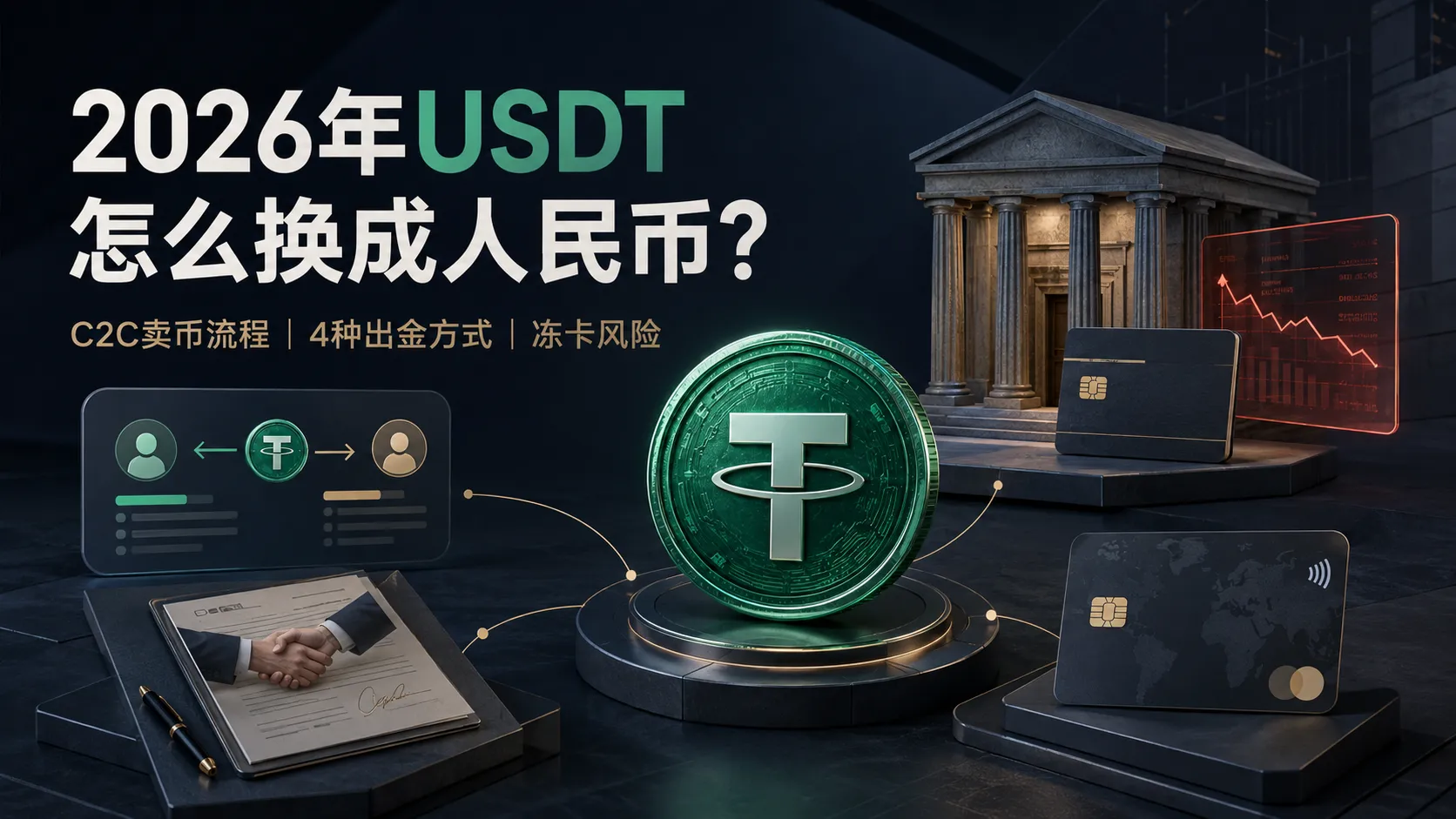
Table of contents

Binance new user rewards
20% trading fee rebate
Official Binance registration. Complete identity verification (KYC) to trade and withdraw.
The common ways to convert USDT into fiat include exchange P2P trading, private OTC, licensed-platform fiat withdrawal, and spending with a crypto debit card. For most beginners, the hard part isn't finding the "sell" button — it's figuring out who actually pays the fiat, whether the transaction record is complete, and what risks your bank account may face.
If you haven't decided which off-ramp path to take — P2P selling, on-chain withdrawal, fiat withdrawal (SWIFT) or OTC — start with Binance withdrawal guide: fees, timing and account-freeze risks compared across 4 methods, then come back here for the step-by-step operation and troubleshooting.
All four methods appear to "turn coins into money", but the funding paths are different:
- P2P usually means receiving a transfer from an unknown individual or merchant;
- After selling on a licensed platform, you typically withdraw the platform-supported fiat to your own same-name bank account;
- A crypto card mainly solves spending, not directly converting to your local fiat;
- Private OTC lacks platform escrow, making the counterparty and the source of funds harder to verify.
A note for readers in jurisdictions that restrict virtual-asset activity: virtual-asset exchange, trade matching and related financial services may be strictly regulated or restricted, and may carry anti-money-laundering and foreign-exchange risks.[1] The civil validity, asset treatment and legal responsibility of any personal holding or occasional transaction depend on the specific conduct and facts of the case. This article does not draw any legality conclusion about a specific transaction.
This article does not offer any method to split transactions, switch accounts or evade bank monitoring. The operation section only explains how a P2P order is structured. Whether the relevant services are available should be based on your local rules and the platform's actual pages.
Platform escrow can reduce the risk of a buyer not releasing coins after you pay, but it cannot replace your own verification of actual receipt, cannot guarantee that the fiat payment has a clean source, and cannot guarantee that your bank account won't be restricted by the bank or by authorities.[2]
Reminder: This article only explains different ways to convert virtual assets and their risks, and is not investment, trading or legal advice. Service scope, account requirements and related rules vary by region. Please refer to your local rules and the platform's actual pages.
Quick overview
If you remember only one sentence:
Judge your region and bank-account situation first, then consider speed and cost; there is no "safe off-ramp amount" that works for everyone.
| Your situation | What to consider first |
|---|---|
| Your region restricts or prohibits virtual-asset trading | Understand the local regulatory and legal risk; don't treat P2P as an ordinary bank transfer |
| Your region allows licensed platforms | Check the platform's license, supported fiat and same-name account requirement |
| You can only receive fiat from strangers | Focus on the risk that you cannot fully verify the payer's upstream funds |
| First time learning about off-ramp paths | Study platform rules and local requirements; don't act based on a tutorial alone |
| Your bank account is already restricted | Confirm the restriction type with the bank, keep records, and consult a lawyer if needed |
Many older articles classify off-ramps by amount — "a few thousand via P2P, tens of thousands by splitting, large amounts via OTC" — but this is unreliable. Whether a bank account is restricted depends not only on the amount, but also on the payer's source of funds, transaction frequency, account history, judicial inquiries and the bank's risk model. Splitting into smaller amounts does not change the nature of the involved funds.
Table of contents
- First, distinguish: selling, withdrawing and fiat withdrawal
- The 4 paths to convert USDT into fiat
- Judge 4 conditions before choosing an off-ramp path
- The 7 steps of P2P selling: what to check at each step
- The 4 most common judgment errors in P2P selling
- Why a bank account may be restricted
- What to do after a bank account is restricted
- Common off-ramp methods, verified: what each actually solves
- FAQ
- Related reading
If all goes smoothly, a P2P sell can be done in about 10 minutes. The two places you're most likely to stumble: releasing coins after only seeing a payment screenshot, and treating a merchant's "fund settling period" as a safety guarantee.
1. First, distinguish: selling, withdrawing and fiat withdrawal
Many beginners get stuck at step one — mixing up several similar-sounding terms.
Let's clarify three things first.
P2P selling: sell USDT to a counterparty matched by the platform; the fiat is usually transferred by the counterparty to your real-name receiving account.
Withdrawal (on-chain): move USDT from one platform account or wallet address to another account or address. The asset is still USDT, not converted to fiat.
Fiat withdrawal: first sell the virtual asset for fiat (such as USD, EUR, HKD or another supported currency) on a platform that supports fiat trading, then withdraw that fiat to your own same-name bank account.[3]
The biggest difference between fiat withdrawal and P2P selling is the payment structure. In P2P, the counterparty usually transfers to you; a licensed platform's fiat withdrawal is usually processed by the platform or a partner bank, and requires your bank account name to match your platform identity.
So when people search "USDT to fiat", the actual need usually falls into four categories:
- Sell USDT on the P2P market and receive fiat paid by the counterparty;
- Trade with a private OTC counterparty;
- Sell USDT on a licensed platform and withdraw the platform-supported fiat to your same-name bank account;
- Spend with a crypto card instead of withdrawing fiat directly to a bank account.
If you don't understand what USDT is yet, start here:
What is USDT? Uses and risks of Tether (2026)
2. The 4 paths to convert USDT into fiat
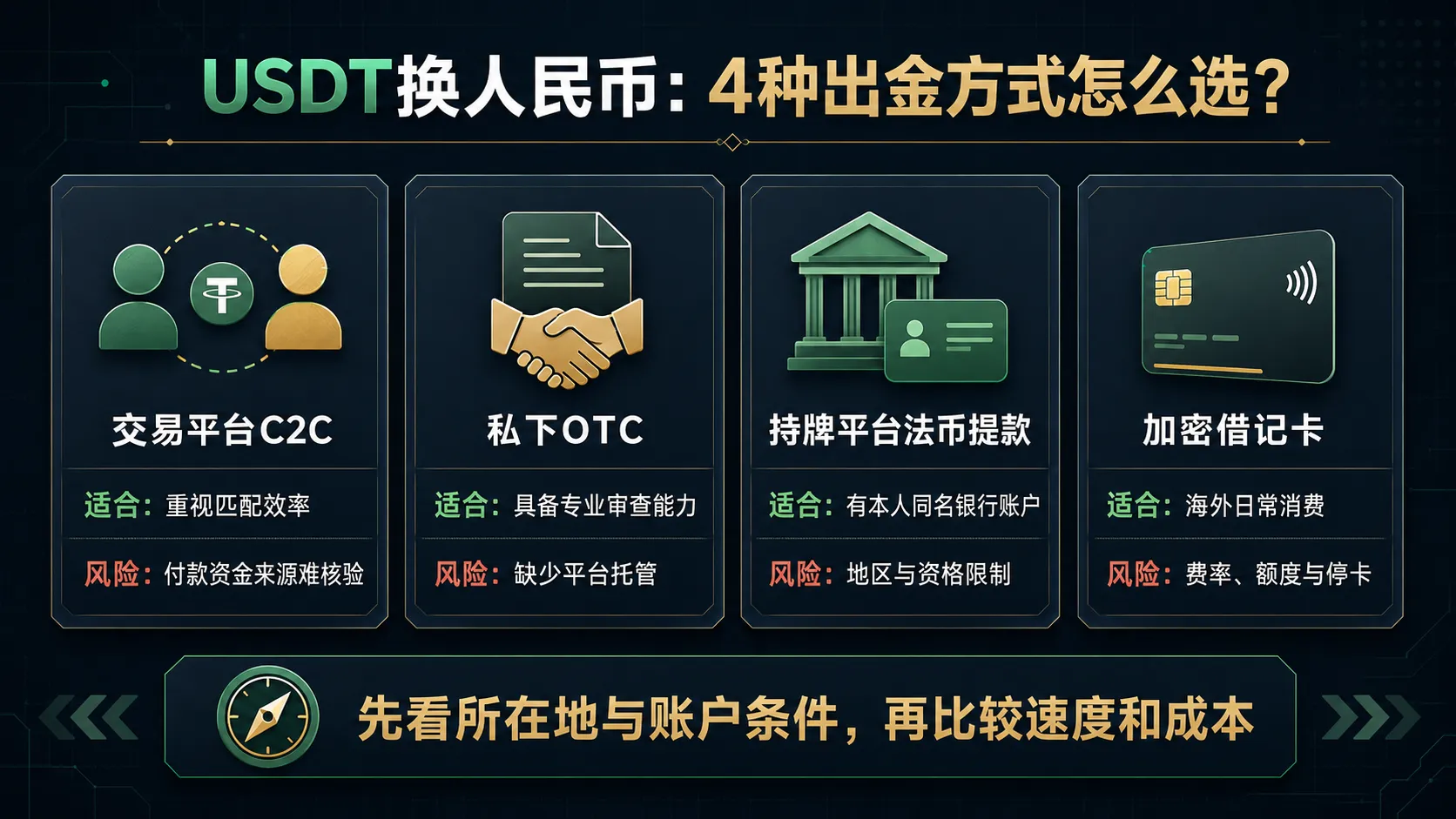
| Path | Who pays the fiat | Main advantage | Main risk | Best for |
|---|---|---|---|---|
| Exchange P2P | Unknown individual or verified merchant | Easy matching, platform escrow | Cannot fully verify the upstream source of the payment | Users in regions where it's allowed and who understand the risk |
| Private OTC | Private counterparty | Amount and rate are negotiable | No platform escrow; higher fraud and tainted-funds risk | Users or institutions with strong due-diligence ability |
| Licensed-platform fiat withdrawal | Platform or partner bank | Usually goes to your same-name account, relatively complete record | Region, eligibility, currency and bank restrictions | Users with an eligible account who value fund records |
| Crypto debit card | Card issuer and payment network | Usable for daily spending in certain regions | Fees, limits, region and card-suspension risk | Users with overseas spending needs |
Exchange P2P: the platform escrows the virtual asset, reducing the risk of direct default between the two sides. But the fiat is still usually paid by the counterparty, and platform verification cannot prove that every payment's upstream funds are clean.
Private OTC: lacks platform escrow and order records, making the counterparty's identity, rate, payment account and fund source harder to verify. For beginners, if you cannot verify the actual counterparty, the payment account and the complete order record, you should not choose private OTC just because the quote is higher or the arrival is faster. If the payment still ultimately comes from a stranger's personal account, you get no extra compliance guarantee, and the fund source still needs to be judged.
Licensed-platform fiat withdrawal: applicability depends on your location, the platform's license, supported currencies and bank account. Some platforms require fiat to be withdrawn only to a same-name account.[4] It is not simply the same as "a local bank account directly receiving fiat".
Crypto debit card: essentially a spending tool. Card issuance fees, top-up fees, exchange spreads, ATM withdrawal fees and regional restrictions vary widely from card to card and cannot be written uniformly as "2%–3%"; always go by the specific issuer's fee schedule.
3. Judge 4 conditions before choosing an off-ramp path
When choosing an off-ramp path, many people first classify by amount: small amounts via P2P, larger amounts via other channels. But amount is only one risk variable and cannot alone decide whether a path is suitable.
Before comparing arrival speed, quotes and fees, answer these four questions first.
1. Does your region allow this service?
The same platform may open different P2P, fiat-withdrawal and payment methods in different regions. Seeing an entry in the App only means your account may currently display the feature; it does not mean the service complies with local rules, nor that the bank must accept the funds.
2. Who pays the fiat?
This is the most important difference between P2P and licensed-platform withdrawal.
- P2P: usually paid by the counterparty;
- Licensed-platform withdrawal: usually processed by the platform or a partner bank;
- Private OTC: the payer and the actual counterparty may differ;
- Crypto card: settled through the card issuer and payment network.
3. Is the receiving account your own same-name account?
Legitimate platforms usually require your platform identity to match the bank account name. Third-party payment on your behalf, using a family member's bank card, or receiving and transferring on someone else's behalf all significantly increase the difficulty of explaining the fund relationship.
4. Can this path leave a complete record?
At minimum, it should include:
- Platform order number;
- Counterparty page information;
- Order chat records;
- Actual payer's name;
- Bank or payment-platform statement;
- Record of the coin's origin;
- On-chain transaction hash when relevant.
Amount is not the only risk variable. There is no publicly uniform "amounts above X will definitely trigger risk control" or "below a certain amount is safe". Splitting, switching accounts or changing the coin also cannot change the true source of the payment.
4. The 7 steps of P2P selling: what to check at each step
Below uses a common platform page as an example to explain the basic structure of a P2P order. Account names, page entries, supported fiat and payment methods differ by platform.
The following process only helps you understand how a P2P order works, and does not mean the service is available or compliant in your region. Before operating, check the platform's service scope and your local requirements.
Step 1: Move USDT to the funding account
Open the App → Wallet → Transfer, and move USDT from the "spot account" to the "funding account".
Internal transfers within the same platform usually don't involve on-chain network fees and generally arrive quickly, but the specific rules and status depend on the platform's current page.
Account names differ by platform; don't apply one platform's "funding account" rules to all platforms.
Step 2: Set up the payment method
Go to P2P → Settings → Payment methods, and add a bank account or local payment method.
The receiving account name usually needs to match your platform KYC name. A mismatch can cause order appeals, payment returns or account review; third-party payment may also void the platform's order protection.
Step 3: Enter the sell page
If the platform has opened the service to your account, enter the P2P page, select "Sell", and view the currently supported virtual assets, fiat and payment methods. Some regions or accounts may not display certain fiat and payment options.
Step 4: Choose a merchant — my actual order of judgment
When I actually sell USDT on P2P, I used to compare amount and quote first. After more experience, I adjusted the order: first look at the merchant's account history, cumulative order count, recent completion rate and my own trade history, and only compare the quote last.
I generally focus on:
- Account creation time and first-transaction time;
- I personally prefer accounts that have been around for more than a year, but I don't treat "over a year" as a safety standard;
- 30-day order count and completion rate;
- Cumulative order count and number of counterparties;
- Whether it's a platform-verified advertiser;
- The payment methods the current ad supports;
- Whether the trading limit fits your needs;
- Whether it requires going off-platform to communicate;
- Whether the current order is covered by platform protection.
My actual order of choice is: first exclude merchants who require off-platform communication or whose order info is clearly abnormal, then compare account age, order data and my own trade history, and only look at the quote last. If a familiar and an unfamiliar merchant differ by only a few cents, I usually won't switch counterparties just for that spread.
Take a merchant I have repeatedly traded with as an example: at the time of the screenshot, the account had been created 1,772 days ago, the first trade was 1,541 days ago, cumulative orders exceeded 70,000, and 3,418 were completed in the last 30 days, with a 100% completion rate. Among the recent order records I kept, the amounts completed with this merchant include 650, 1,000, 2,000 and 2,500 (in fiat).
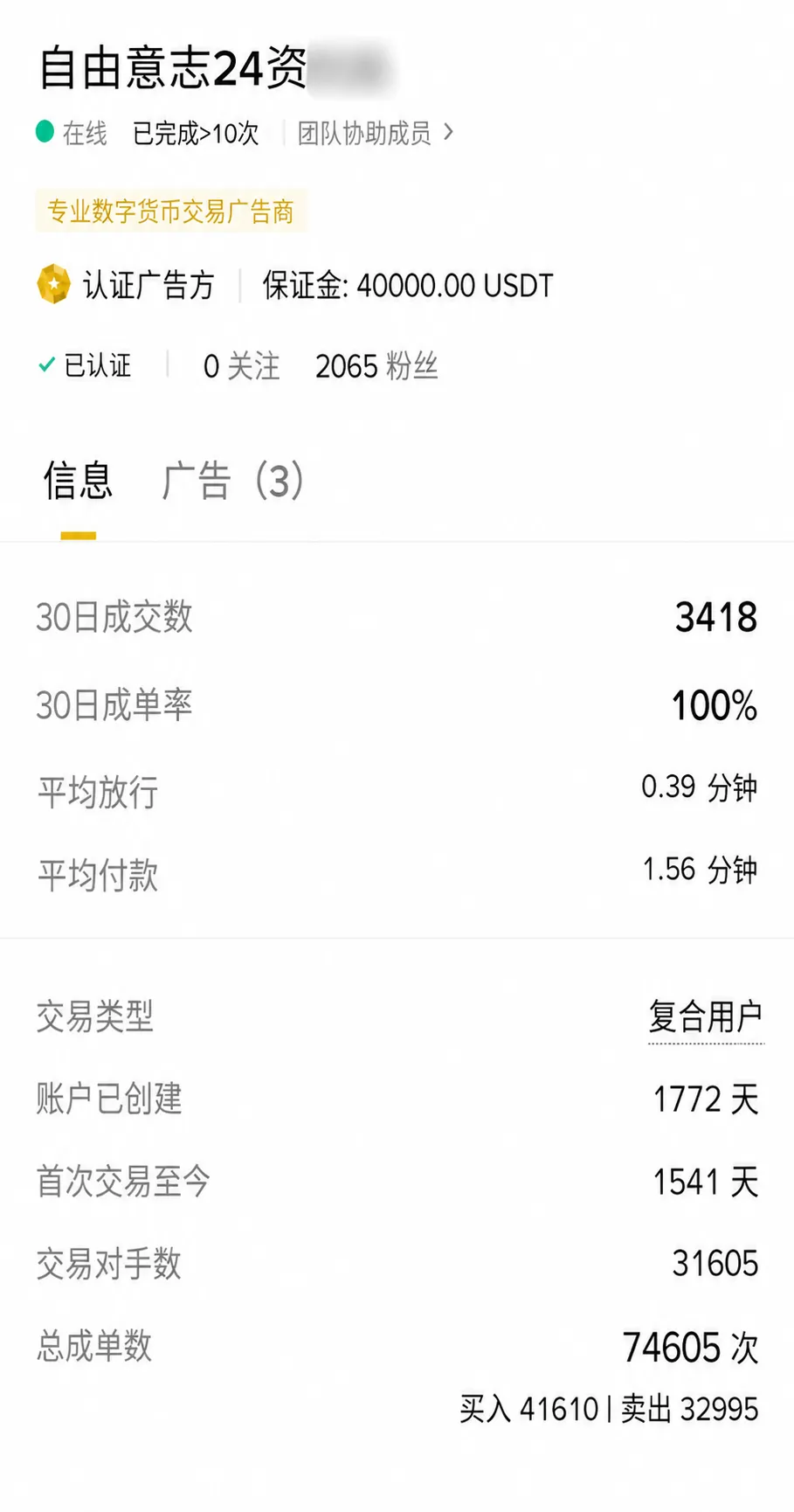
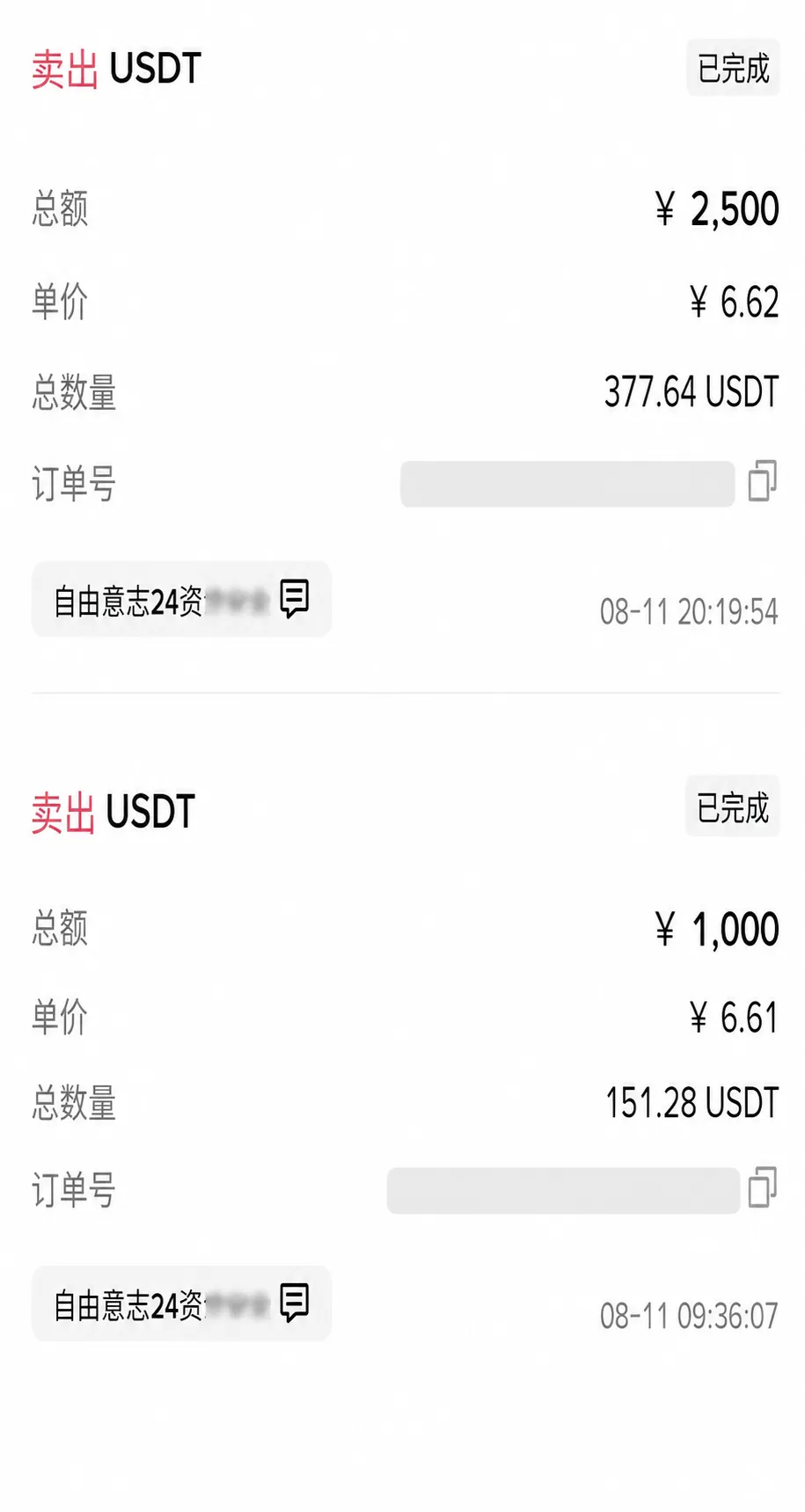
These records show the account has existed for a long time with a high historical trade volume, and they are consistent with the multiple historical orders I kept. But these metrics only reflect past trading performance; they cannot prove that the current fiat payment's upstream source is clean. Even with a merchant I've traded with before, I still re-confirm the payer, the received amount and the order info.
I personally mainly use a payment app for receiving, because checking the receipt record is convenient. This is just my habit, not a claim that a payment app is safer than a bank account.
Experience boundary: these records can show how I filter merchants, but cannot prove that "a fixed old merchant + a payment app" eliminates account-freeze risk.
Some platforms or specific P2P zones may offer a compensation mechanism for frozen accounts, but the compensation ratio, amount cap, applicable orders, exclusions and required documents can change. Before placing an order, check the rules that actually apply to the current order and save the rules page. Platform compensation is not the same as the bank lifting a restriction, and not every freeze qualifies for compensation.
If you cannot find official terms that apply to the current order, don't treat "100% compensation" or "up to X USDT" as a confirmed conclusion.
Step 5: Place the order and wait for the buyer to pay
Confirm the quantity, unit price and total, then place the order. Your USDT is escrowed by the platform.
After the buyer clicks "I've paid", don't rush to release the coins.
Step 6: Confirm your account actually received the money
This is the step where you're most likely to be scammed.
A payment screenshot sent by the buyer doesn't mean your account actually received the money. Payment screenshots can be forged, and SMS notifications can be faked. Open your own banking or payment app and check whether the real balance has increased.
Only after confirming the real receipt, click "Confirm receipt and release".
Besides confirming the amount actually arrived, also check whether the actual payer's name matches the order identity. If you receive payments from multiple differently-named accounts, the order amount doesn't match the actual receipt, or the counterparty asks you to refund to another account, pause the release and handle it through the platform's order appeal.
If the order genuinely needs a refund, let the platform step in first to confirm the original payment path and refund method. Don't refund to a new account number casually provided in the chat, and don't send money to a third party unrelated to the original payer, otherwise you may suffer a secondary loss.
When the payer, received amount or refund path is abnormal, don't release the coins just because the counterparty is urging you. Keep the USDT in platform escrow and wait for the appeal result.
Step 7: Release the coins and finish
After confirming receipt, click release; the USDT goes to the buyer and the fiat stays in your account.
The payment time of a P2P order is determined by the ad terms, payment channel and counterparty's action; it can't be uniformly promised as "arrives within a day". Go by the current order countdown and the platform page.
Official resource: Binance P2P safety guide
5. The 4 most common judgment errors in P2P selling
Error 1: Mixing up the spot account and the funding account
On some platforms, P2P trading can only use assets in the funding account. If the page shows insufficient balance, first check which account the assets are in and the platform's current rules; don't repeatedly top up or transfer.
Account names differ by platform; don't apply one platform's "funding account" rules to all platforms.
Error 2: Only looking at the payment screenshot without verifying real receipt
Payment screenshots, SMS notifications and bank pages sent by the counterparty cannot replace your own verification.
Before releasing, at least confirm:
- Your own banking or payment app shows a real credit;
- The amount matches the order;
- The actual payer matches the order info;
- The funds are not from multiple split payments;
- The counterparty is not asking to go off-platform.
Error 3: Treating a "fund settling period" as a safety guarantee
People online often suggest waiting 24 hours, 48 hours or even 3 days before moving the money out. But there is no publicly uniform bank rule proving that waiting a certain time prevents restriction.
If the upstream funds are tied to a case, waiting won't change their nature. The correct approach isn't guessing a "safe time", but keeping complete transaction records, avoiding receiving/transferring on others' behalf, and cooperating with the bank or authorities after a restriction appears.
Error 4: Assuming a previously-traded merchant is always safe
I personally prefer merchants that have been around over a year, with more cumulative orders and a trade history with me. This reduces the information gap versus a complete stranger, but doesn't guarantee every future payment is clean.
A merchant's receiving/paying accounts, the actual payer and the fund path can all change. So even for a fixed, previously-traded merchant, re-check every order:
- Whether the actual payer matches the order identity;
- Whether multiple differently-named accounts are paying;
- Whether the received amount matches the order;
- Whether off-platform communication is required;
- Whether the current order is covered by platform protection.
An old merchant and historical orders are screening information, not a safety promise.
6. Why a bank account may be restricted?
The core problem of P2P selling is: you usually cannot fully verify the upstream source of the fiat payer's funds.
A typical scenario:
- A victim is deceived and pays as instructed;
- The fraudster may control the funds to buy USDT, or may induce the victim to pay directly to the P2P seller's account;
- The seller releases USDT after seeing the fiat arrive;
- After the victim reports it, authorities trace the fiat fund chain;
- Accounts that received the involved funds may be subject to restriction measures.
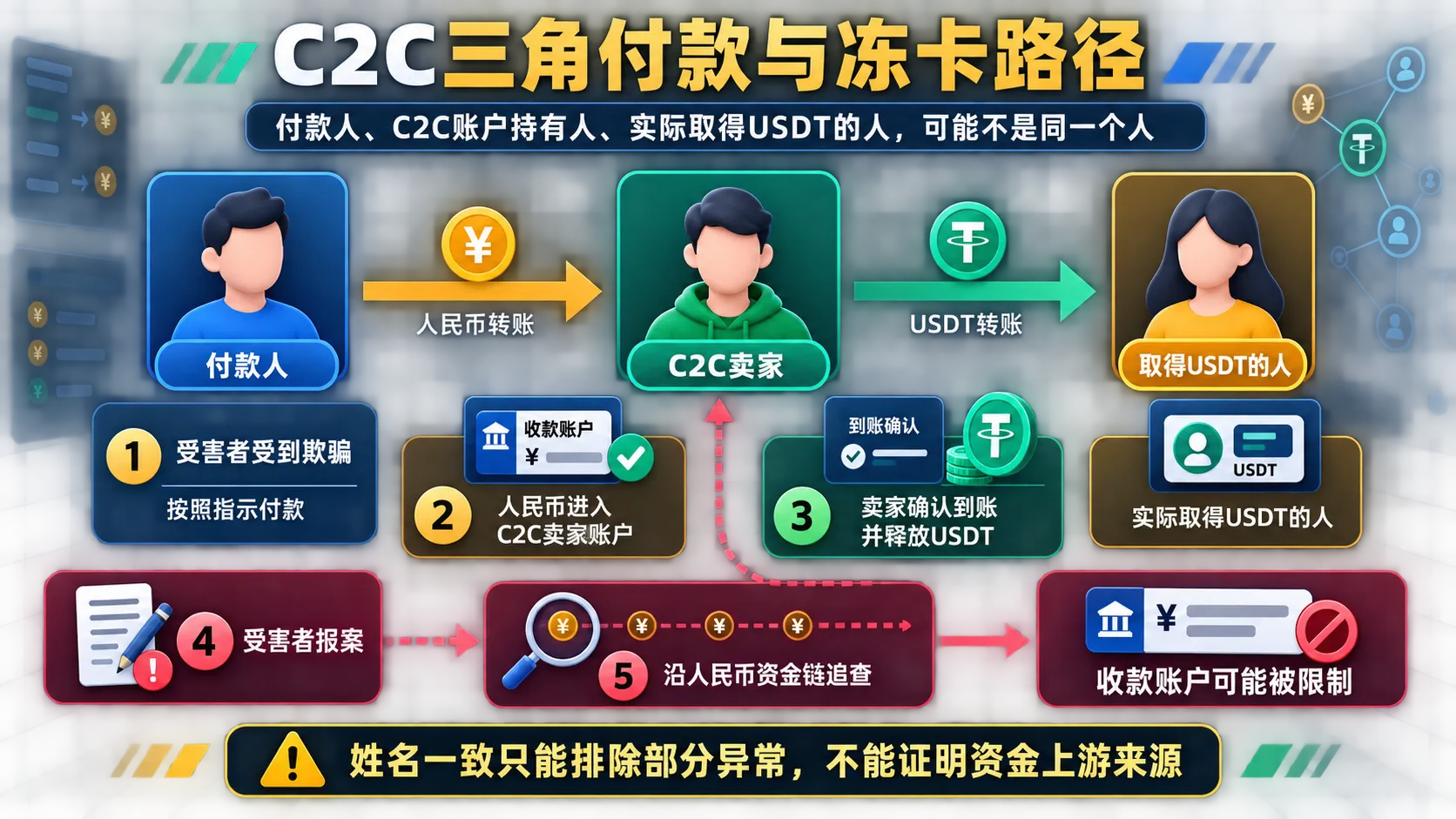
In this "triangle payment", the payer, the P2P account holder and the person who actually obtains the USDT may not be the same person. This is why you need to check whether the actual payer matches the order identity. A name mismatch is a clear abnormal signal, but a name match only rules out part of the third-party payment problem and cannot prove the complete upstream source.
This does not mean every P2P trade has a problem, nor that a verified merchant's funds are necessarily problematic. The key is: an ordinary user cannot, just from a platform account, trade volume and completion rate, judge the complete source of each fiat payment.
Practices that reduce some operational risk and help preserve evidence
- Only use your own real-name account
Your platform identity, bank account and receiving account should be consistent. Don't borrow a family member's or friend's account, and don't receive or transfer on someone else's behalf.
- Refuse third-party payment
If the actual payer doesn't match the order counterparty, pause the trade and contact the platform. Don't ignore the name mismatch just because the money has arrived.
- Don't go off-platform to communicate
Don't switch to other chat channels at the buyer's request. The order chat record is important evidence in a dispute.
- Don't take part in receiving/transferring on others' behalf or inflating transactions
So-called "help me receive", "package the statement", "buy coins on my behalf" or "cash out for me" can make your account part of an illegal fund-transfer chain.
- Keep complete evidence
Keep orders, chats, the payer's name, bank statements, asset origin and on-chain hashes. Keeping just one order screenshot is usually not enough.
- Don't believe a fixed "safe amount"
There is no publicly uniform "below X won't trigger risk control". Amount, frequency, counterparty, fund source and account history can all affect the result.
- Don't try to evade risk control
Splitting, switching cards, changing the payer, hiding the transaction nature or fabricating the fund purpose cannot change the true source of funds, and may make later explanation harder.
Note: these practices only help preserve evidence and reduce some operational and fraud risk; they cannot guarantee your bank account won't be restricted. No platform verification, merchant label or compensation plan can replace the bank's or authorities' judgment on the fiat fund chain.
7. What to do after a bank account is restricted?
First confirm the specific reason the account "can't be used" with the bank. What people call a "frozen account" may correspond to different situations:
- Bank account risk control;
- Restriction on non-counter transactions;
- Payment-channel restriction;
- Freeze or payment stop by law enforcement;
- Measures taken by other judicial authorities.
Different situations have different handling authorities, documents and deadlines; don't judge on your own from the App prompt alone.
Step 1: Contact the bank to confirm the restriction type
Ask the bank:
- Whether it's an internal bank restriction or a judicial measure;
- Whether the restriction covers the whole card or part of the functions;
- Whether you can find out which authority took the measure;
- What identity and transaction documents are needed;
- Whether there's a case number, contact info or written notice.
Step 2: Organize complete documents
Prepare in advance:
- ID and bank-card information;
- Platform identity information;
- P2P order number;
- Order chat records;
- Actual payer's name and amount;
- Bank statements;
- USDT origin and transaction records;
- On-chain transaction hash;
- Platform appeal or customer-service records.
Step 3: Explain the transaction truthfully
Don't delete chats, forge contracts, fabricate a loan relationship or invent a product transaction. Contradictions between documents may make verification more complicated.
Step 4: Don't route around using someone else's bank card
Don't keep receiving with a family member's or friend's account, and don't help others move the involved funds. This won't solve the original account's problem and may bring more accounts into the investigation.
Step 5: Don't refund privately without verification
If someone asks you to refund to a designated account citing "involved funds" or "help to unfreeze", don't transfer based on a phone call, chat record or documents they provide alone. First verify the person's identity, the freezing authority and the case information; for refunds, restitution or fund returns, follow the procedure confirmed by the bank, the investigating authority or a qualified lawyer.
Privately transferring money to another account may not lift the original restriction and may cause new fund losses.
Step 6: Consult a lawyer if necessary
If it involves judicial authorities, a large amount, cross-region handling or a demand for restitution, don't rely only on online tutorials. Consult a lawyer familiar with criminal, anti-money-laundering or virtual-asset cases.
8. Common off-ramp methods, verified: what each actually solves
Around USDT off-ramps, many specific-looking methods circulate online — waiting a few days, splitting into small amounts, switching receiving accounts, converting to another coin first, or only trading with a fixed old merchant.
These methods solve different problems. Some reduce part of the operational risk, some are just personal experience, and some cannot change the source of the fiat payment.
| Common method | What it actually solves | What it can't solve |
|---|---|---|
| Choosing a verified old merchant | Reduces the information gap vs. a complete stranger | Can't prove the upstream source of the current payment |
| Repeatedly trading with the same merchant | Can reference past payment speed and communication record | Can't guarantee future payments have the same fund source |
| Using platform escrow | Reduces part of the default risk | Can't stop the bank or authorities from investigating the fund chain |
| Checking the payer's name | Detects third-party payment and multi-person payment anomalies | Can't fully verify the payer's upstream funds |
| Receiving via a payment app | Convenient for viewing and saving receipt records | Can't change the fund source or guarantee the account won't be restricted |
| Waiting 2–3 days after receipt | No reliable evidence of a uniform protective effect | Can't change the nature of involved funds |
| Splitting a large amount into multiple | Only changes the single-order amount | Can't create a "safe amount" or change the fund source |
| Converting USDT to BTC or ETH first | Changes the type of virtual asset sold | Can't change the final fiat payer and upstream fund chain |
| Licensed-platform fiat withdrawal | Fund path and account relationship are usually clearer | Can't eliminate eligibility review, fund-source verification, tax and bank review |
These methods are easy to believe because people often interpret "nothing went wrong after this operation" as "this operation prevents things from going wrong". But a single normal transaction only shows no visible anomaly occurred that time; it can't prove that the waiting time, amount, receiving tool or coin played a protective role.
What's more valuable is verification and record-keeping
Relatively valuable practices include:
- Use your own real-name receiving account;
- Check the merchant's account history and long-term trade data;
- Check whether the actual payer matches the order identity;
- Refuse third-party payment and multi-person payment;
- Don't go off-platform to communicate;
- Keep orders, chats, statements and asset-origin records;
- Handle anomalies through the platform's appeal process.
These practices can't guarantee your bank or payment account won't be restricted, but can reduce part of the operational and fraud risk, and leave a relatively complete record if a problem occurs.
Conclusion: a fixed old merchant, payment-app receipt and historical orders can be personal screening experience, but can't be proof of "no account freeze". Every order still needs re-checking.
9. FAQ
Q1: How much does it cost to convert USDT to fiat?
The actual cost of P2P may include platform trading fees, buy-sell spreads and merchant quote differences. Some orders may not charge a separate trading fee, but can't be uniformly understood as "completely free".
Licensed platforms may also involve spot trading fees, fiat withdrawal fees and bank transfer fees; crypto cards may involve top-up fees, exchange spreads, spending fees and ATM withdrawal fees. Go by your current account, order page and the service provider's fee schedule.
Q2: How much is suitable for a first off-ramp?
A small test helps you get familiar with the order flow, verify receipt info and understand the platform's appeal entry, but there is no legally or bank-guaranteed "safe test amount". A successful test also can't prove the same merchant's next payment has the same fund source.
So the point of a first operation isn't finding some safe number, but confirming the local rules, platform service scope, real-name relationship and evidence-keeping method.
Q3: Which is safer — a bank account or a payment app?
I currently mainly receive via a payment app, because viewing the actual receipt info and historical statements is convenient; this is a habit formed over many P2P trades.
But this doesn't mean a payment app is safer than a bank account. All receiving tools may be subject to restriction measures based on transaction behavior, account history, fund chain and judicial inquiries. The receiving method only changes the receiving channel; it can't change the upstream fund source of the fiat payer.
When choosing a receiving method, I focus on three conditions:
- It must be my own real-name account;
- I can clearly verify the actual payer and received amount;
- I can keep a complete transaction statement.
Don't advertise any receiving tool as "freeze-proof".
Q4: Can I unfreeze a restricted bank account by myself?
First contact the bank to confirm the restriction type. For bank internal risk control and non-counter restrictions, you can submit identity proof, account statements and transaction documents as the bank requires, but whether and how long it takes to restore depends on the review result. For measures taken by judicial authorities, contact the relevant authority and cooperate with the verification. Don't judge on your own from the App prompt, and don't route around using someone else's account.
Q5: Do verified and old merchants avoid receiving tainted funds?
There's no guarantee. Verification status, account age, trade volume and completion rate mainly reflect the merchant's platform verification status and historical trading performance, and can't prove the complete upstream source of the current payment. They can be screening indicators, but every order still needs checking the actual payer, received amount and abnormal payments.
Q6: Is it safer to convert USDT to BTC or ETH before cashing out?
It won't automatically become safer just by switching coins.
The bank-account risk mainly depends on the final fiat payer and upstream fund chain, not whether you're selling USDT, BTC or ETH. If a strange P2P counterparty ultimately pays the fiat, the fund-source risk still exists.
Converting to BTC or ETH first also adds trading fees, spreads, price volatility and record complexity, so it shouldn't be used as a way to reduce account-freeze risk.
Q7: What's the difference between off-ramp and withdrawal?
Off-ramp usually means selling a virtual asset and receiving fiat; withdrawal means moving USDT from one account or address to another, with the asset still being USDT.
There's also licensed-platform fiat withdrawal, meaning after selling the virtual asset, withdrawing the platform-supported fiat to your own same-name bank account.
Before operating, first judge whether you need P2P selling, licensed-platform fiat withdrawal, or simply transferring USDT, to avoid choosing the wrong function.
Related reading
- How to buy USDT on Binance 2026: P2P process, choosing a merchant and payment — buying and selling both involve merchant screening, but selling additionally requires attention to the actual payer and fiat fund-source risk
- How to buy USDT on OKX: P2P process and pitfalls (2026) — for understanding another platform's P2P account structure and order flow; specific features depend on your region's actual page
- Sent crypto to the wrong chain? Withdrawal networks and wallet addresses (2026) — if withdrawing is involved before selling, understand the TRC20/ERC20 difference first
- What is BEP20 USDT? Binance-Peg BSC-USD vs native USDT — before withdrawing, distinguish the TRC20/ERC20/BEP20 networks and coins
- Where should I keep USDT bought on Binance/OKX? On the exchange or in a wallet (2026) — think about where to keep your coins before cashing out
- What is USDT? Uses and risks of Tether (2026) — if you're not sure what USDT is, start here
- Binance vs OKX: which is better for beginners? A 5-dimension hands-on comparison — still deciding on a platform? Start here
- Beginner trading safety guide: don't trust signal groups, avoid high leverage — for more on fake support, private trades and receiving/transferring on others' behalf
Data verification notes
The key facts in this article were checked on 2026-10-16 against FATF, Binance, HashKey and OSL official resources, item by item:
- Regulatory scope: virtual-asset exchange, trade matching and related financial services may be strictly regulated or restricted in some jurisdictions, and may carry anti-money-laundering and foreign-exchange risks. Source: FATF virtual assets resources.
- Boundary of platform escrow: platform escrow can reduce transaction default risk, but cannot guarantee the fiat payment is clean, nor that the bank account won't be restricted by the bank or authorities. Source: Binance P2P safety guide.
- Fiat withdrawal path: first sell the virtual asset for fiat on a platform that supports fiat trading, then withdraw the fiat to your own same-name bank account. Source: OSL fiat conversion guide.
- Same-name account requirement: some licensed platforms require fiat to be withdrawn only to a same-name account. Source: HashKey Exchange fiat withdrawal guidelines.
Disclaimer
This article is for risk education about USDT off-ramp paths only, and does not constitute investment, wealth-management or trading advice, nor any form of compliance or legal opinion.
Crypto asset prices are volatile, and off-ramp also involves anti-money-laundering and foreign-exchange legal and regulatory risks. Different regions have different attitudes and rules toward virtual-asset trading. Please refer to your local laws and regulations, and consult a professional before any large operation.
This article does not provide coin-selling, cashing-out or operation-on-behalf services, and does not collect user personal information.
- FATF virtual assets resourcesAnti-money-laundering and foreign-exchange risk
- Binance P2P safety guidePlatform escrow does not guarantee the safety of the fiat funds
- OSL fiat conversion guideFiat withdrawal path via a licensed platform
- HashKey Exchange fiat withdrawal guidelinesSame-name account requirement for fiat withdrawal
- 2026-10-16UpdateAdded evidence-chain citations and "Data verification notes", updated the key-fact verification date.
See ourEditorial Policy and the correction process in ourCorrections Policy.
The CoinTrailHub editorial team focuses on crypto education for beginners, exchange security and P2P trading risk. This article is compiled from official sources and public data, reviewed by humans, and strives for accuracy but is not investment advice.
Last updated:2026-09-15 · Content reviewed by humans · Learn more
© 2026 CoinTrailHub · Original content. Reproduction or rewriting without permission is prohibited.