
Is USDC safe? Circle reserves, the freeze mechanism, and the difference from USDT (2026)
Table of contents

Binance new user rewards
20% trading fee rebate
Official Binance registration. Complete identity verification (KYC) to trade and withdraw.
Is USDC safe? Besides reserves and price depegging, there's another easily overlooked risk: Circle can restrict token transfers from specific wallet addresses through the USDC contract. Even if you withdraw USDC from an exchange to your own wallet, this restriction still exists.
USDC is a US-dollar stablecoin issued by Circle, aiming to keep roughly 1 USDC = 1 USD. It has public reserve disclosure and third-party assurance reports, but these measures can't eliminate address-freezing, depegging, and platform risks.
If you're worried about whether your USDC is safe, start with four direct answers:
| Your concern | Direct answer |
|---|---|
| Can Circle freeze USDC? | Yes, the contract has an address blacklist mechanism |
| Can your own wallet be frozen? | USDC transfer ability may still be restricted |
| Can the blacklist be checked? | On some networks you can check via official contract state |
| Can you unfreeze it yourself? | No, switching wallets or private keys won't bypass it; handle by cause |
This article focuses on Circle's freeze authority, blacklist checking, and troubleshooting abnormal transfers. For which is safer between USDC and USDT and how their reserve transparency differs, the site has a full comparison in What's the difference between USDT and USDC? Which is safer and how to choose (2026), so I won't repeat it here.
About 9 minutes to read. First remember two things: Circle's blacklist restriction happens at the token-contract layer — switching wallets or re-importing a seed phrase won't bypass it; and a failed transfer isn't the same as being frozen — troubleshoot in the order of network, gas, then transaction receipt.
1. Is USDC safe? Start with Circle's freeze authority
USDC's price stability and asset control are two different things.
When you hold USDC, even if you control the wallet's private key, transfers still have to comply with the USDC smart contract's rules.
Circle has set address-blacklist permissions in the relevant EVM contracts, which can restrict specific addresses from receiving or sending USDC. This restriction happens at the token layer and doesn't mean the whole wallet or other crypto assets are frozen.[1]
So to judge whether USDC is safe, you need to understand the token's freeze mechanism, not just the issuer's reserves.
2. Why can Circle freeze USDC? The blacklist mechanism explained
Circle has set blacklist permissions in some USDC smart contracts.
This isn't a feature of the user's wallet app — it's a rule of the token contract itself.
Taking the EVM networks that use Circle's FiatToken contract system as an example, the contract includes the following methods or query functions (actual method names and casing depend on the deployed contract's ABI):
| Contract method or query function | What it does |
|---|---|
blacklist(address) | Adds a specified address to the blacklist |
unBlacklist(address) | Removes an address from the blacklist |
isBlacklisted(address) | Checks whether an address is blacklisted |
Besides the address blacklist, Circle's relevant EVM contracts also have a pause mechanism. The blacklist targets specific addresses, while a contract pause can affect transfers and other operations for the entire token contract. The two are different administrative permissions and shouldn't be confused.
These permissions aren't usable by any ordinary token holder. Blacklist operations are controlled by a designated contract role.
Once an address is blacklisted, USDC transfers involving that address are restricted. In Circle's public EVM contract design, a blacklisted address cannot normally send or receive the corresponding token.
One important point:
What's frozen is the token-transfer ability in a specific contract, which doesn't necessarily mean the whole wallet is disabled.
For example, a wallet address holds ETH, USDC, and other tokens. Suppose the address is blacklisted in the Ethereum USDC contract — you can't conclude from that alone that "ETH and all other tokens are also frozen by Circle."
Different assets have their own contract or network rules.
That's why the USDC freeze question must distinguish asset, network, and contract.
3. If you withdraw USDC to your own wallet, can it still be frozen?
That possibility exists.
Many beginners think that once they withdraw coins from Binance or OKX to a self-custody wallet like MetaMask, as long as they hold the seed phrase, their assets can't be frozen.
That understanding is incomplete.
A self-custody wallet reduces dependence on the exchange account, but it can't cancel the permissions the token issuer wrote into the contract.
| Where it's held | Main control and restrictions |
|---|---|
| Binance or OKX account | Exchange account risk control, platform custody, and related token restrictions |
| Self-custody wallet like MetaMask | You control the private key, but USDC contract rules still apply |
| DeFi smart contract | Protocol rules, smart-contract risk, and USDC token restrictions |
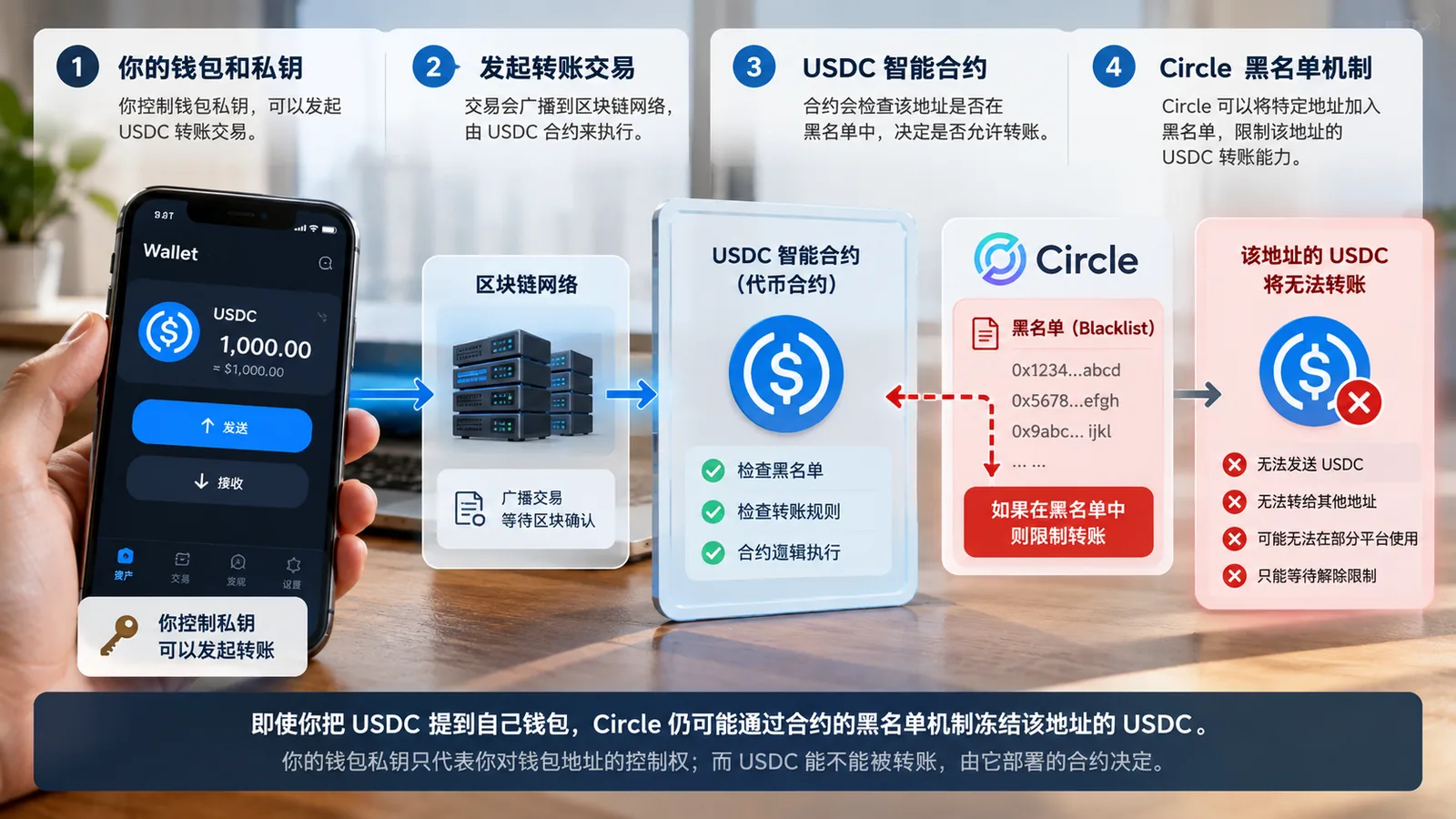
Suppose you withdraw 2,000 USDC from an exchange to a personal wallet on Ethereum.
Normally, you can sign transfers with your wallet.
But if that wallet address is blacklisted by the USDC contract, simply switching phones, re-importing the seed phrase, or connecting another wallet app won't lift the token contract's restriction on that address.
The reason is simple: the wallet interface changed, but the holding address on the blockchain and the USDC contract state didn't.
Self-custody solves the private-key control problem, not the issuer-freeze problem.
4. When might Circle freeze an address?
According to Circle's official USDC terms, address restrictions and freezes may involve suspected illegal activity, violation of applicable terms, and valid government legal orders.[2]
But avoid two misunderstandings:
First, not every failed USDC transfer means Circle froze your address.
Second, you can't conclude that USDC is immune to compliance investigation or related restrictions just because you haven't engaged in illegal activity.
You need to distinguish the following situations:
| Situation | Does it equal a Circle freeze? |
|---|---|
| Address added to the USDC contract blacklist | A token-layer restriction |
| Exchange restricting account withdrawal | Not necessarily |
| Wallet balance showing an anomaly | Not necessarily |
| Insufficient gas for the transfer | No |
| Recipient doesn't support the current network | No |
If USDC can't be sent out, first confirm which type of problem it is — don't immediately conclude the funds were confiscated by the issuer.
Also, being blacklisted, having token transfers restricted, and having funds legally disposed of are different concepts. Don't write them all as "Circle directly confiscates user funds."
5. How to check whether a USDC address is blacklisted?
This is the most important hands-on part of the article.
If you hold native USDC on Ethereum, you can view the verified USDC contract on Etherscan and try to read the blacklist state.
Step 1: confirm which network the USDC is on
Open your wallet or exchange records first and confirm which network the asset belongs to.
For example:
- Ethereum
- Base
- Arbitrum
- Solana
USDC on different networks can't use the same query interface just because it shares the same name.
In particular, distinguish Circle's native USDC from wrapped or bridged assets issued by other entities.
Step 2: find the official USDC contract for that network
Don't casually copy a contract address that just says "USDC" from a search engine.
First confirm the network and contract via the USDC contract addresses published by Circle, then open the block explorer for that network.
For example, the native USDC contract address on Ethereum mainnet is 0xA0b86991c6218b36c1d19D4a2e9Eb0cE3606eB48. You can verify the address on the Circle multi-chain USDC page, then open that contract page on Etherscan.[3]
Step 3: check the contract's read functions
On Etherscan, open the verified USDC contract page, find Contract, and look at the available Read as Proxy or the corresponding read entry.
If there's an isBlacklisted query method:
- Enter the wallet's public address you want to check;
- Click query;
- View the returned result.
| Query return value | Meaning |
|---|---|
true | The address is currently blacklisted by the corresponding USDC contract |
false | The address is not currently blacklisted by that contract |
Note that false only represents the current queried contract's blacklist state. It doesn't guarantee the exchange won't restrict withdrawals, that smart contracts won't error, or that the address can't be restricted in the future.
If the page doesn't have the same method names, don't force-apply Ethereum's instructions. Different contract versions and networks may use different implementations.
Checking blacklist status doesn't require connecting a wallet. The whole process only needs the wallet's public address — no seed phrase, no private key, no wallet connection, authorization, or transaction signing. Any page that asks you to connect a wallet, provide a private key, or authorize a contract in the name of "checking freeze status" should be treated as high risk.
6. What to do if USDC is frozen? Can it be unfrozen?
If you've confirmed via the correct contract that the address is blacklisted, first don't repeatedly pay fees trying to transfer.
In Circle's EVM contract design, there's permission to remove an address from the blacklist, but ordinary wallet holders can't invoke the admin permission themselves to lift the restriction.
Handle it in this order:
Step 1: save evidence. Record the relevant network, the wallet's public address, the correct USDC contract, the failed transaction's TxID, and the blacklist query result.
Step 2: distinguish the source of the freeze. If the exchange account can't withdraw, first check the exchange account notifications and official support; if the on-chain contract indeed shows the address is blacklisted, then consider the token issuer's process.
Step 3: contact through official channels. If it involves a Circle address restriction, consult Circle's official support and applicable terms; if it involves an exchange account restriction, handle it through the relevant exchange's official support channel.
Step 4: don't trust paid unfreezing services. Any so-called unfreezing solution that asks you to enter a seed phrase, hand over a private key, send a "verification fee" first, or authorize an unfamiliar contract should be treated as high risk.
That the Circle contract technically has an un-blacklist function doesn't mean all frozen addresses can appeal successfully, nor that there's a uniform unfreezing time.
7. USDC won't send: freeze, exchange risk control, or network problem?
Many users searching "USDC frozen" are actually hitting a different problem.
You can troubleshoot in this order:
| Symptom | Check first |
|---|---|
| Exchange shows withdrawal prohibited | Platform account notifications and risk-control status |
| Wallet says insufficient gas | Native-token balance on the current network |
| On-chain transaction failed | Transaction receipt and contract error |
Blacklist query returns true | The corresponding USDC contract restriction |
| Recipient shows no arrival | Network, TxID, contract, and platform deposit support |
For example, USDC transfers on Ethereum normally need ETH to pay gas. Even if your wallet has 1,000 USDC, you may not be able to send it out if you lack the ETH needed to pay the transaction fee.
That's not a Circle freeze.
Likewise, if you see "withdrawal paused" on an exchange, you can't directly infer that an on-chain address was added to the USDC blacklist.
The correct troubleshooting order is: network → balance and gas → transaction receipt → contract blacklist → platform risk control.
8. Are Circle's reserves safe? What's the difference from USDT?
The freeze mechanism is an important USDC risk, but not the only one.
Circle's public transparency page provides USDC reserve disclosure, including circulating supply, reserve assets, and third-party assurance reports. The reserves mainly involve cash, short-term US Treasury bills, and related highly liquid assets.
As of October 8, 2026, Circle's publicly disclosed reserves and circulating supply are roughly as follows (subject to the official transparency page):
| Item | Amount |
|---|---|
| USDC circulating supply | About $73 billion |
| Total reserve assets | About $73.2 billion |
| Reserve coverage | About 100.27% |
Note: the above is Circle's public data as of October 8, 2026. The reserve coverage is estimated from rounded figures shown on the official site, not a precise ratio published by an auditor. The data changes with issuance, redemption, and reserve changes.[4]
But you need to distinguish:
- Reserve coverage doesn't mean the price will never depeg.
- Monthly third-party assurance reports don't guarantee against all risks.
- Reserve asset quality can't eliminate the address-freeze ability.
During the 2023 Silicon Valley Bank incident, USDC noticeably dropped below $1, showing that banking and market liquidity risks can still affect a stablecoin's price.
USDT also has a centralized issuer's address-restriction mechanism. For the detailed differences in reserves, disclosure, market liquidity, and use cases, read What's the difference between USDT and USDC? Which is safer and how to choose (2026).
For users worried about freezes, the more critical point is:
Neither USDC nor USDT can provide a guarantee that the issuer is completely unable to interfere with token transfers.
9. FAQ
Can Circle freeze the USDC in my MetaMask?
That's possible. MetaMask manages the wallet and signing, but can't cancel Circle's address-restriction permission in the corresponding USDC contract.
After a USDC address is blacklisted, can it still receive coins?
In Circle's public EVM FiatToken contract design, a blacklisted address's token transfers in and out are both restricted. But the specific behavior on other networks or contract versions needs to be checked in the corresponding implementation.
After USDC is frozen, can I unfreeze it by switching wallets?
If the freeze is on the USDC contract state corresponding to the original wallet address, switching wallet apps, devices, or re-importing the same seed phrase won't lift the restriction. Whether the blacklist can be removed is decided by the authorized party and the applicable process.
Does a failed USDC transfer mean it's frozen?
No. Insufficient gas, an exchange pausing withdrawals, network errors, or contract execution failures can all cause a transfer to fail. You need to check the transaction record and the specific error reason first.
Can USDT also be frozen?
Yes. USDT also has an issuer's address-restriction ability. The two tokens' specific contract implementations and operating processes aren't identical, so you can't directly apply USDC's query method to USDT.
Data verification notes
The key facts in this article were verified on 2026-10-11 against Circle's official terms, contract docs, and transparency page, item by item as follows:
- Blacklist permission: Circle's EVM FiatToken contract includes permissions such as blacklist / unBlacklist / isBlacklisted, which can restrict specific addresses from receiving or sending USDC, but only affect the tokens within that contract. Source: Circle FiatToken contract design docs (blacklist and permissions).
- Freeze trigger scenarios: Circle's official USDC terms state that address restrictions may involve suspected illegal activity, violation of applicable terms, and valid government legal orders. Source: Circle USDC Terms of Service (freeze authority and address restrictions).
- Contract address: the native USDC contract on Ethereum mainnet is
0xA0b86991c6218b36c1d19D4a2e9Eb0cE3606eB48, and should be based on the contract address published by Circle. Source: Circle supported chains and assets. - Reserve data: as of October 8, 2026, USDC circulating supply is about $73 billion and reserve assets about $73.2 billion, with coverage of about 100.27%, estimated from rounded figures on the official site. Source: Circle USDC transparency page (reserve disclosure).
What to read next
- What's the difference between USDT and USDC? Which is safer and how to choose (2026) — a detailed comparison of reserves, liquidity, and use cases.
- Is USDT reliable? Tether reserves, depegging risk, and the freeze mechanism (2026) — understand USDT's issuer risk further.
- Where to put USDT bought on Binance/OKX? Exchange or wallet (2026) — understand the difference between exchange custody and self-custody.
- Sent to the wrong network? Withdrawal networks and wallet addresses (2026) — troubleshoot network and address errors.
Disclaimer
This article is only for educating about stablecoin security mechanisms and transfer risk, and does not constitute investment advice. USDC contract mechanisms and query entries may differ across blockchains; actual operations should be based on the official contract and platform announcements of the corresponding network.
- 2026-10-17UpdateAdded evidence-chain superscripts and "Data verification notes".
See ourEditorial Policy and the correction process in ourCorrections Policy.
The CoinTrailHub editorial team focuses on crypto education for beginners, exchange security and P2P trading risk. This article is compiled from official sources and public data, reviewed by humans, and strives for accuracy but is not investment advice.
Last updated:2026-10-11 · Content reviewed by humans · Learn more
© 2026 CoinTrailHub · Original content. Reproduction or rewriting without permission is prohibited.