
What is a stablecoin? How it differs from US dollars and bank deposits + USDT vs USDC for beginners (2026)
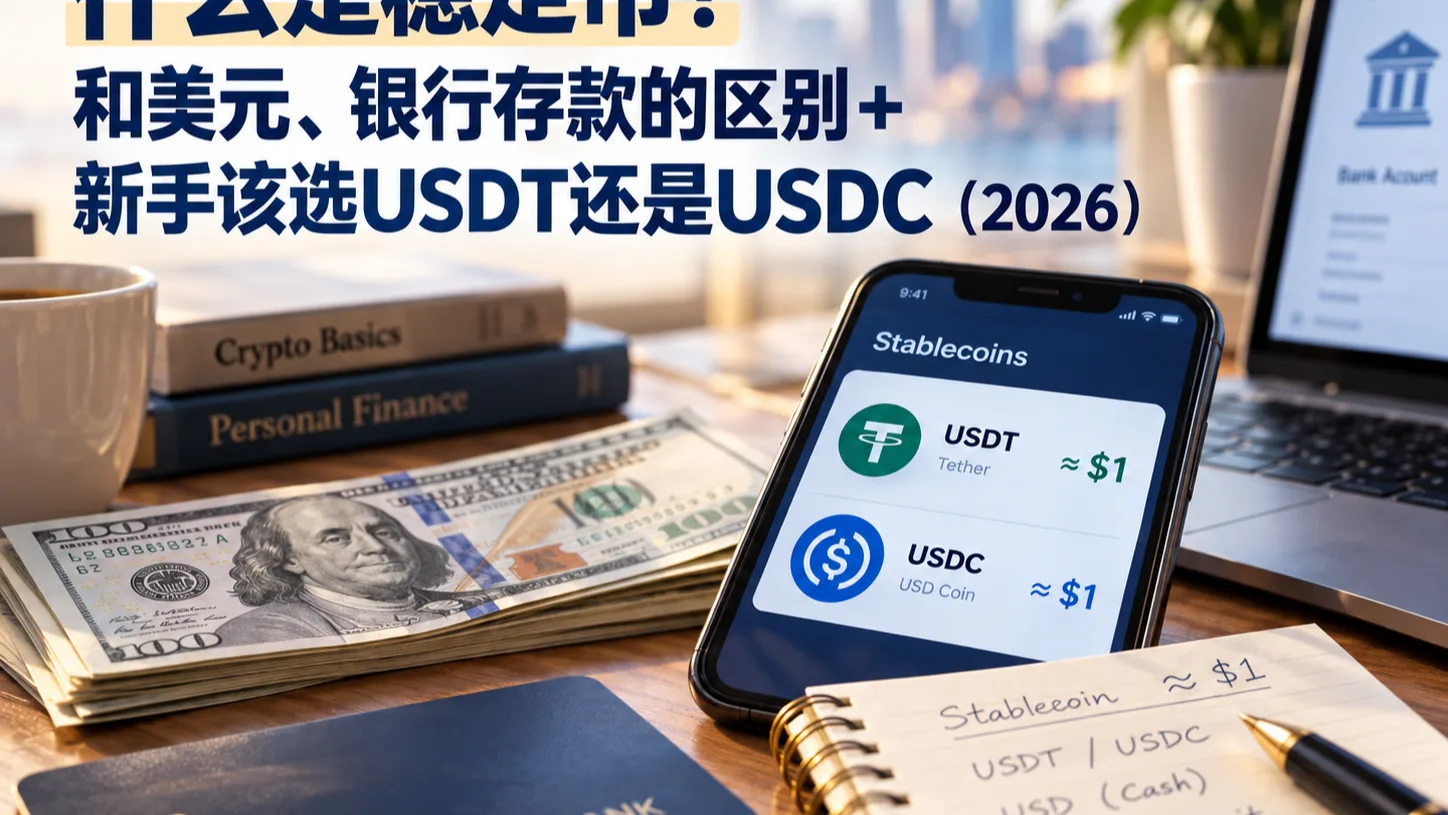
Table of contents

Binance new user rewards
20% trading fee rebate
Official Binance registration. Complete identity verification (KYC) to trade and withdraw.
A stablecoin is a type of crypto asset pegged to assets such as the US dollar, designed to keep its price as stable as possible. The most common are USDT and USDC, which usually target 1 coin ≈ 1 dollar. They are neither dollar cash nor bank deposits.
Which one should a beginner pick first? For trading, P2P buying/selling, and transfers between platforms, most people look at USDT first; if you care more about reserve transparency and public disclosure, it's worth learning about USDC.
This article mainly answers three questions:
- How exactly do stablecoins differ from US dollars and bank deposits?
- Why can a stablecoin stay near 1 dollar?
- For first-time use, should you choose USDT or USDC?
Remember the single most important line first: a price near 1 dollar does not mean it's as safe as 1 dollar in a bank.
Risk note: this article is for stablecoin fundamentals and practical usage and does not constitute investment advice. A stablecoin is not a bank deposit, and there is no guarantee that "it has stayed near 1 dollar for a long time, so your principal is definitely safe."
Core info: understand stablecoins in 30 seconds
| Beginner question | Direct answer |
|---|---|
| What is a stablecoin? | A type of crypto asset whose price is designed to stay relatively stable; the most common are USD stablecoins |
| Are USDT and USDC US dollars? | No, they are crypto assets pegged to the US dollar |
| Is a stablecoin a bank deposit? | No, holding a stablecoin is not the same as holding a deposit-protected bank balance |
| Does 1 USDT always equal 1 dollar? | No, it normally stays near 1 dollar but can depeg under market stress |
| Can a stablecoin go wrong? | Yes — issuer, reserve, depeg, freeze, exchange, and wallet risks |
| USDT or USDC for a beginner? | For trading, P2P, and transfers, look at USDT first; if you care about reserve disclosure, look into USDC |
| Is a stablecoin a substitute for a bank deposit? | No — the legal relationship and risk protection are completely different |
Remember in one line
A stablecoin solves "price stability as much as possible" — not "funds that are absolutely safe."
USDT or USDC? The short answer first
Direct answer: if you mainly use it for P2P buying/selling, trading BTC/ETH, or transferring between exchanges, look at USDT first; if you care more about reserve disclosure, third-party attestation, and public verification, it's worth learning about USDC.
Neither is a bank deposit, and neither is a zero-risk asset.
| Main use | Look at first | Why |
|---|---|---|
| P2P buying/selling | USDT | Most platforms' fiat trading scenarios center on USDT |
| Buying/selling BTC, ETH | USDT | Trading-pair coverage and market liquidity are usually wider |
| Transfers between exchanges | USDT | Platform and network support is usually broader |
| On-chain DeFi | USDT / USDC | Depends on the specific chain and protocol support |
| Care more about public reserve info | USDC | Circle provides relatively frequent reserve disclosure and third-party attestation |
| Cannot accept issuer freezing at all | Neither fits | USDT and USDC are both centrally issued stablecoins |
Table of contents
- What exactly is a stablecoin?
- Why can a stablecoin stay near 1 dollar?
- How do stablecoins differ from US dollars and bank deposits?
- What types of stablecoins are there?
- What are the main stablecoins?
- How are USDT, USDC, RLUSD, and USDS related?
- USDT or USDC for beginners?
- Why do stablecoins depeg?
- What are the risks of stablecoins?
- What changed in stablecoin regulation in 2026?
- What do USDT and USDC reserves look like now?
- The two easiest beginner mistakes
- When does it make sense to use a stablecoin?
- What else should you learn before your first use?
- FAQ
What exactly is a stablecoin?
A stablecoin is a type of crypto asset pegged to assets such as the US dollar, which keeps its price as stable as possible through reserves, collateral, redemption, or other mechanisms.
The most common ones on the market today are USD stablecoins.
For example, 1 USDT ≈ 1 dollar, 1 USDC ≈ 1 dollar. The most important symbol here is "≈" rather than "=", because a stablecoin's target is to stay near 1 dollar, but the market trading price can still fluctuate.
USDT and USDC can be used to:
- Transfer on a blockchain;
- Deposit into an exchange;
- Withdraw to a personal wallet;
- Buy BTC and ETH;
- Make some on-chain payments;
- Be used in DeFi protocols.
For example, if you buy 1,000 USDT via Binance P2P, you can then:
- Buy BTC with USDT;
- Buy ETH with USDT;
- Send it to another exchange;
- Withdraw it to your own wallet;
- Use it in on-chain apps that support USDT.
So from a usage experience perspective, a stablecoin is a lot like a "digital dollar tool" in the crypto market; but from a legal and risk perspective, it is not the same as dollars in a bank account.
Why can a stablecoin stay near 1 dollar?
Fiat-backed stablecoins like USDT and USDC keep their price near 1 dollar mainly through reserve assets, an issuance-and-redemption mechanism, and market arbitrage working together.
You can think of it as three layers.
1. Reserve assets
The issuer holds reserve assets to back the stablecoins already issued.
Different stablecoins have different reserve structures, which may include:
- Cash;
- Short-term US Treasury bills;
- Overnight repos;
- Other assets that meet the issuer's reserve policy.
So when judging a stablecoin's risk, you shouldn't only look at "is it at 1 dollar right now" — you should also look at "what assets actually back it."
2. Issuance and redemption
Eligible institutional clients can usually, under the rules, go dollars → mint stablecoins, or stablecoins → redeem dollars. As long as this issuance-and-redemption system runs normally, arbitrage opportunities can arise when the stablecoin's price clearly deviates from 1 dollar.
3. Market arbitrage
A simplified example: suppose a USD stablecoin drops to 1 coin = 0.98 dollars. If market participants still believe it can ultimately be redeemed at close to 1 dollar, they may buy it cheaply.
Conversely, if a stablecoin is clearly above 1 dollar, people may increase supply by issuing or selling.
So the price stability of fiat-backed stablecoins usually comes from reserve assets + issuance/redemption + market arbitrage working together.
Body image 1: Why a stablecoin stays near 1 dollar — the three layers of reserve assets, issuance/redemption, and market arbitrage
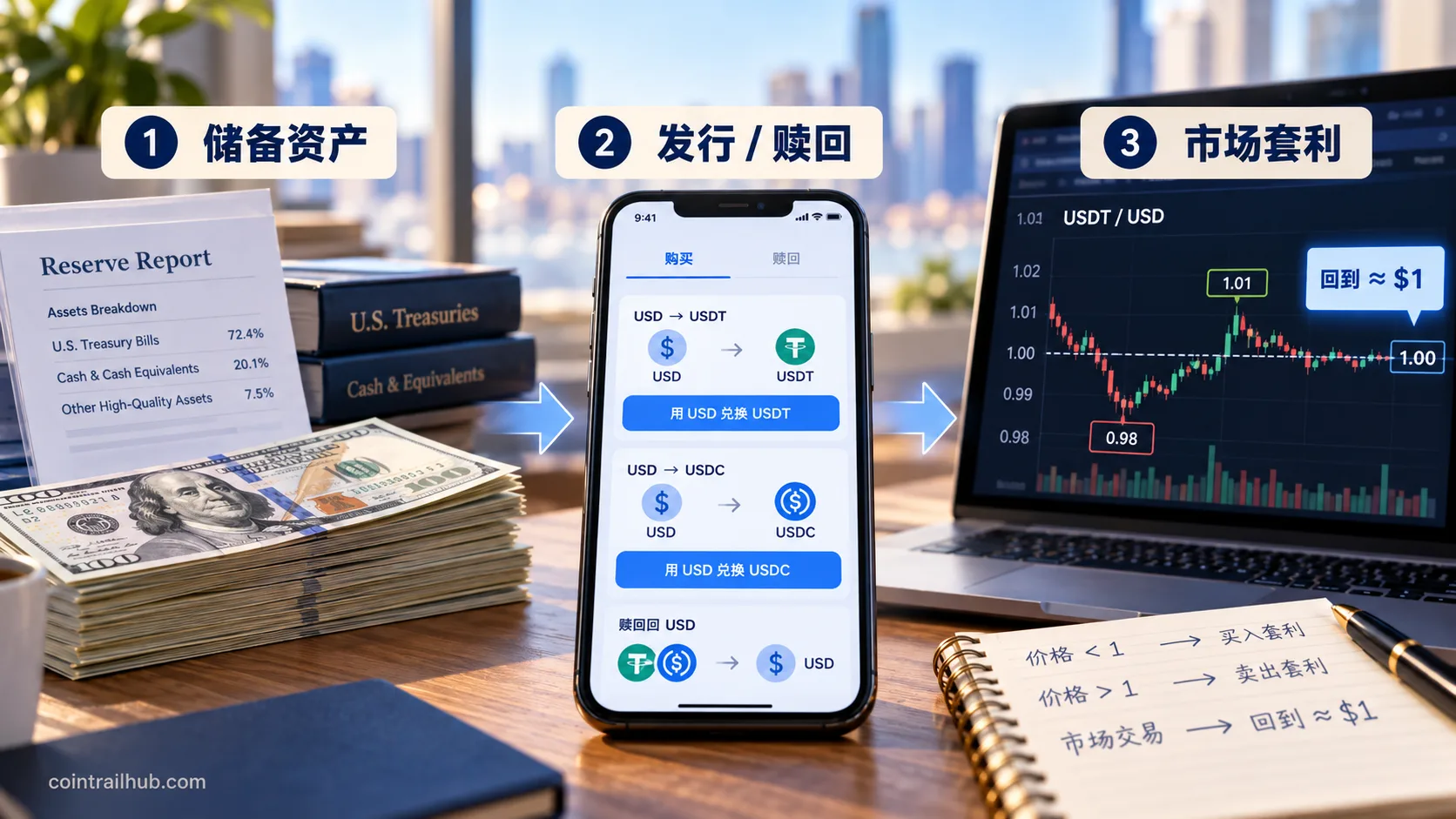
Figure: the basic mechanism by which a fiat-backed stablecoin maintains its peg. Reserve assets provide the foundation, issuance and redemption form the conversion channel, and market arbitrage helps the price return toward 1 dollar after a deviation.
This also explains why, when the market suddenly starts doubting:
- Whether the reserves are enough;
- Whether the reserves are real;
- Whether the banks are sound;
- Whether redemption can still happen smoothly;
the stablecoin can depeg.
How do stablecoins differ from US dollars and bank deposits?
The biggest difference is in legal nature and protection mechanisms: a stablecoin is a crypto asset, a dollar is fiat currency, and a bank deposit is a deposit liability the bank owes the depositor.
The three cannot simply be treated as equal.
| Dimension | Stablecoins like USDT / USDC | US dollar cash | Bank dollar deposit |
|---|---|---|---|
| Nature | A crypto asset on a blockchain | US fiat currency | A deposit liability the bank owes the depositor |
| Basis of value | Reserve assets, redemption mechanism, and market confidence | The US monetary system | The banking system and related legal protections |
| Target price | Usually pegged to 1 dollar | Is itself a dollar | Denominated in dollars |
| Can it depeg? | Yes | A dollar can't depeg against itself | A balance usually doesn't depeg due to secondary-market trading |
| Deposit insurance | A stablecoin itself is not an insured deposit | Not applicable | Eligible deposits may be covered by local deposit insurance |
| On-chain transfers | Yes | Can't transfer directly on-chain | Usually through bank payment networks |
| Can it be frozen? | Some centralized stablecoins can restrict specific addresses | Not applicable | An account may be restricted by judicial action, sanctions, or bank risk control |
Body image 2: the core differences between stablecoins, dollar cash, and bank deposits

Figure: USDT and USDC are pegged to the US dollar, but they are still crypto assets — not dollar cash and not bank deposits. The three differ clearly in legal nature, deposit insurance, transfer method, and account-restriction mechanisms.
The easiest misunderstanding here is: "bank deposits have deposit insurance" does not mean "every bank in every country, every account type, and any amount is unlimitedly protected." For example, US FDIC deposit insurance has specific rules about eligible institutions, account types, and legal coverage limits; and a stablecoin does not automatically become a bank deposit just because it has USD in its name.
So the more accurate statement is:
USDT and USDC are crypto assets pegged to the US dollar, not a digital version of a bank dollar deposit.
What types of stablecoins are there?
Stablecoins can be classified by "what keeps their price stable." Beginners most often encounter fiat-backed stablecoins such as USDT and USDC.
There are mainly three types.
Type 1: fiat-backed stablecoins
Common examples:
- USDT
- USDC
- RLUSD
These are usually issued by centralized institutions and hold reserves such as cash and US Treasury bills.
Advantages typically include:
- The mechanism is relatively easy to understand;
- Wide exchange support;
- Good market liquidity;
- A relatively clear issuance-and-redemption mechanism.
Main risks include:
- Issuer risk;
- Reserve asset risk;
- Custodian risk;
- Bank risk;
- Regulatory risk;
- Address freeze risk.
For the vast majority of beginners, this is the first type they encounter.
Type 2: crypto-collateralized or on-chain stablecoins
Common representative systems include:
- DAI
- USDS
These stablecoins usually maintain their price through:
- Crypto collateral;
- Over-collateralization;
- Liquidation mechanisms;
- On-chain governance;
- A combination of multiple reserve assets.
To judge the risk of these stablecoins, you additionally need to look at:
- What the collateral is;
- What the collateralization ratio is;
- Who can change protocol parameters;
- How liquidation works in extreme markets;
- Whether reserves also contain other centralized stablecoins or real-world assets.
So you can't simply read "decentralized stablecoin" as "no centralized risk at all."
Type 3: algorithmic or incentive-driven stablecoins
These stablecoins may mainly rely on:
- Algorithms;
- Arbitrage;
- Dual-token mechanisms;
- Market incentives;
to maintain their price, rather than directly relying on full dollar reserves.
One of the most famous risk cases is TerraUSD (UST): in May 2022, UST depegged severely, and its mechanism ultimately entered a death spiral.
The most important lesson for beginners from this case is:
Having Stable, USD, or Dollar in the name does not mean it's a low-risk asset.
What are the main stablecoins?
USDT (Tether) is a centralized, fiat-backed stablecoin issued by Tether, pegged to 1 dollar; USDC is a centralized, fiat-backed stablecoin issued by Circle, pegged to 1 dollar. Beginners don't need to study dozens of stablecoins at the start — understanding these two usually covers most real usage.
| Stablecoin | Issuer / system | Main characteristics |
|---|---|---|
| USDT | Tether | Large scale; wide coverage in exchanges, P2P, and transfers |
| USDC | Circle | Relatively frequent reserve disclosure; broad institutional and on-chain usage |
| RLUSD | Ripple | US dollar stablecoin launched by Ripple |
| DAI / USDS | Maker / Sky ecosystem | Mechanism differs from centralized fiat-backed stablecoins |
When judging a stablecoin, don't just look at the name. At least check:
- Who issues it?
- What assets back it?
- Can it be redeemed?
- Are reserves publicly disclosed?
- Does the issuer have freeze powers?
How are USDT, USDC, RLUSD, and USDS related?
To make it easier for beginners, you can put several common stablecoins in one entity-relationship table.
| Stablecoin | Type | Issuer / system | Main peg target | Centrally issued? |
|---|---|---|---|---|
| USDT | Fiat-backed | Tether | 1 dollar | Yes |
| USDC | Fiat-backed | Circle | 1 dollar | Yes |
| RLUSD | Fiat-backed | Ripple | 1 dollar | Yes |
| USDS | On-chain stablecoin system | Sky | 1 dollar | Mechanism differs from USDT / USDC |
So USDT, USDC, and RLUSD are all USD stablecoins, but with different issuers, reserve structures, regulation, and use cases — similar names do not mean identical risk.
USDT or USDC for beginners?
If you mainly use it for trading, P2P, buying/selling BTC/ETH, and cross-exchange transfers, look at USDT first; if you care more about reserve transparency and public verification, it's worth learning about USDC.
This isn't a question of "which is definitely safer" but "which fits your use case." For a direct item-by-item comparison, see USDT vs USDC: which is safer and how to choose.
Body image 3: USDT or USDC for beginners? Decide by use case
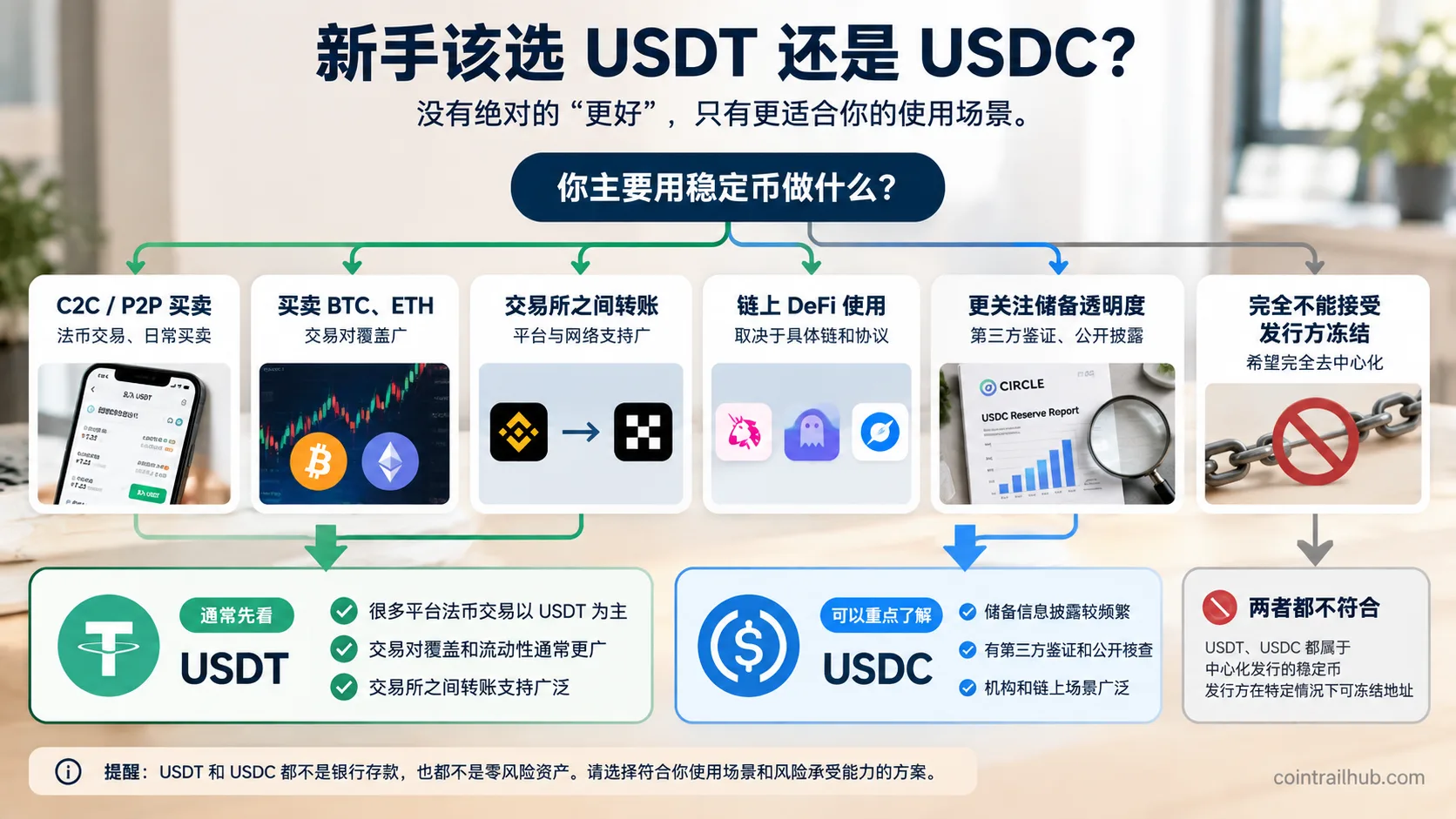
Figure: there is no absolute "which is better" between USDT and USDC. For P2P, trading, and cross-platform transfers, USDT is usually more common; if you care about reserve transparency and public verification, look into USDC; if you cannot accept a centralized issuer freezing an address at all, neither meets that requirement.
Who is USDT better for?
If you mainly:
- Trade on exchanges like Binance or OKX;
- Buy and sell stablecoins via P2P;
- Use it as a funding bridge before buying BTC or ETH;
- Transfer between multiple platforms;
you'll usually encounter USDT earlier.
USDT's main strengths are liquidity, trading depth, platform coverage, and breadth of use. But to be clear: USDT being more widely used does not mean it is definitely safer than USDC. To understand USDT on its own, start with What is USDT? Tether's uses and risks.
Who is USDC better for?
If you particularly care about:
- Reserve composition;
- Reserve disclosure;
- Third-party attestation;
- Institutional-grade on-chain applications;
USDC is worth learning about.
Circle continuously publishes USDC reserve information, and its reserve system mainly includes:
- Cash;
- Short-term US Treasury bills;
- Overnight US Treasury repos and other highly liquid assets.
So one of USDC's main strengths is that reserve information is relatively easy to keep publicly verifying, but you still can't conclude USDC = risk-free. To learn more about USDC's risks, see Is USDC safe? Circle reserves, the freeze mechanism, and how it differs from USDT.
The most core difference between USDT and USDC
A simple way to remember: USDT has wide coverage, strong trading depth, and many P2P/trading scenarios; USDC has relatively high reserve disclosure transparency and more direct public verification. It is not the binary of USDT = unsafe, USDC = safe.
Why do stablecoins depeg?
A stablecoin usually depegs when the market starts doubting the issuer, the reserve assets, redemption ability, banking channels, or the stability mechanism.
A "depeg" is when a stablecoin's market price clearly deviates from its target price. For example, if the target was 1 coin = 1 dollar, under market stress it might become 0.99 dollars, 0.98 dollars, or even lower.
The common causes are as follows.
1. Reserves questioned
The market may suddenly start doubting:
- Whether the reserves are real;
- Whether the reserves are sufficient;
- The quality of the reserve assets;
- Whether they can be liquidated quickly.
Once confidence drops, selling pressure can rise.
2. Redemption channel blocked
Even if on-paper reserves are sufficient, if a large number of redemptions happen in a short time and there are problems with:
- Banking channels;
- Issuer processes;
- Fund settlement;
- Liquidity;
it can also cause secondary-market price volatility.
3. Bank or custodian risk
Fiat stablecoins don't run completely outside the traditional financial system.
Their reserves may still involve:
- Banks;
- Custodians;
- The US Treasury market;
- The repo market.
If any key link has problems, it can also affect market confidence.
4. Extreme market panic
Stablecoins also trade freely on exchanges and on-chain markets. In extreme cases, when many users sell at once, the price can deviate from 1 dollar in a short time.
So:
A stablecoin's "stability" is the result of a mechanism that keeps running — it is not code guaranteeing it always equals 1 dollar.
What are the risks of stablecoins?
The biggest stablecoin misconception is treating "price stability" as "no risk to funds." In fact, stablecoins still carry issuer, reserve, depeg, freeze, exchange, wallet, and smart-contract risks, among others.
| Risk | What it means |
|---|---|
| Issuer risk | A centralized stablecoin depends on the issuing institution continuing to operate normally |
| Reserve risk | The quality, liquidity, and custody of reserve assets affect redemption ability |
| Depeg risk | The market price may deviate from the target price temporarily or even for a long time |
| Freeze risk | Some centralized stablecoin issuers can restrict specific addresses |
| Exchange risk | Keeping a stablecoin on an exchange means taking on platform custody risk |
| Wallet risk | Self-custody means bearing the risk of losing or leaking private keys and seed phrases |
| Smart-contract risk | Using DeFi means taking on protocol-vulnerability and smart-contract risk |
| Network risk | Sending on the wrong chain or to the wrong address can make assets hard to recover |
A key note: withdrawing USDT or USDC to your own wallet does not make the issuer's contract powers disappear. Self-custody mainly solves "assets are no longer held by the exchange for you," but it does not automatically solve:
- Stablecoin issuer risk;
- Reserve risk;
- Depeg risk;
- Contract-level freeze risk.
So self-custody ≠ eliminating all of a stablecoin's own risks.
What changed in stablecoin regulation in 2026?
As of 2026, stablecoin regulation is clearly becoming institutionalized. The US GENIUS Act has been signed into law, but it should not be read as the entire regulatory framework already being fully implemented.
The GENIUS Act is now law
The US GENIUS Act was officially signed into law on July 18, 2025.
It establishes a federal-level regulatory framework for payment stablecoins and involves:
- Reserve asset requirements;
- Information disclosure;
- Issuer eligibility;
- Compliance requirements;
- Risk management;
- Redemption mechanisms.
One of its core directions is to make the reserves, issuance, and disclosure standards of payment stablecoins more institutionalized.
But "already law" does not mean "all rules are already implemented"
As of October 4, 2026, the more accurate statement is: the GENIUS Act has been passed, and regulators are still advancing the specific implementing rules and the regulatory framework. So it is not recommended to simply write "the US stablecoin law is fully implemented."
Ordinary beginners don't need to memorize all the legal details — they just need to understand one trend:
Mainstream USD stablecoins will face clearer reserve, issuance-eligibility, disclosure, and regulatory requirements going forward.
But even with clearer regulation, you can't conclude "stablecoins will have no risk from now on" — regulation can only reduce some risks, not eliminate all of them.
What do USDT and USDC reserves look like now?
Reserve assets are one of the most important indicators for judging whether a fiat-backed stablecoin is sound, but reserve structures change, so you should rely on the issuer's latest official disclosure.
USDT
In its Q2 2026 disclosure on the official reserve page, Tether stated that as of June 30, 2026, roughly $184.6 billion of USDT was in circulation, with reserves remaining heavily concentrated in short-duration, high-quality, highly liquid assets.
The point for beginners isn't to memorize a specific percentage, but to look at:
- Total reserves;
- Share of US Treasuries;
- Cash and cash equivalents;
- Share of other assets;
- The latest reserve report;
- Third-party attestation documents.
Because these numbers change over time.
USDC
Circle continuously publishes USDC reserve information on its official transparency page.
USDC reserves mainly include:
- Cash;
- Short-term US Treasury bills;
- Overnight US Treasury repos and other highly liquid assets.
Circle also continuously discloses reserve composition, USDC circulation, minting and redemption changes, and third-party attestation. So if you care a lot about "whether I can keep checking the reserves myself," USDC's public materials are usually easier to look up; still, sufficient reserve disclosure ≠ no risk.
The two easiest beginner mistakes
Mistake 1: seeing $1.00 and thinking it's the same as a bank deposit
This is the most common stablecoin misconception. An exchange may show USDT $1.00 for a long time, but that price only tells you the market is currently willing to buy and sell 1 USDT for about 1 dollar. It doesn't automatically tell you:
- Who issues it;
- Where the reserves are;
- How good the reserves are;
- Whether there is deposit insurance;
- Whether redemption works normally;
- Who has freeze powers;
- What happens if the platform fails.
So don't derive price stability directly into principal is absolutely safe.
Mistake 2: assuming it's safe because "USD" is in the name
The market has many tokens named XXXUSD, USDXXX, XXX Dollar, or XXX Stable. But USD is not a safety certification, and Stable is not a regulatory certification.
To judge a stablecoin, at least check:
- Who issues it?
- What assets back it?
- Can it be redeemed?
- Is there public disclosure?
- Are there freeze or admin powers?
If you can't answer these five questions at all, don't assume it's low-risk just because the name looks like dollars.
When does it make sense to use a stablecoin?
A stablecoin is better suited as a tool for trading, transfers, on-chain settlement, and short-term fund bridging — not simply as a substitute for a bank deposit.
| Your situation | The more practical choice |
|---|---|
| Planning to buy BTC, ETH | USDT is usually more common |
| P2P buying/selling | Check the USDT market on the platform first |
| Short-term trading funds | USDT / USDC both work; choose by trading pair |
| Cross-wallet transfers | First confirm the coin and blockchain network both sides support |
| DeFi | Choose USDT or USDC based on the specific protocol |
| Especially care about reserve disclosure | Look into USDC |
| Large long-term savings | Don't treat a stablecoin as a simple bank-deposit substitute |
| Cannot accept issuer freezing at all | Neither USDT nor USDC meets this requirement |
A simple decision order is:
Step 1: what do I want to do with the stablecoin?
↓
Step 2: what do the platform, wallet, and network support?
↓
Step 3: then compare the convenience and risks of USDT and USDC.
This is more practical than first asking "which stablecoin is best?".
What else should you learn before your first use?
When first encountering stablecoins, beyond understanding the difference between USDT and USDC, the more important thing is to learn how to buy them, how to choose a network, and where to keep them after buying.
1. How to buy stablecoins?
The first step is usually fiat → USDT / USDC. If you mainly use Binance or OKX, continue with: How to buy USDT for the first time: a complete tutorial from registration to arrival (works for Binance/OKX).
This kind of tutorial should focus on:
- Registration;
- KYC;
- Buying;
- P2P;
- Confirming arrival;
- The first transfer.
2. Which network should you choose for transfers?
This is where beginners most often suffer real fund losses. The same USDT can exist on different blockchain networks, such as:
- Ethereum
- Tron
- BNB Smart Chain
- Arbitrum
- Solana
- Other supported networks
So the same coin does not mean you can pick any network — when transferring, you must confirm that the network the sending platform supports and the network the receiving platform supports match. For example, USDT-TRC20 → the recipient must support USDT-TRC20; you can't pick another chain just because it's all USDT.
3. Keep it on the exchange or in a wallet after buying?
After buying stablecoins, you still have to decide whether to keep them on the exchange or withdraw to your own wallet — the risks differ.
Keeping on an exchange
Advantages:
- Simple to operate;
- Convenient to trade;
- No need to manage a seed phrase yourself.
Risks:
- You bear platform custody risk;
- The account may be subject to risk control or restrictions.
Keeping in a personal wallet
Advantages:
- You control the private key;
- No longer fully reliant on exchange custody.
Risks:
- Losing the private key;
- Leaking the seed phrase;
- Sending on the wrong chain;
- Sending to the wrong address;
- Phishing approvals.
Continue with: Where should you keep USDT bought on Binance/OKX? Exchange or wallet (2026).
FAQ
What is a stablecoin?
A stablecoin is a type of crypto asset whose target price stays relatively stable. The most common are USD stablecoins such as USDT and USDC, which usually target 1 coin near 1 dollar, but that does not mean the price never changes.
Is a stablecoin the same as the US dollar?
No. The dollar is fiat currency; USDT and USDC are crypto assets pegged to the US dollar. So 1 USDT ≈ 1 dollar does not equal 1 USDT is 1 dollar in a bank account.
Is a stablecoin a bank deposit?
No. A stablecoin is not a bank deposit, and it doesn't automatically get deposit insurance just because its price is near 1 dollar. The legal relationship, asset protection, and risk structure of a bank deposit and a stablecoin are completely different.
Is USDT a stablecoin?
Yes. USDT (Tether) is one of the most common USD stablecoins, usually targeting 1 USDT ≈ 1 USD, and is widely used for exchange trading, P2P, cross-platform transfers, and on-chain payments.
Is USDC a stablecoin?
Yes. USDC is a USD stablecoin issued by Circle, also targeting 1 USDC near 1 dollar. One of its main features is relatively frequent reserve disclosure, making public verification easier.
Can a stablecoin depeg?
Yes. If the market doubts the issuer, reserve assets, banking channels, or redemption ability, a stablecoin's price can deviate from 1 dollar. This deviation is called a depeg.
Can a stablecoin go to zero?
No stablecoin can promise it will never fail. The risk depends on:
- The stability mechanism;
- The reserve assets;
- The issuer;
- Redemption ability;
- Market liquidity;
- The regulatory environment.
History has already seen cases like UST where the stability mechanism failed, so you can't assume that just because a coin is called a "stablecoin," it has no extreme risk.
Which is safer, USDT or USDC?
You can't simply say one is absolutely safer. USDT's main strengths are:
- Strong liquidity;
- Wide exchange coverage;
- Many P2P and transfer scenarios.
One of USDC's main strengths is:
- Relatively frequent reserve disclosure;
- Easier public verification;
- A relatively clear third-party attestation mechanism.
Both are centrally issued stablecoins, and both carry issuer, regulatory, and address-restriction risks.
Which is better for a beginner, USDT or USDC?
For trading, P2P, and cross-platform transfers, beginners usually encounter USDT earlier; if you care more about reserve transparency, look into USDC. The final choice should depend on your use case, not just asking which coin is "best."
Can USDT and USDC be frozen?
It's possible. USDT and USDC are centrally issued stablecoins, and issuers hold certain smart-contract admin powers. In cases involving sanctions, judicial requests, illegal-activity investigations, or compliance requirements, specific addresses may be restricted. Even if a stablecoin has been withdrawn to a personal wallet, the issuer's contract powers do not disappear.
Are stablecoins suitable for long-term saving?
It's not recommended to treat a stablecoin as a simple substitute for a bank deposit. A stablecoin still carries:
- Issuer risk;
- Reserve risk;
- Depeg risk;
- Freeze risk;
- Wallet risk;
- Exchange risk.
For large long-term funds, you should understand these risks first.
What should you pay most attention to on your first stablecoin use?
First confirm the coin, the network, and the address. On your first use, especially remember to:
- Confirm you're buying the correct stablecoin;
- Confirm the sending and receiving networks match;
- Check the receiving address;
- Do a small test transfer before a large one.
For beginners, these practical steps usually matter more than agonizing over a few cents' price difference between USDT and USDC.
Related reads
What is USDT? Tether's uses and risks (2026) — to understand USDT on its own, start here.
USDT vs USDC: which is safer and how to choose (2026) — a direct comparison of the two main stablecoins.
Is USDT reliable? Tether reserves, depeg risk, and the freeze mechanism (2026) — focus on Tether's reserves, depeg, and freeze risks.
Is USDC safe? Circle reserves, the freeze mechanism, and how it differs from USDT (2026) — focus on Circle's reserves and USDC risks.
How to buy USDT for the first time: a complete tutorial from registration to arrival (works for Binance/OKX) — the full steps from registration to buying to arrival.
Where should you keep USDT bought on Binance/OKX? Exchange or wallet (2026) — how to store stablecoins after buying.
Disclaimer
This article is for stablecoin fundamentals education and practical usage only, and does not constitute investment, financial, or trading advice.
Stablecoins may involve:
- Issuer risk;
- Reserve risk;
- Depeg risk;
- Address-freeze risk;
- Regulatory risk;
- Exchange risk;
- Wallet-security risk;
- Smart-contract risk;
- Blockchain-network risk.
A stablecoin is not a bank deposit, and just because its price has stayed near 1 dollar for a long time does not mean it has the same risk profile as dollars in a bank account.
When buying, depositing, withdrawing, transferring, or authorizing on-chain, please confirm:
- You are using official channels;
- The coin is correct;
- The blockchain network matches;
- The receiving address is correct;
- Do a small test transfer before a large one.
Operate only after understanding the relevant risks.
See ourEditorial Policy and the correction process in ourCorrections Policy.
The CoinTrailHub editorial team focuses on crypto education for beginners, exchange security and P2P trading risk. This article is compiled from official sources and public data, reviewed by humans, and strives for accuracy but is not investment advice.
Last updated:2026-10-04 · Content reviewed by humans · Learn more
© 2026 CoinTrailHub · Original content. Reproduction or rewriting without permission is prohibited.