
Is USDT reliable? Tether reserves, depegging risk, and the freeze mechanism (2026)
Table of contents

Binance new user rewards
20% trading fee rebate
Official Binance registration. Complete identity verification (KYC) to trade and withdraw.
Is USDT reliable? A 30-second answer
USDT can be used normally for trading, transfers, and short-term cash management, but it should not be understood as an "absolutely safe digital dollar" or a bank deposit.
As of October 3, 2026, a few important facts for judging whether USDT is reliable:
- USDT is backed by real reserves. Tether's reserves are currently concentrated mainly in short-term, highly liquid assets such as US Treasury bills.
- Tether has completed a full financial-statement audit. In August 2026, KPMG U.S. completed Tether International's first full independent audit of its 2025 annual financial statements, with an unqualified opinion.
- USDT has depegged before. During market-stress periods such as 2018 and 2022, USDT deviated from $1 to varying degrees.
- USDT can be frozen. Tether retains the ability to freeze addresses; even if you withdraw USDT to a wallet where you control the private key, this ability still exists.
- USDT is not a bank deposit. Holding USDT still carries issuer, reserve, depegging, freeze, platform, and regulatory risks.
So the more accurate conclusion is:
USDT is one of the largest, most liquid, and most widely accepted centralized stablecoins, but "mainstream" and "staying near $1 for the long term" do not equal zero risk.
If you only use a small amount for trading, transfers, or short-term needs, USDT is a very common tool; if you plan to put a large amount of money into USDT for the long term, you need to also consider issuer, custody, and concentration risk.
About 8 minutes to read. First remember two things: in August 2026 Tether completed its first full annual audit, but an audit does not equal zero risk; and the issuer's address-freeze authority does not disappear just because you withdraw USDT to a self-custody wallet.
Is USDT safe? The 7 questions you actually need to look at
| Your concern | Direct answer |
|---|---|
| Is USDT reliable? | It can be used normally, but it is not a risk-free asset |
| Can USDT collapse or go to zero? | Extreme risk cannot be ruled out; no one can promise it will never happen |
| Does USDT have real reserves? | Yes, reserves are mainly highly liquid assets such as US Treasury bills |
| Does Tether have a full audit? | Yes. It completed its first full annual financial-statement audit in 2026 |
| Can USDT depeg? | Yes, it has happened before in history |
| Can USDT be frozen? | Yes, Tether has the ability to freeze addresses |
| Can it still be frozen in a cold wallet? | Yes. A cold wallet controls the private key, not Tether's token-layer authority |
If you just want to judge "can USDT be used," the answer is yes.
But if what you really mean is "if I keep a large amount of money in USDT long-term, could it suddenly disappear one day," then you shouldn't just look at whether it's currently at $1 — you should keep reading about reserves, audit, redemption, depegging, and the freeze mechanism below.
Table of contents
- What is USDT and why it stays near $1
- What USDT's reserves actually are
- Are Tether's reserves enough
- Does Tether now have a full audit
- Can USDT collapse or go to zero
- Why does USDT depeg
- How many times has USDT depegged in history
- Can USDT be frozen
- Why it can still be frozen in your own wallet
- Which is more reliable, USDT or USDC
- Is USDT suitable for long-term large savings
- FAQ
What is USDT? Why can it stay near $1?
USDT (Tether USDt) is a centralized dollar stablecoin issued by Tether, designed so that:
1 USDT ≈ 1 USD.
It is not the dollar itself, and it is not a bank deposit.
USDT staying near $1 over the long term relies on three core mechanisms:
First, reserves. Tether holds reserve assets to back the USDT it has issued.
Second, issuance and redemption. Eligible institutional clients can process USDT through Tether's issuance and redemption system.
Third, market arbitrage. When USDT on the secondary market deviates clearly from $1, as long as the issuance and redemption mechanism still works, arbitrage activity usually pushes the price back toward the target price.
So USDT's stability is not because "the code mandates it always equals $1," but because: reserve assets + redemption ability + market arbitrage, together, keep it as close to $1 as possible.
For the basic use cases, start with: What is USDT? The uses and risks of Tether (2026).
This article focuses on another layer of questions: whether the reserves are real, whether it can collapse, whether it can depeg, and whether Tether can freeze your coins.
What are USDT's reserves?
USDT is backed by reserve assets, not entirely reliant on market confidence to maintain its price.
As of 2026, Tether's reserves are clearly concentrated in short-term, high-quality, highly liquid assets, with US Treasury bills occupying an important position.
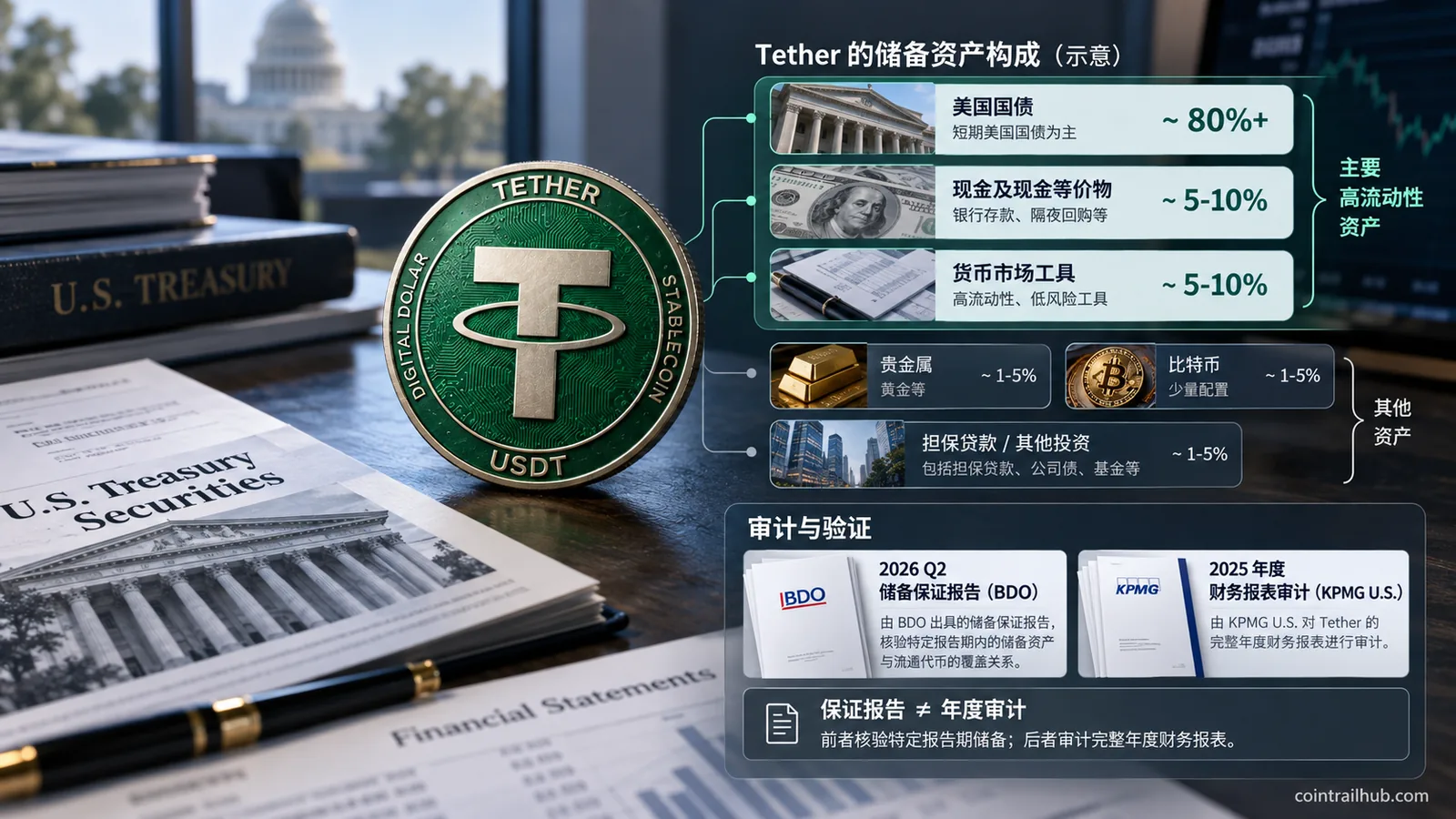
Tether's published 2026 Q2 Financial Figures and Reserves Report shows that as of June 30, 2026, there were roughly $184.6 billion in USDT in circulation, while still maintaining a reserve buffer above the related liabilities.[1]
Its reserve system involves assets including:
- US Treasury bills and other cash equivalents;
- Cash and bank deposits;
- Money-market and similar highly liquid instruments;
- Precious metals;
- Bitcoin;
- Secured loans;
- Other investments.
There is an important change here: today's Tether reserve structure can no longer be described with the old impression of "a lot of commercial paper" from years ago. Tether has gradually exited commercial paper and significantly increased the share of highly liquid assets such as US Treasury bills.
Are USDT's reserves enough? How should you look at it?
Judging whether USDT's reserves are reliable can't stop at the single sentence "reserves exceed 100%." More important are these three things:
| What to judge | Why it matters |
|---|---|
| Do the assets cover the related liabilities | Determines whether the on-book reserves are sufficient |
| What the reserves are | US Treasury bills, cash, etc. are usually easier to use for redemptions than low-liquidity assets |
| Who verifies this data | Determines how much outsiders can verify Tether's disclosure |
So when discussing USDT now, the more worthwhile question is no longer "does Tether even have reserves," but: what is the quality of the reserves, can they be liquidated quickly in extreme conditions, and what level of third-party verification has this data undergone.
Does Tether have a full audit? The 2026 answer has changed
Yes.
This is where many old articles are outdated. Over the past few years, you could often see this statement:
"Tether only has reserve attestation reports, not a full financial audit."
That statement used to be true. But by August 2026 it is no longer accurate.
On August 13, 2026, Tether announced: KPMG U.S. had completed a full independent audit of Tether International's financial statements for the year ended December 31, 2025, and issued an unqualified audit opinion.[2]
This was also Tether's first full annual financial-statement audit.
What's the difference between Tether's audit and its reserve attestation reports?
You now need to separate two things:
| Type | What it mainly verifies |
|---|---|
| Quarterly reserve attestation report (Attestation) | Verifies reserve and related liability data for a specific reporting period |
| Annual financial-statement audit (Audit) | A broader independent audit of the full annual financial statements |
In 2026 Q2, Tether still had BDO issue an independent assurance report on its Financial Figures and Reserves Report.[3] Meanwhile, KPMG U.S. completed a full independent audit of Tether International's 2025 annual financial statements.
So in 2026, saying "USDT has never had a full audit" is outdated information.
Does a full audit mean USDT is now risk-free?
No.
An audit mainly improves how checkable the financial information is. It cannot guarantee: that USDT will never depeg, that the reserve structure will never change, that the market will never see extreme redemptions, that Tether will never face regulatory risk, or that USDT addresses will never be frozen.
So the most accurate statement is:
Tether completed its first full independent annual financial-statement audit in 2026, and transparency is clearly higher than before, but an audit does not mean USDT becomes a zero-risk asset.
Can USDT collapse? Could it suddenly go to zero?
No one can guarantee that USDT will never experience severe depegging or even failure. But that also doesn't mean "USDT could collapse at any time." To judge whether USDT could have serious problems, you should mainly watch three factors.
1. Whether Tether's reserves can support redemptions
If reserves are concentrated mainly in short-term US Treasury bills, cash, and other highly liquid assets, in theory they can handle concentrated redemptions more easily than holding large amounts of low-liquidity loans, commercial paper, or volatile assets. This is also why changes to Tether's reserve structure matter so much.
2. Whether the market believes USDT can be redeemed normally
A stablecoin's price is not determined only by its "on-book assets." The market also needs to believe that 1 USDT can ultimately still be exchanged for a value near $1. Once the market suddenly doubts the reserves' authenticity, the banking channels, the redemption ability, or Tether's regulatory situation, USDT on the secondary market may see concentrated selling. At that point, even if the reserves are ultimately fine, USDT's price may temporarily fall to $0.99, $0.98, or even lower. That is depegging.
3. Tether is still a centralized issuer
Holding USDT is not the same as holding real bank dollars. USDT users ultimately still bear a certain amount of Tether issuer risk.
So the most accurate answer to "can USDT collapse" is:
As of 2026 public information, Tether's reserve quality, third-party verification, and audit transparency have clearly improved compared to the early years, and USDT has survived multiple market stress tests; but no centralized stablecoin can provide a guarantee of "it will absolutely never fail."
Why was Tether's reserve questioned for so long?
Because the doubts didn't come from nowhere. Tether did experience reserve-disclosure disputes in the past.
In 2021, the New York State Attorney General's Office (NYAG) reached a settlement with Bitfinex and Tether that included a $18.5 million fine, with the related documents involving past disclosure issues about reserves and the company's financial condition.[4]
This is also why many early articles listed "Tether reserve transparency" as one of USDT's biggest risks. But you need to distinguish two points in time.
Tether in the past
Went through: reserve-disclosure disputes, a relatively high share of commercial paper, and the lack of a full annual financial-statement audit.
Tether in 2026
Several important changes have appeared: regular reserve reports, reserves more concentrated in highly liquid assets such as US Treasury bills, and the first full independent annual financial-statement audit completed in 2026.
Therefore:
That Tether had transparency disputes is a historical fact; but using the disclosure status from a few years ago to describe USDT in 2026 is also inaccurate.
Can USDT depeg?
Yes.
USDT's target is 1 USDT ≈ 1 USD; this is not "it must strictly equal $1.0000 at all times and on every exchange."
USDT's price on the secondary market is formed by buyers and sellers. Normally, the redemption mechanism and arbitrage help the price return to near $1.
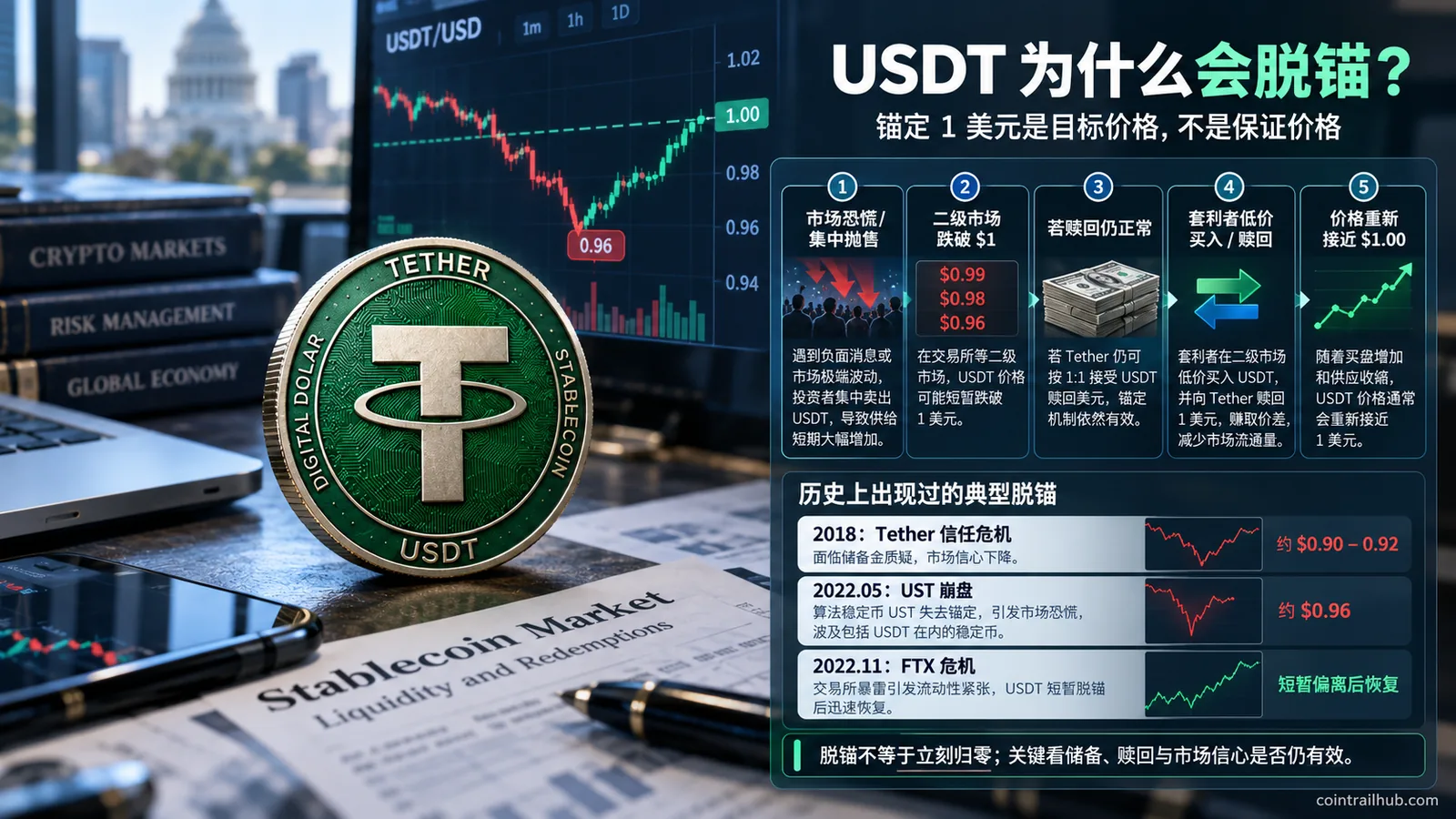
But during market panic, the following can happen:
Many users sell USDT at the same time → selling pressure increases on the secondary market → USDT falls below $1 → if Tether's redemption still works normally → arbitrageurs buy cheap → redeem or wait for the price to recover → USDT moves back toward $1.
Therefore:
A stablecoin's "stability" is not that the price never fluctuates, but that there is a mechanism pulling the market price back toward the target price.
If any one link — reserves, redemption, or market confidence — truly fails, depegging may become more severe or last longer.
Has USDT depegged in history?
It has depegged, more than once. The more typical periods include:
2018: the Tether trust crisis
In October 2018, the market grew concerned about Tether's banking relationships, reserves, and Bitfinex. Because different trading platforms quoted different prices, the lowest prices weren't entirely consistent, but on some markets USDT briefly fell to around $0.90–0.92.[5] The price later recovered to near $1.
May 2022: the UST collapse
In May 2022, Terra's algorithmic stablecoin UST severely depegged and ultimately collapsed, and the whole stablecoin market panicked. During that period, USDT briefly fell below $0.96 on some markets, then moved back toward $1.[6]
One thing especially worth noting here: UST and USDT do not use the same stabilization mechanism. UST at the time relied mainly on algorithms and LUNA arbitrage to maintain its peg, whereas USDT is backed by reserve assets managed by the issuer. So you cannot directly reason "since UST went to zero, USDT will definitely go to zero the same way." But the UST event showed one thing: even a crisis in a different stablecoin can trigger short-term panic about USDT.
The 2022 FTX crisis
During the FTX collapse, the whole crypto market again saw a liquidity and trust crisis, and USDT also experienced brief price deviations.
These historical events all eventually recovered the peg. But it must be emphasized:
"It recovered every time in history" is a past fact, not a guarantee that it will recover next time.
Can USDT be frozen?
Yes.
As the centralized issuer of USDT, Tether has the ability to freeze specific blockchain addresses. This is not a theoretical function — Tether has repeatedly publicly disclosed cooperation with law enforcement to freeze related USDT addresses and assets.
Therefore: USDT is an asset that can be self-custodied, but it is not an asset free of issuer control authority. This is also an important structural difference between USDT and BTC.
If you withdraw USDT to your own wallet, can it still be frozen?
That possibility exists.
This is a point beginners especially misunderstand. For example, you withdraw USDT from Binance or OKX to MetaMask, Trust Wallet, TokenPocket, Ledger, or another hardware wallet — at that point you do control the wallet's private key.
But you control the wallet, not Tether's USDT contract.
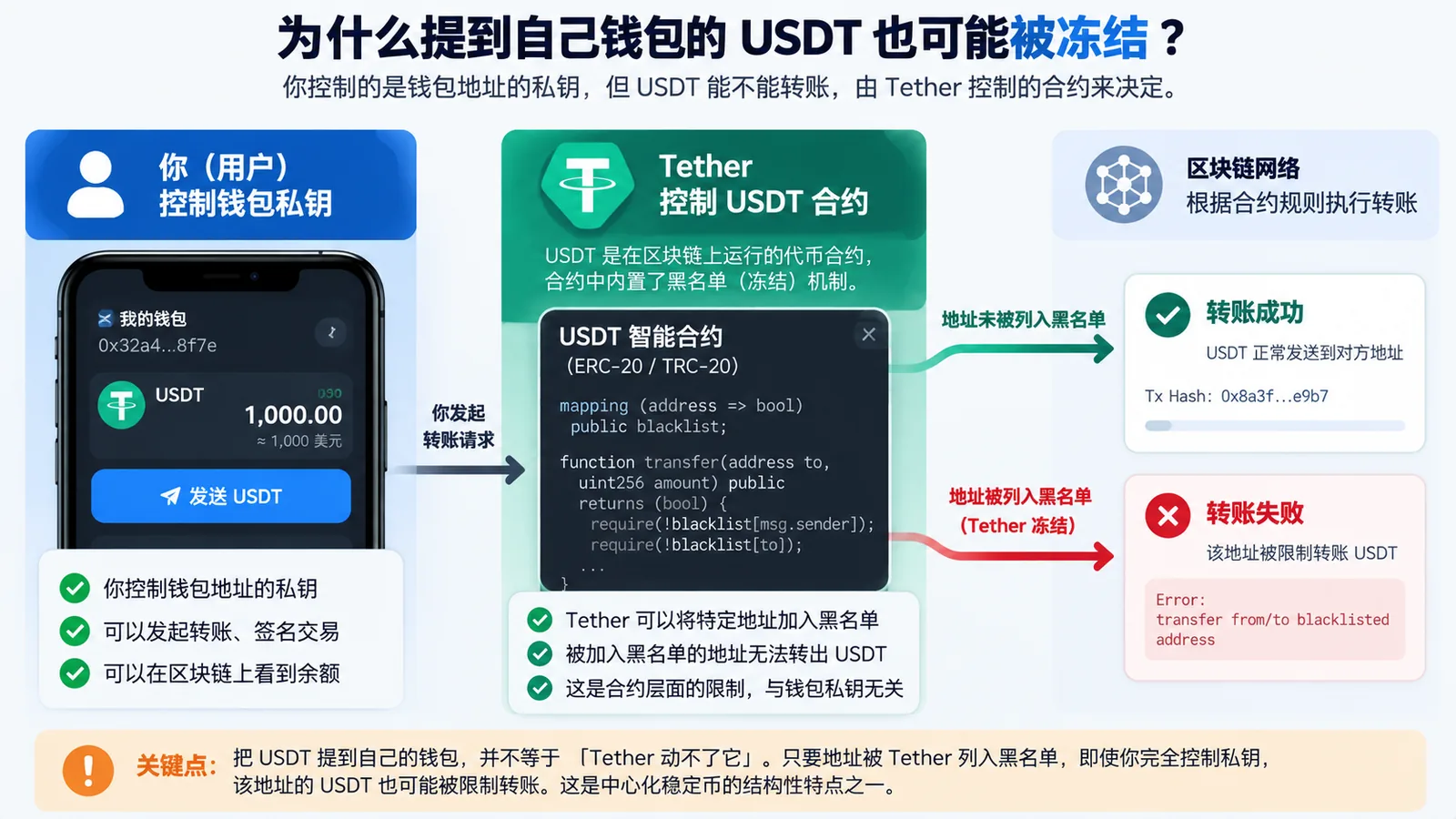
If an address is added by Tether to the corresponding freeze or blacklist mechanism, the USDT in that address may no longer be able to be transferred normally.
So:
A self-custody wallet solves the "who holds the private key" problem, not the USDT issuer's contract authority.
Is a Tether freeze the same as an exchange freeze?
No. This is another place that is very easy to confuse.
| Situation | Who takes the action |
|---|---|
| Tether address freeze | Tether |
| Binance / OKX account freeze or risk control | The exchange |
| Bank card frozen | The bank or relevant judicial/law-enforcement bodies |
| Wallet cannot transfer | Could also be technical reasons like gas, network, authorization, or contract |
So when you see "my USDT is frozen," don't rush to conclude it's Tether. First confirm: whether the USDT is still in the address, whether the block explorer still shows the balance, whether the address is restricted by the Tether contract, whether it's exchange account risk control, whether the platform paused withdrawals, whether it's insufficient gas, or whether you selected the wrong network. These situations are handled completely differently.
If you're worried about "withdrawing to a bank card freezing the card," that's a different type of risk from a Tether contract freeze. See: Withdrawing USDT to a bank card: full steps + fees + arrival time + card-freeze risk (2026).
Will ordinary users' USDT suddenly be frozen by Tether?
Using USDT normally does not mean your address will be randomly frozen.
Tether's publicly disclosed freeze actions usually involve: law-enforcement requests, sanction-related addresses, stolen funds, hacking, fraud, money laundering, or other compliance investigations.
Therefore: "Tether has the ability to freeze" and "ordinary users are easily frozen" cannot be treated as the same thing. But users still need to know: this issuer authority objectively exists. This is one of the important differences between centralized stablecoins and assets like BTC that have no central issuer.
Is it safer to keep USDT on an exchange or in a wallet?
No storage method can eliminate all risks. The two methods solve different problems.
Keeping USDT on an exchange
For example Binance, OKX.
Pros: convenient buying/selling, no need to safeguard a seed phrase yourself, fast asset conversion, relatively simple for beginners.
Risks: the exchange itself has operational and custody risk, the account may trigger platform risk control, the user does not directly hold the on-chain private key, and Tether's issuer freeze authority still exists.
Keeping USDT in your own wallet
Pros: you control the private key and don't directly bear the custody risk of any single exchange account.
Risks: seed-phrase leaks may lead to theft, a transfer to the wrong address usually cannot be reversed, malicious authorization may cause loss, you need to prepare gas yourself, and Tether's address-freeze ability still exists.
So:
"Withdrawing USDT to a wallet" solves exchange-custody risk, but does not turn USDT into a fully decentralized dollar.
For more, see: Where to put USDT bought on Binance/OKX? Exchange or wallet (2026).
Which is more reliable, USDT or USDC?
You can't simply say USDT is definitely safer than USDC, or that USDC is definitely safer than USDT. The two have different strengths.
| Dimension | USDT | USDC |
|---|---|---|
| Market size | Larger | Smaller |
| Trading liquidity | Very strong | Strong |
| P2P coverage | Very broad | Relatively less |
| On-chain coverage | Very broad | Broad |
| Main reserve assets | Mainly highly liquid assets such as US Treasury bills | Cash, short-term Treasury bills, and related highly liquid assets |
| Reserve disclosure | Regular reserve reports | High-frequency reserve disclosure |
| Annual financial audit | First full independent audit completed in 2026 | Circle's financial statements undergo annual audits |
| Address-freeze ability | Yes | Yes |
| Historical clear depegs | Yes | Yes |
| Main strength | Liquidity, coverage, trading scenarios | Disclosure frequency and reserve structure are easier to check continuously |
If you reframe the question as specific scenarios:
Which is more convenient for daily trading and P2P?
USDT usually has broader coverage.
Which is easier to continuously verify reserves?
USDC's public disclosure frequency and structure are more straightforward.
Which will absolutely never have problems?
Neither can make that guarantee. USDT and USDC are both stablecoins with centralized issuers, and both face issuer risk, reserve risk, regulatory risk, address-freeze risk, and depegging risk.
For details on USDC: Is USDC safe? Circle reserves, the freeze mechanism, and the difference from USDT (2026).
For a direct comparison: What's the difference between USDT and USDC? Which is safer and how to choose (2026).
Is USDT suitable for long-term savings?
If "saving" means: converting a large amount of household savings entirely into USDT for the long term and leaving it untouched for years, then you need to pay special attention:
USDT is not a bank deposit. Although it tries to maintain a $1 price, users still bear Tether issuer risk, reserve-asset risk, extreme depegging risk, regulatory risk, address-freeze risk, and exchange or wallet risk.
So:
"The price is relatively stable" cannot be equated with "suitable as a replacement for a bank deposit."
In what situations should you pay special attention to USDT risk?
| Your situation | What matters most |
|---|---|
| Small amount of USDT for daily trading | Whether the network, address, and platform are correct |
| Frequent P2P buying/selling | Merchants, payment, and platform risk control |
| Large long-term USDT holding | Issuer and concentration risk |
| All funds in one stablecoin | Single-issuer risk |
| All USDT on one exchange | Single-platform custody risk |
| All USDT in one wallet | Wallet and private-key risk |
| Using USDT in DeFi | Protocol and smart-contract risk |
| Especially care about assets not being freezable | Both USDT and USDC have issuer freeze ability |
What you really need to avoid is:
Misunderstanding "USDT's price is stable" as "all related risks don't exist."
Which layer of USDT is actually reliable?
Breaking the risks apart makes it easier to understand:
| Risk | Can USDT solve it |
|---|---|
| Large price swings of BTC, ETH | Its main goal is to reduce this volatility |
| Tether issuer risk | No |
| Reserve risk | Cannot fully eliminate |
| Short-term depegging risk | No |
| Address freeze | No |
| Exchange failure | No |
| Exchange account risk control | No |
| Wallet seed-phrase leak | No |
| Malicious authorization | No |
| DeFi contract vulnerability | No |
| Sending to the wrong chain or address | No |
So:
USDT mainly solves the "dollar denomination and price stability" problem; it does not take care of exchange, wallet, DeFi, transfer, and regulatory risks for you.
Final conclusion: is USDT actually reliable?
If you want a single sentence:
USDT is a highly mature, highly liquid, and very widely used centralized stablecoin, but it is not a risk-free digital dollar.
As of October 3, 2026:
- Tether's reserves are mainly highly liquid assets such as US Treasury bills;
- Tether keeps publishing independent reserve attestation reports;
- The first full independent annual financial-statement audit was completed in 2026;
- USDT has depegged multiple times in history and recovered;
- Tether still retains on-chain address-freeze ability.
These facts show: today's USDT can no longer be described with the "reserves are completely opaque" impression from a few years ago. But equally, you cannot conclude "USDT will never have problems" just because of "large scale + audited + recovered the peg in history."
For ordinary users, the more accurate understanding is:
USDT is a very mainstream on-chain dollar-denominated and settlement tool, not an asset with risk properties completely identical to dollar bank deposits.
FAQ
Is USDT reliable?
USDT is one of the largest and most liquid stablecoins. Tether holds reserve assets and keeps publishing third-party reserve reports; in 2026 it also completed its first full independent annual financial-statement audit. But USDT still carries issuer, depegging, freeze, regulatory, and platform risks, so it can be used normally, but should not be understood as a zero-risk asset.
Is USDT safe?
Compared to highly volatile crypto assets, USDT aims to maintain a price near $1, so its price swings are usually smaller. But "price stability" does not equal "completely safe." Users still need to consider Tether reserve, issuer, depegging, freeze, exchange, and wallet risks.
Can USDT collapse?
No one can guarantee that USDT will never have serious problems. As of 2026, Tether's reserves are concentrated mainly in highly liquid assets, it keeps undergoing third-party verification, and it has completed its first full annual financial-statement audit. These factors help in judging its reserve and financial condition, but they cannot reduce future risk to zero.
Can USDT go to zero?
In theory, any stablecoin has an extreme failure risk. But USDT's mechanism differs from the collapsed UST: USDT is backed by reserve assets managed by Tether, while UST at the time relied mainly on an algorithmic mechanism and LUNA arbitrage to maintain its peg. So you can't directly apply UST's collapse path to USDT.
Does USDT have reserves?
Yes. Tether regularly publishes its Financial Figures and Reserves Report, disclosing the reserve assets used to back USDT and other tokens. As of 2026, the reserves are concentrated mainly in high-quality, highly liquid assets such as US Treasury bills.
Does USDT have a full audit?
Yes. In August 2026, KPMG U.S. completed a full independent audit of Tether International's financial statements for the year ended December 31, 2025, and issued an unqualified opinion. So saying "Tether has never had a full financial audit" in 2026 is no longer accurate.
Can USDT depeg?
Yes. USDT's $1 is a target price, not a guarantee that it strictly equals $1 at any moment. During market-stress periods such as 2018 and 2022, USDT clearly fell below $1, then recovered to near the pegged price.
Why does USDT depeg?
Common causes include: market panic, doubts about reserves, many users selling at the same time, concerns about redemption or banking channels, or a trust crisis across the whole stablecoin market. As long as the redemption and arbitrage mechanisms still work, the price usually has a force pulling it back toward $1, but there is no guarantee it will recover every time.
Can USDT be frozen?
Yes. Tether has the ability to freeze specific blockchain addresses, and has repeatedly publicly cooperated with law enforcement to freeze related USDT. This is part of the structure of a centralized stablecoin.
Can USDT in a cold wallet still be frozen?
Possibly. A cold wallet lets you control the private key yourself, but cannot cancel the USDT smart contract's issuer authority. So: controlling the wallet private key ≠ controlling the USDT contract.
Will ordinary users' normal USDT use be frozen?
Normal use does not mean it will be randomly frozen. Tether's publicly disclosed freezes usually involve law-enforcement requests, sanctions, fraud, theft, hacking, or other compliance investigations. But "doesn't happen often" does not mean "Tether has no freeze ability."
Which is safer, USDT or USDC?
You can't judge on a single dimension. USDT's strengths are mainly market size, trading liquidity, P2P, and global coverage; USDC's reserve structure and disclosure frequency are usually easier to verify continuously. Both have centralized issuers, and both have address-freeze ability.
Is USDT suitable for long-term storage of large funds?
USDT is not a bank deposit. If it's a small amount for trading and transfers, it's a very common tool; if you plan to concentrate a large amount of funds entirely in USDT for the long term, you also need to consider issuer, regulatory, freeze, depegging, and concentration risks.
Where do I check USDT's reserves?
First look at Tether Transparency / Financial Figures and Reserves Reports. Don't rely only on a fixed percentage reposted online. Tether's USDT circulating supply, total reserves, Treasury-bill size, and other reserve assets all change over time. For the latest data, refer to Tether's latest official report and the corresponding third-party verification documents.
Data verification notes
The key facts in this article were checked on 2026-10-03 against Tether's official disclosures, the NYAG announcement, and public market data, item by item as follows:
- Circulating supply and reserves: the 2026 Q2 report shows that as of June 30, 2026, about $184.6 billion in USDT was in circulation, with reserves still exceeding the related liabilities. Source: Tether Transparency page.
- First full audit: per the August 13, 2026 announcement, KPMG U.S. completed a full audit of Tether International's financial statements for the year ended December 31, 2025, issuing an unqualified opinion. Source: Tether official website.
- Quarterly assurance report: the 2026 Q2 Financial Figures and Reserves Report was still given an independent assurance report by BDO. Source: Tether Transparency page.
- NYAG settlement: in 2021 the New York State Attorney General's Office reached a settlement with Bitfinex and Tether that included an $18.5 million fine. Source: NYAG — Bitfinex/Tether 2021 settlement announcement.
- 2018 depeg: in October 2018, USDT briefly fell to around $0.90–0.92 on some markets, then recovered to near $1. Source: CoinMarketCap — Tether USDt.
- 2022 depeg: during the UST collapse in May 2022, USDT briefly fell below $0.96 on some markets, then moved back toward $1. Source: CoinMarketCap — Tether USDt.
What to read next
Is USDC safe? Circle reserves, the freeze mechanism, and the difference from USDT (2026) — USDC's reserves, audit, and freeze mechanism
What's the difference between USDT and USDC? Which is safer and how to choose (2026) — directly compare the two mainstream stablecoins
What is USDT? The uses and risks of Tether (2026) — understand USDT's basic mechanism first
Where to put USDT bought on Binance/OKX? Exchange or wallet (2026) — decide where a stablecoin should be kept
Sent to the wrong chain — can you get it back? Withdrawal networks and wallet addresses (2026) — the network issues you must understand before transferring USDT
Disclaimer
This article is only for educating about stablecoin mechanisms and risks, and does not constitute investment advice, financial advice, trading advice, or legal opinion.
Stablecoins such as USDT and USDC may all face: issuer risk, reserve risk, depegging risk, address-freeze risk, regulatory risk, exchange risk, wallet security risk, and smart-contract risk.
Stablecoins are not bank deposits. You should not assume they have risk properties completely identical to dollars in a bank account just because the name contains "USD" or the price has long stayed near $1.
For deposits, withdrawals, transfers, and authorization operations, confirm the official website, the correct blockchain network, and the receiving address.
- Tether Transparency page
- Tether official website
- CoinMarketCap — Tether USDt
- Circle Transparency page
- NYAG — Bitfinex/Tether 2021 settlement announcement2021 settlement and $18.5 million fine
- 2026-10-17UpdateAdded evidence-chain superscripts and "Data verification notes".
See ourEditorial Policy and the correction process in ourCorrections Policy.
The CoinTrailHub editorial team focuses on crypto education for beginners, exchange security and P2P trading risk. This article is compiled from official sources and public data, reviewed by humans, and strives for accuracy but is not investment advice.
Last updated:2026-10-03 · Content reviewed by humans · Learn more
© 2026 CoinTrailHub · Original content. Reproduction or rewriting without permission is prohibited.