
Are Stablecoins Safe? Depegs, Reserves, Freezing and Exchange Risks (2026)
Table of contents

Binance new user rewards
20% trading fee rebate
Official Binance registration. Complete identity verification (KYC) to trade and withdraw.
You're holding some USDT that has been sitting near $1 for months, and it's easy to think: "Isn't this just dollars? Can I park it here like a deposit?"
That thought is exactly the right starting point for understanding stablecoin risk. Because the biggest misunderstanding about stablecoins is treating "price stability" as "safety".
The short answer: stablecoins are fine for trading, transferring and short-term turnover, but they are not bank deposits and not zero-risk assets. Their "stability" only solves one thing — keeping the price as close to $1 as possible. Whether the issuer gets into trouble, whether reserves are sufficient, whether your coins can be frozen, whether the exchange fails — a stablecoin does not protect you from any of these.
So "are stablecoins safe?" shouldn't be a yes-or-no question. The real questions are: how much are you holding, in whose hands, for how long, and whether you can accept the worst case. This article walks through the five risks — depeg, reserves, freezing, exchange and wallet — then shows how to judge whether you should hold stablecoins, how much, and where.
If you haven't yet sorted out how stablecoins differ from US dollars and bank deposits, read this first: What Is a Stablecoin? How It Differs from US Dollars and Bank Deposits + Should Beginners Choose USDT or USDC (2026).
About 8 minutes to read. First remember two things: a depeg doesn't mean zero, but "it recovered before" doesn't guarantee "it will recover next time"; and holding your own private keys does not cancel the issuer's ability to freeze coins at the contract level.
A stablecoin's "stability" and "safety" are two different things
A stablecoin's "stability" comes from three things working together to pull the price back near $1: the issuer holding reserves, issuance and redemption, and market arbitrage. This mechanism does work — it solves the big price swings you get when pricing things in BTC, one price today and another tomorrow.
But it doesn't solve another whole category of problems. This table makes it clear at a glance:
| Risk | Does the stablecoin's "stability" solve it for you |
|---|---|
| Big price swings like BTC and ETH | Its main goal is to reduce this volatility |
| The issuer gets into trouble | No |
| Reserves are insufficient, can't redeem | No |
| A temporary depeg | No |
| Your address gets frozen by the issuer | No |
| An exchange fails, account gets restricted | No |
| Your wallet seed phrase leaks | No |
| You transfer to the wrong chain or wrong address | No |
In one sentence: a stablecoin solves the "pricing and price volatility" problem, but it does not take responsibility for issuer, reserve, freezing, platform and wallet risks. So between "it's near $1" and "it's absolutely safe" sits that entire table. The mechanism itself is explained in Ethereum.org's guide to stablecoins.[1]
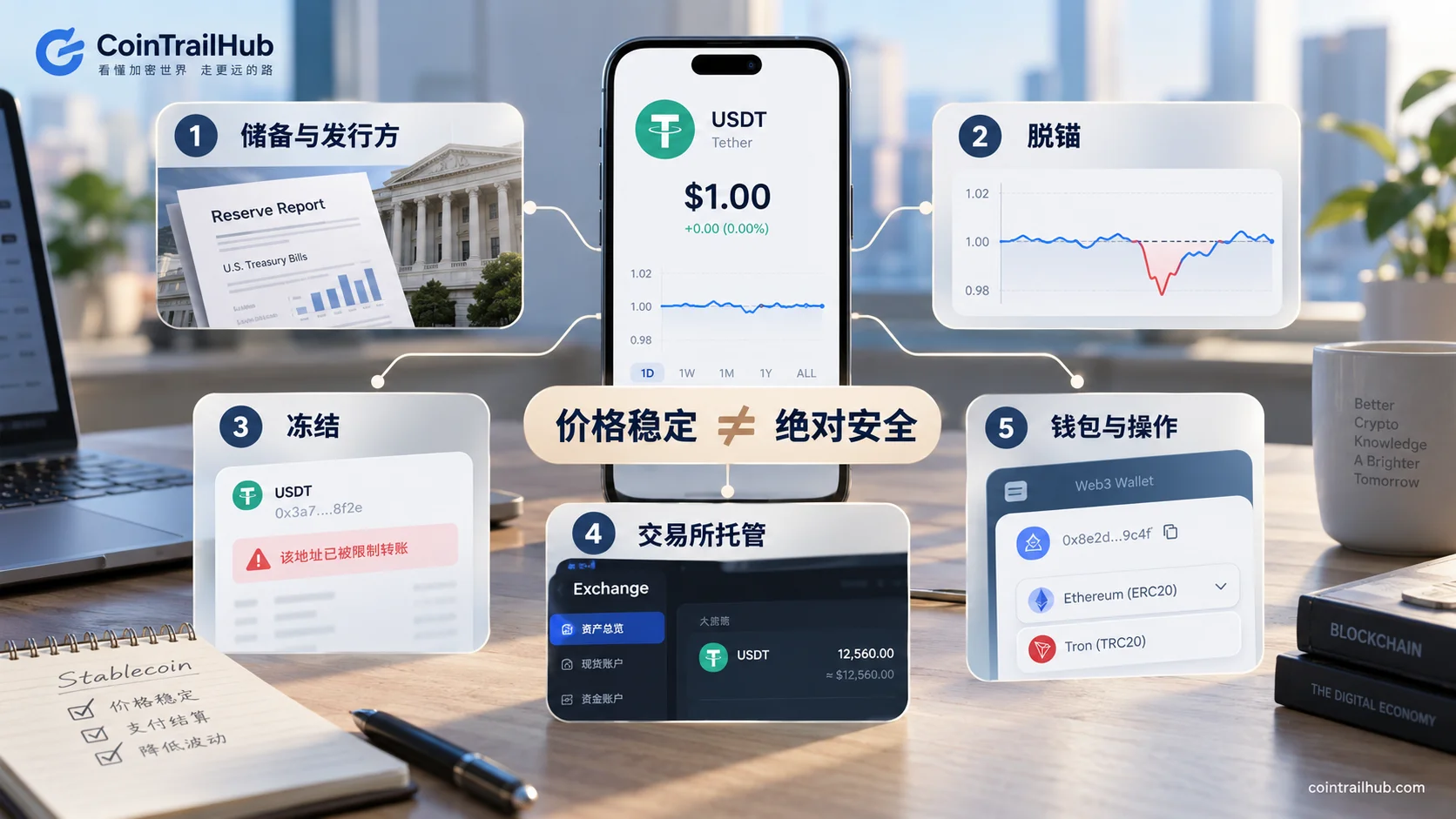
A stablecoin's price staying near $1 only means low price volatility. It does not mean that reserve, depeg, freezing, exchange custody and wallet-operation risks have gone away.
Risk 1: Reserves and the issuer — is there actually enough behind it
The price of centralized stablecoins (USDT, USDC) is essentially built on "the issuer holds matching reserves, and users trust they can redeem". So the first risk is: is the issuer reliable, are reserves sufficient, and can they make good.
This area is much better than it was a few years ago, but "better" doesn't mean "no risk":
- Tether (USDT) has concentrated its reserves in highly liquid assets like US Treasuries, and in August 2026 it announced it had completed its first full annual financial statement audit. Reserve data is available on Tether Transparency.[2]For a detailed breakdown, see: Is USDT Safe? Tether Reserves, Depegs and Freezing (2026).
- Circle (USDC) holds reserves mostly in cash and short-term US Treasuries, discloses frequently and is relatively easy to verify yourself, see Circle Transparency.[3]Details: Is USDC Safe? Circle Reserves and the Freezing Mechanism (2026).
But "audit completed" doesn't mean "you can see everything"
There's a detail many people miss, worth calling out on its own.
In August 2026, KPMG U.S. completed the first full financial statement audit of Tether's issuing entity, issued an unqualified opinion, and disclosed that reserves exceeded related liabilities by about $6.814 billion.[4]That is a real transparency improvement.
But Tether only published a press release; the full audit report and the financial statements themselves were not fully disclosed to the public — on its transparency page, ordinary users can still mainly see BDO's quarterly reserve attestation, not that full KPMG audit report. And the audit covered one entity and one fiscal year (FY2025).
So the correct understanding is:
The fact that Tether completed its first full audit is real; but "audit completed" is not the same as "the full audit report is publicly available." An audit raises how verifiable the information is, but it doesn't turn a stablecoin into a zero-risk asset.
What this means for you: for small amounts of short-term turnover, this risk barely affects you; but holding a large amount long-term in a single stablecoin means concentrating your risk on one issuer.
Risk 2: Depeg — "near $1" doesn't mean "always $1"
A depeg is when a stablecoin temporarily drifts away from $1 in the secondary market. It has happened, more than once:
| Time | Event | Result |
|---|---|---|
| 2018 | Tether trust crisis, USDT clearly below $1 | Later re-pegged |
| 2022 | UST collapse triggered stablecoin panic, USDT briefly and clearly drifted | Later re-pegged |
| 2023 | Silicon Valley Bank failed, part of Circle's reserves affected, USDC de-pegged sharply | Later re-pegged |
| 2022 | UST's algorithmic mechanism failed, entered a death spiral | Never regained the $1 peg |
This table shows a crucial distinction: "it de-pegged before" doesn't mean "it will go to zero", but "it's called a stablecoin" doesn't mean "it will definitely come back after a depeg." USDT and USDC's short depegs all recovered; UST's mechanism collapse shows that a stablecoin can also lose its peg permanently.
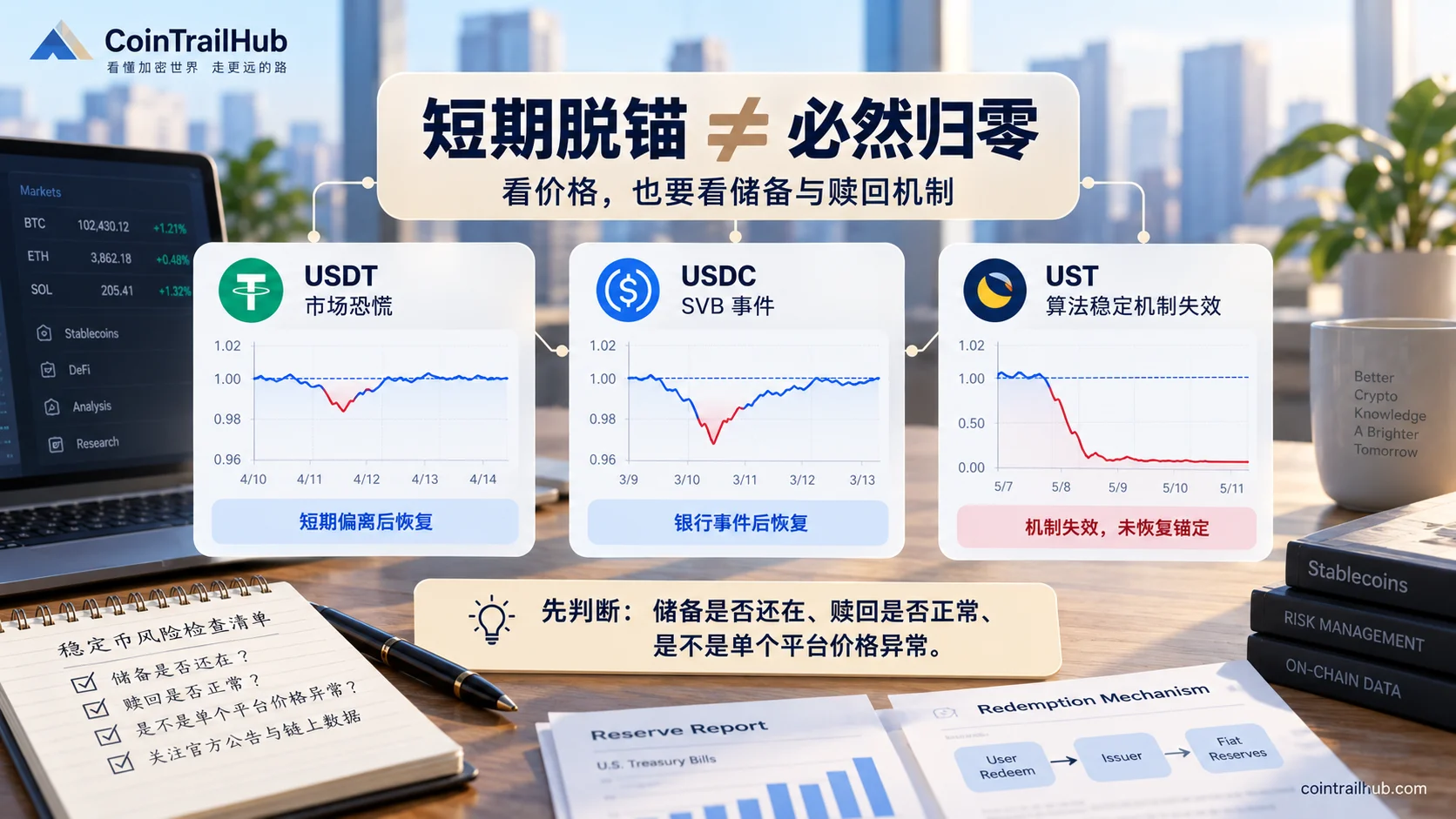
A short depeg is not zero. When judging risk, what matters more is whether reserves still exist, whether redemption is still working, and whether the stability mechanism itself has failed.
So what you really need to remember is: "pegged to $1" is a goal, not a contract. Once the market doubts the reserves, the redemption channel or the banking relationships, the price drops first — even if the reserves turn out to be fine. What determines whether it can recover isn't how far the price fell, but whether the reserve and redemption mechanism still works.
What this means for you: if you must convert stablecoins into money at exactly $1 at some point (for example, you have a payment due soon), even a few percentage points of depeg can cost you temporarily. Conversely, if you're not in a rush to cash out, a short depeg usually has limited impact — provided it eventually recovers.
Risk 3: Freezing — holding the private key doesn't mean controlling the coin
This is the point beginners most easily get wrong.
USDT and USDC both have centralized issuers, and the token contracts carry blacklist/freeze capabilities. The issuer can freeze the stablecoins at a given address — for example when cooperating with law enforcement, fighting hackers or complying with sanctions — even if that address's private key is entirely in your hands.
So "withdrawing your stablecoins to your own wallet" solves the "exchange custody risk", but it does not turn USDT/USDC into "dollars no one can touch". Your wallet's private key only proves you control the "wallet address"; whether "this token can be transferred" is decided by the issuer's contract.
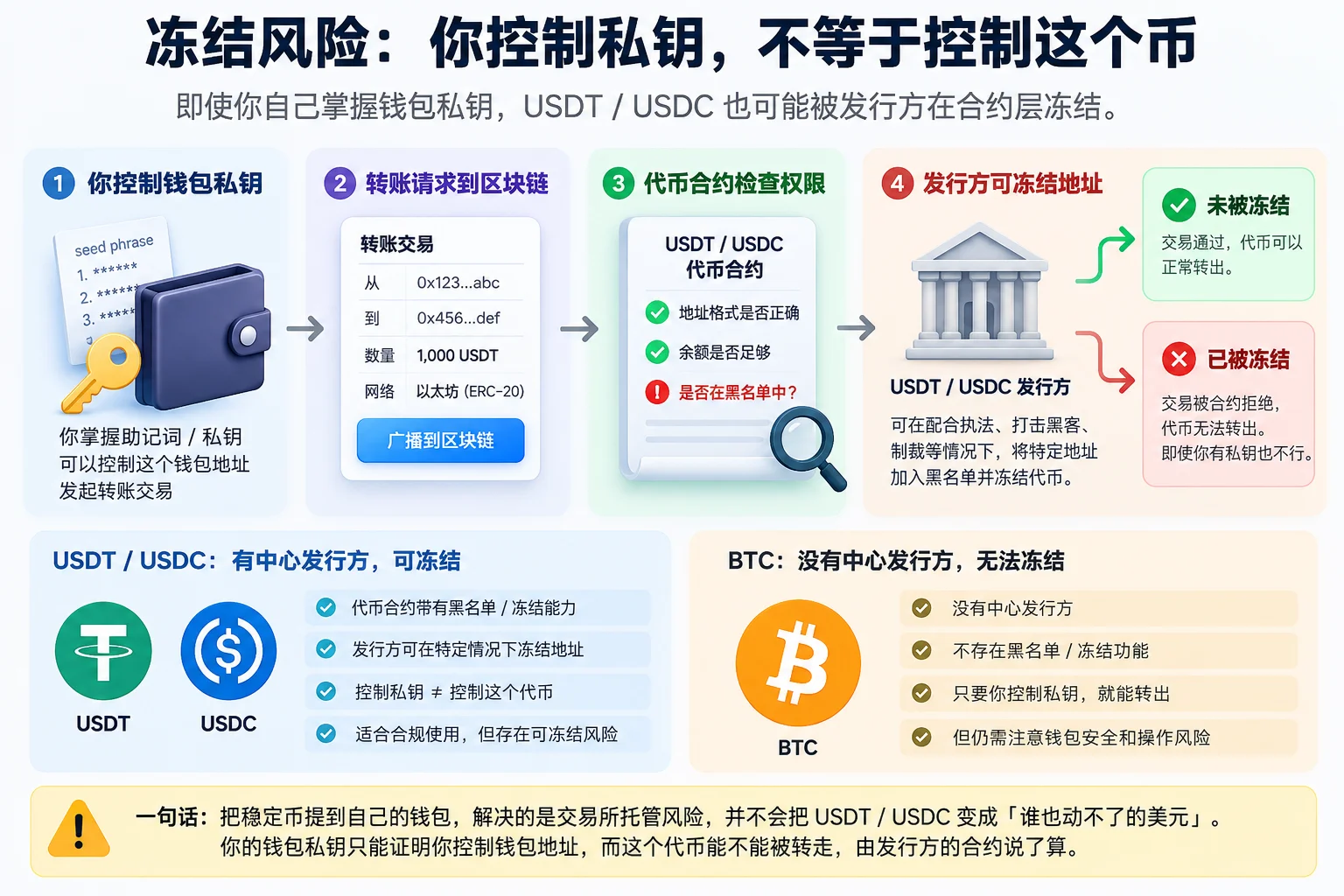
Holding your own wallet private key lets you control the address and reduces exchange custody risk, but USDT and USDC are still centrally-issued stablecoins, and a specific address can still be frozen by the issuer in compliance, law-enforcement or sanction situations.
This is one of the most fundamental differences between stablecoins and assets like BTC that have no central issuer.
What this means for you: normal, compliant use won't get you frozen out of nowhere (freezing usually targets law enforcement, sanctions, stolen funds and similar cases); but the "can be frozen" capability objectively exists and you need to know about it. Especially if you care a lot about "assets that absolutely cannot be interfered with" — then neither USDT nor USDC is the answer.
Risk 4: Keeping it on an exchange — custody risk is another layer
The issuer risk of the stablecoin itself is one layer; keeping your coins on an exchange adds another layer of "platform custody risk".
On an exchange: convenient for trading, no need to store a seed phrase yourself, but you take on that exchange's operational, risk-control and account-freeze risks, and you don't directly hold the on-chain private key.
In your own wallet: you hold the private key and don't bear any single exchange's custody risk, but you must handle seed-phrase leaks, wrong-chain transfers, malicious approvals and forgotten backups yourself.
Neither side is "absolutely safe"; they solve different problems. For a detailed guide on choosing, see: Where to Keep the USDT You Bought on Binance/OKX? On the Exchange or Withdraw to a Wallet (2026).
What this means for you: small amounts traded frequently are usually more convenient on an exchange; a large amount left untouched long-term carries higher risk if concentrated in one place — in that case you should think about diversification, not obsess over "which exchange is the safest".
Risk 5: Wallet and operations — most of the pitfalls are on your side
The last category of risk is exactly where ordinary users slip up most often:
- Wrong chain or wrong address — if you pick the wrong network, the coins can be very hard to recover, see: Can You Recover a Wrong-Chain Transfer? Withdrawal Networks and Wallet Addresses (2026);
- Seed-phrase leak, saving screenshots, storing in the cloud — whoever gets the seed phrase gets the wallet;
- Careless approvals, clicking unknown DApps — a malicious approval can move your coins out;
- Picking the wrong network to save fees, or sending a large amount without a small test first.
These risks have little to do with "whether the stablecoin itself is safe", but they genuinely decide whether your coins are still there in the end. A lot of people lose money not because a stablecoin blew up, but because they made an operating mistake.
How do stablecoins differ from bank deposits in risk
Many people asking "are stablecoins safe" really mean "can they replace bank deposits". The answer is in this table:
| Dimension | USDT / USDC | Bank deposit |
|---|---|---|
| Price | Aims to stay near $1 | Is fiat money itself |
| Source of trust | Issuer + reserve assets | The banking system |
| Deposit protection | Usually no traditional deposit insurance | Eligible deposits protected by local scheme |
| Depeg | Possible | No equivalent concept |
| Freezing | Issuer can freeze addresses | Account can be frozen by law |
| Hold your own private key | Yes | Not applicable |
One-sentence conclusion: a stablecoin is more like a dollar-denominated digital asset running on a blockchain, not the dollars in your bank account moved onto a chain as-is. The two carry different risk structures and can't replace each other.
When something goes wrong, first figure out which layer broke
If you see an abnormal USDT or USDC price, don't just look at how much it dropped. Check in this order:
- Is the whole crypto market swinging violently?
- Has the issuer's reserve or disclosure changed?
- Is redemption still working normally?
- Is it only one exchange showing an abnormal price?
- Has the stability mechanism itself failed? (Most serious — recall the UST case.)
For a short depeg, first check "are reserves and redemption still there"; a mechanism failure is a more dangerous signal than a few points of temporary price drop.
So how do you use them more safely? Find your situation
Back to the opening question: are stablecoins safe? The answer only holds once you put "you" into it. Look at this table:
| Your situation | What you should care about most |
|---|---|
| Small USDT for daily trading and transfers | Network, address and platform must be right, don't transfer wrong |
| Frequently trading P2P | Merchant, payment and platform risk control |
| Large amount sitting long-term | Issuer concentration risk, don't put it all on one |
| All funds in a single stablecoin | Single-issuer risk |
| Everything on one exchange | Single-platform custody risk |
| You care a lot about "can't be frozen" | Neither USDT nor USDC is the answer |
| Using stablecoins in DeFi | A stable stablecoin ≠ a safe protocol, two different things |
What you really need to avoid is mistaking "USDT is near $1" for "all risks are gone". Price stability reduces volatility, but the five layers of risk — issuer, reserve, depeg, freezing, platform and wallet — don't disappear on their own.
FAQ
Are stablecoins safe?
They're fine for trading, transferring and short-term turnover, but they are not bank deposits and not zero-risk. Their "stability" only solves the price-volatility problem; issuer, reserve, depeg, freezing, exchange and wallet risks still exist.
Are stablecoins as safe as bank deposits?
No. Bank deposits in most countries are backed by deposit insurance and the banking system; a stablecoin is a crypto asset issued by an issuer, kept near its price by the issuer's reserves and redemption mechanism, without the same deposit protection.
Can a stablecoin go to zero?
Any stablecoin theoretically carries an extreme failure risk. Backed centralized stablecoins like USDT and USDC differ from algorithmically-maintained mechanisms like UST, so the risk profile is different; but "different risk" doesn't mean "can't go wrong".
What should I do if a stablecoin depegs?
Don't panic; judge whether it's a moment of fear or a real mechanism problem: check reserve disclosures, check whether redemption is working, check whether the whole market depegged together. If it's just short-term panic and the issuer's reserves are fine, there's usually a pull back toward the peg; but "it recovered before" doesn't guarantee "it will recover this time".
Will USDT in a cold wallet never be frozen?
No. A cold wallet lets you hold your own private keys, but it can't cancel the issuer's contract-level freeze capability. Holding the private key ≠ controlling the contract.
Are stablecoins suitable for long-term storage of large funds?
Not suitable as a "risk-free deposit". Small amounts for turnover are fine; concentrating a large long-term amount in one stablecoin and one issuer means concentrating risk. Think diversification, not either/or.
Data verification notes
The key facts in this article were checked on 2026-10-05 against official Tether and Circle disclosures and public materials, as follows:
- The stablecoin stability mechanism: relies on the issuer holding reserves, issuance and redemption, and market arbitrage to pull the price back near $1; a price near $1 does not mean issuer, reserve, freezing and other risks disappear. Source: Ethereum.org Stablecoins.
- Tether reserve composition: reserves have been clearly concentrated in highly liquid assets like US Treasuries, and reserve data is disclosed regularly on the transparency page. Source: Tether Transparency / official Tether reserve reports.
- Circle reserve composition: USDC reserves are mostly cash and short-term US Treasuries, disclosed frequently and verifiable on the official transparency page. Source: Circle Transparency / USDC Reserve Disclosures.
- Tether's first full audit: in August 2026 KPMG U.S. completed Tether's first full annual financial statement audit with an unqualified opinion, disclosing reserves exceeding related liabilities by about $6.814 billion; the full audit report was not fully disclosed to the public. Source: Tether first full KPMG audit announcement.
Keep reading next
What Is a Stablecoin? How It Differs from US Dollars and Bank Deposits + Should Beginners Choose USDT or USDC (2026) — start with the basic mechanism of stablecoins
Is USDT Safe? Tether Reserves, Depegs and Freezing (2026) — a dedicated breakdown of reserves, audits and freezing
Is USDC Safe? Circle Reserves and the Freezing Mechanism (2026) — Circle's reserve disclosures and depeg history
Where to Keep the USDT You Bought on Binance/OKX? On the Exchange or Withdraw to a Wallet (2026) — decide where to keep your stablecoins
Can You Recover a Wrong-Chain Transfer? Withdrawal Networks and Wallet Addresses (2026) — the network issues you must understand before transferring
Disclaimer
This article is for educational purposes about stablecoin mechanisms and risks only, and does not constitute investment, financial, trading or legal advice.
Stablecoins may face issuer risk, reserve risk, depeg risk, address-freezing risk, regulatory risk, exchange risk, wallet-security risk and smart-contract risk. A stablecoin is not a bank deposit, and just because its name contains "USD" or its price has long stayed near $1, you should not treat it as carrying the exact same risk profile as dollars in a bank account.
When topping up, withdrawing, transferring or approving, please confirm the official website, the correct blockchain network and the receiving address.
- 2026-10-17UpdateAdded evidence-chain superscripts and Data Verification Notes.
See ourEditorial Policy and the correction process in ourCorrections Policy.
The CoinTrailHub editorial team focuses on crypto education for beginners, exchange security and P2P trading risk. This article is compiled from official sources and public data, reviewed by humans, and strives for accuracy but is not investment advice.
Last updated:2026-10-05 · Content reviewed by humans · Learn more
© 2026 CoinTrailHub · Original content. Reproduction or rewriting without permission is prohibited.