
How Do Beginners Avoid Trading Pitfalls? Don't Trust Signal Callers, Stay Away from High Leverage
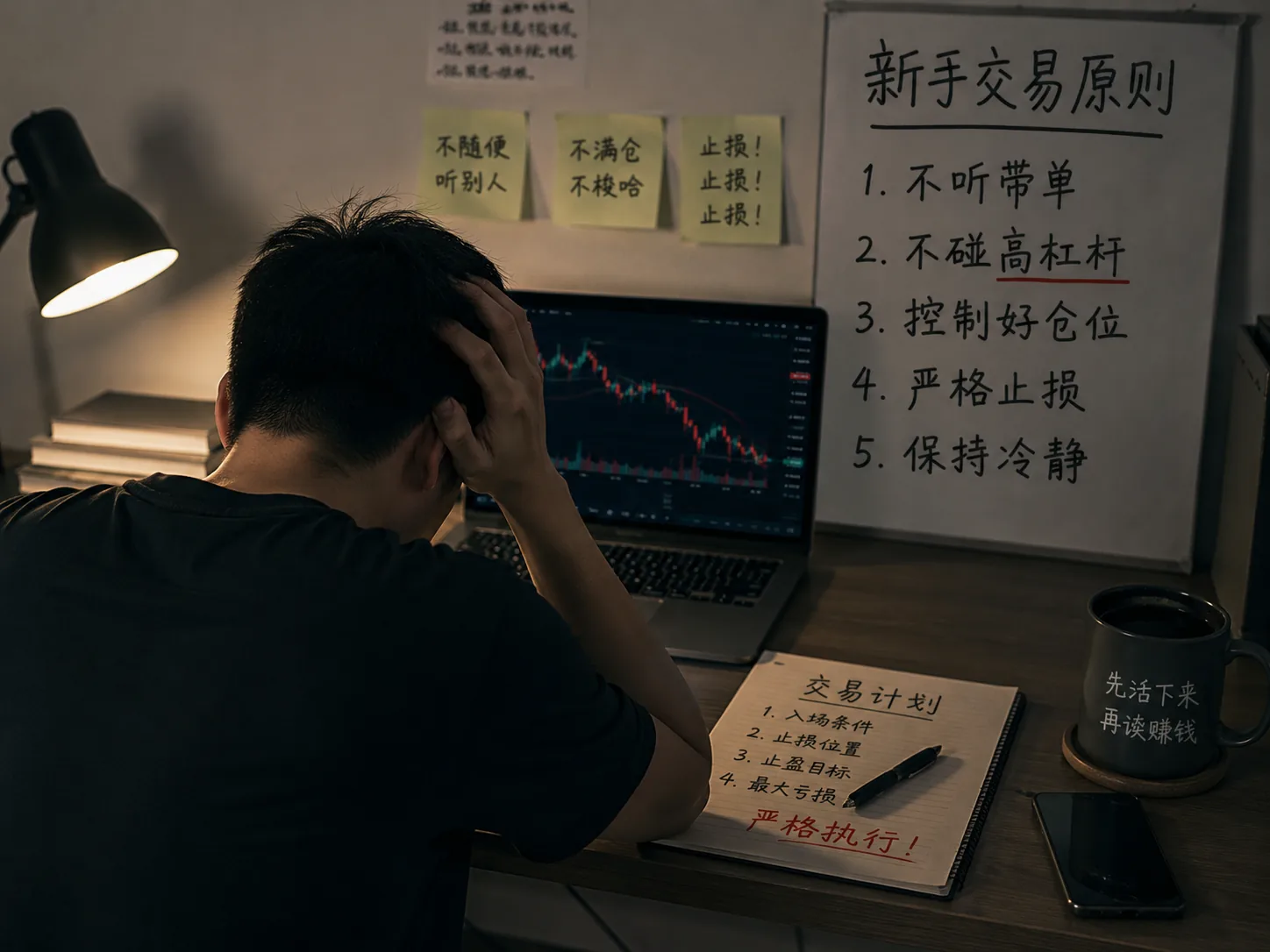
Table of contents

Binance new user rewards
20% trading fee rebate
Official Binance registration. Complete identity verification (KYC) to trade and withdraw.
Many beginners enter crypto convinced they lose money because they can't read candlestick charts.
But what I've seen far more often is this:
Before the market even gets a real chance to hurt you, signal callers, high leverage, and refusing to cut losses have already finished you off.
Most beginner trading losses come down to four pitfalls:
- Trusting signal callers
- Believing in high leverage
- Holding losses while taking profits too early
- Trading with no stop-loss, only hope
This article won't teach complex indicators, and it won't predict the market.
I want to make one thing clear:
When you're just starting out, the most important thing isn't making fast money — it's not getting harvested by the market and your own psychology together.
This article is for beginner crypto risk education only and is not investment, financial, or trading advice. Crypto asset prices are extremely volatile — before trading, first confirm you can actually bear the loss.
If you haven't yet figured out exchange accounts, security settings, USDT, USDC, wallet addresses, and withdrawal networks, don't jump straight into futures or high leverage. Start with the basics: Crypto Beginner's Guide, How to Register on Binance (2026), and Where Is It Safer to Store Your USDT After Buying.
About 5 minutes to read. Remember two mistakes first: trusting signal callers, and treating high leverage as a way to turn things around.
This article isn't written for professional traders
It's for beginners who have just entered crypto and still can't tell spot, futures, leverage, and liquidation apart.
Because most people don't lose on the market itself — they lose on:
Following someone else's signal calls.
Chasing pumps with oversized positions.
Getting liquidated on high leverage.
Refusing to cut losses after losing.
So this article won't recommend any coin, and won't give any entry or exit point. It only covers the trading mistakes beginners make most often.
My judgment is simple:
The first thing a beginner should learn isn't trading technique — it's restraint.
Pitfall #1: Treating signal callers as a lifeline
Beginners are the most easily drawn to "signal callers".
That's normal.
When you don't understand something yourself, you want to find someone who does.
The problem is, many so-called "teachers" aren't here to teach you to trade — they're here to drain you.
The usual playbook goes like this:
First, post a few "accurate" calls in the group.
Then show profit screenshots to build trust.
Then start saying "the opportunity is here", "this one is solid", "don't size too small".
Finally, guide you into futures, higher leverage, and frequent trading.
You think he's helping you make money.
But often, he's making money off fee rebates, course fees, membership fees — or even the traffic from your liquidation.
Here's a simple test:
Anyone urging you to place an order right now — question their motive first.
Real, responsible risk education will always warn you first:
Move less.
Size small.
Don't get carried away.
Don't borrow.
Stay away from high leverage.
Rather than pushing you every day:
Get in fast.
Don't miss it.
Go all in.
This one is solid.
If someone really makes steady money from trading, why would they need to urge beginners to place orders in a group every day?
It's not a nice thing to say, but it's useful.
Pitfall #2: Thinking high leverage is a way to turn things around
The first thing that hooks beginners when they meet futures is leverage.
10x, 20x, 50x, 100x.
It looks like you can amplify returns with little capital.
The problem is, leverage amplifies not just returns — but losses too.
As Binance Academy's explainer on leverage trading points out, leverage amplifies both potential gains and potential losses.[1] In a high-volatility environment like crypto, if you jump into high leverage before you understand margin, liquidation, and risk management, you're essentially hard-carrying market swings with very little room for error.
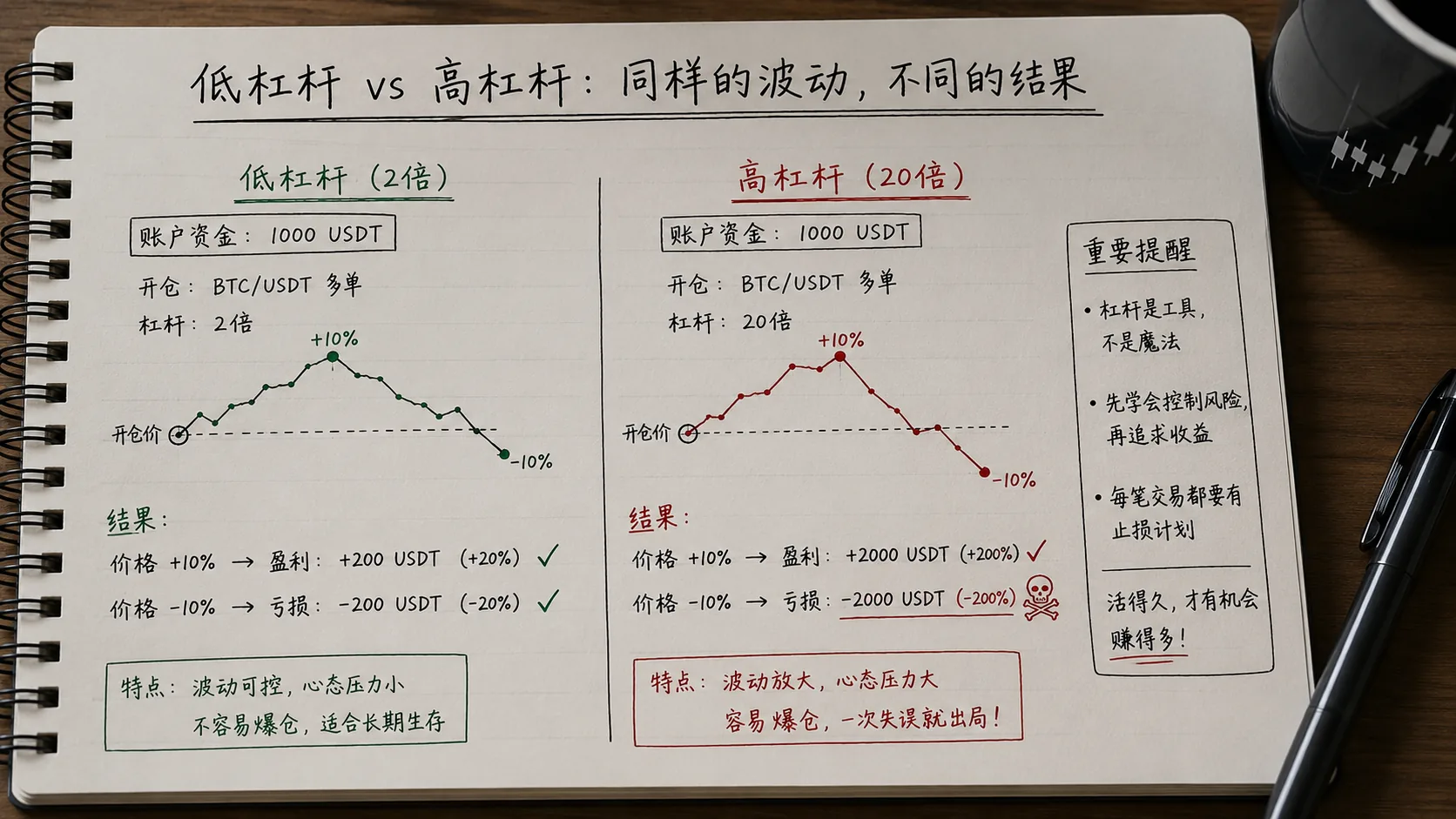
You think you're just using less money to participate in a trade.
In reality, you're using less room for error to carry bigger swings.
Crypto is volatile to begin with.
Without leverage, a 10% drop might just be a drawdown.
With high leverage, a tiny adverse move can trigger liquidation.[2]
The scariest part is that beginners often do make money at first.
First small win — you think you've got it.
Second win — you think you have a gift.
Third time you size up, and risk starts to spiral.
Many people don't die on their first loss — they die in the illusion created by a few early small wins.
So I don't recommend beginners touch high leverage at the start.
Not because leverage can never be used, but because beginners usually haven't built three things yet:
Position sizing.
Stop-loss discipline.
A mechanism to step away after consecutive losses.
Without those three, leverage isn't a tool — it's an accelerator.
Accelerating the illusion of profit.
And accelerating the reality of loss.
Pitfall #3: Taking profits too early and holding losses too long
A very typical beginner problem:
When you're up, you're timid.
When you're down, you're bold.
Up 3%, sell immediately.
Down 10%, tell yourself it's just a pullback.
Down 20%, start saying you're bullish long-term.
Down 40%, it becomes "as long as I don't sell, I haven't lost".
That's not a trading plan.
That's emotion taking over the account.
Worse, many people clearly wanted a short-term trade at first, but once they're down, they force it into a long-term hold.
Before buying, they say:
"I'll just do a quick trade and get out with some profit."
After the drop, it becomes:
"This project definitely has long-term value."
After another drop:
"When the bull market returns, I'll definitely break even."
This is the most common beginner path to losses.
It's not that they set out to lose big — it's that every step gives them a new excuse.
The hardest part of trading isn't buying.
The hardest part is admitting you were wrong.
If you're doing a short-term trade, figure these out in advance:
How far down means your call was wrong?
How much loss means you must exit?
What's the maximum this trade can lose?
If you don't answer these in advance, the moment a loss shows up, you'll almost always become irrational.
Before really trading, beginners should fill in the basics first. Learn How to Register on Binance (2026), then understand the difference between USDC and USDT, and finally look at how to avoid sending funds on the wrong chain with withdrawal networks and wallet addresses.
Pitfall #4: No stop-loss, only hope
Many people say they'll use a stop-loss, but when an actual loss shows up, they can't pull the trigger.
The reason is simple:
Stop-loss hurts.
It means admitting this trade was wrong.
It means the account balance really is smaller.
It means the market just slapped your previous judgment in the face.
So many people would rather stop looking at the account than stop out.
The problem is, the market doesn't stop falling just because you're not looking.
The pain of a stop-loss is immediate; the pain of liquidation is devastating — yet many end up choosing the latter.
I'd suggest beginners think of stop-loss as a protective mechanism, not a failure.
A stop-loss doesn't prove you're bad.
A stop-loss prevents one mistake from becoming an unrecoverable loss.
Especially in crypto, many coins don't just bounce back.
Some altcoins drop and may never come back for a long time.
Some projects lose liquidity once the hype fades.
Some "good news" is just short-term speculation.
If you rely on hope to carry every loss, eventually you'll hit one you can't carry.
The market occasionally gives you a chance to break even.
But you can't treat "occasionally" as a strategy.
| Pitfall | Typical behavior | The right move |
|---|---|---|
| Trusting signal callers | Urging you to order now, go all in | Question the motive of anyone urging you to order right now |
| Believing in high leverage | Thinking small capital can amplify returns | Don't touch high leverage before you have position sizing and stop-loss discipline |
| Taking profits early, holding losses | Selling fast when up, finding excuses when down | Decide in advance how far down means you're wrong, and the max you can lose |
| No stop-loss | Would rather stop looking than stop out | Treat stop-loss as protection, so one mistake doesn't become a big loss |
A real scenario: how a small loss becomes a big one
A very common scenario.
A beginner sees a teacher in the group say a coin is about to break out, so he chases in.
It rises a little, but he doesn't sell, because the teacher says there's more room.
After a while the price pulls back, and he thinks it's just a shakeout.
It keeps falling, so he starts averaging down to lower his cost.
It falls further, and he can't bring himself to stop out — he starts scrolling the news for something bullish to comfort himself.
Finally the price sinks deeper and deeper, and he's no longer trading — he's waiting for a miracle.
In this whole process, the real problem isn't that he bought wrong once.
The real problem is:
No judgment of his own.
No stop-loss set in advance.
No position control.
Treating averaging down as a solution.
Treating someone else's signal call as his own trading plan.
Many big losses start from a small loss that could have been contained.
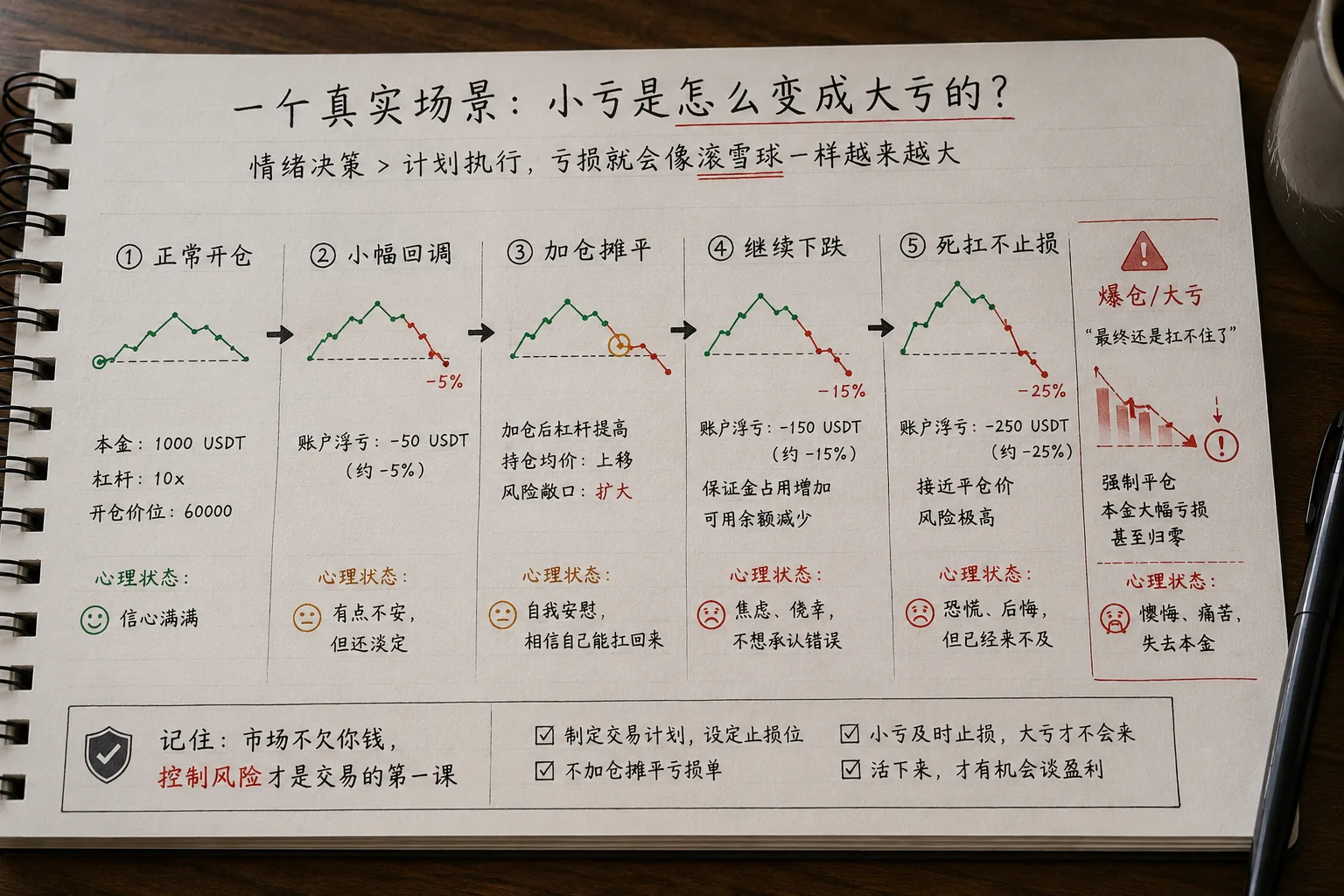
If it had started as a small position with a preset maximum loss, it might have just been an ordinary mistake.
But with an oversized position, leverage, following signal calls, and no stop-loss, it can turn into serious damage.
The most expensive tuition in trading isn't the money you lose.
The most expensive tuition is losing money and still believing "the market didn't give me a chance", instead of admitting you handed your judgment to someone else.
What beginners should actually do: set your bottom lines before trading
I'm not against learning to trade.
But I don't recommend beginners charge straight into futures, high leverage, and get-rich-quick scalping.
You can set a few bottom lines for yourself first:
Don't trade with living expenses.
Don't trade with borrowed money.
Don't follow signal calls from strangers.
Don't go all in on one coin.
Don't touch futures you don't understand.
Step away after consecutive losses.
Decide the maximum loss for every trade in advance.
These don't sound exciting, but they matter.
Because the market never runs short of opportunities.
What's really scarce is capital, patience, and judgment.
If you miss one move today, nothing happens.
But if you blow up your capital in one impulsive moment, then when a real opportunity comes, you won't even be eligible to participate.
If you're just starting to practice trading, I'd suggest spending 1–2 months on demo trading only, or using a very small spot position, to get a feel for the rules and your own emotions before committing real money.
For beginners, avoiding trading pitfalls isn't an empty slogan.
It determines whether you can survive in this market a little longer.
A few honest words to close
Crypto isn't something you can't trade.
But beginners must first understand:
Trading isn't won by passion.
It isn't carried by a teacher.
And it isn't turned around by high leverage.
Don't trust signal callers.
Don't believe in high leverage.
Don't turn a loss into a belief.
Don't treat someone else's signal call as your own judgment.
If you're just entering crypto, I'd suggest starting from the basics:
First understand How to Register on Binance (2026).
Then understand stablecoins like USDT and USDC.
Then understand wallet addresses, withdrawal networks, and the risk of wrong-chain transfers.
Finally consider whether you're actually suited to trading.
The scariest thing in crypto isn't being slow.
The scariest thing is handing over your chips before you understand the rules of the game.
Related reading
- Binance Account Hacked? 4-Step Recovery + 5 Causes
- Binance/OKX Account Security Checklist: How to Enable 2FA, Anti-Phishing Code and Withdrawal Whitelist (2026)
- How to Spot Trade on Binance? Market Orders, Limit Orders and Trade History (2026 Tested)
Data verification notes
The key facts in this article were checked on 2026-10-16 against Binance Academy's official explainer, point by point:
- Leverage's double edge: leverage amplifies both potential gains and potential losses. Source: Binance Academy "What Is Leverage in Crypto Trading".
- Liquidation risk: using high leverage before understanding margin and the liquidation mechanism means a small adverse price move can trigger liquidation. Source: Binance Academy "What Is Leverage in Crypto Trading".
Risk notice
Crypto asset prices are extremely volatile, and trading can result in the loss of your principal. This article is for beginner risk education only and is not investment advice, trading advice, or any promise of returns. Any trading should be based on your own judgment and risk tolerance.
- Binance Academy — What Is Leverage in Crypto TradingLeverage amplifies both gains and losses, plus liquidation risk
- 2026-10-16UpdateAdded evidence-chain superscripts and Data Verification Notes; updated the key-fact verification date.
See ourEditorial Policy and the correction process in ourCorrections Policy.
The CoinTrailHub editorial team focuses on crypto education for beginners, exchange security and P2P trading risk. This article is compiled from official sources and public data, reviewed by humans, and strives for accuracy but is not investment advice.
Last updated:2026-07-03 · Content reviewed by humans · Learn more
© 2026 CoinTrailHub · Original content. Reproduction or rewriting without permission is prohibited.