
What Is BEP20 USDT? How It Differs from ERC20 and TRC20, Fees, and How to Spot a Fake (2026)
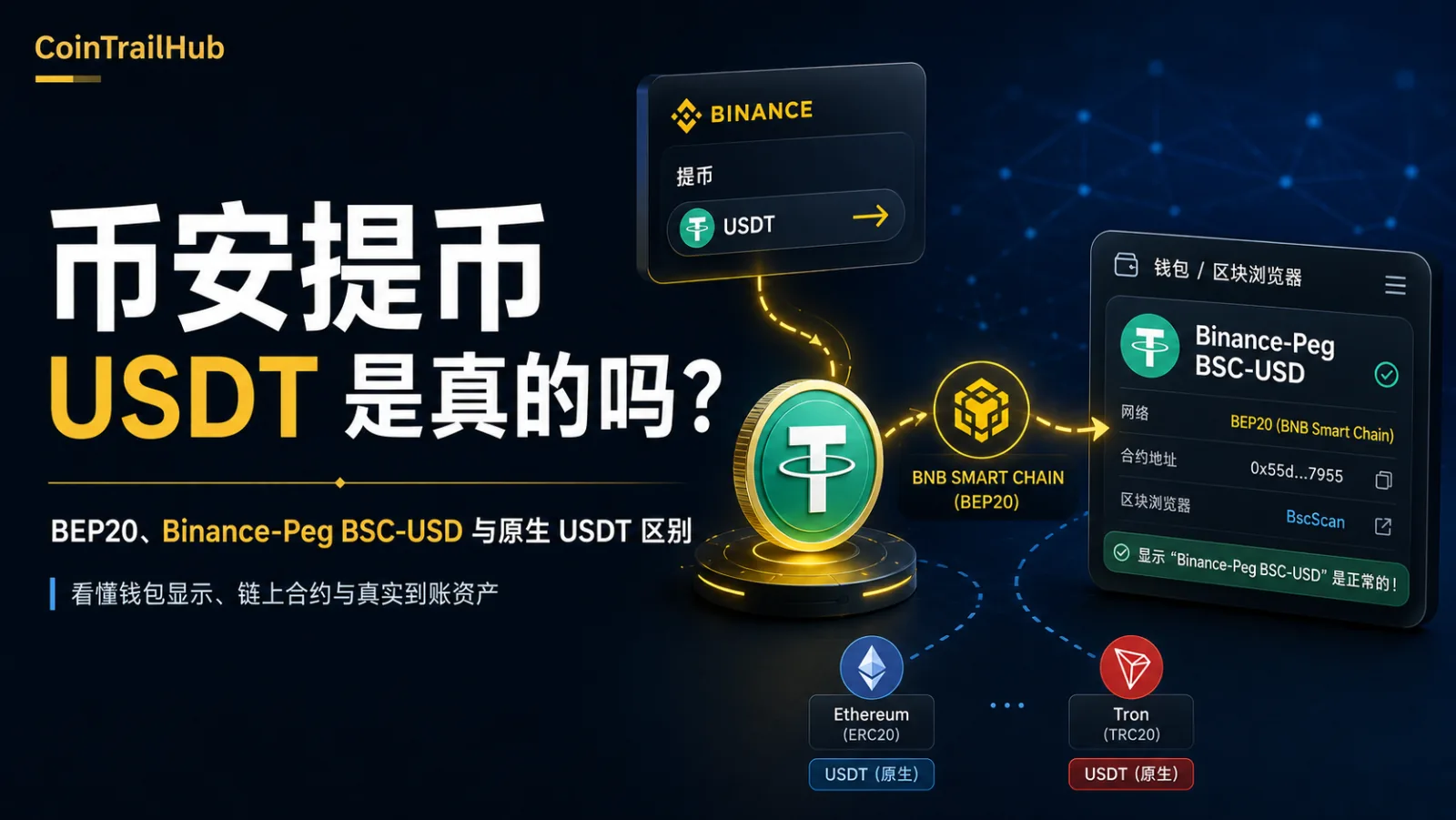
Table of contents

Binance new user rewards
20% trading fee rebate
Official Binance registration. Complete identity verification (KYC) to trade and withdraw.
BEP20 USDT is USDT that runs on the BNB Smart Chain (BSC). If you choose BNB Smart Chain (BEP20) when withdrawing USDT from Binance and then see BSC USDT in your wallet, that's normal and doesn't mean you received a fake coin.
However, it is not the same token as ERC20 USDT on Ethereum or TRC20 USDT on Tron. The biggest differences between the three are the network, gas, address format, platform support and withdrawal fees.
Here's the summary first:
| The question you care about | Answer |
|---|---|
| Is BEP20 USDT real? | Yes, the key is verifying the correct network and official contract |
| Which chain is BEP20? | BNB Smart Chain (BSC) |
| What does the address start with? | Usually 0x |
| What pays the transfer gas? | BNB |
| Is it the same address as ERC20? | Both may start with 0x, but the networks are completely different |
| Is it the same as TRC20? | No, TRC20 is on the Tron network and addresses usually start with T |
| Which has the cheapest fees? | BEP20 and TRC20 are usually cheaper than Ethereum, but exchange withdrawal fees change in real time |
| What goes wrong most easily? | Only checking the address, not the network |
In one sentence:
BEP20, ERC20 and TRC20 are not three different USDT prices; they are three ways USDT is used on different blockchain networks. When transferring, the most important thing isn't "which is cheapest" — it's that the sender and receiver must support the same network.
If you haven't yet systematically understood what USDT is, start here: What Is USDT? Tether's Uses and Risks (2026).
Note: This article is compiled from public on-chain data and public materials and does not constitute investment advice. The contract addresses and issuer relationships mentioned here can all be checked publicly on BscScan, Etherscan and Tether's official transparency page. Platform rules, fees and Tether's issuance change over time, so always rely on the latest data on official pages.
About 8 minutes to read. First remember two things: BEP20, ERC20 and TRC20 are three USDTs on three chains, and choosing the wrong network is more dangerous than choosing an expensive one; if your wallet has no BNB for gas, your BEP20 USDT can't be sent out.
What is BEP20 USDT?
BEP20 is a token standard on the BNB Smart Chain (BSC). BSC was formerly called Binance Smart Chain, then renamed BNB Smart Chain. You can think of it as the "token format" on this chain, just like ERC20 on Ethereum and TRC20 on Tron.
"BEP20 USDT" refers to the USDT circulating on the BNB Smart Chain. In everyday talk, "BEP20 USDT", "BSC USDT" and "BEP20 U" basically mean the same thing — the mainstream USDT contract on this chain is 0x55d398326f99059fF775485246999027B3197955, and if you enter that address on BscScan, you'll see it's called Binance-Peg BSC-USD.[1]
Here's an important point to remember: BEP20 describes a "standard", not a specific coin. Many different tokens conform to the BEP20 standard, and USDT is just one of them.
Is BEP20 USDT real? Why does it show Binance-Peg BSC-USD?
It's real, not a fake coin. This is also the thing that scares beginners the most the first time they withdraw.
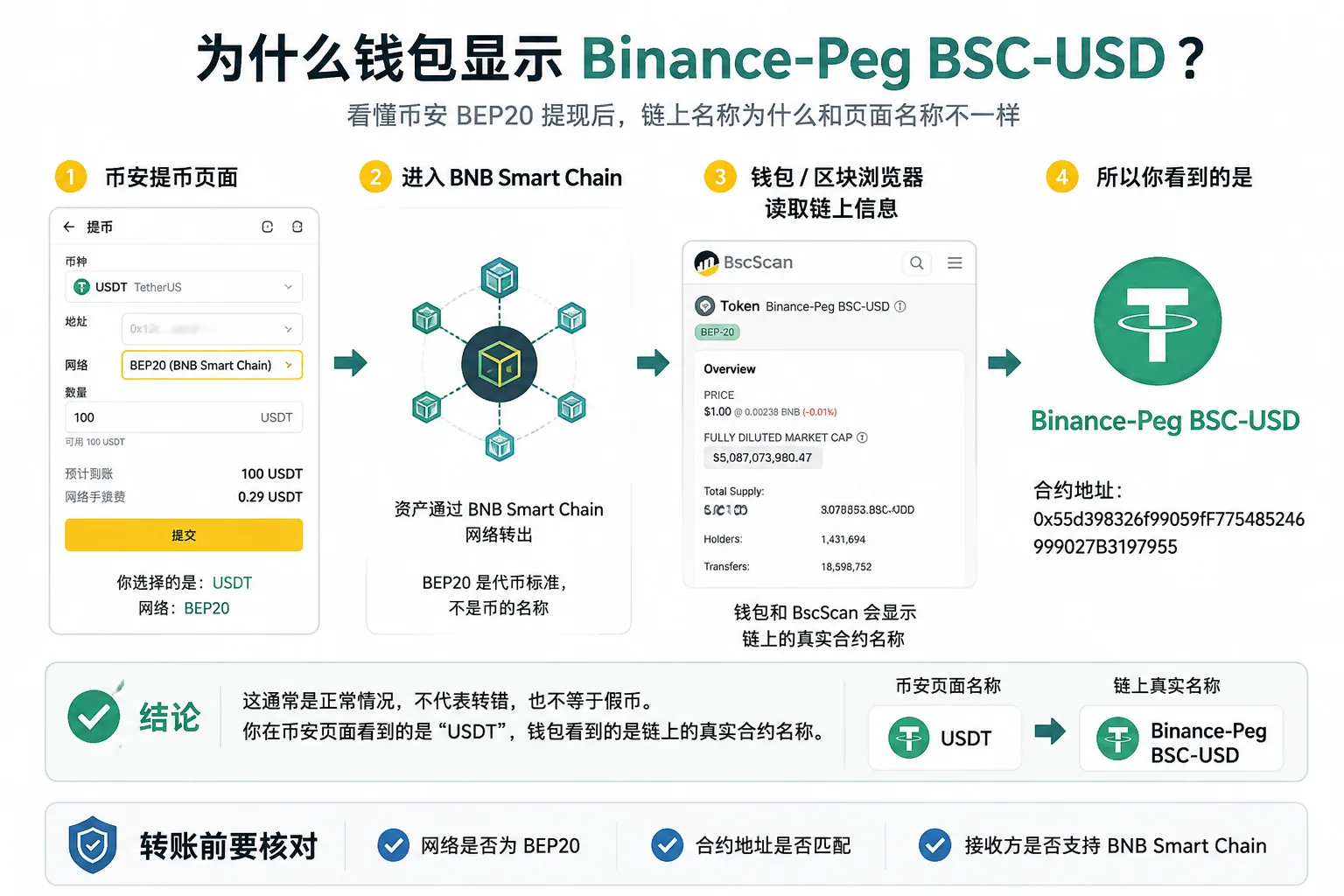
The Binance withdrawal page says "USDT" because what you're withdrawing is a dollar stablecoin, and "USDT" is the easiest way to say it. But when you withdraw the coins to your own wallet and open BscScan, you see the real on-chain contract name — Binance-Peg BSC-USD. Both names exist at once: one is the user-facing name, and one is the real on-chain name.
| The name you see | Who actually issued it | Which chain |
|---|---|---|
| BEP20 USDT (the common case) | Binance-Peg BSC-USD (a Binance pegged asset) | BNB Smart Chain |
| Binance-Peg BSC-USD (shown on BscScan) | Binance (same thing as above) | BNB Smart Chain |
| Native USDT (ERC20) | Tether | Ethereum |
| Native USDT (TRC20) | Tether | Tron |
One-sentence distinction: both represent the value of USDT, but the on-chain issuance and custody mechanisms differ — USDT on Ethereum and Tron is issued directly by Tether, while the common version on BSC is a pegged asset (Binance-Peg BSC-USD).[2] That's a "mechanism difference", not a "real vs fake difference".
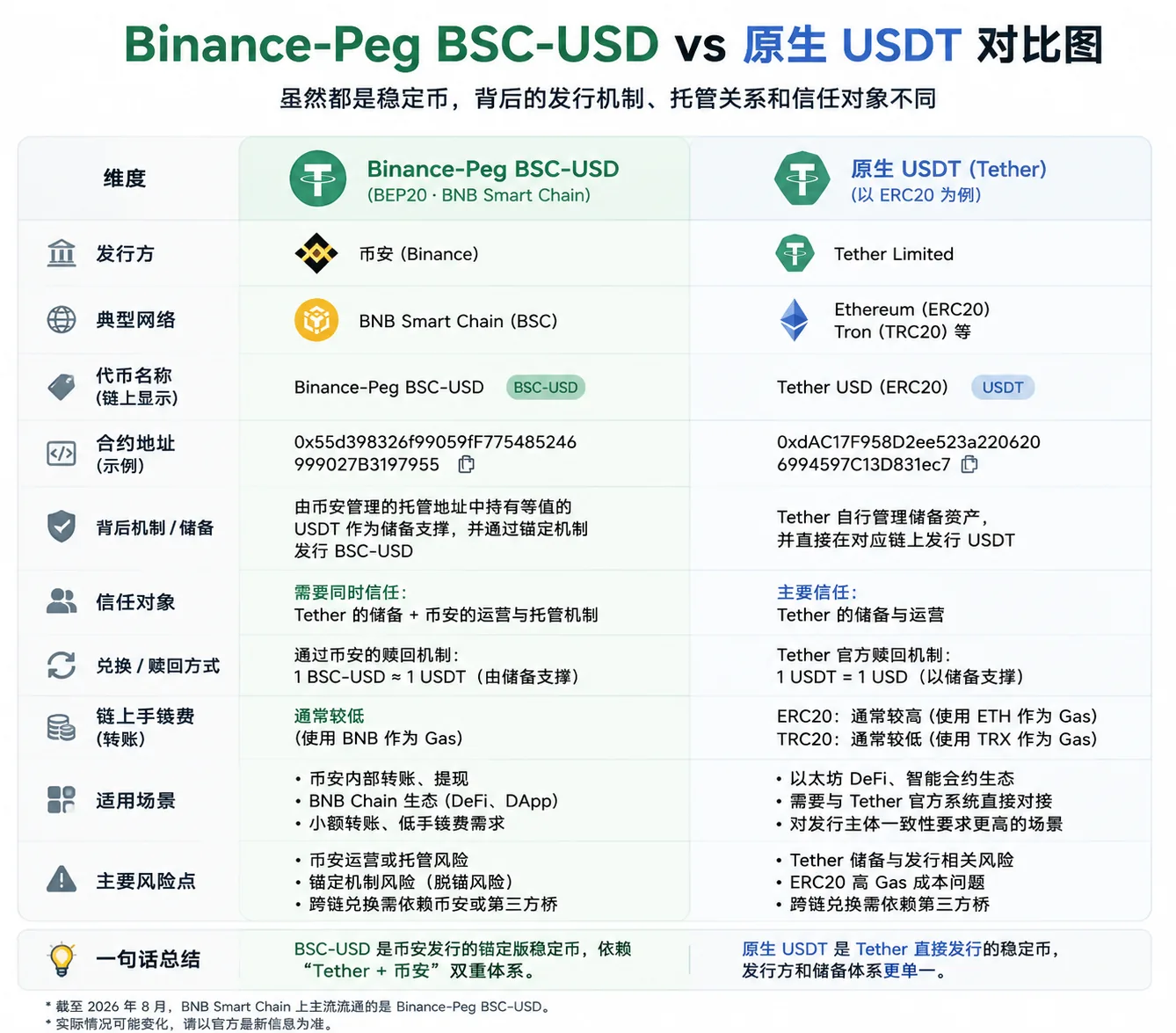
So it isn't a fake coin — it works normally on platforms or wallets that support BNB Smart Chain and this contract; but its trust model differs from native USDT — there's one extra layer of reliance on Binance.[3]A pegged token aims for 1:1, but that doesn't mean it's always strictly 1:1; in extreme cases it can briefly drift. If you care a lot about "who the issuer really is", just factor that in — you don't need to treat it as a fake coin.
What's the difference between BEP20, ERC20 and TRC20?
These three words all describe "token standards".
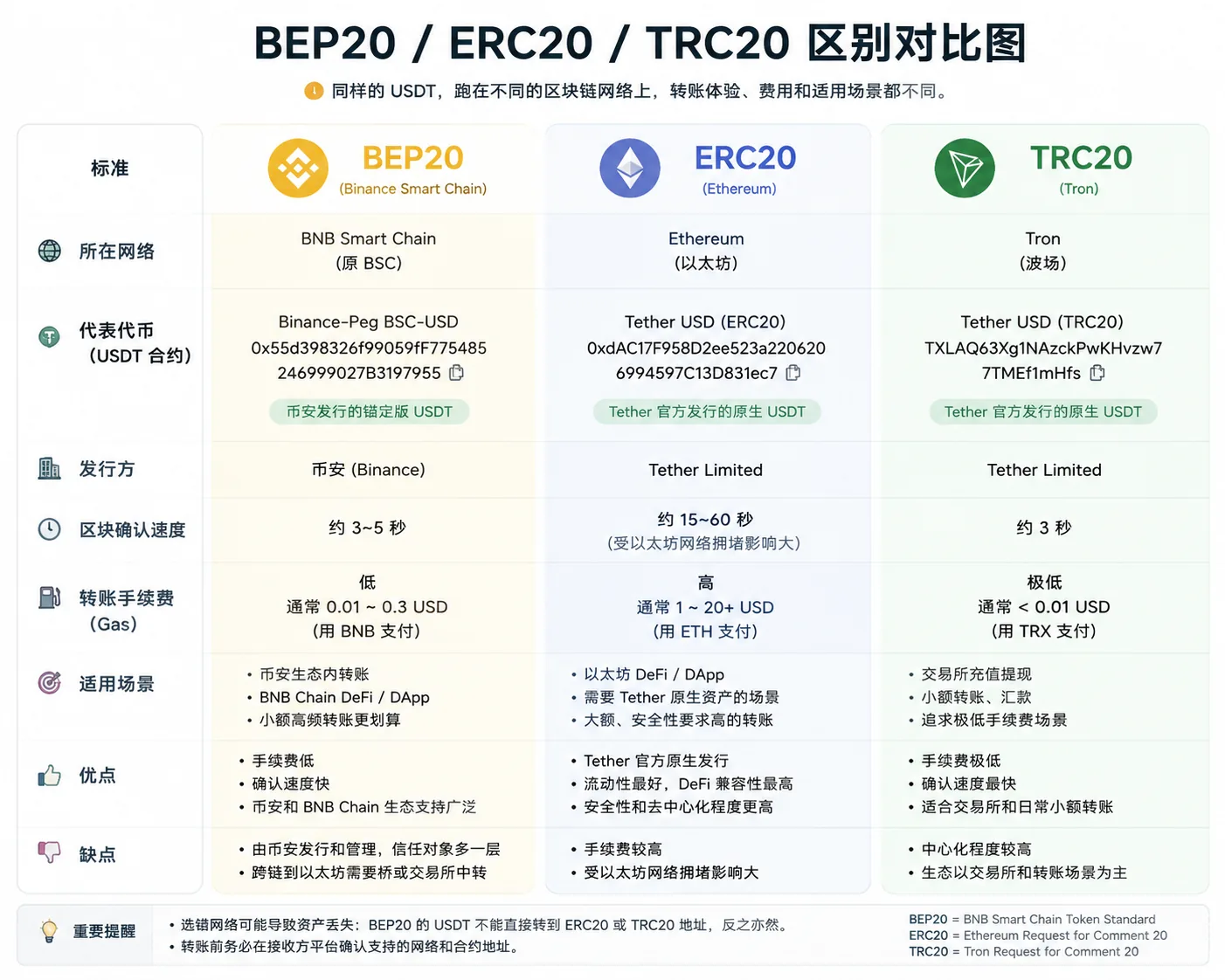
| Standard | Network | Address format | Network-fee characteristic | Gas asset |
|---|---|---|---|---|
| BEP20 | BNB Smart Chain (BSC) | Starts with 0x | Usually low | BNB |
| ERC20 | Ethereum | Starts with 0x | Usually high, clearly affected by congestion | ETH |
| TRC20 | Tron | Starts with T | Usually low, but depends on the platform and on-chain resource mechanism | TRX |
Two key things to remember:
First, a standard is not a coin. BEP20, ERC20 and TRC20 are token standards on different chains, and USDT is just one of many tokens that conform to these standards.
Second, networks are not the same thing. The same "USDT" can exist on different blockchain networks, but assets on different networks can't simply turn into assets on another chain through a normal transfer; moving across networks usually requires exchange deposits/withdrawals, an officially supported cross-chain mechanism or a bridge tool.
Which is cheaper — BEP20, ERC20 or TRC20?
"Fees" actually come in two layers — don't mix them up:
- On-chain gas (network fee): determined by the blockchain you use. BEP20 pays in BNB and is usually low; ERC20 pays in ETH and is affected by Ethereum gas fluctuations; TRC20 uses TRX and TRON's Energy / Bandwidth resource mechanism.[4]
- Exchange withdrawal fee: set by platforms like Binance and OKX themselves, adjusts dynamically, and is not the same as the real on-chain gas. When actually withdrawing, rely on the fee shown on the platform's withdrawal page.
Using the on-chain situation in early October 2026 as a reference:
| Network | Gas / resource asset | On-chain transfer cost reference | Fee characteristic |
|---|---|---|---|
| BEP20 | BNB | Commonly around $0.01–$0.05, possibly lower when gas is low | Usually very cheap, good for small and frequent transfers |
| ERC20 | ETH | Commonly around $0.5–$3+ | Affected by Ethereum gas, can rise clearly when congested |
| TRC20 | TRX / Energy / Bandwidth | 0 TRX to tens of TRX can all happen | Whether you have enough Energy / Bandwidth directly affects the actual fee |
Note: This table is an on-chain cost reference, not Binance's or OKX's USDT withdrawal fee, and not a fixed rate. Actual fees will differ as network conditions, wallet resources and platform rules change.
So if you only compare on-chain cost, BEP20 is usually one of the cheapest tiers; ERC20 is generally higher and more volatile; and TRC20 can't simply be written as a fixed "1 USDT" or a fixed amount of TRX, because whether resources are sufficient directly affects the actual fee.
For example, recent USDT transfers on TRON show that some transactions consume tens of thousands of Energy but actually show a 0 TRX charge, meaning the sending account had or received enough on-chain resources.
I've broken down the relationship between BNB Chain, BSC and BEP20 in detail in another article: Can You Pay BNB Chain Fees with USDT? BEP20 Transfers and Gas, Tested (2026).
How to choose BEP20 USDT? When to use it?
BEP20 solves "cheap and convenient", while native USDT emphasizes "consistent issuer". It depends on your situation:
| Your situation | My suggestion | Reason |
|---|---|---|
| Only moving USDT within Binance and its ecosystem | BEP20 is fine | Low fees, supported on both sides |
| Small amounts for practicing with wallets and swaps | BEP20 is suitable | Low gas, cheap to experiment |
| Going into Ethereum DeFi | Use ERC20 USDT directly | Use the native token of the corresponding chain, don't rely on bridges |
| The recipient only supports BEP20 | You can only use BEP20 | If networks don't match, assets can't be credited |
| You care a lot about "the issuer being Tether itself" | Look into native USDT | A simpler counterparty |
Don't treat "BEP20 USDT" as a good-or-bad question; first figure out which chain it's most convenient for you to use it on.
I've written separately about keeping USDT on an exchange vs in a wallet: Where to Keep the USDT You Bought on Binance/OKX? On the Exchange or Withdraw to a Wallet (2026).
BEP20 and ERC20 both use 0x, so why can't I transfer them interchangeably?
Because "same address format" doesn't mean "same network".
BEP20 and ERC20 both use the 0x address format, but the assets are recorded on different blockchains. If the recipient is an exchange or custodian platform that hasn't enabled the corresponding network for that deposit, the assets may not be credited automatically; if it's a wallet where you control the private key, it's handled differently. So don't choose a network just because the addresses look the same.
Before transferring, always check these 5 things:
- Check the network: the network the sender chooses must match what the recipient supports.
- Check the address: after copying, look at the first few and last few characters; don't just trust "copied successfully".
- Check the fee asset: BEP20 transfers need a small amount of BNB for gas; without BNB in the wallet, nothing can be sent.
- Confirm Memo/Tag: most Binance BEP20 deposit addresses don't need one, but some platforms may; the deposit page will say clearly.
- Test with a small amount: the first time you send to a new address, send a very small amount first to confirm it arrives.
I've fully covered handling a wrong-chain transfer in another article: Can You Recover a Wrong-Chain Transfer? Withdrawal Networks and Wallet Addresses (2026).
How to tell if BEP20 USDT is real or fake?
Just seeing the word "USDT" in your wallet doesn't prove it's real.
BNB Smart Chain is an open network — anyone can create a token and set its name and symbol to look like "USDT". So you can't judge real from fake by name alone; it's more reliable to check these three things:
1. Confirm the network first. BEP20 USDT should be on the BNB Smart Chain (BSC).
2. Verify the contract address. Check the Token Contract in your wallet or on BscScan; don't just look at the "USDT" name and icon. The USDT contract Binance currently recognizes on BNB Smart Chain is 0x55d398326f99059fF775485246999027B3197955. When copying a contract address, get it from Binance, a trusted block explorer or the project's official materials — not from unknown group chats, search ads or private messages.
3. Check whether the platform actually supports this network. Even if you hold the correct BSC USDT, if the receiving exchange hasn't enabled USDT-BEP20 deposits, you can't send it there.
So "real or fake" and "can it be transferred" are two different questions:
Real vs fake first depends on the network and contract; whether it can be transferred depends on the networks the receiving platform supports.
Why does transferring BEP20 USDT need BNB?
On the BNB Smart Chain, transferring needs a small amount of BNB as gas (network fee).
That's the rule of BSC: every on-chain operation pays gas, and BSC pays it with BNB.[5]So a wallet with only USDT and no BNB can't send anything out. Before your first transfer, leave a little BNB in the wallet.
FAQ
Are BEP20 USDT and ERC20 USDT the same?
No. The mainstream USDT on BEP20 is the Binance-maintained pegged token Binance-Peg BSC-USD, while USDT on ERC20 is the native USDT issued directly by Tether. Both are called USDT, but the on-chain issuance/custody mechanism and network differ.
Is BEP20 USDT safe?
It's not a fake coin — it works normally on platforms or wallets that support BNB Smart Chain and this contract; but its trust model differs from native USDT, with one extra layer of reliance on Binance. Both carry issuer and pegging risks; don't treat it as fully equivalent to Tether's native USDT.
How do I check whether a USDT was natively issued by Tether?
Go to a block explorer, check the contract, and verify the issuer and contract address. The native USDT contract on Ethereum is 0xdAC17F958D2ee523a2206206994597C13D831ec7, and the mainstream Binance-Peg BSC-USD contract on BEP20 is 0x55d398326f99059fF775485246999027B3197955.
Do I definitely need BNB to transfer USDT on BEP20?
Yes. BSC pays gas with BNB; without BNB in the wallet you may not be able to send anything out.
How do I convert BEP20 USDT back to ERC20 USDT?
Two routes: first, deposit the BEP20 USDT back to Binance and withdraw it as ERC20; second, use a cross-chain bridge. For beginners, going through Binance's internal accounting is usually simpler and avoids one more layer of third-party bridge contract risk.
Data verification notes
The key facts in this article were checked on 2026-10-03 against BscScan, Etherscan and BNB Chain and TRON official documentation, as follows:
- BEP20 USDT contract: the mainstream USDT contract on BNB Smart Chain is
0x55d398326f99059fF775485246999027B3197955, and its on-chain name is Binance-Peg BSC-USD. Source: BscScan: Binance-Peg BSC-USD contract. - Native vs pegged: USDT on Ethereum is issued directly by Tether (ERC20), while the common version on BSC is a pegged asset issued by Binance, and the two have different on-chain issuance and custody mechanisms. Source: Etherscan: Tether USD (ERC20) contract.
- Reserve backing of the pegged asset: Binance-Peg assets are maintained by Binance with a corresponding reserve backing address, so they carry one extra layer of reliance on Binance compared with native USDT. Source: BscScan: Binance-Peg reserve backing address.
- TRC20 fee mechanism: TRON transfers consume Energy / Bandwidth resources, and whether resources are sufficient directly affects the actual fee; some transactions can show a 0 TRX charge. Source: TRON official documentation.
- BSC gas rule: every on-chain operation on the BNB Smart Chain pays gas with BNB, and a wallet without BNB cannot send tokens out. Source: BNB Chain official documentation.
Related reading
- What Is USDT? Tether's Uses and Risks (2026) — start with the basics of USDT
- Can You Recover a Wrong-Chain Transfer? Withdrawal Networks and Wallet Addresses (2026) — what to do if you picked the wrong withdrawal network
- Can You Pay BNB Chain Fees with USDT? BEP20 Transfers and Gas, Tested (2026) — a complete breakdown of the network BEP20 lives on
- Where to Keep the USDT You Bought on Binance/OKX? On the Exchange or Withdraw to a Wallet (2026) — decide where to keep your USDT
- Withdrawing USDT to a Bank Card: Full Steps + Fees + Arrival Time + Card-Freeze Risk (2026) — read this if you want to convert USDT to fiat and withdraw to a bank card
- USDT vs USDC: What's the Difference? Which Is Safer and How to Choose (2026) — compare with another stablecoin
Disclaimer
This article is for educational purposes about stablecoins, cross-chain transfers and on-chain assets only, and does not constitute any investment, financial or trading advice.
Crypto assets and stablecoins carry issuer risk, custody risk, peg/depeg risk, bridge risk, platform risk, network-security risk and operational risk. Any operation involving deposits, withdrawals, transfers and wallet approvals should first confirm the official channel and be done only after fully understanding the risks.
- BscScan: Binance-Peg BSC-USD contractVerify the BEP20 USDT contract address (to tell real from fake)
- Etherscan: Tether USD (ERC20) contractVerify the Ethereum native USDT contract address
- BscScan: Binance-Peg reserve backing addressBinance-Peg reserve backing address
- Tether official transparency pageUSDT issuance and reserve transparency
- BNB Chain official documentationThe BSC mechanism of paying gas with BNB
- TRON official documentationThe TRON Energy/Bandwidth resource mechanism
- CoinMarketCap: Tether USDtTether USDt market overview
- 2026-10-17UpdateAdded evidence-chain superscripts and Data Verification Notes.
- 2026-10-03UpdateRestructured the explanation of BEP20 USDT authenticity, network differences, fees and transfer verification.
- 2026-09-15UpdateExpanded the BEP20/ERC20/TRC20 comparison plus withdrawal-fee and on-chain-fee explanations.
See ourEditorial Policy and the correction process in ourCorrections Policy.
The CoinTrailHub editorial team focuses on crypto education for beginners, exchange security and P2P trading risk. This article is compiled from official sources and public data, reviewed by humans, and strives for accuracy but is not investment advice.
Last updated:2026-10-03 · Content reviewed by humans · Learn more
© 2026 CoinTrailHub · Original content. Reproduction or rewriting without permission is prohibited.