
What is RLUSD? How it differs from USDT and USDC
Table of contents

Binance new user rewards
20% trading fee rebate
Official Binance registration. Complete identity verification (KYC) to trade and withdraw.
Cooperation note
This article has no promotional relationship with Ripple, Binance, Tether, or Circle, and contains no referral codes or promotional links. All views are based on public information.
This article does not constitute investment advice. Stablecoins carry depegging, issuer-credit, reserve-transparency, and regulatory risks. Please fully understand these before making decisions.
Three things to remember first
- XRP solves "how to move value," RLUSD solves "what price unit to move it in" — the two are not competitors.
- RLUSD is a stablecoin whose goal is to stay near $1, not a tool to make XRP rise.
- USDT, USDC, and RLUSD have no absolute "best" — it depends on which ecosystem you use.
About 12 minutes to read. First remember two things: RLUSD is the dollar stablecoin of the XRP Ledger ecosystem, not a price tool for XRP; and although they're all called stablecoins, USDT, USDC, and RLUSD have completely different issuers and reserve-disclosure methods — don't judge by name and price alone.
What are XRP, XRP Ledger, RLUSD, USDT, and USDC?
Many new users first exposed to the XRP ecosystem confuse several concepts. This table maps the five names:
| Name | Type | Main role | Simple understanding |
|---|---|---|---|
| XRP | Crypto asset | Value transfer, network liquidity, fees | The native asset of XRP Ledger |
| XRP Ledger (XRPL) | Blockchain network | Processing transactions, issuing assets, supporting apps | The infrastructure carrying digital assets |
| RLUSD | Dollar stablecoin | Stable denomination, payment, settlement | The digital dollar in the XRPL ecosystem |
| USDT | Stablecoin | Trading, transfers | A globally widely used stablecoin |
| USDC | Stablecoin | DeFi, financial applications | A commonly used stable asset in institutional and on-chain finance |
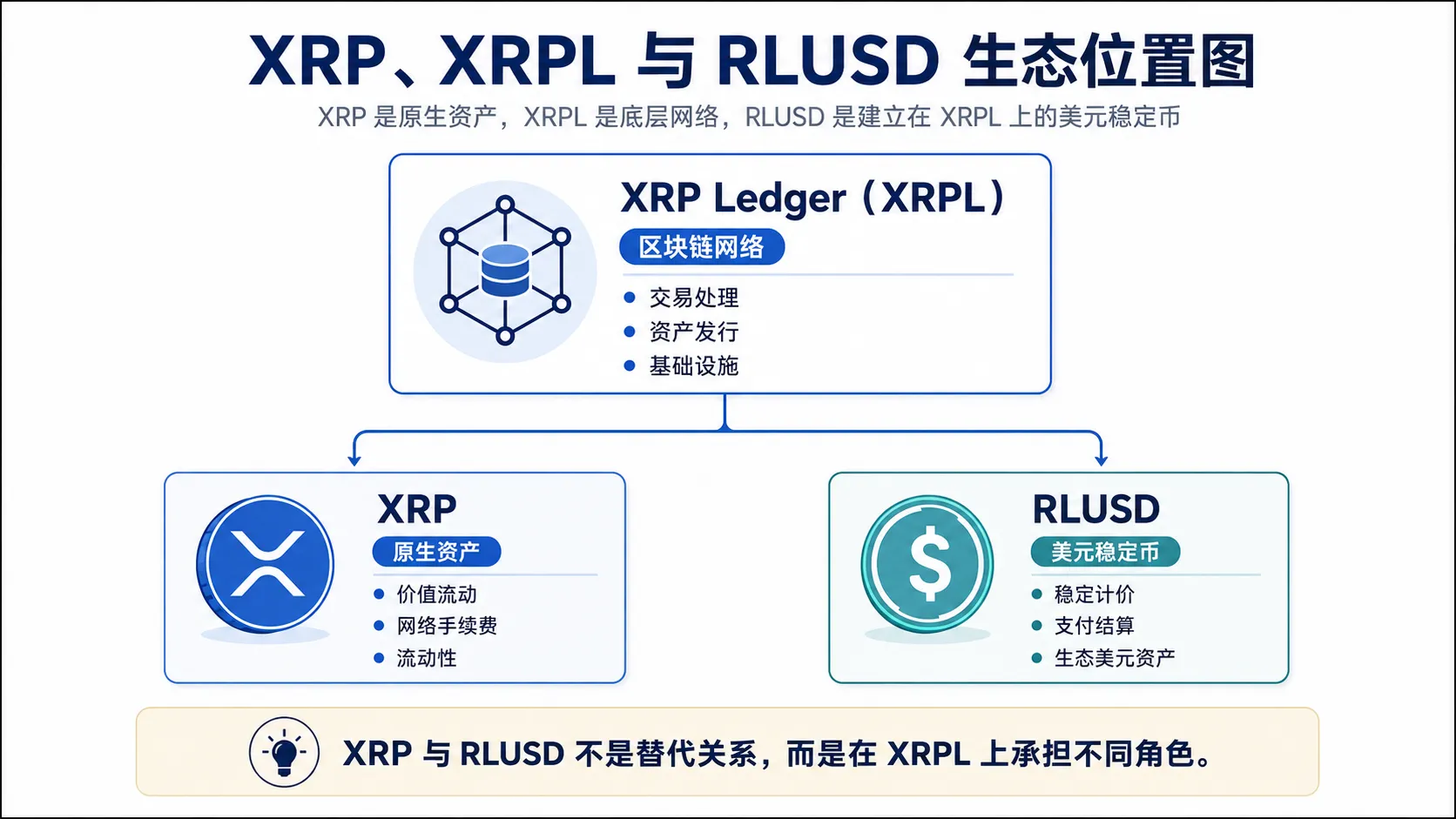
Remember this three-layer relationship in one sentence: XRPL is the network, XRP is the native asset, and RLUSD is the dollar-denominated stable asset in the ecosystem. If you're new to stablecoins, start with What is USDT.
Why is XRP related to payments?
One of XRP Ledger's design goals is to improve the efficiency of value transfer in the traditional financial system. If you don't yet know XRPL, start with What is XRP Ledger.
Traditional cross-border payments often pass through multiple financial institutions, take longer processing flows, and require coordination across financial systems in different regions. Blockchain networks aim to improve this with faster transaction confirmations, round-the-clock operation, and global value transfer.
As XRP Ledger's native asset, XRP plays the roles of network fees, value transfer, and liquidity. So one of the most important early directions of the XRP ecosystem is enabling value to flow more efficiently around the world.
Why does XRP Ledger still need a stablecoin?
Many people ask: if XRP can transfer value, why does it need RLUSD?
The key is that a financial ecosystem needs not only the ability to transfer assets, but also a stable unit of account. The real-world financial market works the same way — assets like stocks and bonds are for growth and allocation, while the dollar is for denomination and settlement:
| Traditional finance | Blockchain finance |
|---|---|
| Stocks, bonds, and other assets | Volatile assets like BTC, ETH, XRP |
| Units of account like the dollar | Stablecoins like USDT, USDC, RLUSD |
Stocks don't lose value because the dollar exists; likewise, XRP doesn't lose its role because stablecoins exist. The two play different roles:
| Asset | Role |
|---|---|
| XRP | Value transfer, network asset, liquidity |
| Stablecoin | Dollar denomination, trading medium, settlement tool |
So RLUSD exists not because XRP can't make payments, but to give XRP Ledger a stable dollar asset.
Why was RLUSD created?
When people first see RLUSD, many ask: Ripple already has XRP, why does it need to issue a stablecoin?
The reason is that XRP and stablecoins solve different problems. RLUSD (Ripple USD) is the dollar stablecoin launched by Ripple. Ripple announced the RLUSD plan in April 2024, and after months of testing, officially launched it in December 2024, aiming to add a stable dollar asset to the XRP Ledger ecosystem.[1]
According to Ripple's official information, RLUSD aims to maintain a value of $1 while supporting both the XRP Ledger and Ethereum networks, using a reserve-backed model supported by assets such as cash and cash equivalents.[2]
RLUSD development timeline
| Time | Event |
|---|---|
| April 2024 | Ripple announced the RLUSD plan |
| December 2024 | RLUSD officially launched into the market |
| 2025–2026 | Observing ecosystem adoption, liquidity, and institutional take-up |
Why did Ripple launch its own stablecoin?
On the surface, the market already has USDT and USDC — why does it need RLUSD? Because stablecoins have become essential infrastructure for blockchain ecosystems.
Over the past few years, USDT and USDC have built clear advantages. If an ecosystem lacks a stable dollar asset, users and apps may have to use other ecosystems' stablecoins, rely on external liquidity, or even leave their own network to complete transactions.
So RLUSD can be understood as an important step by Ripple to add dollar liquidity and financial infrastructure to XRP Ledger.
Comparing the market size and user base of USDT, USDC, and RLUSD
Stablecoin competition is not simply about who launched first; what really determines competitiveness is market size, user base, liquidity, and the application ecosystem. The stablecoin market is still mainly dominated by USDT and USDC. Stablecoin market caps change with the market, so this article does not cite a fixed real-time ranking.
Positioning comparison of the three stablecoins
| Project | USDT | USDC | RLUSD |
|---|---|---|---|
| Issuer | Tether | Circle | Ripple |
| Launch time | 2014 | 2018 | Announced 2024 |
| Market position | One of the largest stablecoins | One of the leading stablecoins | An emerging stablecoin |
| Main users | Trading users, exchange users | Institutions, DeFi users, developers | XRP Ledger users |
| Core strength | Liquidity, coverage | Financial applications, institutional partnerships | Integration with the XRPL ecosystem |
| Main scenarios | Trading, transfers, trading-pair settlement | DeFi, RWA, institutional finance | XRPL payments, on-chain applications |
Why has USDT become one of the largest stablecoins?
USDT's biggest advantage is not technology but network effects. After years of development, USDT has become the default dollar asset in many trading markets, with strengths in broad exchange support, rich trading pairs, deep liquidity, and mature user habits.
For USDT's reserve composition, see the Tether official transparency page.
Why does USDC attract attention in financial applications?
USDC and USDT take different paths. USDC emphasizes compliance positioning, enterprise partnerships, and financial applications, which is why it attracts attention in DeFi, RWA, and institutional finance. See the Circle official USDC page for details.
To learn more about the difference between the two, see What's the difference between USDC and USDT.
Where is RLUSD's competitive position?
RLUSD faces a reality: it is not entering an empty market, but a market where USDT and USDC have built years of advantages. So RLUSD's question is not "can it issue a stablecoin," but whether it can form a distinctive use case within XRP Ledger.
It is more likely to compete in directions such as XRPL ecosystem dollar assets, Ripple payment-related scenarios, and enterprise settlement needs, rather than challenging USDT's trading-market position in the short term.
How does RLUSD stay near $1?
The core question for a stablecoin is: why can 1 RLUSD stay near $1? Because a stablecoin doesn't create value by rising; it needs a stabilization mechanism to maintain its target price.
RLUSD uses a reserve-backed model. Simply put, RLUSD's value foundation comes from the reserve assets held by the issuer, not from an algorithm automatically adjusting the price.[3] For the specific reserve mechanism, see the RLUSD whitepaper published by Ripple.
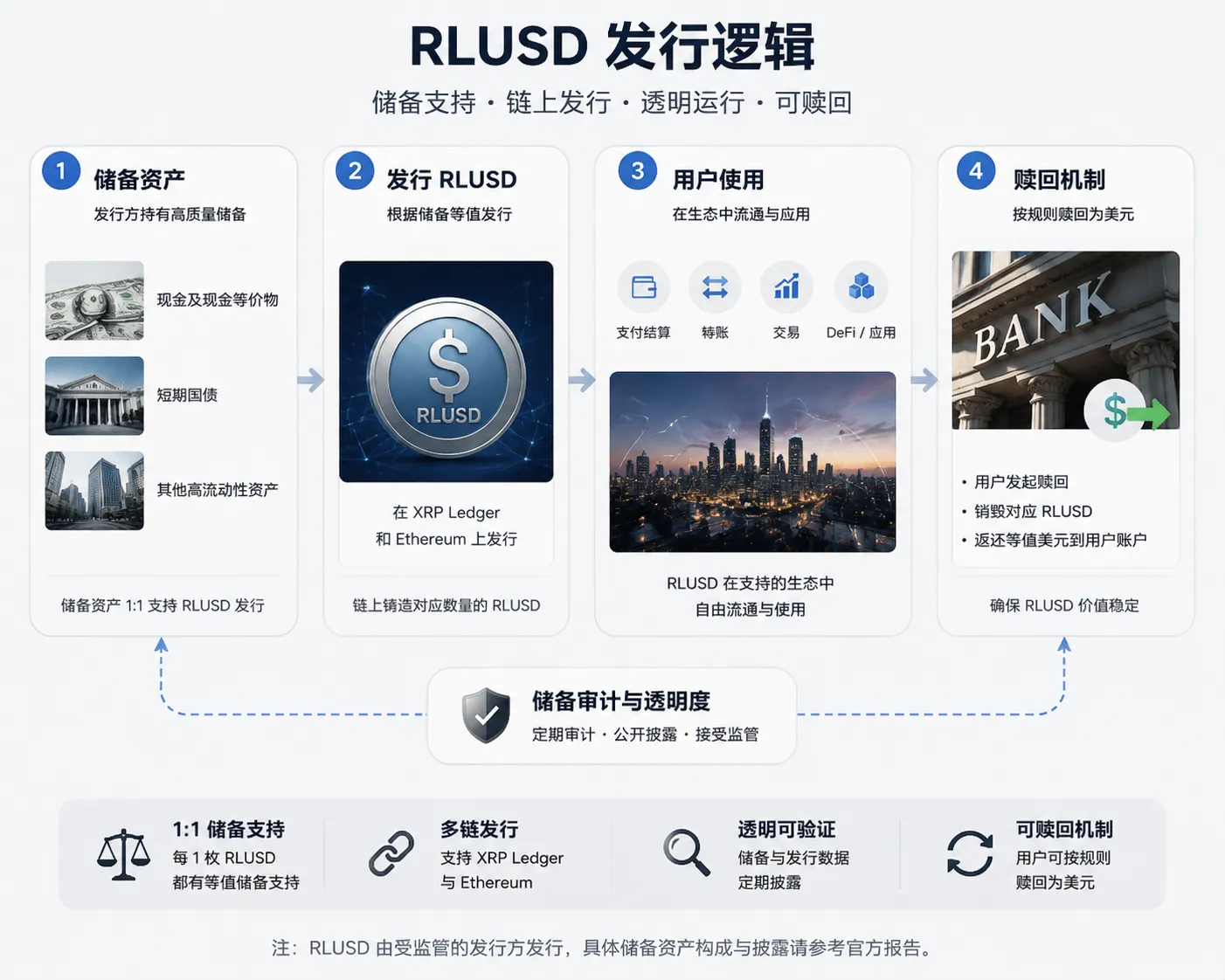
How RLUSD operates
| Step | Process |
|---|---|
| 1 | The user obtains RLUSD; the issuer manages the corresponding backing assets |
| 2 | The issuer holds reserves to back the stablecoin's value |
| 3 | The circulating supply increases or decreases according to issuance rules |
| 4 | The user uses or redeems under supported conditions |
Key factors for a stablecoin's stability
| Factor | Description |
|---|---|
| Reserve assets | Whether there are enough assets backing the circulating stablecoin |
| Issuance mechanism | Whether issuance and burning are clear |
| Transparency | Whether users can access relevant information |
| Redemption ability | Whether it can be redeemed according to the mechanism |
| Market liquidity | Whether there is enough trading depth |
How do XRPL stablecoins differ from ERC-20 stablecoins?
Ethereum users are familiar with smart contracts, tokens, and wallet addresses; XRP Ledger uses Issued Currency (issued assets) and involves the Trust Line mechanism.[4]
| ERC-20 stablecoin | XRPL issued asset | |
|---|---|---|
| Underlying mechanism | Smart-contract token | Ledger-issued asset |
| User operation | Authorizing the contract | Setting up a Trust Line |
| Key focus | Contract address | Issuer identity |
These two asset mechanisms can be referenced respectively in the XRP Ledger official docs and the Ethereum ERC-20 official docs.
XRPL users need to note that you can't look only at the asset name — you must also confirm the Currency Code, Issuer, and Trust Line. If you're not yet familiar with on-chain wallets and asset management, start with What is a cryptocurrency wallet.
Is RLUSD a way to invest in XRP?
The answer is direct: no. RLUSD and XRP have completely different functions:
| XRP | RLUSD | |
|---|---|---|
| Type | Crypto asset | Dollar stablecoin |
| Price change | Fluctuates with the market | Targets near $1 |
| Main role | Value transfer, liquidity | Stable denomination, payment, settlement |
| Does it pursue appreciation | Yes | No |
Why holding RLUSD is not the same as investing in XRP?
RLUSD's goal is not appreciation but maintaining stable dollar value. Holding 1,000 RLUSD targets roughly $1,000 in value, not waiting for it to rise.
Then what effect does RLUSD have on XRP?
The two have no direct price relationship; you can't simply understand it as "RLUSD develops → XRP will definitely rise." More precisely, RLUSD affects XRP Ledger's ecosystem development ability: if more apps are built on XRPL, more users use XRPL, and more financial scenarios adopt XRPL in the future, the whole ecosystem's activity may strengthen as a result.
But RLUSD itself is not a price lever for XRP.
How is RLUSD related to RWA?
RWA (real-world asset tokenization) includes gold, stocks, funds, bonds, and so on:
| Type | Example |
|---|---|
| Gold | Gold tokens |
| Stocks | Tokenized stocks |
| Funds | On-chain funds |
| Bonds | Digital bonds |
Once these assets enter the blockchain, they need stable denomination, trading settlement, and value conversion, so stablecoins are one of the infrastructure pieces for RWA. To learn how real-world assets enter the blockchain, read Is RWA on-chain assets worth investing in.
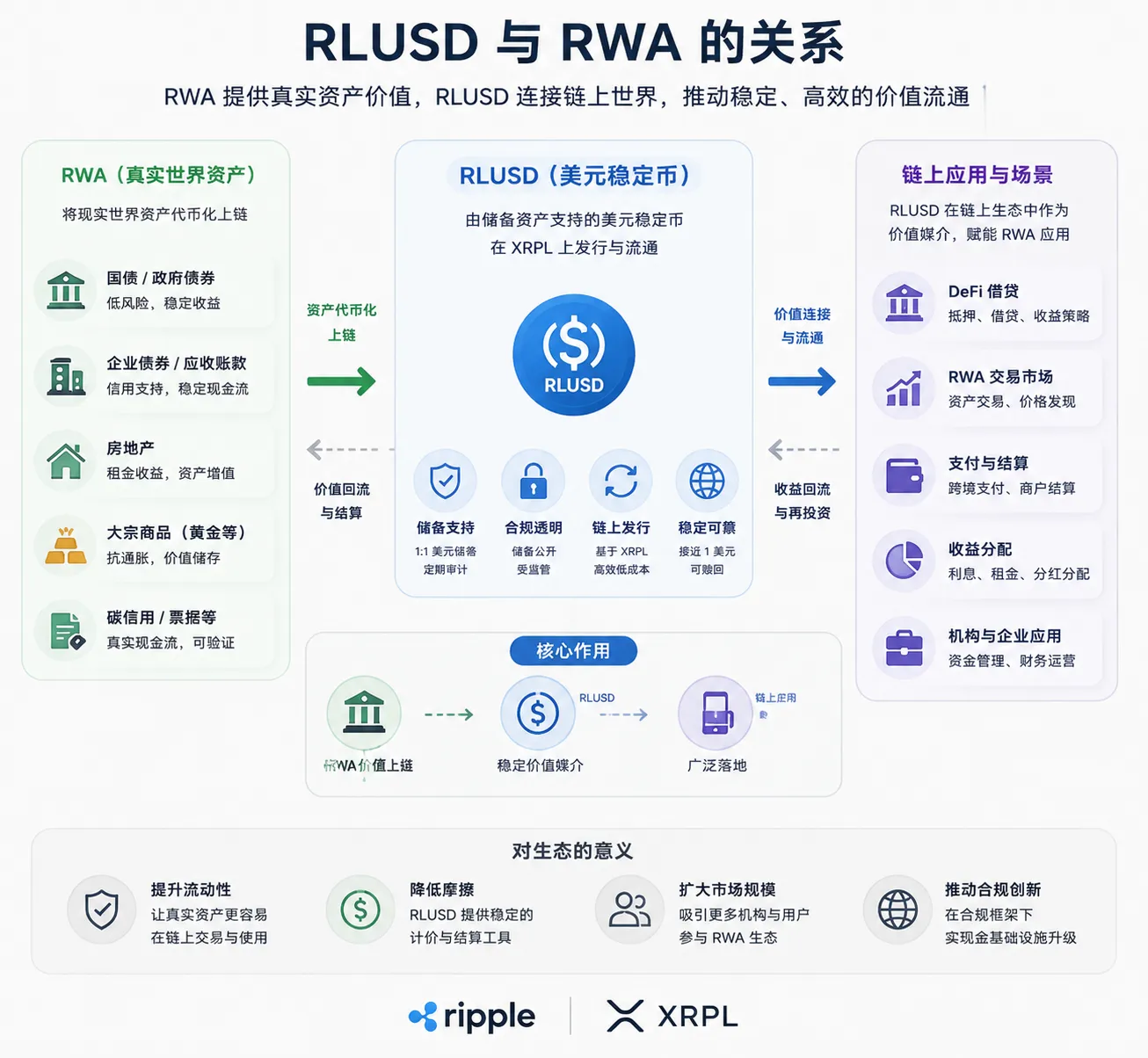
Does RWA currently use RLUSD?
This needs an objective view: many RWA projects currently use USDC or other stablecoins as settlement assets, not "RWA must use RLUSD." RLUSD's opportunity lies in whether XRP Ledger expands usage in asset issuance, enterprise finance, and on-chain settlement in the future — in which case RLUSD could become the dollar asset of the XRPL ecosystem.
What challenges does RLUSD currently face?
The hardest part of a stablecoin is not issuance but whether there is real usage demand:
| Challenge | Reason |
|---|---|
| Liquidity | Needs more market support |
| Wallet support | Needs to be convenient for users |
| Application ecosystem | Needs real scenarios |
| User habits | USDT/USDC are already mature |
Should ordinary users choose RLUSD, USDT, or USDC?
There is no absolute answer; it depends on your use case:
| Need | Choice |
|---|---|
| Trading BTC, ETH | USDT |
| DeFi applications | USDC |
| XRP Ledger ecosystem | Watch RLUSD |
| Enterprise finance research | USDC/RLUSD |
| Cross-platform transfers | Depends on platform support |
Also, no matter which stablecoin you choose, when using a non-custodial wallet you should first secure What is a seed phrase.
One observation: RLUSD is XRP Ledger's response to the stablecoin era
(The analysis below is based on public information and market conditions, and does not constitute investment advice.)
RLUSD's significance is not just adding another stablecoin; it reflects a trend: stablecoins have become essential infrastructure for blockchain ecosystems. USDT and USDC have already built years of advantages, and the core question RLUSD faces is not "can it issue," but whether it can form real usage demand within XRP Ledger.
In the future, the stablecoin market may not be one stablecoin replacing all, but different stablecoins serving different ecosystems.
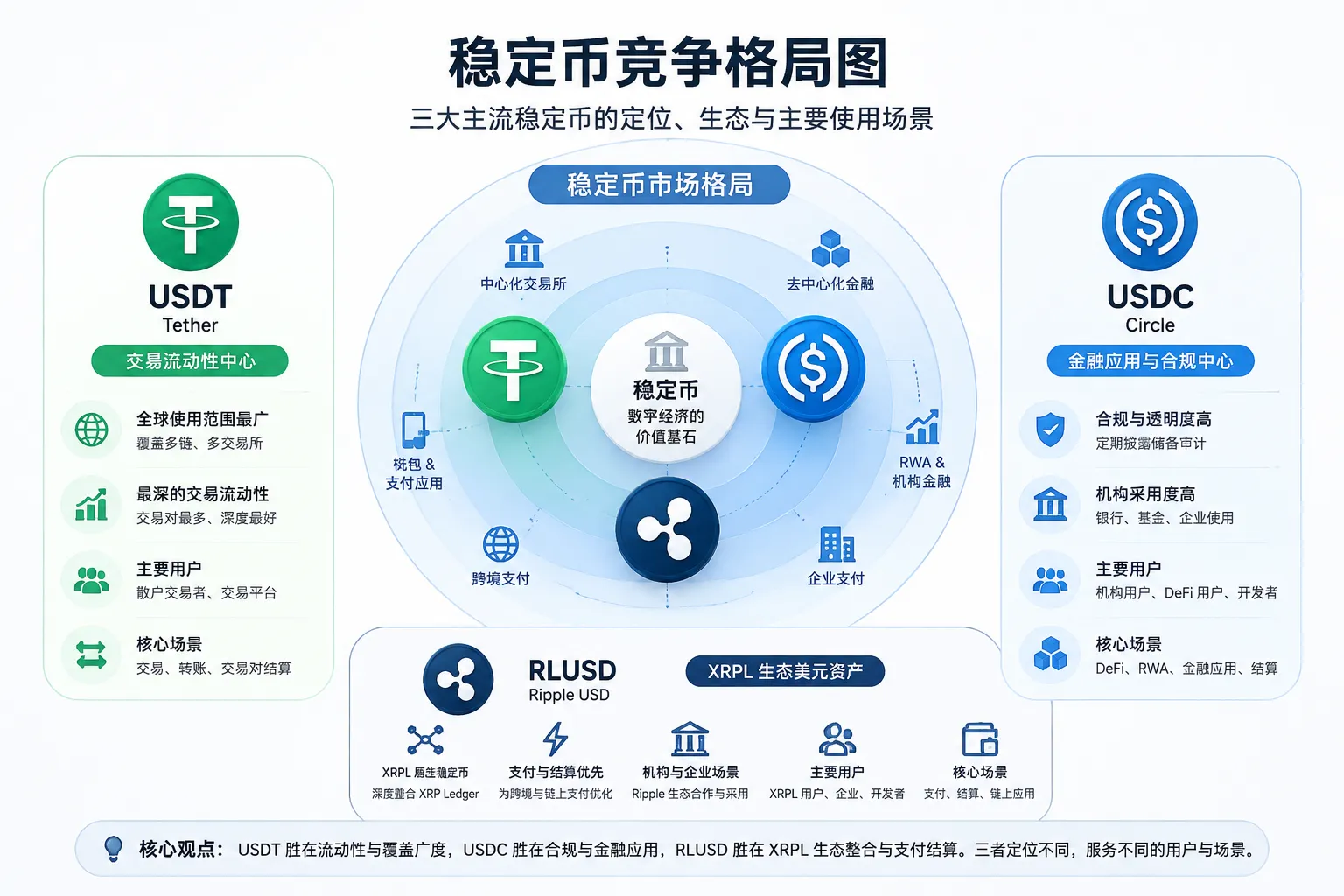
| Stablecoin | Main positioning |
|---|---|
| USDT | Trading-market liquidity |
| USDC | Financial applications and institutional scenarios |
| RLUSD | XRP Ledger ecosystem dollar asset |
FAQ
Is RLUSD XRP?
No. XRP is XRP Ledger's native asset; RLUSD is a dollar stablecoin.
Can holding RLUSD make XRP rise?
You can't understand it that way directly. RLUSD may strengthen the XRP Ledger ecosystem, but it is not itself a price tool for XRP.
Will RLUSD replace USDT?
There is currently no basis to judge so. USDT already has mature liquidity and a user network.
Which is better, RLUSD or USDC?
It depends on the scenario. USDC is more mature in financial applications, while RLUSD focuses more on the XRPL ecosystem.
Is RLUSD on XRPL the same as on Ethereum?
The asset's goal is the same, but the network differs. When using it, confirm the network, wallet support, and address type — don't transfer directly across networks.
One-sentence summary
RLUSD is not a replacement for XRP; it's more like a piece of infrastructure XRP Ledger added in the stablecoin era: XRP handles value movement, RLUSD handles stable dollar denomination.
USDT, USDC, and RLUSD have no absolute best — the key is which ecosystem you use, and what problem you need to solve.
Data verification notes
The key facts in this article were checked on 2026-10-16 against Ripple and XRPL official materials, item by item as follows:
- RLUSD timeline: Ripple announced the RLUSD plan in April 2024, and after months of testing officially launched it in December 2024. Source: Ripple official RLUSD page.
- RLUSD reserves and networks: it targets a value of $1, supports both XRP Ledger and Ethereum, and uses a reserve model backed by assets such as cash and cash equivalents. Source: Ripple official RLUSD page.
- Reserve-backed model: RLUSD's value foundation comes from the reserve assets held by the issuer, not from an algorithm automatically adjusting the price. Source: RLUSD whitepaper.
- XRPL asset mechanism: XRP Ledger uses Issued Currency (issued assets) and Trust Line, different from the ERC-20 smart-contract token mechanism. Source: XRP Ledger official docs.
Related articles
- What is XRP Ledger — Ripple, cross-border payments, and how it differs from Bitcoin and Ethereum
- What's the difference between USDC and USDT — the selection criteria for the two mainstream stablecoins
- What is USDT — the uses, networks, and risks of Tether
- Is RWA on-chain assets worth investing in — how real-world assets enter the blockchain
- What is a cryptocurrency wallet — wallet addresses, seed phrases, and asset security
- What is a seed phrase — why no one can help you recover assets if you lose it
Disclaimer
This article is only for educating about RLUSD, stablecoins, and the XRP Ledger ecosystem, and does not constitute any investment advice, financial advice, or trading advice.
Crypto assets and stablecoins carry market risk, issuer risk, reserve risk, regulatory risk, liquidity risk, platform risk, network-security risk, and operational risk.
Stablecoins can depeg. Any operation involving deposits, withdrawals, transfers, cross-chain, wallet authorization, and asset management should first confirm official channels and only proceed after fully understanding the risks.
- Ripple official RLUSD pageRLUSD issuer, reserve model, and supported networks
- RLUSD whitepaperRLUSD reserves and mechanism
- XRP Ledger official docsXRPL fungible token mechanism
- Circle USDCUSDC official information
- Tether official transparency pageUSDT reserve transparency
- Ethereum ERC-20 standardERC-20 token standard
- 2026-10-17UpdateAdded evidence-chain superscripts and "Data verification notes".
- 2026-08-23UpdateInitial release: explained the relationship between XRP, RLUSD, USDT, and USDC, and the choice scenarios.
See ourEditorial Policy and the correction process in ourCorrections Policy.
The CoinTrailHub editorial team focuses on crypto education for beginners, exchange security and P2P trading risk. This article is compiled from official sources and public data, reviewed by humans, and strives for accuracy but is not investment advice.
Last updated:2026-08-23 · Content reviewed by humans · Learn more
© 2026 CoinTrailHub · Original content. Reproduction or rewriting without permission is prohibited.