
How to Choose a Crypto Exchange for Beginners: Binance vs OKX — Safety, Liquidity, Deposits and Fees

Table of contents

Binance new user rewards
20% trading fee rebate
Official Binance registration. Complete identity verification (KYC) to trade and withdraw.
Let's get straight to the conclusion: there is no "absolute best" exchange, but the order of judgment is basically fixed —
Safety > Liquidity > Deposit/withdrawal convenience > Fees > Interface experience.
Binance and OKX are the two candidates almost every beginner runs into, but choosing one is not about who has lower fees — it's safety first, then liquidity, then deposits, and only then fees.
Too many people rush in comparing only fees, then run into a frozen payment account on P2P or a withdrawal that never arrives, and only then regret it. This article gives you a 5-minute decision framework that explains "how to choose" once and for all.
About a 4-minute read. First remember: pick a platform by safety and deposits first, then compare fees; more coins does not mean deeper liquidity.
1. Look at these 5 criteria first — order matters
To judge whether a platform is worth using long-term, look at 5 criteria, in this priority order:
| Priority | Criterion | What to check | Why |
|---|---|---|---|
| 1 | Safety | Operating history, proof-of-reserves, risk controls | Your assets are in the platform's hands; survive first if something goes wrong |
| 2 | Liquidity | Order-book depth, bid-ask spread | Determines whether trades go through smoothly |
| 3 | Deposits & withdrawals | Fiat channels, withdrawal networks | Whether money can get in and out |
| 4 | Fees | Rate, spread, slippage, withdrawal fee | Long-term cost |
| 5 | Experience | Interface, tutorials, support | You deal with it every day |
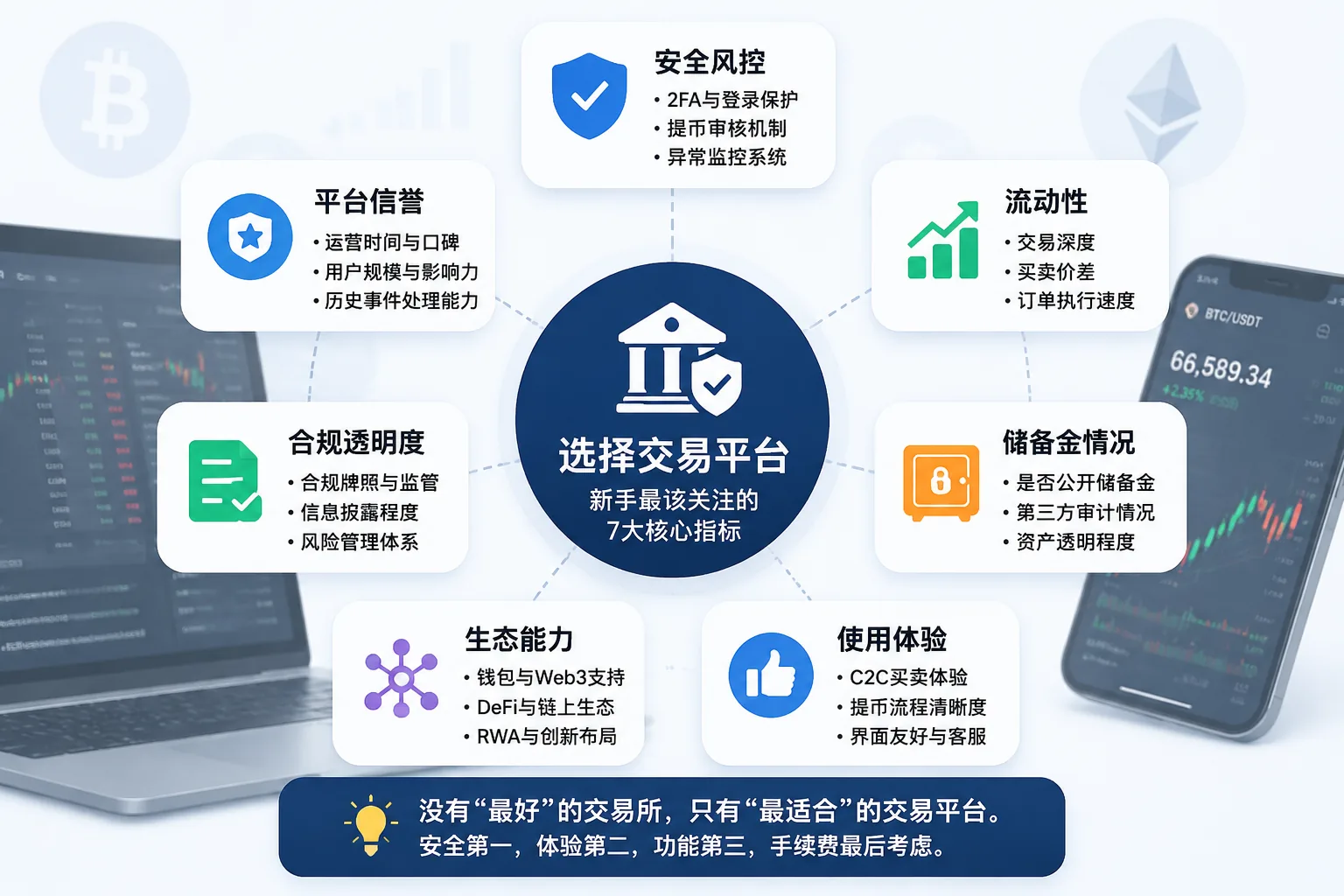
Let's go through each one.
1. Safety: first check whether the platform is reliable
An exchange connects to funds, trading and wallets, so "can it survive long-term" matters far more than "how low are the fees".
Safety mainly comes down to three things:
- Platform reputation: operating history, user scale, and how it handled past incidents. Recognition does not equal absolute safety, but a platform with a long track record and a large user base shows a clear difference when withdrawal anomalies or sharp market swings hit.
- Proof-of-reserves (PoR): a platform publicly disclosing its asset reserves is a transparency signal, and you can cross-check it with third-party data platforms like DeFiLlama.[2] But it is not a safety guarantee — don't read it as "has reserves, so nothing can go wrong".
- Account risk controls: 2FA, withdrawal whitelist, anti-phishing code, abnormal-device detection. These features feel invisible day to day, but they are your lifeline when a password leaks or you click a phishing link.
2. Liquidity: why the experience differs so much across platforms
When buying a small amount of BTC or ETH, you barely feel the difference in liquidity.
But when the market moves fast, the gap shows: on a liquid platform, trades fill easily and the spread is small; on a thin platform, you buy a bit high, sell a bit low, and wait longer to fill.
Remember this: more coins ≠ deeper liquidity. A token being listed doesn't mean it has enough depth for you to trade smoothly.
3. Deposits & withdrawals: whether money can get in and out
When choosing a platform, first confirm it supports the fiat channels you use (for example P2P or bank transfer), and the withdrawal networks you'll need (TRC20, ERC20, BEP20, etc.).
Many people ignore this step and end up with a platform that "looks great but is a pain to get money in and out of". A clunky funding path hurts more than higher fees.
4. Fees: important, but don't rank them first
Fees obviously matter, especially for frequent traders. But for a beginner just entering, they shouldn't be the top priority.
Buy 1,000 USDT: at 0.1% the fee is about 1 USDT, at 0.05% about 0.5 USDT — a 0.5 USDT difference.[1] Yet a wrong withdrawal network or poor account security can cost far more than that difference.
Also, real cost isn't the fee alone — spread and slippage count too. Some platforms look cheap on the rate but end up more expensive on the actual fill price.
So the order is: reliability → safety → experience → liquidity → fee optimization. Pick a stable, easy platform first, and think about cutting costs once you're comfortable.
5. Experience: it affects you every day
Platforms can look identical on paper; the real difference is in the details: how clear the buy-USDT flow is, how obvious withdrawal warnings are, how readable the pages are, how complete the help docs are.
For a beginner, a feature-heavy platform isn't necessarily better than a simple, clear one.
2. How to choose between Binance and OKX
Many people ask "which is better, Binance or OKX". There's no standard answer, because the two platforms head in different directions.
| Comparison | Binance | OKX |
|---|---|---|
| Platform direction | Full-service trading platform | Trading + Web3 ecosystem |
| Main strength | User scale, order-book depth, product range | Wallet, on-chain ecosystem, Web3 features |
| Suited for | Buying coins, spot trading, basic use | Users who want to explore wallets and on-chain apps |
| Beginner experience | Rich tutorial resources, large user base | Feature-rich, needs a learning curve |
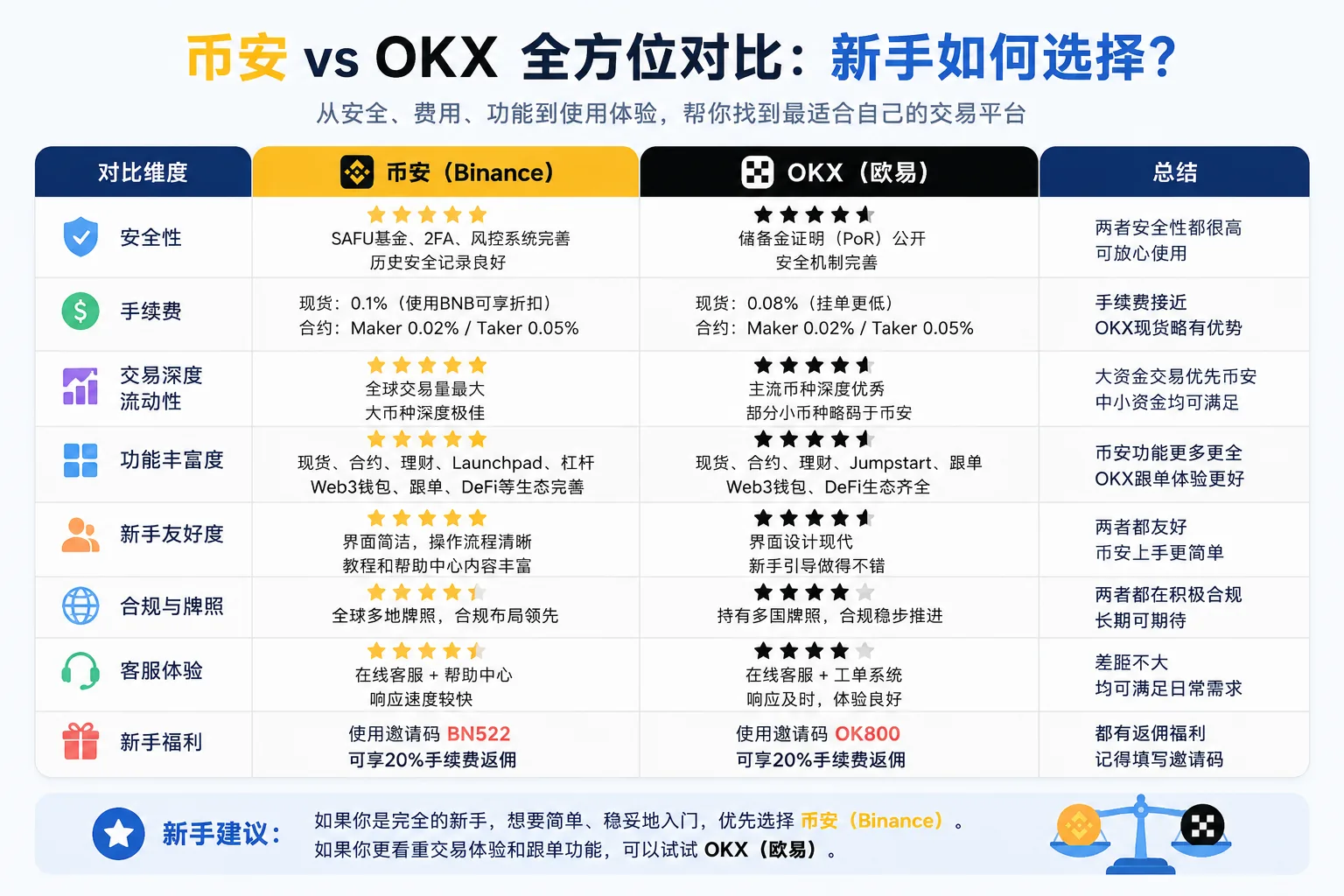
If your main need is buying BTC and USDT and doing basic trading, both work — focus on which one feels more natural to you.
If you later want to get into Web3 wallets, DeFi or RWA, then consider the ecosystem. When first entering, there's no need to research every feature up front — get the basics of buying, withdrawing and account security right first.
For a deeper comparison, read: Binance vs OKX: which is better for beginners? A 5-dimension hands-on comparison
Preparing to register? Read these two: Binance registration guide (2026) and How to register for OKX.
3. Don't register for many exchanges at once
Many people register on one platform for a promo, then another when they see a recommendation, and end up with a pile of apps and a mailbox full of accounts — assets getting more scattered.
For most people, one primary platform + one backup platform is enough.
Get comfortable with one platform first: knowing how to buy, how to withdraw and how to protect your account is far more effective than researching several platforms at once.
4. If I were starting over, here's how I'd choose
Go in this order:
- Pick a mature platform: look at reputation, safety, liquidity and experience; don't get pulled in by promos alone.
- Set up account security first: protect the account before moving funds.
- Test the full flow: buy a small amount of USDT, make a small withdrawal, transfer to a wallet, and run the whole path end to end.
- Explore more directions later: Web3, RWA and so on — once the basics are second nature.
5. After choosing, do these things first (don't rush a big deposit)
Picking the right platform isn't the end of it. After registering, do three things:
First, set up account security. An independent password, a 2FA authenticator, an anti-phishing code and a withdrawal whitelist — turn these on first. For the full checklist, read: Binance/OKX account security checklist: how to enable 2FA, anti-phishing code and withdrawal whitelist (2026)
Second, for your first USDT purchase via P2P, remember "no funds received, no release". A payment screenshot isn't receipt, an SMS notification isn't receipt, and the counterparty's urging isn't receipt — the only standard is you logging into your own account and confirming the funds actually arrived. First time, test with a small amount and run the flow through. Full process here: How to buy USDT on Binance 2026: P2P process, choosing a seller and payment
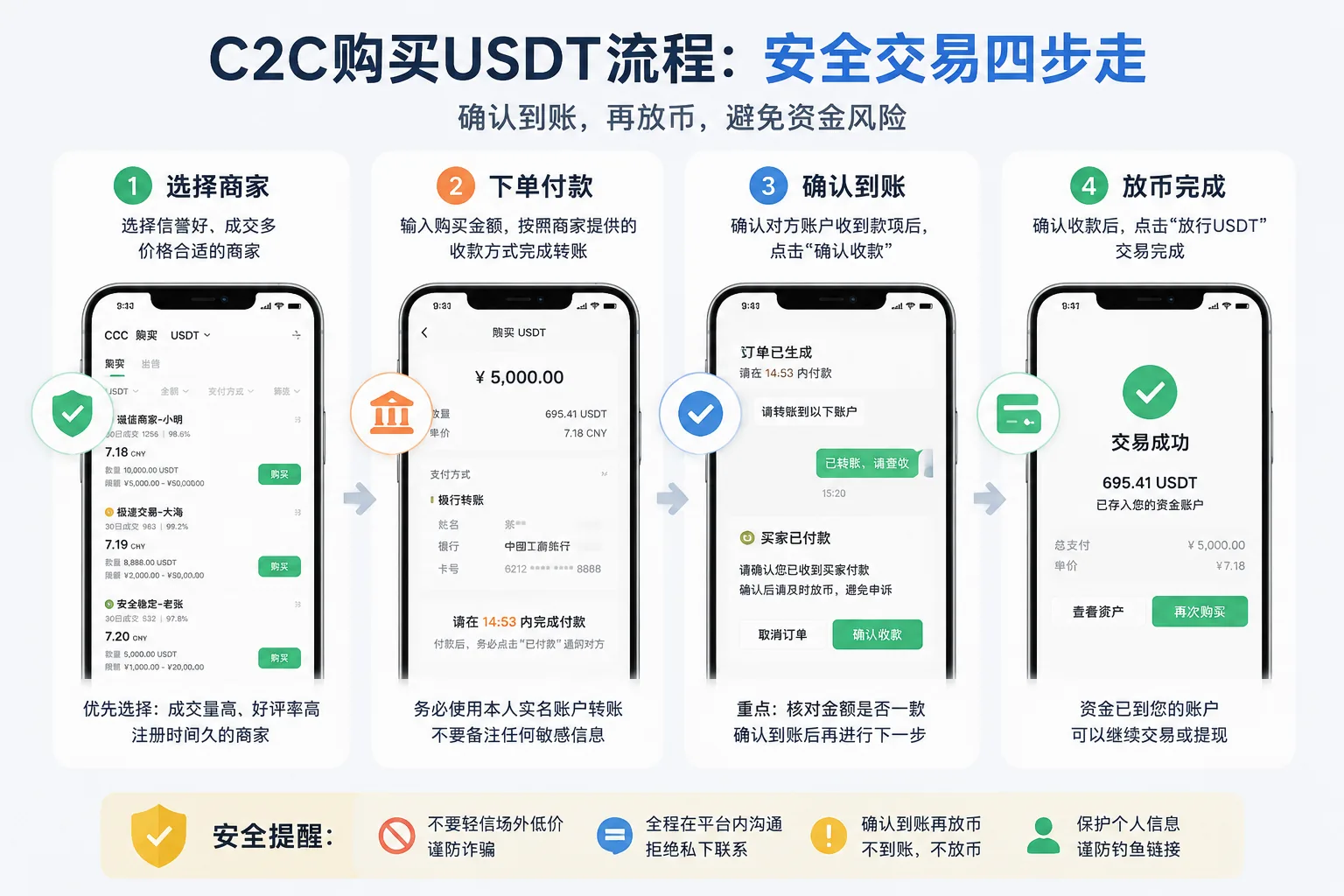
Third, for your first withdrawal, test with a small amount and confirm the receiving network first. When withdrawing, don't start by asking "which network has the lowest fee" — first confirm which networks the recipient supports. Pick the wrong network and your assets may never arrive. Related risks here: Sent crypto to the wrong chain? Withdrawal networks and wallet addresses (2026)
FAQ: choosing an exchange as a beginner
1. What should a beginner look at first when choosing an exchange?
Don't just look at fees. The priority is safety > liquidity > deposit/withdrawal convenience > fees > experience. An exchange is a long-term tool, so judge it holistically.
2. Which is better for beginners, Binance or OKX?
There's no absolute answer. For mainly buying BTC and USDT and doing basic trading, focus on the operating experience; if you plan to get into Web3, wallets or on-chain later, then look at the ecosystem.
3. Are big exchanges always safe?
No, no platform can guarantee absolute safety. But mature platforms usually have more complete security mechanisms, more operating experience and more user validation.
4. What matters most when buying USDT for the first time?
Confirming receipt. Don't release coins early because the counterparty urges you — remember "no funds received, no release".
5. Why do withdrawals go wrong easily?
Because different blockchain networks have different rules. Confirm the address, network and recipient support before you operate.
6. What is proof-of-reserves for?
Proof-of-reserves increases a platform's transparency, but it doesn't mean absolute safety. Judge a platform by combining operating history, security systems and user reputation.
Finally: don't rush to find the "best exchange"
There are more and more trading platforms in 2026, but someone just entering doesn't need to research a dozen platforms at the start.
A stable, clear and easy-to-use platform often beats a feature-packed one for long-term use. Get one platform truly figured out first — run through buying USDT, withdrawing and account security — then explore Web3 and RWA according to your own needs once you're comfortable.
Entering the crypto market, the first step isn't chasing the most feature-rich tool — it's finding the right entry point for you.
Related reading
- Binance vs OKX: which is better for beginners? A 5-dimension hands-on comparison
- Is Binance safe? 2026 real-account fees compared with OKX
- Is Bitget safe? Reserves, fees and the 2026 controversies, item by item
Data verification notes
The key facts in this article were checked on 2026-10-16, item by item:
- Spot fee example: a regular user's spot maker/taker fee is commonly around 0.1%, and may differ by platform, VIP tier and activity (some tiers can reach around 0.05%); always go by each platform's fee page. Source: Binance spot fee schedule.
- Proof-of-reserves (PoR): third-party platforms like DeFiLlama aggregate centralized exchanges' reserves and transparency data, useful as a reference but not a guarantee of platform safety. Source: DeFiLlama.
Risk notice: this article is experience-sharing about choosing a crypto trading platform and does not constitute investment advice. Platform rules and policies may change; always refer to the latest official information.
- Binance spot fee scheduleRegular users' spot maker/taker fee is around 0.1%
- DeFiLlamaAggregated centralized-exchange proof-of-reserves (PoR) and transparency data
- 2026-10-16UpdateAdded evidence-chain citations and "Data verification notes", updated the key-fact verification date.
See ourEditorial Policy and the correction process in ourCorrections Policy.
The CoinTrailHub editorial team focuses on crypto education for beginners, exchange security and P2P trading risk. This article is compiled from official sources and public data, reviewed by humans, and strives for accuracy but is not investment advice.
Last updated:2026-09-20 · Content reviewed by humans · Learn more
© 2026 CoinTrailHub · Original content. Reproduction or rewriting without permission is prohibited.