
Is Bitget Safe? Reserves, Fees and the 2026 Controversy, Verified Item by Item
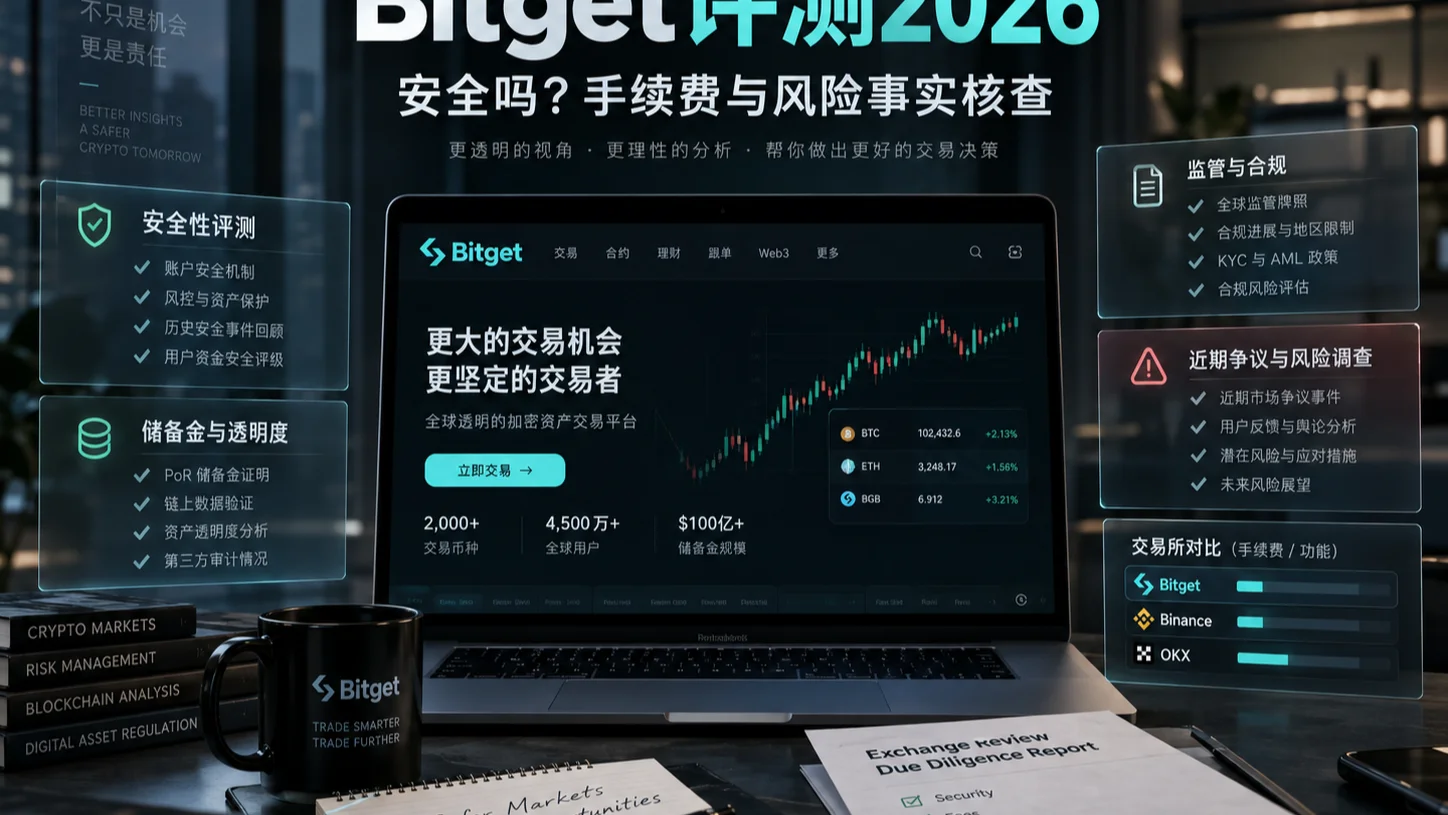
Table of contents

Binance new user rewards
20% trading fee rebate
Official Binance registration. Complete identity verification (KYC) to trade and withdraw.
If you're torn about "what Bitget is actually like, whether it's safe, whether it will run off with the money", the most important point comes first:
Bitget is a large crypto-asset trading platform that has operated for years, publishes a proof of reserves, and holds registrations, licenses, or other regulatory access in multiple jurisdictions; but this information cannot prove the platform has no risk. In 2026, it was also drawn into a public controversy over abnormal price action in some small-cap tokens, and the public evidence so far is not sufficient to prove that Bitget itself participated in market manipulation.
So this article will not simply slap a "safe" or "unsafe" label on Bitget. Instead, it separately examines its asset transparency, regulatory status, fees, copy-trading costs, and what the 2026 controversy can currently prove.
My take:
- Mainly interested in copy trading, futures, and small/mid-cap new tokens → Bitget treats these as key features; but these products involve leverage, copy-trade leader losses, and price-manipulation risk, and beginners without experience should not read "low barrier to entry" as "low risk"
- You care about "no outstanding public controversy right now" → Bitget has a recent controversy — you need to judge for yourself
- Just buying BTC/ETH to hold long-term → Binance or OKX is the more common choice; Bitget has no obvious advantage
Core information
| What you care about most | Verification result as of September 2026 |
|---|---|
| Is Bitget safe? | Bitget publishes a proof of reserves and holds registrations, licenses, or other regulatory access in multiple regions. But a centralized exchange still carries custody, operational, regulatory, and cybersecurity risk — it cannot be treated simply as "absolutely safe" |
| Will Bitget run off with the money? | There is currently no public evidence that Bitget is preparing to stop operating or abscond with funds. But no centralized exchange's future solvency and operating status can be guaranteed in advance, so it is not advisable to treat "it won't run" as a basis for judgment |
| Is Bitget a scam? | There is currently not enough public evidence to label Bitget a scam. It is a large trading platform that continues to operate, but that does not mean every product and token on it is risk-free |
| Are the fees cheap? | Standard spot fees for regular users are Maker/Taker 0.10%/0.10%; standard futures fees are 0.02%/0.06%. Copy trading may also incur profit sharing |
| What's the 2026 controversy? | ZachXBT publicly questioned the abnormal prices and supply concentration of tokens like LAB, and traced large amounts of tokens flowing through centralized exchanges including Bitget. Existing public information cannot directly prove Bitget actively participated in manipulation |
| How to choose vs Binance / OKX? | Bitget has strengths in copy trading and some new-asset coverage; platform scale, fees, regional availability, and risk appetite should be compared separately — no single platform suits everyone |
After reading this article you will know:
- What Bitget's asset transparency and regulatory status actually look like
- What the 2026 controversy can and cannot prove
- Whether the fees are actually cheap, and the real cost of copy trading
- What useful features Bitget has and what needs trade-offs
- Who Bitget suits and who it doesn't
Risk notice: this article is for basic crypto education and platform fact-checking only, and is not investment or account-opening advice. Crypto trading involves risk — judge independently based on your own situation.
About 8 minutes to read. Remember first: a proof of reserves only shows the asset coverage the platform discloses, not a full financial audit; copy trading costs a 10%–20% profit share on top of fees.
1. What is Bitget?
Founded in 2018 and headquartered in Seychelles, Bitget is one of the higher-ranked crypto exchanges by user count, with the company claiming over 100 million users. It has no fixed official Chinese name — Chinese-speaking users simply call it "Bitget".
A few key figures (as of September 2026, from public sources):
- Founded: 2018
- Users: 100M+ (company figure)
- Current CEO: Gracy Chen
- Core products: spot, futures, copy trading (Bitget's signature), earn, and a Web3 wallet
Bitget's biggest early label was "copy trading". It was one of the first exchanges to make copy trading both large and complete, and rode that to a large user base in Southeast Asia, Europe, and Latin America. For beginners, this is also why many people first hear about Bitget.
If you're not yet familiar with basic exchange concepts, read this first: How to Choose a Crypto Exchange for Beginners: Binance vs OKX — Safety, Liquidity, Deposits and Fees.
2. Is Bitget safe?
This is the most important question in choosing an exchange, and the one people searching Bitget care about most. I'll approach it from three angles: asset transparency, regulatory status, and the controversy that can't be avoided.
Asset transparency: Proof of Reserves (PoR)
Since late 2022, Bitget has periodically published a Proof of Reserves (PoR), using a Merkle-tree method to let users verify whether the platform's main assets fully cover user assets.
Bitget's PoR published in August 2026 showed a total reserve ratio of 122%, and the company said it has now published its 45th consecutive monthly PoR. Under the PoR scope Bitget discloses, the user assets included in the disclosure currently receive more than 1:1 reserve coverage.[1]
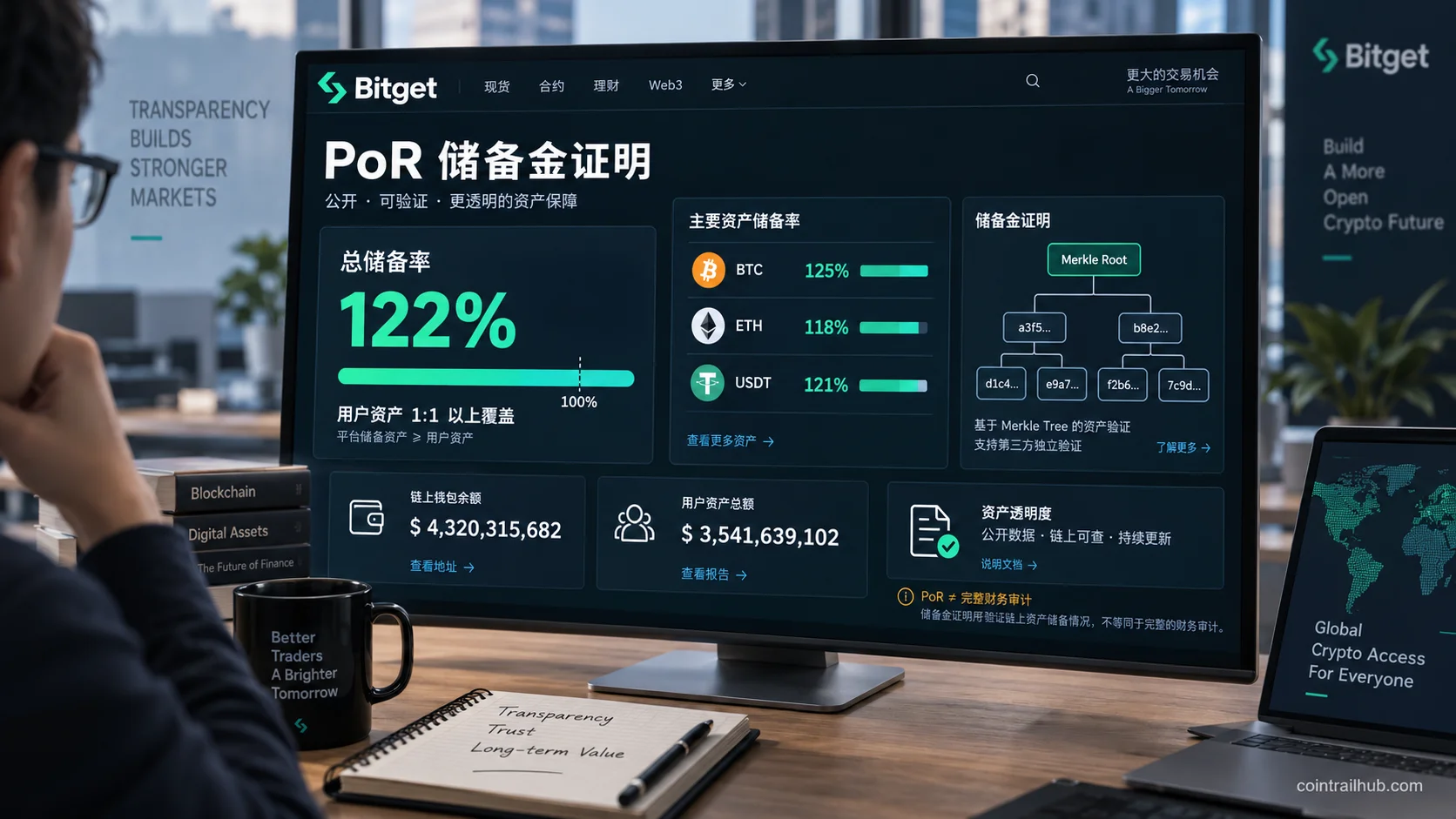
But a PoR is not the same as a full financial audit. It mainly answers whether the wallet assets the platform discloses can cover the corresponding user assets — it cannot by itself prove the company has no other liabilities, operational risk, or future liquidity problems.
You can check the latest data on the Bitget Proof of Reserves page.
Regulatory and registration status
Judging a crypto exchange's "compliance" isn't as simple as counting how many "licenses" it holds.
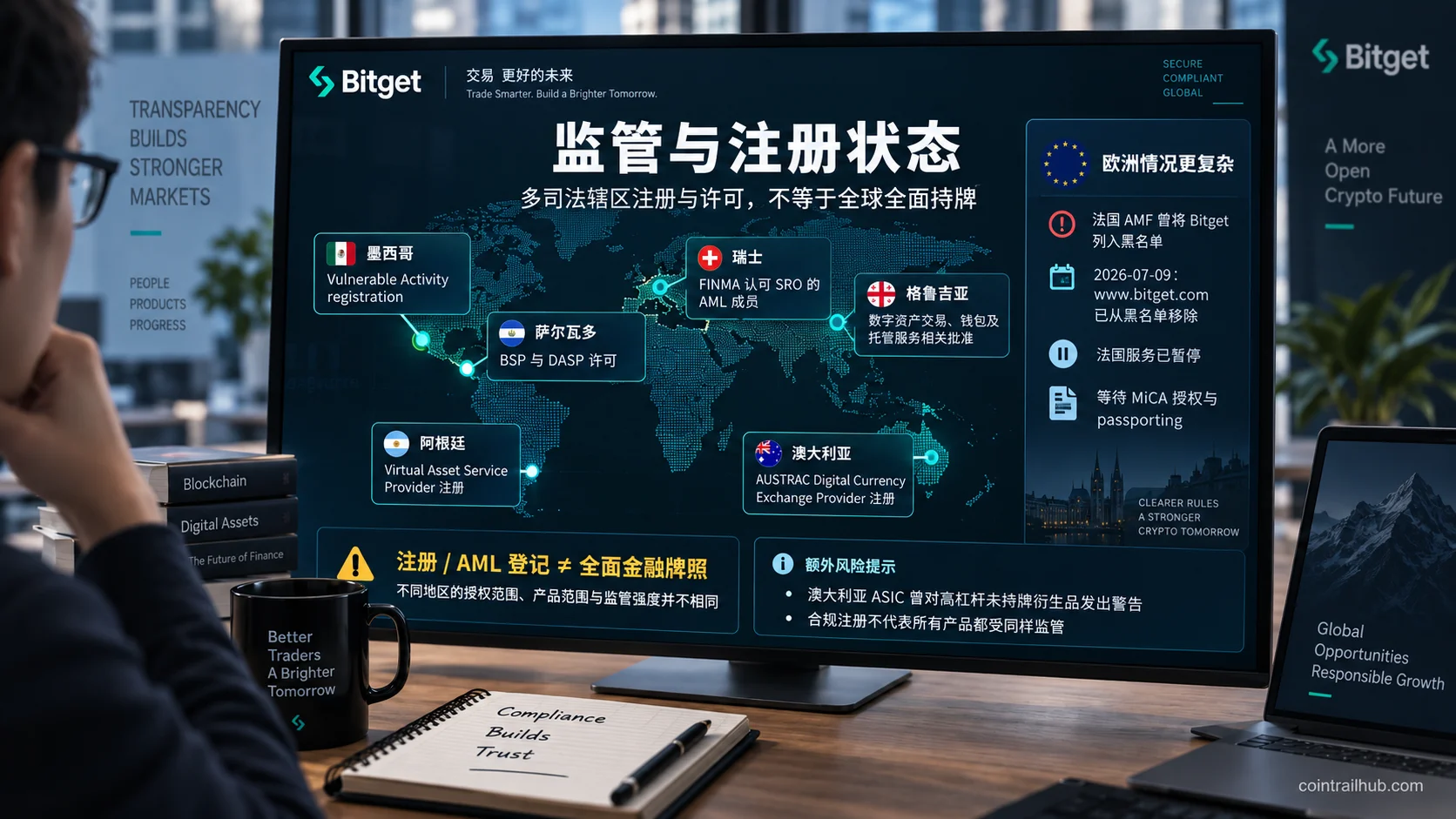
Regulatory arrangements differ widely by country: some are full business licenses, some are only virtual-asset service-provider registrations, AML registrations, or access for specific businesses, and the scope of services permitted also differs.
As of September 2026, some of the regulatory registrations or access listed on Bitget's official regulatory page include:
| Region | Regulatory status published by Bitget |
|---|---|
| Australia | AUSTRAC Digital Currency Exchange Provider registration |
| El Salvador | BSP and DASP licenses |
| Georgia | Approvals related to digital-asset trading, wallet, and custody services |
| Argentina | Virtual Asset Service Provider registration |
| Mexico | Vulnerable Activity registration |
| Switzerland | AML member of a FINMA-recognized SRO |
A distinction is especially important here: registration or AML enrollment is not the same as a full financial license in the banking or securities sense, and it does not mean all of Bitget's products are equally regulated in that region.
Europe is more complicated
Bitget was once added to the crypto-asset blacklist by France's AMF for not having the necessary local registration. The AMF's current page also notes that www.bitget.com was removed from the blacklist on July 9, 2026.[2]
At the same time, Bitget stopped providing services to French users in early 2026 and said it would serve through a compliant European platform after completing MiCA authorization and the related passporting.
So as of this article's verification time, the old VASP registrations in Poland, Lithuania, and elsewhere should not simply be written as "already obtained an EU MiCA CASP license".
In addition, Australia's ASIC issued a public warning in July 2025 about Bitget offering unlicensed crypto derivatives with up to 125x leverage to local investors.[3]
The more accurate conclusion: Bitget has established regulatory registrations and licenses across multiple jurisdictions, but the scope of authorization differs by region — it cannot be summarized as "globally fully licensed".
The 2026 controversy: abnormal trading allegations around LAB and other tokens
This is worth knowing when evaluating Bitget, but it requires strictly separating "confirmed on-chain behavior" from "inferred exchange responsibility".
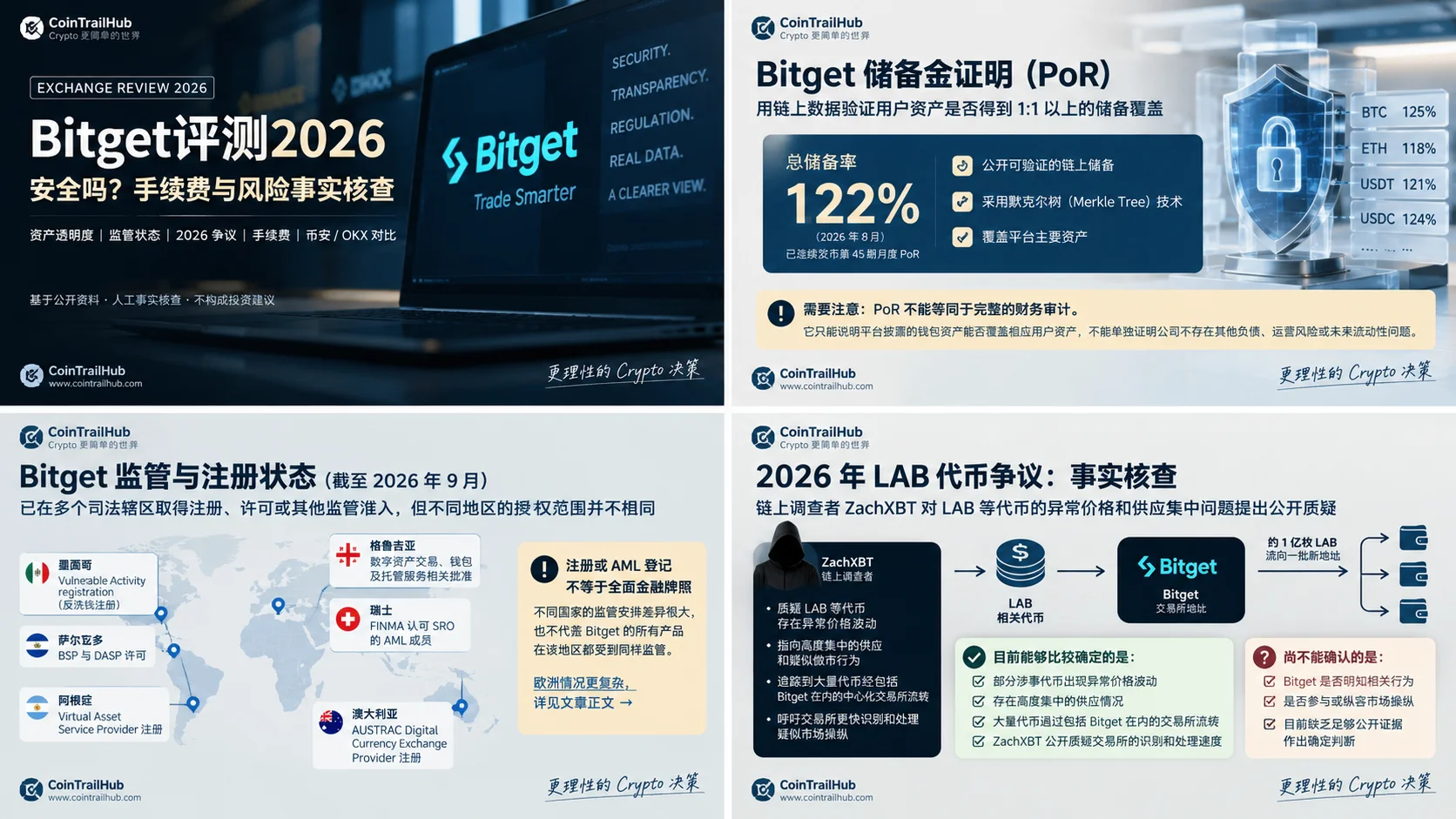
In May 2026, on-chain investigator ZachXBT repeatedly and publicly questioned the supply concentration, abnormal price swings, and suspected market-making behavior of several small-cap tokens including LAB.
LAB drew especially heavy attention.
According to public on-chain analysis, large amounts of LAB tokens once flowed into Bitget addresses, and about 100 million LAB then flowed from Bitget to a batch of new addresses.[4] ZachXBT used this to question whether the related tokens may have highly concentrated supply and coordinated trading behavior, and called on centralized exchanges including Bitget to identify and handle suspected market manipulation faster.
He also publicly named Bitget CEO Gracy Chen, criticizing the exchange for still earning trading fees during periods of abnormal trading volume.
One point needs special attention: this information does not directly prove that Bitget itself planned or participated in token price manipulation.
What is relatively certain at present is:
- Some of the tokens involved did show very abnormal price swings and supply concentration;
- Large amounts of tokens flowed through centralized-exchange addresses including Bitget;
- ZachXBT publicly questioned how quickly the exchanges identified and handled these abnormal behaviors;
- There is not enough public evidence to make a firm judgment on whether Bitget knew, participated, or was complicit.
So this article treats the matter as a platform risk-control and small-cap token trading risk case, not a regulator-confirmed Bitget market-manipulation incident.
For ordinary users, the more practical reminder is: small-cap new tokens, tokens with highly concentrated supply, and high-leverage derivatives inherently carry higher price-manipulation and liquidity risk than mainstream assets like BTC and ETH.
This is also why "fast new listings" can be both a product feature of a trading platform and a source of additional risk that users need to recognize.
3. Are the fees actually cheap?
Bitget's fees are not "cheap", but they're not expensive either — they sit at a normal level for mainstream exchanges.
Spot fees
| Exchange | Maker | Taker |
|---|---|---|
| Bitget | 0.10% | 0.10% |
| Binance | 0.10% | 0.10% |
| OKX | 0.08% | 0.10% |
For regular-user spot fees, Bitget is the same as Binance and slightly higher than OKX's Maker (0.10% vs 0.08%).[5] Using the platform token BGB to offset fees can bring Bitget spot down to 0.08%. The difference is small.
Futures fees
| Exchange | Maker | Taker |
|---|---|---|
| Bitget | 0.02% | 0.06% |
| Binance | 0.02% | 0.05% |
| OKX | 0.02% | 0.05% |
On futures, Bitget's Taker fee is 0.01% higher than Binance and OKX (0.06% vs 0.05%). For people who trade futures frequently, this adds up to a visible difference over time. Bitget's BGB discount mainly covers spot and margin and does not extend to futures — futures can only be reduced by upgrading your VIP level.
Copy trading charges a separate "profit share"
This is the item Bitget users most easily overlook: the followers in copy trading pay a profit share to the copied trader, usually 10%–20% of realized profit (the exact ratio is set by the trader), on top of the normal fees.
Many people assume "copy trading only costs the normal fee" — in fact, this 10%–20% is the biggest part of the real copy-trading cost. One point deserves special note: copy-trading profit sharing uses a High-Water-Mark mechanism, so net profit that has already been settled will not be shared again.[6] Be sure to check this before copy trading.
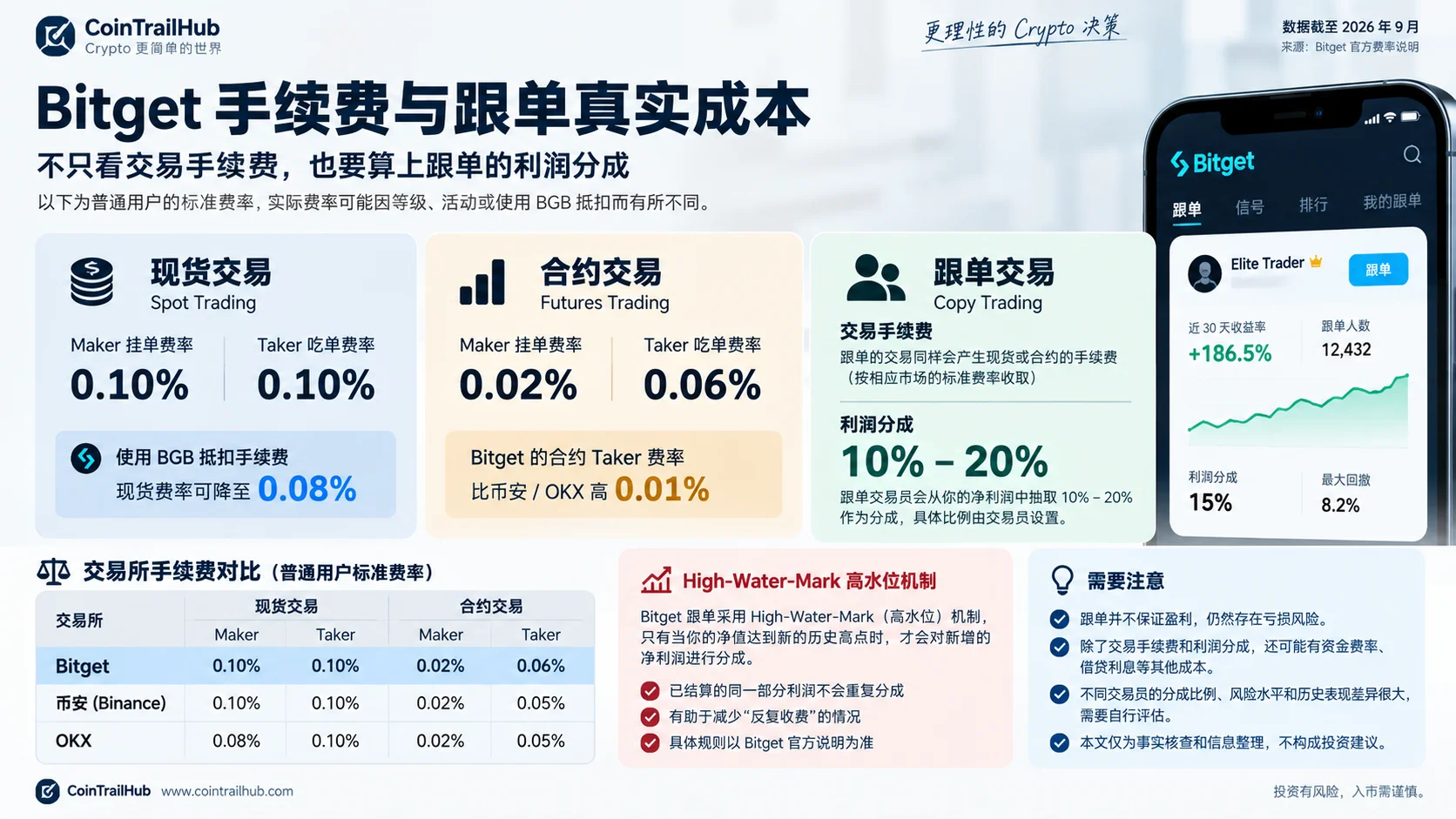
Overall: Bitget's fees are "normal but not advantageous", and the real cost of copy trading is easy to underestimate. See the Bitget spot fee explanation and Bitget product fee explanation for the official rates.
4. Strengths: where does Bitget shine?
1. Copy trading is a core product
Bitget's copy trading is one of the platform's most core products, with a fairly complete feature set and screening dimensions. You can filter copied traders by return rate, drawdown, and number of followers, and view their historical copy-trading records.
Bitget treats copy trading as a key feature, but it also involves leverage, copy-trade leader losses, liquidity, and price-manipulation risk. Beginners without experience should not read "low barrier to entry" as "low risk" — copy trading also bears extra fees and profit sharing, copy-trade leaders can lose money, and copy trading does not equal guaranteed profit.
2. New tokens and small/mid-cap assets are a major direction
Bitget has long treated new tokens and small/mid-cap assets as one of its major product directions. If you're specifically aiming to "get into new tokens early", this may be why you're looking at Bitget.
But this cuts both ways — the abnormal-trading controversy described earlier concentrated precisely on this kind of new token. Fast listings ≠ safer.
3. Rich futures lineup and many leverage options
Bitget's futures product line is fairly rich, and the leverage ceiling is high (up to 125x was offered in some regions). For experienced futures traders, the range of choices is wide. But high leverage is a danger rather than an advantage for beginners, and is not recommended here.
5. Weaknesses: places that need trade-offs
1. A recent outstanding public controversy
Binance and OKX have both operated for longer and been through multiple market cycles, and are more mature in user scale, liquidity, and the Chinese-language ecosystem. But both also have historical security incidents, regulatory controversies, and centralized-custody risk — they cannot simply be understood as having "no negative records".
What makes Bitget special is that it is currently in the middle of a 2026 public controversy (the abnormal-trading allegations around LAB and other tokens, detailed above). On "the platform's current reputation" alone, Bitget requires more judgment from you.
2. Fees are not advantageous, and copy trading costs more
Spot is level with Binance and slightly higher than OKX; futures Taker is 0.01% higher than both; copy trading adds a 10%–20% profit share. There is no "cheaper" argument on price.
3. The Chinese-language ecosystem and third-party content are less rich than Binance/OKX
Binance and OKX have operated longer in the Chinese market, so their Chinese-language tutorials, communities, and third-party content ecosystem are richer. As for customer-support response speed, it is affected by region, issue type, and time of day; this article did not run a customer-support test under uniform conditions, so it does not rank them.
4. New tokens carry higher risk
Fast listings mean you are more likely to step on tokens that are "controlled, highly volatile, and pumped-and-dumped". This is not unique to Bitget, but it is more common there.
6. Bitget vs Binance vs OKX: one table
| Dimension | Bitget | Binance | OKX |
|---|---|---|---|
| Founded | 2018 | 2017 | 2017 |
| Spot Maker / Taker | 0.10% / 0.10% | 0.10% / 0.10% | 0.08% / 0.10% |
| Futures Maker / Taker | 0.02% / 0.06% | 0.02% / 0.05% | 0.02% / 0.05% |
| Copy-trade profit share | 10%–20% (high-water mark) | Set by the trader | Set by the trader |
| PoR update frequency | Monthly (45th) | Irregular | Monthly |
| Regulatory status | Multi-jurisdiction registrations/licenses, with blacklist/warning records | Multi-jurisdiction licenses | Multi-jurisdiction licenses |
| Recent public controversy | Yes (LAB and other tokens) | None found in this article's scope | None found in this article's scope |
| Our referral code | None | BN522 (20%) | OK800 (20%) |
If you're torn between Binance and OKX, see this more detailed comparison: Binance vs OKX: Which Is Better for Beginners? A 5-Dimension Hands-On Comparison.
7. Who suits Bitget?
Rather than "is Bitget good or bad", it's better to ask "which needs do its features match".
Bitget's features are more likely to match these needs
- You mainly want copy trading, and accept its profit sharing and risk
- You already have crypto basics and want early opportunities in small/mid-cap new tokens
- You've used Binance/OKX and want another account to diversify platform risk
- You mainly trade futures and can accept a slightly higher Taker fee than Binance/OKX
Be especially cautious in these cases
- You've never touched crypto and can't yet tell BTC from USDT — Bitget's feature density and risky products challenge beginners more
- You only buy BTC/ETH to hold long-term — Binance or OKX is the more common choice; no need to open another platform just for this
- You care strongly about "no outstanding public controversy right now" — Bitget can't satisfy that for you
- You're used to Chinese-language support — Binance/OKX have a more mature Chinese content ecosystem
8. Advice for beginners
If you decide to use Bitget, follow this order:
- Clarify your needs first: do you want copy trading, mainstream coins, or new tokens? Bitget's value-for-money is completely different depending on the need.
- Set up security: enable 2FA and set a withdrawal whitelist. This applies to every exchange — it won't be repeated but must be done.
- Do the math before copy trading: fees + 10%–20% profit share + copy-trade leader loss risk — understand all three before placing an order. Note that profit sharing uses a high-water-mark mechanism, so the same settled net profit won't be shared twice.
- Don't touch new tokens you don't understand: where listings are fast, pump-and-dumps are fast too.
9. FAQ
1. Will Bitget run off with the money?
There is currently no public evidence that Bitget is preparing to stop operating or abscond with funds. It has over 100 million users, holds registrations or licenses in multiple jurisdictions, and continues to publish proof of reserves.
But no centralized exchange's future solvency and operating status can be guaranteed in advance — FTX is the best warning. So don't treat "it won't run" as a basis for judgment, and don't put all your assets on any single platform long-term.
2. Is Bitget a scam?
There is currently not enough public evidence to label Bitget a scam. It is a large trading platform that continues to operate, and its spot, futures, and proof of reserves are all genuinely running.
The 2026 controversy points to abnormal price behavior and suspected market-making in individual tokens on the platform, not that the platform itself is a scam. But "not a scam" is not the same as "zero risk" — keep the two separate.
3. Which is safer, Bitget or Binance?
On safety, Binance and OKX have operated longer, have larger user bases, and a more mature Chinese-language ecosystem, but they also have historical security incidents, regulatory controversies, and centralized-custody risk — you can't simply say one is "absolutely safer".
Bitget has a proof of reserves and registrations/licenses in multiple jurisdictions, but has a recent outstanding public controversy. If "clean reputation right now" is your top priority, Bitget is not currently ahead.
4. Are Bitget's fees actually cheap?
Not cheap, not expensive. Spot is level with Binance, and futures Taker is 0.01% higher than Binance/OKX. Copy trading adds a 10%–20% profit share, a cost many people don't factor in (profit sharing uses a high-water-mark mechanism, so it isn't double-shared).
5. Is Bitget suitable for beginners?
For users with no crypto experience at all, Bitget weights copy trading, futures, and new tokens more heavily, so the learning cost and risk-recognition requirement are higher; if you only want to understand spot buying/selling and USDT first, a simpler product path may be easier to start with.
6. Does Bitget have an official Chinese name?
No — it has no fixed official Chinese name; Chinese-speaking users simply call it "Bitget". If someone promotes it using a transliterated name, go by the official site and be wary of links from unknown sources.
Summary
Bitget is a mainstream trading platform that has operated for years with a considerable scale: its user count, regulatory registrations, and proof of reserves all genuinely exist, and labels like "exit scam" or "scam" currently have no evidence behind them.
But "not a scam" is not the same as "zero risk". It sits inside an outstanding controversy over abnormal small-cap token trading, which is a reputation shortfall; its fees aren't advantageous, and the profit-share cost of copy trading is easy to underestimate.
So this article's conclusion isn't "whether you should use Bitget", but:
- If you want copy trading or value its fast coverage of new small/mid-cap tokens, Bitget has corresponding value — provided you understand its costs (fees + profit share) and risks (market-making manipulation, high leverage).
- If you only buy BTC/ETH and want peace of mind and a Chinese-language ecosystem, Binance or OKX is the more common choice.
Whichever you choose: enable 2FA, set a withdrawal whitelist, and don't keep all your assets on a single platform long-term.
If you prefer Binance or OKX, you can register through the referral links below for a 20% fee rebate:
- Binance code BN522: Register on Binance
- OKX code OK800: Register on OKX
Have questions? Join the CoinTrailHub Telegram community.
Data verification notes
The key facts in this article were checked on 2026-10-16 against Bitget official data, regulator announcements, and third-party investigation reports, point by point:
- Proof of reserves coverage: Bitget's August 2026 PoR showed a total reserve ratio of 122%, and the company said it has published its 45th consecutive monthly report; under the PoR scope Bitget discloses, the user assets included receive more than 1:1 reserve coverage. Source: Bitget August 2026 Proof of Reserves report (45th).
- French blacklist status: Bitget was once blacklisted by France's AMF for lacking the necessary local registration; the AMF's current page also notes www.bitget.com was removed from the blacklist on July 9, 2026. Source: AMF notice on Bitget's blacklisting.
- Australian regulatory warning: Australia's ASIC issued a public warning in July 2025 about Bitget offering unlicensed crypto derivatives with up to 125x leverage to local investors. Source: ABC News — Bitget still marketing in Australia after ASIC intervention.
- On-chain flows of LAB tokens: according to public on-chain analysis, large amounts of LAB tokens once flowed into Bitget addresses, and about 100 million LAB then flowed from Bitget to a batch of new addresses; this does not directly prove Bitget participated in price manipulation. Source: The Block — ZachXBT accuses LAB and other tokens of abnormal price action.
- Standard spot fees: Bitget's standard spot fee for regular users is Maker/Taker 0.10%/0.10%, and using BGB to offset can bring it down to 0.08%. Source: Bitget spot trading fee FAQ.
- Copy-trade profit share uses a high-water mark: copy-trading followers pay the copied trader a profit share, usually 10%–20% of realized profit, on top of fees; the share uses a High-Water-Mark mechanism so the same settled net profit is not shared twice. Source: Bitget copy-trading profit-share high-water-mark explanation.
Related reading
- Binance vs OKX: Which Is Better for Beginners? A 5-Dimension Hands-On Comparison
- How to Choose a Crypto Exchange for Beginners: Binance vs OKX — Safety, Liquidity, Deposits and Fees
- Beginner Trading Pitfalls: Don't Trust Signal Callers, Stay Away from High Leverage
- How Much Are Binance Fees? Spot/Futures/Withdrawal Rates, BNB Discount + BN522 Rebate Saving Up to 40%
- Is Binance Safe? Is It a Scam? SAFU Reserve + $4.3B Settlement, Verified Item by Item (2026)
References
Official sources
- Bitget spot trading fee FAQ
- Bitget product fee FAQ (copy trading/bots/stocks/gold)
- Bitget copy trading profit-share high-water-mark explanation
- Bitget August 2026 Proof of Reserves report (45th)
- Bitget global regulatory registration and licenses page
- Bitget notice on suspending services for French users
Regulator sources
- AMF notice on Bitget's blacklisting
- ABC News: Bitget still marketing in Australia after ASIC intervention
Third-party investigations and reports
- The Block: ZachXBT accuses LAB and other tokens of abnormal price action
- avoid.net: Bitget investigation archive
Third-party investigations and reports are used only to describe the course of the public controversy, and do not mean CoinTrailHub treats the related allegations as a confirmed regulatory conclusion.
This article was first published on September 12, 2026. Its conclusions are based on fact-checking public sources and regulatory information, not this site's own testing; Bitget's reserve ratio, fees, and regulatory status may change over time — refer to Bitget's official pages.
- Bitget spot trading fee FAQ
- Bitget product fee FAQ (copy trading/bots/stocks/gold)
- Bitget copy trading profit-share high-water-mark explanation
- Bitget August 2026 Proof of Reserves report (45th)
- Bitget global regulatory registration and licenses page
- Bitget notice on suspending services for French users
- AMF notice on Bitget's blacklisting
- The Block: ZachXBT accuses LAB and other tokens of abnormal price action
- ABC News: Bitget still marketing in Australia after ASIC intervention
- avoid.net: Bitget investigation archive
- 2026-10-17UpdateAdded evidence-chain superscripts and "Data verification notes".
- 2026-09-12UpdateFirst published. Fact-check based on public sources, targeting the GSC trust-intent keywords "Is Bitget safe / will it run off with the money".
- 2026-09-13UpdateTightened compliance wording; softened inducement language on copy trading/futures, de-absolutized controversial wording in the comparison table, added sponsored attributes to partner links and strengthened disclosure.
See ourEditorial Policy and the correction process in ourCorrections Policy.
The CoinTrailHub editorial team focuses on crypto education for beginners, exchange security and P2P trading risk. This article is compiled from official sources and public data, reviewed by humans, and strives for accuracy but is not investment advice.
Last updated:2026-09-13 · Content reviewed by humans · Learn more
© 2026 CoinTrailHub · Original content. Reproduction or rewriting without permission is prohibited.