
How to Deposit, Withdraw and Sell USDT: A Complete Beginner Guide to Fiat On/Off-Ramps (2026)
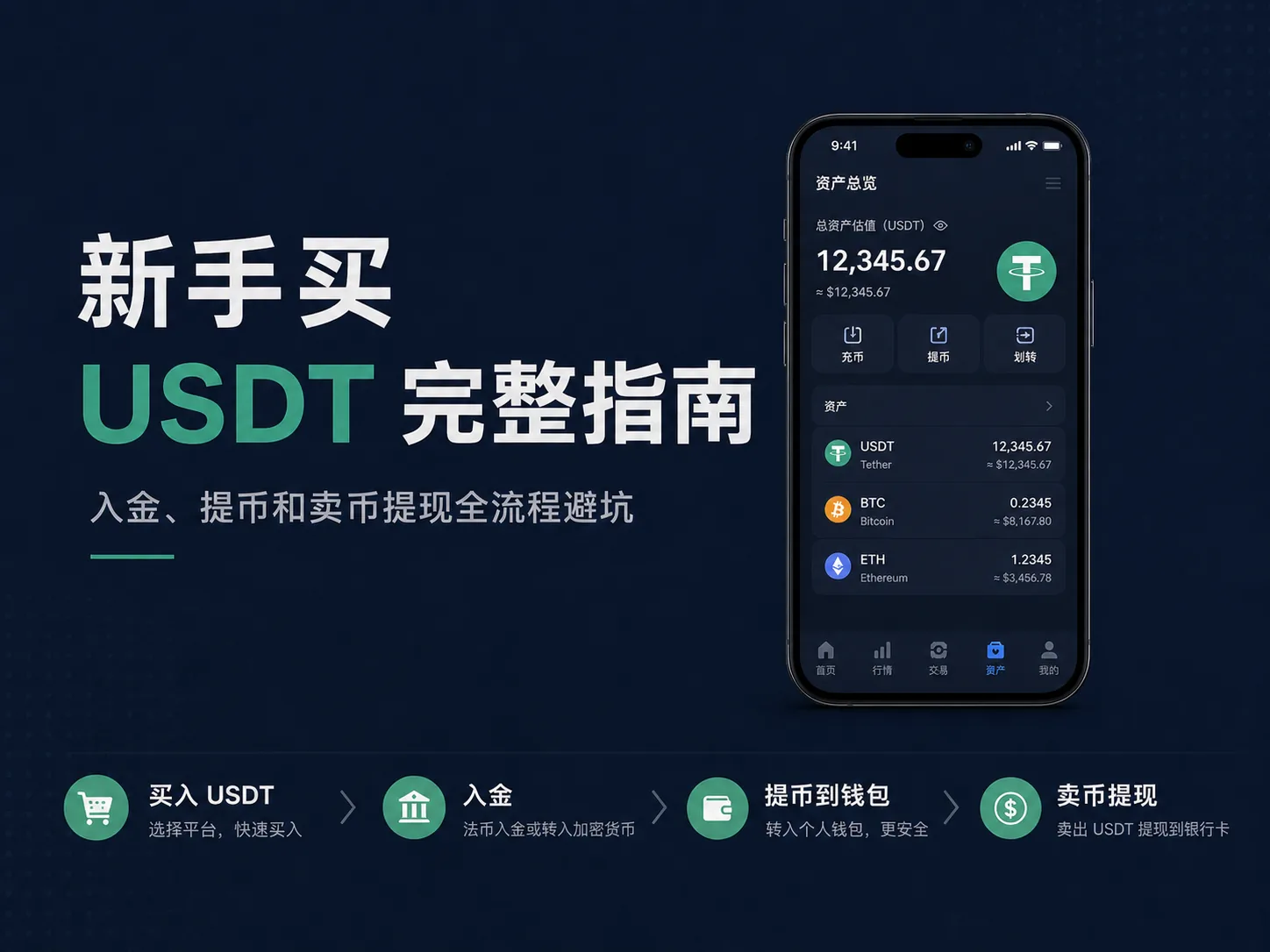
Table of contents

Binance new user rewards
20% trading fee rebate
Official Binance registration. Complete identity verification (KYC) to trade and withdraw.
Many beginners buying USDT for the first time aren't actually nervous about placing the order — they're nervous about the minutes after paying.
The money has already been sent, but the USDT hasn't arrived.
The page shows "waiting for the seller to release".
The seller hasn't replied yet.
You don't know whether to chase, whether you can cancel, or whether you've been scammed.
That's the part of a beginner's first on/off-ramp that's easiest to get stressed about.
So when first getting into crypto, don't start by researching which coin to buy, how much it'll rise, or whether a bull market is coming.
What you really need to understand first is:
how does money actually come in?
how do you buy USDT?
where do you keep it after buying?
how do you sell it later and convert it back to your own local currency?
In crypto, people usually call this the on/off-ramp.
Simply put:
- Deposit (on-ramp): convert fiat into USDT
- Withdraw: move coins from the exchange to a wallet or another platform
- Cash out (off-ramp): sell USDT, convert back to fiat and withdraw to your own account
Sounds simple, but the most common beginner mistakes are exactly here.
For example:
- only looking at the lowest price when buying P2P;
- operating in a hurry before doing KYC;
- forgetting to click "I've paid" after paying;
- not knowing which account the USDT landed in;
- choosing the wrong network when withdrawing;
- sending USDT to an unsupported address;
- releasing coins when selling without confirming real receipt;
- having assets stolen by fake support, fake platforms or off-platform trades.
This article doesn't teach advanced trading, and doesn't encourage you to go all-in.
I'll only cover the single most practical thing:
how a beginner safely buys USDT the first time, and then withdraws and cashes out.
I suggest you get this basic path working first, then study BTC, ETH, wallets, RWA or on-chain assets.
This article is for crypto beginner learning only, and is not investment, trading, legal or tax advice. Different regions may have different restrictions on platform access, identity verification, P2P trading, withdrawals and cash-out features; always go by the platform's actual App page.
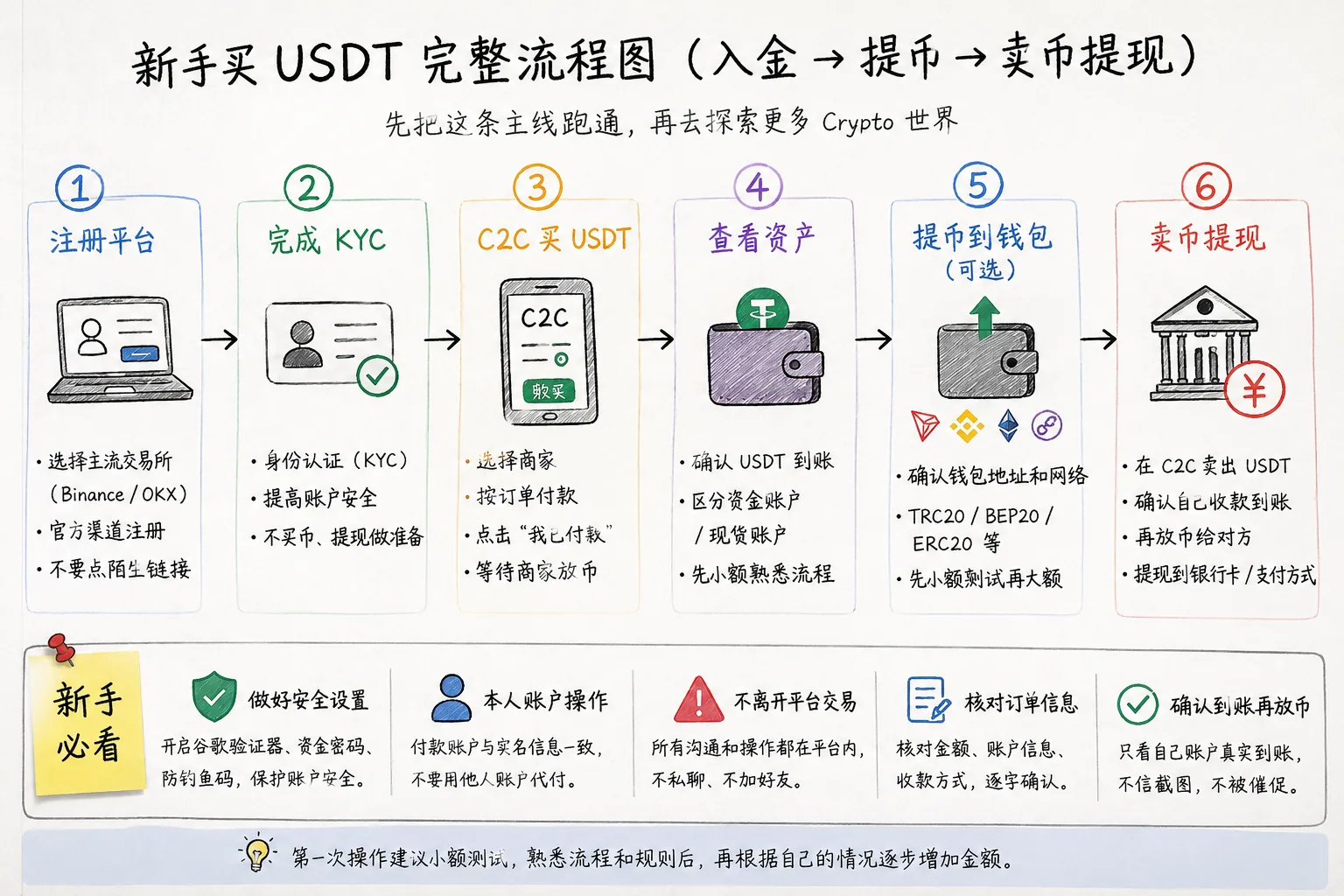
The full flow in 30 seconds
A beginner just needs to remember this main line:
Register on a platform → complete KYC → set up security → buy USDT via P2P → understand your assets → withdraw when needed → sell and cash out later.
First time, a small test is strongly recommended.
The goal of this operation isn't to make money, but to confirm you know:
- where the money leaves from;
- which account the USDT lands in;
- how to read the order status;
- what to do if the seller doesn't release;
- what to check before withdrawing;
- when you can release coins when selling.
| Step | What to do | Beginner focus |
|---|---|---|
| Register on an exchange | Choose a mainstream platform like Binance or OKX | Only use official channels, don't click unknown links |
| Complete KYC | Upload ID documents and pass verification | Must be done inside the official App or website |
| Buy USDT | Choose a seller and pay via P2P | Don't just look at price; check completion rate and notes |
| Check assets | Confirm whether USDT has arrived | Distinguish funding, spot and wallet accounts |
| Withdraw to a wallet | Move USDT to an on-chain wallet | Address and network must match; test small first |
| Sell and cash out | Sell via P2P back to fiat | Release only after real receipt; don't trust screenshots |
The core is one sentence: don't chase speed the first time — get the flow done safely.
1. What are deposit, withdrawal and cash-out?
1. Deposit
Deposit means converting fiat into USDT or other crypto assets.
The most common way is P2P buying.
Some platforms also call P2P "quick buy" — different names, but the core logic is similar:
you pick a seller and pay according to the order.
after the seller confirms receipt, the platform releases USDT to your account.
For most beginners, the first deposit is usually just:
buying USDT via P2P.
2. Withdrawal
Withdrawal isn't the same as cashing out.
Withdrawal means moving coins out of the exchange, e.g. to MetaMask, Trust Wallet, the OKX Web3 wallet, or another trading platform.
The easiest place for a withdrawal to go wrong is:
choosing the wrong network.
The same USDT may run on TRC20, BEP20, ERC20, Polygon, Arbitrum and other networks.
If the address and network don't match, funds may not arrive at best, or be very hard to recover at worst.[2]
3. Cash-out
Cash-out means selling USDT, converting back to fiat, and withdrawing to your own account.
There's one iron rule here:
confirm that you've actually received the money before releasing coins.[3]
Don't just look at screenshots.
Don't listen to the other party's urging.
Don't leave the platform to chat privately.
Don't accept off-platform trade requests.
2. What to prepare before buying USDT?
Don't rush in to buy; get these things done first.
1. Pick your primary platform
A beginner should focus on one mainstream platform first.
My personal view is:
if Binance works normally for you, use Binance as your primary platform.
It's not that OKX is bad, but Binance is better suited as a long-term primary platform; if Binance doesn't work smoothly, or you want to learn more about Web3 wallets and on-chain assets, use OKX as your second platform.
The two platforms don't differ much on core on/off-ramp fees; check this table first:
| On/off-ramp dimension | Binance | OKX |
|---|---|---|
| Spot fee (this site's test) | Taker 0.10% | Maker 0.08% / Taker 0.10% |
| USDT withdrawal (TRC20, third-party compiled) | About 1 USDT | About 1 USDT |
| P2P buy/sell USDT | Platform usually charges no extra fee | Platform usually charges no extra fee |
Fees adjust with platform policy; go by the App's real-time display. Since core fees are close, a beginner's choice mainly comes down to which one feels smoother and which has sellers with higher completion rates.
I don't suggest beginners register on five or six platforms at once.
More platforms doesn't mean safer — it means you're more likely to mix up:
- funding account;
- spot account;
- Web3 wallet;
- withdrawal network;
- P2P order records.
Get one platform down first, then prepare a second as backup — that's steadier.
Start with:
- Binance registration guide (2026)
- How to register for OKX
- Binance vs OKX: which is better for beginners? A 5-dimension hands-on comparison
2. Complete KYC
P2P buying almost always requires identity verification.
Beginners shouldn't look for so-called "proxy verification" or "proxy buying".
These look convenient but are actually high-risk:
- the account may not be fully under your control;
- your identity documents may be misused;
- later withdrawals, risk controls and appeals all become messy;
- the other party can run away at any time.
Identity verification is only done inside the official App or website.
3. Set up security
Before buying USDT, at least enable these basic security settings:
- Google Authenticator;
- phone or email verification;
- anti-phishing code;
- funding password;
- device management;
- withdrawal address whitelist.
These steps look like a hassle, but they really save you a lot of trouble later.
A trading-platform account isn't an ordinary app account.
It involves funds, identity information and withdrawal permissions — get the security foundation right first.
4. Prepare a small test amount
For your first USDT purchase, don't start big.
It's more important to run the flow with a small amount you can fully afford to lose.
The point of this operation isn't how much you buy, but figuring out:
- how to choose a seller;
- how to pay;
- how to confirm USDT arrival;
- where the USDT is after buying;
- what to do if the seller doesn't release;
- how to withdraw later;
- how to sell and cash out later.
The first time learning the flow isn't about who buys more — it's about who makes fewer mistakes.
3. Step 1: pick a primary trading platform
Don't register on a pile of platforms at once.
The more platforms, the more easily a beginner gets confused:
- verification codes everywhere;
- account types mixed up;
- assets scattered;
- passwords hard to manage;
- hard to check records later.
The steadier approach:
pick one primary platform and run the line of register → KYC → security setup → P2P USDT buying through first.
Then prepare a second platform as backup.
My advice is still the same sentence:
if Binance works normally, use Binance first; if you want to supplement Web3 and on-chain asset learning, prepare OKX.
4. Step 2: register, KYC and security setup
The correct order is:
- register an account;
- complete KYC;
- enable security settings;
- get familiar with the asset page;
- then buy USDT via P2P.
Never register while rushing to move money at the same time.
And don't listen to people who say:
"I'll buy for you."
"Transfer me the money, I'll operate for you."
"You don't know how, I'll do it remotely for you."
The easiest place for a crypto beginner to get burned is handing operations that should be done by yourself over to a stranger.
5. Step 3: buy USDT via P2P
Buying USDT via P2P is essentially a platform-matched trade.
You pay the seller, and after the seller confirms receipt, the platform releases USDT to your account.[1]
Some platforms show it as P2P or quick buy — different names, but you only need to understand the core logic:
you pay, the seller confirms receipt, the platform releases coins.
For specific steps, read:
- How to buy USDT on Binance 2026: P2P process, choosing a seller and payment
- How to buy USDT on OKX: P2P process and pitfalls (2026)
Don't just look at price when choosing a seller
Many beginners place an order the moment they see a seller who's a bit cheaper.
That's the most common pitfall.
P2P buying isn't just about price — also check these:
| What to check when choosing a seller | Why it matters |
|---|---|
| Completion rate | Too low a completion rate means unstable orders |
| Number of completed orders | Too few orders, limited reference value |
| Seller notes | Overly complex notes, beginners make mistakes |
| Payment method | Confirm you can actually use it |
| Per-order limit | Don't pick an order beyond your funds |
| Release speed | Slow release wastes time |
| Whether off-platform contact is required | Be wary; don't trade outside the platform |
A seller with the lowest price but a wall of notes is best avoided on your first time.
The payment account should match your verified identity
In P2P trading, the payment account should ideally match your platform identity.
Don't pay with someone else's account.
Don't let someone pay on your behalf.
Don't receive money for others.
Don't transfer privately outside the order.
These actions easily trigger risk controls and cause disputes.
Return to the platform to confirm after paying
Many beginners think it's over after paying.
It isn't.
After paying, go back to the order page and click "I've paid" (or a similar button) as the platform requires.
Then wait for the seller to confirm receipt and release coins.
If the coins still aren't released, don't leave the platform to chat privately.
First contact the seller within the order; if needed, file an appeal through the platform's process.
6. Step 4: where should bought USDT go?
After buying, many people get stuck on:
should USDT stay on the exchange or go to a wallet?
My advice:
don't rush to withdraw the first time.
First get three things clear:
- which account the USDT landed in;
- the difference between an exchange account and a wallet;
- how to pick a withdrawal network.
An exchange suits beginner learning and short-term use; the advantage is convenience.
A wallet gives you more control, but only if you truly understand seed phrases, private keys, networks and addresses.
A wallet isn't automatically safer.
If you don't even know what a seed phrase is, moving coins to a wallet can actually be more dangerous.
| Where to keep | Pros | Risks |
|---|---|---|
| Exchange | Convenient, suits beginner learning and short-term use | Platform risk, account risk, withdrawal-permission risk |
| Web3 wallet | You control the assets, suits on-chain operations | Losing seed phrase, approval risk, wrong-network risk |
| Cold wallet | Better for long-term self-custody | Higher learning curve, beginners make mistakes |
Start with:
- Where should I keep USDT bought on Binance/OKX? On the exchange or in a wallet (2026)
- What is a crypto wallet? Wallet addresses, seed phrases and asset security (2026)
- What is a seed phrase? Why no one can help you recover assets if you lose it (2026)
7. Step 5: check the network before withdrawing
This is where beginners most often hit big problems.
USDT runs on many networks.
Common ones include TRC20, BEP20, ERC20, Polygon, Arbitrum and others.
| Network | Fee (approx.) | Arrival time (approx.) | Reminder |
|---|---|---|---|
| TRC20 (Tron) | About 1 USDT | 1–3 minutes | Default first choice on most platforms; confirm the wallet supports it |
| BEP20 (BNB Chain) | About 0.1 USDT | 1–3 minutes | Lower fee, but can't be mixed with an ERC20 address |
| ERC20 (Ethereum mainnet) | A few to tens of USDT, volatile | 5–15 minutes | Broad ecosystem support, but not recommended for small withdrawals |
| Polygon / Arbitrum | Usually lower | 1–3 minutes | Confirm both exchange and wallet support the network |
| Solana / TON etc. | Varies by chain | Varies by chain | Watch address format and Memo / Tag requirements |
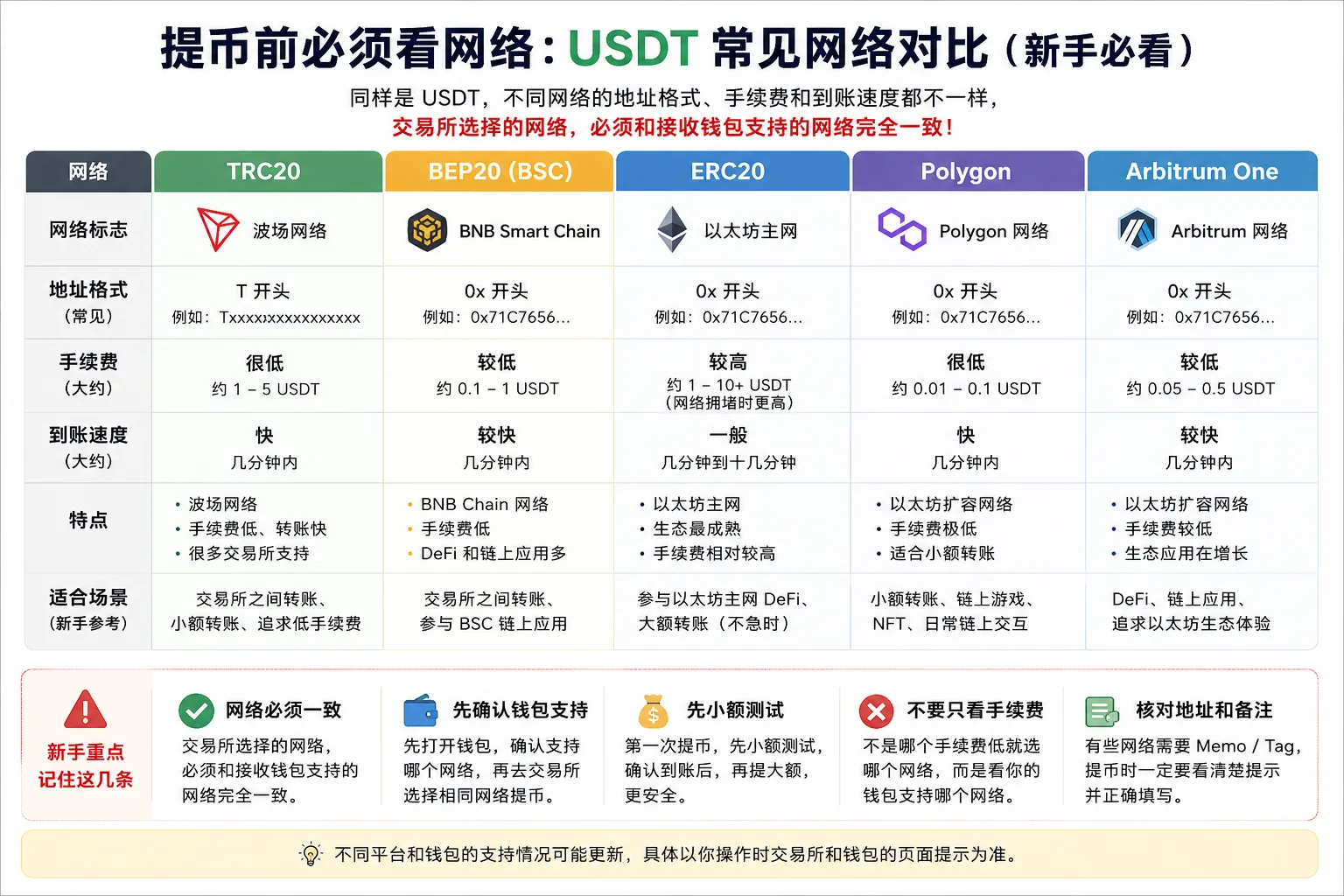
The above are third-party compiled common ranges, which float by platform and time; always go by the withdrawal page's real-time display.[4]Also, network fees are usually a fixed amount — withdrawing 10 USDT and 1,000 USDT cost the same, so the fee share is higher on small withdrawals.
There's only one core principle:
the withdrawal network you choose on the exchange must exactly match the network the receiving wallet supports.
Don't just look at low fees.
Don't just copy the address.
Don't assume "it's all USDT, so it should all arrive".
It's not about whichever network is cheap — your wallet must support that network.
For withdrawal rules, you can refer to the platform's official help pages, such as the Binance withdrawal guide or the OKX withdrawal guide.
But in the end, go by the network, fee and arrival prompts shown on the App when you actually operate.
For your first withdrawal, I suggest:
- first confirm which networks the wallet supports;
- choose the same network on the exchange;
- copy the address and check the first and last few characters;
- test small first;
- after confirming arrival, consider a larger amount.
If you don't understand these yet, don't rush to withdraw.
Read this first:
Sent crypto to the wrong chain? Withdrawal networks and wallet addresses (2026)
8. Step 6: how to sell USDT and cash out?
Selling USDT is what many people call the off-ramp.
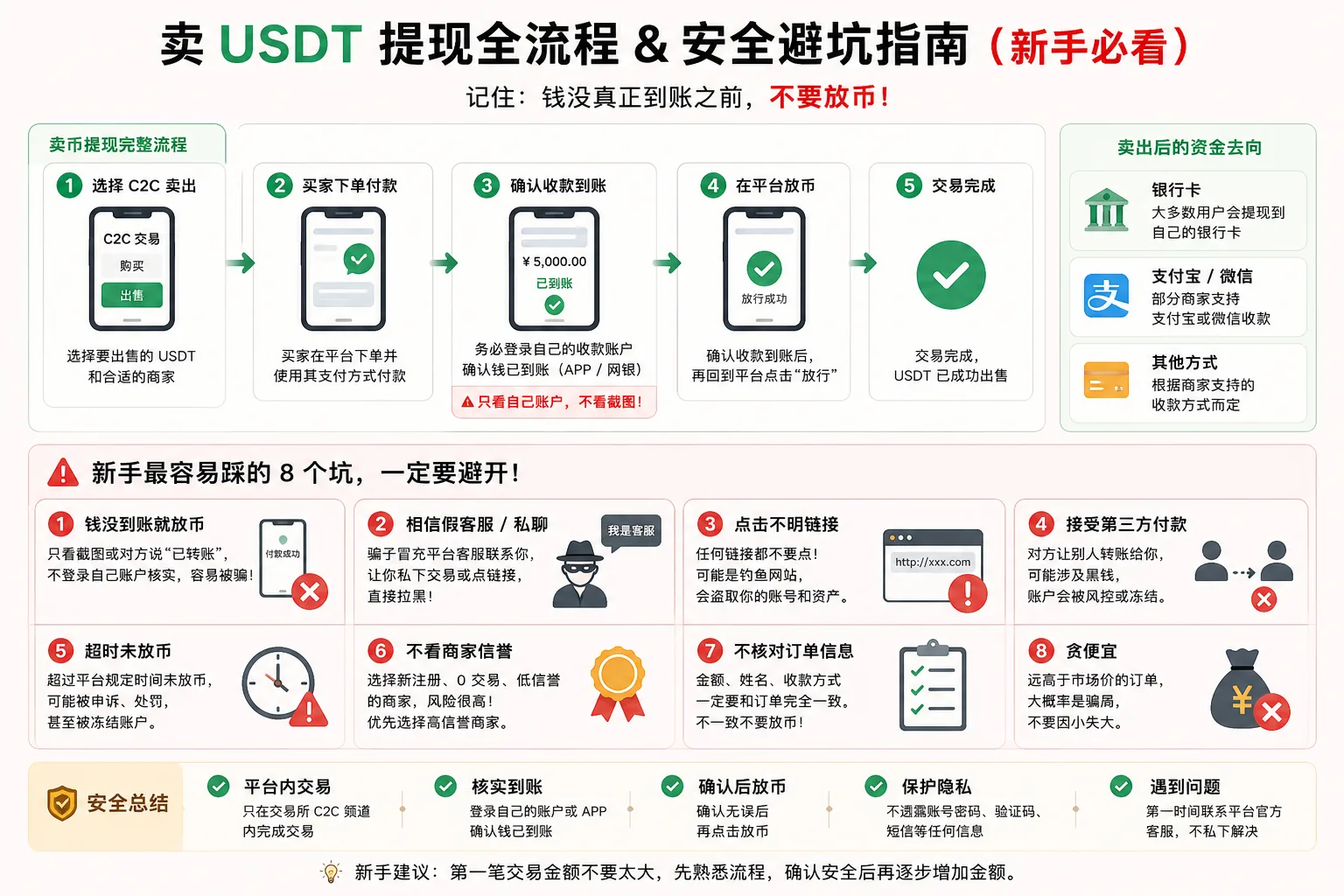
The common way is:
on the platform's P2P page, choose to sell USDT, pick a buyer, confirm the payment method, then wait for the other party to pay.
The single most important sentence when selling is:
only release coins after your own account has actually received the money.
Don't just look at screenshots.
Don't believe "the bank is delayed, release first".
Don't leave the platform to chat privately.
Don't accept third-party payments.
Don't change the payment method outside the order.
Also, if the money you receive from selling comes from funds tied to fraud or gambling, your bank account may be frozen by the bank or authorities. So besides confirming receipt, try to only trade with sellers who have high completion rates and clean records, and avoid large or frequent rapid in-and-out movements in a short time.
If the other party urges you:
"I've transferred it, release the coins now."
Stay calm.
The point of selling USDT isn't speed — it's confirming real receipt.
9. The 9 most common beginner pitfalls
| Pitfall | Why it's dangerous | How to avoid |
|---|---|---|
| Proxy buying | Funds and account handed to others, extremely high risk | Operate yourself via the official App |
| Registering via unknown links | Easy to land on phishing sites | Only use official channels or trusted pages |
| Only looking at the lowest P2P price | Cheap sellers aren't always best for beginners | Check completion rate, notes, order count and limits together |
| Mismatched payment account | Easy to trigger risk control or disputes | Use your own verified account as much as possible |
| Wrong withdrawal network | Funds may not arrive or be hard to recover | Address and network must match |
| Releasing before confirming receipt | Screenshots can be faked | Only trust your own account's real receipt |
| Receiving problem funds and freezing your account | The buyer's funds may be tied to fraud, freezing your bank account | Only trade with high-completion-rate sellers, avoid large rapid in-and-out |
| Touching futures and altcoins too early | Easy to get hurt by volatility and leverage | Learn stablecoins, wallets and networks first |
| Ignoring platform risk-control prompts | Easy to be lured by fake support | Only handle things inside the official App/website |
Special reminder: platform risk control isn't necessarily bad
After large deposits, withdrawals, frequent trading, abnormal logins or device changes, the platform may sometimes ask you to provide extra documents or re-verify.
This doesn't necessarily mean your account is in trouble — often it's just normal risk control.
What you really need to watch for is:
someone suddenly claims to be support in Telegram, group chats or private messages, asking for your verification code, ID photos, wallet seed phrase, or telling you to transfer to some "safe account".
If this happens, don't operate privately.
Only handle it inside the official App/website.
10. FAQ
1. Can a beginner use a bank card to buy USDT?
Many P2P sellers support bank cards, bank transfers or other local payment methods, but go by what the platform page shows.
Beginners should note:
- the payment account should ideally match your platform identity;
- don't pay with someone else's bank card or account;
- don't let someone pay on your behalf;
- don't accept off-platform trade requests.
If the payment account doesn't match your verified identity, it may cause order disputes or platform risk control.
2. What if USDT never arrives after buying?
First, don't leave the platform to chat privately, and don't pay repeatedly.
Check:
- whether you've clicked "I've paid" in the order;
- whether the payment amount matches the order;
- whether the payment account matches your identity;
- whether the seller is still within the processing time;
- whether there's an appeal entry on the order page.
If the seller still hasn't released after the platform's time limit, prioritize the platform's in-order appeal process; don't trust any off-platform "support".
3. Are withdrawal and cash-out the same thing?
No.
Withdrawal is moving crypto from the exchange to a wallet or another platform.
Cash-out is usually selling assets, converting back to fiat and receiving it in your own account.
4. Do I have to withdraw USDT to a wallet?
Not necessarily.
If you don't yet understand seed phrases, private keys and withdrawal networks, don't rush to withdraw.
For beginners, learning the flow with small amounts first matters more than blindly chasing "self-custody".
5. Does withdrawing cost a fee? How long does it take?
Withdrawing usually incurs a network fee.
Different coins and networks have different fees.
Arrival time also depends on:
- the chosen network;
- on-chain congestion;
- the exchange's review speed;
- the wallet's confirmation speed.
First withdrawal, test small first, then consider larger amounts.
6. Is selling USDT safe?
P2P selling has risks.
But as long as you stick to one principle, the risk drops a lot:
don't release coins until the money has actually arrived.
Don't trust screenshots.
Don't be rushed.
Don't leave the platform to chat privately.
Don't accept third-party payments.
7. Is it suitable for a beginner to buy BTC directly?
If you don't yet understand USDT, wallets and withdrawal networks, don't rush to buy various coins at the start.
Learning the basic flow first matters more than chasing trends.
11. Final word
Buying USDT for the first time, there's really no need to rush.
Don't start out thinking about:
- buying BTC;
- jumping into futures;
- withdrawing to a wallet;
- getting into on-chain assets;
- short-term trading.
These can all be learned gradually later.
The most important thing at step one is:
can you safely complete one full flow.
The steadier order is:
register → complete KYC → set up security → small USDT purchase → understand asset accounts → learn wallets → learn withdrawal networks → then consider selling/cashing out and on-chain assets.
A lot of crypto losses aren't from market moves — they're from basic operational mistakes.
Go slow, and go steady — that's actually the smartest approach for a beginner.
Recommended reading
- How to buy USDT on Binance 2026: P2P process, choosing a seller and payment
- How to buy USDT on OKX: P2P process and pitfalls (2026)
- Binance registration guide (2026)
- How to register for OKX
- Where should I keep USDT bought on Binance/OKX? On the exchange or in a wallet (2026)
- Sent crypto to the wrong chain? Withdrawal networks and wallet addresses (2026)
- What is a crypto wallet? Wallet addresses, seed phrases and asset security (2026)
External references
Data verification notes
The key facts in this article were checked on 2026-10-16 against Binance's and OKX's official guides, item by item:
- P2P buying flow: the buyer pays per the order, and after the seller confirms receipt, the platform releases USDT to the buyer's account. Source: OKX P2P buying guide.
- Withdrawal network: the withdrawal address and network must match; a wrong network may mean funds don't arrive or are hard to recover. Source: Binance withdrawal guide.
- P2P selling: confirm you've actually received the money before releasing coins; don't trust screenshots or off-platform urging. Source: OKX selling guide.
- Withdrawal fees: the per-network fees and arrival times are third-party compiled common ranges; go by the withdrawal page's real-time display. Source: Binance withdrawal guide.
Risk notice
This article is for crypto beginner onboarding and platform-usage education only, and is not investment, trading, legal or tax advice. Digital asset prices are volatile, and stablecoins are not the same as bank deposits.
Different regions may restrict platform access, identity verification, P2P buying, withdrawals, selling and cash-out features. All rules are subject to the platform's official pages and the actual App prompts.
Author note
The CoinTrailHub editorial team has long focused on crypto beginner tutorials, trading-platform workflows, stablecoins, wallet security and on-chain asset education. This site's content aims to be understandable, pitfall-avoiding and step-by-step actionable for beginners, and does not encourage blind trading or offer any return guarantees.
- Binance withdrawal guideWithdrawal network selection and arrival rules
- OKX P2P buying guideP2P buying flow (seller confirms payment, platform releases coins)
- OKX selling guideP2P selling and confirmation-of-receipt rules
- OKX withdrawal guideWithdrawal steps and network selection
- 2026-10-16UpdateAdded evidence-chain citations and "Data verification notes", updated the key-fact verification date.
- 2026-09-23UpdateAdded USDT withdrawal fee and arrival-time ranges per network, Binance/OKX on/off-ramp fee comparison, and a bank-account freeze risk notice.
See ourEditorial Policy and the correction process in ourCorrections Policy.
The CoinTrailHub editorial team focuses on crypto education for beginners, exchange security and P2P trading risk. This article is compiled from official sources and public data, reviewed by humans, and strives for accuracy but is not investment advice.
Last updated:2026-09-23 · Content reviewed by humans · Learn more
© 2026 CoinTrailHub · Original content. Reproduction or rewriting without permission is prohibited.