
Is PancakeSwap worth using? DEX swap fees and pitfalls (2026)
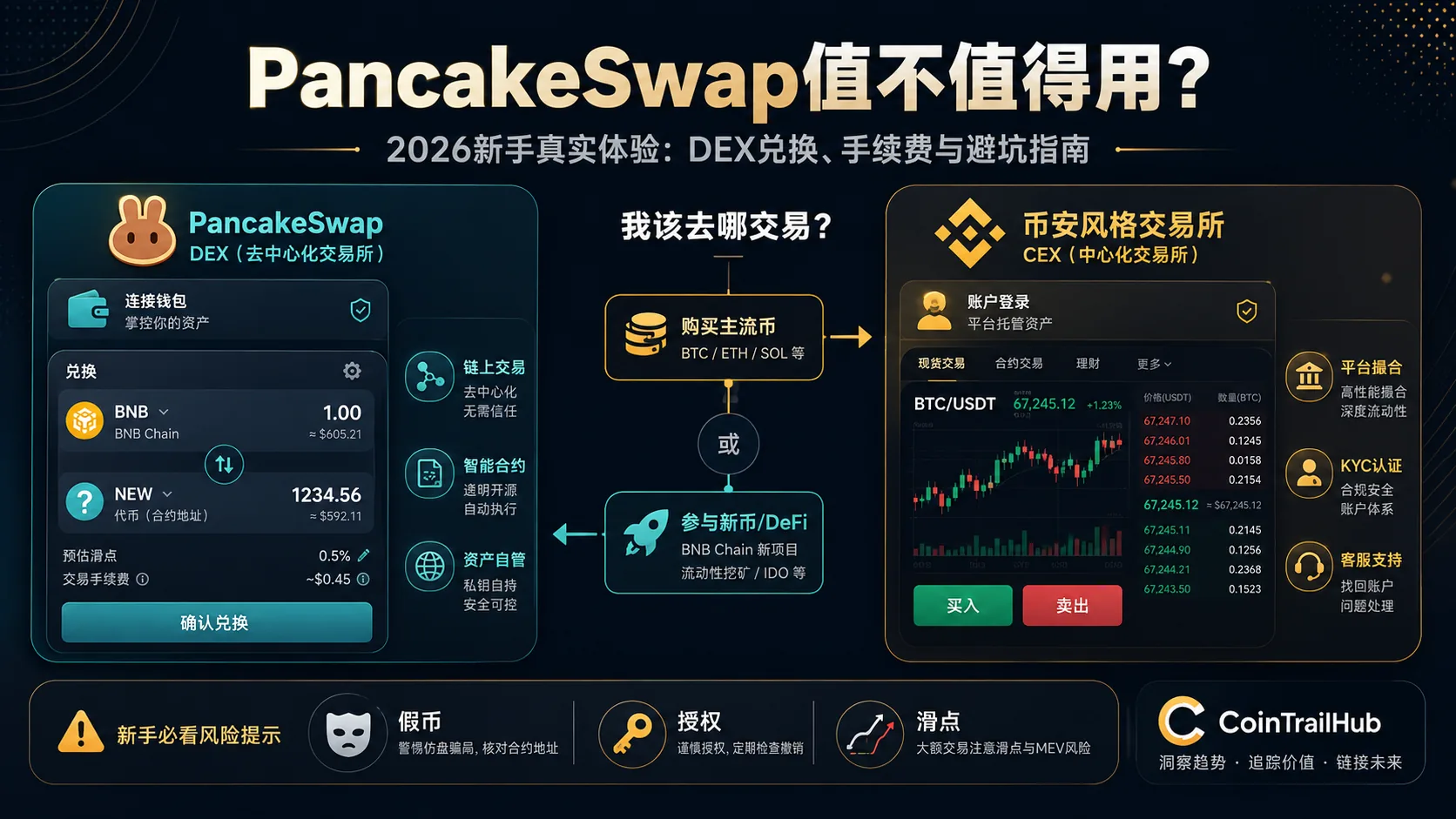
Table of contents

Binance new user rewards
20% trading fee rebate
Official Binance registration. Complete identity verification (KYC) to trade and withdraw.
Whether PancakeSwap is worth using doesn't depend on whether it's good, but on what you're trying to do. If you only want to buy and sell mainstream coins like BTC and ETH, Binance is easier; if you want to swap tokens or do DeFi on BNB Chain, PancakeSwap is the unavoidable first stop — but only if you first learn to avoid the three pitfalls of fake tokens, approvals, and slippage.
About 9 minutes to read. First remember two things: the swap fee of about 0.25% is not actually lower than a centralized exchange — what's really cheap is the on-chain gas; and a DEX has no customer support, so nobody can undo it for you before you hit confirm.
Reminder: this article is personal usage experience, not investment advice. A decentralized exchange (DEX) has no customer support and no password recovery, and involves risks like fake tokens, unlimited approvals, and slippage — beginners must finish the pitfalls section before acting.
One-sentence version:
| Your goal | Recommendation |
|---|---|
| Buy/sell BTC / ETH / mainstream coins | Use Binance, not PancakeSwap |
| Buy new or small-cap tokens on BNB Chain | Use PancakeSwap, but learn to avoid pitfalls |
| Do DeFi, liquidity mining | Use PancakeSwap, but understand impermanent loss |
| Have never touched a wallet or approvals | Don't use it yet — learn wallet basics first |
PancakeSwap is a widely used decentralized exchange (DEX) in the BNB Chain ecosystem, running on an automated market maker (AMM) mechanism. Users interact with smart contracts directly through their wallet to complete token swaps, and it's one of the most common entry points for people entering BNB Chain DeFi. There's no registration, no KYC, and no deposit/withdraw button — everything depends on you connecting your wallet.[1]
These two "no's" — no customer support and no account-recovery mechanism — are the root of many beginner pitfalls. On a centralized exchange you can contact support if you make a mistake; on PancakeSwap, a wrong click can mean the money is simply gone.
Who needs / who doesn't need it
| Your situation | Recommendation |
|---|---|
| Only want to buy/sell BTC, ETH, BNB, and other mainstream coins | Don't need it — Binance spot fees are lower and it's easier |
| Want to buy a new token just listed on BNB Chain | Need it — such coins usually only exist on DEXs |
| Want to do liquidity mining and earn fee shares | Need it — PancakeSwap is one of the main entry points |
| Want to try DeFi but can't even use a wallet | Hold off — learn wallet basics first |
| Have USDT and want to swap into a BNB Chain asset | Can — but first distinguish the withdrawal network |
What is PancakeSwap? Why do its fees look low?
PancakeSwap launched in 2020, initially built on the BNB Chain ecosystem, and has since expanded to multiple blockchain networks. Its core features include:
- Token Swap
- Liquidity Providing
- Yield Farming
- NFT and other ecosystem features (optional)
For beginners, the first two features are the most commonly used.
Many beginners first hear about PancakeSwap because someone told them "on-chain trading fees are low and there's no registration."
But first clarify one thing: PancakeSwap and Binance are not the same thing.
Binance is a centralized exchange (CEX) — your coins sit in a Binance account and trades are matched by Binance. PancakeSwap is a decentralized exchange (DEX) — your coins always stay in your own wallet, and trades are completed on-chain through smart contracts.
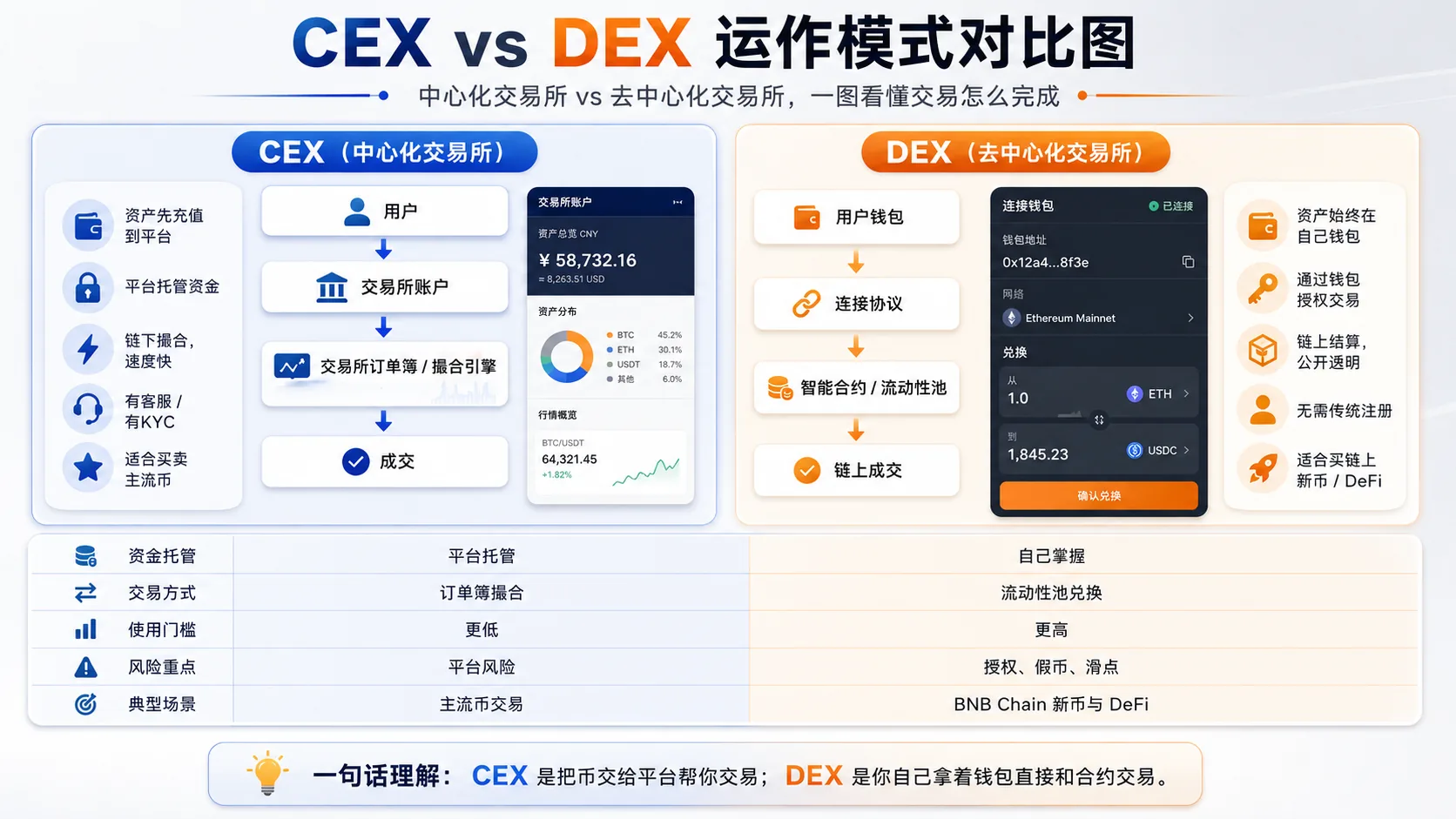
The swap fee of common PancakeSwap AMM pools (e.g. traditional liquidity pools) is usually about 0.25%. Most of this fee goes to the users providing liquidity, and part of it is used for ecosystem incentives and CAKE-related mechanisms according to protocol rules. Different trading modes, pool types, and networks may differ — the order page is the final authority.[2]
0.25% looks higher than Binance's base spot fee of about 0.1%. But PancakeSwap wins on something else: extremely low gas fees.
Because it runs on BNB Smart Chain (BSC), and on-chain gas on BSC is very cheap. In my article Is BNB Chain worth using? I tested that a normal BNB Chain transfer at the time cost about 0.002 USD in gas, and it varies with network conditions.[3]
So the "low fee" claim needs to be split: the swap fee (0.25%) is not low, but the on-chain gas is almost negligible. For very small trades, the gas you save can be more favorable than a CEX's withdrawal fee.
PancakeSwap vs Binance: should a beginner choose a DEX or an exchange?
This is the most common beginner question — just look at the comparison table:
| Dimension | PancakeSwap | Binance (CEX) | Uniswap (Ethereum) |
|---|---|---|---|
| Trading type | DEX | CEX | DEX |
| Chain | BNB Chain | Off-chain matching | Ethereum |
| Swap fee | 0.25% | Spot about 0.1% | 0.3% (some pools differ) |
| On-chain gas | Very low | None | Higher |
| KYC required | No | Yes | No |
| Customer support | None | Yes | None |
| Asset control | Yourself | Platform custody | Yourself |
| Best for | BNB Chain ecosystem, new tokens | Mainstream coin trading | Ethereum ecosystem |
One-sentence summary: off-chain mainstream coins → Binance; on-chain BNB Chain ecosystem → PancakeSwap; Ethereum ecosystem → Uniswap.
Don't move BTC and ETH to PancakeSwap just for the sake of "decentralization." On Binance, mainstream coins have lower spot fees, better liquidity, and customer support if something goes wrong.
Fee breakdown: what does one swap actually deduct?
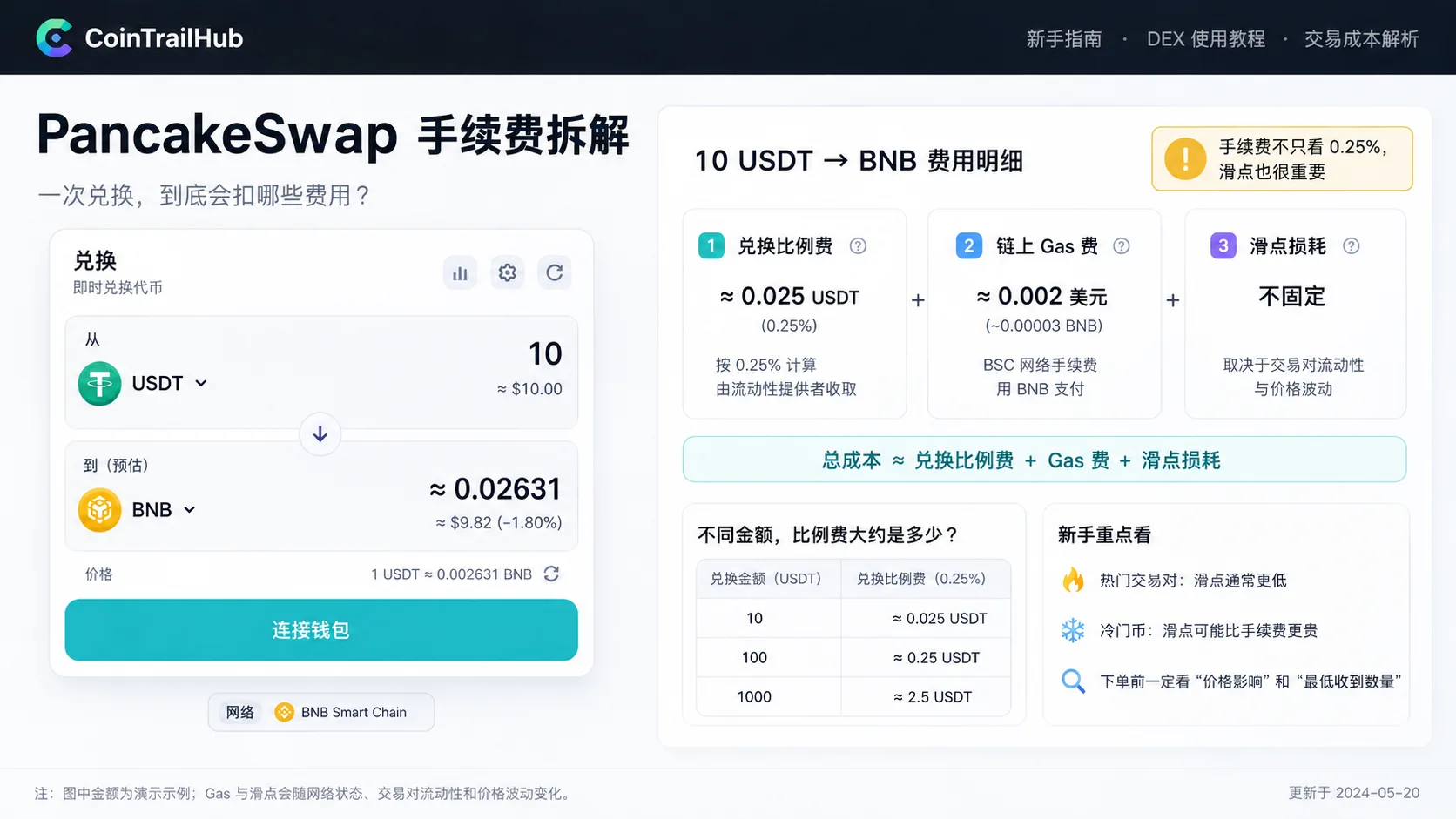
Take a 10 USDT-to-BNB swap as an example and break the fees down (amounts are for demonstration; the page display is final):
| Fee type | Amount | Explanation |
|---|---|---|
| Swap fee | About 0.025 USDT | Calculated at 0.25% |
| On-chain gas | About 0.002 USD (converted) | BSC gas, paid in BNB |
| Slippage loss | Uncertain | Depends on the pair's liquidity |
If you only look at the swap fee (0.25%), the reference fee for different amounts is:
| Swap amount | Reference fee |
|---|---|
| 10 USD | About 0.025 USD |
| 100 USD | About 0.25 USD |
| 1000 USD | About 2.5 USD |
The thing most easily overlooked here is not the fee but slippage.
Slippage is the difference between "the price you see" and "the price you actually get." Popular pairs have deep liquidity and small slippage; cold pairs have poor liquidity and potentially alarming slippage.
When placing a PancakeSwap order, the page shows "price impact" and "minimum received" — you must read these two numbers clearly before confirming.
The experience also differs a lot by amount; a simple reference:
| Amount | Recommendation |
|---|---|
| Under 10 USD | Good for learning the flow; you won't mind losing it |
| 100–1000 USD | Good for normal experience; gas and slippage are both controllable |
| A few thousand USD or more | Watch liquidity and price impact; don't place it all at once |
| Large trades | Prefer Binance or split the order to avoid on-chain slippage and attack risk |
What does a beginner need to prepare before using PancakeSwap?
Before actually starting, prepare these in order:
| Step | Explanation |
|---|---|
| 1 | Register on an exchange and buy USDT (buy mainstream coins directly here) |
| 2 | Prepare a wallet that supports BNB Chain |
| 3 | Buy a small amount of BNB to pay for gas |
| 4 | Transfer USDT and BNB from the exchange into the wallet |
| 5 | Connect to PancakeSwap and start swapping |
If you haven't registered on an exchange yet, read the Binance registration guide (2026); for buying USDT, see how to buy USDT on Binance.
It's recommended to prepare two wallets
The first mistake many beginners make is connecting their long-term main wallet directly to various DeFi protocols. A safer approach is to separate your money:
| Wallet | Purpose |
|---|---|
| Main wallet | Long-term storage of large assets like BTC and ETH; don't connect to unfamiliar protocols |
| Test wallet | Try DEXs, claim airdrops, test new projects, with small amounts |
First run the full flow with a test wallet, and only after confirming it works should you consider using the main wallet.
Hands-on: the complete steps for your first PancakeSwap swap
Don't put in a large amount the first time you use a DEX. I recommend testing the full flow with under 10 USD first: connect wallet → approve → swap → check the transaction record. Only after you understand each step should you consider increasing the amount.
Step 1: prepare your wallet and gas
You need a wallet that supports BNB Chain (e.g. Trust Wallet, MetaMask) containing: the token you want to swap + a small amount of BNB for gas. For how to choose and use a wallet, see wallet basics for beginners.
Step 2: connect your wallet
Open the PancakeSwap official site, click "Connect Wallet," select your wallet, and confirm. Make sure to check that the URL is the official domain and you haven't entered a phishing site.
Step 3: select tokens
Choose "the coin you pay" on top and "the coin you receive" below.
A key action here: when adding a token for the first time, add it by contract address, not by searching the name. Searching the name will bring up a bunch of fake coins with the same name.
Step 4: set slippage
The default slippage is usually 0.5%. For cold coins you need to raise it a bit, otherwise the trade will fail. But don't raise it too high, or a "sandwich attack" will eat more of your profit.
Step 5: confirm + approve
The first time you swap a token, an "Approve" window pops up — this is the operation that lets the contract use that token.
When approving, change "unlimited" to "the amount you need this time," or revoke the approval after the trade. This is where beginners get hit the most; I'll explain it in detail below.
My selection logic: what to use when
| Your situation | Recommended | Why |
|---|---|---|
| Buy or sell mainstream coins | Binance | Low fees, customer support, good liquidity |
| Buy a new token on BNB Chain | PancakeSwap | New tokens usually only exist on DEXs |
| Do liquidity mining | PancakeSwap | Main entry point, deep pools |
| Large swaps | Binance | Avoid on-chain slippage and attack risk |
| Just curious and want to try | PancakeSwap, small amount | Try with a few U; you won't mind losing it |
My principle: if a centralized exchange can handle it, prefer the centralized exchange; only use a DEX for what the CEX can't buy. A DEX isn't more advanced — it's just freer, and freedom has a cost.
The pitfalls I hit (key section)
This part cost me real money, and it's where PancakeSwap beginners crash most often.
The three most common beginner pitfalls on PancakeSwap
The three most common beginner risks on PancakeSwap aren't "not knowing which button to click," but ignoring three checks before trading: verifying the contract address, preventing unlimited approvals, and confirming the slippage range. Get into these three habits before swapping and you'll clearly lower your chances of a pitfall.
Pitfall 1: searching the token name and buying a fake coin
Scenario: many beginners buying a new BNB Chain token for the first time type the token name directly, see a dozen results, and buy the first one.
Cause: on PancakeSwap anyone can create tokens and pairs, so a single name can have dozens of fake coins.
Lesson: always add tokens by contract address, not by searching the name. Get the contract address from CoinGecko, CoinMarketCap, or the project's official channels, then verify the first and last few characters after copying it.
Pitfall 2: unlimited approval — the contract can move your coins anytime
Scenario: on the first swap an "Approve" window pops up, and many beginners click confirm without looking closely — the word "unlimited" is written right there.
Cause: the default approval is "unlimited," meaning the contract technically can move your entire balance of that token anytime. If the contract has a vulnerability, or you approved a malicious contract, the money can be drained.
Lesson: change the allowance to "the amount you need this time," or use a tool like revoke.cash to revoke the approval after the trade. This habit can save you once.
Pitfall 3: slippage too low, trades keep failing
Scenario: many beginners use the default 0.5% slippage to swap highly volatile cold coins and repeatedly hit "transaction failed" — while the on-chain gas has already been deducted.
Cause: if slippage is too low, any small price move makes the trade unfillable, but the gas is already spent.
Lesson: raise slippage appropriately for cold coins (e.g. 1%–3%), and keep an eye on the "minimum received" number — make sure you can accept it.
Pitfall 4: providing liquidity and getting eaten by impermanent loss
Scenario: many beginners see high liquidity-mining yields and deposit two coins at 1:1, then one of them crashes, and the final withdrawn value is less than if they had just held.
Cause: this is "impermanent loss" (IL). The two coins you provide as liquidity — as soon as their relative prices change, you'll be down a bit compared to "holding and not doing anything."[4]
Lesson: mining rewards must cover the impermanent loss to be worth it. Beginners should start with stablecoin pairs (like USDT/USDC), which have the smallest IL.
Pitfall 5: entering a phishing site and getting the wallet drained
Scenario: someone clicks a link like "claim PancakeSwap rewards," connects their wallet, and the coins get moved out.
Cause: it's a phishing site imitating PancakeSwap, tricking you into connecting your wallet and approving a malicious contract.
Lesson: only enter PancakeSwap through official channels; don't click "claim" or "airdrop" in unknown links. Recognize the official domain and double-check before connecting.
Looking back, the truly hard part of a DEX was never clicking Swap — it's asking yourself three questions before confirming: is this coin fake? Is this approval reasonable? Is this price worth filling? Get these three clear and you'll avoid most pitfalls.
Decision framework: when to use PancakeSwap, when to use Binance
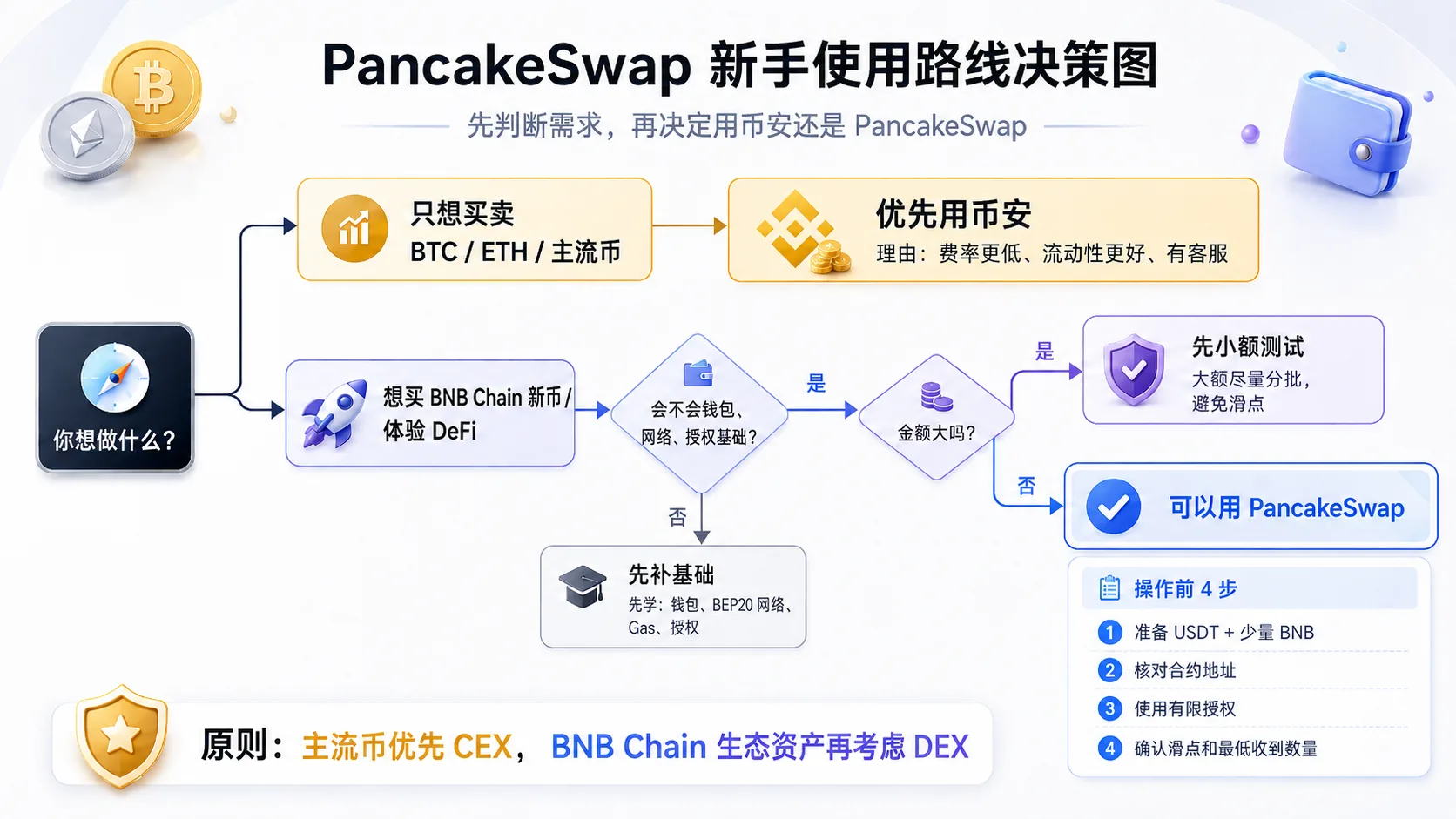
A simple decision order — just follow it:
- Can you buy this coin on Binance? → If yes, use Binance.
- Can't buy it, but is it on BNB Chain? → If yes, use PancakeSwap.
- Is the amount large? → If large, buy in batches on Binance; don't eat on-chain slippage all at once on a DEX.
- Do you know how to verify contract addresses and manage approvals? → If not, study up first.
If the answer to question 4 is "no," then no matter how cheap or convenient, don't rush onto PancakeSwap.
Is PancakeSwap safe? Official entry points and risk reminders
Protocol safety and usage risk are not the same thing
The conclusion first: PancakeSwap's protocol has been audited multiple times and is one of the relatively mature DEXs; but most beginner losses come from fake tokens, malicious approvals, phishing sites, and operational mistakes, not from the protocol itself being hacked.
In other words, "is PancakeSwap safe" and "will you lose money on PancakeSwap" are two different questions. The former is about the protocol and contracts; the latter is about whether you avoid the pitfalls below.
How to confirm the official entry point
Phishing sites are one of the common loss sources for PancakeSwap users — entering through the right door is half the battle:
- Recognize the official domain: only access via the official domain; don't click "claim" or "airdrop" in unknown links.
- Don't enter through search ads: the PancakeSwap ad slots in search engines can be phishing sites; type the URL directly or use a bookmark.
- Verify before connecting your wallet: when connecting, it shows the URL requesting authorization — confirm it's the official domain before confirming.
- Don't trust "official support": PancakeSwap is a decentralized protocol with no support; anyone who messages you saying "I'll help you solve the problem" is a scammer.
Five risk reminders
Ranked by severity from high to low; beginners should first defend against the top three "direct money loss" high-risk items:
- Phishing risk (high): only enter through official channels; don't click "claim"/"airdrop" links of unknown origin. Connect your wallet on a phishing site and the coins can be moved out directly.
- Malicious approval (high): use limited approvals instead of unlimited, and regularly revoke unused approvals. Approve a malicious contract and it can move your coins anytime.
- Private key / seed phrase leak (high): never tell anyone your seed phrase under any circumstances, and never enter it on unfamiliar websites. For wallet security, see how to prevent wallet theft? Seed phrase, wrong-chain transfer, and approval risk (2026).
- Fake token risk (medium): only trust contract addresses, not names. Before buying, check the contract address on BscScan to see if the holder count and liquidity are normal.
- Impermanent loss risk (medium): liquidity mining is not guaranteed profit; calculate the impermanent loss first before deciding.
FAQ
Q1: Is PancakeSwap safe? Is it worth using?
PancakeSwap's protocol is one of the relatively mature DEXs, but user risk mainly comes from fake tokens, approvals, phishing, and wrong operations, not the protocol itself. Whether it's worth using depends on what you're doing: use Binance for mainstream coins, and use PancakeSwap for BNB Chain tokens.
Q2: What's the difference between PancakeSwap and Binance?
Binance is a centralized exchange — your coins are in platform custody, trades are matched off-chain, and there's customer support. PancakeSwap is a decentralized exchange — your coins are in your own wallet, trades complete on-chain through contracts, and there's no support. One is "custody + convenience," the other is "self-custody + freedom."
Q3: What are PancakeSwap's fees?
The swap fee is about 0.25%, plus BNB Chain's on-chain gas (extremely low, a few cents converted). The page display is final, and slippage is separate.
Q4: First time using PancakeSwap, how do I avoid buying a fake coin?
Add tokens by contract address, not by searching the name. Get the contract address from CoinGecko, CoinMarketCap, or the project's official site, then verify the contract info and liquidity on BscScan.
Q5: What is an approval (Approve)? Why is it risky?
An approval is the operation that lets a smart contract use a token in your wallet. The default "unlimited approval" means the contract can move your entire balance of that token anytime; if the contract has a vulnerability or you approved a malicious contract, the money can be drained. The fix is to use a limited allowance, or revoke the approval after the trade.
Q6: What is impermanent loss in liquidity mining?
When you provide liquidity, as soon as the two tokens' relative prices change, you'll be down a bit compared to "holding and not doing anything" — that loss is impermanent loss. Beginners should start with stablecoin pairs, and the rewards must cover the IL to be worth it.
Q7: Does PancakeSwap require registration?
No traditional account registration. PancakeSwap is a decentralized protocol — you just connect your own wallet, with no username, password, or KYC flow.
Q8: Can I withdraw from PancakeSwap?
PancakeSwap itself isn't an exchange and has no deposit/withdraw button. Your assets always stay in your own wallet; to "withdraw" you send the token through your wallet to another address or a trading platform (like Binance), then sell it there for fiat.
Q9: Does PancakeSwap support USDT?
Yes, but watch the network. USDT has different versions on different chains — USDT on BNB Chain usually uses the BEP20 format, and the display name may differ by issuance method (e.g. Binance-bridged Binance-Peg BSC-USD or Tether's native version); Ethereum has ERC20 USDT. They're not the same asset network — sending on the wrong network means the asset won't arrive. Before using a DEX, sort out the network first; see can it be recovered after a wrong-chain transfer.
Q10: What's the relationship between PancakeSwap and a wallet?
PancakeSwap is not a wallet — it's just a trading protocol you use by connecting your wallet. Your assets always live in your own wallet; PancakeSwap doesn't custody your coins, and there's no "PancakeSwap account" concept. So wallet security equals asset security — if you lose the seed phrase or private key, no one can recover it. For wallet basics see wallet basics for beginners; for security settings see how to prevent wallet theft? Seed phrase, wrong-chain transfer, and approval risk (2026).
Data verification notes
The key facts in this article were checked on 2026-08-14 against PancakeSwap official docs, BscScan, and DeFiLlama, item by item:
- Usage: PancakeSwap is an on-chain protocol; it requires no platform account registration or KYC, and works by connecting a self-custody wallet. Source: PancakeSwap official docs.
- Swap fee: the swap fee of common AMM pools is about 0.25%; different trading modes, pool types, and networks may differ, with the order page as final. Source: PancakeSwap official docs.
- On-chain gas: in 2026-08 a normal BNB Smart Chain transfer's on-chain gas was about 0.002 USD converted, fluctuating with network conditions. Source: BscScan.
- Impermanent loss: after providing liquidity, a relative price change in the two tokens makes the position value lower than holding-and-not-doing-anything; the difference is impermanent loss. Source: PancakeSwap official docs.
Related recommendations
- How to buy USDT on Binance (2026): P2P purchase flow, choosing a merchant, and payment — get your USDT ready first; it's step one of on-chain operations
- Can BNB Chain pay fees with USDT? BEP20 transfer and gas test (2026) — before deciding to use PancakeSwap, figure out whether BNB Chain is worth it
- Can it be recovered after a wrong-chain transfer? Withdrawal network and wallet address (2026) — network and address knowledge you must know before using a DEX
- Binance registration guide (2026) — read here first if you don't have a Binance account
- How do beginners avoid trading pitfalls? Don't trust signal teachers, stay away from high leverage — the most easily overlooked risks on your trading journey
Disclaimer
This article is only for sharing PancakeSwap and decentralized-trading usage experience and technical education, and does not constitute any investment advice, financial advice, or trading advice.
Crypto asset prices are highly volatile, and decentralized trading carries additional risks such as fake tokens, smart-contract vulnerabilities, approvals, slippage, impermanent loss, and phishing. Users should judge carefully according to their own risk tolerance and the laws of their location. Before operating in a DeFi protocol, be sure to confirm the contract address, approval scope, and related risks.
- PancakeSwap official docsAMM swap fee of 0.25% and pool rules
- DeFiLlamaLiquidity pool size and TVL data
- BscScanToken contract address and liquidity verification
- 2026-10-17UpdateAdded evidence-chain superscripts and "Data verification notes".
See ourEditorial Policy and the correction process in ourCorrections Policy.
The CoinTrailHub editorial team focuses on crypto education for beginners, exchange security and P2P trading risk. This article is compiled from official sources and public data, reviewed by humans, and strives for accuracy but is not investment advice.
Last updated:2026-08-14 · Content reviewed by humans · Learn more
© 2026 CoinTrailHub · Original content. Reproduction or rewriting without permission is prohibited.