
Is Bitcoin a scam? 10 doubts, debunked one by one (2026)
Table of contents

Binance new user rewards
20% trading fee rebate
Official Binance registration. Complete identity verification (KYC) to trade and withdraw.
Bitcoin is not a scam, and the protocol itself is secure — but it is not a risk-free asset. It's a decentralized protocol that has been running since 2009, with real use cases, but also long-standing controversies and risks. I began systematically researching BTC's technology, usage flow and controversies in 2025, and after hands-on testing and source verification, I formed the judgment framework in this article. This piece presents the full verification process and conclusions — and also explains why many rational observers still remain skeptical.
Reminder: this article is a record of a personal verification process and does not constitute investment advice. Crypto assets are extremely volatile. Any decision involving money should be made based on your own risk tolerance.
Before diving deep, let's quickly review the 10 most common questions. The controversy around Bitcoin doesn't come from a single factor — it spans value, security, regulation, energy and technology.
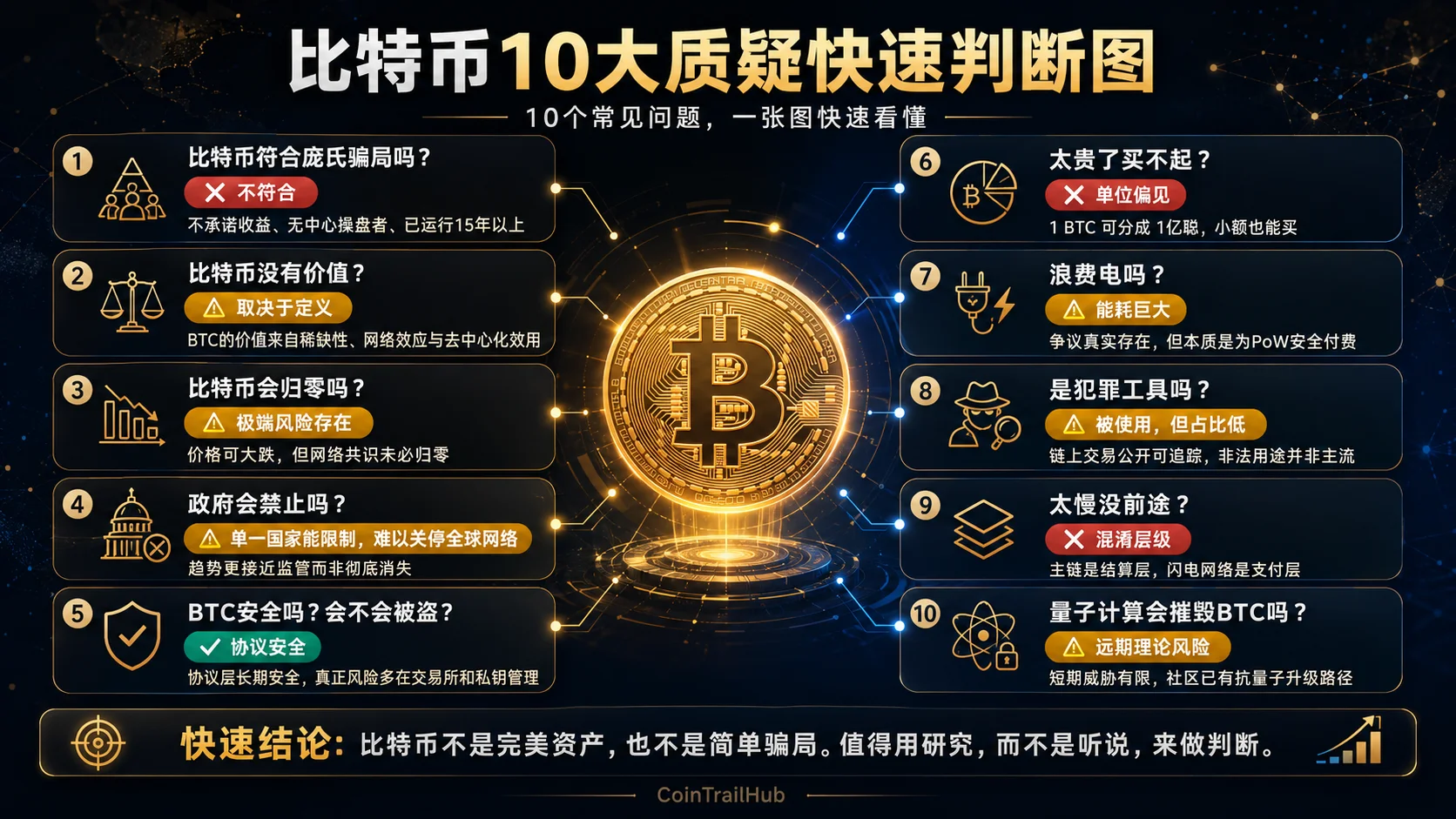
30 seconds to understand: answers to Bitcoin's 10 biggest doubts
| Common doubt | Verdict | Core answer |
|---|---|---|
| Does Bitcoin fit a Ponzi scheme? | No | It promises no returns, has no central operator, has run since 2009 and keeps operating through multiple market cycles |
| Does Bitcoin have no value? | Depends on definition | Gold and fiat also have no "intrinsic value" in a DCF sense; BTC provides real utility like inflation-resistant savings and permissionless payments |
| Will Bitcoin go to zero? | Extreme risk exists | It's been declared "dead" hundreds of times and still runs; total consensus collapse would require everyone giving up simultaneously |
| Will governments ban it? | China banned it, but the global trend is regulation | A single country's ban can't shut down a decentralized network; major economies are building regulatory frameworks |
| Is BTC safe? Will it be stolen? | The protocol is safe | The protocol layer has never been breached since 2009; an exchange hack ≠ Bitcoin being hacked |
| Too expensive to afford? | Unit bias | The smallest unit 1 satoshi = 0.00000001 BTC; you can buy tiny fractions and start small |
| Does it waste electricity? | Huge energy use, use case optimizing | Energy use is a security budget, not waste; the share of renewables in mining is rising |
| Is it a tool for crime? | Used, but a small share | A permanently public ledger is a fatal flaw for criminals; the illicit share is lower than traditional finance |
| Too slow to have a future? | Confusing layers | The main chain is the settlement layer, Lightning is the payment layer — layered architecture is the internet's mature model |
| Will quantum computers destroy it? | Long-term theoretical risk | Practical quantum computers are 10-20 years away; the community already has a clear quantum-resistant upgrade path |
If you remember only one thing: Bitcoin isn't perfect, and it doesn't need your "faith." It deserves to be judged by research, not hearsay.
It's recommended to first read What is Bitcoin (BTC)? Principles, value and risks (2026) to build the basics — this article will be more rewarding afterward.
Why do so many people think Bitcoin is a scam?
Before debunking each doubt, understand a more fundamental question: why is the "Bitcoin is a scam" impression so widespread? It's not just that people lack understanding — there are several objective reasons:
Wild price swings. BTC has repeatedly risen dozens of times and then fallen over 80%. This violent volatility superficially resembles the "pump-and-dump" pattern of traditional financial fraud, which invites the association.
Too many early scam projects. The 2017 ICO bubble, the 2022 FTX collapse and similar events deeply bound "cryptocurrency" and "fraud" together in public perception. Many people equate fraud by exchanges and projects with a problem in the Bitcoin protocol itself — which is exactly the distinction this article focuses on.
Complex technical concepts. Decentralization, PoW consensus, the UTXO model — these are far removed from everyday experience. When people can't understand how something works, "scam" is the least-effort explanation.
Media reports easily conflate. "Bitcoin exchange hacked," "Bitcoin used for money laundering" — headlines often don't distinguish the Bitcoin protocol from the services running on top of it, causing the public to conflate the two. This is also the core issue that Doubt 5 and Doubt 8 below clarify.
Understanding this background helps distinguish which doubts about Bitcoin are fact-based reasonable concerns and which are misunderstandings from information transmission.
Who should read / who shouldn't
| Your situation | Recommendation |
|---|---|
| You've heard lots of negative claims and aren't sure whether BTC is worth your time | Should read — this helps you make that decision |
| You're about to try a small amount and want to understand the main risks first | Should read — focus on Doubts 4, 5, 7, 10 |
| You already hold BTC and want to confirm your judgment is rational | Should read — focus on Doubts 1, 2, 3 + the critics' view |
| You've already researched deeply and have a clear judgment | Skim the table of contents; focus on the "critics' view" and FAQ |
| You just want material to argue with people | No need — this article helps you judge, not argue |
| You firmly believe BTC is worthless and don't want to change your mind | No need — I respect your judgment |
My verification method
Before debunking each doubt, let me first explain how I verified — this matters more than the conclusions themselves. You can use the same method to verify any claim about Bitcoin.
Three methods:
Check the original source. Don't settle for secondhand information. The definition of a Ponzi scheme? Check the SEC website. Bitcoin's code? Check GitHub. Energy data? Check Cambridge CBECI. Cross-verify official docs at Bitcoin.org and Binance Research. The vast majority of controversies dissolve once you check the original source — information distortion in secondhand transmission is severe.
Test with a small amount. I bought my first BTC with about $100, then withdrew it to a self-custody wallet. That on-chain transfer cost a dollar or two in fees under normal congestion and confirmed in about 10 minutes; more importantly, I experienced firsthand the essential difference between "holding your own private keys" and "leaving it on an exchange" — with the former, if you lose your seed phrase, no one can help you recover it. Reading 100 articles is no substitute for doing it once yourself.
Look for counter-evidence. For each doubt I reversed the question: "If I'm wrong, what evidence would prove it?" For example, when verifying "Ponzi scheme," I first looked up the legal definition and compared it point by point. Don't only look for evidence that supports your position — that's confirmation bias, not verification.
Doubt 1: Is Bitcoin a Ponzi scheme?
My doubt
This was the biggest concern. People around me had asserted "this is a Ponzi scheme" after losing money trading crypto — and I thought it made sense at the time. After all, a purely digital thing with no physical backing looks like a scam no matter how you see it.
How I verified
First, check the definition. I looked up the legal definition of a Ponzi scheme on the SEC website. Four core characteristics: ① promises fixed or stable high returns; ② pays early investors with later investors' money; ③ needs a constant inflow of new money or it collapses immediately; ④ needs a centralized operator forging the books behind the scenes.
Second, compare point by point. Does Bitcoin promise any return? No. Satoshi's whitepaper contains no promise of investment return. Bitcoin's price sometimes rises severalfold in a year and sometimes falls 70-80% in a year — no Ponzi scheme could withstand a drop of that magnitude without collapsing.
Third, find the operator. A Ponzi scheme needs a living operator. Satoshi disappeared in 2011 and never reappeared. What drives Bitcoin today is tens of thousands of independently running nodes, miners and developers worldwide — no one can unilaterally control the ledger, change the rules or forge transactions.
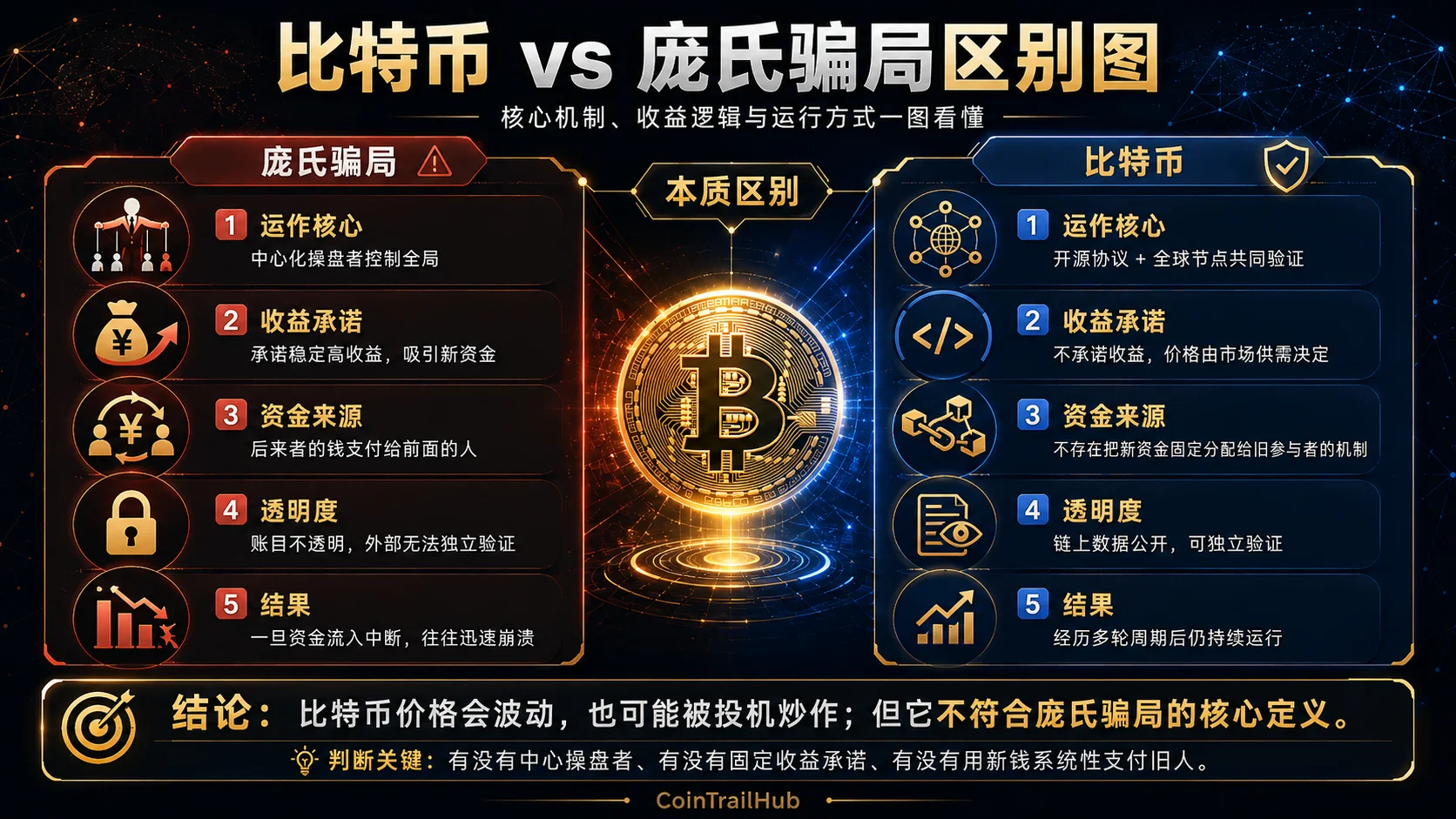
My conclusion
Bitcoin is not a Ponzi scheme. Its price is likewise influenced by global supply and demand and market consensus, but its value logic isn't identical to stocks or gold — stocks have cash-flow expectations, gold has commodity properties, and BTC's core is the utility of a decentralized network. Confusing "price determined by supply and demand" with "paying old investors with new investors' money" is the most common cognitive error.
Bitcoin has survived at least four "new-money droughts" in 15 years: the 2014 Mt. Gox collapse, the 84% drop in 2018, the 2022 FTX collapse and the 2022 LUNA crash. Each event meant massive capital flight. A Ponzi scheme collapses after one such event. Bitcoin didn't.
A thought experiment: suppose a Ponzi scheme and a decentralized network both run for 15 years. The former needs a living operator continuously attracting new money. The latter needs tens of thousands of nodes running the same open-source code. Which is more likely to survive 15 years?
Doubt 2: Bitcoin has no value, so why do people buy it?
My doubt
"It's just air, it has no intrinsic value" — this was the criticism I heard most. But later I asked myself: what exactly is "intrinsic value"?
How I verified
I made a list to see where different assets' value comes from:
| Asset | Source of value |
|---|---|
| Gold | Scarcity, millennia of historical consensus, industrial demand |
| Stocks | Expectations of future cash flows |
| Fiat | National credit and institutional consensus |
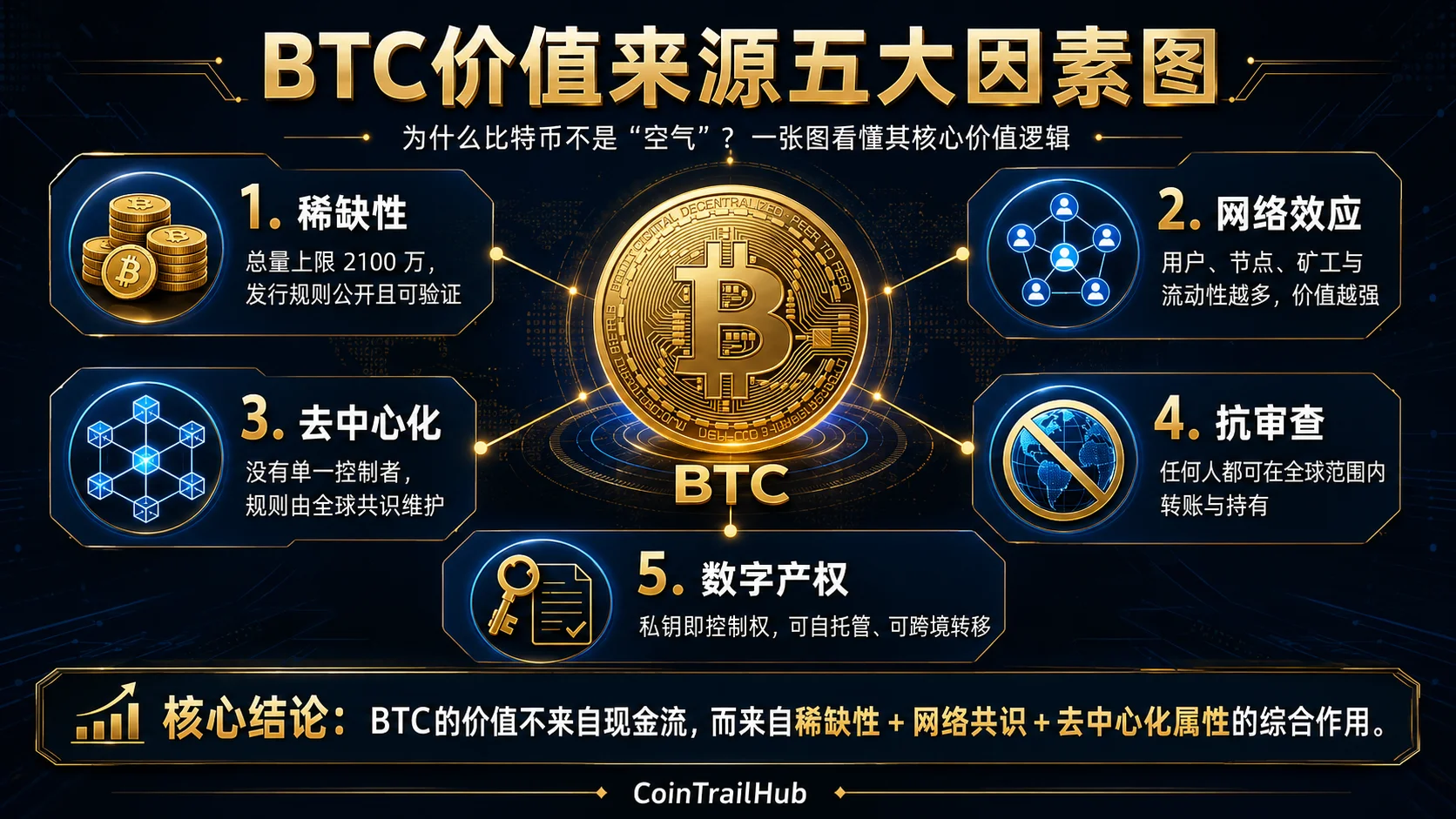
| BTC | Scarcity, network effects, decentralization |
The vast majority of things we call "assets" have their value ultimately grounded in some form of consensus. The difference lies in the type of consensus and the time it has accumulated — gold relies on 5,000 years of history, fiat on government credit, and BTC on code rules, a fixed-supply mechanism and consensus among network participants.
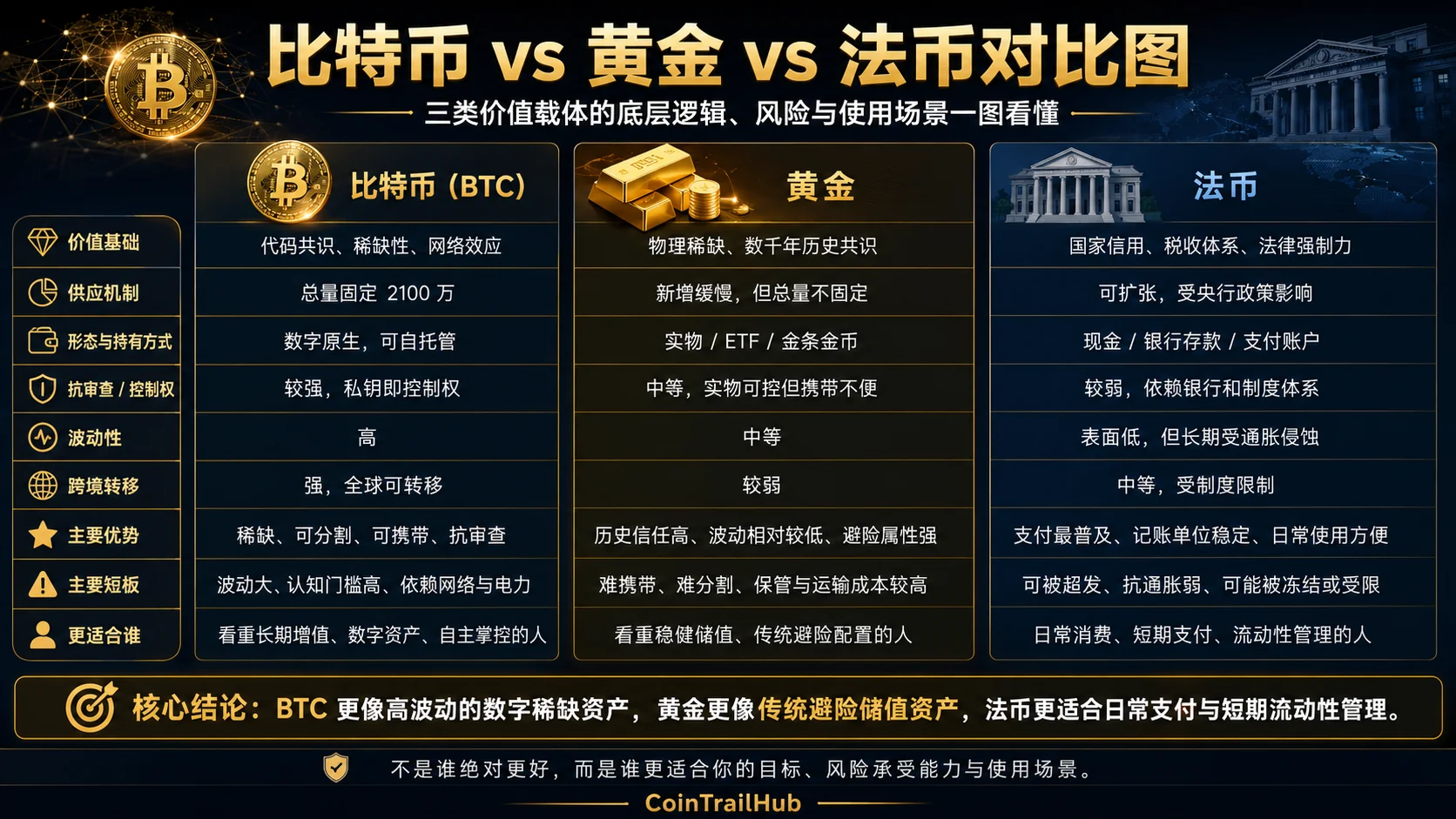
What utility does Bitcoin provide?
Not cash flow, but not nothing either:
- A digital store of value with a fixed-supply mechanism. For people in regions with severe currency depreciation (such as Argentina with 200%+ annual inflation and Turkey with 60%+), BTC offers a choice outside the traditional financial system — actual BTC usage in these regions far exceeds that of developed countries
- Permissionless global payments. No bank account, no identity verification, send any amount to anyone in the world — for people without stable banking services, it provides a transfer method that requires no traditional financial institution
- Unconfiscatable digital property. With your private key properly held (12 or 24 seed words), no government, bank or hacker can freeze or confiscate your BTC
My conclusion
BTC's value doesn't come from discounted cash flow — it comes from a category of thing that has never existed before: a global, decentralized, scarce digital-native property-rights system. You don't have to accept this value proposition, but reducing it to "air" is giving up on thinking.
I recommend reading Why does Bitcoin have value? Scarcity, decentralization, network effects for the complete value-analysis framework.
Doubt 3: Will Bitcoin go to zero?
My doubt
"This thing has risen so much, it'll go to zero eventually." After BTC's big rise and correction in 2017, many believed the "zero thesis" had been validated. But its price later recovered through volatility — which made the "zero thesis" harder to stand by.
How I verified
There's a website called Bitcoin Obituaries that specifically records how many times mainstream media declared "Bitcoin is dead." That number keeps growing over the years — the first Bitcoin obituary appeared in 2010, when BTC was under $1. After every subsequent crash, media republished an article about "Bitcoin finally being done." After every "death," the network resumed operating.
This isn't religious faith — it's the Lindy Effect: the longer a technology has existed, the higher the probability it will continue to exist. A book that's been in print for 100 years will very likely stay in print another 100. A network that has run for over a decade without collapsing has an increasing historical basis for continuing to exist.
In what sense could "zero" happen? Two scenarios:
- A fatal protocol-level vulnerability. This has never happened in 15 years. Bitcoin's code is an open-source project continuously reviewed by the world's top cryptographers and security researchers — vulnerabilities are more likely to be found and fixed than quietly exploited
- Total collapse of global consensus. Everyone simultaneously decides to stop using Bitcoin. Given the large number of holding addresses worldwide, markets like the US launching spot BTC ETF products, and institutional holdings — this scenario requires multiple extreme conditions simultaneously, and there's no clear sign it's happening
My conclusion
Asset prices can swing wildly (BTC has repeatedly fallen over 80%), but volatility isn't the same as going to zero. Confusing "price drop" with "value disappearing" is the most common cognitive error for beginners.
Doubt 4: Will governments ban Bitcoin?
My doubt
When China banned Bitcoin in 2021, I also thought "it's over, this thing is done." It didn't disappear — its price recovered through volatility. This made me realize — I may have overestimated a single country's influence over a decentralized network.
How I verified
The most persuasive evidence is the China ban itself. In September 2021, the People's Bank of China and other ministries jointly issued a document explicitly declaring "virtual currency business activities are illegal financial activities" — one of the world's strictest Bitcoin bans, covering trading, mining and all financial services.
The result? Large numbers of Chinese miners migrated overseas, to places like the US and Kazakhstan. Bitcoin's global hashrate recovered within months and hit new highs. A decentralized global network has one physical property: no single country can "turn it off." Shutting down tens of thousands of full nodes distributed worldwide is both legally and technically impossible.
Global trend: regulation, not prohibition
From 2024 to 2026, the regulatory direction of major economies is very clear:
- United States: spot BTC ETFs approved (with BlackRock, Fidelity and other institutions involved), traditional financial institutions starting to offer compliant investment channels
- European Union: the MiCA regulation is fully in effect, providing the world's most complete crypto regulatory framework
- Japan, South Korea, Singapore, UAE, Hong Kong: all have established compliance frameworks and issued exchange licenses
- El Salvador: listed BTC as legal tender in 2021 and continues to promote related crypto policies
My conclusion
More and more major economies are shifting from outright bans to building regulatory frameworks. The reason is pragmatic — banning a decentralized protocol faces fundamental technical difficulties; bringing it under regulation can actually achieve taxation, anti-money-laundering and investor protection.
Strict regulation (such as restricting self-custody wallets) may affect use cases. But the narrative that "a government ban will make BTC go to zero overnight" contradicts 15 years of empirical history.
Doubt 5: Is BTC safe? Will it be stolen?
My doubt
Every now and then there's news like "exchange X hacked for hundreds of millions" — this made me think Bitcoin itself was unsafe.
How I verified
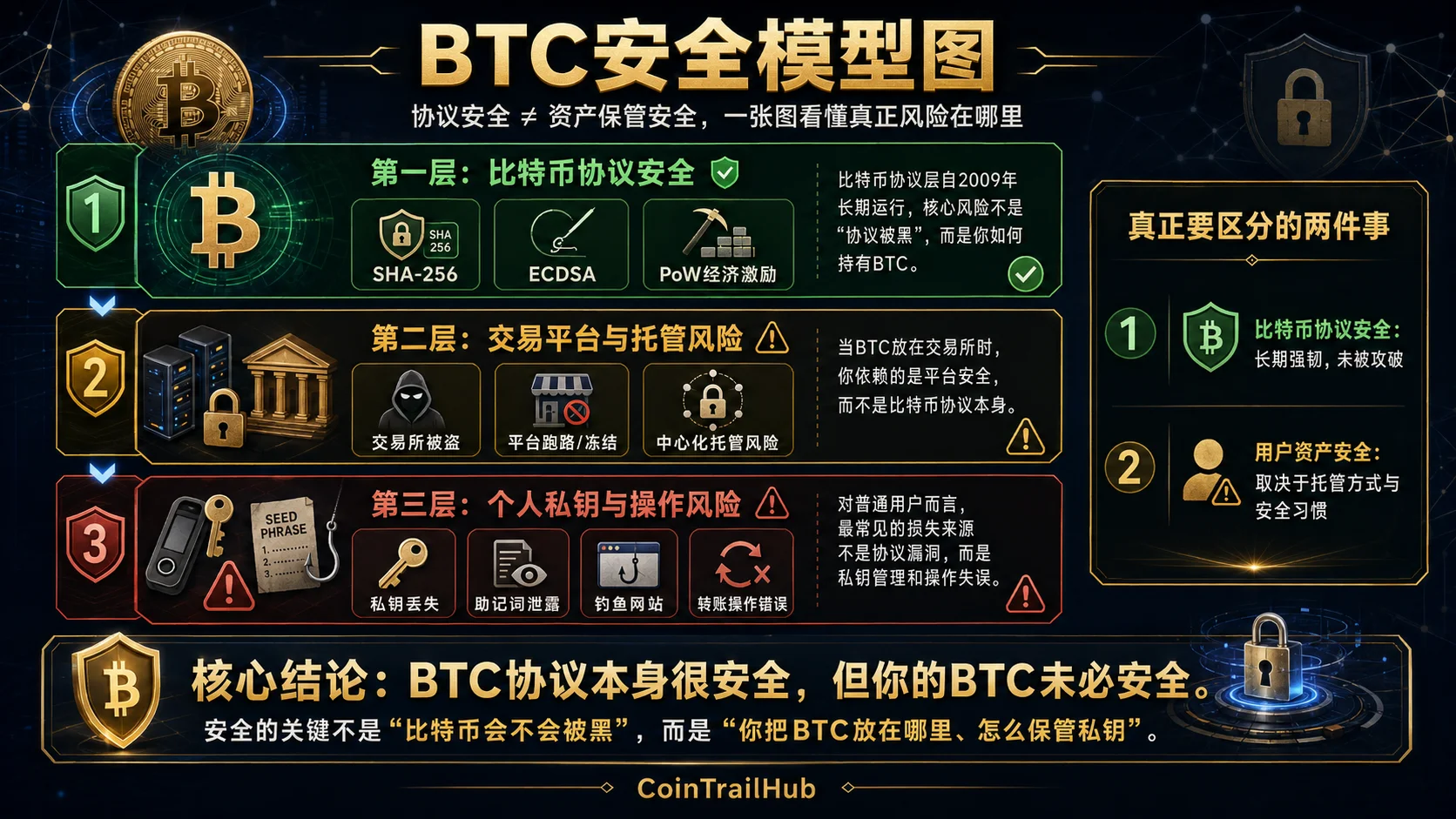
Bitcoin has been running since January 3, 2009, and the protocol layer has never been successfully attacked. The world's top hackers, intelligence agencies and cryptography researchers have been scrutinizing its open-source code for 15 years — if there were a way to forge transactions or mint coins out of thin air, someone would have done it already.
Protocol security comes from three layers:
- The SHA-256 hash algorithm. A NIST-published standard algorithm that countless security systems worldwide (including military and financial) depend on
- Elliptic Curve Digital Signatures (ECDSA). The private-key space is 2^256 — brute-forcing a private key requires computational work far exceeding the number of atoms in the universe
- Economic incentives. The cost of an attack (controlling 51% of network hashrate, millions of dollars in electricity per hour) far exceeds the benefit (at most double-spending your own transactions)
Exchange hacks ≠ Bitcoin being hacked
This is the most important distinction to make.
Mt. Gox (2014), Bitfinex (2016), FTX (2022) — in every "Bitcoin stolen" event, what was hacked was a centralized exchange's server, not the Bitcoin protocol. It's like a bank being robbed — you can't say "the dollar system was breached."
Bitcoin protocol security ≠ your personal asset security. If you keep BTC on an exchange, your security depends on that exchange. Only by holding your own private keys (self-custody wallet) do you actually get the security guarantee the Bitcoin protocol provides.
For ordinary users, the biggest risks are usually not attacks on the Bitcoin network, but private-key management errors, phishing attacks and platform risk. These are the most common causes of asset loss in actual use.
I recommend reading What is a crypto wallet? Addresses, seed phrases and asset security (2026) to understand the difference between self-custody wallets and exchanges.
If you're worried about a specific exchange (e.g. whether Bitget is safe and might collapse), read Is Bitget safe? Reserves, fees and 2026 controversies checked item by item.
Doubt 6: Is Bitcoin too expensive to afford?
My doubt
When BTC was around $60,000 in 2024, I opened a trading platform, glanced at the price and closed it — "60k a coin, can't afford it." Only later did I learn you can buy tiny fractions.
How I verified
This is the easiest doubt to verify — pure math.
1 BTC = 100,000,000 satoshis (Satoshi). You can buy 0.001 BTC, 0.0001 BTC, or even 1,000 satoshis. Different platforms have different minimum purchase amounts, usually starting from a few dozen dollars.
Bitcoin isn't a "buy one whole thing" concept — it's more like gold. You wouldn't say "gold is too expensive, I can't afford a whole gold bar," because you can perfectly well buy 1 gram.
Unit bias
Psychologists have found that humans naturally tend to think of asset prices in terms of "one whole unit." A price tag of tens of thousands of dollars per BTC makes many people close the page immediately — even though they could easily buy just one thousandth.
This bias exists in other assets too: Berkshire Hathaway Class A shares are about $600,000 each, and many find them "too expensive"; an apartment in a major city costs millions, but you can participate through REITs with a few thousand dollars.
My conclusion
A single unit's price doesn't tell you whether an asset is "expensive" or "cheap." Whether it's expensive depends on your judgment of its value, not the price per unit. If you think BTC's long-term logic holds, allocate an amount you can afford based on your financial situation.
If you're about to try a small amount, first read Binance registration tutorial (2026) for the full process.
Doubt 7: Does Bitcoin waste electricity?
My doubt
"Mining consumes a country's worth of electricity" — this claim is devastating, and it's the doubt that made me hesitate the longest.
How I verified
First, figure out what the energy is "buying." According to the Cambridge Bitcoin Electricity Consumption Index (CBECI), the BTC network consumes about 100-150 TWh per year (checked 2026-08) — roughly equivalent to the annual electricity use of the Netherlands or Argentina. This number is staggering; I don't deny it.
But the key isn't "how much," but "why." PoW's electricity consumption is a deliberate design for Bitcoin's security: it makes attacking the network prohibitively expensive. You can think of PoW energy use as the operating cost of Bitcoin's security — like what the banking system spends on security, data centers and armored transport, just scattered across different line items that no one sums up and calls "banking waste."
Second, mining and renewables are reinforcing each other. Miners chase the cheapest electricity, and the cheapest often comes from surplus renewables — wasted hydropower during wet seasons, excess wind and solar in Texas. Without mining, this electricity is often curtailed (wasted). In addition, miners use otherwise-flared or vented methane from oil extraction to generate power for mining — turning an environmental problem into an economic resource.
According to the energy-mix estimates of the Cambridge Bitcoin Electricity Consumption Index (CBECI) (checked 2026-08), the share of renewables in Bitcoin mining is rising, though the specific percentage varies by methodology. The mining community is continuously migrating to cheaper energy (a large portion of which is renewable).
My conclusion
Bitcoin genuinely consumes a lot of electricity — there's no need to defend that. But whether it's "waste" depends on whether you think what it provides has value. If you think BTC has real utility (inflation-resistant savings, permissionless payments, self-custody property rights), that electricity is the security budget for providing those services to global users. If you think it's a zero-value speculation — then any electricity is waste.
Rather than arguing about "saving electricity," first understand what the electricity actually buys. I recommend reading Is Bitcoin mining still profitable? Settle these four accounts first (2026) for the technical details of PoW.
Doubt 8: Is Bitcoin a tool for crime?
My doubt
"Bitcoin is used by criminals" — this claim appears repeatedly in movies, TV shows and news.
How I verified
This claim has one fatal flaw: Bitcoin's transaction records are completely public and permanently undeletable. Every transaction is recorded on the blockchain, and anyone can browse them in real time on blockstream.info or mempool.space.
Bitcoin is pseudonymous — an address is a string of characters that doesn't directly show a real name. But your activity leaves a permanent digital trail.
More importantly, on-chain analysis (Chain Analysis) is already a mature industry. Chainalysis, Elliptic and similar companies provide blockchain transaction-tracking services specifically for law enforcement. The US Department of Justice recovered billions of dollars worth of BTC through on-chain analysis in the 2022 Bitfinex hack case. In the 2021 Colonial Pipeline ransomware case, the FBI recovered most of the ransom through on-chain analysis.
Different institutions use different statistical methods, so specific percentages vary, but overall research shows illicit activity is not the main component of crypto transactions. And for actual criminals, Bitcoin has one fatal problem: a permanently public, undeletable ledger. You accept a ransom in BTC today, and ten years from now law enforcement may trace you with more advanced technology. This is also why more crime is shifting to privacy coins or cash — cash has stronger anonymity properties in many scenarios, though cash is likewise subject to legal regulation.
Doubt 9: Is Bitcoin too slow to have a future?
My doubt
"Seven transactions per second? Visa does 65,000 — how could Bitcoin possibly replace payments?" This was my first reaction when I started learning BTC's technology.
How I verified
This criticism confuses the different roles of the "settlement layer" and the "payment layer." Bitcoin's main chain is positioned as a global settlement layer, not an everyday payment layer.
The main chain's "slowness" is deliberate design: the 10-minute block interval gives new blocks enough time to propagate to tens of thousands of nodes worldwide; the limited block size lets ordinary computers run full nodes, keeping the network decentralized.
Lightning Network: the solution for everyday payments
Everyday small payments don't need the main chain. The Lightning Network is a second-layer payment protocol built on top of the BTC main chain: two parties open a "payment channel" on the main chain, and within the channel they can make unlimited, near-instant, near-zero-fee transfers. Only opening and closing the channel goes on-chain. See the Lightning Network official documentation.
In theory, Lightning can support far higher transaction throughput than the main chain, with sub-second confirmation and near-zero fees. As of 2026, it's being integrated by more and more merchants and payment platforms — including El Salvador's nationwide BTC payment infrastructure.
My conclusion
Layered architecture is the internet's mature model. The IP protocol doesn't deliver web pages; HTTP is built on top of IP. No one says "IP is too simple, so the internet has no future." Bitcoin is the same: the main chain is the most secure settlement layer, and Lightning is the fast, cheap payment layer.
I recommend reading Is Lightning Network worth using? Fees, speed and common pitfalls (2026) for the technical details.
Doubt 10: Will quantum computers destroy BTC?
My doubt
This most "science-fiction"-sounding concern was actually the quickest one for me to put down — once I checked the timeline, I was reassured.
How I verified
Quantum computers do theoretically threaten the ECDSA signatures Bitcoin uses. But the gap between a "theoretical threat" and an "actual threat" is large:
- Practical quantum computers don't exist yet. The strongest quantum computers today have about 1,000 physical qubits, while breaking ECDSA requires millions — an order-of-magnitude gap
- Most modern Bitcoin addresses only briefly expose their public key when spending. Used properly, the attack window is only about 10 minutes
- The community already has a clear upgrade path. NIST standardized post-quantum cryptography (PQC) algorithms in 2024, and Bitcoin can switch to quantum-resistant signatures through a soft fork
My conclusion
The quantum-computer threat to Bitcoin is more accurately described as "a known, solvable long-term technical risk" — not "an imminent terminator." Global banks, governments and military communication systems likewise depend on ECDSA and RSA. If quantum computers could really break these algorithms, "BTC is broken" wouldn't be the headline — "the global financial system needs an emergency upgrade" would be.
Why do rational investors still doubt Bitcoin?
Understanding an asset requires not only the supporters' reasons but also understanding why critics reject it. Here are the three most common arguments from critics — these aren't "misunderstandings," but reasonable doubts:
1. Bitcoin produces no cash flow
Stocks have profits, bonds have interest, real estate has rent. Bitcoin produces no cash flow — your only source of return from holding BTC is someone willing to buy it from you at a higher price.
This is a real criticism. Under the traditional value-investing framework (DCF model), BTC's fundamental value truly can't be computed. But the same criticism applies to gold — gold produces no cash flow, and industrial use accounts for less than 15% of its market value.
My judgment: this criticism correctly points out that BTC doesn't fit traditional valuation models. But it can't prove BTC "has no value" — it only shows that BTC's value source differs from stocks/bonds and belongs to the independent asset category of "store of value."
2. Too volatile for ordinary people
BTC has repeatedly fallen over 80%. For people who need the money, this volatility is unaffordable.
This criticism is valid. BTC's annualized volatility far exceeds traditional asset classes. No one should put money they need in the short term into BTC.
My judgment: this kind of violent volatility is a common feature of emerging asset classes, not a BTC-only problem. Gold also experienced huge volatility in the first decade-plus after the 1971 collapse of the Bretton Woods system. Volatility declines as markets mature and participants grow — but that process takes time. Until then, only using money you can afford to lose is the only strategy.
3. The technology may be replaced by a better solution
Tens of thousands of cryptocurrencies have emerged in 15 years, some technically more advanced than BTC (faster confirmation, lower energy use, stronger privacy).
This criticism is also valid. Bitcoin is not the most technically "advanced" blockchain. But technical advancement and market success are two different things. Bitcoin's core advantage isn't technical performance — it's network effects and decentralization: the most nodes, the most miners, the largest market cap and liquidity, the longest operating history. These form a moat deeper than any technical parameter.
My judgment: technological replacement is a real risk. But so far, no project calling itself a "Bitcoin killer" has come close to BTC in decentralization and security. A real competitor may emerge in the future — but that "future" is at least several years, possibly more than a decade, away.
These critics' views aren't "wrong." They're reasonable risks worth taking seriously. Understanding the core arguments of both supporters and critics lets you form your own judgment — rather than simply picking a side.
Three places I once misunderstood Bitcoin
Misconception 1: Because of the "wasteful electricity" criticism, never bothered to learn
Scenario: in early 2023, when BTC's price was low, someone suggested I spend time learning about this asset. My reaction was "what value does something that wastes this much electricity have" — and I never thought about it again. Later, as the market moved, I realized I hadn't actually understood the asset — neither its risks nor its value proposition.
Reason: I conflated two questions — "this thing uses a lot of energy" and "is this thing worth learning about." They're different dimensions of judgment. Apply the same standard to gold mining: the annual environmental cost from energy, water and chemicals far exceeds Bitcoin's — do you therefore hold no gold-related assets?
Lesson: making a moral judgment about energy use, and judging whether something is worth learning about, are two different things. If you don't like its energy use, don't hold it. But using "not environmentally friendly" as a reason not to study — you're ultimately making a decision based on your own cognitive bias, not contributing to environmentalism.
Misconception 2: Because of unit bias, assumed I couldn't afford it and never researched
Scenario: when BTC was about $60,000 in 2024, I glanced at the price and closed it — "60k a coin, can't afford it." Only later did I learn you can buy 0.001 BTC = $60.
Reason: pure unit bias. Humans naturally think of prices in "one whole unit." "One BTC = $60,000" directly triggered the psychological switch of "can't afford it" — without checking the minimum purchase amount.
Lesson: unit bias may be the most expensive cognitive bias. You don't need to "afford a whole Bitcoin" to start — just as you don't need to afford a whole gold bar to invest in gold. Checking the minimum purchase amount takes 10 seconds; the cost of not checking may be missing a multi-year window of understanding.
Misconception 3: Only read headlines, equating "exchange hacked" with "Bitcoin unsafe"
Scenario: for a long time, every time I saw "exchange X hacked" news, I silently reinforced my "Bitcoin is unsafe" conclusion. It wasn't until I operated it myself that I realized every "hack" was an exchange's server being breached — the Bitcoin protocol itself has never been broken.
Reason: headlines say "Bitcoin exchange hacked for X hundred million," and ordinary people (including me at the time) don't distinguish "exchange security" from "protocol security" — it all sounds like "something went wrong with Bitcoin."
Lesson: "exchange hacked" and "Bitcoin breached" are two completely different things. If you keep BTC in a self-custody wallet (holding your own private keys), an exchange hack has nothing to do with you. This distinction is crucial for asset security.
Decision framework: when to take Bitcoin seriously
| Your situation | Recommendation | Reason |
|---|---|---|
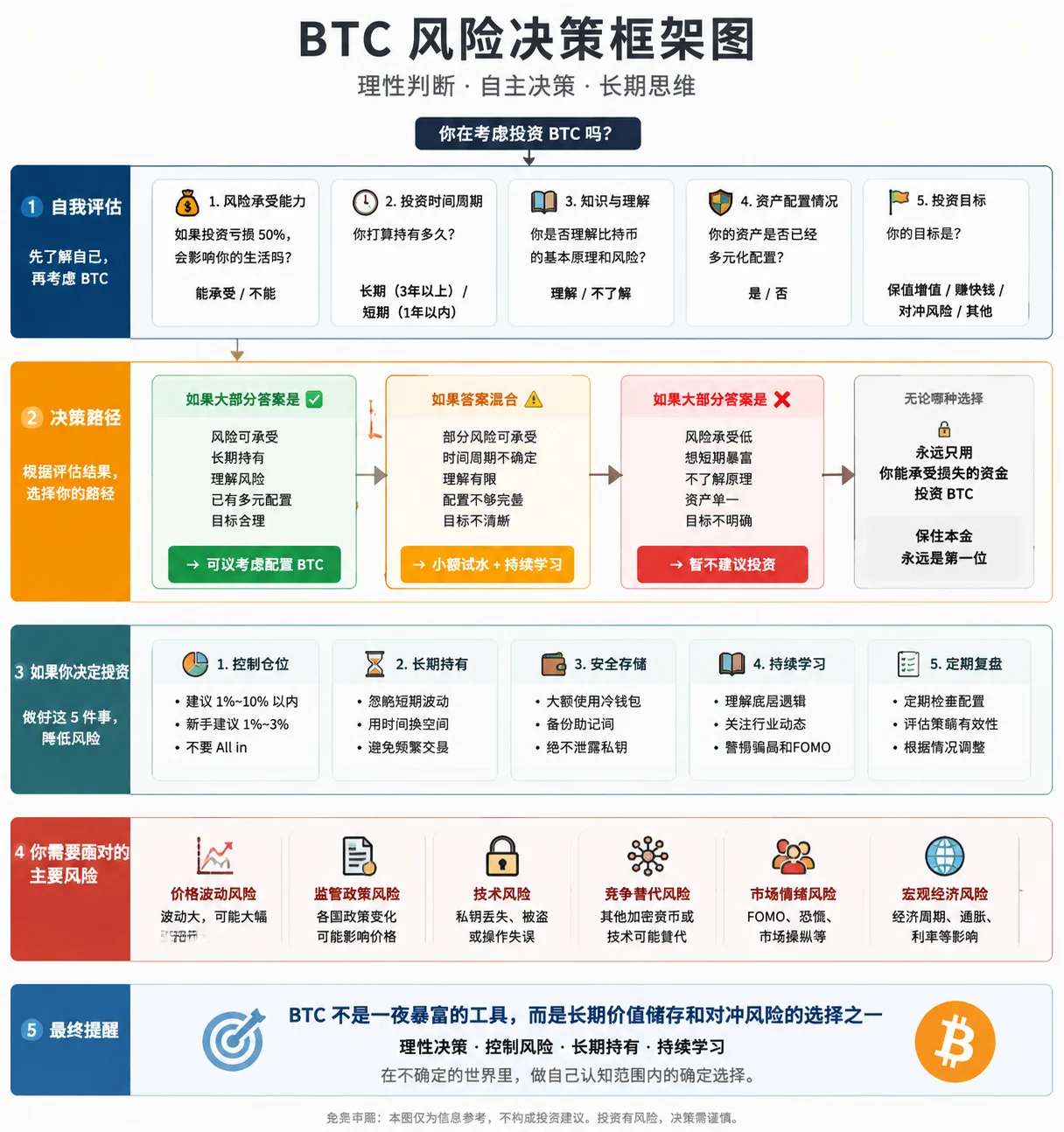
| You have spare money you won't need for 3-5 years | Worth researching; a common risk-management approach is to keep high-volatility assets to a small portion of your overall assets | BTC has been through multiple cycles, but future performance can't be guaranteed; short-term money isn't suitable |
| You live in a country with severe inflation or capital controls | Worth serious research | BTC's censorship-resistance and scarcity are most practically valuable in this situation |
| You're just curious and want to learn | Spend 2 hours on the whitepaper + do one small operation | Learning costs little; not learning may mean missing an important technology |
| You need the money within 6 months | Not suitable | BTC's short-term volatility is too high; it may fall sharply within 6 months |
| You can't tolerate any volatility | Not suitable | BTC's annualized volatility far exceeds traditional assets; you won't sleep well |
| You already have sufficient emergency savings and insurance | Worth considering research | BTC should belong to funds whose major loss wouldn't affect your normal life |
| You're borrowing to invest or using leverage | Absolutely not | Leverage + volatility = disaster. This is one of the main causes of major losses for many investors |
Core principle: only use money you can completely afford to lose. This applies to any high-risk asset, but is especially important for Bitcoin — the volatility will make people without mental preparation make the worst buy/sell decisions.
If you decide to try a small amount, first read Buying BTC for the first time in 2026: don't rush the order, think about what to do after you buy for the full buying process and safety notes.
Summary
Looking back at this year of verification, the biggest gain wasn't the answer to "is Bitcoin worth buying" — it was learning a thinking habit: when facing something highly controversial, use "understand first, then judge" instead of "pick a side first, then find reasons."
The final conclusion in three sentences:
- Bitcoin is neither a scam nor perfect. It's a decentralized protocol that has run for 15 years, with real utility and real risks.
- Critics' core arguments (no cash flow, high volatility, technology may be replaced) are reasonable and worth taking seriously. They aren't "misunderstandings" to refute, but risk factors to weigh into your decision.
- You don't need to like BTC — but if you exclude it based on "hearsay" rather than "research," you may miss one of the most important technological experiments of this era. Whether you ultimately buy or not, a research-based decision is 100x better than a hearsay-based one.
FAQ
Q1: Is Bitcoin safe? Will I be scammed?
In one sentence: the Bitcoin protocol itself is very safe, but "whether your Bitcoin is safe" is a different matter — it depends on who holds the private key. This distinction is so important that I devoted a whole section to it; see "Doubt 5: Is BTC safe?" in the body.
Q2: So what's the conclusion? Should I buy?
It depends on your financial situation, risk tolerance and investment horizon — no one can answer for you. This article helps eliminate information asymmetry; it doesn't give investment advice. If you decide not to buy after reading — that's also a good, research-based decision.
Q3: What is Bitcoin's biggest risk?
Not price volatility — if the price falls you can still choose not to sell. The real risks are threefold: ① private-key loss (once lost, it's gone forever; the Bitcoin network has no "password recovery" function); ② platform risk (exchange runs off, gets hacked or freezes your account, and your BTC is out of your control); ③ errors from insufficient understanding (wrong address, phishing, leaking your seed phrase). What these three risks share: they can all be greatly reduced through learning and good security habits. Start with What is a crypto wallet? to build your security foundation.
Q4: How much is a reasonable amount to start?
A common risk-management approach is to keep high-volatility assets to a small portion of your overall assets, using money you can completely afford to lose. Minimum purchase amounts vary by platform, usually starting from a few dozen dollars. I recommend walking through the full flow once with a small amount (buy → withdraw → custody), then consider whether to add more.
Q5: What if I still think it's a scam after reading?
That's completely fine. But ask yourself: is your judgment based on research or hearsay? If the latter, spending 2 hours reading Satoshi's whitepaper (only 9 pages) is more valuable than scrolling 100 short videos. The final conclusion doesn't matter — the process of judging is itself worthwhile.
Q6: Between Bitcoin and gold, which is more suitable for ordinary people?
They share similarities (scarcity, store of value), but differ greatly. Gold has 5,000 years of consensus history; BTC only has a decade-plus — so gold is far less volatile. BTC is a programmable digital asset, globally transferable and self-custodiable. My approach: gold and BTC are complementary, not substitutes. If you have a gold allocation, BTC can serve as the high-risk, high-volatility complement.
Q7: What risk needs the most attention when holding BTC?
Private-key security, then platform risk. If the price falls you can choose not to sell, but if you lose your private key it's gone forever; on an exchange, the risk becomes the platform running off or being hacked. Start with What is a crypto wallet? to build this foundation.
Q8: I'm starting to learn now — what's the fastest entry point?
Recommended learning path: ① read What is Bitcoin? (15 min) → ② read Why does Bitcoin have value? (understand the value logic) → ③ register on Binance or OKX and buy your first BTC with about $100 to experience it → ④ download a self-custody wallet and withdraw the BTC from the exchange (understand what "private key" actually means). These four steps take about 2-3 hours and are more useful than reading 100 argument articles.
Q9: What is Bitcoin's biggest technical advantage over other crypto assets?
The answer is decentralization, security and long-term operating record — speed and energy efficiency aren't its strengths. Bitcoin chose to sacrifice some transaction efficiency in exchange for a global settlement network that needs no central institution to maintain and that anyone can participate in verifying. This design trade-off (decentralization > efficiency) is the core feature that distinguishes Bitcoin from most later projects, and the technical foundation for its continued operation through multiple market cycles.
Related reading
- What is Bitcoin (BTC)? Principles, value and risks (2026) — first BTC lesson, 15 minutes to build the basics
- Why does Bitcoin have value? Scarcity, decentralization, network effects — deep dive into value logic, the core framework cited repeatedly here
- What is a crypto wallet? Addresses, seed phrases and asset security (2026) — private-key security is the most important foundation for holding BTC, extended reading for this article's security discussion
- Is Bitcoin mining still profitable? Settle these four accounts first (2026) — technical details of PoW, mining and energy
- Is Lightning Network worth using? Fees, speed and common pitfalls (2026) — why BTC's "slowness" isn't a problem: the technical logic of layered architecture
- New to crypto? Learn in this order to avoid detours — overall learning path for beginners
Disclaimer
This article only shares the process of personally verifying common doubts about Bitcoin and a judgment framework, and does not constitute investment, financial or trading advice.
Crypto asset prices are volatile, and related services may carry platform risk, market risk, network security risk and operational risk. Users should judge carefully based on their own risk tolerance and follow the laws and regulations of their location.
Any behavior involving private-key management, transfers or asset custody should first fully understand the risks, then test with a small amount. Only use money you can completely afford to lose.
- SEC Investor Education pageThe legal definition and four characteristics of a Ponzi scheme
- Satoshi Nakamoto WhitepaperThe whitepaper makes no investment-return promises
- Bitcoin.orgBitcoin basic concepts and operating principles
- 99Bitcoins Bitcoin ObituariesA tally of how many times mainstream media declared Bitcoin dead
- Cambridge Bitcoin Electricity Consumption Index (CBECI)Estimates of annual network power use and energy mix
- ChainalysisOn-chain tracking and the share of illicit transactions
- NIST Post-Quantum Cryptography Standards2024 standardization of PQC algorithms
- Lightning Network official documentationHow second-layer payment channels work
- Binance ResearchAn official cross-verification source for industry data
See ourEditorial Policy and the correction process in ourCorrections Policy.
The CoinTrailHub editorial team focuses on crypto education for beginners, exchange security and P2P trading risk. This article is compiled from official sources and public data, reviewed by humans, and strives for accuracy but is not investment advice.
Last updated:2026-08-21 · Content reviewed by humans · Learn more
© 2026 CoinTrailHub · Original content. Reproduction or rewriting without permission is prohibited.