
Is Bitcoin Mining Still Profitable? Do These Four Calculations First (2026)
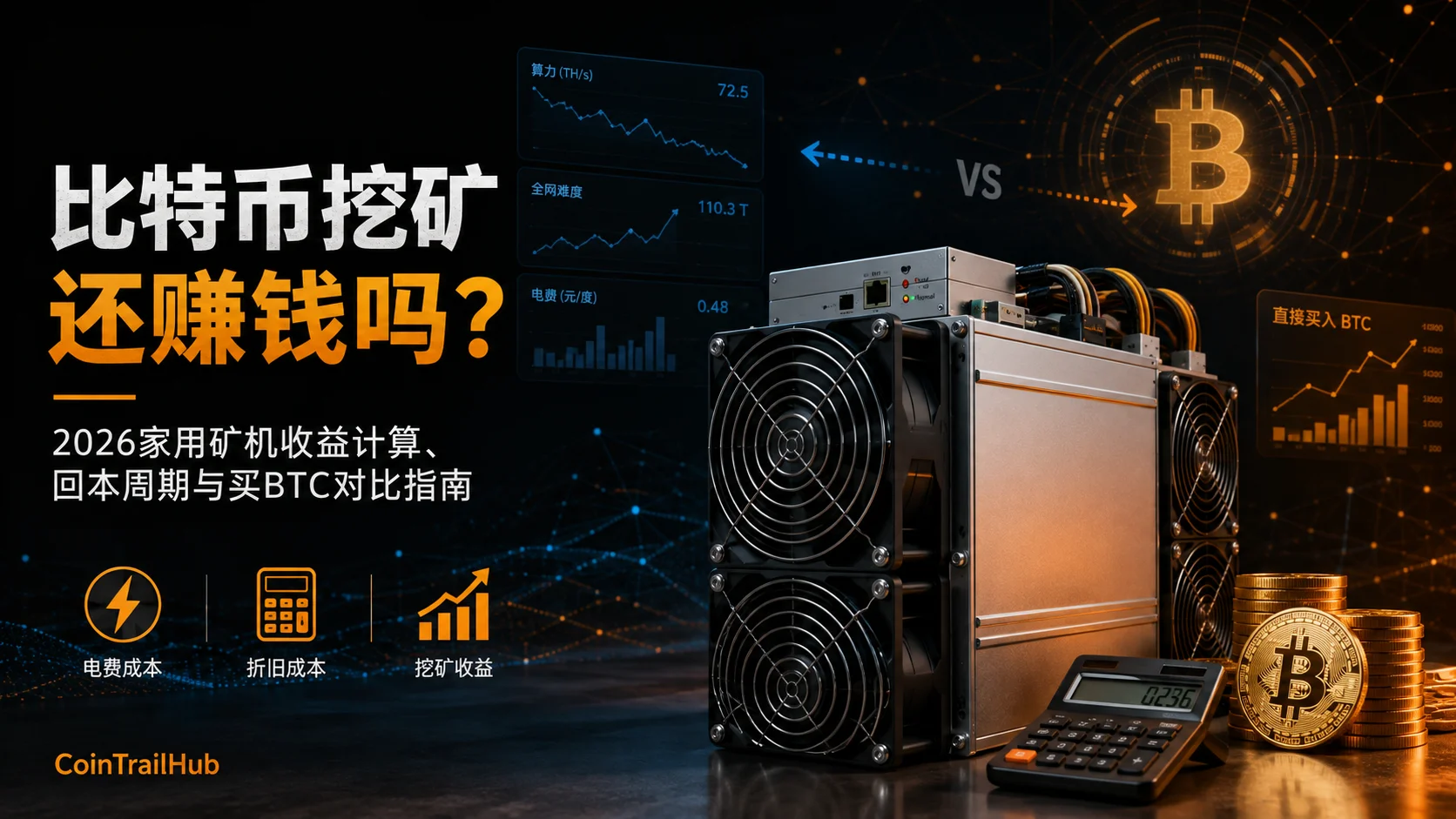
Table of contents

Binance new user rewards
20% trading fee rebate
Official Binance registration. Complete identity verification (KYC) to trade and withdraw.
Is Bitcoin Mining Still Profitable? Do These Four Calculations First (2026)
The biggest misconception about Bitcoin mining in 2026 is looking only at the revenue figure a mining pool displays while ignoring electricity, miner depreciation, cooling costs, and opportunity cost. Those four costs added together often turn an apparent "profit" into an actual "break-even at best."
This article skips the cryptography and focuses only on what ordinary users actually care about: upfront cost, real returns, payback period, and how to choose between mining and simply holding BTC.
Every conclusion is backed by verifiable data sources and explicit calculation logic. If a number doesn't match your situation, substitute your own parameters into the formulas provided.
This is an educational estimation analysis and does not constitute investment advice. Mining involves multiple risks including hardware investment, electricity cost, price volatility, and regulatory compliance — make your own judgment.
Core conclusion
For the vast majority of ordinary users, buying BTC directly in 2026 is simpler and more cost-effective than buying a miner.
Why: household electricity prices, miner depreciation, noise/cooling, and hardware obsolescence push most people's real returns close to break-even.
Mining is only worth deep investigation if ALL of the following hold:
- Electricity below $0.03/kWh
- A dedicated cooling space (non-residential)
- Willingness to accept a 3+ year payback period
If you don't meet these conditions, the rest of this article shows you how to put the same money to better use.
Data sources and calculation method
This analysis references the following public data:
- Miner specs: official spec sheets for Bitmain Antminer S21 Pro / S19 XP and MicroBT Whatsminer M63S
- Network data: the public Bitcoin blockchain ledger (block reward, block time, total hashrate)
- Pool fees: fee structures published by F2Pool, Antpool, and ViaBTC
- Electricity reference: publicly reported power prices in major global mining regions
- BTC price: public market data from CoinMarketCap / CoinGecko
All models use conservative estimates and do not include extreme bull-market upside. Actual returns fluctuate with BTC price, network difficulty, and miner efficiency; these figures are not a prediction of future returns.
The 2026 choice for ordinary people: buy a miner or buy BTC directly?
This is the core question of the whole article, so we answer it up front.
Historical case study: two ways to spend $10,000
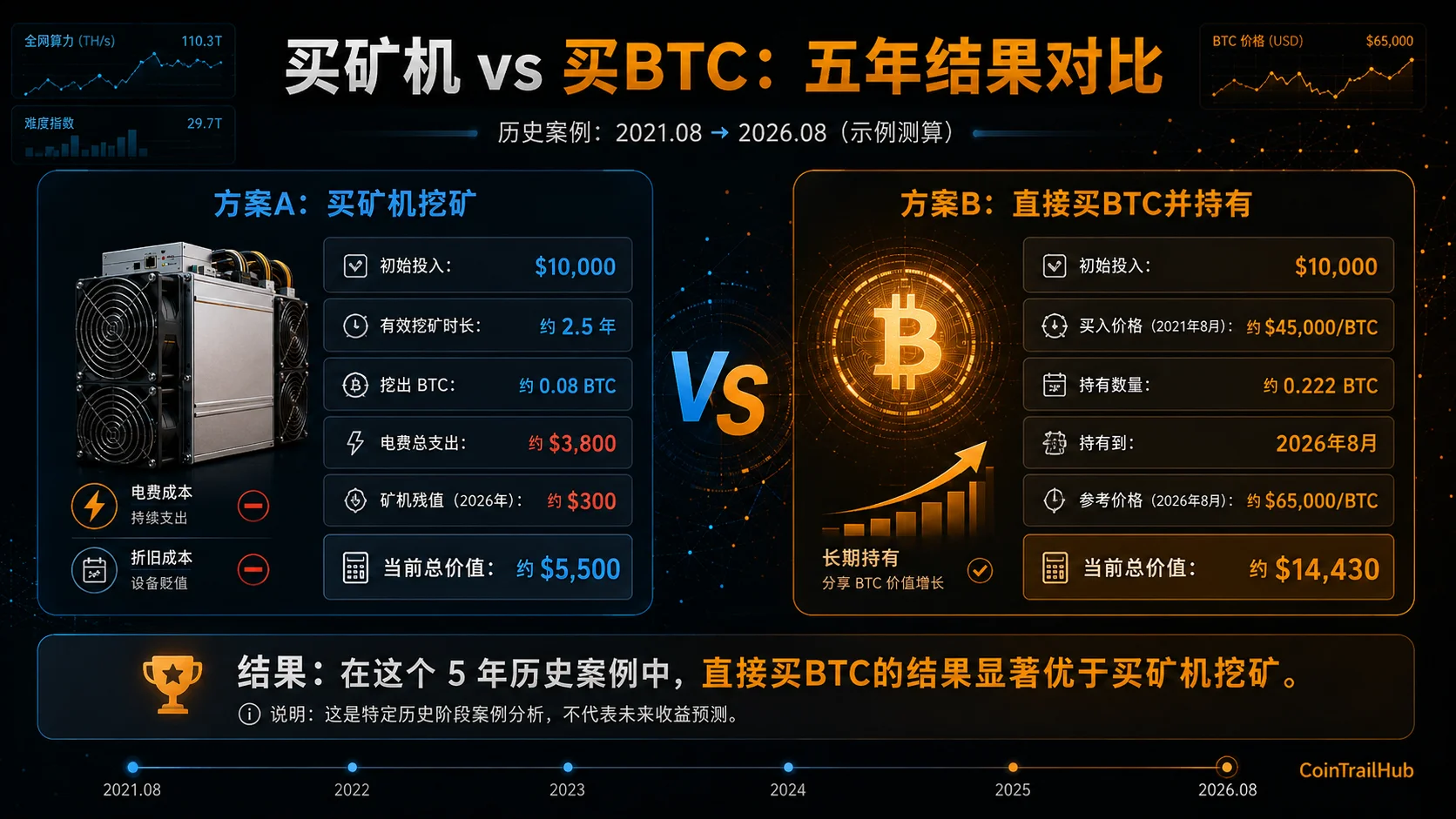
This is a case study of one specific historical period (August 2021 to August 2026), used to illustrate how mining and direct holding diverged. It is not a prediction of future returns.
Assume that in August 2021 you had $10,000. BTC was around $45,000, and the Antminer S19 Pro (110 TH/s, 29.5 J/TH) was the flagship miner at the time.
Option A: buy a miner and mine
- Miner cost: ~$8,000 (supply was tight, heavy premium)
- The remaining $2,000 covers electricity at $0.05/kWh
- Real competitive lifespan of ~2.5 years — in 2021 the S19 Pro was flagship, but by 2023–2024, the more efficient S19 XP (21.5 J/TH) and S21 series (15 J/TH) launched in succession, and after the 2024 halving cut the block reward in half, machines like the S19 Pro were already near their shutdown price at $0.05/kWh
Option B: buy BTC directly and hold
- $10,000 ÷ $45,000 ≈ 0.222 BTC
- Held to August 2026, BTC around $65,000
| Comparison | Option A (mining) | Option B (buy & hold) |
|---|---|---|
| Initial outlay | $10,000 | $10,000 |
| Effective mining duration | ~2.5 years | — |
| BTC mined / held | ~0.08 BTC (mined) | 0.222 BTC (held) |
| Total electricity paid | ~$3,800 | $0 |
| Miner resale value (2026) | ~$300 | — |
| Total value today | ~$5,500 | ~$14,430 |
Under this historical period's assumptions, holding BTC directly clearly outperformed buying a miner. And holding BTC involves no noise, cooling, miner maintenance, or hardware obsolescence.
When might mining win?
All three conditions must hold:
- Electricity well below $0.03/kWh
- BTC rises substantially during the mining period
- You can buy the latest-gen miner at launch price (not at a speculative premium)
The probability of all three aligning is low. This isn't "mining is bad" — it's economics: if mining ROI stayed persistently above buying BTC, capital would flood in → total hashrate rises → per-unit returns fall → ROI reverts to equilibrium. Mining's long-run returns naturally gravitate toward the network-average electricity-cost line.
For most users without cheap power and a professional setup, holding BTC directly is usually simpler and, across multiple historical cycles, has shown higher capital efficiency.
Who is mining suited to?
Not everyone should avoid mining. If you happen to fall into the following cases, mining may be worth investigating:
| Suited | Not suited |
|---|---|
| Low-cost power (<$0.03/kWh) | Ordinary households ($0.08–0.15/kWh) |
| Dedicated cooling space (server room/garage/warehouse) | Apartment/residential buildings |
| Accept a 3+ year payback period | Want quick money, short-term arbitrage |
| Interest in running the Bitcoin network | No maintenance experience, don't want hassle |
| Abundant capital, don't need liquidity | Tight on cash, may need to sell in a hurry |
The value of this table is: it doesn't discourage everyone — it helps you figure out which group you're in. If you're in the right-hand column, no regrets — knowing your position is itself a decision advantage.
Three typical scenarios, quick self-check
Scenario 1: I have a $5,000 budget. Should I buy a miner or BTC?
→ Buy BTC. $5,000 buys about 0.077 BTC (at $65,000), zero maintenance, sellable anytime. If you buy a miner instead, $3,650 gets one S21 Pro and the remaining $1,350 covers electricity for roughly 10 months — after which you have a depreciating miner plus the BTC it mined, together likely worth less than the 0.077 BTC you could have held directly. Detailed calculations later in this article.
Scenario 2: My electricity is $0.08/kWh. Can I mine?
→ It's not economical. $0.08/kWh is the hard-loss line — at that price, electricity + depreciation already exceed the miner's daily output. Every extra day you run it, you lose more. Residential electricity ($0.08–0.15/kWh) is inherently unsuitable for mining. This is physics, not a personal failing.
Scenario 3: I'm just interested in "participating in the Bitcoin network." Do I have to mine?
→ Not at all. Running a full Bitcoin node (any old computer) contributes far more to network decentralization than a home miner, with zero electricity burden. Mining is a commercial activity, not the only way to participate. If your goal is purely to support Bitcoin, running a full node is the purer path.
What is mining, anyway? (30-second version)
Skip this section if you already know the mechanics.
Mining = a global guessing-number competition. Miners use the SHA-256 hash function to keep guessing numbers; whoever guesses right gets to package the next block and earns the block reward (currently 3.125 BTC) + transaction fees.
Three core rules: ① pure brute force, no skill — more hashrate, higher chance of winning; ② zero-sum competition — there's only one winner every 10 minutes, and your share of hashrate = your share of revenue; ③ physical cost can't be faked — attacking Bitcoin requires the same electricity cost as honest mining, which is the foundation of PoW security.
For more detailed technical mechanics, see Why Bitcoin Doesn't Need Banks. For your purposes, the three points above are enough to decide — you don't need to understand SHA-256 to calculate electricity cost and revenue.
How to calculate miner returns: one formula
This is the foundation of every mining decision. Once you understand this formula, you don't need any "mining profitability calculator" — those tools just plug in the variables for you.
Daily revenue formula
Daily gross revenue (BTC) =
  Your hashrate (TH/s)
  ÷ Network hashrate (TH/s)
  × Daily total network output (BTC)

Daily total network output ≈
  144 (blocks per day)
  × [3.125 (block reward) + average fees per block]
Using the Antminer S21 Pro (234 TH/s) with mid-2026 parameters:
Daily gross revenue = 234 ÷ 750,000,000 × 144 × 3.2 ≈ 0.000144 BTC/day
(here 3.2 = 3.125 block reward + ~0.075 average fees)

At $65,000/BTC ≈ $9.36/day
From gross revenue to net profit after full costs
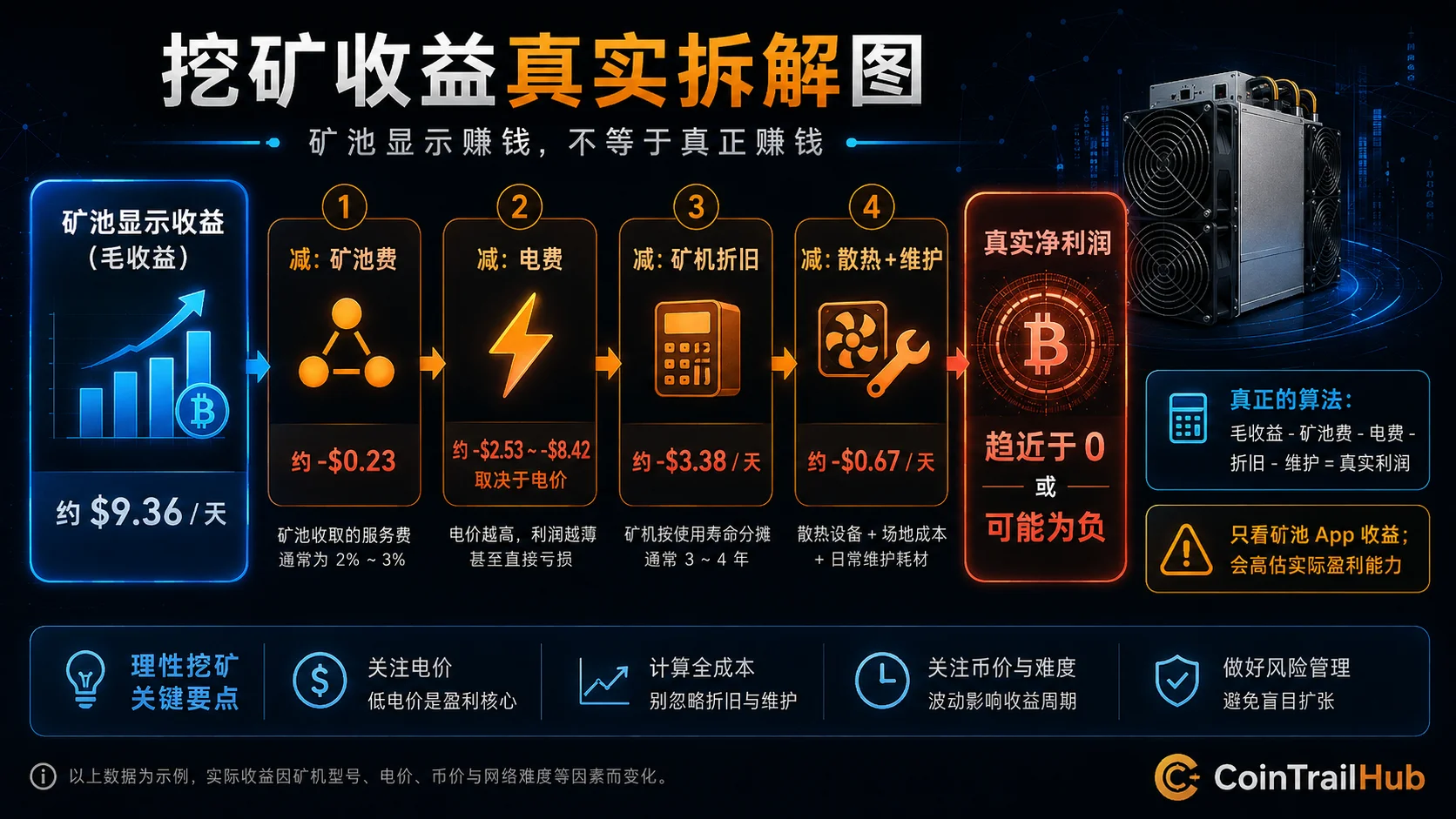
Gross revenue ($9.36)
  − Pool fee (2.5%)            → −$0.23
  − Electricity (84.24 kWh × rate)  → −$2.53 to −$8.42
  − Miner depreciation ($3,650÷36÷30)  → −$3.38/day
  − Cooling and maintenance     → −$0.67/day
  = Net profit after full costs
Plugging in different electricity rates:
| Electricity | Electricity/day | Net profit/day after all costs |
|---|---|---|
| $0.03/kWh | $2.53 | ~$2.55 (profitable) |
| $0.05/kWh | $4.21 | ~$0.87 (thin margin) |
| $0.08/kWh | $6.74 | −$1.66 (loss) |
| $0.11/kWh | $9.27 | −$4.19 (heavy loss) |
This is why electricity is the single most critical variable in a mining decision — it directly determines whether you profit, break even, or lose. $0.08/kWh is the hard-loss line (electricity + depreciation exceed output), and $0.11/kWh is the shutdown line (electricity alone exceeds revenue).
DIY: estimate your payback period with 3 numbers
If you don't want to read the detailed calculations below, use this simplified formula:
Real payback days ≈
  Miner price ($)
  ÷ [ daily BTC output × BTC price − daily pool fee − daily electricity − daily depreciation ]
Example: S21 Pro at $3,650, daily output ~$9, daily electricity $4.05 (at $0.048/kWh), daily depreciation $3.38, daily pool fee $0.23.
Daily real net profit ≈ $9 − $0.23 − $4.05 − $3.38 = $1.34/day
Payback days ≈ $3,650 ÷ $1.34 ≈ 2,724 days (about 7.5 years)
This number swings wildly with BTC price. If BTC rises 50%, the payback period might shrink to 3–4 years; if BTC drops 30%, payback becomes a distant dream. Mining's biggest variable isn't the miner — it's the coin price.
S21 Pro return breakdown: revenue, electricity, and real costs
Based on official Antminer S21 Pro specs (234 TH/s, 3,510W, ~$3,650 purchase) and public network hashrate data (Mempool.space), here's a typical operation at $0.048/kWh:
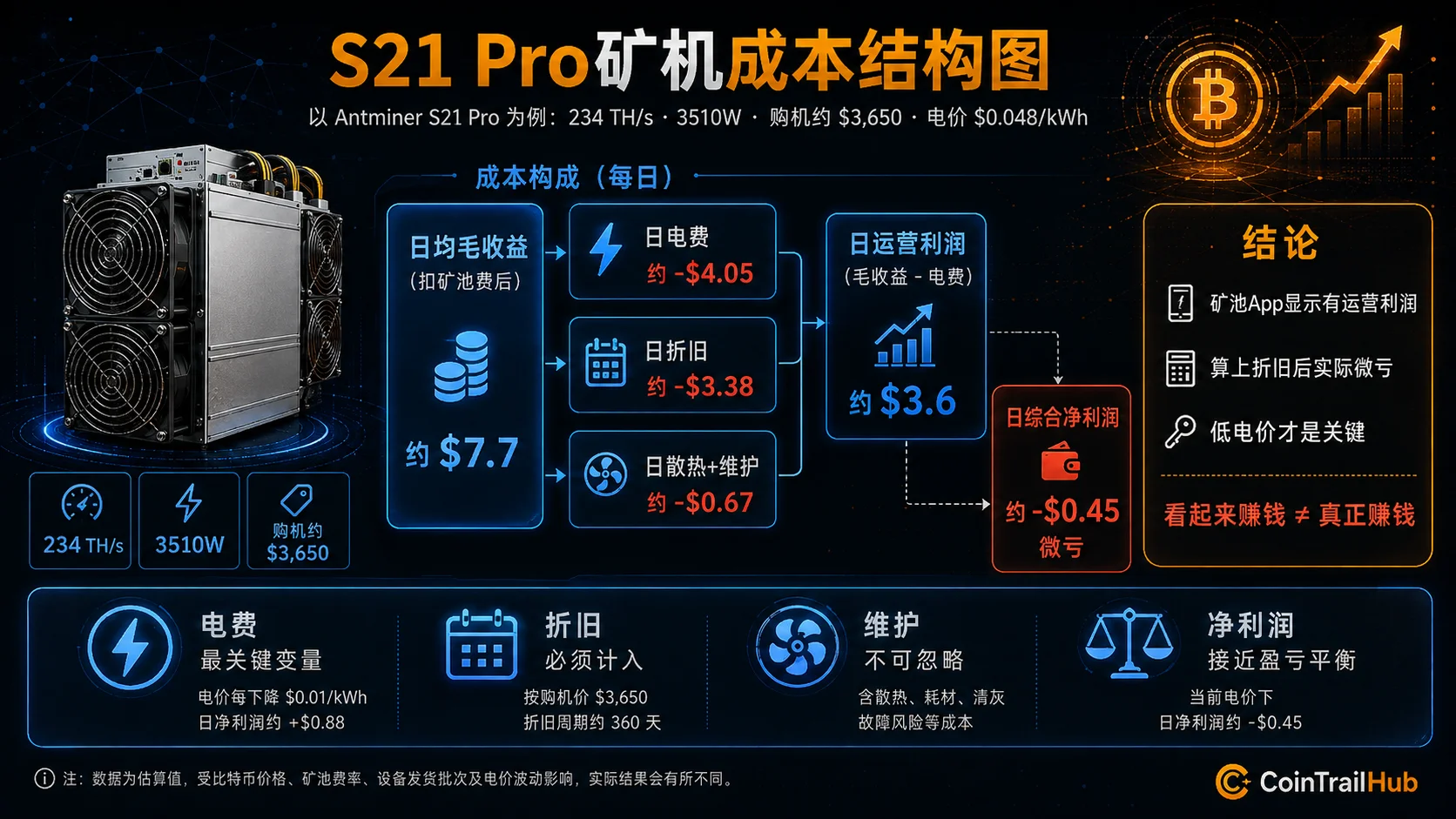
| Item | Data |
|---|---|
| Average daily gross revenue (after pool fee) | ~$7.7 |
| Daily electricity (84.24 kWh × $0.048) | ~$4.05 |
| Daily operating profit (gross − electricity) | ~$3.6 |
| Daily depreciation ($3,650÷36÷30) | ~$3.38 |
| Daily cooling + maintenance | ~$0.67 |
| Daily net profit after full costs | ~−$0.45 (slight loss) |
Actual returns fluctuate ±10–15% due to difficulty changes and miner hashrate variance. This is a model based on public parameters.
At $0.048/kWh, this miner is actually operating at a slight loss. The pool app shows you "making money" every day (operating profit $3.6/day), but after depreciation the real net profit is negative — you mined coins, but didn't actually make money.
When does it actually turn profitable?
- BTC rises substantially — from $65,000 to $100,000, the same hashrate produces 50%+ more fiat value per day
- Electricity well below $0.03/kWh — after depreciation, net profit of $2–3/day, payback shortened to 3–4 years
Mining's biggest hidden cost: 4 accounts many people overlook
Electricity and miner price are explicit costs everyone calculates. According to the Cambridge Bitcoin Electricity Consumption Index (CBECI), the Bitcoin network consumes roughly 120–160 TWh per year — against energy costs at that scale, an individual miner's power-price negotiating ability is close to zero. What really makes solo mining "not add up" are these overlooked costs.
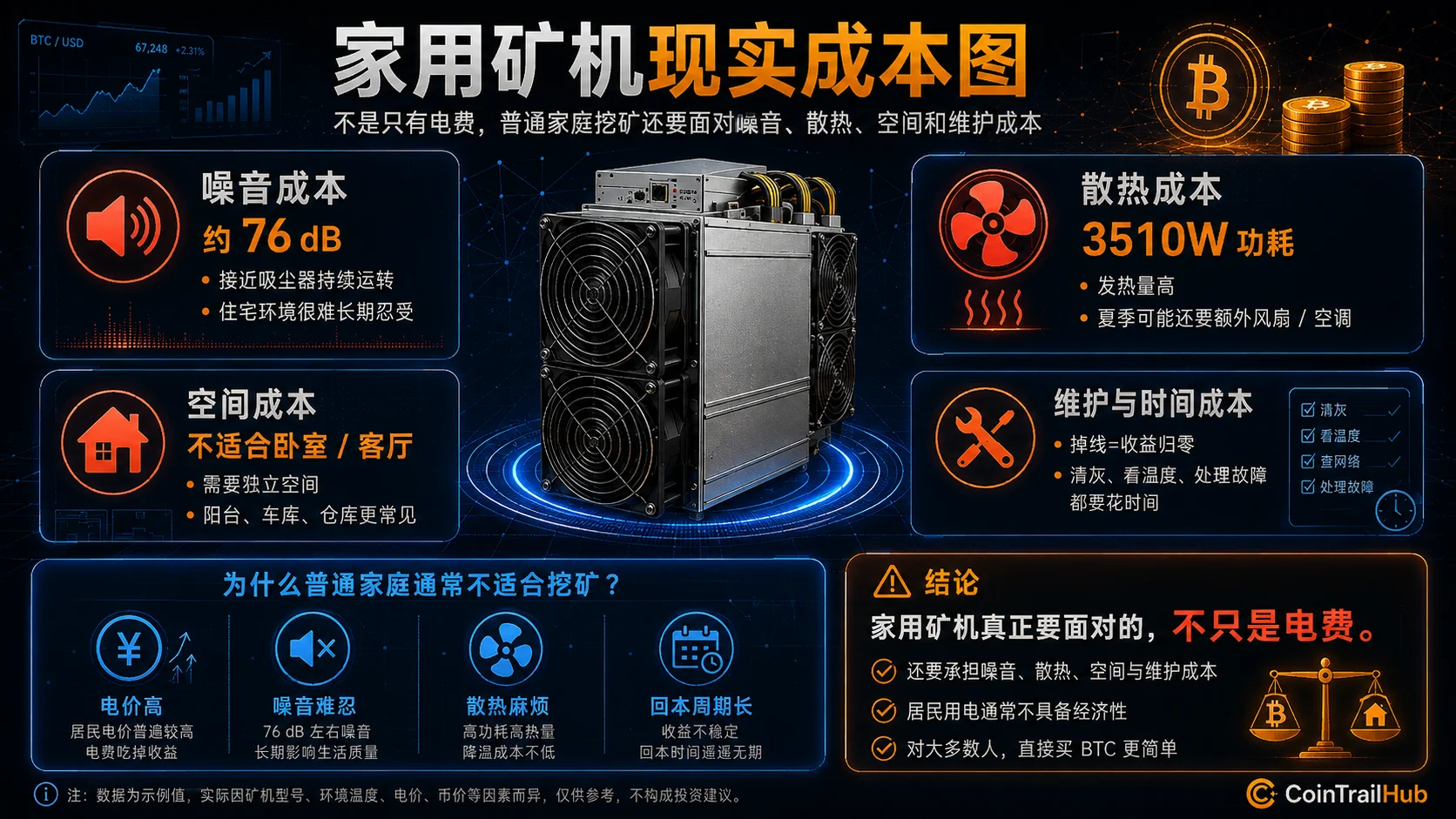
① Time cost
A miner is not a "plug it in and forget it" device. In real operation you need to:
- Monitor miner online status (offline = zero revenue until you notice)
- Check temperature (overheating triggers protective shutdown or chip damage)
- Update firmware (pool changes, security patches)
- Handle faults (voltage instability, network outages, hardware anomalies)
Professional farms have operations teams working 7×24 in shifts. A solo miner is on their own — if your miner goes offline while you sleep and you only notice 8 hours later, those 8 hours of revenue are already gone.
② Space cost
The S21 Pro is about 76 dB (like a vacuum cleaner running 24/7) and draws 3,510W (heat output comparable to a large air conditioner at full load). You can't put it in your bedroom (noise), can't put it in the living room (the whole household protests), can't put it on the balcony (neighbors complain + uncontrollable temperature/humidity).
There are only two solutions: a dedicated machine room (extra space cost), or hosting at a farm (an extra $50–100/month, further squeezing profit).
③ Capital lock-up
$3,650 for a miner is money "locked" in hardware with zero liquidity. If you urgently need cash, you can't sell half a miner chip — only the whole machine, and used miners depreciate fast (after a new generation launches, older models can drop 30–50%).
By contrast, $3,650 in BTC can be partially sold at any time — completely different liquidity.
④ Opportunity cost
This is the most important account. The same capital, if used to buy and hold BTC directly, has shown higher capital efficiency across multiple historical cycles (see the 5-year backtest earlier). A miner isn't "making money" — it's "exchanging" electricity + depreciation + time + noise for Bitcoin, and the exchange rate is usually worse than buying directly.
Mining is better suited to people who believe in "participating in Bitcoin network security" and enjoy the process of "producing digital assets with physical cost" — it's more of a hobby than an optimal investment strategy.
The 5 things solo miners regret most
These come from real miner-community feedback — not calculated risks, but lessons learned by people who've been burned.
1. Underestimating the noise — you buy it, then discover you can't place it anywhere
"I thought 76 dB would be acceptable, until it ran in my home for the first night."
The S21 Pro's 76 dB is continuous, unchanging industrial noise — not like a vacuum that stops after 10 minutes. It runs 24 hours × 365 days. The low-frequency hum penetrates walls. Put it in the garage? The neighbor knocks the next day. Put it on the balcony? Property management and the neighbors upstairs and downstairs all come knocking. The only real solutions are a dedicated room or hosting at a farm — both cost extra.
How to avoid it: before ordering, go hear a miner running in person at a farm. If you can't, play 76 dB white noise on a speaker at home on loop for 24 hours — if you can stand it, then consider buying.
2. Electricity is higher than you think — "tiered pricing" eats all your profit
"I assumed $0.05/kWh was enough, but my utility charged me $0.12/kWh in the top tier."
Residential electricity in many places is not a flat rate — it's tiered, and beyond a certain usage you automatically jump to a higher tier. One S21 Pro consumes about 2,500 kWh per month, easily pushing into the second or third tier. Your "$0.05" assumption becomes an actual $0.10–$0.15, and the profit statement instantly turns red.
How to avoid it: check your local tiered-pricing upper limit first, and calculate at the highest tier. If the top tier exceeds $0.08/kWh, home mining basically isn't worth considering.
3. The miner depreciates faster than it earns — you only realize how much you lost when you sell it used
"I paid $3,650, and a year later listing it at $1,500 got no takers."
A miner isn't an ordinary electronic product — once a new generation launches and an older model's efficiency falls behind, the used market collapses. The S19 series dropped over 50% in used price after the S21 launched. You calculate "how much BTC I mined" every day, but the machine itself is depreciating faster. Final accounting: you mined $2,000 of BTC, the miner lost $2,500 — net loss of $500 plus six months of noise and hassle.
How to avoid it: the moment you buy a miner, write the depreciation into your daily ledger. Don't just look at the "revenue" the pool app shows — subtract the $3.38/day depreciation first.
4. Ignoring opportunity cost — looking back, directly buying the coin would have doubled
"If I'd just bought BTC with the miner money, my assets would be double now."
This is the most regretted one. Buy a $3,650 miner in late 2024, spend a year mining out about $2,500 of BTC, miner resale $1,800 — total return about $4,300. But if you'd bought $3,650 of BTC directly in late 2024, it might have become $6,000+ by late 2025 — with zero maintenance, zero noise, zero electricity. You put in more effort and got a lower return.
How to avoid it: before deciding, calculate both paths side by side in a spreadsheet — path A (buy miner + pay electricity + depreciation), path B (same money buying BTC directly and holding). Finish path B first, then decide whether to take path A.
5. Thinking "mining is a belief," then discovering it's just losing money
"I told myself 'I'm supporting the Bitcoin network' — but when the monthly electricity bill came, that reason wasn't enough anymore."
Many people start mining with a sense of "participating in a decentralized network." The reality: a single home miner contributes almost nothing to network security, while you pay $100–200/month in electricity for that "belief." What actually secures the network are the farms operating at scale in sub-$0.02/kWh regions — an individual's participation has negligible impact. If your motive is "supporting Bitcoin," running a full node (zero cost, genuinely helps decentralization) is better.
How to avoid it: ask yourself honestly — if someone told you the 5-year total would be a loss, would you still mine? If the answer is "no," then you don't actually enjoy mining — you just thought you could profit. In that case, buying the coin directly is more honest.
Choosing a miner in 2026: recommendations by user type
Skip the CPU→GPU→FPGA→ASIC evolution history. In 2026 only ASIC miners matter. Here are three representative models:
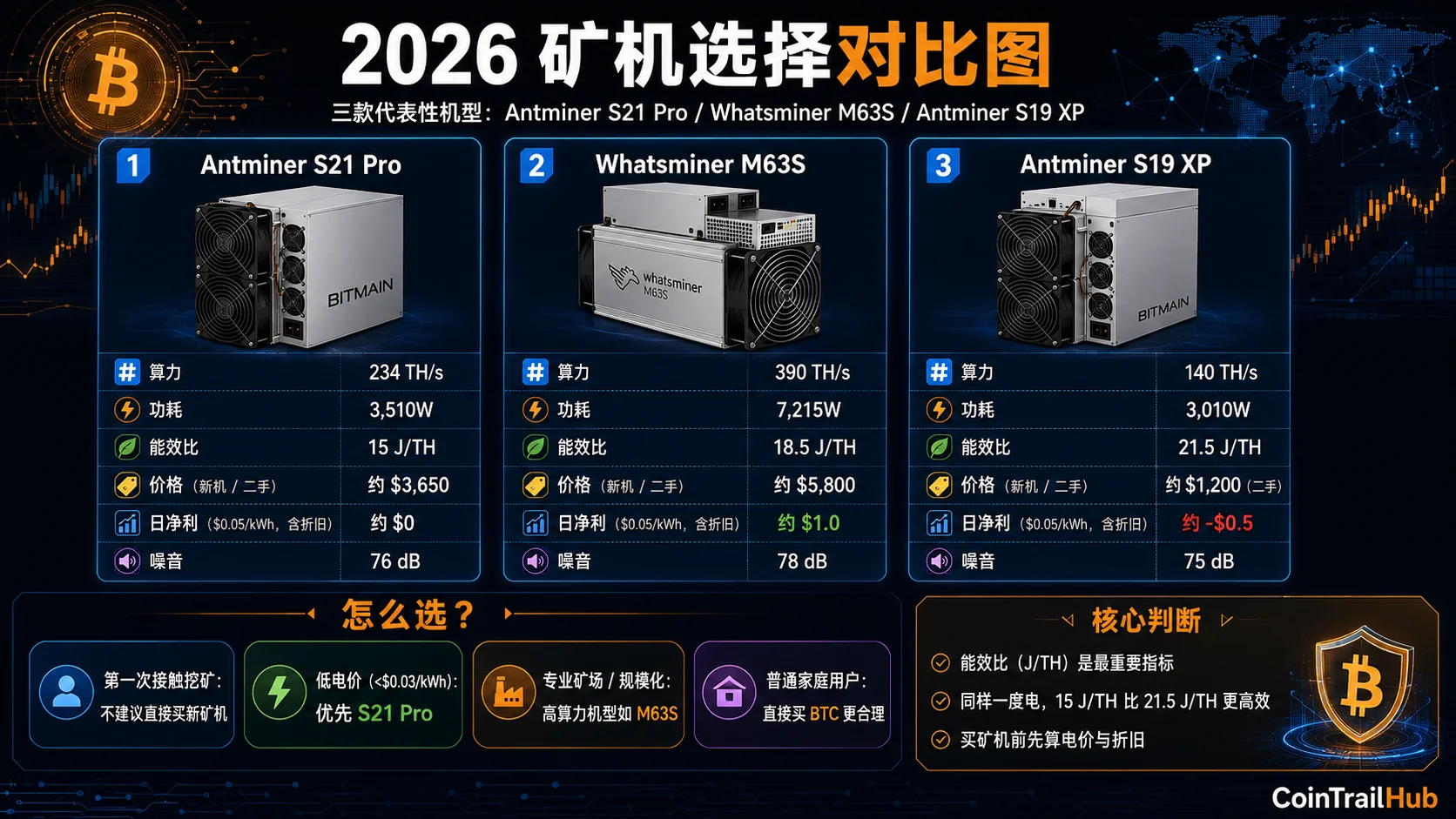
| Spec | Antminer S21 Pro | Whatsminer M63S | Antminer S19 XP |
|---|---|---|---|
| Hashrate | 234 TH/s | 390 TH/s | 140 TH/s |
| Power draw | 3,510W | 7,215W | 3,010W |
| Efficiency | 15 J/TH | 18.5 J/TH | 21.5 J/TH |
| Price (new) | ~$3,650 | ~$5,800 | ~$1,200 (used) |
| Daily net ($0.05/kWh incl. depreciation) | ~$0 | ~$1.0 | ~−$0.5 |
| Noise | 76 dB | 78 dB | 75 dB |
Efficiency (J/TH) is the most important metric when choosing a miner. It expresses how many joules of electricity are needed per 1 TH/s of hashrate. For the same kWh, a 15 J/TH machine produces 43% more than a 21.5 J/TH one. Don't just look at "how many TH/s" — calculate efficiency first.
Recommendations by user type
| User type | Recommendation | Why |
|---|---|---|
| First time with mining | Don't buy a new miner directly | Use the formulas in this article to calculate your break-even line first; if you're just learning, research public hashrate-market mechanics rather than buying high-risk contracts directly |
| Has low-cost power (<$0.03/kWh) | S21 Pro new | Best efficiency, payback within a reasonable range |
| Power at $0.03–0.05/kWh | Research thoroughly before deciding | Margin is very thin and depends on your BTC outlook; if you just want to "make money," buying the coin directly is simpler |
| Professional farm / at scale | High-hashrate models (e.g. M63S) | Scale amortizes ops costs; high-hashrate machines have lower per-unit management cost |
| Ordinary household | Buy BTC directly | Residential electricity ($0.08–0.15/kWh) makes mining likely unprofitable |
Used-miner caution: overclocked machines with aged chips, refurbished units repaired multiple times, and devices with tampered firmware that overstates hashrate are all common in the used market. If you can't verify, go through official channels or reputable large dealers — paying 10% more beats buying a "mining lemon."
Choosing a mining pool: fees, payout models, and stability compared
One S21 Pro is about 0.00003% of network hashrate, so solo miners must join a pool — combining hashrate and splitting rewards by contribution when a block is found.
Quick comparison of three major pools for individual users (data from official disclosures by F2Pool, Antpool, and ViaBTC):
| Spec | F2Pool | Antpool | ViaBTC |
|---|---|---|---|
| Payout model / fee | FPPS / 2.5% | FPPS / 0–2% | PPS+ / 2% |
| Daily revenue difference | Baseline | +~3% | −~1% |
| Highlights | Lightning Network withdrawals | Free on-chain withdrawal to Binance | Lowest withdrawal threshold (0.0005 BTC) |
Daily revenue differs by less than 5% across the three — choose a pool by fees and withdrawal convenience, not "which pays more." For individual miners, FPPS is recommended — stable daily payouts with under 15% variance. F2Pool has good support + Lightning withdrawals; Antpool suits Binance users.
Difficulty adjustment's effect on returns (1-minute version)
Bitcoin checks its average block time every 2,016 blocks (about two weeks) (see How the Blockchain Records Transactions for block structure):
- Under 10 minutes → difficulty rises → same hashrate produces less
- Over 10 minutes → difficulty drops → same hashrate produces more
What does this mean for you? When network hashrate rises, your revenue falls. Over the past two years, network hashrate grew from ~350 EH/s to ~750 EH/s — more than doubling. The same miner's output has been diluted by nearly half over two years. A miner isn't a fixed-capacity machine — it's a net fishing in an ever-widening river: same net, but the fish are shared among more and more people.
After China's 2021 mining crackdown, network hashrate briefly plunged 50%, and miners still running enjoyed about two weeks of "excess returns" — until difficulty auto-adjusted downward and the benefit of reduced competition was repriced. This is the most fascinating thing about mining: it isn't a static profit/loss calculation, but a dynamic game.
What other options do ordinary people have? A decision tree
After the calculations above, most people's conclusion should be "don't mine." But if you genuinely want to participate, here are three paths:
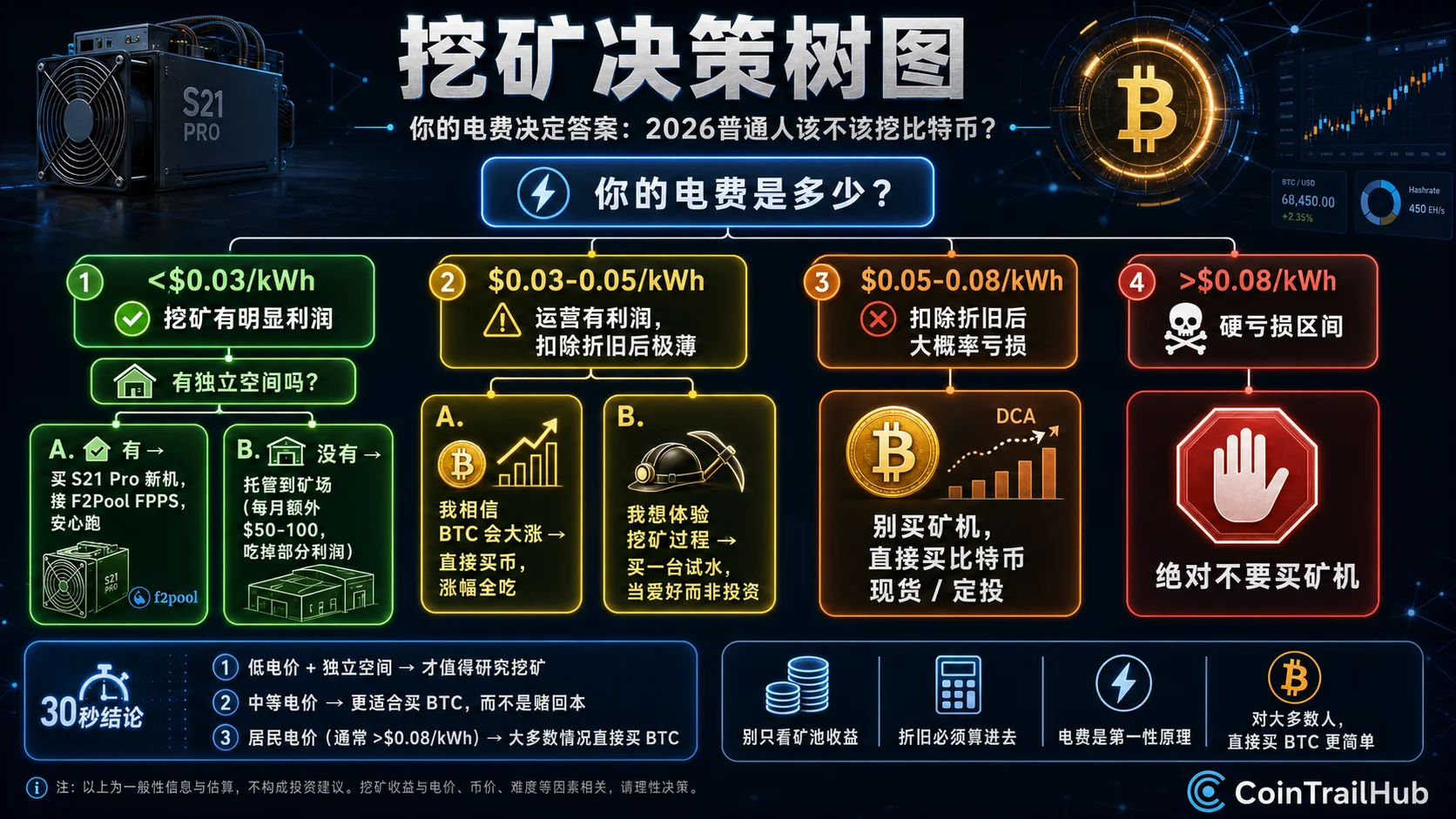
What is your electricity price?
│
├─ <$0.03/kWh → mining has clear profit
│   └─ Do you have dedicated space?
│       ├─ Yes → buy an S21 Pro new, join F2Pool FPPS, run it in peace
│       └─ No → host at a farm (extra $50–100/month, eats some profit)
│
├─ $0.03–0.05/kWh → operating profit, but razor-thin after depreciation
│   └─ "I believe BTC will surge" → buy the coin directly, keep all the upside, no electricity/depreciation
│   └─ "I want to experience mining" → buy one to try, as a hobby not an investment
│
├─ $0.05–0.08/kWh → likely a loss after depreciation
│   └─ Don't buy a miner; buy BTC spot / dollar-cost average directly
│
└─ >$0.08/kWh → hard-loss zone
    └─ Absolutely do not buy a miner
Three participation paths
Path 1: buy your own miner
- Pros: full control, transparent revenue, unique satisfaction of mining coins
- Cons: noise + cooling + power negotiation — three high hurdles
- Verdict: suits people with cheap power and a belief in "participating in network security." For most users, this is not the optimal use of capital.
Path 2: cloud-hashrate contracts
- Pros: zero hardware, zero noise, low entry amount
- Cons: the industry is a mixed bag, many platforms don't actually run real miners
- Current state: the market has seen platforms lacking real hashrate proof and transparent operations — users must carefully verify actual miner deployment and revenue sources. Beware of any platform promising "fixed daily returns," "capital protection," or "guaranteed profit" — real mining returns fluctuate, and no one can promise fixed returns.
- If you insist on trying: only use listed/regulated platforms such as Bitdeer (Nasdaq-listed, with real farm audits) and NiceHash (a P2P hashrate market with a transparent model), and never invest more than 5% of what you can afford to lose.
Path 3: buy Bitcoin directly (the best solution for most people)
- Pros: zero maintenance, zero electricity, good liquidity
- Verdict: for most users without cheap power or a professional setup, this is the simpler choice. Use the miner money to buy BTC, and use the electricity budget to dollar-cost-average more in — higher capital efficiency across multiple historical cycles.
- See the next section "If your conclusion is 'don't mine'" for specifics.
If your conclusion is "don't mine": how to start holding Bitcoin?
If you've judged that mining isn't for you — this isn't a "giving up" conclusion, but one that helps you avoid a wrong investment. Now the question is: if not mining, how do you use the same money to participate in Bitcoin?
Here's the shortest path from zero to holding BTC, with no complicated operations.
Step 1: register on an exchange (5 minutes)
Choose a mainstream platform, complete registration and KYC identity verification:
| Platform | Features | Registration |
|---|---|---|
| Binance | Largest globally, best liquidity, P2P supports fiat currencies | Register · Code: BN522 |
| OKX | Strong global support, smooth P2P experience | Register · Code: OK800 |
Both platforms support P2P trading in local fiat currencies. Registering with a referral code usually gets you a fee discount.
Step 2: buy USDT
In Binance or OKX's P2P / express-buy section, buy USDT (a dollar-pegged stablecoin) with your local fiat currency. Choose the payment method, follow the platform's guidance, and USDT arrives automatically.
Step 3: buy BTC and withdraw
Buy BTC with USDT in the spot market, then withdraw to your own wallet (a cold wallet like Ledger or Trezor is recommended, or a hot wallet like the OKX Web3 Wallet).
For full operational details (including wallet selection, withdrawal precautions, and DCA strategy), see Buying BTC for the First Time in 2026: Don't Rush, First Decide What to Do After Buying
FAQ
Q1: Buy a miner or buy BTC — which is more cost-effective?
For most users, buying BTC directly is usually simpler. The historical case study in this article (2021–2026) shows that with the same $10,000, holding BTC clearly outperformed buying a miner. A miner earns the "hard money" of exchanging cost for coin, while buying earns the "long-term return" of holding a scarce asset. Mining's ROI can only be competitive if electricity is below $0.03/kWh AND you have dedicated cooling space.
Q2: Can I mine Bitcoin at home?
Technically yes, but it's usually uneconomical at residential electricity rates. Residential electricity in most places runs $0.08–0.15/kWh, which after depreciation is likely a loss. Home mining not only fails the electricity math, but the noise and heat are hard for a normal home to bear. Mining farms concentrate in regions with the cheapest power (hydropower, flared gas, stranded energy), not in residential areas — that's dictated by economics.
Q3: My electricity is $0.04–0.06/kWh and I have $5,000. Miner or coin?
Buy the coin. At $0.04–0.06/kWh, even if operations show a profit, net profit after miner depreciation is near zero or thin. If your $5,000 goes into a miner, you face noise, cooling, hardware obsolescence, and locked-up liquidity; if it goes into BTC, you get zero maintenance and sellability anytime. Only if electricity is below $0.03/kWh AND you accept a 3+ year payback period is mining worth deep investigation.
Q4: Can home mining still make money in 2026?
The conditions are strict: electricity <$0.03/kWh + dedicated space + BTC doesn't drop. In the $0.03–0.05/kWh range, net profit after depreciation is near zero — you can mine BTC, but you don't earn fiat profit. For most households, residential electricity ($0.08–0.15/kWh) makes mining unlikely to cover its full costs.
Q5: Is the S21 Pro worth buying?
Depends on your electricity price. Electricity <$0.03/kWh: worth studying, its efficiency is competitive in the current market. $0.03–0.05/kWh: calculate carefully, net profit is very thin. >$0.05/kWh: not recommended, likely unprofitable after depreciation.
Q6: What electricity price makes mining worthwhile?
- Below $0.03/kWh: worthwhile, net profit $2–3+/day
- $0.03–0.05/kWh: marginal, net profit <$1/day
- Above $0.05/kWh: not worthwhile, net profit near zero or negative after depreciation
- $0.08/kWh: hard-loss line, electricity + depreciation exceed output
- $0.11/kWh: shutdown line, electricity alone exceeds revenue
Residential electricity in most developed countries falls in the third band. That's why large farms concentrate in regions with very cheap power, not in residential areas.
Q7: The pool app shows me "making money" every day — how do I know if it's actually worthwhile?
The pool app only shows gross revenue and doesn't subtract depreciation. The real calculation: your daily gross − daily pool fee − daily electricity − daily depreciation (purchase price ÷ 1,080 days) − daily cooling/maintenance. If the result is positive, you're actually making money. Most home miners turn negative once depreciation is added back — the pool makes you feel profitable, but accounting for the fact that the machine depreciates daily, you may just be "using time to earn the BTC you should have bought directly."
Q8: Are cloud-hashrate platforms trustworthy? How do I spot a scam?
The market has seen platforms lacking real hashrate proof and transparent operations. When choosing, check: whether the platform is listed on a regulated exchange (like Bitdeer on Nasdaq), whether it publishes farm audit reports, and whether the revenue model is transparent (like NiceHash's P2P hashrate market). Beware of any platform promising "fixed daily returns," "capital protection," or "high-return lockups" — real mining returns fluctuate. If you insist on trying, invest no more than 5% of what you can afford to lose.
Q9: Mining vs dollar-cost averaging Bitcoin — which suits ordinary people better?
For most ordinary users without cheap power, holding BTC directly usually has lower operational complexity — no hardware to buy, no electricity to pay, no noise/cooling to handle, no hardware obsolescence to worry about. Mining suits miners who value "participating in network security" itself, not ordinary users seeking the simplest investment path.
Q10: How much electricity does a home miner use in 24 hours?
Take the S21 Pro: 3,510W (wall power, including PSU loss), running 24 hours consumes about 84 kWh per day. At $0.08/kWh residential rates, that's about $6.7/day, or roughly $200/month. This doesn't count the extra electricity for air conditioning/fans to cool it (possibly +20–30% more in summer). A single miner's monthly consumption of about 2,500 kWh compares to a typical household's 300–500 kWh/month — one miner uses as much as 5–8 households combined.
Q11: Are used miners reliable?
High risk, not recommended for beginners. Common problems in the used market: ① overclocking has aged the chips, hashrate is unstable; ② refurbished units repaired multiple times, far higher failure rate than new; ③ tampered firmware that overstates hashrate or embeds a donation address. Even a machine that looks fine externally may have chips near end of life. If you must buy used on a limited budget: go through reputable dealers, not individual sellers; require a hashrate-board test report; confirm no repair marks; and don't pay more than 50% of the new price. But the most reassuring advice remains — with the same budget, buy BTC directly.
Not sure whether to mine? A 30-second self-check
Check the items that apply to you and get a quick answer:
| # | Criterion | Your situation |
|---|---|---|
| 1 | My electricity is below $0.03/kWh? | ☐ Yes / ☐ No |
| 2 | I have dedicated cooling space (non-residential)? | ☐ Yes / ☐ No |
| 3 | I can accept a 3+ year payback period? | ☐ Yes / ☐ No |
| 4 | I know what 76 dB+ miner noise feels like? | ☐ Yes / ☐ No |
| 5 | I don't need this money within a year? | ☐ Yes / ☐ No |
| 6 | I can accept BTC going sideways for 3 years? | ☐ Yes / ☐ No |
How to read:
- All 6 "Yes" → you have the core conditions for mining, worth deep investigation. See the S21 Pro analysis and pool-selection sections in this article.
- 3–5 "Yes" → conditions aren't fully mature, but keep watching. Buy BTC directly first, and reconsider mining when electricity or conditions improve.
- 0–2 "Yes" → mining isn't for you. Use the miner + electricity money to dollar-cost-average BTC instead — likely the better choice.
If you answered "No" to item 1 (electricity), skip the other five. Electricity is the first principle of a mining decision — if the price is wrong, no other condition can compensate.
After the self-check, if the answer is "not suited to mining" —
You don't need a miner, don't need to negotiate electricity, don't need to endure 76 dB of noise.
Take the $3,650 you'd spend on a miner and buy BTC directly, then use the electricity money you saved for monthly dollar-cost averaging. No maintenance, no depreciation, sellable anytime.
See the previous section "If your conclusion is 'don't mine': how to start holding Bitcoin?" — from registering on an exchange to buying BTC and withdrawing to a wallet, three steps total.
Summary
This article answers one question from start to finish: in 2026, should you get into mining?
Final advice for three types of users:
If your electricity exceeds $0.05/kWh: mining is not recommended. In this band, net profit after miner depreciation is near zero or negative. Use the same money to buy Bitcoin directly — history provides a better reference. Don't make a financially risky decision just because "mining sounds cool."
If your electricity is below $0.03/kWh and you have dedicated space: you're among the few with genuine mining economics. Buy an S21 Pro, join F2Pool FPPS, and use this article's cost model to calculate your own break-even price. Treat it as a long-term hobby + passive income combination, not a get-rich-quick scheme.
If you're just curious about mining: you already know enough after reading this. Mining's principles and economic logic are far more interesting than the cost-benefit of doing it yourself. Understand it, but you don't have to get in.
Bitcoin mining is one of the most fascinating parts of this industry — the most elegant bridge between the digital and physical worlds. But elegance doesn't equal profit. Before any decision, return to the electricity decision table at the top of this article: the final determinant isn't miner specs, but your electricity price, capital cost, and risk tolerance.
Related reading
- Buying BTC for the First Time in 2026: Don't Rush, First Decide What to Do After Buying — concrete steps and decision framework for buying
- Why Bitcoin Doesn't Need Banks: UTXO, Nodes, PoW — where PoW sits in the Bitcoin system
- How the Blockchain Records Transactions: Blocks, Hashes, Proof of Work (2026) — what exactly is inside the blocks miners package
- What Is a Bitcoin Node? Full Nodes, Light Nodes, and Miner Nodes — the difference between miner nodes and full nodes
Disclaimer
This article is an educational estimation analysis and decision reference for Bitcoin mining only, and does not constitute investment advice, financial advice, or a trading strategy. The miner models, prices, and return figures cited are simulated from public parameters and specific assumptions and do not guarantee any future returns. Crypto markets are highly volatile, and mining involves multiple risks including hardware investment, electricity cost, regulatory compliance, and price volatility. Past performance does not indicate future results. Any investment decision should be based on independent research and, where necessary, consultation with a licensed professional. The author and CoinTrailHub are not liable for any direct or indirect loss arising from the information in this article.
The CoinTrailHub editorial team focuses on crypto education for beginners, exchange security and P2P trading risk. This article is compiled from official sources and public data, reviewed by humans, and strives for accuracy but is not investment advice.
Last updated:2026-08-08 · Content reviewed by humans · Learn more
© 2026 CoinTrailHub · Original content. Reproduction or rewriting without permission is prohibited.